anaheim-gazette 1912-01-11
Scanned page
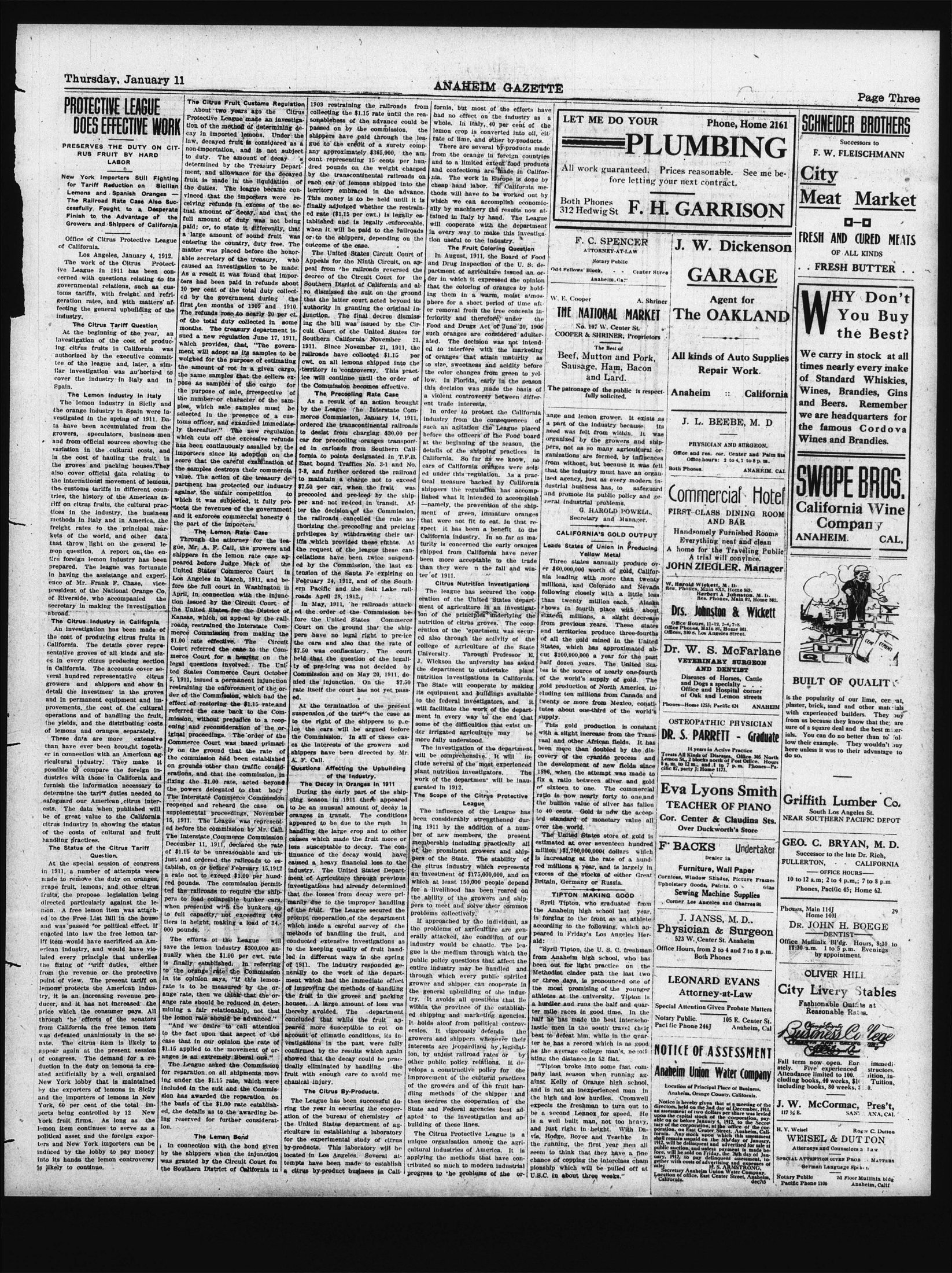
Searchable text
PROTECTIVE LEAGUE DOES EFFECTIVE WORK
PRESERVES THE DUTY ON CITRUS FRUIT BY HARD LABOR
New York Importers Still Fighting for Tariff Reduction on Sicilian Lemons and Spanish Oranges — The Railroad Rate Case Also Successfully Fought to a Desperate Finish to the Advantage of the Growers and Shippers of California
Office of Citrus Protective League of California.
Los Angeles, January 4, 1912.
The work of the Citrus Protective League in 1911 has been concerned with questions relating to its governmental relations, such as customs tariffs, with freight and refrigeration rates, and with matters affecting the general upbuilding of the industry.
The Citrus Tariff Question
At the beginning of the year, an investigation of the cost of producing citrus fruits in California was authorized by the executive committee of the league and, later, a similar investigation was authorized to cover the industry in Italy and in Spain.
The Lemon Industry in Italy
The lemon industry in Sicily and the orange industry in Spain were investigated in the spring of 1911. Data have been accumulated from the growers, speculators, business men and from official sources showing the variation in the cultural costs, and in the cost of hauling the fruit in the groves and packing houses. They also cover official data relating to
The Citrus Fruit Customs Regulation
About two years ago the Citrus Protective League made an investigation of the method of determining decay in imported lemons. Under the law, decayed fruit is considered as a non-importation, and is not subject to duty. The amount of decay is determined by the Treasury Department, and allowance for the decayed fruit is made in the liquidation of the duties. The league became convinced that the importers were receiving refunds in excess of the actual amount of decay, and that the full amount of duty was not being paid; or, to state it differently, that a large amount of sound fruit was entering the country, duty free. The matter was placed before the honorable secretary of the treasury, who caused an investigation to be made. As a result it was found that importers had been paid in refunds about 10 per cent of the total duty collected by the government during the first ten months of 1909 and 1910. The refunds rose to nearly 20 per ct. of the total duty collected in some months. The treasury department issued a new regulation June 17, 1911, which provides, that, "The government will adopt as its samples to be weighed for the purpose of estimating the amount of rot in a given cargo, the same samples that the sellers expose as samples of the cargo for the purpose of sale, irrespective of the number or character of the samples, which sale samples must be selected in the presence of a customs officer, and examined immediately thereafter." The new regulation which cuts off the excessive refunds has been continuously assailed by the importers since its adoption on the score that the careful examination of the samples destroys their commercial value.
The United States Appeals for the appeal from the decree of the Southern District so dismissed that the latter authority in grant jurisdiction. The filing the bill was cwt. on all lemon territory in control ice will continue at Commission.
The Precooling
As a result of by the League merce Commission ordered the transfer to desist from car for precooling ed in carloads from formia to points d East bound Traffic 7-8, and further o
The Lemon Industry in Italy
The lemon industry in Sicily and the orange industry in Spain were investigated in the spring of 1911. Data have been accumulated from the growers, speculators, business men and from official sources showing the variation in the cultural costs, and in the cost of hauling the fruit in the groves and packing houses. They also cover official data relating to the international movement of lemons, the customs tariffs in different countries, the history of the American tariff on citrus fruits, the cultural practices in the industry, the business methods in Italy and in America, the freight rates to the principal markets of the world, and other data that throw light on the general lemon question. A report on the entire foreign lemon industry has been prepared. The league was fortunate in having the assistance and experience of Mr. Frank F. Chase, vice-president of the National Orange Co. of Riverside, who accompanied the secretary in making the investigation abroad.
The Citrus Industry in California
An investigation has been made of the cost of producing citrus fruits in California. The details cover representative groves of all kinds and sizes in every citrus producing section in California. The accounts cover several hundred representative citrus growers and shippers and show in detail the investment in the groves and in permanent equipment and improvements, the cost of the cultural operations and of handling the fruit, the yields, and the distributing costs of lemons and oranges separately.
These data are more extensive than have ever been brought together in connection with an American agricultural industry. They make it possible to compare the foreign industries with those in California and furnish the information necessary to determine the tariff duties needed to safeguard our American citrus interests. The data when published will be of great value to the California citrus industry in showing the status of the costs of cultural and fruit handling practices.
The Status of the Citrus Tariff Question.
At the special session of congress in 1911, a number of attempts were made to remove the duty on oranges, grape fruit, lemons; and other citrus fruits; the propose legislation being
the same samples that the sellers expose as samples of the cargo for the purpose of sale, irrespective of the number or character of the samples, which sale samples must be selected in the presence of a customs officer, and examined immediately thereafter." The new regulation which cuts off the excessive refunds has been continuously assailed by the importers since its adoption on the score that the careful examination of the samples destroys their commercial value. The action of the treasury department has protected our industry against the unfair competition to which it was subjected, it fully protects the revenues of the government and it enforces commercial honesty on the part of the importers.
The Lemon Rate Case
Through the attorney for the league, Mr. A. F. Call, the growers and shippers in the lemon rate case appeared before Judge Mack of the United States Commerce Court in Los Angeles in March, 1911, and before the full court in Washington in April, in connection with the injunction issued by the Circuit Court of the United States for the District of Kansas, which, on appeal by the railroads, restrained the Interstate Commerce Commission from making the $1.00 rate effective. The Circuit Court referred the case to the Commerce Court for a hearing on legal questions involved. The United States Commerce Court October 5, 1911, issued a permanent injunction restraining the enforcement of the order of the Commission, which had the effect of restoring the $1.15 rate,and referred the case back to the Commission, without prejudice to a reopening and reconsideration of the original proceedings. The order of the Commerce Court was based primarily on the ground that the rate of the commission had been established on grounds other than traffic considerations, and that the commission, in fixing the $1.00 rate, acted beyond the powers delegated to that body. The Interstate Commerce Commission reopened and reheard the case on supplemental proceedings, November 15, 1911. The League was represented before the commission by Mr. Call. The Interstate Commerce Commission December 11, 1911, declared the rate of $1.15 to be unreasonable and unjust and ordered the railroads to establish, on or before February 15, 1912 a rate not to exceed $1.00 per hundred pounds. The commission permitted the railroads to require the shipners to load collapsible hunker cars.
The Precooling
As a result of by the League of Merce Commission ordered the transfer to desist from car for precooling ed in carloads from formia to points due East bound Traffic 7-8, and further oo to maintain a charge $7.50 per car, which precooled and precooled and not re-cooled ter die decision oo railroads can thorizing t he precool privileges by within iffs which provided t he request of thie cellations have been d by the Commission tension of the San February 24, 1912, eern Pacific and thie roads April 28, 1911.
In May, 1911, he ed the order of thie fore the United S Court on thie groupers have no legal cars and also $7.50 was confiscated held that thie quest y of pre-icing was Commission and on thie injunction rate itself thie court ed.
At thie termination suspension of thie trai to thie right of thie ice she cars will b thie Commission. In thie interests of thie shippers have been b A.F.Call.
Questions Affecting of thie In
The Decay in Orga During the early pping season in 1911 to be an unusual amber oranges in transit. appeared to be due thie handling thie large cr causes which made thie less susceptible to deci nuance of thie deca caused a heavy finan industry. The United ment of Agriculture thie investigations had alr that thie losses from
The Status of the Citrus Tariff Question.
At the special session of congress in 1911, a number of attempts were made to remove the duty on oranges, grape fruit, lemons, and other citrus fruits, the propose legislation being directed particularly against the lemon. A free lemon item was attached to the Free List Bill in the house and was passed or political effect. If enacted into law the free lemon tariff item would have sacrificed an American industry, and would have violated every principle that underlies the fixing of tariff duties, either from the revenue or the protective point of view. The present tariff on lemons protects the American industry, it is an increasing revenue producer, and it has not increased the price which the consumer pays. All through the efforts of the senators from California the free lemon item was defeated unanimously in the senate. The citrus item is likely to appear again at the present session of congress. The demand for a reduction in the duty on lemons is created artificially by a well organized New York lobby that is maintained by the exporters of lemons in Sicily and the importers of lemons in New York, 60 per cent of the total imports being controlled by 12 New York fruit firms. As long as the lemon item continues to serve as a political asset and the foreign exporters and New York importers can be induced by the lobby to pay money into its hands the lemon controversy is likely to continue.
The efforts or the League will save the lemon industry $200,000 annually when the $1.00 per cwt. rate is finally established. In referring to the orange rate the Commission in its opinion says, "If this lemon rate is to be measured by the orange rate, then we think that the orange rate should be reduced in determining a fair relationship, not that the lemon rate should be advanced."
"And we desire to call attention to the fact upon that aspect of the case that in our opinion the rate of $1.15 applied to the movement of oranges is an extremely liberal one."
The League asked the Commission for reparation on all shipments moving under the $1.15 rate, which were included in the suit and the Commission has awarded the reparation on the basis of the $1.00 rate established, the details as to the awarding being reserved for further consideration.
The Lemon Bond
In connection with the bond given by the shippers when the injunction was granted by the Circuit Court for the Southern District of California in
ANAHEIM GAZETTE
regulation Citrus investigation dealing under the subject way is Depart-decayed action of one cone re-that being that it was the honor who made import about collect the 1910. per ct. some extent is 1911, govern- to beinating cargo, laws ex- for of sam- be custi-diateation funds by the ton of orcaia
1909 restraining the railroads from collecting the $1.15 rate until the reasonableness of the advance could be passed on by the commission, the shippers have paid through the league to the credit of a surety company approximately $365,000, the amount representing 15 cents per hundred pounds on the weight charged by the transcontinental railroads on each car of lemons shipped into the territory embraced in the advance. This money is to be held until it is finally adjudged whether the restrained rate ($1.15 per cwt.) is legally established and is legally enforceable, when it will be paid to the railroads or to the shippers, depending on the outcome of the case.
The United States Circuit Court of Appeals for the Ninth Circuit, on appeal from the railroads reversed the decree of the Circuit Court for the Southern District of California and also dismissed the suit on the ground that the latter court acted beyond its authority in granting the original injunction. The final decree dismissing the bill was issued by the Circuit Court of the United States for Southern California November 21, 1911. Since November 21, 1911, the railroads have collected $1.15 per cwt. on all lemons shipped into the territory in controversy. This practice will continue until the order of the Commission becomes effective.
The Precooling Rate Case
As a result of an action brought by the League the Interstate Commerce Commission, January 14, 1911, ordered the transcontinental railroads to desist from charging $30.00 per car for precooling oranges transported in carloads from Southern California to points designated in T.F.B. East bound Traffic No. 3-1 and No. 7-8, and further ordered the railroad fornia, but most of the efforts have had no effect on the industry as a whole. In Italy, 40 per cent of the lemon crop is converted into oil, citrate of lime, and other by-products.
There are several by-products made from the orange in foreign countries and to a limited extent food products and confections are made in California. The work in Europe is done by cheap hand labor. In California methods will have to be worked out by which we can accomplish economically by machinery the results now attained in Italy by hand. The League will cooperate with the department in every way to make this investigation useful to the industry.
The Fruit Coloring Question
In August, 1911, the Board of Food and Drug Inspection of the U.S. department of agriculture issued an order in which it expressed the opinion that the coloring of oranges by holding them in a warm, moist atmosphere for a short period of time after removal from the tree conceals inferiority and therefore, under the Food and Drugs Act of June 30, 1906 such oranges are considered adulterated. The decision was not intended to interfere with the marketing of oranges that attain maturity as to size, sweetness and acidity before the color changes from green to yellow. In Florida, early in the season this decision was made the basis of a violent controversy between different trade interests.
In order to protect the California industry from the consequences of such an agitation the League placed before the officers of the Food board at the beginning of the season, the details of the shipping practices in California. So far as we know, no cars of California oranges were seized under this regulation. As a pre-ange and lemon grower. It exists as a part of the industry because its need was felt from within. It was organized by the growers and shippers, not as so many agricultural organizations are formed, by influences from without, but because it was felt that the industry must have an organ-
The Precooling Rate Case
As a result of an action brought by the League the Interstate Commerce Commission, January 14, 1911, ordered the transcontinental railroads to desist from charging $30.00 per car for precooling oranges transported in carloads from Southern California to points designated in T.F.B. East bound Traffics No. 3-1 and No. 7-8, and further ordered the railroad to maintain a charge not to exceed $7.50 per car, when the fruit was precooled and pre-iced by the shipper and not re-iced in transit. After the decision of the Commission, the railroads cancelled the rule authorizing the precooling and precaring privileges by withdrawing their tariffs which provided these rights. At the request of the league these cancellations have been twice suspended by the Commission, the last extension of the Santa Fe expiring on February 24, 1912, and of the Southern Pacific and the Salt Lake railroads April 28, 1912.
In May, 1911, he railroads attacked the order of the Commission before the United States Commerce Court on the ground that the shippers have no legal right to pre-ice the cars and also that the rate of $7.50 was confiscatory. The court held that the question of the legality of pre-icing was not decided by Commission and on May 20, 1911, denied the injunction. On the $7.50 rate itself the court has not yet passed.
At the termination of the present suspension of the tariff case as to the right of the shippers to pre-ice the cars will be argued before the Commission. In all of these cases the interests of the growers and shippers have been directed by Mr. A. F. Call.
Questions Affecting the Upbuilding of the Industry.
The Decay in Oranges in 1911
During the early part of the shipping season in 1911 there appeared to be an unusual amount of decay in oranges in transit. The conditions appeared to be due to the rush in handling the large crop and to other causes which made the fruit more or less susceptible to decay. The continuance of the decay would have caused a heavy financial loss to the industry. The United States Department of Agriculture through previous investigations had already determined that the losses from decay were prible and lemon grower. It exists as a part of the industry because its need was felt from within. It was organized by the growers and shippers, not as so many agricultural organizations are formed, by influences from without, but because it was felt that the industry must have an organized agency, just as every modern industrial business has, to safeguard and promote its public policy and general industrial problems.
G. HAROLD POWELL.
Secretary and Manager.
CALIFORNIA'S GOLD OUTPUT
Leads States of Union in Producing Yellow Metal
Three states annually produce over $60,000,000 worth of gold, California leading with more than twenty millions, and Colorado and Nevada following closely with a little less than twenty million each. Alaska shows in fourth place with about sixteen millions, a slight decrease from previous years. These states and territories produce three-fourths of all the gold mined in the United States, which has approximated about $100,000,000 a year for the past half dozen years. The United States is the source of nearly one-fourth of the world's supply of gold. The gold production of North America, including ten millions from Canada and twenty or more from Mexico, constitutes about one-third of the world's supply.
This gold production is constant with a slight increase from the Transvaal and other African fields. It has been more than doubled by the discovery of the cyanide process and the development of new fields since 1896, when the attempt was made to fix a ratio between silver and gold of sixteen to one. The commercial ratio is now nearly forty to one,and the bullion value of silver has fallen to 40 cents. Gold is now the accepted standard of monetary value all over the world.
The United States store of gold is estimated at over seventeen hundred million) $1,700,000,000 (dollars which is increasing at the rate of a hundred millions a year, and is largely in excess of the stocks of either Great Britain, Germany or Russia.
TIPTON MAKING GOOD
ping season in 1911 there appeared to be an unusual amount of decay in oranges in transit. The conditions appeared to be due to the rush in handling the large crop and to other causes which made the fruit more or less susceptible to decay. The continuance of the decay would have caused a heavy financial loss to the industry. The United States Department of Agriculture through previous investigations had already determined that the losses from decay were primarily due to the improper handling of the fruit. The League secured the prompt cooperation of the department which made a careful survey of the methods of handling the fruit, and conducted extensive investigations as to the keeping quality of fruit handled in different ways in the spring of 1911. The industry responded generally to the work of the department which had the immediate effect of improving the methods of handling the fruit in the groves and packing houses. A large amount of loss was thereby avoided. The department concluded that while the fruit appeared more susceptible to rot on account of climatic conditions, its investigations in the past were fully confirmed by the results which again showed that the decay could be practically eliminated by handling the fruit with enough care to avoid mechanical injury.
The Citrus By-Products.
The League has been successful during the year in securing the cooperation of the bureau of chemistry of the United States department of agriculture in establishing a laboratory for the experimental study of citrus by-products. This laboratory will be located in Los Angeles. Several attempts have been made to establish a citrus by-product business in California.
League
The influence of the League has been considerably strengthened during 1911 by the addition of a number of new members, the present membership including practically all of the prominent growers and shippers of the State. The stability of the citrus industry which represents an investment of $175,000,000, and on which at least 150,000 people depend for a livelihood has been reared on the ability of the growers and shippers to meet and solve their common problems collectively.
If approached by the individual, as the problems of agriculture are generally attacked, the condition of our industry would be chaotic. The league is the medium through which the public policy questions that affect the entire industry may be handled and through which every public spirited grower and shipper can cooperate in the general upbuilding of the industry. It avoids all questions that lie within the province of the established shipping and marketing agencies. It holds aloof from political controversies. It vigorously defends the growers and shippers whenever their interests are jeopardized by legislation, by unjust railroad rates or by other public policy relations. It develops a constructive policy for the improvement of the cultural practices of the growers and of the fruit handling methods of the shipper and then secures the cooperation of the State and Federal agencies best adapted to the investigation and upbuilding of these lines.
The Citrus Protective League is a unique organization among the agricultural industries of America. It is applying the methods that have contributed so much to modern industrial progress to the problems of the or-
the bullion value of silver has fallen to 40 cents. Gold is now the accepted standard of monetary value all over the world.
The United States store of gold is estimated at over seventeen hundred million ($1,700,000,000) dollars which is increasing at the rate of a hundred millions a year, and is largely in excess of the stocks of either Great Britain, Germany or Russia.
TIPTON MAKING GOOD
Syril Tipton, who graduated from the Anaheim high school last year, is forging to the front as an athlete according to the following, which appeared in Friday's Los Angeles Herald:
"Syril Tipton, the U.S.C. freshman from Anaheim high school, who has been out for light practice on the Methodist cinder path the last two or three days, is pronounced one of the most promising of the younger athletes at the university. Tipton is a hurdler and runs the half and quarter mile races in good time. In the half he has made the best interscholastic men in the south' travel their best to defeat him, while in the quarter he has a record which is as good as the average college man's, not obligating the distance in 52 flat."
Tipton broke into some fast company last season when running against Kelly of Orange high school, and is not an inexperienced man in the high and low hurdles. Cromwell expects the freshman to turn out to be a second Lennox for speed. He is a well built man, not too heavy, and just right in height. With Davis, Hodge, Boyer and Teschke in the running, the first year men all seem to think that they have a fine chance of coping with interclass chanpionship which will be pulled off at U.S.C. in about three weeks."
WE DO YOUR Phone, Home 2161
PLUMBING
guaranteed. Prices reasonable. See me before letting your next contract.
F. H. GARRISON
SCHNEIDER BROTHERS
Successors to
F. W. FLEISCHMANN
City
Meat Market
FRESH AND CURED MEATS
OF ALL KINDS
FRESH BUTTER
SPENCER
ORNEY-AT-LAW
Rotary Public
Center St.
Anaheim, Cal.
A. Shriner
NATIONAL MARKET
W. Center St.
HRINER, Proprietors
The Best of
ton and Pork,
Ham, Bacon
d Lard.
of the public is respectly solicited.
J. W. Dickenson
GARAGE
Agent for
The OAKLAND
All kinds of Auto Supplies
Repair Work.
Anaheim :: California
J. L. BEEBE, M. D.
PHYSICIAN AND SURGEON.
Office and res. cor. Center and Palm Sta.
Office hours: 2 to 4,7 to 8 p.m.
Both Phones.
ANAHEIM, CAI
Anaheim :: California
J. L. BEEBE, M. D.
PHYSICIAN AND SURGEON.
Office and res. cor. Center and Palm Sts.
Office hours: 2 to 4, 7 to 8 p.m.
Both Phones.
Commercial Hotel
FIRST-CLASS DINING ROOM
AND BAR
Handsomely Furnished Room
Everything neat and clean
A home for the Traveling Public
A trial will convince.
JOHN ZIEGLER, Manager
W. Harold Wickett, M. D.
Res. Phones, Main 8X3, Home 863.
Herbert A Johnston, M. D.
Res. Phones, Main 82, Home 862.
Drs. Johnston & Wickett
Office Hours, 11-13, 2-4, 7-8.
Office Phones, Main 81, Home 861.
Offices, 310 S. Los Angeles Street.
Dr. W. S. McFarlane
VETERINARY SURGEON
AND DENTIST
Diseases of Horses, Cattle
and Dogs a specialty...
Office and Hospital corner
of Oak and Lemon streets
Phones—Home 1253; Pacific 424 ANAHEIM
OSTEOPATHIC PHYSICIAN
DR. S. PARRETT - Graduate
14 years in Active Practice
Treats All Kinds of Diseases. Office 305 North Lemon St., 2 blocks north of Post Office. Hours 8 a.m. to 12 m., and 1 to 7 p.m. Phones—Pacific 87, party J; Home 1173.
Eva Lyons Smith
TEACHER OF PIANO
Cor. Center & Claudina Sts.
Over Duckworth's Store
F' BACKS Undertaker
Dealer in
Furniture, Wall Paper
Cornices, Window Shades, Picture Frames
Upholstery Goods, Paints, O Glass
Sewing Machine Supplies
of Standard Whiskies,
Wines, Brandies, Gins
and Beers. Remember
we are headquarters for
the famous Cordova
Wines and Brandies.
SWOPE BROS.
California Wine Company
ANAHEIM.
BUILT OF QUALITY
is the popularity of our lime, cement,
plaster, brick, sand and other materials
with experienced builders. They buy
from us because they know that they are
sure of a square deal and the best materials.
You can do no better than to follow their example. They wouldn't buy here unless it was to their advantage to do so.
Griffith Lumber Co.
South Los Angeles St.
NEAR SOUTHERN PACIFIC DEPOT
GEO. C. BRYAN, M. D.
Successor to the late Dr. Rich,
FULLERTON, CALIFORNIA
OFFICE HOURS—
10 to 12 a.m.; 2 to 4 p.m.; 7 to 8 p.m.
Phones, Pacific 45; Home 62.
TEACHER OF PIANO
Cor. Center & Claudina Sts.
Over Duckworth's Store
F' BACKS Undertaker
Dealer in
Furniture, Wall Paper
Cornices, Window Shades, Picture Frames
Upholstery Goods, Paints, O Glass
Sewing Machine Supplies
Corner Los Angeles and Charres St
J. JANSS, M.D.
Physician & Surgeon
523 W. Center St. Anaheim
Office Hours, from 2 to 4 and 7 to 8 p.m.
Both Phones
LEONARD EVANS
Attorney-at-Law
Special Attention Given Probate Matters
Notary Public. 105 E. Center St.
Pacific Phone 246J Anaheim, Cal
NOTICE OF ASSESSMENT
Anaheim Union Water Company
Location of Principal Place of Business,
Anaheim, Orange County, California.
Notice is hereby given that at a meeting of the directors, held on the 2nd day of December, 1911, an assessment of two dollars per share was levied upon the capital stock of the corporation, payable on or before January 4, 1912, to the Secretary of the corporation, at the office of the corporation, on East Center Street, Anaheim, California. Any stock upon which this assessment shall remain unpaid on the 5th day of January, 1912, will be delinquent and advertised for sale at public auction, and unless payment is made before, will be sold on Friday, the 26th day of January, 1912, to pay delinquent assessment, together with costs of advertising and expenses of sale.
Secretary Anaheim Union Water Company.
Location of office, East Center Street, Anaheim, California.
Griffith Lumber Co.
South Los Angeles St.
NEAR SOUTHERN PACIFIC DEPOT
GEO. C. BRYAN, M.D.
Successor to the late Dr. Rich,
FULLERTON, CALIFORNIA
OFFICE HOURS—
10 to 12 a.m; 2 to 4 p.m.; 7 to 8 p.m.
Phones, Pacific 45; Home 62.
Phones, Main 114J
Home 1401
DR. JOHN H. BOEGE
DENTIST
Office Mullinix Bl'dg. Hours, 8:30 to 11:30 a.m. 1 to 5 p.m. Evenings by appointment.
OLIVER HILL
City Livery Stables
Fashionable Outfits at Reasonable Rates.
Fall term now open. Entrance immediately. Five experienced instructors. Attendance limited to 100. Tuition, including books, 40 weeks, $100.
J. W. McCormac, Pres't,
117½ E. SANTA ANA, CAL.
H. V. Weisel
Roger C. Dutton
WEISEL & DUTTON
Attorneys and Counselors a Law
SPECIAL ATTENTION GIVEN PHONE MATTERS
German Language Spoken.
Notary Public
2d Floor Mullinix bldg
Pacific Phone 1106
Anaheim, Calif