anaheim-gazette 1912-01-11
Scanned page
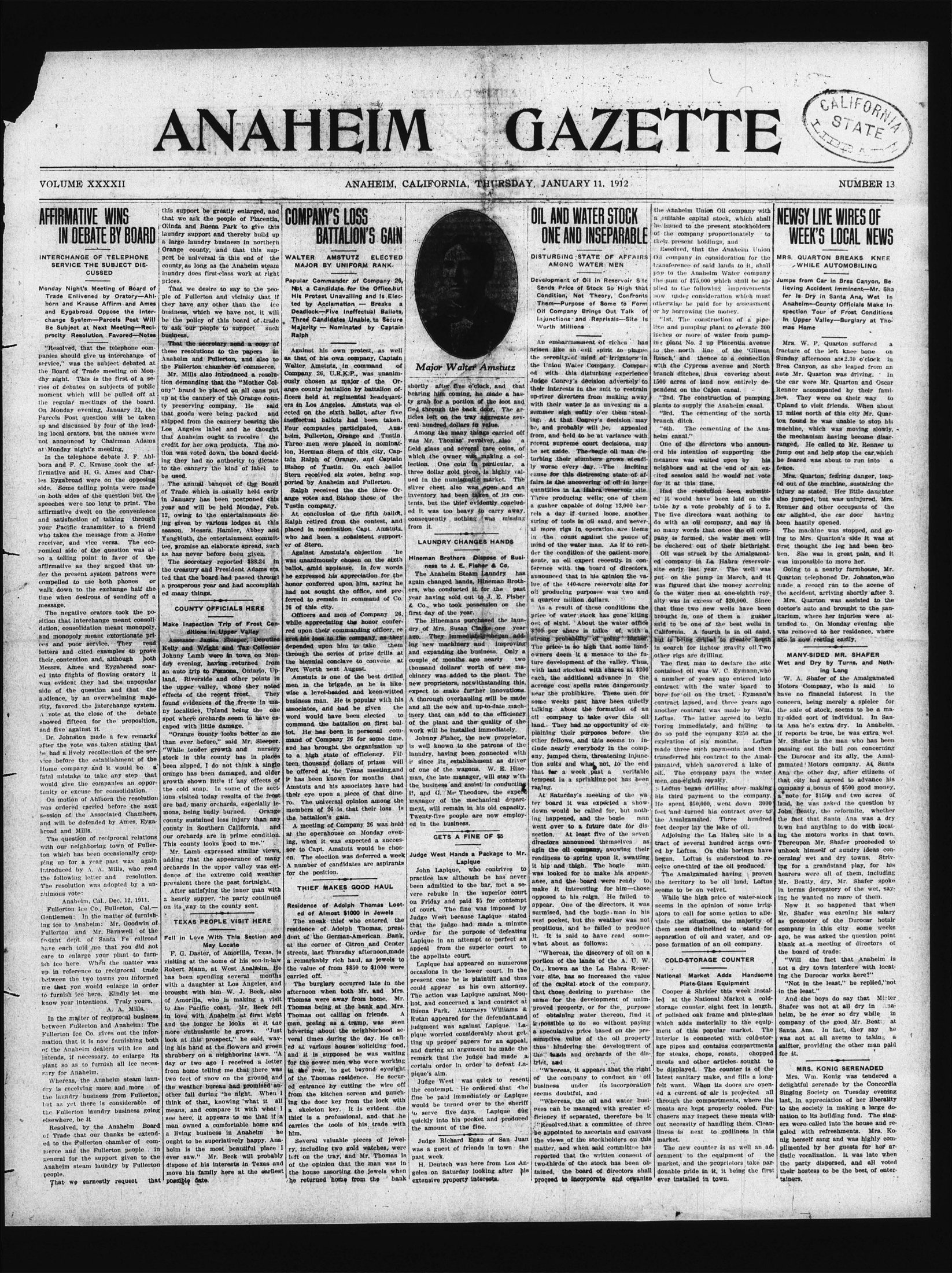
Searchable text
AFFIRMATIVE WINS IN DEBATE BY BOARD
INTERCHANGE OF TELEPHONE SERVICE THE SUBJECT DISCUSSED
Monday Night's Meeting of Board of Trade Enlivened by Oratory—Ahlborn and Krause Affirm and Ames and Eygabroad Oppose the Interchange System—Parcels Post Will Be Subject at Next Meeting—Reciprocity Resolution, Favored—Notes
"Resolved, that the telephone companies should give us interchange of service," was the subject debated at the Board of Trade meeting on Monday night. This is the first of a series of debates on subjects of public moment which will be pulled off at the regular meetings of the board. On Monday evening, January 22, the Parcels Post question will be taken up and discussed by four of the leading local orators, but the names were not announced by Chairman Adams at Monday night's meeting.
In the telephone debate J. F. Ahlborn and F. C. Krause took the affirmative and H. G. Ames and Char-
This is the first of a series of debates on subjects of public moment which will be pulled off at the regular meetings of the board. On Monday evening, January 22, the Parcels Post question will be taken up and discussed by four of the leading local orators, but the names were not announced by Chairman Adams at Monday night's meeting.
In the telephone debate J. F. Ahlborn and F. C. Krause took the affirmative and H. G. Ames and Charles Eygabroad were on the opposing side. Some telling points were made on both sides of the question but the speeches were too long to print. The affirmative dwelt on the convenience and satisfaction of talking through your Pacific transmitter to a friend who takes the message from a Home receiver, and vice versa. The economical side of the question was also a telling point in favor of the affirmative as they argued that under the present system patrons were compelled to use both phones or walk down to the exchange half the time when desirous of sending off a message.
The negative orators took the position that interchange meant consolidation, consolidation meant monopoly, and monopoly meant extortionate prices and poor service. They read letters and cited examples to prove their contention and, although both Messrs. Ames and Eygabroad soared into flights of flowing oratory it was evident they had the unpopular side of the question and that the audience, by an overwhelming majority, favored the interchange system. A vote at the close of the debate showed fifteen for the proposition, and five against it.
Dr. Johnston made a few remarks after the vote was taken stating that he had a lively recollection of the service before the establishment of the Home company and it would be a fatal mistake to take any step that would give the companies an opportunity or excuse for consolidation.
On motion of Ahlborn the resolution was ordered carried before the next session of the Associated Chambers, and will be defended by Ames, Eygabroad and Mills.
The question of reciprocal relations with our neighboring town of Fullerton which has been occasionally cropping up for a year past was again introduced by A. A. Mills, who read the following letter and resolution. The resolution was adopted by a unanimous vote:
Mr. Mills also introduced a resolution demanding that the "Mother Colony" brand be placed on all cans put up at the cannery of the Orange county preserving company. He said that goods were being packed and shipped from the cannery bearing the Los Angeles label and he thought that Anaheim ought to receive the credit for her own products. The motion was voted down, the board deciding they had no authority to dictate to the cannery the kind of label to be used.
The annual banquet of the Board of Trade which is usually held early in January has been postponed this year and will be held Monday, Feb. 12, owing to the entertainments being given by various lodges at this season. Messrs. Hamler, Abbey and Yungbluth, the entertainment committee, promise an elaborate spread, such as has never before been given.
The secretary reported $88.34 in the treasury and President Adams stated that the board had passed through a prosperous year and had accomplish many things.
COUNTY OFFICIALS HERE
Make Inspection Trip of Frost Conditions in Upper Valley
Assessor James Sleeper, Deputy Kelly and Wright and Tax Collector Johnny Lamb were in town on Monday evening, having returned from an auto trip to Pomona, Ontario, Upland, Riverside and other points in the upper valley, where they noted effects of the recent frost. They found evidences of the freeze in many localities, Upland being the one spot where orchards seem to have escaped with little damage.
"Orange county looks better to me than ever before," said Mr. Sleeper.
"While tender growth and nursery stock in this county has in places been nipped, I do not think a single orange has been damaged, and older growth shown little if any effects of the cold snap. In some of the sections visited today results of the frost are bad, many orchards, especially lemons, being badly burned. Orange county sustained less injury than any county in Southern California, and our orchards are in prime condition. This county looks good to me."
Mr. Lamb expressed similar views, adding that the appearance of many orchards in the upper valley was evidence of the extreme cold weather prevalent there the past fortnight.
After satisfying the inner man with a hearty supper, the party continued
On motion of Anborn the resolution was ordered carried before the next session of the Associated Chambers, and will be defended by Ames, Eygabroad and Mills.
The question of reciprocal relations with our neighboring town of Fullerton which has been occasionally cropping up for a year past was again introduced by A. A. Mills, who read the following letter and resolution. The resolution was adopted by a unanimous vote:
Anaheim, Cal., Dec. 12, 1911.
Fullerton Ice Co., Fullerton, Cal.—Gentlemen: In the matter of furnishing ice to Anaheim: Mr. Goodwin of Fullerton and Mr. Barnwell of the freight dept. of Santa Fe railroad have each told me that you did not care to enlarge your plant to furnish ice here. When the matter was up in reference to reciprocal trade between the two towns you informed me that you would enlarge in order to furnish ice here. Kindly let me know your intentions. Truly yours,
A. A. Mills.
In the matter of reciprocal business between Fullerton and Anaheim: The Fullerton Ice Co. gives out the information that it is now furnishing both of the Anaheim dealers with ice and intends, if necessary, to enlarge its plant so as to furnish all ice necessary for Anaheim.
Whereas, the Anaheim steam laundry is receiving more and more of the laundry business from Fullerton, but as yet there is considerable of the Fullerton laundry business going elsewhere, be it.
Resolved, by the Anaheim Board of Trade that our thanks be extended to the Fullerton chamber of commerce and the Fullerton people in general for the support given to the Anaheim steam laundry by Fullerton people.
That we earnestly request that
Fell in Love With This Section and May Locate
F. G. Daster, of Amorilla, Texas, is visiting at the home of his son-in-law Robert Mann, at West Anaheim. He has been spending several months with a daughter at Los Angeles, and brought with him W. J. Beck, also of Amorilla, who is making a visit to the Pacific coast. Mr. Beck fell in love with Anaheim at first sight and the longer he looks at it the more enthusiastic he grows. "Just look at this prospect," he said, waving his hand at the flowers and green shrubbery on a neighboring lawn. "A day or two ago I received a letter from home telling me that there was two feet of snow on the ground and the weather bureau had promised another fall during the night. When I think of that, knowing what it all means, and compare it with what I see here, it appears to me that if a man owned a comfortable home and a living business in Anaheim he ought to be superlatively happy. Anaheim is the most beautiful place I ever saw." Mr. Beck will probably dispose of his interests in Texas and move his family here at the earliest possible date.
The universal opinion members of 26 is than the battalion's gain.
A meeting of Company at the operahouse on ing, when it was expressed to Capt. Amstutz en. The election was a number of candidates for the position.
THIEF MAKES GREAT
Residence of Adolph ed of Almost $100.
The sneak thief whose residence of the German-America at the corner of City streets, last Thursday a remarkably rich haunted the value of from $850 carried off.
The burglary occurred afternoon when both Thomas were away from Thomas being at the Thomas out calling one man, posing as a tree hovering about the several times during thieved at various houses and it is supposed for the sewer men who in the rear, to get of the Thomas residenced entrance by cutting from the kitchen scrubbing the door key from a skeleton key. It thief is a professional carries the tools of him.
Several valuable parry, including two gold left on the tray, and of the opinion that the house assorting he returned home fr
HEIM GAZETE
ANAHEIM, CALIFORNIA, THURSDAY, JANUARY 11, 1912
COMPANY’S LOSS
BATTALION’S GAIN
WALTER AMSTUTZ ELECTED
MAJOR BY UNIFORM RANK.
Popular Commander of Company 26,
Not a Candidate for the Office, but
His Protest Unavailing and Is Elected by Acclamation — Breaks a Deadlock—Five Ineffectual Ballots,
Three Candidates Unable to Secure Majority — Nominated by Captain Ralph
Against his own protest, as well as that of his own company, Captain Walter Amstutz, in command of Company 26, U.R.K.P., was unanimously chosen as major of the Orange county battalion by battalion officers held at regimental headquarters in Los Angeles. Amstutz was elected on the sixth ballot, after five ineffectual ballots had been taken. Four companies participated, Anaheim, Fullerton, Orange and Tustin. Three men were placed in nomination, Herman Stern of this city, Captain Ralph of Orange, and Captain Bishop of Tustin. On each ballot Stern received six votes being sup-
Major Walter Amstutz
shortly after five o'clock, and that hearing him coming, he made a hasty grab for a portion of the loot and fled through the back door. The articles left on the tray aggregate several hundred dollars in value.
Among the many things carried off was Mr. Thomas' revolver, also a field glass and several rare coins, of which the owner was making a collection. One coin in particular, a three dollar gold piece, is highly val-
OIL AND WATER STOCK
ONE AND INSEPARABLE
DISTURBING STATE OF AFFAIRS
AMONG WATER MEN
Development of Oil in Reservoir Site Sends Price of Stock So High that Condition, Not Theory, Confronts Them—Purpose of Some to Form Oil Company Brings Out Talk of Injunctions and Reprisals—Site Is Worth Millions
An embarrassment of riches has arisen like an evil spirit to plague the serenity of mind of irrigators in the Union Water Company. Compared with this disturbing experience Judge Conrey's decision adversely to their interests in the suit to restrain up-river diverters from making away with their water is as unvexing as a summer sigh softly o'er them stealing. At that Conrey's decision may be, and probably will be, appealed from, and held to be at variance with recent supreme court decisions, may be set aside. The bogie oil man disturbing their slumbers grows steadily worse every day. The inciting cause for this distressing state of af-
Company 20, U.K.R.P., was unanimously chosen as major of the Orange county battalion by battalion officers held at regimental headquarters in Los Angeles. Amstutz was elected on the sixth ballot, after five ineffectual ballots had been taken. Four companies participated. Anaheim, Fullerton, Orange and Tustin. Three men were placed in nomination, Herman Stern of this city, Captain Ralph of Orange, and Captain Bishop of Tustin. On each ballot Stern received six votes, being supported by Anaheim and Fullerton.
Ralph received the three Orange votes and Bishop those of the Tustin company.
At conclusion of the fifth ballot, Ralph retired from the contest, and placed in nomination Capt. Amstutz, who had been a consistent supporter of Stern.
Against Amstutz's objection he was unanimously chosen on the sixth ballot, amid applause. In few words he expressed his appreciation for the honor conferred upon him, saying he had not sought the office, and preferred to remain in command of Co. 26 of this city.
Officers and men of Company 26, while appreciating the honor conferred upon their commanding officer, regreat his loss to the company, as they depended upon him to take them through the series of prize drills at the biennial conclave to convene at Fort Worth next August.
Amstutz is one of the best drilled men in the brigade, as he is likewise a level-headed and keen-witted business man. He is popular with his associates, and had he given the word would have been elected to command the battalion on first ballot. He has been in personal command of Company 26 for some time, and has brought the organization up to a high state of efficiency. Fifteen thousand dollars of prizes will be offered at the Texas meeting, and it has been known for months that Amstutz and his associates have had their eye upon a piece of that dinero. The universal opinion among the members of 26 is that their loss is the battalion's gain.
A meeting of Company 26 was held at the operahouse on Monday evening, when it was expected a successor to Capt. Amstutz would be chosen. The election was deferred a week. A number of candidates are aspirants for the position.
THIEF MAKES GOOD HAUL
shortly after five o'clock, and that hearing him coming, he made a hasty grab for a portion of the loot and fled through the back door. The articles left on the tray aggregate several hundred dollars in value.
Among the many things carried off was Mr. Thomas' revolver, also a field glass and several rare coins, of which the owner was making a collection. One coin in particular, a three dollar gold piece, is highly valued in the numismatic market. The silver chest also was open and an inventory had been taken of its contents, but the thief evidently concluded it was too heavy to carry away, consequently nothing was missing from it.
LAUNDRY CHANGES HANDS
Hineman Brothers Dispose of Business to J. E. Fisher & Co.
The Anaheim Steam Laundry has again changed hands, Hineman Brothers, who conducted it for the past year having sold out to J. E. Fisher & Co., who took possession on the first day of the year.
The Hinemans purchased the laundry of Mrs. Susan Clarke one year ago. They immediately began adding new machinery and improving and expanding the business. Only a couple of months ago nearly two thousand dollars' worth of new machinery was added to the plant. The new proprietors, notwithstanding this, expect to make further innovations. A thorough overhauling will be made and all the new and up-to-date machinery that can add to the efficiency of the plant and the quality of the work will be installed immediately.
Johnny Fisher, the new proprietor, is well known to the patrons of the laundry, having been connected with it since its establishment as driver of one of the wagons. W. E. Hineman, the late manager, will stay with the business and assist in conducting it, and G. M. Theodore, the expert manager of the mechanical department, will remain in his old capacity. Twenty-five people are now employed in the business.
GETS A FINE OF $5
Judge West Hands a Package to Mr. Lapique
John Lapique, who contrives to practice law although he has never been admitted to the bar, met a severe rebuke in the superior court Judge Conrey's decision adversely to their interests in the suit to restrain up-river diverters from making away with their water is as unvexing as a summer sigh softly o'er them stealing. At that Conrey's decision may be, and probably will be, appealed from, and held to be at variance with recent supreme court decisions, may be set aside. The bogie oil man disturbing their slumbers grows steadily worse every day. The inciting cause for this distressing state of affairs is the uncovering of oil in large quantities in La Habra-reservoir site. Three producing wells; one of them a gusher capable of doing 12,000 barrels a day if turned loose, another string of tools in oil sand, and several more rigs in operation are items in the count against the peace of mind of the water man. As if to render the condition of the patient more acute, an oil expert recently in conference with the board of directors, announced that in his opinion the value of the 440-acre reservoir site for oil producing purposes was two and a quarter million dollars.
As a result of these conditions the price of water stock has gone kiting out of sight. About the water office $200 per share is talke of, with a strong probability of going higher. The price is so high that some landowners deem it a menace to the future development of the valley. Thus, with land stocked with shares at $200 each, the additional advance in the acreage cost spells rates dangerously near the prohibitive. These men for some weeks past have been quietly talking about the formation of an oil company to take over this oil land.- They had no opportunity of explaining their purposes before the other fellows, and this seems to include nearly everybody in the company, jumped them, threatening injunction suits and what not, to the end that for a week past a veritable tempest in a sprinkling-pot has been raging.
At Saturday's meeting of the water board it was expected a showdown would be called for, but nothing happened, and the bogie man went over to a future date for dissection. At least five of the seven directors announced themselves as agin the oil company, avowing their readiness to spring upon it, swatting it hip and thigh. The bogie man was looked for to make his appearance, and the board were ready to make it interesting for him—those opposed to his reign. He failed to
The universal opinion among the members of 26 is that their loss is the battalion's gain.
A meeting of Company 26 was held at the operahouse on Monday evening, when it was expected a successor to Capt. Amstutz would be chosen. The election was deferred a week. A number of candidates are aspirants for the position.
THIEF MAKES GOOD HAUL
Residence of Adolph Thomas Looted of Almost $1000 in Jewels
The sneak thief who entered the residence of Adolph Thomas, president of the German-American Bank, at the corner of Citron and Center streets, last Thursday afternoon, made a remarkably rich haul, as jewels to the value of from $850 to $1000 were carried off.
The burglary occurred late in the afternoon when both Mr. and Mrs. Thomas were away from home, Mr. Thomas being at the bank and Mrs. Thomas out calling on friends. A man, posing as a tramp, was seen hovering about the neighborhood several times during the day. He called at various houses soliciting food, and it is supposed he was waiting for the sewer men who were working in the rear, to get beyond eyesight of the Thomas residence. He secured entrance by cutting the wire off from the kitchen screen and punching the door key from the lock with a skeleton key. It is evident the thief is a professional, and that he carries the tools of his trade with him.
Several valuable pieces of jewelry, including two gold watches, were left on the tray, and Mr. Thomas is of the opinion that the man was in the house assorting the jewels when he returned home from the bank manager of the mechanical department, will remain in his old capacity. Twenty-five people are now employed in the business.
GETS A FINE OF $5
Judge West Hands a Package to Mr. Lapique
John Lapique, who contrives to practice law although he has never been admitted to the bar, met a severe rebuke in the superior court on Friday and paid $5 for contempt of court. The fine was imposed by Judge West because Lapique stated that the judge had made a minute order for the purpose of defeating Lapique in an attempt to perfect an appeal from the superior court to the appellate court.
Lapique has appeared on numerous occasions in the lower court. In the present case he is plaintiff and thus could appear as his own attorney. The action was Lapique against Mouhot, and concerned a land contract at Buena Park. Attorneys Williams & Rutan appeared for the defendant, and judgment was against Lapique. Lapique worried considerably about getting up proper papers for an appeal, and during an argument he made the remark that the judge had made a certain order in order to defeat Lapique's aim.
Judge West was quick to resent the contempt. He ordered that the fine be paid immediately or Lapique would be turned over to the sheriff to serve five days. Lapique dug quickly into his pocket and produced the amount of the fine.
Judge Richard Egan of San Juan was a guest of friends in town the past week.
H. Deutsch was here from Los Angeles on Saturday looking after his extensive property interests.
At least five of the seven directors announced themselves as agin the oil company, avowing their readiness to spring upon it, swatting it hip and thigh. The bogie man was looked for to make his appearance, and the board were ready to make it interesting for him—those opposed to his reign. He failed to appear. One of the directors, it was surmised, had the bogie-man in his vest pocket, but the weather was not propitious, and he failed to produce it. It is said to have read somewhat about as follows:
"Whereas, the discovery of oil on a portion of the lands of the A. U. W. Co., known as the La Habra Reservoir site, has so increased the value of the capital stock of the company, that those desiring to purchase the same for the development of unimproved property, or for the purpose of obtaining water thereon, find it impossible to do so without paying a speculative price based on the presumptive value of the oil property thus hindering the development of the lands and orchards of the district," and
"Whereas, it appears that the right of the company to conduct an oil business under its incorporation seems doubtful," and
"Whereas, the oil and water business can be managed with greater efficiency if separated, therefore be it."
Resolved that a committee of three be appointed to ascertain and canvass the views of the stockholders on this matter, and when said committee has reported that the written consent of two-thirds of the stock has been obtained, the board of directors shall proceed to incorporate and organize
ZETTE
11. 1912
NUMBER 13
ER STOCK
SEPARABLE
E OF AFFAIRS
ER MEN
In Reservoir Site
Stock So High that
theory, Confronts
Some to Form
Gaps Out Talk of
Reprisals—Site Is
of riches has
spirit to plague
of irrigators in
company. Comparbing experience
on adversely to
suit to restrain
making away
is unvexing as a
o'er them steal-
's decision may
be, appealed
that variance with
decisions, may
oil man disgrows steadiThe inciting
the Anaheim Union Oil company with a suitable capital stock, which shall be issued to the present stockholders of the company proportionately to their present holdings, and
Resolved, that the Anaheim Union Oil company in consideration for the transference of said lands to it, shall pay to the Anaheim Water company the sum of $75,000 which shall be applied to the following improvements now under consideration which must otherwise be paid for by assessment or by borrowing the money.
"1st. The construction of a pipe-line and pumping plant to elevate 300 inches or more of water from pumping plant No. 2 up Placentia avenue to the north line of the 'Gilman Ranch,' and thence to a connection with the Cypress avenue and North branch ditches, thus covering about 1500 acres of land now entirely dependent on the Cajon canal.
"2nd. The construction of pumping plants to supply the Anaheim canal.
"3rd. The cementing of the north branch ditch.
"4th. The cementing of the Anaheim canal."
One of the directors who announced his intention of supporting the measure was waited upon by his neighbors and at the end of an excited session said he would not retire.
NEWSY LIVE WIRES OF WEEK'S LOCAL NEWS
MRS. QUARTON BREAKS KNEE WHILE AUTOMOBILING
Jumps from Car in Brea Canyon, Believing Accident Imminent—Mr. Shafer Is Dry in Santa Ana, Wet In Anaheim—County Officials Make Inspection Tour of Frost Conditions In Upper Valley—Burglary at Thomas Home
Mrs. W. P. Quarton suffered a fracture of the left knee bone on Sunday afternoon at 2:30 o'clock in Brea Canyon, as she leaped from an auto Mr. Quarton was driving. In the car were Mr. Quarton and Oscar Renner accompanied by their families. They were on their way to Upland to visit friends. When about 13 miles north of this city Mr. Quarton found he was unable to stop his machine, which was moving slowly, the mechanism having become disarranged. He called to Mr. Renner to jump out and help stop the car, which he feared was about to run into a fence.
MANY-SIDED MR. SHAFER
Wet and Dry by Turns, and Nothing Long
W. A. Shafer of the Amalgamated Motors Company, who is said to have no financial interest in the concern, being merely a spieler for the sale of stock, seems to be a many-sided sort of individual. In Santa Ana he’s extra dry. In Anaheim, if reports be true, he was extra wet. Mr. Shafer is the man who has been passing out the bull con concerning the Durocar and its ally, the Amalgamated Motors company. At Santa Ana the other day, after citizens of that city had agreed to advance his company a bonus of $500 good money, a note for $1509 and two acres of land, he was asked the question by John Beatty, the reformite, whether the fact that Santa Ana was a dry town had anything to do with locating the motors works in that town. Thereupon Mr. Shafer proceeded to unhook himself of sundry ideas concerning wet and dry towns. Striving for a grandstand play, for his hearers were all of them, including Mr. Beatty, dry, Mr. Shafer spoke in terms derogatory of the wet, saying he wanted no more of them.
The first man to declare the site contained oil was W. C. Eymann, who a number of years ago entered into contract with the water board to bore for oil on the tract. Eymann’s contract lapsed, and three years ago another contract was made by Wm. Loftus. The latter agreed to begin boring immediately, and failing to do so paid the company $250 at the expiration of six months. Loftus made three such payments and then transferred his contract to the Amalgamated, which uncovered a lake of oil. The company pays the water men one-eighth royalty.
Loftus began drilling after making his third payment to the company. He spent $50,000, went down 3000 feet and turned his contract over to the Amalgamated. Three hundred feet deeper lay the lake of oil.
Adjoining the La Habra site is a tract of several hundred acres owned by Loftus. On this borings have begun. Loftus is understood to receive one-third of the oil produced.
The Amalgamated having proven the territory to be oil land, Loftus seems to be on velvet.
While the high price of water-stock auto Mr. Quarton was driving. In the car were Mr. Quarton and Oscar Renner accompanied by their families. They were on their way to Upland to visit friends. When about 13 miles north of this city Mr. Quarton found he was unable to stop his machine, which was moving slowly, the mechanism having become disarranged. He called to Mr. Renner to jump out and help stop the car, which he feared was about to run into a fence.
Mrs. Quarton, fearing danger, leaped out of the machine, sustaining the injury as stated. Her little daughter also jumped, but was uninjured. Mrs. Renner and other occupants of the car alighted, the car door having been hastily opened.
The machine was stopped, and going to Mrs. Quarton’s side it was at first thought the leg had been broken. She was in great pain, and it was impossible to move her.
Going to a nearby farmhouse, Mr. Quarton telephoned Dr. Johnston, who made a record ran to the scene of the accident, arriving shortly after 3.
Mrs. Quarton was assisted to the doctor’s auto and brought to the sanitarium, where her injuries were attended to. On Monday evening she was removed to her residence, where she is now resting easily.
MANY-SIDED MR. SHAFER
Wet and Dry by Turns, and Nothing Long
W. A. Shafer of the Amalgamated Motors Company, who is said to have no financial interest in the concern, being merely a spieler for the sale of stock, seems to be a many-sided sort of individual. In Santa Ana he’s extra dry. In Anaheim, if reports be true, he was extra wet. Mr. Shafer is the man who has been passing out the bull con concerning the Durocar and its ally, the Amalgamated Motors company. At Santa Ana the other day, after citizens of that city had agreed to advance his company a bonus of $500 good money, a note for $1509 and two acres of land, he was asked the question by John Beatty, the reformite, whether the fact that Santa Ana was a dry town had anything to do with locating the motors works in that town. Thereupon Mr. Shafer proceeded to unhook himself of sundry ideas concerning wet and dry towns. Striving for a grandstand play, for his hearers were all of them, including Mr. Beatty, dry, Mr. Shafer spoke in terms derogatory of the wet, saying he wanted no more of them.
He spent $50,000, went down 3000 feet and turned his contract over to the Amalgamated. Three hundred feet deeper lay the lake of oil.
Adjoining the La Habra site is a tract of several hundred acres owned by Loftus. On this borings have begun. Loftus is understood to receive one-third of the oil produced.
The Amalgamated having proven the territory to be oil land, Loftus seems to be on velvet.
While the high price of water-stock seems in the opinion of some irrigators to call for some action to alleviate the situation, the majority of them seem disinclined to stand for separation of oil and water, and oppose formation of an oil company.
COLD-STORAGE COUNTER
National Market Adds Handsome Plate-Glass Equipment
Cooper & Shriner this week installed at the National Market a cold-storage counter, eight feet in length, of polished oak frame and plate-glass which adds materially to the equipment of this popular market. The interior is connected with cold-storage pipes and contains compartments for steaks, chops, roasts, chopped meats and other articles sought to be displayed. The counter is of the latest sanitary make, and fills a long-felt want. When its doors are opened a current of air is projected all through the compartments, where the meats are kept properly cooled. Purchasers may inspect these meats without necessity of handling them. Cleanliness is next to godliness in this market.
The new counter is as well an adornment to the equipment of the market, and the proprietors take pardonable pride in it, it being the first ever installed in town.
MRS. KONIG SERENADED
Mrs. Wm. Konig was tendered a delightful serenade by the Concordia Singing Society on Tuesday evening last, in appreciation of her liberality to the society in making a large donation to its building fund. The singers were called into the house and regaled with refreshments. Mrs. Konig herself sang and was highly complimented by her guests for her artistic vocalization. It was late when the party dispersed, and all voted their hostess to be the best of entertainers.