anaheim-gazette 1911-12-21
Scanned page
Searchable text
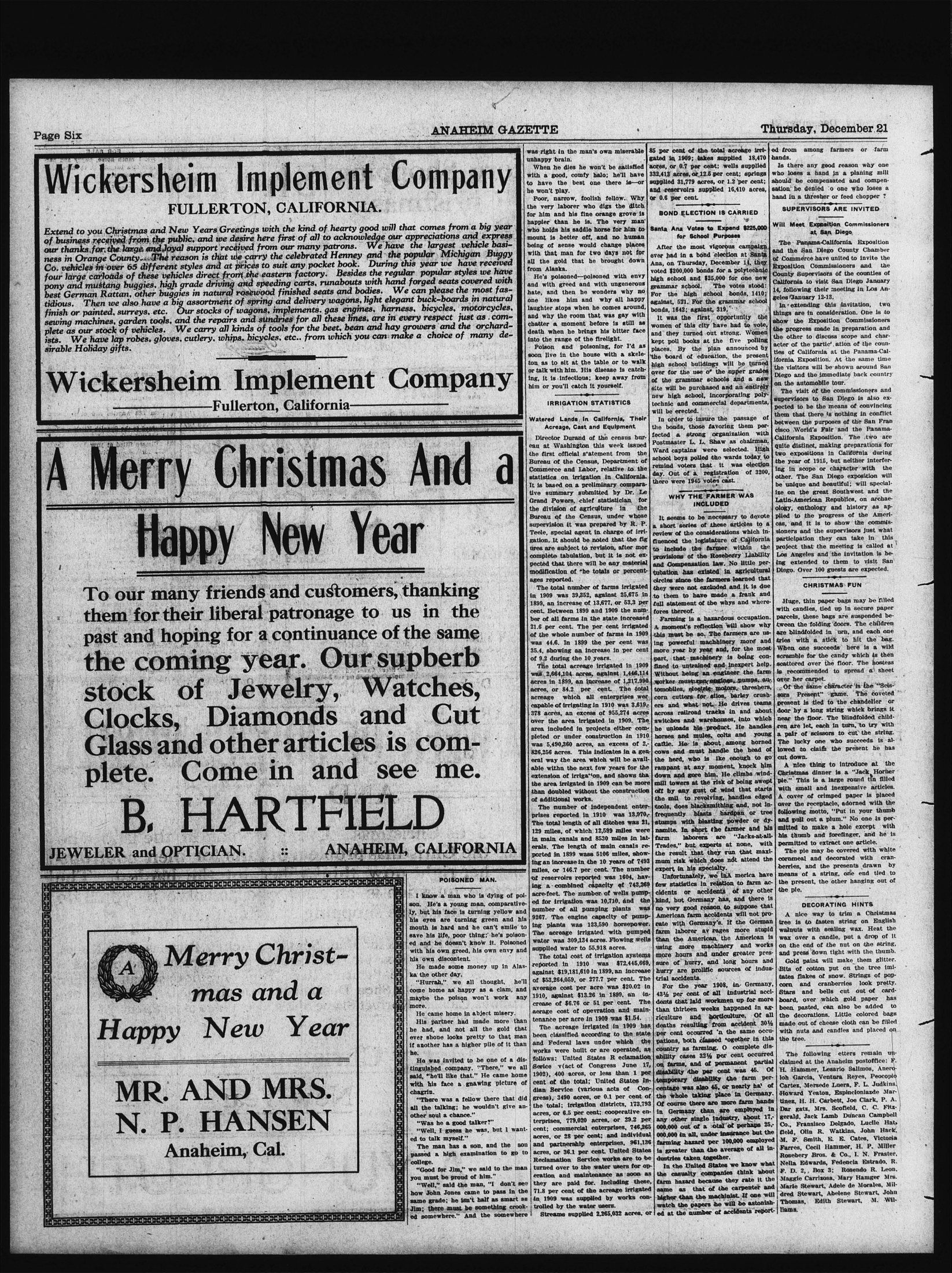
Wickersheim Implement
FULLERTON, CALIFORN
Extend to you Christmas and New Years Greetings with the kind of hearty
of business received from the public, and we desire here first of all to acknowl
our thanks for the large and loyal support received from our many patrons,
ness in Orange County. The reason is that we carry the celebrated Henne
Co. vehicles in over 65 different styles and at prices to suit any pocket book
four large carloads of these vehicles direct from the eastern factory. Beside
pony and mustang buggies, high grade driving and speeding carts, runabout
best German Rattan, other buggies in natural rosewood finished seats and
tidious. Then we also have a big assortment of spring and delivery wagon
finish or painted, surreys, etc. Our stocks of wagons, implements, gas eng
sewing machines, garden tools, and the repairs and sundries for all these lin
plete as our stock of vehicles. We carry all kinds of tools for the beet, bee
ists. We have lap robes, gloves, cutlery, whips, bicycles, etc.. from which y
sirable Holiday gifts.
Wickersheim Implement
Fullerton, California
Wickersheim Implement
Fullerton, California
A Merry Christmas
Happy New Year
To our many friends and custom
them for their liberal patronage
past and hoping for a continuan
the coming year. Our
stock of Jewelry,
Clocks, Diamonds
Glass and other article
plete. Come in and
B, HARTFI
JEWELER and OPTICIAN.
B. HARTFIELD
JEWELER and OPTICIAN. ANAHEIM
Merry Christmas and a
Happy New Year
MR. AND MRS.
N. P. HANSEN
Anaheim, Cal.
ANAHEIM GAZETTE
Olement Company
CALIFORNIA.
In the kind of hearty good will that comes from a big year first of all to acknowledge our appreciations and express our many patrons. We have the largest vehicle basi- ne celebrated Henney and the popular Michigan Buggy suit any pocket book. During this year we have received new factory. Besides the regular popular styles we have ing carts, runabouts with hand forged seats covered with finished seats and bodies. We can please the most fas- and delivery wagons, light elegant buck-boards in natural implements, gas engines, harness, bicycles, motorcycles, series for all these lines, are in every respect just as com- ols for the beet, bean and hay growers and the orchard-, etc.. from which you can make a choice of many de-
Olement Company
California
was right in the man's own miserable unhappy brain.
When he dies he won't be satisfied with a good, comfy halo; he'll have to have the best one there is—or he won't play.
Poor, narrow, foolish fellow. Why the very laborer who digs the ditch for him and his fine orange grove is happier than he is. The very man who holds his saddle horse for him to mount is better off, and no human being of sense would change places with that man for two days not for all the gold that he brought down from Alaska.
He's poisoned—poisoned with envy and with greed and with ungenerous hate, and then he wonders why no one likes him and why all happy laughter stops when he comes around, and why the room that was gay with chatter a moment before is still as death when he brings his bitter face into the range of the firelight.
Poison and poisoning, for I'd as soon live in the house with a skeleton as to sit at the table or to walk or talk with him. His disease is catching, it is infectious; keep away from him or you'll catch it yourself.
IRRIGATION STATISTICS
Watered Lands in California, Their Acreage, Cast and Equipment
Director Durand of the census bureau at Washington this week issued the first official statement from the Bureau of the Census, Department of Commerce and Labor, relative to the
Christmas And A New Year
and customers, thanking us in the continuance of the same year. Our superb jewelry, Watches, Bonds and Cut articles is com- and see me.
RTFIELD
ANAHEIM, CALIFORNIA
IRRIGATION STATISTICS
Watered Lands in California, Their Acreage, Cast and Equipment
Director Durand of the census bureau at Washington this week issued the first official statement from the Bureau of the Census, Department of Commerce and Labor, relative to the statistics on irrigation in California. It is based on a preliminary comparative summary submitted by Dr. Le Grand Powers, chief statistician for the division of agriculture in the Bureau of the Census, under whose supervision it was prepared by R. P. Teele, special agent in charge of irrigation. It should be noted that the figures are subject to revision, after more complete tabulation, but it is not expected that there will be any material modification of the totals or percentages reported.
The total number of farms irrigated in 1909 was 39,352, against 25,675 in 1899, an increase of 13,677, or 53.3 per cent. Between 1899 and 1909 the number of all farms in the state increased 21.6 per cent. The per cent irrigated of the whole number of farms in 1909 was 44.6. In 1899 the per cent was 35.4, showing an increase in per cent of 9.2 during the 10 years.
The total acreage irrigated in 1909 was 2,664,104 acres, against 1,446,114 acres in 1899, an increase of 1,217,990 acres, or 84.2 per cent. The total acreage which all enterprises were capable of irrigating in 1910 was 3,619,378 acres, an excess of 955,274 acres over the area irrigated in 1909. The area included in projects either completed or under construction in 1910 was 5,490,360 acres, an excess of 2,826,256 acres. This indicates in a general way the area which will be available within the next few years for the extension of irrigation, and shows that the area irrigated in 1909 can be more than doubled without the construction of additional works.
The number of independent enterprises reported in 1910 was 13,970. The total length of all ditches was 21,129 miles, of which 12,599 miles were in main canals and 8530 miles in laterals. The length of main canals reported in 1899 was 5106 miles, showing an increase in the 10 years of 7493 miles, or 146.7 per cent. The number of reservoirs reported was 1604, having a combined capacity of 743,269 acre-feet. The number of wells pumping water is infectious; keep away from him or you'll catch it yourself.
IRRIGATION STATISTICS
Watered Lands in California, Their Acreage, Cast and Equipment
Director Durand of the census bureau at Washington this week issued the first official statement from the Bureau of the Census, Department of Commerce and Labor, relative to the statistics on irrigation in California. It is based on a preliminary comparative summary submitted by Dr. Le Grand Powers, chief statistician for the division of agriculture in the Bureau of the Census, under whose supervision it was prepared by R. P. Teele, special agent in charge of irrigation. It should be noted that the figures are subject to revision, after more complete tabulation, but it is not expected that there will be any material modification of the totals or percentages reported.
The total number of farms irrigated in 1909 was 39,352, against 25,675 in 1899, an increase of 13,677, or 53.3 per cent. Between 1899 and 1909 the number of all farms in the state increased 21.6 per cent. The per cent irrigated of the whole number of farms in 1909 was 44.6. In 1899 the per cent was 35.4, showing an increase in per cent of 9.2 during the 10 years.
The total acreage irrigated in 1909 was 2,664,104 acres, against 1,446,114 acres in 1899, an increase of 13,677, or 53.3 per cent. Between 1899 and 1909 the number of all farms in the state increased 21.6 per cent. The per cent irrigated of the whole number of farms in 1909 was 44.6. In 1899 the per cent was 35.4, showing an increase in per cent of 9.2 during the 10 years.
The number of independent enterprises reported in 1910 was 13,970. The total length of all ditches was 21,129 miles, of which 12,599 miles were in main canals and 8530 miles in laterals. The length of main canals reported in 1899 was 5106 miles, showing an increase in the 10 years of 7493 miles, or 146.7 per cent. The number of reservoirs reported was 1604, having a combined capacity of 743,269 acre-feet. The number of wells pumping water is infectious; keep away from him or you'll catch it yourself.
IRRIGATION STATISTICS
Watered Lands in California, Their Acreage, Cast and Equipment
Director Durand of the census bureau at Washington this week issued the first official statement from the Bureau of the Census, Department of Commerce and Labor, relative to the statistics on irrigation in California. It is based on a preliminary comparative summary submitted by Dr. Le Grand Powers, chief statistician for the division of agriculture in the Bureau of the Census, under whose supervision it was prepared by R. P. Teele, special agent in charge of irrigation. It should be noted that the figures are subject to revision, after more complete tabulation, but it is not expected that there will be any material modification of the totals or percentages reported.
The total number of farms irrigated in 1909 was 39,352, against 25,675 in 1899, an increase of 13,677, or 53.3 per cent. Between 1899 and 1909 the number of all farms in the state increased 21.6 per cent. The per cent irrigated of the whole number of farms in 1909 was 44.6. In 1899 the per cent was 35.4, showing an increase in per cent of 9.2 during the 10 years.
The total acreage irrigated in 1909 was 2,664,104 acres, against 1,446,114 acres in 1899, an increase of 13,677, or 53.3 per cent. Between 1899 and
POISONED MAN.
I know a man who is dying of poison. He's a young man, comparatively but his face is turning yellow and his eyes are turning green and his mouth is hard and he can't smile to save his life, poor thing; he's poisoned and he doesn't know it. Poisoned with his own greed, his own envy and his own discontent.
He made some money up in Alaska the other day.
"Hurrah," we all thought, he'll come home as happy as a clam, and maybe the poison won't work any more.
He came home in abject misery.
His partner had made more than he had, and not all the gold that ever shone looks pretty to that man if another has a higher pile of it than he.
He was invited to be one of a distinguished company. "There," we all said, "he'll like that." He came home with his face a gnawing picture of chagrin.
"There was a fellow there that did all the talking; he wouldn't give another soul a chance."
"Was he a good talker?"
"Well, I guess he was, but I wanted to talk myself."
The man has a son, and the son passed a high examination to go to college.
"Good for Jim," we said to the man you must be proud of him."
"Well," said the man, "I don't see how John Jones came to pass in the same grade; he isn't half as smart as Jim; there must be something crooked somewhere." And the somewhere
The number of independent enterprises reported in 1910 was 13,970. The total length of all ditches was 21,129 miles, of which 12,599 miles were in main canals and 8530 miles in laterals. The length of main canals reported in 1899 was 5106 miles, showing an increase in the 10 years of 7493 miles, or 146.7 per cent. The number of reservoirs reported was 1604, having a combined capacity of 743,269 acre-feet. The number of wells pumped for irrigation was 10,710, and the number of all pumping plants was 9267. The engine capacity of pumping plants was 123,590 horsepower. The acreage irrigated with pumped water was 309,134 acres. Flowing wells supplied water to 55,918 acres.
The total cost of irrigation systems reported in 1910 was $72,445,669 against $19,181,610 in 1899, an increase of $53,264,059, or 277.7 per cent. The average cost per acre was $20.02 in 1910, against $13.26 in 1899, an increase of $6.76 or 51 per cent. The average cost of operation and maintenance per acre in 1909 was $1.54.
The acreage irrigated in 1909 has been classified according to the state and Federal laws under which the works were built or are operated, as follows: United States R eclamation Service v(act of Congress June 17, 1902), 400 acres, or less than 1 per cent of the total; United States Indian Service (various acts of Congress), 3490 acres, or 0.1 per cent of the total; irrigation districts, 173,793 acres, or 6.5 per cent; cooperative enterprises, 779,020 acres, or 29.2 per cent; commercial enterprises, 746,265 acres, or 28 per cent; and individual partnership enterprises, 961,136 acres, or 36.1 per cent. United States Reclamation Service works are to be turned over to the water users for operation and maintenance as soon as they are paid for. Including these, 71.8 per cent of the acreage irrigated in 1909 was supplied by works controlled by the water users.
Streams supplied 2,265,032 acres, or
Thursday, December 21
BOND ELECTION IS CARRIED
Santa Ana Votes to Expend $225,000 for School Purposes
After the most vigorous campaign ever had in a bond election at Santa Ana, on Thursday, December 14, they voted $200,000 bonds for a polytechnic high school and $25,000 for one new grammar school. The votes stood: For the high school bonds, 1410; against, 521. For the grammar school bonds, 1642; against, 319.
It was the first opportunity the women of this city have had to vote, and they turned out strong. Women kept poll books at the five polling places. By the plan announced by the board of education, the present high school buildings will be turned over for the use of the upper grades of the grammar schools and a new site will be purchased and an entirely new high school, incorporating polytechnic and commercial departments, will be erected.
In order to insure the passage of the bonds, those favoring them perfected a strong organization with Postmaster L. L. Shaw as chairman. Ward captains were selected. High school boys polled the wards today to remind voters that it was election day. Out of a registration of 3200,
ed from among farmers or farm hands.
Is there any good reason why one who loses a hand in a planing mill should be compensated and compensation be denied to one who loses a hand in a thresher or feed chopper?
SUPERVISORS ARE INVITED
Will Meet Exposition Commissioners at San Diego
The Panama-California Exposition and the San Diego County Chamber of Commerce have united to invite the Exposition Commissioners and the County Supervisors of the counties of California to visit San Diego January 14, following their meeting in Los Angeles January 12-13.
In extending this invitation, two things are in consideration. One is to show the Exposition Commissioners the progress made in preparation and the other to discuss scope and character of the participation of the counties of California at the Panama-California Exposition. At the same time the visitors will be shown around San Diego and the immediate back country on the automobile tour.
The visit of the commissioners and supervisors to San Diego is also expected to be the means of convincing them that there is nothing in conflict between the purposes of the San Francisco World's Fair and the Panama-California Exposition. The two are quite distinct, making preparations for two expositions in California during the year of 1915, but neither interfering in scope or character with the
WHY THE FARMER WAS INCLUDED
It seems to be necessary to devote a short series of these articles to a review of the considerations which influenced the legislature of California to include the farmer within the provisions of the Roseberry Liability and Compensation law. No little perturbation has existed in agricultural circles since the farmers learned that they were not excluded and it is due to them to have made a frank and full statement of the whys and wherefores thereof.
Farming is a hazardous occupation. A moment's reflection will show why this must be so. The farmers are using powerful machinery more and more year by year and, for the most part, that machinery is being confined to untrained and inexperienced help. Without being an engineer the farm worker must run engines, pumps, automobiles, electric motors, threshers, corn cutters for allos, barley crushers and what not. He drives teams across railroad tracks in and about switches and warehouses, into which he unloads his product. He handles horses and mules, colts and young cattle. He is about among horned cows and must handle the head of the herd, who is like enough to go rampant at any moment, knock him down and gore him. He climbs windmill towers at the risk of being swept off by any gust of wind that starts the mill to revolving, handles edged tools, does blacksmithing and, not infrequently blasts hardpan or tree stumps with blasting powder or dynamite. In short the farmer and his farm laborers are "Jacks-at-all-Trades," but experts at none, with the result that they run that maximum risk which does not attend the expert in his specialty.
Unfortunately, we in America have few statistics in relation to farm accidents or accidents of any other kind but Germany has and there is Diego and the immediate back country on the automobile tour.
The visit of the commissioners and supervisors to San Diego is also expected to be the means of convincing them that there is nothing in conflict between the purposes of the San Francisco World's Fair and the Panama-California Exposition. The two are quite distinct, making preparations for two expositions in California during the year of 1915, but neither interfering in scope or character with the other. The San Diego exposition will be unique and beautiful; will specialize on the great Southwest and the Latin-American Republics, on archaeology, enthology and history as applied to the progress of the Americas, and it is to show the commissioners and the supervisors just what participation they can take in this project that the meeting is called at Los Angeles and the invitation is being extended to them to visit San Diego. Over 100 guests are expected.
CHRISTMAS FUN
Huge, thin paper bags may be filled with candies, tied up in secure paper parcels, these bags are suspended between the folding doors. The children are blindfolded in urn, and each one tries with a stick to hit the bag. When one succeeds here is a wild scramble for the candy which is then scattered over the floor. The hostess is recommended to spread a sheet over her carpet.
Of the same character is the "Scissors Present" game. The coveted present is tied to the chandelier or door by a long string which brings it near the floor. The blindfolded children are let, each in turn, to try with a pair of scissors to cut the string. The lucky one who succeeds is allowed to claim the present he has cut down.
A nice thing to introduce at the Christmas dinner is a "Jack Horner pie." This is a large round tin filled with small and inexpensive articles. A cover of crimped paper is placed over the receptacle, adorned with the following motto, "Put in your thumb and pull out a plum." No one is permitted to make a hole except with his thumb and forefinger, and he is permitted to extract one article.
The pie may be covered with white cornmeal and decorated with cranberries, and the presents drawn by means of a string, one end tied to the present, the other hanging out of the pie.
independent enterprise was 13,970 miles in all ditches was 21,825,999 miles were 8530 miles in latitude main canals reached 5106 miles, showing 10 years of 7493 percent. The number and was 1604, hawk capacity of 743,269 per of wells pumped 10,710, and the operating plants was capacity of pumped 590 horsepower. Used with pumped acres. Flowing wells 918 acres.
Irrigation systems was $72,445,669, an increase of 1899, an increase of 7.7 per cent. The ore was $20.02 in 1899, an increase of 1 per cent. The operation and main-1909 was $1.54.
Activated in 1909 has leading to the state under which the are operated, as states R eclamation Congress June 17, less than 1 per United States Inus acts of Con-0.1 per cent of districts, 173,793 unit; cooperative enterprises, or 29.2 per enterprises, 746,265 unit; and individual enterprises, 961,136 unit. United States works are to be water users for op-ance as soon as including these, the acreage irrigated by works con-users.
In the United States we know what the casualty companies think about farm hazard because they rate it the same as that of the carpenter and higher than the machinist. If one will watch the papers he will be astonished at the number of accidents report-over the receptacle, adorned with the following motto, "Put in your thumb and pull out a plum." No one is permitted to make a hole except with his thumb and forefinger, and he is permitted to extract one article.
The pie may be covered with white cornmeal and decorated with cranberries, and the presents drawn by means of a string, one end tied to the present, the other hanging out of the pie.
DECORATING HINTS
A nice way to trim a Christmas tree is to fasten string on English walnuts with sealing wax. Heat the wax over a candle, put a drop of it on the end of the nut on the string, and press down tight with the thumb.
Gold paint will make them glitter. Bits of cotton put on the tree imitates flakes of snow. Strings of popcorn and cranberries look pretty. Stars and bells cut out of cardboard, over which gold paper has been pasted, can also be added to the decorations. Little colored bags made out of cheese cloth can be filled with nuts and candies and placed on the tree.
The following etters remain unclaimed at the Anaheim postoffice: F. H. Hammer, Lesario Salimos, Aneroloh Garcia, Ventura Reyes, Peocopio Cartez, Mersede Luera, F. L. Judkins, Howard Yeaton, Espincloniazde Martinez, H. H. Carbett, Joe Clark, P. A. Dar gatz, Mrs. Scofield, C. C. Fitzgerald, Jack Lamb Duncan Campbell Co., Fransisco Delgado, Lucile Hatfield, Olin R. Watkins, John Hack, M. F. Smith, E. E. Cates, Victoria Farres, Cecil Hammer, H. P. Miller Rosebery Bros. & Co., I. N. Fraster, Nella Edwards, Fedencia Estrado, R. F. D. 2, Box 3; Rosendo R. Leon, Maggie Carrizosa, Mary Hamger Mrs. Marie Stewart, Adele de Morales, Mildred Stewart, Abelene Stewart, John Thomas, Edith Stewart, M. Williams.