anaheim-gazette 1911-11-16
Scanned page
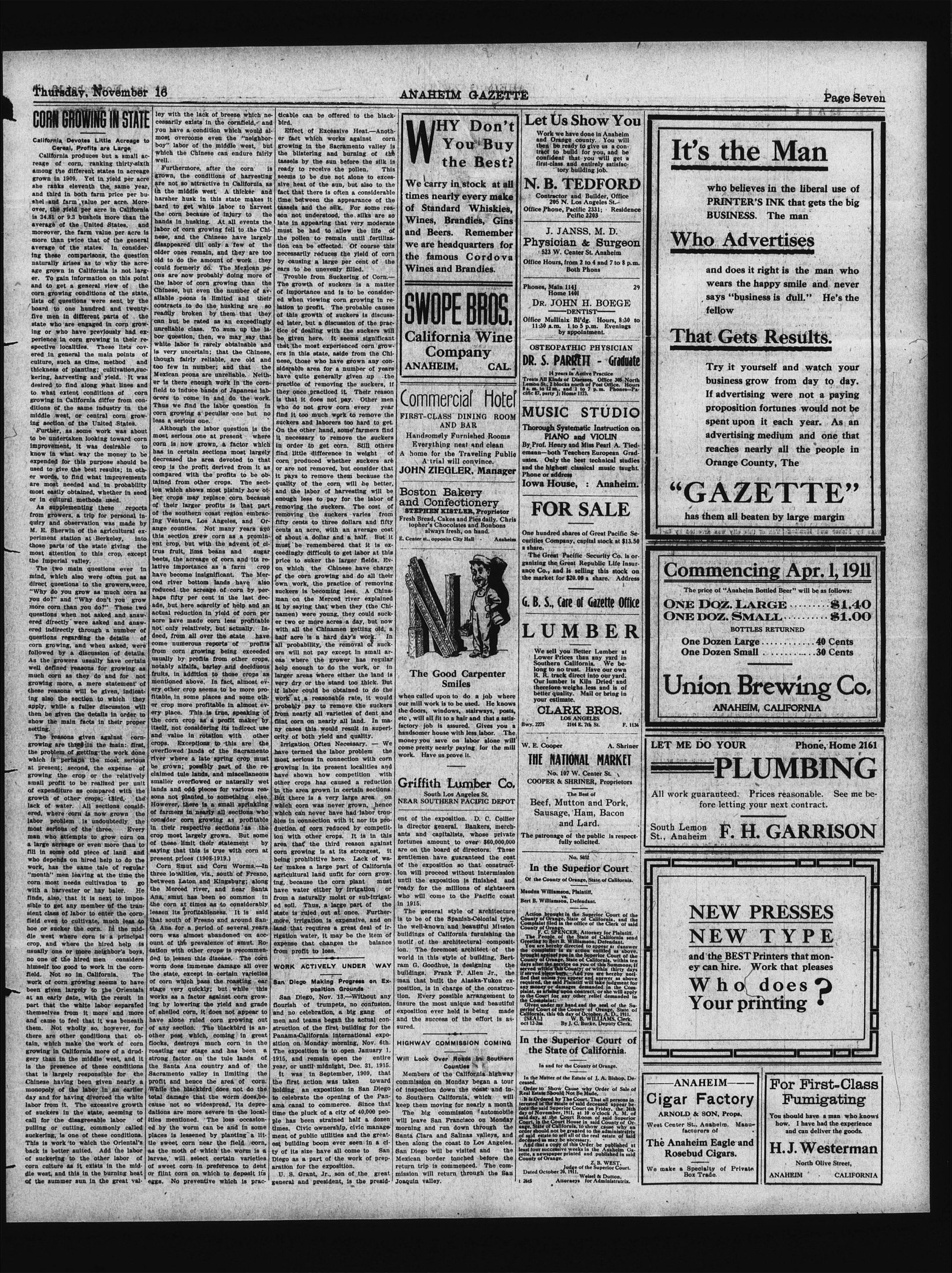
Searchable text
CORN GROWING IN STATE
California Devotes Little Acreage to Cereal, Profits are Large
California produces but a small acreage of corn, ranking thirty-sixth among the different states in acreage grown in 1909. Yet in yield per acre she ranks eleventh the same year, and third in both farm price per bushel and farm value per acre. Moreover, the yield per acre in California is 34.81 or 9.3 bushels more than the average of the United States, and moreover, the farm value per acre is more than twice that of the general average of the states. In considering these comparisons, the question naturally arises as to why the acreage grown in California is not larger. To gain information on this point and to get a general view of the corn growing conditions of the state, lists of questions were sent by the board to one hundred and twenty-five men in different parts of the state who are engaged in corn growing or who have previously had experience in corn growing in their respective localities. These lists covered in general the main points of culture, such as time, method and thickness of planting; cultivation, suckering, harvesting and yield. It was desired to find along what lines and to what extent conditions of corn growing in California differ from conditions of the same industry in the middle west, or central corn growing section of the United States.
Further, as some work was about to be undertaken looking toward corn improvement, it was desirable to know in what way the money to be expended for this purpose should be used to give the best results; in other words with the lack of breeze which necessarily exists in the cornfield, and you have a condition which would almost overcome even the "neighbor-boy" labor of the middle west, but which the Chinese can endure fairly well.
Furthermore, after the corn is grown, the conditions of harvesting are not so attractive in California as in the middle west. A thicker and harsher husk in this state makes it hard to get white labor to harvest the corn because of injury to the hands in husking. At all events the labor of corn growing fell to the Chinese, and the Chinese have largely disappeared till only a few of the older ones remain, and they are too old to do the amount of work they could formerly do. The Mexican peons are now probably doing more of the labor of corn growing than the Chinese, but even the number of available peons is limited and their contracts to do the husking are so readily broken by them that they can but be rated as an exceedingly unreliable class. To sum up the labor question, then, we may say that white labor is rarely obtainable and is very uncertain; that the Chinese, though fairly reliable, are old and too few in number; and that the Mexican peons are unreliable. Neither is there enough work in the corn field to induce bands of Japanese laborers to come in and do the work. Thus we find the labor question in corn growing a peculiar one but no less a serious one.
Although the labor question is the most serious one at present where corn is now grown, a factor which has in certain sections most largely decreased the area devoted to that crop is the profit derived from it as compared with the profits to be obtained can be offered to bird.
Effect of Excessive Fact which works against growing in the Sacramento blistering and burnt tassels by the sun before ready to receive the pot seems to be due not alone since heat of the sun, but fact that there is often a time between the appearance tassels and the silk. For son not understood, the late in appearing that veil must be had to allow the pollen to remain unction can be effected. Of necessarily reduces the yield by causing a large per centears to be unevenly filled.
Trouble from Suckerling
The growth of suckers of importance and is to ed when viewing corn graftation to profit. The proof of this growth of suckers ed later, but a discussion vice of dealing with the be given here. It seem that the most experienced ers in this state, aside from nese, those who have grow siderable area for a num have quite generally give practice of removing them they once practiced it. That it does not pay who do not grow corn e find it too much work to suckers and laborers too On the other hand, some it necessary to remove in order to get corn. find little difference in corn produced whether or are not removed, but
kering, harvesting and yield. It was desired to find along what lines and to what extent conditions of corn growing in California differ from conditions of the same industry in the middle west, or central corn growing section of the United States.
Further, as some work was about to be undertaken looking toward corn improvement, it was desirable to know in what way the money to be expended for this purpose should be used to give the best results; in other words, to find what improvements are most needed and in probability most easily obtained, whether in seed or in cultural methods used.
As supplementing these reports from growers, a trip for personal inquiry and observation was made by M. E. Sherwin of the agricultural experiment station at Berkeley, into those parts of the state giving the most attention to this crop, except the Imperial valley.
The two main questions ever in mind, which also were often put as direct questions to the growers, were, "Why do you grow as much corn as you do?" and "Why don't you grow more corn than you do?" These two questions when not asked and answered directly were asked and answered indirectly through a number of questions regarding the details of corn growing, and when asked, were followed by a discussion of details. As the growers usually have certain well defined reasons for growing as much corn as they do and for not growing more, a mere statement of these reasons will be given, indicating also the section to which they apply, while a fuller discussion will then be given the details in order to show the main facts in their proper setting.
The reasons given against corn-growing are three in the main: first, the problem of getting the work done which is perhaps the most serious at present; second, the expense of growing the crop or the relatively small profit to be realized per unit of expenditure as compared with the growth of other crops; third, the lack of water. All sections considered, where corn is now grown the labor problem is undoubtedly the most serious of the three. Every man who attempts to grow corn on a large acreage or even more than to fill in some odd piece of land and who depends on hired help to do the work, has the same tale of regular "month" men leaving at the time the corn most needs cultivation to go with a harvester or hay baler. He finds, also, that it is next to imbos-
Mexican peons are unreliable. Neither is there enough work in the corn-field to induce bands of Japanese laborers to come in and do the work. Thus we find the labor question in corn growing a peculiar one but no less a serious one.
Although the labor question is the most serious one at present where corn is now grown, a factor which has in certain sections most largely decreased the area devoted to that crop is the profit derived from it as compared with the profits to be obtained from other crops. The section which shows most plainly how other crops may replace corn because of their larger profits is that part of the southern coast region embracing Ventura, Los Angeles, and Orange counties. Not many years ago this section grew corn as a prominent crop, but with the advent of citrus fruit, lima beans and sugar beets, the acreage of corn and its relative importance as a farm crop have become insignificant. The Merced river bottom lands have also reduced the acreage of corn by perhaps fifty per cent in the last decade, but here scarcity of help and an actual reduction in yield of corn per acre have made corn less profitable not only relatively, but actually. Indeed, from all over the state have come numerous reports of profits from corn growing being exceeded usually by profits from other crops, notably alfalfa, barley and deciduous fruits, in addition to those crops as mentioned above. In fact, almost every other crop seems to be more profitable in some places and some other crop more profitable in almost every place. This is true, speaking of the corn crop as a profit maker by itself, not considering its indirect use and value in rotation with other crops. Exceptions to this are the overflowed lands of the Sacramento river where a late spring crop must be grown; possibly part of the reclaimed tule lands, and miscellaneous smaller overflowed or naturally wet lands and odd pieces for various reasons not planted to something else. However, there is a small sprinkling of farmers in nearly all sections who consider corn growing as profitable in their respective sections' as the crop most largely grown. But some of these limit their statement by saying that this is true with corn at present prices (1908-1919.).
Corn Smut and Corn Worms.—In three localities, viz., south of Fresno, between Laton and Kingsburg; along the Merced river, and near Santa Ana, smut has been so common in Mexican peons are unreliable. Neither is there enough work in the corn-field to induce bands of Japanese laborers to come in and do the work. Thus we find the labor question in corn growing a peculiar one but no less a serious one.
Although the labor question is the most serious one at present where corn is now grown, a factor which has in certain sections most largely decreased the area devoted to that crop is the profit derived from it as compared with the profits to be obtained from other crops. The section which shows most plainly how other crops may replace corn because of their larger profits is that part of the southern coast region embracing Ventura, Los Angeles, and Orange counties. Not many years ago this section grew corn as a prominent crop, but with the advent of citrus fruit, lima beans and sugar beets, the acreage of corn and its relative importance as a farm crop have become insignificant. The Merced river bottom lands have also reduced the acreage of corn by perhaps fifty per cent in the last decade, but here scarcity of help and an actual reduction in yield of corn per acre have made corn less profitable not only relatively, but actually. Indeed, from all over the state have come numerous reports of profits from corn growing being exceeded usually by profits from other crops, notably alfalfa, barley and deciduous fruits, in addition to those crops as mentioned above. In fact, almost every other crop seems to be more profitable in some places and some other crop more profitable in almost every place. This is true, speaking of the corn crop as a profit maker by itself, not considering its indirect use and value in rotation with other crops. Exceptions to this are the overflowed lands of the Sacramento river where a late spring crop must be grown; possibly part of the reclaimed tule lands, and miscellaneous smaller overflowed or naturally wet lands and odd pieces for various reasons not planted to something else. However, there is a small sprinkling of farmers in nearly all sections who consider corn growing as profitable in their respective sections' as the crop most largely grown. But some of these limit their statement by saying that this is true with corn at present prices (1908-1919.).
Irrigation Often Necessitates that labor produce most serious in connection with growing in its present location have shown how competence other crops has caused them in the area grown in certain areas. But there is a very large which corn was never grown which can never have had blades in connection with it. Production of corn reduced by ion with other crops. Its area that the third reason corn growing is at its stale being prohibitive here. Iter makes a large part of agricultural land unfit for ingcing because the corn plant have water either by irrigation from a naturally moist or
growth or other crops; third, the lack of water. All sections considered, where corn is now grown the labor problem is undoubtedly the most serious of the three. Every man who attempts to grow corn on a large acreage or even more than to fill in some odd piece of land and who depends on hired help to do the work, has the same tale of regular "month" men leaving at the time the corn most needs cultivation to go with a harvester or hay baler. He finds, also, that it is next to impossible to get any member of the transient class of labor to enter the corn field even to cultivate, much less to hoe or sucker the corn. In the middle west where corn is a principal crop, and where the hired help is usually one or more neighbor's boys, no one of the hired men considers himself too good to work in the cornfield. Not so in California. The work of corn growing seems to have been given largely to the Orientals at an early date, with the result in part that the white labor separated themselves from it more and more and came to feel that it was beneath them. Not wholly so, however, for there are other conditions that obtain, which make the work of corn growing in California more of a drudgery than in the middle west, and it is the presence of these conditions that is largely responsible for the Chinese having been given nearly a monopoly of the labor in an earlier day and for having divorced the white labor from it. The excessive growth of suckers in the state, seeming to call for the disagreeable labor of pulling or cutting, commonly called suckering, is one of these conditions. This is work to which the Oriental's back is better suited. Add the labor of suckering to the other labor of corn culture as it exists in the middle west, and this in the burning heat of the summer sun in the great valleys not plumbed to something else. However, there is a small sprinkling of farmers in nearly all sections who consider corn growing as profitable in their respective sections as the crop most largely grown. But some of these limit their statement by saying that this is true with corn at present prices (1908-1919.).
Corn Smut and Corn Worms.—In three localities, viz., south of Fresno, between Laton and Kingsburg; along the Merced river, and near Santa Ana, smut has been so common in the corn at times as to considerably lessen its profitableness. It is said that south of Fresno and around Santa Ana for a period of several years corn was almost abandoned on account of the prevalence of smut. Rotation with other crops is recommended to lessen this disease. The corn worm does immense damage all over the state, except in certain varieties of corn which pass the roasting ear stage very quickly; but while this works as a factor against corn growing by lowering the yield and grade of shelled corn, it does not appear to have alone ruled corn growing out of any section. The blackbird is another pest which, coming in great flocks, destroys much corn in the roasting ear stage and has been a strong factor on the tule lands of the Santa Ana country and of the Sacramento valley in limiting the profit and hence the area of corn. While the blackbird does not do the total damage that the worm does, because not so widespread, its depredations are more severe in the localities mentioned. The loss occasioned by the worm can be and in some places is lessened by planting a little sweet corn near the field corn, as the moth of which the worm is a larvae, will select certain varieties of sweet corn in preference to dent or flint corn on which to deposit its eggs. No preventive which is practiced.
WORK ACTIVELY UNDERTAKEN
San Diego Making Program Position Group
San Diego, Nov. 13.—W flourish of trumpets, no and no celebration, a big men and teams began the construction of the first building Panama-California international on Monday morning. The exposition is to open 1915, and remain open year, or until midnight. It was in September, the first action was taken holding an exposition in order to celebrate the opening oama canal to commerce. Time the pluck of a city of ple has been strained hard times. Civic ownership, citment of public utilities and est building boom ever setty of its size have all com Diego as a part of the worarion for the exposition.
U. S. Grant, Jr., son of general and president, is
ANAHEIM GAZETTE
Effect of Excessive Heat.—Another fact which works against corn growing in the Sacramento valley is the blistering and burning of the cassels by the sun before the silk is ready to receive the pollen. This seems to be due not alone to excessive heat of the sun, but also to the fact that there is often a considerable time between the appearance of the cassels and the silk. For some reason not understood, the silks are so late in appearing that very moderate must be had to allow the life of the pollen to remain until fertilization can be effected. Of course this necessarily reduces the yield of corn by causing a large per cent of the years to be unevenly filled.
Trouble from Suckering of Corn.—The growth of suckers is a matter of importance and is to be considered when viewing corn growing in relation to profit. The probable causes of this growth of suckers is discussed later, but a discussion of the practice of dealing with the suckers will be given here. It seems significant that the most experienced corn growers in this state, aside from the Chinese, those who have grown any considerable area for a number of years have quite generally given up the practice of removing the suckers, if they once practiced it. Their reasons are that it does not pay. Other men who do not grow corn every year find it too much work to remove the suckers and laborers too hard to get. On the other hand, some farmers find it necessary to remove the suckers in order to get corn. Still others find little difference in weight of corn produced whether suckers are or are not removed, but consider that applicable can be offered to the blackbird.
WHY Don’t You Buy the Best?
We carry in stock at all times nearly every make of Standard Whiskies, Wines, Brandies, Gins and Beers. Remember we are headquarters for the famous Cordova Wines and Brandies.
SWOPE BROS.
California Wine Company
ANAHEIM, CAL.
Commercial Hotel
FIRST-CLASS DINING ROOM AND BAR
Handsomely Furnished Rooms
Everything neat and clean
A home for the Traveling Public
A trial will convince.
JOHN ZIEGLER, Manager
Let Us Show You
Work we have done in Anaheim and Orange county. You will then be ready to give us a contract to build for you, and be confident that you will get a first-class and entirely satisfactory building job.
N. B. TEDFORD
Contractor and Builder, Office 205 N. Los Angeles St.
Office Phone, Pacific 2331; Residence Pcific 2203
J. JANSS, M. D.
Physioian & Surgeon
523 W. Center St. Anaheim
Office Hours, from 2 to 4 and 7 to 8 p.m.
Both Phons
Phones, Main 114J
Home 140l
DR. JOHN H. BOEGE
DENTIST
Office Mullinix Bl'dg. Hours, 8:30 to 11:30 a.m. 1 to 5 p.m. Evenings by appointment.
OSTEOPATHIC PHYSICIAN
DR. S. PARRETT - Graduate
14 years in Active Practice
Treats All Kinds of Diseases. Office 305 North Lemon St., 2 blocks north of Post Office. Hours 8 a.m. to 12 m., and 1 to 7 p.m. Phones—Pacific 87, party J; Home 1173.
MUSIC STUDIO
Thorough Systematic Instruction on PIANO and VIOLIN
By Prof. Henry and Miss Pearl A. Tiedemann—both Teachers European Graduates. Only the best technical studies and the highest classical music taught.
Phone or address
Commercial Hotel
FIRST-CLASS DINING ROOM AND BAR
Handsomely Furnished Rooms
Everything neat and clean
A home for the Traveling Public
A trial will convince.
JOHN ZIEGLER, Manager
Boston Bakery and Confectionery
STEPHEN KISTLER, Proprietor
Fresh Bread, Cakes and Pies daily. Chris topher's Chocolates and Bonbons always fresh, on hand.
E. Center St., opposite City Hall Anaheim
The Good Carpenter Smiles
when called upon to do a job where our mill work is to be used. He knows the doors, windows, stairways, posts, etc., will all fit to a hair and that a satisfactory job is assured. Gives you a handsomer house with less labor. The money you save on labor alone will come pretty nearly paying for the mill work. Have us prove it.
Griffith Lumber Co.
South Los Angeles St.
NEAR SOUTHERN PACIFIC DEPOT
ent of the exposition. D. C. Collier is director general. Bankers, merchants and capitalists, whose private fortunes amount to over $60,000,000 are on the board of directors. These gentlemen have guaranteed the cost of the exposition so that construction will proceed without intermission until the exposition is finished and ready for the millions of sightseers who will come to the Pacific coast
MUSIC STUDIO
Thorough Systematic Instruction on PIANO and VIOLIN
By Prof. Henry and Miss Pearl A. Tiedemann—both Teachers European Graduates. Only the best technical studies and the highest classical music taught. Phone or address
Iowa House: Anaheim.
FOR SALE
One hundred shares of Great Pacific Securities Company, capital stock at $13.50 a share.
The Great Pacific Security Co. is organizing the Great Republic Life Insurance Co., and is selling this stock on the market for $20.00 a share. Address
G. B. S., Care of Gazette Office
LUMBER
We sell you Better Lumber at Lower Prices than any yard in Southern California. We belong to no trust. Have our own R. R. track direct into our yard. Our lumber is Kiln Dried and therefore weighs less and is of better quality. Mall or bring in your estimate.
CLARK BROS.
LOS ANGELES
Bwy. 2275
2144 E. 7th St.
F. 1136
W. E. Cooper
A. Shriner
THE NATIONAL MARKET
No. 107 W. Center St.
COOPER & SHRINER, Proprietors
The Best of Beef, Mutton and Pork,
Sausage, Ham, Bacon and Lard.
The patronage of the public is respectfully solicited.
No. 5032
In the Superior Court
Of the County of Orange, State of California.
Maudna Williamson, Plainatt, Va.
Treats All Kinds of Diseases. Office 305 North Lemon St., 2 blocks north of Post Office. Hours 8 a.m. to 12 m., and 1 to 7 p.m. Phones—Pacific 87, party J: Home 1173.
NEAR SOUTHERN PACIFIC DEPOT
ent of the exposition. D. C. Collier is director general. Bankers, merchants and capitalists, whose private fortunes amount to over $60,000,000 are on the board of directors. These gentlemen have guaranteed the cost of the exposition so that construction will proceed without intermission until the exposition is finished and ready for the millions of sightseers who will come to the Pacific coast in 1915.
The general style of architecture is to be of the Spanish-Colonial type, the well-known and beautiful Mission buildings of California furnishing the motif of the architectural composition. The foremost architect of the world in this style of building, Bertram G. Goodhue, is designing the buildings. Frank P. Allen Jr., the man that built the Alaska-Yukon exposition, is in charge of the construction. Every possible arrangement to insure the most unique and beautiful exposition ever held is being made and the success of the effort is assured.
HIGHWAY COMMISSION COMING
Will Look Over Roads in Southern Counties
Members of the California highway commission on Monday began a tour of inspection down the coast and into Southern California, which will keep them moving for nearly a month.
The big commission automobile will leave San Francisco on Monday morning and run down through the Santa Clara and Salinas valleys, and then along the coast to Los Angeles. San Diego will be visited and the Mexican border touched before the return trip is commenced. The commission will return through the San Joaquin valley.
Beef, Mutton and Pork,
Sausage, Ham, Bacon
and Lard.
The patronage of the public is respectfully solicited.
No. 5032
In the Superior Court
Of the County of Orange, State of California.
Maudna Williamson, Plaintiff,
vs.
Bert B. Williamson, Defendant.
Action brought in the Superior Court of the County of Orange, State of California, and the Complaint filed in the office of the Clerk of said County of Orange.
F. C. SPENCER, Attorney for Plaintiff.
The People of the State of California send Greeting to Bert B. Williamson, Defendant.
You are hereby directed to appear as answer to the complaint in an action entitled as above, brought against you in the Superior Court of the County of Orange, State of California, within ten days after the service on you of this Summons; if served within this County; or within thirty days if served elsewhere. And you are hereby notified that unless you appear and answer as above required, the said Plaintiff will take judgment for any money or damages demanded in the Complaint, as arising upon contract, or she will apply to the Court for any other relief demanded in the Complaint:
Given under my hand and the seal of the Superior Court of the County of Orange, State of California, this 4th day of October, A.D., 1911.
[SEAL]
W. B. WILLIAMS, Clerk.
oct 12-2m
By J. C. Burke, Deputy Clerk.
In the Superior Court of the State of California.
In and for the County of Orange.
In the Matter of the Estate of J. A. Bishop, Deceased.
Order to Show Cause why Order of Sale of Real Estate Should Not Be Made.
It is Ordered by The Court. That all persons interested in the estate of said deceased appear before the said Superior Court on Friday, the 24th day of November, 1911, at 10 o'clock A.M. of said day, at the Court Room of said Superior Court, in the Court House in said County of Orange, State of California, to show cause why an order should not be granted to the administratrix of said estate to sell all of the real estate of said deceased as may be necessary.
And that a copy of this Order be published at least four successive weeks in the Anaheim Gazette, a newspaper printed and published in said County of Orange.
Z. B. WEST,
Judge of the Superior Court.
Dated October 20, 1911.
Weisel & Dutton,
Attorneys for Administratrix.
It’s the Man
who believes in the liberal use of PRINTER’S INK that gets the big BUSINESS. The man
Who Advertises
and does it right is the man who wears the happy smile and never says “business is dull.” He's the fellow
That Gets Results.
Try it yourself and watch your business grow from day to day.
If advertising were not a paying proposition fortunes would not be spent upon it each year. As an advertising medium and one that reaches nearly all the people in Orange County, The
business grow from day to day. If advertising were not a paying proposition fortunes would not be spent upon it each year. As an advertising medium and one that reaches nearly all the people in Orange County, The
"GAZETTE"
has them all beaten by large margin
Commencing Apr. 1, 1911
The price of "Anaheim Bottled Beer" will be as follows:
ONE DOZ. LARGE $1.40
ONE DOZ. SMALL $1.00
BOTTLES RETURNED
One Dozen Large 40 Cents
One Dozen Small 30 Cents
Union Brewing Co.
ANAHEIM, CALIFORNIA
LET ME DO YOUR Phone, Home 2161
PLUMBING
All work guaranteed. Prices reasonable. See me before letting your next contract.
South Lemon St., Anaheim F. H. GARRISON
NEW PRESSES
NEW TYPE
and the BEST Printers that money can hire. Work that pleases
Who does Your printing?
ANAHEIM
Cigar Factory
ARNOLD & SON, Props,
West Center St., Anaheim. Manufacturers of
The Anaheim Eagle and Rosebud Cigars.
We make a Specialty of Private Box Trade.
For First-Class Fumigating
You should have a man who knows how. I have had the experience and can deliver the goods.
H.J. Westerman
North Olive Street,
ANAHEIM CALIFORNIA