anaheim-gazette 1911-11-16
Scanned page
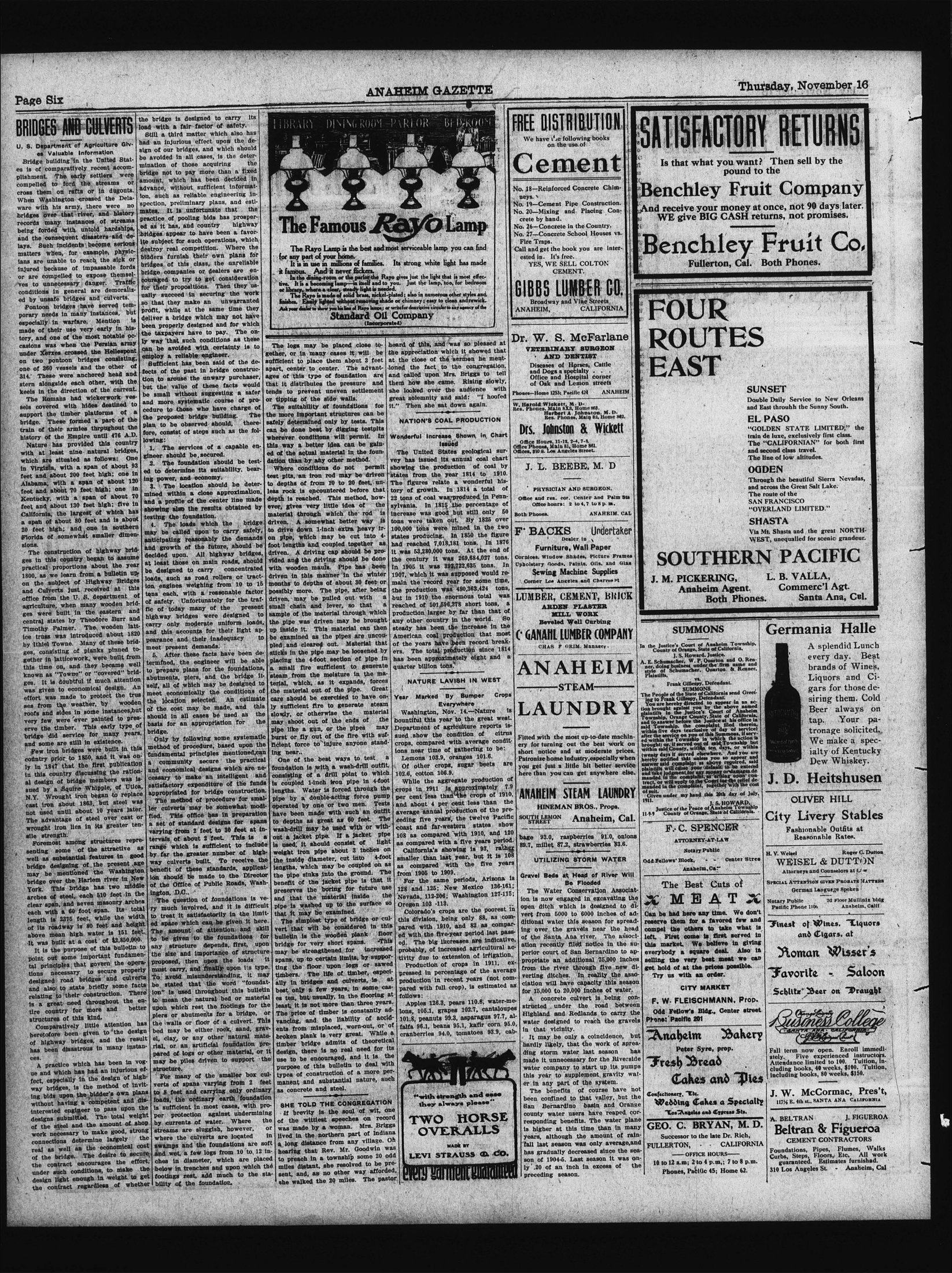
Searchable text
BRIDGES AND CULVERTS
U. S. Department of Agriculture Gives Valuable Information
Bridge building in the United States is of comparatively recent accomplishment. The early settlers were compelled to ford the streams or cross them on rafts or in dugouts. When Washington crossed the Delaware with his army, there were no bridges over that river, and history records many instances of streams being forced with untold hardships, and the consequent disasters and delays. Such incidents become serious matters when, for example, physicians are unable to reach the sick or injured because of impassable fords or are compelled to expose themselves to unnecessary danger. Traffic conditions in general are demoralized by unsafe bridges and culverts.
Pontoon bridges have served temporary needs in many instances, but especially in warfare. Mention is made of their use very early in history, and one of the most notable occasions was when the Persian army under Xerxes crossed the Hellespont on two pontoon bridges consisting, one of 360 vessels and the other of 314. These were anchored head and stern alongside each other, with the keels in the direction of the current.
The Romans had wickerwork vessels covered with hides destined to support the timber platforms of a bridge. These formed a part of the train of their armies throughout the history of the Empire until 476 A.D.
Nature has provided this country with at least nine natural bridges, which are situated as follows: One in Virginia, with a span of about 93 feet and about 290 feet high; one in the bridge is designed to carry its load with a fair factor of safety.
Still a third matter which also has had an injurious effect upon the design of our bridges, and which should be avoided in all cases, is the determination of those acquiring the bridge not to pay more than a fixed amount, which has been decided in advance, without sufficient information, such as reliable engineering inspection, preliminary plans, and estimates. It is unfortunate that the practice of pooling bids has prospered as it has, and country highway bridges appear to have been a favorite subject for such operations, which destroy real competition. Where the bidders furnish their own plans for bridges of this class, the unreliable bridge companies or dealers are encouraged to try to get consideration for their propositions. Then they usually succeed in securing the work so that they make an unwarranted profit, while at the same time they deliver a bridge which may not have been properly designed and for which the taxpayers have to pay. The only way that such conditions as these can be avoided with certainty is to employ a reliable engineer.
Sufficient has been said of the defects of the past in bridge construction to arouse the unwary purchaser, but the value of these facts would be small without suggesting a safer and more systematic course of procedure to those who have charge of the proposed bridge building. The plan to be observed should, therefore, consist of steps such as the following:
1. The services of a capable engineer should be secured.
2. The foundation should be tested to determine its suitability, bearing
These were anchored head and stern alongside each other, with the keels in the direction of the current.
The Romans had wickerwork vessels covered with hides destined to support the timber platforms of a bridge. These formed a part of the train of their armies throughout the history of the Empire until 476 A.D.
Nature has provided this country with at least nine natural bridges, which are situated as follows: One in Virginia, with a span of about 93 feet and about 200 feet high; one in Alabama, with a span of about 120 feet and about 70 feet high; one in Kentucky, with a span of about 70 feet and about 130 feet high; five in California, the largest of which has a span of about 80 feet and is about 20 feet high; and one in southern Florida of somewhat smaller dimensions.
The construction of highway bridges in this country began to assume practical proportions about the year 1800, as we learn from a bulletin upon the subject of Highway Bridges and Culverts just received at this office from the U.S. department of agriculture, when many wooden bridges were built in the eastern and central states by Theodore Burr and Timothy Palmer. The wooden lattice truss was introduced about 1820 by Ithiel Towne. Many of these bridges, consisting of planks pinned together in latticework, were built from this time on, and they became well known as "Towne" or "covered" bridges. It is doubtful if much attention was given to economical design. An effort was made to protect the trusses from the weather, by wooden roofs and sides in some instances, but very few were ever painted to preserve the timber. This early type of bridge did service for many years, and some are still in existence.
Few iron bridges were built in this country prior to 1850, and it was only in 1847 that the first publication in this country discussing the rational design of bridge members was issued by a Squire Whipple, of Utica, N.Y. Wrought iron began to replace cast iron about 1863, but steel was not used until about 10 years later. The advantage of steel over cast or wrought iron lies in its greater tensile strength.
Foremost among structures representing some of the attractive as well as substantial features in good bridge designing of the present age may be mentioned the Washington bridge over the Harlem river in New York. This bridge has two middle arches of steel, each 510 feet in the tion to arouse the unwary purchaser, but the value of these facts would be small without suggesting a safer and more systematic course of procedure to those who have charge of the proposed bridge building. The plan to be observed should therefore, consist of steps such as the following:
1. The services of a capable engineer should be secured.
2. The foundation should be tested to determine its suitability, bearing power, and economy.
3. The location should be determined within a close approximation, and a profile of the center line made showing also the results obtained by testing the foundation.
4. The loads which the bridge may be called upon to carry safely, anticipating reasonably the demands and growth of the future, should be decided upon. All highway bridges, at least those on main roads, should be designed to carry concentrated loads, such as road rollers or traction engines weighing from 10 to 15 tons each, with a reasonable factor of safety. Unfortunately for the traffic of today many of the present highway bridges were designed to carry only moderate uniform loads, and this accounts for their light appearance and their inadequacy to meet present demands.
5. After these facts have been determined, the engineer will be able to prepare plans for the foundations, abutments, piers, and the bridge itself, all of which may be designed to meet economically the conditions of the location selected. An estimate of the cost may be made, and this should in all cases be used as the basis for an appropriation for the bridge.
Only by following some systematic method of procedure, based upon the fundamental principles mentioned can a community secure the practical and economical designs which are necessary to make an intelligent and satisfactory expenditure of the funds appropriated for bridge construction.
The method of procedure for smaller culverts may be somewhat modified. This office has in preparation a set of standard designs for spans varying from 2 feet to 30 feet at intervals of about 2 feet. This is a range which is sufficient to include by far the greater number of highway culverts built. To receive the benefit of these standards, application should be made to the Director of the Office of Public Roads, Washington, D.C..
The suitability of foundations for more important structures safely determined only by tests can be done best by digging wherever conditions will permit this way a better idea can be added of the actual material in formation than by any other method.
Where conditions do not test pits, an iron rod may be to depths of from 10 to 20 less rock is encountered below depth is reached. This meets ever, gives very little idea material through which the driven. A somewhat better to drive down 1-inch extra on pipe, which may be cut foot lengths and coupled together driven. A driving cap should vided and the driving should with wooden mauls. Pipe driven in this manner in months to depths of about possibly more. The pipe, as driven, may be pulled out small chain and lever, so sample of the material through the pipe was driven may be up inside it. This material be examined as the pipes applied and cleared out. Maxticks in the pipe may be placed at the four sections a small fire sufficient to steam from the moisture in material, which, as it expands the material out of the pipe care should be exercised to ly sufficient fire to generate slowly, or otherwise the pipe may shoot out of the end pipe like a gun, or the plumb burst or fly out of the firefficient force to injure any ing near...
One of the best ways to foundation is with a wash-consisting of a drill point is coupled 1-inch iron pipe lengths. Water is forced to pipe by a double-acting operated by one or two m have been made with such depths as great as 60 wash-drill may be used without a jacket pipe. If a jacket is used, it should consist weight iron pipe about 3 inches inside diameter, cut into lengths, which may be coated the pipe sinks into the gut benefit of the jacket pipe preserves the boring for and that the material in
cast iron about 1863, but steel was not used until about 10 years later. The advantage of steel over cast or wrought iron lies in its greater tensile strength.
Foremost among structures representing some of the attractive as well as substantial features in good bridge designing of the present age may be mentioned the Washington bridge over the Harlem river in New York. This bridge has two middle arches of steel, each 510 feet in the clear span, and seven masonry arches each with a 60 foot span. Its total length is 2375 feet, while the width of its roadway is 80 feet and height above mean high water is 151 feet. It was built at a cost of $2,850,000.
It is the purpose of this bulletin to point out some important fundamental principles that govern the operations necessary to secure properly designed road bridges and culverts and also to state briefly some facts relating to their construction. There is a great need throughout the entire country for more and better structures of this kind.
Comparatively little attention has heretofore been given to the design of highway bridges, and the result has been disastrous in many instances.
A practice which has been in vogue and which has had an injurious effect, especially in the design of highway bridges, is the method of inviting bids upon the bidder's own plans without having a competent and disinterested engineer to pass upon the designs submitted. The total weight of the steel and the amount of shop work necessary to make good, strong connections determine largely the real as well as the economical cost of the bridge. The desire to secure the contract encourages the effort, under such conditions, to make the design light enough in weight to get the contract regardless of whether
The method of procedure for smaller culverts may be somewhat modified. This office has in preparation a set of standard designs for spans varying from 2 feet to 30 feet at intervals of about 2 feet. This is a range which is sufficient to include by far the greater number of highway culverts built. To receive the benefit of these standards, application should be made to the Director of the Office of Public Roads, Washington, D.C.
The question of foundations is very much involved, and it is difficult to treat it satisfactorily in the limited space which can be given it here. The amount of attention and skill to be given to the foundations for any structure depends, first, upon the size and importance of structure proposed, then upon the loads it must carry, and finally upon its type. To avoid misunderstanding, it may be stated that the word "foundation" is used throughout this bulletin to mean the natural bed or material upon which rest the footings for the pliers or abutments for a bridge, or the walls or floor of a culvert. This bed may be either rock, sand, gravel, clay, or any other natural material, or an artificial foundation prepared of logs or other material, or it may be piles driven to support the structure.
For many of the smaller box culverts of spans varying from 2 feet to 8 feet and carrying only ordinary loads, the ordinary earth foundation is sufficient in most cases, with proper protection against undermining by currents of water. Where the streams are sluggish, however, or where the culverts are located in swamps and the foundations are soft and wet, a few logs from 10 to 12 inches in diameter, which are placed below in trenches and upon which the footings rest, add much to the stability of the foundation.
ANAHEIM GAZETTE
LIBRARY DINING ROOM PARLOR BEDROOM
The Famous Rayo Lamp
The Rayo Lamp is the best and most serviceable lamp you can find for any part of your home.
It is in use in millions of families. Its strong white light has made it famous. And it never flickers.
In the dining-room or the parlor the Rayo gives just the light that is most effective. It is a becoming lamp—in itself and to you. Just the lamp, too, for bedroom or library, where a clear, steady light is needed.
The Rayo is made of solid brass, nickel-plated; also in numerous other styles and finishes. Easily lighted without removing shade or chimney; easy to clean and rewick.
Ask your dealer to show you his line of Rayo lamps; or write for descriptive circular to any agency of the Standard Oil Company (Incorporated)
FREE DISTRIBUTION
We have the following books on the use of Cement
No. 18—Reinforced Concrete Chimneys.
No. 19—Cement Pipe Construction.
No. 20—Mixing and Placing Concrete by hand.
No. 26—Concrete in the Country.
No. 27—Concrete School Houses vs. Fire Traps.
Call and get the book you are interested in. It's free.
YES, WE SELL COLTON CEMENT.
GIBBS LUMBER CO.
Broadway and Vine Streets
ANAHEIM, CALIFORNIA
Dr. W. S. McFarlane
VETERINARY SURGEON AND DENTIST
Diseases of Horses, Cattle and Dogs a specialty ... Office and Hospital corner of Oak and Lemon streets
Phones—Home 1253; Pacific 424 ANAHEIM
W. Harold Wickett, M.D.
Res. Phones, Main 8X8, Home 863.
Herbert A. Johnston, M.D.
Res. Phones, Main 82, Home 862.
Drs. Johnston & Wickett
Office Hours, 11-12, 2-4, 7-8.
Office Phones, Main 81, Home 861.
Offices, 310 S. Los Angeles Street.
J. L. BEEBE, M. D
NATION'S COAL PRODUCTION
Wonderful Increase Shown in Chart Issued
The United States geological survey has issued its annual coal chart showing the production of coal by states from the year 1814 to 1910.
The figures relate a wonderful history of growth. In 1814 a total of 22 tons of coal was produced in Pennsylvania. In 1815 the percentage of increase was good but still only 50 tons were taken out. By 1825 over 100,000 tons were mined in the two states producing. In 1850 the figure had reached 7,018,181 tons. In 1876 it was 53,280,000 tons. At the end of the century it was 269,684,027 tons. In 1905 it was 392,722,635 tons. In 1907, which it was supposed would remain the record year for some time, the production was 480,363,424 tons, but in 1910 the enormous total was reached of 501,596,378 short tons, a production larger by far than that of any other country in the world. So steady has been the increase in the American coal production that most of the years have been record breakers. The total production since 1814 has been approximately eight and a quarter billion tons.
NATURE LAVISH IN WEST
Year Marked By Bumper Crops Everywhere
Washington, Nov. 14.—Nature is bountiful this year to the great west. Department of agriculture reports issued show the condition of citrus crops, compared with average conditions near time of gathering to be:
Lemons 103.9, oranges 101.6.
Of other crops, sugar beets are 102.6, cotton 106.9.
While the aggregate production of crops in 1911 is approximately 7.9 per cent less than the crops of 1910, and about 4 per cent less than the average annual production of the preceding five years, the twelve Pacific coast and far-western states show 108 as compared with 1910, and 120 as compared with a five years period.
California's showing is 93, rather smaller than last year, but it is 108 as compared with the five years from 1905 to 1909.
For the same periods, Arizona is 128 and 125; New Mexico 136-161; Nevada, 112-206; Washington 127-115;
Office and Hospital corner of Oak and Lemon streets
Phones—Home 1253; Pacific 424 ANAHEIM
W. Harold Wickett, M.D.
Res. Phones, Main 8X8, Home 863.
Herbert A. Johnston, M.D.
Res. Phones, Main 82, Home 862.
Drs. Johnston & Wickett
Office Hours, 11-12, 2-4, 7-8.
Office Phones, Main 81, Home 861.
Offices, 310 S. Los Angeles Street.
J. L. BEEBE, M. D
PHYSICIAN AND SURGEON.
Office and res. cor. Center and Palm Sts
Office hours: 2 to 4,7 to 8 p.m.
Both Phones.
ANAHEIM CAL
F' BACKS Undertaker
Dealer in Furniture, Wall Paper
Cornices, Window Shades, Picture Frames
Upholstery Goods, Paints, Oils, and Glas
Sewing Machine Supplies
Corner Los Angeles and Charleston
LUMBER, CEMENT, BRICK
ARDEN PLASTER
MILL WORK
Beveled Well Curbing
C GANAHL LUMBER COMPANY
CHAS F GRIM. Manager.
ANAHEIM
STEAM
LAUNDRY
Fitted with the most up-to-date machinery for turning out the best work on short notice and at moderate prices. Patronize home industry, especially when you get just a little bit better service here than you can get anywhere else.
ANAHEIM STEAM LAUNDRY
HINEMAN BROS., Props.
SOUTH LEMON
Anaheim, Cal.
bage 93.0, raspberries 91.0, onions
89.7, millet 87.2, strawberries 83.6.
UTILIZING STORM WATER
Gravel Beds at Head of River Will Be Flooded
The Water Conservation Association is now engaged in excavating the
The benefit of the jacket pipe is that it preserves the boring for future use and that the material inside the pipe is washed up to the surface so that it may be examined.
The simplest type of bridge or culvert that will be considered in this bulletin is the wooden plank floor bridge for very short spans. This may be strengthened for increased spans, up to certain limits, by supporting the floor upon logs or sawed numbers. The life of timber, especially in bridges and culverts, is at least only a few years, in some cases ten, but usually, in the flooring at least, it is not more than three years. The price of timber is constantly advancing, and the liability of accidents from misplaced, worn-out, or broken planks is very great. While a timber bridge admits of theoretical design, there is no real need for its use to be encouraged, and it is the purpose of this bulletin to deal with types of construction of a more permanent and substantial nature, such as concrete and steel.
SHE TOLD THE CONGREGATION
If brevity is the soul of wit, one of the wittiest speeches on record was made by a woman. Mrs. Briggs lived in the northern part of Indiana a long distance from any village. Oh hearing that Rev. Mr. Goodwin was to preach in a township some 20 odd miles distant, she resolved to be present, and, as no other way afforded, she walked the 20 miles. The pastor
"with strength and ease they always please"
TWO HORSE OVERALLS
MADE BY
LEVI STRAUSS & CO.
Thursday, November 16
SATISFACTORY RETURNS
Is that what you want? Then sell by the pound to the
Benchley Fruit Company
And receive your money at once, not 90 days later.
WE give BIG CASH returns, not promises.
Benchley Fruit Co,
Fullerton, Cal. Both Phones.
FOUR ROUTES EAST
SUNSET
Double Daily Service to New Orleans and East throuhh the Sunny South.
EL PASO
"GOLDEN STATE LIMITED," the train de luxe, exclusively first class.
The "CALIFORNIAN" for both first and second class travel.
The line of low altitudes.
OGDEN
SUNSET
Double Daily Service to New Orleans and East through the Sunny South.
EL PASO
"GOLDEN STATE LIMITED," the train de luxe, exclusively first class.
The "CALIFORNIAN" for both first and second class travel.
The line of low altitudes.
OGDEN
Through the beautiful Sierra Nevadas, and across the Great Salt Lake.
The route of the SAN FRANCISCO "OVERLAND LIMITED."
SHASTA
Via Mt. Shasta and the great NORTH-WEST, unequalled for scenic grandeur.
SOUTHERN PACIFIC
J. M. PICKERING,
Anaheim Agent.
Both Phones.
L. B. VALLA,
Commerc'l Agt.
Santa Ana, Cal.
SUMMONS
In the Justice's Court of Anaheim Township, County of Orange, State of California,
J. S. Howard, Justice.
A. E. Schumacher, W. P. Quarton and O. Renner, doing business under the firm name and style of Schumacher, Quarton & Renner, Plaintiffs,
vs.
Frank Gillespy, Defendant.
SUMMONS
The People of the State of California send Greeting to Frank Gillespy, Defendant.
You are hereby directed to appear in an action brought against you by the above named plaintiffs in the Justice's Court of Anaheim Township, Orange County, State of California, and to answer before the Justice at his office in said Township, the complaint filed therein, within five days (exclusive of day of service) after the service on you of this Summons, if served within the Township in which the action is brought; or if served out of said Township but within said County, within ten days, or within twenty days if served elsewhere. And you are hereby notified that unless you so appear and answer said complaint as above required, said plaintiffs will cause your default to be entered and take judgment for any money or damages de manded in the complaint, as arising upon contract, or will apply to the Court for the relief demanded in the complaint, together with the cost of suit.
Given under my hand this 20th day of July, 1911.
J. S. HOWARD,
Justice of the Peace of Anaheim Township
County of Orange, State of California.
F. C. SPENCER
ATTORNEY-AT-LAW
Notary Public
Odd Fellows' Block,
Center Street
Anaheim, Cal.
The Best Cuts of MEAT
Germania Halle
A splendid Lunch every day. Best brands of Wines, Liquors and Cigars for those desiring them. Cold Beer always on tap. Your patronage solicited. We make a specialty of Kentucky Dew Whiskey.
J. D. Heitshusen
OLIVER HILL
City Livery Stables
Fashionable Outfits at Reasonable Rates.
H. V. Weisel
Roger C. Dutton
WEISEL & DUTTON
Attorneys and Counselors at Law
SPECIAL ATTENTION GIVEN PROBATE MATTERS
German Language Spoken
F. C. SPENCER
ATTORNEY-AT-LAW
Notary Public
Odd Fellows' Block, Center Street
Anaheim, Cal.
The Best Cuts of MEAT
Can be had here any time. We don't reserve them for a favored few and compel the others to take what is left. First come is first served in this market. We believe in giving everybody a square deal. Also in selling the very best meat we can get hold of at the prices possible.
Try us with an order.
CITY MARKET
F. W. FLEISCHMANN, Prop.
Odd Fellow's Bldg., Center street
Phone: Pacific 201
Anaheim Bakery
Peter Syre, prop.
Fresh Bread
Cakes and Pies
Confectionery, Etc.
Wedding Cakes a Specialty
Los Angeles and Express Sts.
GEO. C. BRYAN, M. D.
Successor to the late Dr. Rich,
FULLERTON, CALIFORNIA
OFFICE HOURS—
10 to 12 a.m; 2 to 4 p.m.; 7 to 8 p.m.
Phones, Pacific 45; Home 62.
OLIVER HILL
City Livery Stables
Fashionable Outfits at Reasonable Rates.
H. V. Weisel Roger G. Dutton
WEISEL & DUTTON
Attorneys and Counselors at Law
SPECIAL ATTENTION GIVEN PROBATE MATTERS
German Language Spoken
Notary Public 2d Floor Mullinix bldg
Pacific Phone 1106 Anaheim, Calif
Finest of Wines, Liquors and Tigars, at
Roman Wisser's
Favorite - Saloon
Schlitz Beer on Draught
Business College
Fall term now open. Enroll immediately. Five experienced instructors.
Attendance limited to 100. Tuition, including books, 40 weeks, $100. Tuition, including books, 80 weeks, $150.
J. W. McCormac, Pres't,
117½ E. 4th st., SANTA ANA CALIFORNIA
A. BELTRAN J. FIGUEROA
Beltran & Figueroa
CEMENT CONTRACTORS
Foundations, Pipes, Flumes, Walks Curbs, Steps, Floors, Etc. All work guaranteed. Estimates furnished.
310 Los Angeles St. - Anaheim, Cal