anaheim-gazette 1911-11-02
Scanned page
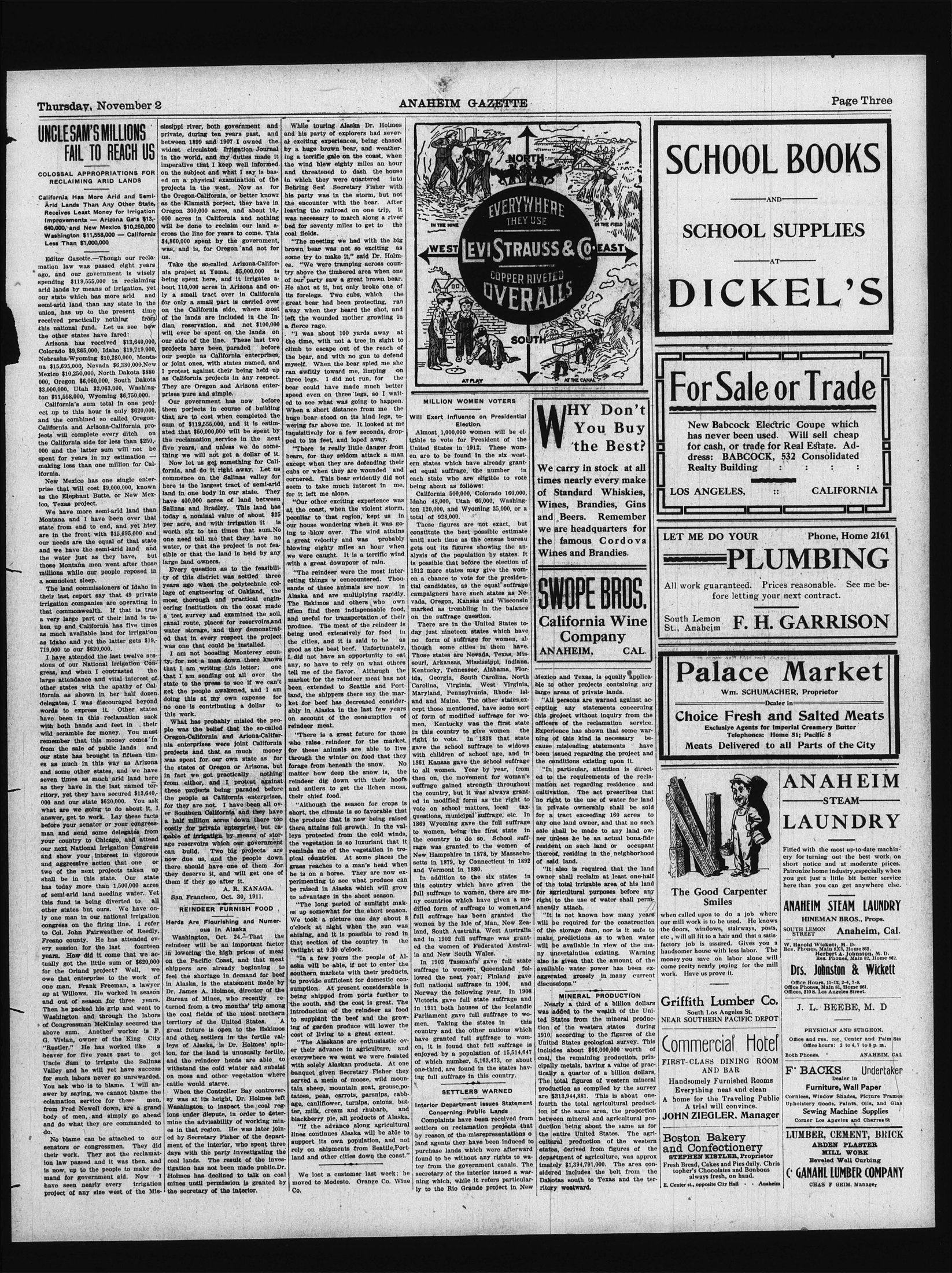
Searchable text
UNCLE SAM'S MILLIONS FAIL TO REACH US
COLOSSAL APPROPRIATIONS FOR RECLAIMING ARID LANDS
California Has More Arid and Semi-Arid Lands Than Any Other State, Receives Least Money for Irrigation Improvements — Arizona Gets $13,-640,000, and New Mexico $10,250,000 Washington $11,558,000 — California Less Than $1,000,000
Editor Gazette.—Though our reclamation law was passed eight years ago, and our government is wisely spending $119,555,000 in reclaiming arid lands by means of irrigation, yet our state which has more arid and semi-arid land than any state in the union, has up to the present time received practically nothing from this national fund. Let us see how the other states have fared:
Arizona has received $13,640,000, Colorado $9,865,000, Idaho $19,719,000, Nebraska-Wyoming $10,280,000, Montana $15,695,000, Nevada $6,380,000, New Mexico $10,250,000, North Dakota $880,000, Oregon $6,060,000, South Dakota $3,000,000, Utah $2,063,000, Washington $11,558,000, Wyoming $6,750,000.
California's sum total in one project up to this hour is only $620,000, and the combined so called Oregon-California and Arizona-California projects will complete every ditch on the California side for less than $250,-000 and the latter sum will not be spent for years in my estimation — making less than one million for California.
sissippi river, both government and private, during ten years past, and between 1899 and 1907 I owned the widest circulated Irrigation Journal in the world, and my duties made it imperative that I keep well informed on the subject and what I say is based on a physical examination of the projects in the west. Now as for the Oregon-California, or better knowr as the Klamath porject, they have in Oregon 300,000 acres, and about 10,-000 acres in California and nothing will be done to reclaim our land across the line for years to come. This $4,860,000 spent by the government, was, and is, for Oregon and not for us.
Take the so-called Arizona-California project at Yuma. $5,000,000 is being spent here, and it irrigates about 110,000 acres in Arizona and only a small tract over in California for only a small part is carried over on the California side, where most of the lands are included in the Indian reservation, and not $100,000 will ever be spent on the lands on our side of the line. These last two projects have been paraded before our people as California enterprises, or joint ones, with states named, and I protest against their being held up as California projects in any respect. They are Oregon and Arizona enterprises pure and simple.
Our government has now before them porjects in course of building that are to cost when completed the sum of $119,555,000, and it is estimated that $50,000,000 will be spent by the reclamation service in the next five years, and unless we do something we will not get a dollar of it.
Now let us get something for California, and do it right away. Let us while touring Alaska and his party of explorers exciting experiences by a huge brown bear ing a terrific gale on the wind blew eighty feet and threatened to die in which they were quenched Behring Sea. Secretly his party was in the encounter with the leaving the railroad owed was necessary to mar bed for seventy miles of coal fields.
"The meeting we had brown bear was not some try to make it," es. "We were trampled try above the timbered of our party saw a great He shot at it, but only its forelegs. Two cub great bear had been away when they heard left the wounded mother a fierce rage.
"I was about 100 yr the time, with not a climb to escape out of the bear, and with no myself. When the bear ran swiftly toward me three legs. I did not bear could have made speed even on three ed to see what was go When a short distance huge bear stood on it wering far above me. Inquisitively for a few ped to its feet, and lo"
"There is really little bears, for they seldom except when they are cubs or when they are
California's sum total in one project up to this hour is only $620,000, and the combined so called Oregon-California and Arizona-California projects will complete every ditch on the California side for less than $250,000 and the latter sum will not be spent for years in my estimation — making less than one million for California.
New Mexico has one single enterprise that will cost $9,000,000, known as the Elephant Butte, or New Mexico, Texas project.
We have more semi-arid land than Montana and I have been over that state from end to end, and yet htey are in the front with $15,695,000 and our needs are the equal of that state and we have the semi-arid land and the water just as they have, but those Montana men went after those millions while our people reposed in a somnolent sleep.
The land commissioners of Idaho in their last report say that 49 private irrigation companies are operating in that commonwealth. If that is true a very large part of their land is taken up and California has five times as much available land for irrigation as Idaho and yet the latter gets $19,719,000 to our $620,000.
I have attended the last twelve sessions of our National Irrigation Congress, and when I contrasted the large attendance and vital interest of other states with the apathy of California as shown in her half dozen delegates, I was discouraged beyond words to express it. Other states have been in this reclamation sack with both hands and feet in their wild scramble for money. You must remember that this money comes in from the sale of public lands and our state has brought in fifteen times as much in this way as Arizona and some other states, and we have seven times as much arid land here as they have in the last named territory, yet they have secured $13,640,000 and our state $620,000. You ask what are we going to do about it. I answer, get to work. Lay these facts before your senator or your congressman and send some delegates from your country to Chicago, and attend our next National Irrigation Congress and show your interest in vigorous and aggressive action that one or two of the next projects taken up shall be in this state. Our state has today more than 1,500,000 acres of semi-arid land needing water. Yet as California projects in any respect. They are Oregon and Arizona enterprises pure and simple.
Our government has now before them porjects in course of building that are to cost when completed the sum of $119,555,000, and it is estimated that $50,000,000 will be spent by the reclamation service in the next five years, and unless we do something we will not get a dollar of it.
Now let us get something for California, and do it right away. Let us commence on the Salinas valley for here is the largest tract of semi-arid land in one body in our state. They have 400,000 acres of land between Salinas and Bradley. This land has today a nominal value of about $25 per acre, and with irrigation it is worth six to ten times that sum.No one need tell me that they have no water, or that the project is not feasible or that the land is held by any large land owners.
Every question as to the feasibility of this district was settled three years ago when the polytechnic college of engineering of Oakland, the most thorough and practical engineering institution on the coast made a test survey and examined the soil, canal route, places for reservoirs,and water storage, and they demonstrated that in every respect the project was one that could be installed.
I am not boosting Monterey county, for not a man down there knows that I am writing this letter; one that I am sending out all over the state to the press to see if we can't get the people awakened, and I am doing this at my own expense for no one is contributing a dollar to this work.
What has probably misled the people was the belief that the so-called Oregon-California and Ariona-California enterprises were joint California projects and that as much money was spent for our own state as for the states of Oregon or Arizona, but in fact we got practically nothing from either, and I protest against these projects being paraded before the people as California enterprises, for they are not. I have been all over Southern California and they have a half million acres down there too costly for private enterprise, but capable of irrigatign by means of storage reservoirs which our government can build. Two big projects are now due us, and the people down there should have one of them for they deserve it, and will get one of them if they go after it.
A. R. KANAGA.
San Francisco, Oct. 30, 1911.
000 and our state $620,000. You ask what are we going to do about it. I answer, get to work. Lay these facts before your senator or your congressman and send some delegates from your country to Chicago, and attend our next National Irrigation Congress and show your interest in vigorous and aggressive action that one or two of the next projects taken up shall be in this state. Our state has today more than 1,500,000 acres of semi-arid land needing water. Yet this fund is being diverted to all other states but ours. We have only one man in our national irrigation congress on the firing line. I refer to Col. John Fairweather of Reedly, Fresno county. He has attended every session for the last fourteen years. How did it come that we actually got the little sum of $620,000 for the Orland project? Well, we owe that enterprise to the work of one man. Frank Freeman, a lawyer up at Willows. He worked in season and out of season for three years. Then he packed his grip and went to Washington and through the labors of Congressman McKinlay secured the above sum. Another worker is F. G. Vivian, owner of the King City "Rustler." He has worked like a beaver for five years past to get Uncle Sam to irrigate the Salinas Valley and he will yet have success for such labors never go unrewarded. You ask who is to blame. I will answer by saying, we cannot blame the eclamation service for these men, from Fred Newell down, are a grand body of men, and simply go ahead and do what they are commanded to do.
No blame can be attached to our senators or congressmen. They did their work. They got the reclamation law passed and it was then, and is now, up to the people to make demand for government aid. Now I have seen nearly every irrigation project of any size west of the Mis-
"Although the seas short, the climate is no there attains full growth protected from the vegetation is so reminds me of the vical countries. At grass reaches to a m he is on a horse. The perimenting to see w be raised in Alaska to advantage in the s
"The long period es up somewhat for We took a picture o'clock at night wh shining, and it is po that section of the twilight at 9:30 o'clock.
"In a few years thaska will be able, if southern markets wish to provide sufficient sumption. At present being shipped from the south, and the introduction of the to supplant the bee ing of garden produce cost of living to a
"The Alaskans are er their advance in everywhere we went with solely Alaskan y banquet given Secrete served a menu of m tain sheep, mountain tatoes, peas, carrots age, cauliflower, tur ter, milk, cream an blackberry pie, all pr
"If the advance al lines continues Alaska support its own pop rely on shipments f land and other cities."
We lost a custom moved to Modesto. Co.
While touring Alaska Dr. Holmes and his party of explorers had several exciting experiences, being chased by a huge brown bear, and weathering a terrific gale on the coast, when the wind blew eighty miles an hour and threatened to dash the house in which they were quartered into Behring Sea. Secretary Fisher with his party was in the storm, but not the encounter with the bear. After leaving the railroad on one trip, it was necessary to march along a river bed for seventy miles to get to the coal fields.
"The meeting we had with the big brown bear was not so exciting as some try to make it," said Dr. Holmes. "We were tramping across country above the timbered area when one of our party saw a great brown bear. He shot at it, but only broke one of its forelegs. Two cubs, which the great bear had been protecting, ran away when they heard the shot, and left the wounded mother growling in a fierce rage.
"I was about 100 yards away at the time, with not a tree in sight to climb to escape out of the reach of the bear, and with no gun to defend myself. When the bear spied me she ran swiftly toward me, limping on three legs. I did not run, for the bear could have made much better speed even on three legs, so I waited to see what was going to happen. When a short distance from me the huge bear stood on its hind legs, towering far above me. It looked at me inquisitively for a few seconds, dropped to its feet, and loped away.
"There is really little danger from bears, for they seldom attack a man except when they are defending their cubs or when they are wounded and..."
three legs. I did not run, for the bear could have made much better speed even on three legs, so I waited to see what was going to happen. When a short distance from me the huge bear stood on its hind legs, towering far above me. It looked at me inquisitively for a few seconds, dropped to its feet, and loped away.
"There is really little danger from bears, for they seldom attack a man except when they are defending their cubs or when they are wounded and cornered. This bear evidently did not seem to take much interest in me, for it left me alone.
"Our other exciting experience was at the coast, when the violent storm peculiar to that region, kept us in our house wondering when it was going to blow over. The wind attains a great velocity and was probably blowing eighty miles an hour when we were caught. It is a terrific wind with a great downpour of rain.
"The reindeer were the most interesting things we encountered. Thousands of threese animals are now in Alaska and are multiplying rapidly. The Eskimos and others who own them find them indispensable food, and useful for transportation of their produce. The meat of the reindeer is being used extensively for food in the cities, and it is said to be as good as the best beef. Unfortunately, I did not have an opportunity to eat any, so have to rely on what others tell me of the flavor. Although the market for the reindeer meat has not been extended to Seattle and Portland, the shippers there say the market for beef has decreased considerably in Alaska in the last few years on account of the consumption of reindeer meat.
"There is a great future for those who raise reindeer for the market, for these animals are able to live through the winter on food that they forage from beneath the snow. No matter how deep the snow is, the reindeer dig down with their hoofs and antlers to get the lichen moss, their chief food.
"Although the season for crops is short, the climate is so favorable that the produce that is now being raised there attains full growth. In the valleys protected from the cold winds, the vegetation is so luxuriant that it reminds me of the vegetation in tropical countries. At some places the grass reaches to a man's head when he is on a horse. They are now experimenting to see what produce can be raised in Alaska which will grow to advantage in the short season."
MILLION WOMEN VOTERS
Will Exert Influence on Presidential Election
Almost 1,000,000 women will be eligible to vote for President of the United States in 1912. These women are to be found in the six western states which have already granted equal suffrage, the number in each state who are eligible to vote being about as follows:
California 500,000, Colorado 160,000, Idaho 48,000, Utah 65,000, Washington 120,000, and Wyoming 35,000, or a total of 928,000.
These figures are not exact, but constitute the best possible estimate until such time as the census bureau gets out its figures showing the analysis of the population by states. It is possible that before the election of 1912 more states may give the women a chance to vote for the presidential candidates, as the equal suffrage campaigners have such states as Nevada, Oregon, Kansas and Wisconsin marked as trembling in the balance on the suffrage question.
There are in the United States today just nineteen states which have no form of suffrage for women, although some cities in them have. Those states are Nevada, Texas, Missouri, Arkansas, Mississippi, Indiana, Kentucky, Tennessee, Alabama, Florida, Georgia, South Carolina, North Carolina, Virginia, West Virginia, Maryland, Pennsylvania, Rhode Island and Maine. The other states except those mentioned have some sort of form of modified suffrage for women. Kentucky was the first state in this country to give women the right to vote. In 1838 that state gave the school suffrage to widows with children of school age, and in 1861 Kansas gave the school suffrage to all women. Year by year, from then on, the movement for woman's suffrage gained strength throughout the country, but it was always granted in modified form as the right to vote on school matters, local tax questions, municipal suffrage, etc. In 1869 Wyoming gave the full suffrage to women, being the first state in the country to do so. School suffrage was granted to the women of New Hampshire in 1878, by Massachusetts in 1879, by Connecticut in 1892 and Vermont in 1880.
In addition to the six states in this country which have given the full suffrage to women, there are many other states which have given the full suffrage to women.
WHY Don’t You Buy the Best?
We carry in stock at all times nearly every make of Standard Whiskies, Wines, Brandies, Gins and Beers. Remember we are headquarters for the famous Cordova Wines and Brandies.
SWOPE BROS.
California Wine Company
ANAHEIM,
CAL.
Mexico and Texas, is equally applicable to other projects containing any large areas of private lands.
"All persons are warned against accepting any statements concerning this project without inquiry from the officers of the reclamation service. Experience has shown that some warning of this kind is necessary because misleading statements have been issued regarding the project and the conditions existing upon it.
"In particular, attention is directed to the requirements of the reclamation act regarding residence and cultivation. The act prescribes that no right to the use of water for land in private ownership shall be sold for a tract exceeding 160 acres to any one land owner, and that no such sale shall be made to any land owner unless he be an actual bona-fide resident on such land or occupant thereof, residing in the neighborhood of said land.
"It also is required that the land owner shall reclaim at least one-half of the total irrigable area of his land for agricultural purposes before any right to use of water shall perm."
"Although the season for crops is short, the climate is so favorable that the produce that is now being raised there attains full growth. In the valleys protected from the cold winds, the vegetation is so luxuriant that it reminds me of the vegetation in tropical countries. At some places the grass reaches to a man's head when he is on a horse. They are now experimenting to see what produce can be raised in Alaska which will grow to advantage in the short season.
"The long period of sunlight makes up somewhat for the short season. We took a picture one day about 8 o'clock at night when the sun was shining, and it is possible to read in that section of the country in the twilight at 9:30 o'clock.
"In a few years the people of Alaska will be able, if not to enter the southern markets with their products, to provide sufficient for domestic consumption. At present considerable is being shipped from ports further to the south, and the cost is great. The introduction of the reindeer as food to supplant the beef and the growing of garden produce will lower the cost of living to a great extent.
"The Alaskans are enthusiastic over their advance in agriculture, and everywhere we went we were feasted with solely Alaskan products. At one banquet given Secretary Fisher they served a menu of moose, wild mountain sheep, mountain goat, grouse, potatoes, peas, carrots, parsnips, cabbage, cauliflower, turnips, onions, butter, milk, cream and rhubarb, and blackberry pie, all products of Alaska.
"If the advance along agricultural lines continues Alaska will be able to support its own population, and not rely on shipments from Seattle, Portland and other cities down the coast."
We lost a customer last week; he moved to Modesto. Orange Co. Wine Co."
SCHOOL BOOKS
AND
SCHOOL SUPPLIES
AT
DICKEL'S
For Sale or Trade
New Babcock Electric Coupe which has never been used. Will sell cheap for cash, or trade for Real Estate. Address: BABCOCK, 532 Consolidated Realty Building
For Sale or Trade
New Babcock Electric Coupe which has never been used. Will sell cheap for cash, or trade for Real Estate. Address: BABCOCK, 532 Consolidated Realty Building : : : :
LOS ANGELES, CALIFORNIA
LET ME DO YOUR Phone, Home 2161
PLUMBING
All work guaranteed. Prices reasonable. See me before letting your next contract.
South Lemon St., Anaheim F. H. GARRISON
Palace Market
Wm. SCHUMACHER, Proprietor
Dcaler in
Choice Fresh and Salted Meats
Exclusive Agents for Imperial Creamery Butter
Telephones: Home 51; Pacific 5
Meats Delivered to all Parts of the City
ANAHEIM
STEAM
LAUNDRY
Fitted with the most up-to-date machinery for turning out the best work on short notice and at moderate prices. Patronize home industry, especially when you get just a little bit better service here than you can get anywhere else.
The Good Carpenter
The Good Carpenter Smiles
when called upon to do a job where our mill work is to be used. He knows the doors, windows, stairways, posts, etc., will all fit to a hair and that a satisfactory job is assured. Gives you a handsomer house with less labor. The money you save on labor alone will come pretty nearly paying for the mill work. Have us prove it.
Griffith Lumber Co,
South Los Angeles St.
NEAR SOUTHERN PACIFIC DEPOT
Commercial Hotel
FIRST-CLASS DINING ROOM AND BAR
Handsomely Furnished Rooms
Everything neat and clean
A home for the Traveling Public
A trial will convince.
JOHN ZIEGLER, Manager
Boston Bakery and Confectionery
STEPHEN KISTLER, Proprietor
Fresh Bread, Cakes and Pies daily. Chris topher's Chocolates and Bonbons always fresh, on hand.
E. Center st., opposite City Hall · · Anaheim
STEAM LAUNDRY
Fitted with the most up-to-date machinery for turning out the best work on short notice and at moderate prices. Patronize home industry, especially when you get just a little bit better service here than you can get anywhere else.
ANAHEIM STEAM LAUNDRY
HINEMAN BROS., Props.
SOUTH LEMON STREET
Anaheim, Cal.
W. Harold Wickett, M.D.
Res. Phones, Main 8X3, Home 863.
Herbert A. Johnston, M.D.
Res. Phones, Main 82, Home 862.
Drs. Johnston & Wickett
Office Hours: 11-12, 2-4, 7-8.
Office Phones, Main 81, Home 861.
Offices, 810 S. Los Angeles Street.
J. L. BEEBE, M.D
PHYSICIAN AND SURGEON.
Office and res. cor. Center and Palm Sts
Office hours: 2 to 4, 7 to 8 p.m.
Both Phones.
ANAHEIM, CAL
F' BACKS Undertaker
Dealer in
Furniture, Wall Paper
Cornices, Window Shades, Picture Frames
Upholstery Goods, Paints, Oils, and Glas
Sewing Machine Supplies
Corner Los Angeles and Charres St
LUMBER, CEMENT, BRICK
ARDEN PLASTER
MILL WORK
Beveled Well Curbing
C' GANAHL LUMBER COMPANY
CHAS F GRIM, Manager