anaheim-gazette 1911-10-12
Scanned page
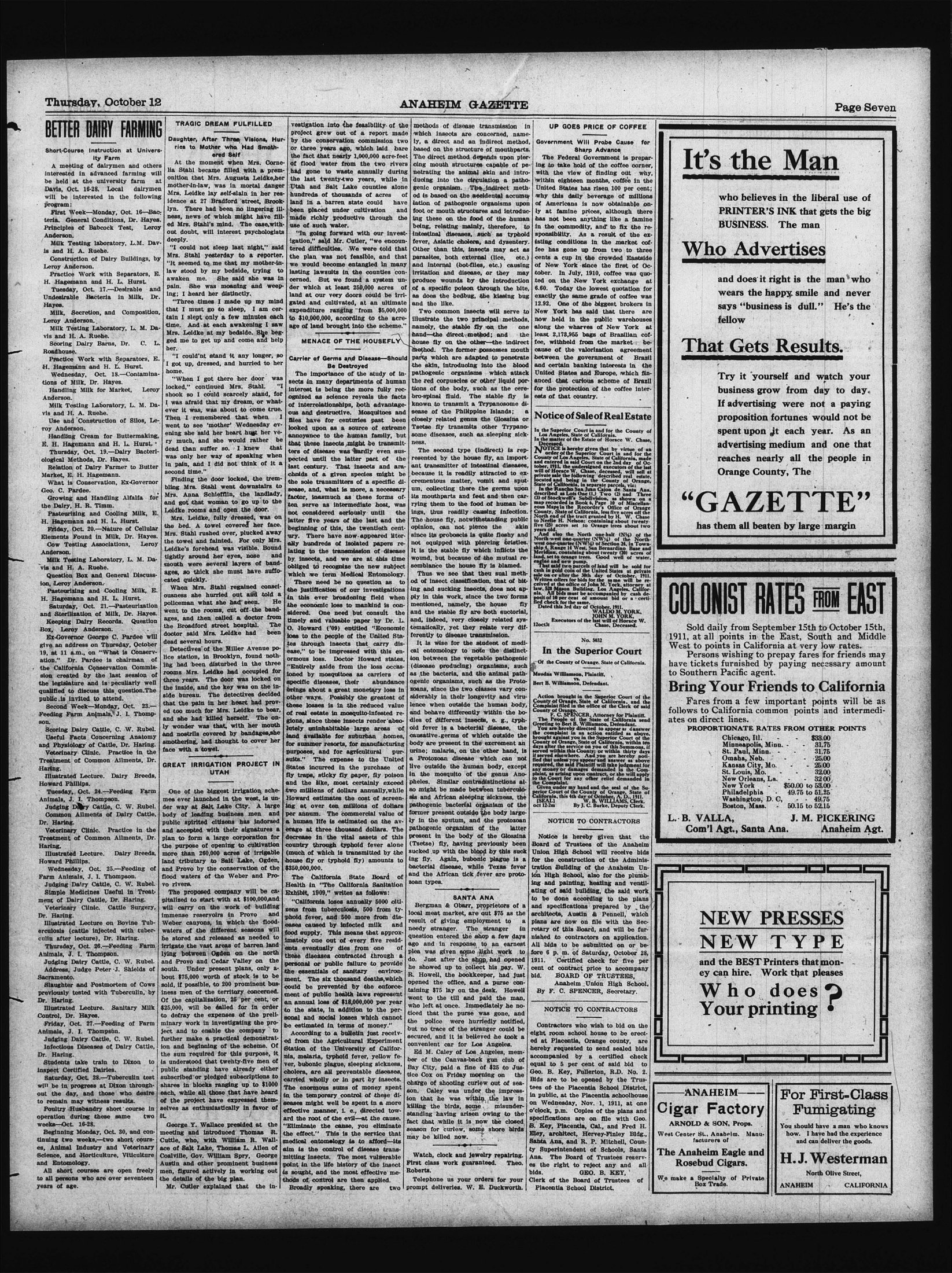
Searchable text
BETTER DAIRY FARMING
Short-Course Instruction at University Farm
A meeting of dairymen and others interested in advanced farming will be held at the university farm at Davis, Oct. 16-28. Local dairymen will be interested in the following program:
First Week—Monday, Oct. 16—Bacteria. General Conditions, Dr. Hayes. Principles of Babcock Test, Leroy Anderson.
Milk Testing laboratory, L.M. Davis and H. A. Ruehe.
Construction of Dairy Buildings, by Leroy Anderson.
Practice Work with Separators, E. H. Hagemann and H. L. Hurst.
Tuesday, Oct. 17.—Desirable and Undesirable Bacteria in Milk, Dr. Hayes.
Milk, Secretion, and Composition, Leroy Anderson.
Milk Testing Laboratory, L. M. Davis and H. A. Ruehe.
Scoring Dairy Barns, Dr. C. L. Roadhouse.
Practice Work with Separators, E. H. Hagemann and H. L. Hurst.
Wednesday, Oct. 18.—Contaminations of Milk, Dr. Hayes.
Handling Milk for Market, Leroy Anderson.
Milk Testing Laboratory, L. M. Davis and H. A. Ruehe.
Use and Construction of Silos, Leroy Anderson.
Handling Cream for Buttermaking, E. H. Hagemann and H. L. Hurst.
Thursday, Oct. 19.—Dairy Bacteriological Methods, Dr. Hayes.
Relation of Dairy Farmer to Butter Market, E. H. Hagemann.
TRAGIC DREAM FULFILLED
Daughter, After Three Visions, Hurries to Mother who Had Smothered Self
At the moment when Mrs. Cornelia Stahl became filled with a premotion that Mrs. Augusta Leidke, her mother-in-law, was in mortal danger Mrs. Leidke lay self-slain in her residence at 27 Bradford street, Brooklyn. There had been no lingering illness, news of which might have filled Mrs. Stahl's mind. The case without doubt, will interest psychologists deeply.
"I could not sleep last night," said Mrs. Stahl yesterday to a reporter.
"It seemed to me that my mother-in-law stood by my bedside, trying to awaken me. She said she was in pain. She was moaning and weeping; I heard her distinctly."
"Three times I made up my mind that I must go to sleep, I am certain I slept only a few minutes each time. And at each awakening I saw Mrs. Leidke at my bedside. She begged me to get up and come and help her."
"I couldn't stand it any longer, so I got up, dressed, and hurried to her home.
"When I got there her door was locked," continued Mrs. Stahl.
"I shook so I could scarcely stand, for I was afraid that my dream, or whatever it was, was about to come true. Then I remembered that when I went to see 'mother' Wednesday evening she said her heart hurt her very much, and she would rather be dead than suffer so. I knew that was only her way of speaking when in pain, and I did not think of it a second time."
Wednesday, Oct. 18.—Contaminations of Milk, Dr. Hayes.
Handling Milk for Market, Leroy Anderson.
Milk Testing Laboratory, L. M. Davis and H. A. Ruehe.
Use and Construction of Silos, Leroy Anderson.
Handling Cream for Buttermaking, E. H. Hagemann and H. L. Hurst.
Thursday, Oct. 19.—Dairy Bacteriological Methods, Dr. Hayes.
Relation of Dairy Farmer to Butter Market, E. H. Hagemann.
What is Conservation, Ex-Governor Geo. C. Pardee.
Growing and Handling Alfalfa for the Dairy, H. R. Timm.
Pasteurizing and Cooling Milk, E. H. Hagemann and H. L. Hurst.
Friday, Oct. 20.—Nature of Cellular Elements Found in Milk, Dr. Hayes.
Cow Testing Associations, Leroy Anderson.
Milk Testing Laboratory, L. M. Davis and H. A. Ruehe.
Question Box and General Discussion, Leroy Anderson.
Pasteurizing and Cooling Milk, E. H. Hagemann and H. L. Hurst.
Saturday, Oct. 21.—Pasteurization and Sterilization of Milk, Dr. Hayes.
Keeping Dairy Records. Question Box, Leroy Anderson.
Ex-Governor George C. Pardee will give an address on Thursday, October 19, at 11 a.m., on "What is Conservation." Dr. Pardee is chairman of the California Conservation Commission created by the last session of the legislature and is peculiarly well qualified to discuss this question.The public is invited to attend.
Second Week—Monday, Oct. 23.—Feeding Farm Animals, J. I. Thompson.
Scoring Dairy Cattle, C. W. Rubel.
Useful Facts Concerning Anatomy and Physiology of Cattle, Dr. Haring.
Veterinary Clinic. Practice in the Treatment of Common Allments, Dr. Haring.
Illustrated Lecture. Dairy Breeds, Howard Phillips.
Tuesday, Oct. 24.—Feeding Farm Animals, J. I. Thompson.
Judging Dairy Cattle, C. W. Rubel.
Common Allments of Dairy Cattle, Dr. Haring.
Veterinary Clinic. Practice in the Treatment of Common Allments, Dr. Haring.
Illustrated Lecture. Dairy Breeds, Howard Phillips.
Wednesday, Oct. 25.—Feeding of Farm Animals, J. I. Thompson.
Judging Dairy Cattle, C. W. Rubel.
Simple Medicines Useful in Treatment of Milk, Dr. Haring.
"When I got there her door was locked," continued Mrs. Stahl. "I shook so I could scarcely stand, for I was afraid that my dream, or whatever it was, was about to come true. Then I remembered that when I went to see 'mother' Wednesday evening she said her heart hurt her very much, and she would rather be dead than suffer so. I knew that was only her way of speaking when in pain, and I did not think of it a second time."
Finding the door locked, the trembling Mrs. Stahl went downstairs to Mrs. Anna Schiefflin, the landlady, and got that woman to go up to the Leidke rooms and open the door.
Mrs. Leidke, fully dressed, was on the bed.A towel covered her face.Mrs. Stahl rushed over, plucked away the towel and fainted. For only Mrs. Leidke's forehead was visible.Bound tightly around her eyes,nose and mouth were several layers of bandages,so thick she must have suffocated quickly.
When Mrs. Stahl regained consciousness she hurried out and told a policeman what she had seen.Hewent to the rooms,cut off the bandages,and then called a doctor from the Broadford street hospital.The doctor said Mrs. Leidke had been dead several hours.
Detectives of the Miller Avenue police station,在Brooklyn,found nothing had been disturbed in the three rooms Mrs. Leidke had occupied for three years.The door was locked on the inside,and the key was on the inside bureau.The detectives decided that the pain in her heart had proved too much for Mrs. Leidke to bear,and she had killed herself.The only wonder was that with her mouth and nostrils covered by bandages,she smothering,had thought to cover her face with a towel.
GREAT IRRIGATION PROJECT IN UTAH
One of the biggest irrigation schemes ever launched in the west,是 under way at Salt Lake City.A large body of leading business men and public spirited citizens has indorsed and accepted with their signatures a plan to form a large corporation for the purpose of opening to cultivation more than 260,000 acres of irrigable land tributary to Salt Lake, Ogden,and Provo by the conservation of the flood waters of the Weber and Provo rivers.
The proposed company will be capitalized to start with at $100,000 and The importance of seects in many departments interest is being the organized as science research of interrelationships,famous and destructive files have for centuries looked upon as a source annoyance to the hustle that these insects miners of disease was expected until the latter last century That ischnids of a given species the sole transmitters of sease,and what is most factor inasmuch as ten serve as intermediates not considered serious latter five years of the beginning of this century There have nowally hundreds of isolating to the transmission by insects,and we are obliged to recognize which we term Medical There need be no justification of our in this ever broaden the economic loss to consider One need be timely and valuable p O Howard ('09) ent loss to the people of these through insects ease,"to be impressedormous loss.Doctor "Entirely aside from ionized by mosquitoes specific diseases,the brings about a great number ways.Possibly these losses is in the real estate in mosquitos since these insects lately uninhabitable land available for summer resorts,four purposes,and for agr suits."The expense States incurred in the fly traps, sticky fly pea and the like,most two millions of dollars Howard estimates the ing at over ten million per annum.The comm a human life is estimated decrease in the vital country through typhoid(much of which is tracing house fly or typhoid from $350,000,000.
The California Health in "The California Exhibit, 1909," writes
Animals, J. I. Thompson.
Judging Dairy Cattle, C. W. Rubel.
Common Allments of Dairy Cattle, Dr. Haring.
Veterinary Clinic. Practice in the Treatment of Common Allments, Dr. Haring.
Illustrated Lecture. Dairy Breeds, Howard Phillips.
Wednesday, Oct. 25.—Feeding of Farm Animals, J. I. Thompson.
Judging Dairy Cattle, C. W. Rubel.
Simple Medicines Useful in Treatment of Dairy Cattle, Dr. Haring.
Veterinary Clinic. Cattle Surgery, Dr. Haring.
Illustrated Lecture on Bovine Tuberculosis (cattle injected with tuberculin after lecture), Dr. Haring.
Thursday, Oct. 26.—Feeding Farm Animals, J. I. Thompson.
Judging Dairy Cattle, C. W. Rubel.
Address, Judge Peter J. Shields of Sacramento.
Slaughter and Postmortem of Cows previously tested with Tuberculin, by Dr. Haring.
Illustrated Lecture. Sanitary Milk Control, Dr. Hayes.
Friday, Oct. 27.—Feeding of Farm Animals, J. I. Thompson.
Judging Dairy Cattle, C. W. Rubel.
Infectious Diseases of Dairy Cattle, Dr. Haring.
Students take train to Dixon to inspect Certified Dairies.
Saturday, Oct. 28.—Tuberculin test will be in progress at Dixon throughout the day, and those who desire to remain may witness results.
Poultry Husbandry short course in operation during these same two weeks—Oct. 16-28.
Beginning Monday, Oct. 30, and continuing two weeks,—two short courses, Animal Industry and Veterinary Science, and Horticulture, Viticulture and Entomology.
All short courses are open freely to all persons who are over seventeen years of age.
The proposed company will be capitalized to start with at $100,000 and will carry on the work of building immense reservoirs in Provo and Weber canyons, in which the floodwaters of the different seasons will be stored and released as needed to irrigate the vast areas of barren land lying between Ogden on the north and Provo and Cedar Valley on the south. Under present plans, only about $75,000 worth of stock is to be sold, if possible, to 200 prominent business men of the territory concerned. Of the capitalization, 25 per cent, or $25,000, will be called for in order to defray the expenses of the preliminary work in investigating the project and to enable the company to further make a practical demonstration and beginning of the scheme. Of the sum required for this purpose, it is understood that twenty-five men of public standing have already either subscribed or pledged subscriptions to shares in blocks ranging up to $1000 each, while all those that have heard of the project have expressed themselves as enthusiastically in favor of it.
George Y. Wallace presided at the meeting and introduced Thomas R. Cuttle, who, with William R. Wallace of Salt Lake, Thomas L. Allen of Coalville, Gov. William Spry, George Austin and other prominent business men, figured actively in working out the details of the big plan.
Mr. Cutler explained that the im-
ANAHEIM GAZETTE
vestigation into the feasibility of the project grew out of a report made by the conservation commission two or three years ago, which laid bare the fact that nearly 1,000,000 acre-feet of flood water from the two rivers had gone to waste annually during the last twenty-two years, while in Utah and Salt Lake counties alone hundreds of thousands of acres of land in a barren state could have been placed under cultivation and made richly productive through the use of such water.
"In going forward with our investigation," said Mr. Cutler, "we encountered difficulties. We were told that the plan was not feasible, and that we would become entangled in many lasting lawsuits in the counties concerned. But we found a system under which at least 250,000 acres of land at our very doors could be irrigated and cultivated, at an ultimate expenditure ranging from $5,000,000 to $10,000,000, according to the acreage of land brought into the scheme."
MENACE OF THE HOUSEFLY
Carrier of Germs and Disease—Should Be Destroyed
The importance of the study of insects in many departments of human interest is being the more fully recognized as science reveals the facts of interrelationships, both advantageous and destructive. Mosquitoes and flies have for centuries past been looked upon as a source of extreme annoyance to the human family, but that these insects might be transmitters of disease was hardly even suspected until the latter part of the last century. That insects and arachnids of a given species might be methods of disease transmission in which insects are concerned, namely, a direct and an indirect method, based on the structure of mouthparts. The direct method depends upon piercing mouth structures capable of penetrating the animal skin and introducing into the circulation a pathogenic organism. The indirect method is based on the accidental accumulation of pathogenic organisms upon foot or mouth structures and introducing these on the food of the human being, relating mainly, therefore, to intestinal diseases, such as typhoid fever, Asiatic cholera, and dysentery. Other than this, insects may act as parasites, both external (lice, etc.) and internal (bot-flies, etc.) causing irritation and disease, or they may produce wounds by the introduction of a specific poison through the bite, as does the bedbug, the kissing bug and the like.
Two common insects will serve to illustrate the two principal methods, namely, the stable fly on one hand—the direct method; and the house fly on the other—the indirect method. The former possesses mouth parts which are adapted to penetrate the skin, introducing into the blood pathogenic organisms which attack the red corpuscles or other liquid portions of the body, such as the cerebro-spinal fluid. The stable fly is known to transmit a Trypanosome disease of the Philippine Islands; a closely related genus the Glossina or Tsetse fly transmits other Trypanosome diseases, such as sleeping sickness.
The second type (indirect) is represented by the house fly, an important transmitter of intestinal diseases, because it is readily attracted to ex-
UP GOES PRICE OF COFFEE
Government Will Probe Cause for Sharp Advance
The Federal Government is preparing to take hold of the coffee corner, with the view of finding out why, within eighteen months, coffee in the United States has risen 100 per cent; why this daily beverage of millions of Americans is now obtainable only at famine prices, although there has not been anything like a famine in the commodity, and to fix the responsibility. As a result of the existing conditions in the market coffee has gone up from two to three cents a cup in the crowded Eastside of New York since the first of October. In July, 1910, coffee was quoted on the New York exchange at 6.60. Today the lowest quotation for exactly the same grade of coffee was 12.92. One of the biggest brokers in New York has said that there are now held in the public warehouses along the wharves of New York at least 2,173,955 bags of Brazilian coffee, withheld from the market because of the valorization agreement between the government of Brazil and certain banking interests in the United States and Europe, which financed that curious scheme of Brazil for the protection of the coffee interests of that country.
Notice of Sale of Real Estate
In the Superior Court in and for the County of Los Angeles, State of California.
In the matter of the Estate of Horace W. Chase,
Deceased.
NOTICE is hereby given that by virtue of an order of the Superior Court in and for the County of Los Angeles, State of California, made and entered in said Court on the 2nd day of October, 1911, the undersigned executors of the last will of Horace W. Chase, deceased, will sell at
The importance of the study of insects in many departments of human interest is being the more fully recognized as science reveals the facts of interrelationships, both advantageous and destructive. Mosquitoes and files have for centuries past been looked upon as a source of extreme annoyance to the human family, but that these insects might be transmitters of disease was hardly even suspected until the latter part of the last century. That insects and arachnids of a given species might be the sole transmitters of a specific disease, and, what is more, a necessary factor, inasmuch as these forms often serve as intermediate host, was not considered seriously until the latter five years of the last and the beginning of this, the twentieth century. There have now appeared literally hundreds of isolated papers relating to the transmission of disease by insects, and we are at this time obliged to recognize the new subject which we term Medical Entomology.
There need be no question as to the justification of our investigations in this ever broadening field when the economic loss to mankind is considered. One need but consult the timely and valuable paper by Dr. L. O. Howard ('09) entitled "Economic loss to the people of the United States through insects that carry disease," to be impressed with this enormous loss. Doctor Howard states, "Entirely aside from the loss occasioned by mosquitoes as carriers of specific diseases, their abundance brings about a great monetary loss in other ways. Possibly the greatest of these losses is in the reduced value of real estate in mosquito-infested regions, since these insects render absolutely uninhabitable large areas of land available for suburban homes, for summer resorts, for manufacturing purposes, and for agricultural pursuits." The expense to the United States incurred in the purchase of fly traps, sticky fly paper, fly poison and the like, most certainly exceed two millions of dollars annually, while Howard estimates the cost of screening at over ten millions of dollars per annum. The commercial value of a human life is estimated on the average at three thousand dollars. The decrease in the vital assets of this country through typhoid fever alone (much of which is transmitted by the house fly or typhoid fly) amounts to $350,000,000.
The California State Board of Health in "The California Sanitation Exhibit, 1909," writes as follows:
SANTA ANA
pathogenic organisms which attach the red corpuscles or other liquid portions of the body, such as the cerebro-spinal fluid. The stable fly is known to transmit a Trypanosome disease of the Philippine Islands; a closely related genus the Glossina or Tsetse fly transmits other Trypanosome diseases, such as sleeping sickness.
The second type (indirect) is represented by the house fly, an important transmitter of intestinal diseases, because it is readily attracted to excrementous matter, vomit and sputum, collecting there the germs upon its mouthparts and feet and then carrying them to the food of human beings, thus readily causing infection. The house fly, notwithstanding public opinion, can not pierce the skin since its proboscis is quite fleshy and not equipped with piercing bristles. It is the stable fly which inflicts the wound, but because of the mutual resemblance the house fly is blamed.
Thus we see that they sual method of insect classification, that of biting and sucking insects, does not apply in this work, since the two forms mentioned, namely, the house fly and the stable fly are both suctorial, and indeed, very closely related systematically, yet they relate very differently to disease transmission.
It is wise for the student of medical entomology to note the distinction between the vegetable pathogenic (disease producing) organisms, such as the bacteria, and the animal pathogenic organisms, such as the Protozoans, since the two classes vary considerably in their longevity and virulence when outside the human body, and behave differently within the bodies of different insects, e.g., typhoid fever is a bacterial disease, the causative germs of which outside the body are present in the excrement an urine; malaria, on the other hand, is a Protozoan disease which can not live outside the human body, except in the mosquito of the genus Anopheles. Similar contradistinctions also might be made between tuberculosis and African sleeping sickness, the pathogenic bacterial organism of the former present outside the body largely in the sputum, and the protozoan pathogenic organism of the latter present in the body of the Glossina (Tsetse) fly, having previously been sucked up with the blood by this sucking fly. Again, bubonic plague is a bacterial disease, while Texas fever and the African tick fever are protozoan types.
NOTICE OF SALE OF REAL ESTATE
In the Superior Court in and for the County of Los Angeles, State of California.
In the matter of the Estate of Horace W. Chase,
Deceased.
NOTICE is hereby given that by virtue of an order of the Superior Court in and for the County of Los Angeles, State of California, made and entered in said Court on the 2nd day of October, 1911, the undersigned executors of the last will of Horace W. Chase, deceased, will sell at private sale the following described real estate located and being in the County of Orange, State of California, in separate parcels; viz:
In the Rancho San Juan Cajon de Santa Ana described as Lots One (1.) Two (2) and Three (3) of Stockwell's Subdivision, as shown on a map recorded in Book 6, Page 19 of Miscellaneous Matter in Recorder's Office of Orange County, State of California, less five acres off the North end of the tract granted by H. W. Chase to Needle H. Nelson: containing about twenty-five (25) acres set to Orange trees about two years old.
And also the North one-half (N/4) of the North-west one-quarter (NW/4) of Section 24, in Township 4, Range 14 West, San Bernardino Base and Meridian, containing about twenty (20) acres of land, set to orange trees. Good well of water, engine and new pump.
That said two parcels of land will be sold for cash in gold coin of the United States at private sale on or after the 30th day of October, 1911. Written offers for bids for the same will be received at the office of John M. York, attorney at law, $28 Mason Building, Los Angeles, California. All bids must be accompanied by cash deposit of 10 per cent of amount bid or a certified check for the same.
Dated this 3rd day of October, 1911.
WALDO M. YORK.
JOHN M. YORK.
Executors of the last will of Horace W.
12oct31
No. 5032
In the Superior Court
Of the County of Orange. State of California.
Maudna Williamson, Plaintiff.
vs.
Bert B. Williamson, Defendant.
Action brought in the Superior Court of the County of Orange. State of California,and the Complaint filed in the office of the Clerk of said County of Orange.
F.C. SPENCER. Attorney for Plaintiff.
The People of the State of California send Greeting to Bert B. Williamson, Defendant.
You are hereby directed to appear en answerthe complaint in an action contained as above,brought against you in the Superior Court ofthe County of Orange.StateofCalifornia.withtentedaysaftertheserviceonyouofthisSummer;ifservedwiththisCounty;orwiththirtydaysifserved elsewhere.Andyouarehereby notifiedthatunlessyouappearandanswerasaboverequired,thesaidPlaintiffwilltakejudgmentforanymoneyordamagesdemandedintheComplaint.as arisingupcontract.orshewillapplytotheCourtforanyotherreliefdemandedintheComplaint.
Given under my hand and seal ofthe Superior Courtofthe CountyofOrange.StateofCalifornia(this4thdayofOctober,A.D.,1911.[SEAL]W.B.WILLIAMS,Clerk.oct12:2mByJ.C.BurkeDeputyClerk.
NOTICE TO CONTRACTORS
Notice is hereby given thatthe BoardofTrusteesoftheAnaheimUnionHighSchoolwillreceivebidsfortheconstructionoftheAdministrationBuildingoftheAnaheimUnionHighSchoolalsofortheplumbingandpainting,heatingandventilatingofsaldbuilding,thesaldworktobedoneaccordingtotheplans
Howard estimates the cost of screening at over ten millions of dollars per annum. The commercial value of a human life is estimated on the average at three thousand dollars. The decrease in the vital assets of this country through typhoid fever alone (much of which is transmitted by the house fly or typhoid fly) amounts to $350,000,000.
The California State Board of Health in "The California Sanitation Exhibit, 1909," writes as follows:
"California loses annually 5000 citizens from tuberculosis, 500 from typhoid fever, and 500 more from diseases caused by infected milk and food supply. This means that approximately one out of every five residents eventually dies from one of these diseases contracted through a personal or public failure to provide the essentials of sanitary environment. The six thousand deaths, which could be prevented by the enforcement of public health laws represent an annual loss of $18,000,000 per year to the state, in addition to the personal and social losses which cannot be estimated in terms of money."
According to a bulletin just received from the Agricultural Experiment Station of the University of California, malaria, typhoid fever, yellow fever, bubonic plague, sleeping sickness, cholera, are all preventable diseases, carried wholly or in part by insects. The enormous sums of money spent in the temporary control of these diseases might well be spent in a more effective manner, i.e., directed toward the root of the evil—at the cause.
"Eliminate the cause, you eliminate the effect." This is the service that medical entomology is to afford—its aim is the control of disease transmitting insects. The most vulnerable point in the life history of the insect is sought, and the most effective methods of control are then applied.
Broadly speaking, there are two pathogenic bacterial organism of the former present outside the body largely in the sputum, and the protozoan pathogenic organism of the latter present in the body of the Glossina (Tsetse) fly, having previously been sucked up with the blood by this sucking fly. Again, bubonic plague is a bacterial disease, while Texas fever and the African tick fever are protozoan types.
SANTA ANA
Bergman & Obarr, proprietors of a local meat market, are out $75 as the result of giving employment to a needy stranger. The stranger in question entered the shop a few days ago and in response to an earnest plea was given some light work to do. Just after the shop had opened he showed up to collect his pay. W. R. Howell, the bookkeeper, had just opened the office, and a purse containing $75 lay on the desk. Howell went to the till and paid the man, who left at once. Immediately he noticed that the purse was gone, and the police were hurriedly notified, but no trace of the stranger could be secured, and it is believed he took a convenient car for Los Angeles.
Ed M. Caley of Los Angeles, member of the Canvas-back gun club of Bay City, paid a fine of $25 to Justice Cox on Friday morning on the charge of shooting curlew out of season. Caley was under the impression that he was within the law in killing the birds, some misunderstanding having arisen owing to the fact that while it is now the closed season for curlew, some shore birds may be killed now.
Watch, clock and jewelry repairing. First class work guaranteed. Theo. Roberts.
Telephone us your orders for your prompt deliveries. W. E. Duckworth.
NOTICE TO CONTRACTORS
Notice is hereby given that the Board of Trustees of the Anaheim Union High School will receive bids for the construction of the Administration Building of the Anaheim Union High School, also for the plumbing and painting, heating and ventilating of said building, the said work to be done according to the plans and specifications prepared by the architects, Austin & Pennell, which plans are now on file with the Secretary of this Board, and will be furnished to contractors on application. All bids to be submitted on or before 6 p.m. of Saturday, October 28, 1911. Certified check for five percent of contract price to accompany bid.
BOARD OF TRUSTEES,
Anaheim Union High School.
By F. C. SPENCER, Secretary.
NOTICE TO CONTRACTORS
Contractors who wish to bid on the eight room school house to be erected at Placentia, Orange county, are hereby requested to send sealed bids accompanied by a certified check equal to 5 per cent of said bid to Geo. B. Key, Fullerton, R.D. No. 2. Bids are to be opened by the Trustees of the Placentia School District, in public, at the Placentia schoolhouse on Wednesday, Nov. 1, 1911, at one o'clock, p.m. Copies of the plans and specifications are on file with Geo. B. Key, Placentia, Cal., and Fred H. Eley, architect, Hervey-Finley Bldg., Santa Ana, and R. P. Mitchell, County Superintendent of Schools, Santa Ana. The Board of Trustees reserves the right to reject any and all bids.
GEO. B. KEY,
Clerk of the Board of Trustees of Placentia School District.
It’s the Man
who believes in the liberal use of PRINTER’S INK that gets the big BUSINESS. The man
Who Advertises
and does it right is the man who wears the happy smile and never says “business is dull.” He’s the fellow
That Gets Results.
Try it yourself and watch your business grow from day to day. If advertising were not a paying proposition fortunes would not be spent upon it each year. As an advertising medium and one that reaches nearly all the people in Orange County, The
"GAZETTE"
has them all beaten by large margin
COLONIST RATES FROM EAST
Sold daily from September 15th to October 15th, 1911, at all points in the East, South and Middle West to points in California at very low rates.
Persons wishing to prepay fares for friends may have tickets furnished by paying necessary amount to Southern Pacific agent.
Bring Your Friends to California
Fares from a few important points will be as follows to California common points and intermediates on direct lines.
PROPORTIONATE RATES FROM OTHER POINTS
Chicago, Ill. - $38.00
Minneapolis, Minn. - 31.75
St. Paul, Minn. - 31.75
Omaha, Neb. - 25.00
Kansas City, Mo. - 25.00
St. Louis, Mo. - 32.00
New Orleans, La. - 32.00
New York - $50.00 to $53.00
Philadelphia - 49.75 to 51.25
Washington, D.C. - 49.75
Boston, Mass. - 50.15 to 52.15
L. B. VALLA,
Com'l Agt., Santa Ana.
J. M. PICKERING
Anaheim Agt.
NEW PRESSES
NEW TYPE
and the BEST Printers that money can hire. Work that pleases
Who does Your printing?
ANAHEIM
Cigar Factory
ARNOLD & SON, Props.
West Center St., Anaheim. Manufacturers of
The Anaheim Eagle and Rosebud Cigars.
We make a Specialty of Private Box Trade.
For First-Class Fumigating
You should have a man who knows how. I have had the experience and can deliver the goods.
H.J. Westerman
North Olive Street,
ANAHEIM CALIFORNIA