anaheim-gazette 1911-10-12
Scanned page
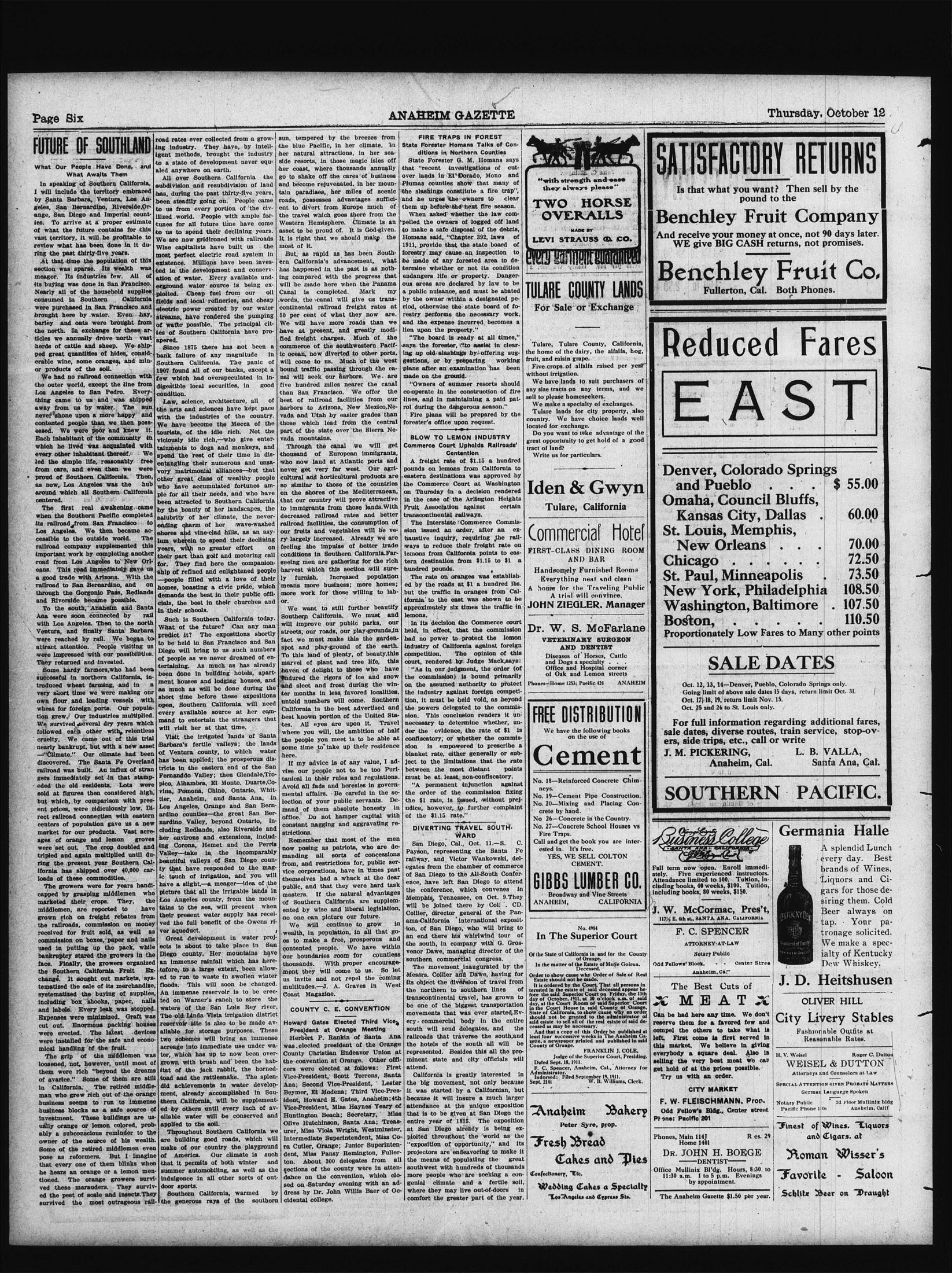
Searchable text
FUTURE OF SOUTHLAND
What Our People Have Done, and What Awaits Them
In speaking of Southern California, I will include the territory embraced by Santa Barbara, Ventura, Los Angeles, San Bernardino, Riverside, Orange, San Diego and Imperial counties. To arrive at a proper estimate of what the future contains for this vast territory, it will be profitable to review what has been done in it during the past thirty-five years.
At that time the population of this section was sparse. Its wealth was meager. Its industries few. All of its buying was done in San Francisco. Nearly all of the household supplies consumed in Southern California were purchased in San Francisco and brought here by water. Even hay, barley and oats were brought from the north. In exchange for these articles we annually drove north vast herds of cattle and sheep. We shipped great quantities of hides, considerable wine, some oranges, and minor products of the soil.
We had no railroad connection with the outer world, except the line from Los Angeles to San Pedro. Everything came to us and was shipped away from us by water. The sun never shone upon a more happy and contented people than we then possessed. We were poor and knew it. Each inhabitant of the community in which he lived was acquainted with every other inhabitant thereof. We led the simple life, reasonably free from care, and even then we were road rates ever collected from a growing industry. They have, by intelligent methods, brought the industry to a state of development never equaled anywhere on earth.
All over Southern California the subdivision and resubdivision of land has, during the past thirty-five years, been steadily going on. People came to us from every portion of the civilized world. People with ample fortunes for all future time have come to us to spend their declining years. We are now gridironed with railroads. Wise capitalists have built us the most perfect electric road system in existence. Millions have been invested in the development and conservation of water. Every available underground water source is being exploited. Cheap fuel from our oil fields and local refineries, and cheap electric power created by our water streams, have rendered the pumping of water possible. The principal cities of Southern California have prospered.
Since 1875 there has not been a bank failure of any magnitude in Southern California. The panic of 1907 found all of our banks, except a few which had overspeculated in indigestible local securities, in good condition.
Law, science, architecture, all of the arts and sciences have kept pace with the industries of the country. We have become the Mecca of the tourists, of the idle rich. Not the viciously idle rich—who give entertainments to dogs and monkeys, and spend the rest of their time in disentangling their numerous and unsavory matrimonial alliances—but that sun, tempered by the blue Pacific, in her natural attractions, side resorts, in those many her coast, where thousands go to shake off the care and become rejuvenated, tain paradises, her milled roads, possesses advanced ent to divert from Europe the travel which goes through Western Hemisphere. Our asset to be proud of. It is right that we should most of it.
But, as rapid as has ever calmed California's advance has happened in the passing compared with the year will be made here when Canal is completed.
Words, the canal will give continental railroad freight 50 per cent of what thou will seek our harbor five hundred miles near than San Francisco. We best of railroad facilities harbors to Arizona, Nevada and Utah by easier those which lead from part of the state over the vada mountains.
Through the canal we thousand of European who now land at Atlantic never get very far west.
We had no railroad connection with the outer world, except the line from Los Angeles to San Pedro. Everything came to us and was shipped away from us by water. The sun never shone upon a more happy and contented people than we then possessed. We were poor and knew it. Each inhabitant of the community in which he lived was acquainted with every other inhabitant thereof. We led the simple life, reasonably free from care, and even then we were proud of Southern California. Then, as now, Los Angeles was the hub around which all Southern California centered.
The first real awakening came when the Southern Pacific completed its railroad from San Francisco to Los Angeles. We then became accessible to the outside world. The railroad company supplemented this important work by completing another road from Los Angeles to New Orleans. This road immediately gave us a good trade with Arizona. With the railroad to San Bernardino, and on through the Gorgonio Pass, Redlands and Riverside became possible.
To the south, Anaheim and Santa Ana were soon connected by rail with Los Angeles. Then to the north Ventura, and finally Santa Barbara were reached by rail. We began to attract attention. People visiting us were impressed with our possibilities. They returned and invested.
Some hardy farmers, who had been successful in northern California, introduced wheat farming, and in a very short time we were making our own flour and loading vessels with wheat for foreign ports. Our population grew. Our industries multiplied. We survived several dry years which followed each other with relentless cruelty. We came out of this trial nearly bankrupt, but with a new asset—"Climate." Our climate had been discovered. The Santa Fe Overland railroad was built. An influx of strangers immediately set in that stampede the old residents. Lots were sold at figures then considered high, but which, by comparison with present prices, were ridiculously low. Direct railroad connection with eastern centers of population gave us a new market for our products. Vast acres of orange and lemon groves were set out. The crop doubled and tripled and again multiplied until during the present year Southern California has shipped over 40,000 carloads of these commodities.
The growers were for years handicapped by grasping middlemen who few which had overspeculated in indigestible local securities, in good condition.
Law, science, architecture, all of the arts and sciences have kept pace with the industries of the country. We have become the Mecca of the tourists, of the idle rich. Not the viciously idle rich—who give entertainments to dogs and monkeys, and spend the rest of their time in disentangling their numerous and unsavory matrimonial alliances—but that other great class of wealthy people who have accumulated fortunes ample for all their needs, and who have been attracted to Southern California by the beauty of her landscapes, the salubrity of her climate, the never-ending charm of her wave-washed shores and vine-clad hills, as an asylum wherein to spend their declining years, with no greater effort on their part than golf and motoring call for. They find here the companionship of refined and enlightened people—people filled with a love of their homes, boasting a civic pride, which demands the best in their public officials, the best in their churches and in their schools.
Such is Southern California today. What of the future? Can any man predict it? The expositions shortly to be held in San Francisco and San Diego will bring to us such numbers of people as we never dreamed of entertaining. As much as has already been done in building hotels, apartment houses and lodging houses, and as much as will be done during the short time before these expositions open, Southern California will need every available source at her command to entertain the strangers that will visit her at that time.
Visit the irrigated lands of Santa Barbara's fertile valleys; the lands of Ventura county, to which water has been applied; the prosperous districts in the eastern end of the San Fernanddo Valley; then Glendale,Tropico, Alhambra, El Monte, Duarte,Covina, Pomona, Chino, Ontario, Whittier, Anaheim, and Santa Ana, in Los Angeles, Orange and San Bernardino counties—the great San Bernardino Valley, beyond Ontario, including Redlands, also Riverside and her environs and extensions, including Corona, Hemet and the Perris Valley—take in the comparably beautiful valleys of San Diego county that have responded to the magic touch of irrigation, and you will have a slight—a meager—idea of the picture that all the irrigable lands in Los Angeles county from the mounnal will seek our harbor five hundred miles near than San Francisco. We best of railroad facilities harbors to Arizona, Nevada and Utah by easier those which lead from part of the state over vada mountains.
Through the canal we thousand of Europeans who now land at Atlantic never get very far west cultural and horticultural so similar to those of on the shores of the Mist that our country will provide immigrants from those decreased railroad rates railroad facilities,the coats our fruits and vegetables largely increased.And feeling the impulse of conditions in Southern California seeing men are gathering harvest which this section furnish.Increased means more business; more work for those who or.
We want to still fund Southern California.Will improve our public streets, our roads, our fact we must make this spot and play ground To this land of plenty,marvel of plant and tree haven of delight to those endured the rigors of life and sleet and frost durer months in less favor untold numbers will cost California is the best known portion of these. All eyes are upon where you will,the amthe people you meet is some time to take up there.
If my advice is of any wise our people not too tanical in their rules and Avoid all fads and heres mental affairs. Be careful selection of your public mand of them absolute office.Do not hamper constant nagging and strictions.
Remember that most now posing as patriots manding all sorts ofrom,and restrictions for vice corporations,have themselves had a whack public,and that they w masters. If the nature
but which, by comparison with present prices, were ridiculously low. Direct railroad connection with eastern centers of population gave us a new market for our products. Vast acreages of orange and lemon groves were set out. The crop doubled and tripled and again multiplied until during the present year Southern California has shipped over 40,000 carloads of these commodities.
The growers were for years handicapped by grasping middlemen who marketed their crops. They, the middlemen, are reported to have grown rich on freight rebates from the railroads, commission on money received for fruit sold, as well as commission on boxes, paper and nails used in putting up the pack, while bankruptcy stared the growers in the face. Finally, the growers organized the Southern California Fruit Exchange. It sought out markets, systematized the sale of its merchandise, systematized the buying of supplies, including box shocks, paper, nails and labels. Every leak was stopped. Expenses were minimized. Graft was cut out. Enormous packing houses were erected. The latest devices were installed for the safe and economical handling of the fruit.
The grip of the middlemen was loosened, not, however, until most of them were rich "beyond the dreams of avarice." Some of them are still in California. The retired middleman who grew rich out of the orange business seems to run to immense business blocks as a safe source of investment. These buildings are usually orange or lemon colored, probably a subconscious reminder to the owner of the source of his wealth. Some of the retired middlemen even pose as reformers. But I imagine that every one of them blinks when he hears an orange or a lemon mentioned. The orange growers survived these marauders. They survived the pest of scale and insects. They survived the most outrageous rail-
Great development in water projects is about to take place in San Diego county. Her mountains have an immense rainfall which has herefore, to a large extent, been allowed to run to waste in swollen winter floods. This will soon be changed. An immense reservoir is to be erected on Warner's ranch to store the waters of the San Luis Rey river. The old Linda Vista irrigation district reservoir site is also to be made available for storage purposes. These two schemes will bring an immense acreage into immediate use under water, which has up to now been overgrown with brush and been the habitat of the jack rabbit, the hornedtoad and the rattlesnake. The splendid achievements in water development, already accomplished in Southern California, will be supplemented by others until every inch of available water will be conserved and applied to the soil.
Throughout Southern California we are building good roads, which will make of our country the playground of America. Our climate is such that it permits of both winter and summer automobiling, as well as the indulgence in all other sorts of outdoor sports.
Southern California, warmed by the generous rays of the southern
sun, tempered by the breezes from the blue Pacific, in her climate, in her natural attractions, in her seaside resorts, in those magic isles off her coast, where thousands annually go to shake off the cares of business and become rejuvenated, in her mountain paradises, her miles of scenic roads, possesses advantages sufficient to divert from Europe much of the travel which goes there from the Western Hemisphere. Climate is an asset to be proud of. It is God-given. It is right that we should make the most of it.
But, as rapid as has been Southern California's advancement, what has happened in the past is as nothing compared with the progress that will be made here when the Panama Canal is completed. Mark my words, the canal will give us transcontinental railroad freight rates at 50 per cent of what they now are. We will have more roads than we have at present, and greatly modified freight charges. Much of the commerce of the southwestern Pacific ocean, now diverted to other ports, will come to us. Much of the west bound traffic passing through the canal will seek our harbors. We are five hundred miles nearer the canal than San Francisco. We offer the best of railroad facilities from our harbors to Arizona, New Mexico, Nevada and Utah by easier grades than those which lead from the central part of the state over the Sierra Nevada mountains.
Through the canal we will get thousand of European immigrants, who now land at Atlantic ports and never get very far west. Our agril-
FIRE TRAPS IN FOREST
State Forester Homans Talks of Conditions in Northern Counties
State Forester G. M. Homans says that "recent investigations of cut-over lands in El Dorado, Mono and Plumas counties show that many of the slashings constitute a fire trap", and he urges the owners to clear them up before the next fire season.
When asked whether the law compelled the owners of logged off land to make a safe disposal of the debris, Homans said, "Chapter 392, laws of 1911, provide that the state board of forestry may cause an inspection to be made of any forested area to determine whether or not its condition endangers life or property. Dangerous areas are declared by law to be a public nuisance, and must be abated by the owner within a designated period, otherwise the state board of forestry performs the necessary work, and the expense incurred becomes a lien upon the property."
"The board is ready at all times," says the forester, "to assist in clearing up old slashings by offering suggestions, or by preparing working plans after an examination has been made on the ground.
"Owners of summer resorts should co-operate in the construction of fire lines, and in maintaining a paid patrol during the dangerous season."
Fire plans will be prepared by the forester's office upon request.
BLOW TO LEMON INDUSTRY
Commerce Court Upholds Railroads' Contention
A freight rate of $1.15 a hundred pounds on lemons from California to
nal will seek our harbors. We are five hundred miles nearer the canal than San Francisco. We offer the best of railroad facilities from our harbors to Arizona, New Mexico, Nevada and Utah by easier grades than those which lead from the central part of the state over the Sierra Nevada mountains.
Through the canal we will get thousand of European immigrants, who now land at Atlantic ports and never get very far west. Our agricultural and horticultural products are so similar to those of the countries on the shores of the Mediterranean, that our country will prove attractive to immigrants from those lands. With decreased railroad rates and better railroad facilities, the consumption of our fruits and vegetables will be very largely increased. Already we are feeling the impulse of better trade conditions in Southern California. Farseeing men are gathering for the rich harvest which this section will surely furnish. Increased population means more business; more homes; more work for those willing to labor.
We want to still further beautify Southern California. We must and will improve our public parks, our streets, our roads, our playgrounds, in fact we must make this the garden spot and play-ground of the earth. To this land of plenty, of beauty, this marvel of plant and tree life, this haven of delight to those who have endured the rigors of ice and snow and sleet and frost during the winter months in less favored localities, untold numbers will come. Southern California is the best advertised and best known portion of the United States. All eyes are upon it. Travel where you will, the ambition of half the people you meet is to be able at some time to take up their residence here.
If my advice is of any value, I advise our people not to be too Puritanical in their rules and regulations. Avoid all fads and heresies in governmental affairs. Be careful in the selection of your public servants. Demand of them absolute honesty in office. Do not hamper capital with constant nagging and aggravating restrictions.
Remember that most of the men now posing as patriots, who are demanding all sorts of concessions from, and restrictions for, public service corporations, have in times past themselves had a whack at the dear public, and that they were hard task masters. If the natural advantages made on the ground.
"Owners of summer resorts should co-operate in the construction of fire lines, and in maintaining a paid patrol during the dangerous season."
Fire plans will be prepared by the forester's office upon request.
BLOW TO LEMON INDUSTRY
Commerce Court Upholds Railroads' Contention
A freight rate of $1.15 a hundred pounds on lemons from California to eastern destinations was approved by the Commerce Court at Washington on Thursday in a decision rendered in the case of the Arlington Heights Fruit Association against certain transcontinental railways.
The Interstate Commerce Commission issued an order, after an exhaustive inquiry, requiring the railways to reduce their freight rate on lemons from California points to eastern destination from $1.15 to $1 a hundred pounds.
The rate on oranges was established by the roads at $1 a hundred lbs. but the traffic in oranges from California to the east was shown to be approximately six times the traffic in lemons.
In its decision the Commerce court held, in effect, that the commission had no power to protect the lemon industry of California against foreign competition. The opinion of this court, rendered by Judge Mack says:
"As in our judgment, the order (of the commission) is bound primarily on the assumed authority to protect the industry against foreign competition, it must be held void, as beyond the powers delegated to the commission. This conclusion renders it unnecessary to determine whether, under the evidence, the rate of $1 is confiscatory, or whether the commission is empowered to prescribe a blanket rate, either generally or subject to the limitations that the rate between the most distant points must be at least non-confiscatory.
"A permanent injunction against the order of the commission fixing the $1 rate, is issued, without prejudice, however, to further complaint of the $1.15 rate."
DIVERTING TRAVEL SOUTH-WARD
San Diego, Cal., Oct. 11.-S. C. Payson, representing the Santa Fe railway, and Victor Wankowski, delegates from the chamber of commerce of San Diego to the All-South Conference, have left San Diego to attend the conference, which convenes in Memphis, Tennessee, on Oct. 9. They
DIVERTING TRAVEL SOUTH-WARD
San Diego, Cal., Oct. 11.—S. C. Payson, representing the Santa Fe railway, and Victor Wankowski, delegates from the chamber of commerce of San Diego to the All-South Conference, have left San Diego to attend the conference, which convenes in Memphis, Tennessee, on Oct. 9. They will be joined there by Col. CD. Collier, director general of the Panama-California international exposition, of San Diego, who will bring to an end there his whirlwind tour of the south, in company with G. Grosvenor Dawe, managing director of the southern commercial congress.
The movement inaugurated by the Messrs. Collier and Dawe, having for its object the diversion of travel from the northern to southern lines of transcontinental travel, has grown to be one of the biggest transportation movements that was ever started. Every commercial body in the entire south will send delegates, and the railroads that traverse the south, and the hotels of the south all will be represented. Besides this all the prominent state and city officials will attend.
California is greatly interested in the big movement, not only because it was started by a Californiaian, but because it will insure a much larger attendance at the unique exposition that is to be given at San Diego the entire year of 1815. The exposition at San Diego already is being exploited throughout the world as the "exposition of opportunity," and its projectors are endeavoring to make it the means of populating the great southwest with hundreds of thousands more people who are seeking a congenial climate and a fertile soil, where they may live out-of-doors in comfort the greater part of the year.
COUNTY C. E. CONVENTION
Howard Gates Elected Third Vice President at Orange Meeting
Herbert P. Rankin of Santa Ana was elected president of the Orange County Christian Endeavor Union at the convention at Orange. Other officers were elected at follows: First Vice-President, Scott Torrens, Santa Ana; Second Vice-President, Lester Beymer, El Modena; Third Vice-President, Howard E. Gates, Anaheim; fourth Vice-President, Miss Haynes Yeary of Huntington Beach; Secretary, Miss Olive Hutchinson, Santa Ana; Treasurer, Miss Viola Wright, Westminster, Intermediate Superintendent, Miss Cora Cutler, Orange; Junior Superintendent, Miss Pansy Remington, Fullerton. About 300 delegates from all sections of the county were in attendance on the convention, which closed on Saturday evening with an address by Dr. John Willis Baer of Occidental college.
Anaheim Bakery
Peter Syre, prop.
Fresh Bread
Cakes and Dies
Confectionery, Etc.
Wedding Cakes a Specialty
Los Angeles and Express Sts.
Thursday, October 12
SATISFACTORY RETURNS
Is that what you want? Then sell by the pound to the
Benchley Fruit Company
And receive your money at once, not 90 days later.
WE give BIG CASH returns, not promises.
Benchley Fruit Co,
Fullerton, Cal. Both Phones.
Reduced Fares
EAST
Denver, Colorado Springs
EAST
Denver, Colorado Springs and Pueblo $ 55.00
Omaha, Council Bluffs, Kansas City, Dallas 60.00
St. Louis, Memphis, New Orleans 70.00
Chicago 72.50
St. Paul, Minneapolis 73.50
New York, Philadelphia 108.50
Washington, Baltimore 107.50
Boston 110.50
Proportionately Low Fares to Many other points
SALE DATES
Oct. 12, 13, 14—Denver, Pueblo, Colorado Springs only.
Going limit of above sale dates 15 days, return limit Oct. 31.
Oct. 17, 18, 19, return limit Nov. 15.
Oct. 25 and 26 to St. Louis only.
For full information regarding additional fares, sale dates, diverse routes, train service, stop-overs, side trips, etc., call or write
J. M. PICKERING, L. B. VALLA,
Anaheim, Cal. Santa Ana, Cal.
SOUTHERN PACIFIC.
Germania Halle
Fall term now open. Enroll immediately. Five experienced instructors.
Attendance limited to 100. Tuition, including books, 40 weeks, $100. Tuition, including books, 80 weeks, $150.
A splendid Lunch every day. Best brands of Wines, Liquors and Cigars for those de-
Business College
SANTA ANA, CALIFORNIA
Fall term now open. Enroll immediately. Five experienced instructors. Attendance limited to 100. Tuition, including books, 40 weeks, $100. Tuition, including books, 80 weeks, $150.
J. W. McCormac, Pres't,
117½ E. 4th st., SANTA ANA, CALIFORNIA
F. C. SPENCER
ATTORNEY-AT-LAW
Notary Public
Odd Fellows' Block, Center Street
Anaheim, Cal.
The Best Cuts of MEAT
Can be had here any time. We don't reserve them for a favored few and compel the others to take what is left. First come is first served in this market. We believe in giving everybody a square deal. Also in selling the very best meat we can get hold of at the prices possible.
Try us with an order.
CITY MARKET
F. W. FLEISCHMANN, Pron.
Odd Fellow's Bldg., Center street
Phone: Pacific 201
Phones, Main 114J R es. 29
Home 140l
DR. JOHN H. BOEGE
DENTIST
Office Mullinix Bl'dg. Hours, 8:30 to 11:30 a.m. 1 to 5 p.m. Evenings by appointment.
The Anaheim Gazette $1.50 per year.
Germania Halle
A splendid Lunch every day. Best brands of Wines, Liquors and Cigars for those desiring them. Cold Beer always on tap. Your patronage solicited. We make a specialty of Kentucky Dew Whiskey.
J. D. Heitshusen
OLIVER HILL
City Livery Stables
Fashionable Outfits at Reasonable Rates.
H. V. Weisel Roger C. Dutton
WEISEL & DUTTON
Attorneys and Counselors at Law
SPECIAL ATTENTION GIVEN PROBATE MATTERS
German Language Spoken
Notary Public 2d Floor Mullinix bldg
Pacific Phone 1106 Anaheim, Calif
Finest of Wines, Liquors and Cigars, at
Roman Wisser's
Favorite - Saloon
Schlitz Beer on Draught