anaheim-gazette 1911-09-07
Scanned page
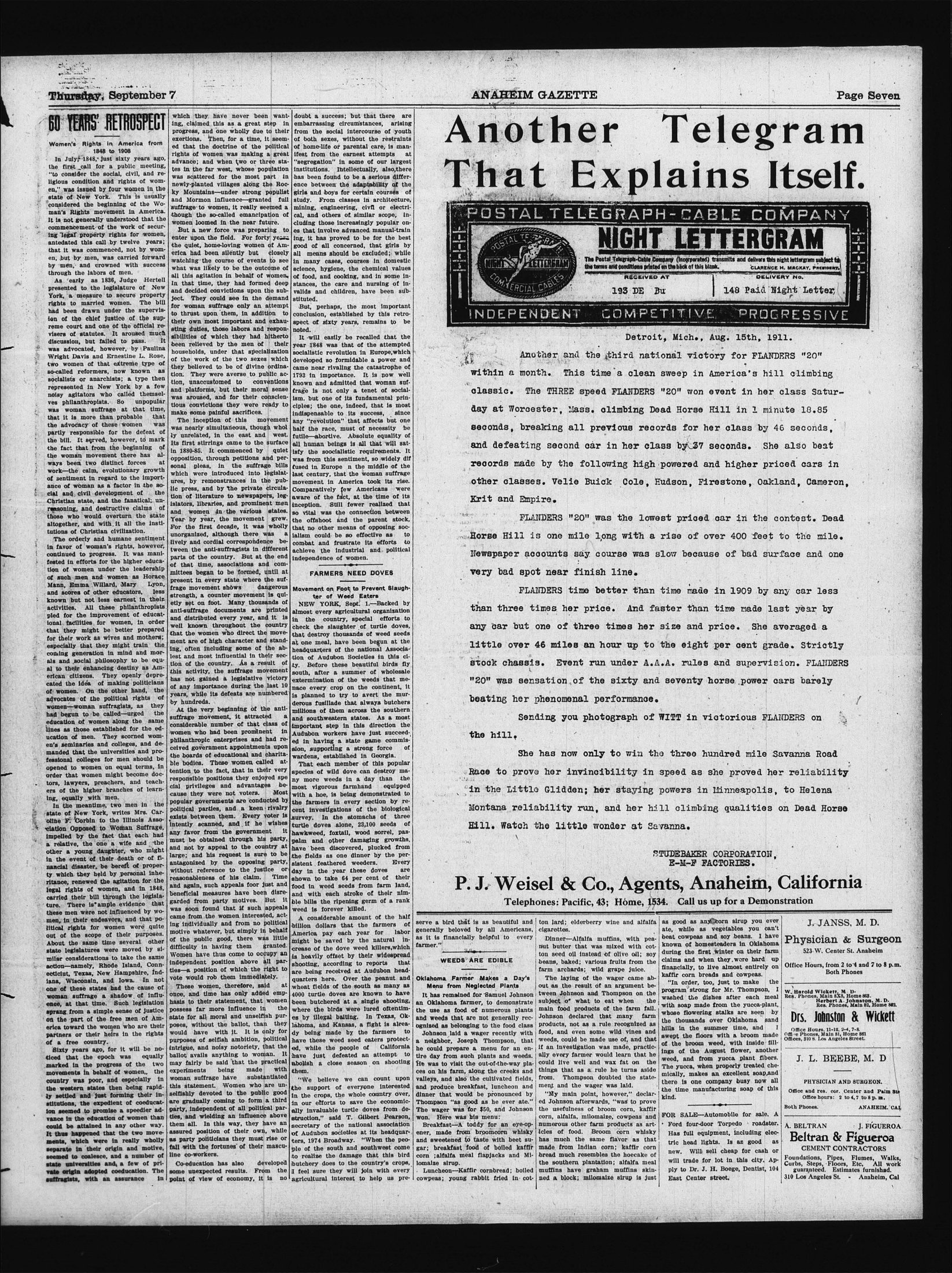
Searchable text
60 YEARS' RETROSPECT
Women's Rights in America from 1848 to 1908
In July, 1848, just sixty years ago, the first call for a public meeting, "to consider the social, civil, and religious condition and rights of women," was issued by four women in the state of New York. This is usually considered the beginning of the Woman's Rights movement in America. It is not generally understood that the commencement of the work of securing legal property rights for women, antedated this call by twelve years; that it was commenced, not by women, but by men, was carried forward by men, and crowned with success through the labors of men.
As early as 1836, Judge Hertell presented to the legislature of New York, a measure to secure property rights to married women. The bill had been drawn under the supervision of the chief justice of the supreme court and one of the official revisers of statutes. It aroused much discussion, but failed to pass. It was advocated, however, by Paulina Wright Davis and Ernestine L. Rose, two women of that extreme type of so-called reformers, now known as socialists or anarchists; a type then represented in New York by a few noisy agitators who called themselves philanthropists. So unpopular was woman suffrage at that time, that it is more than probable that the advocacy of these women was partly responsible for the defeat of the bill. It served, however, to mark the fact that from the beginning of the woman movement there has always been two distinct forces at work—the calm, evolutionary growth which they have never been wanting, claimed this as a great step in progress, and one wholly due to their exertions. Then, for a time, it seemed that the doctrine of the political rights of women was making a great advance; and when two or three states in the far west, whose population was scattered for the most part in newly-planted villages along the Rocky Mountains—under strong populist and Mormon influence—granted full suffrage to women, it really seemed a though the so-called emancipation of women loomed in the near future.
But a new force was preparing to enter upon the field. For forty years the quiet, home-loving women of America had been silently but closely watching the course of events to see what was likely to be the outcome of all this agitation in behalf of women. In that time, they had formed deep and decided convictions upon the subject. They could see in the demand for woman suffrage only an attempt to thrust upon them, in addition to their own most important and exhausting duties, those labors and responsibilities of which they had hitherto been relieved by the men of their households, under that specialization of the work of the two sexes which they believed to be of divine ordination. They were averse to public action, unaccustomed to conventions and platforms, but their moral sense was aroused, and for their conscientious convictions they were ready to make some painful sacrifices.
The inception of this movement was nearly simultaneous, though wholly unrelated, in the east and west. Its first stirrings came to the surface in 1880-85. It commenced by quiet opposition, through petitions and personal pleas, in the suffrage bills which were introduced into legislat-doubt a success; but embarrassing circumstances from the social interest of both sexes, with of home-life or parent ifest from the earner "segregation" in so institutions. Intellel has been found to beence between the s-girls and boys for c-study. From classes mining, engineering cal., and others of a-cluding those increaes that involve advai-ging, it has proved th-e good of all concern-all means should b-in many cases, cou-science, hygiene, th-eof food, and cooking stances, the care a-valids and children-stituted.
But, perhaps, the conclusion, establish-spect of sixty years noted.
It will easily be year 1848 was that socialistic revolution developed so formidable came near rivaling t-1793 in importance. Known and admitted frage is not only a ism. but one of its ciples; the one, ind-indispensable to its any "revolution" tha-half the race, must futile—abortive. Ab- all human beings is isfy the soocialistic was from this sentin-fused in Europe n-last century that th-
socialists or anarchists; a type then represented in New York by a few noisy agitators who called themselves philanthropists. So unpopular was woman suffrage at that time, that it is more than probable that the advocacy of these women was partly responsible for the defeat of the bill. It served, however, to mark the fact that from the beginning of the woman movement there has always been two distinct forces at work—the calm, evolutionary growth of sentiment in regard to the importance of woman as a factor in the social and civil development of the Christian state, and the fanatical, unreasoning, and destructive claims of those who would overturn the state altogether, and with it all the institutions of Christian civilization.
The orderly and humane sentiment in favor of woman's rights, however, continued to progress. It was manifested in efforts for the higher education of women under the leadership of such men and women as Horace Mann, Emma Willard, Mary Lyon, and scores of other educators, less known but not less earnest in their activities. All these philanthropists pled for the improvement of educational facilities for women, in order that they might be better prepared for their work as wives and mothers; especially that they might train the coming generation in mind and morals and social philosophy to be equal to their enhancing destiny as American citizens. They openly depraved the idea of making politicians of women. On the other hand, the advocates of the political rights of women—woman suffragists, as they had begun to be called—urged the education of women along the same lines as those established for the education of men. They scorned women's seminaries and colleges, and demanded that the universities and professional colleges for men should be opened to women on equal terms, in order that women might become doctors, lawyers, preachers, and teachers of the higher branches of learning, equally with men.
In the meantime, two men in the state of New York, writes Mrs. Caroline F. Corbin to the Illinois Association Opposed to Woman Suffrage, impelled by the fact that each had a relative, the one a wife and the other a young daughter, who might in the event of their death or of financial disaster, be bereft of property which they held by personal inheritance, renewed the agitation for the legal rights of women, and in 1848 carried their bill through the legislature. They were averse to public action, unaccustomed to conventions and platforms, but their moral sense was aroused, and for their conscientious convictions they were ready to make some painful sacrifices.
The inception of this movement was nearly simultaneous, though wholly unrelated, in the east and west. Its first stirrings came to the surface in 1880-85. It commenced by quiet opposition, through petitions and personal pleas, in the suffrage bills which were introduced into legislatures, by remonstrances in the public press, and by the private circulation of literature to newspapers, legislators, libraries, and prominent men and women in the various states. Year by year, the movement grew. For the first decade, it was wholly unorganized, although there was a lively and cordial correspondence between the anti-suffragists in different parts of the country. But at the end of that time, associations and committees began to be formed, until at present in every state where the suffrage movement shows dangerous strength, a counter movement is quietly set on foot. Many thousands of anti-suffrage documents are printed and distributed every year, and it is well known throughout the country that the women who direct the movement are of high character and standing, often including some of the ablest and most influential in their section of the country. As a result of this activity, the suffrage movement has not gained a legislative victory of any importance during the last 10 years, while its defeats are numbered by hundreds.
At the very beginning of the anti-suffrage movement, it attracted a considerable number of that class of women who had been prominent in philanthropic enterprises and had received government appointments upon the boards of educational and charitable bodies. These women called attention to the fact, that in their very responsible positions they enjoyed special privileges and advantages because they were not voters. Most popular governments are conducted by political parties, and a keen rivalry exists between them. Every voter is intently scanned, and if he wishes any favor from the government it must be obtained through his party, and not by appeal to the country at large; and his request is sure to be antagonized by the opposing party, without reference to the justice or reasonableness of his claim. Time and again, such appeals fail just and beneficial measures have been disrelevant.
They were averse to public action, unaccustomed to conventions and platforms, but their moral sense was aroused, and for their conscientious convictions they were ready to make some painful sacrifices.
The inception of this movement was nearly simultaneous, though wholly unrelated, in the east and west. Its first stirrings came to the surface in 1880-85. It commenced by quiet opposition, through petitions and personal pleas, in the suffrage bills which were introduced into legislatures, by remonstrances in the public press, and by the private circulation of literature to newspapers, legislators, libraries, and prominent men and women in the various states. Year by year, the movement grew. For the first decade, it was wholly unorganized, although there was a lively and cordial correspondence between the anti-suffragists in different parts of the country. But at the end of that time, associations and committees began to be formed, until at present in every state where the suffrage movement shows dangerous strength, a counter movement is quietly set on foot. Many thousands of anti-suffrage documents are printed and distributed every year, and it is well known throughout the country that the women who direct the movement are of high character and standing, often including some of the ablest and most influential in their section of the country. As a result of this activity, the suffrage movement has not gained a legislative victory of any importance during the last 10 years, while its defeats are numbered by hundreds.
At the very beginning of the anti-suffrage movement, it attracted a considerable number of that class of women who had been prominent in philanthropic enterprises and had received government appointments upon the boards of educational and charitable bodies. These women called attention to the fact, that in their very responsible positions they enjoyed special privileges and advantages because they were not voters. Most popular governments are conducted by political parties, and a keen rivalry exists between them. Every voter is intently scanned, and if he wishes any favor from the government it must be obtained through his party, and not by appeal to the country at large; and his request is sure to be antagonized by the opposing party, without reference to the justice or reasonableness of his claim. Time and again, such appeals fail just and beneficial measures have been disrelevant.
They were averse to public action, unaccustomed to conventions and platforms, but their moral sense was aroused, and for their conscientious convictions they were ready to make some painful sacrifices.
The inception of this movement was nearly simultaneous, though wholly unrelated, in the east and west. Its first stirrings came to the surface in 1880-85. It commenced by quiet opposition, through petitions and personal pleas, in the suffrage bills which were introduced into legislatures, by remonstrances in the public press, and by the private circulation of literature to newspapers, legislators, libraries, and prominent men and women in the various states. Year by year, the movement grew. For the first decade, it was wholly unorganized, although there was a lively and cordial correspondence between the anti-suffragists in different parts of the country. But at the end of that time, associations and committees began to be formed, until at present in every state where the suffrage movement shows dangerous strength, a counter movement is quietly set on foot. Many thousands of anti-suffrage documents are printed and distributed every year, and it is well known throughout the country that the women who direct the movement are of high character and standing, often including some of the ablest and most influential in their section of the country. As a result of this activity, the suffrage movement has not gained a legislative victory of any importance during the last 10 years, while its defeats are numbered by hundreds.
At the very beginning of the anti-suffrage movement, it attracted a considerable number of that class of women who had been prominent in philanthropic enterprises and had received government appointments upon the boards of educational and charitable bodies. These women called attention to the fact, that in their very responsible positions they enjoyed special privileges and advantages because they were not voters. Most popular governments are conducted by political parties, and a keen rivalry exists between them. Every voter is intently scanned, and if he wishes any favor from the government it must be obtained through his party, and not by appeal to the country at large; and his request is sure to be antagonized by the opposing party, without reference to the justice or reasonableness of his claim. Time and again, such appeals fail just and beneficial measures have been disrelevant.
They were averse to public action, unaccustomed to conventions and platforms, but their moral sense was aroused, and for their conscientious convictions they were ready to make some painful sacrifices.
The inception of this movement was nearly simultaneous, though wholly unrelated,inthe eastandwest.Itsfirststirringscametothesurfacein1880-85.itcommencedbyquietopposition,towhichwereintroducedintlegislatures,bylemonstrancesinthepublicpress,andbytheprivatecirculationofliteraturetotweensepilatories.wasfromthissentimentfusedinEuropenastellentcentury,thetreatmentinAmericasComparativelyfewawareofthefact,ainception.Sillfevsovitalwasthecoeffortoffootandthatnoothermeanspecialismcouldbe socombatandfrustrateachievetheindustriaindependenceofwork
FARMERS NEWS
Movement on Foot ter Weed
NEW YORK,
Almost every agriculturalinthecountry,sicheatchtheslaughterthatdestroythousandsatone meal,haveb headquartersofthetionofAudubonSociety.Beforethesebouthalfyear,asummerexterminationofthenaceeverycroponcisplannedtotryderousfusilladeathmillionsofthemacoverandsworthwesternsteamimportantstepintheAudubonworkershomedin havingastationsupportingawarddens,e establishesThateachmemberspeciesofwilddognymoreweedsinmost vigorous farmwithahoe.isbeingthefarmersinevercentinvestigationssurvey.Inthestocturtledovesalone,hawkkweed,foxtail,palmandotherdayhavebeendiscoveredthefieldsasone diidentefeatheredwodayintheyearthishowntotake64poundfoodinweedseedsandwitheachstrong
In the meantime, two men in the state of New York, writes Mrs. Caroline F. Corbin to the Illinois Association Opposed to Woman Suffrage, impelled by the fact that each had a relative, the one a wife and the other a young daughter, who might in the event of their death or of financial disaster, be bereft of property which they held by personal inheritance, renewed the agitation for the legal rights of women, and in 1848, carried their bill through the legislature. There is ample evidence that these men were not influenced by women, in their endeavors, and that political rights for women were quite out of the scope of their purposes. About the same time several other state legislatures were moved by similar considerations to take the same action—namely, Rhode Island, Connecticut, Texas, New Hampshire, Indiana, Wisconsin, and Iowa. In not one of these states had the cause of woman suffrage a shadow of influence, at that time. Such legislation sprang from a simple sense of justice on the part of the free men of America toward the women who are their partners or their heirs in the rights of a free country.
Sixty years ago, for it will be noticed that the epoch was equally marked in the progress of the two movements in behalf of women, the country was poor, and especially in the western states then being rapidly settled and just forming their institutions, the expedient of coeducation seemed to promise a speedier advance in the education of women than could be attained in any other way. It thus happened that the two movements, which were in really wholly separate in their origin and motive, seemed to coalesce, and a number of state universities and a few of private origin adopted coeducation. The suffragists, with an assurance in popular governments are conducted by political parties, and a keen rivalry exists between them. Every voter is intently scanned, and if he wishes any favor from the government it must be obtained through his party, and not by appeal to the country at large; and his request is sure to be antagonized by the opposing party, without reference to the justice or reasonableness of his claim. Time and again, such appeals foor just and beneficial measures have been disregarded from party motives. But it was soon found that if such appeals came from the women interested, acting individually and from no political motive whatever, but simply in behalf of the public good, there was little difficulty in having them granted. Women have thus come to occupy an independent position above all parties—a position of which the right to vote would rob them immediately.
These women, therefore, said at once, and time has only added emphasis to their statement, that women possess far more influence in the state for all moral and unselfish purposes, without the ballot, than they would have with it. It is only for purposes of selfish ambition, political intrigue, and noisy notoriety, that the ballot avails anything to woman. It may fairly be said that the practical experiments being made with woman suffrage have substantiated this statement. Women who are unselfishly devoted to the public good are gradually coming to form a third party, independent of all political parties, and wielding an influence above them all. In this way, they have an assured position of their own, while as party politicians they must rise or fall with the fortunes of their masculine co-workers.
Co-education has also developed some unexpected results. From the point of view of economy, it is no
ANAHEIM GAZETTE
Another Thing That Explains
doubt a success; but that there are embarrassing circumstances, arising from the social intercourse of youth of both sexes, without the restraints of home-life or parental care, is manifest from the earnest attempts at "segregation" in some of our largest institutions. Intellectually, also, there has been found to be a serious difference between the adaptability of the girls and boys for certain courses of study. From classes in architecture, mining, engineering, civil or electrical, and others of similar scope, including those increasingly popular ones that involve advanced manual-training, it has proved to be for the best good of all concerned, that girls by all means should be excluded; while in many cases, courses in domestic science, hygiene, the chemical values of food, and cooking, and in some instances, the care and nursing of invalids and children, have been substituted.
But, perhaps, the most important conclusion, established by this retrospect of sixty years, remains to be noted.
It will easily be recalled that the year 1848 was that of the attempted socialistic revolution in Europe, which developed so formidable a power and came near rivaling the catastrophe of 1793 in importance. It is now well known and admitted that woman suffrage is not only a tenet of socialism, but one of its fundamental principles; the one, indeed, that is most indispensable to its success, since any "revolution" that affects but one half the race, must of necessity be futile—abortive. Absolute equality of all human beings is all that will satisfy the soocialistic requirements. It was from this sentiment, so widely fused in Europe n the middle of the last century, that the woman suffrage
Detroit,
Another and the third national within a month. This time a clean sweep classic. The THREE speed FLANDERS "20 day at Worcester, Mass. climbing Dead seconds, breaking all previous records and defeating second car in her class records made by the following high pow
1793 in importance. It is now well known and admitted that woman suffrage is not only a tenet of socialism, but one of its fundamental principles; the one, indeed, that is most indispensable to its success, since any "revolution" that affects but one half the race, must of necessity be futile—abortive. Absolute equality of all human beings is all that will satisfy the soocialistic requirements. It was from this sentiment, so widely fused in Europe n the middle of the last century, that the woman suffrage movement in America took its rise. Comparatively few Americans were aware of the fact, at the time of its inception. Still fewer realized that so vital was the connection between the offshoot and the parent stock, that no other means of opposing socialism could be so effective as to combat and frustrate its efforts to achieve the industrial and political independence of women.
FARMERS NEED DOVES
Movement on Foot to Prevent Slaughter of Weed Eaters
NEW YORK, Sept. 1.—Backed by almost every agricultural organization in the country, special efforts to check the slaughter of turtle doves, that destroy thousands of weed seeds at one meal, have been begun at the headquarters of the national Association of Audubon Societies in this city. Before these beautiful birds fly south, after a summer of wholesale extermination of the weeds that menace every crop on the continent, it is planned to try to avert the murderous fusillade that always butchers millions of them across the southern and southwestern states. As a most important step in this direction the Audubon workers have just succeeded in having a state game commission, supporting a strong force of wardens, established in Georgia.
That each member of this popular species of wild dove can destroy many more weeds in a day than the most vigorous farmhand equipped with a hoe, is being demonstrated to the farmers in every section by recent investigations of the biological survey. In the stomachs of three turtle doves alone, 23,100 seeds of hawkweed, foxtail, wood sorrel, paspalm and other damaging growths, have been discovered, plucked from the fields as one dinner by the persistent feathered weeders. Every day in the year these doves are shown to take 64 per cent of their food in weed seeds from farm land, and with each stroke of their nim-
the farmers in every section by recent investigations of the biological survey. In the stomachs of three turtle doves alone, 23,100 seeds of hawkweed, foxtail, wood sorrel, paspalm and other damaging growths, have been discovered, plucked from the fields as one dinner by the persistent feathered weeders. Every day in the year these doves are shown to take 64 per cent of their food in weed seeds from farm land, and with each stroke of their nimble bills the ripening germ of a rank weed is forever killed.
A considerable amount of the half billion dollars that the farmers of America pay each year for labor might be saved by the natural increase of the dove weed killers, which is heavily offset by their widespread shooting, according to reports that are being received at Audubon headquarters here. Over the peanut and wheat fields of the south as many as 4000 turtle doves are known to have been butchered at a single shooting, where the birds were lured oftentimes by illegal balting. In Texas, Oklahoma, and Kansas, a fight is already being made by the farmers to have these weed seed eaters protected, while the people of California have just defeated an attempt to abolish a close season on shooting them.
"We believe we can count upon the support of everyone interested in the crops, the whole country over, in our efforts to save the economically invaluable turtle doves from destruction," said T. Gilbert Pearson, secretary of the national association of Audubon societies at its headquarters, 1974 Broadway. "When the people of the south and southwest come to realize the damage that this bird butchery does to the country's crops, I feel sure they will join with every agricultural interest to help us serve a bird that is as beautiful and generally beloved by all Americans, as it is financially helpful to every farmer."
WEEDS ARE EDIBLE
Oklahoma Farmer Makes a Day's Menu from Neglected Plants
It has remained for Samuel Johnson an Oklahoma farmer, to demonstrate the use as food of numerous plants and weeds that are not generally recognized as belonging to the food class.
Johnson laid a wager recently with a neighbor, Joseph Thompson, that he could prepare a menu for an entire day from such plants and weeds. He was to visit the out-of-the-way places on his farm, along the creeks and valleys, and also the cultivated fields, and produce breakfast, luncheon and dinner that would be pronounced by Thompson "as good as he ever ate." The wager was for $50, and Johnson won. Here was his menu:
Breakfast—A toddy for an eye-opener, made from broomcorn whisky and sweetened to taste with beet sugar; breakfast food of boiled kaffir corn; alfalfa meal flapjacks and Milomaize sirup.
Luncheon—Kaffir cornbread; boiled cowpeas; young rabbit fried in cotton lard; elderberry wine and alfalfa cigarettes.
Dinner—Alfalfa muffins, with peanut butter that was mixed with cotton seed oil instead of olive oil; soy beans, baked; various fruits from the farm archards; wild grape juice.
The laying of the wager came about as the result of an argument between Johnson and Thompson on the subject of what to eat when the main food products of the farm fall. Johnson declared that many farm products, not as a rule recognized as food, and even some wild vines and weeds, could be made use of, and that if an investigation was made, practically every farmer would learn that he could live well and wax fat on the things that as a rule he turns aside from. Thompson doubted the statement and the wager was laid.
"My main point, however," declared Johnson afterwards, "was to prove the usefulness of broom corn, kaffir corn, alfalfa, milomaize, cowpeas and numerous other farm products as articles of food. Broom corn whisky has much the same flavor as that made from Indian corn; kaffir corn bread much resembles the hoecake of the southern plantation; alfalfa meal muffins have graham muffins skinned a block; milomaize sirup is just
r Telegram explains Itself.
TELEGRAPH-CABLE COMPANY
NIGHT LETTERGRAM
Postal Telegraph-Cable Company (Incorporated) transmits and delivers this night lettergram subject to terms and conditions printed on the back of this blank.
CLARENCE H. MACKAY, PRESIDENT.
RECEIVED AT 193 DE BU
DELIVERY NO. 148 Paid Night Letter
COMPETITIVE PROGRESSIVE
Detroit, Mich., Aug. 15th, 1911.
The third national victory for FLANDERS "20"
time a clean sweep in America's hill climbing
ed FLANDERS "20" won event in her class Saturclimbing Dead Horse Hill in 1 minute 18.85
previous records for her class by 46 seconds,
or in her class by 37 seconds. She also beat
lowing high powered and higher priced cars in
FLANDERS "20" won event in her class Saturclimbing Dead Horse Hill in 1 minute 18.85
previous records for her class by 46 seconds,
in her class by 37 seconds. She also beat
allowing high powered and higher priced cars in
Cole, Hudson, Firestone, Oakland, Cameron,
was the lowest priced car in the contest. Dead
long with a rise of over 400 feet to the mile.
course was slow because of bad surface and one
sh line.
better than time made in 1909 by any car less
ice. And faster than time made last year by
times her size and price. She averaged a
hour up to the eight per cent grade. Strictly
un under A.A.A. rules and supervision. FLANDERS
the sixty and seventy horse power cars barely
performance.
Photograph of WITT in victorious FLANDERS on
likely to win the three hundred mile Savanna Road
reliability in speed as she proved her reliability
her staying powers in Minneapolis, to Helena
and her hill climbing qualities on Dead Horse
wonder at Savanna.
STUDEBAKER CORPORATION,
E-M-F FACTORIES.
o., Agents, Anaheim, California
and her hill climbing qualities on Dead Horse
wonder at Savanna.
STUDEBAKER CORPORATION,
E-M-F FACTORIES.
o., Agents, Anaheim, California
43; Home, 1534. Call us up for a Demonstration
as good as any corn sirup you ever ate, while as vegetables you can't beat cowpeas and soy beans. I have known of homesteaders in Oklahoma during the first winter on their farm claims and when they were hard up financially, to live almost entirely on kaffir corn breads and cowpeas.
"In order, too, just to make the program strong for Mr. Thompson, I washed the dishes after each meal with soap made from the yucca-plant, whose flowering stalks are seen by the thousands over Oklahoma sand hills in the summer time, and I swept the floors with a broom made of the broom weed, with inside fillings of the August flower, another weed, and from yucca plant fibers. The yucca, when properly treated chemically, makes an excellent soap, and there is one company busy now all the time manufacturing soap of this kind.
FOR SALE—Automobile for sale. A Ford four-door Torpedo roadster. Has full equipment, including electric head lights. Is as good as new. Will sell cheap for cash or will trade for lot in this city. Apply to Dr. J. H. Boege, Dentist, 104 East Center street.
J. JANSS, M. D.
Physician & Surgeon
523 W. Center St. Anaheim
Office Hours, from 2 to 4 and 7 to 8 p.m.
Both Phones
W. Harold Wickett, M. D.
Res. Phones, Main 8X8, Home 863.
Herbert A. Johnston, M. D.
Res. Phones, Main 82, Home 862.
Drs. Johnston & Wickett
Office Hours, 11-12, 2-4, 7-8.
Office Phones, Main 81, Home 861
Offices, 310 S. Los Angeles Street.
J. L. BEEBE, M. D
PHYSICIAN AND SURGEON.
Office and res. cor. Center and Palm St.
Office hours: 2 to 4, 7 to 8 p.m.
Both Phones.
A. BELTRAN
J. FIGUEROA
Beltran & Figueroa
CEMENT CONTRACTORS
Foundations, Pipes, Flumes, Walks,
Curbs, Steps, Floors, Etc., All work guaranteed. Estimates furnished.
310 Los Angeles St. - Anaheim, Cal