anaheim-gazette 1911-08-17
Scanned page
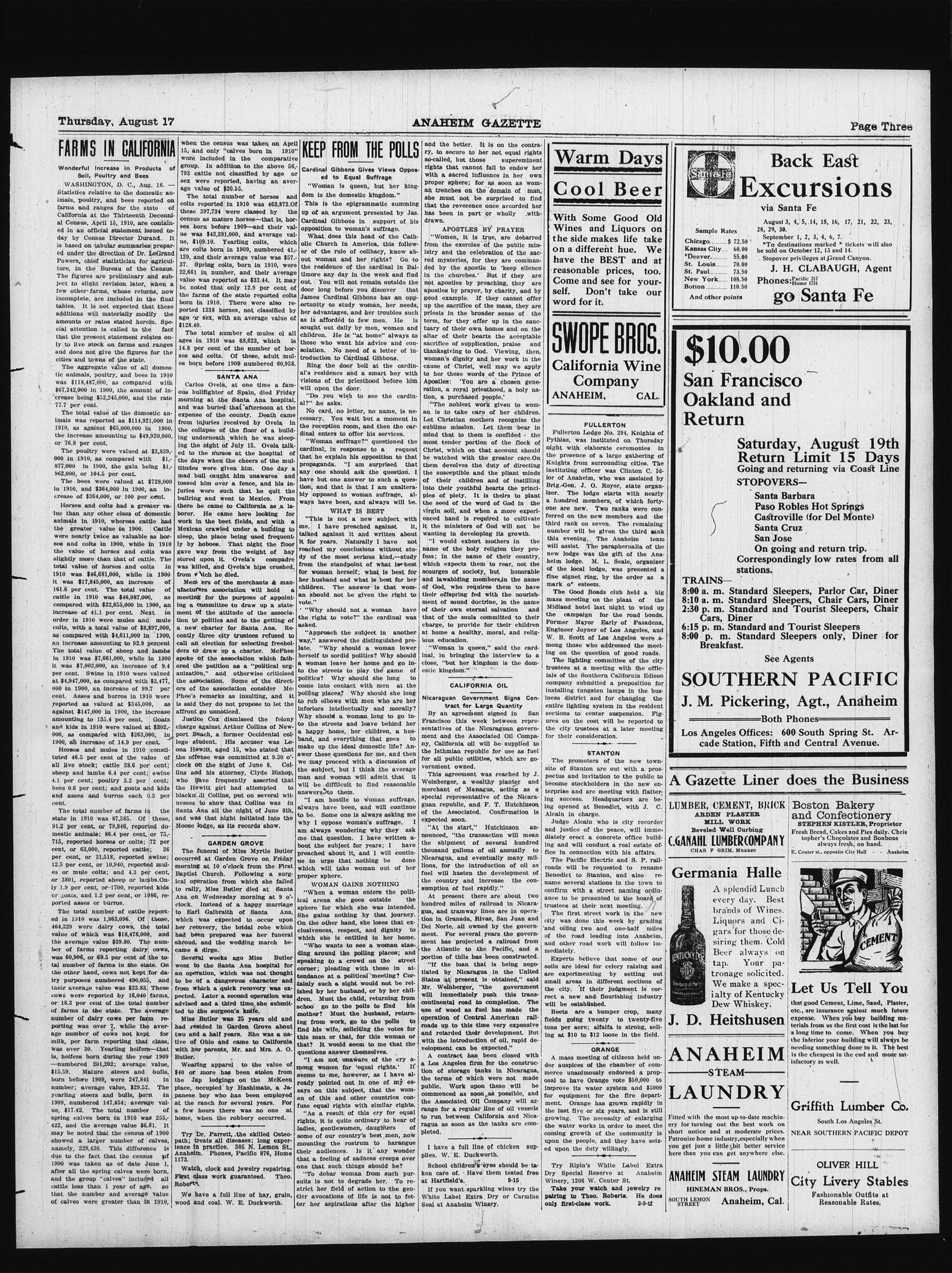
Searchable text
FARMS IN CALIFORNIA
Wonderful Increase in Products of Soil, Poultry and Bees
WASHINGTON, D. C., Aug. 16. — Statistics relative to the domestic animals, poultry, and bees reported on farms and ranges for the state of California at the Thirteenth Decennial Census, April 15, 1910, are contained in an official statement issued today by Census Director Durand. It is based on tabular summaries prepared under the direction of Dr. LeGrand Powers, chief statistician for agriculture, in the Bureau of the Census. The figures are preliminary and subject to slight revision later, when a few other farms, whose returns, now incomplete, are included in the final tables. It is not expected that these additions will materially modify the amounts or rates stated herein. Special attention is called to the fact that the present statement relates only to live stock on farms and ranges and does not give the figures for the cities and towns of the state.
The aggregate value of all domestic animals, poultry, and bees in 1910 was $118,487,000, as compared with $67,242,000 in 1900, the amount of increase being $52,245,000, and the rate 77.7 per cent.
The total value of the domestic animals was reported as $114,921,000 in 1910, as against $65,000,000 in 1900, the increase amounting to $49,920,000, or 76.8 per cent.
The poultry were valued at $3,839,000 in 1910, as compared with $1,-877,000 in 1900, the gain being $1,-962,000, or 104.5 per cent.
when the census was taken on April 15, and only "calves born in 1910" were included in the comparative group. In addition to the above 56,-793 cattle not classified by age or sex were reported, having an average value of $20.55.
The total number of horses and colts reported in 1910 was 462,872. Of these 397,734 were classed by the census as mature horses—that is, horses born before 1909—and their value was $43,391,000, and average value, $109.10. Yearling colts, which are colts born in 1909, numbered 41,-139, and their average value was $57.-37. Spring colts, born in 1910, were 22,661 in number, and their average value was reported as $33.44. It may be noted that only 12.9 per cent of the farms of the state reported colts born in 1910. There were also reported 1338 horses, not classified by age or sex, with an average value of $128.40.
The total number of mules ol all ages in 1910 was 68,623, which is 14.8 per cent of the number of horses and colts. Of these, adult mules born before 1909 numbered 60,958.
SANTA ANA
Carlos Ovela, at one time a famous bullfighter of Spain, died Friday morning at the Santa Ana hospital, and was buried that afternoon at the expense of the county. Death came from injuries received by Ovela in the collapse of the floor of a building underneath which he was sleeping the night of July 15. Ovela talked to the nurses at the hospital of the days when the cheers of the multitudes were given him. One day a mad bull sought him unmercifully.
KEEP FROM
Cardinal Gibbons ed to Equation
"Woman is quickdom is the domestics This is the epiphany up of an argument Cardinal Gibbons opposition to women What does thisolic Church in Aeroforce of the rule offour woman andthe residence of timore any day inout. You will not door long before James Cardinal Gorto opportunity to studyher advantages,andas is afforded tosought out daily children. He is" those who want his solation. No need introduction to Carrion Ring the door al's residence andvisions of the priestswill open the door "Do you wish al?" he asks.
No card, no letcessary. You waitthe reception roomdial enters to offer "Woman suffragacardinal, in responthat he explain hispropaganda." I any one should a
The total value of the domestic animals was reported as $114,921,000 in 1910, as against $65,000,000 in 1900, the increase amounting to $49,920,000, or 76.8 per cent.
The poultry were valued at $3,839,000 in 1910, as compared with $1,877,000 in 1900, the gain being $1,962,000, or 104.5 per cent.
The bees were valued at $728,000 in 1910, and $364,000 in 1900, an increase of $364,000, or 100 per cent.
Horses and colts had a greater value than any other class of domestic animals in 1910, whereas cattle had the greater value in 1900. Cattle were nearly twice as valuable as horses and colts in 1900, while in 1910 the value of horses and colts was slightly more than that of cattle. The total value of horses and colts in 1910 was $46,681,000, while in 1900 it was $17,845,000, an increase of 161.6 per cent. The total value of cattle in 1910 was $46,087,000, as compared with $32,655,000 in 1900, an increase of 41.1 per cent. Next in order in 1910 were mules and mule colts, with a total value of $8,897,000, as compared with $4,611,000 in 1900, an increase amounting to 92.9 percent. The total value of sheep and lambs in 1910 was $7,661,000, while in 1900 it was $7,003,000, an increase of 9.4 per cent. Swine in 1910 were valued at $4,947,000, as compared with $2,477,000 in 1900, an increase of 99.7 per cent. Asses and burros in 1910 were reported as valued at $345,000, as against $147,000 in 1900, the increase amounting to 135.4 per cent. Goats and kids in 1910 were valued at $302,000, as compared with $263,000, in 1900, an increase of 14.9 per cent.
Horses and mules in 1910 constituted 46.5 per cent of the value of all live stock; cattle 38.6 per cent; sheep and lambs 6.4 per cent; swine 4.1 per cent; poultry 3.2 per cent; bees 0.6 per cent; and goats and kids and asses and burros each 0.3 per cent.
The total number of farms in the state in 1910 was 87,585. Of these, 91.2 per cent, or 79,846, reported domestic animals; 86.4 per cent, or 75,715, reported horses or colts; 72 per cent, or 63,000, reported cattle; 36 per cent, or 31,518, reported swine; 12.5 per cent, or 10,940, reported mules or mule colts; and 4.3 per cent, or 3801, reported sheep or lambs. Only 1.9 per cent, or -1700, reported kids or goats; and 1.2 per cent, or 1086, re-
SANTA ANA
Carlos Ovela, at one time a famous bullfighter of Spain, died Friday morning at the Santa Ana hospital, and was buried that afternoon at the expense of the county. Death came from injuries received by Ovela in the collapse of the floor of a building underneath which he was sleeping the night of July 15. Ovela talked to the nurses at the hospital of the days when the cheers of the multitudes were given him. One day a mad bull caught him unawares and tossed him over a fence, and his injuries were such that he quit the bullring and went to Mexico. From there he came to California as a laborer. He came here looking for work in the beet fields, and with a Mexican crawled under a building to sleep, the place being used frequently by hoboes. That night the floor gave way from the weight of hay stored upon it. Ovela's compadre was killed, and Ovela's hips crushed, from which he died.
Members of the merchants & manufacturers association will hold a meeting for the purpose of appointing a committee to draw up a statement of the attitude of the association to politics and to the getting of a new charter for Santa Ana. Recently three city trustees refused to call an election for selecting freeholders to draw up a charter. McPhee spoke of the association which fathered the petition as a "political organization," and otherwise criticised the association. Some of the directors of the association consider McPhee's remarks as insulting, and it is said they do not propose to let the affront go unnoticed.
Justice Cox dismissed the felony charge against Arthur Collins of Newport Beach, a former Occidental college student. His accuser was Leona Hewitt, aged 15 who stated that the offense was committed at 9:30 o'clock on the night of June 8. Collins and his attorney Clyde Bishop who have frequently asserted that the Hewitt girl had attempted to blackmail Collins, put on several witnesses to show that Collins was in Santa Ana all the night of June 8th, and was that night initiated into the Moose lodge, as its records show.
GARDEN GROVE
The funeral of Miss Myrtle Butler occurred at Garden Grove on Friday morning at 10 o'clock from the First Baptist Church. Following a surgical operation from which she failed to rally, Miss Butler died at Santa Ana on Wednesday morning at 9 o'-
The total number of farms in the state in 1910 was 87,585. Of these, 91.2 per cent, or 79,846, reported domestic animals; 86.4 per cent, or 75.715, reported horses or colts; 72 per cent, or 63,000, reported cattle; 36 per cent, or 31,518, reported swine; 12.5 per cent, or 10,940, reported mules or mule colts; and 4.3 per cent, or 3801, reported sheep or lambs. Only 1.9 per cent, or 1700, reported kids or goats, and 1.2 per cent, or 1086, reported asses or burros.
The total number of cattle reported in 1910 was 1,863,096. Of these, 464,329 were dairy cows, the total value of which was $18,478,000, and the average value $39.80. The number of farms reporting dairy cows was 60,906, or 69.5 per cent of the total number of farms in the state. On the other hand, cows not kept for dairy purposes numbered 490,055, and their average value was $23.83. These cows were reported by 16,040 farms, or 18.3 per cent of the total number of farms in the state. The average number of dairy cows per farm reporting was over 7, while the average number of cows not kept for milk, per farm reporting that class, was over 30. Yearling heifers—that is, heifers born during the year 1909—numbered 201,202; average value, $15.59. Mature steers and bulls, born before 1909, were 247,841 in number; average value, $29.52. The yearling steers and bulls, born in 1909, numbered 147,454; average value, $17.42. The total number of spring calves born in 1910 was 255,-422, and the average value $6.81. It may be noted that the census of 1900 showed a larger number of calves, namely, 329,430. This difference is due to the fact that the census of 1900 was taken as of date June 1, after all the spring calves were born, and the group "calves" included all cattle less than 1 year of age, so that the number and average value of calves were greater than in 1910,
GARDEN GROVE
The funeral of Miss Myrtle Butler occurred at Garden Grove on Friday morning at 10 o'clock from the First Baptist Church. Following a surgical operation from which she failed to rally, Miss Butler died at Santa Ana on Wednesday morning at 9 o'clock. Instead of a happy marriage to Earl Galbraith of Santa Ana, which was expected to occur upon her recovery, the bridal robe which had been prepared was her funeral shroud, and the wedding march became a dirge.
Several weeks ago Miss Butler went to the Santa Ana hospital for an operation, which was not thought to be of a dangerous character and from which a quick recovery was expected. Later a second operation was advised and a third time she submitted to the surgeon's knife.
Miss Butler was 25 years old and had resided in Garden Grove about two and a half years. She was a native of Ohio and came to California with her parents, Mr. and Mrs. A. O. Butler.
Wearing apparel to the value of $40 or more has been stolen from the Jap lodgings on the McKeen place, occupied by Hashimato, a Japanese boy who has been employed at the ranch for several years. For a few hours there was no one at home, when the robbery occurred.
Try Dr. Parrett,.the skilled Osteopath; treats all diseases; long experience in practice. 305 N. Lemon St., Anaheim. Phones, Pacific 876, Home 1173.
Watch, clock and jewelry repairing. First class work guaranteed. Theo Roberta.
We have a full line of hay, grain, wood and coal. W.E.Duckworth.
"I am hostile to always have been to be. Some one if why I oppose work am always wonder me that question...about the subject f preached about it,...due to urge that which will take proper sphere.
WOMAN GAIN
"When a woman logical arena she goes sphere for which She gains nothing On the other hand clusiveness, respect which she is entitle "Who wants to ding around the pro speaking to a crowd corner; pleading tendance at a politically such a sightished by her husbanden. Must the choo go to the mother? Must thring from work, go find his wife,solid this man or that,...that? It would see questions answer tht "I am not unawongmong women for seems to me,how ready pointed out says on this subject en of this and ot fuse equal rights w"
"As a result of rights,它 is quite ol ladies,gentlewomen some of our countrymounting the roost their audiences that a feeling of sone that such thing."
"To debar womansuits is not to de strict her field of tter avocations of ter her aspirations."
KEEP FROM THE POLLS
Cardinal Gibbons Gives Views Opposed to Equal Suffrage
"Woman is queen, but her kingdom is the domestic kingdom."
This is the epigrammatic summing up of an argument presented by Jas. Cardinal Gibbons in support of his opposition to woman's suffrage.
What does this head of the Catholic Church in America, this follower of the rule of celibacy, know about woman and her rights? Go to the residence of the cardinal in Baltimore any day in the week and find out. You will not remain outside the door long before you discover that James Cardinal Gibbons has an opportunity to study woman, her needs, her advantages, and her troubles such as is afforded to few men. He is sought out daily by men, women and children. He is "at home" always to those who want his advice and consolation. No need of a letter of introduction to Cardinal Gibbons.
Ring the door bell at the cardinal's residence and a smart boy with visions of the priesthood before him will open the door.
"Do you wish to see the cardinal?" he asks.
No card, no letter, no name, is necessary. You wait but a moment in the reception room, and then the cardinal enters to offer his services.
"Woman suffrage?" questioned the cardinal, in response to a request that he explain his opposition to that propaganda. "I am surprised that any one should ask the question. I and the better. It is on the contrary, to secure to her not equal rights so-called, but those supereminent rights that cannot fail to endow her with a sacred influence in her own proper sphere; for as soon as woman trenches on the domain of man, she must not be surprised to find that the reverence once accorded her has been in part or wholly withdrawn.
APOSTLES BY PRAYER
"Women, it is true, are debarred from the exercise of the public ministry and the celebration of the sacred mysteries, for they are commanded by the apostle to 'keep silence in the churches.' But if they are not apostles by preaching, they are apostles by prayer, by charity, and by good example. If they cannot offer up the sacrifice of the mass, they are priests in the broader sense of the term, for they offer up in the sanctuary of their own homes and on the altar of their hearts the acceptable sacrifice of supplication, praise and thanksgiving to God. Viewing, then, woman's dignity and her work in the cause of Christ, well may we apply to her these words of the Prince of Apostles: 'You are a chosen generation, a royal priesthood, a holy nation, a purchased people.'"
"The noblest work given to woman is to take care of her children. Let Christian mothers recognize the sublime mission. Let them bear in mind that to them is confided—the most tender portion of the flock of Christ, which on that account should be watched with the greater care.On them devolves the duty of directing the susceptible and the pliant minds."
FULLERTON
Fullerton Lodge No. 294, Knights of Pythias, was instituted on Thursday night with elaborate ceremonies in the presence of a large gathering of Knights from surrounding cities. The instituting officer was Clinton C. Idlor of Anaheim, who was assisted by Brig.-Gen. J. O. Royer, state organizer. The lodge starts with nearly a hundred members, of which forty-one are new. Two ranks were conferred on the new members and the third rank on seven. The remaining number will be given the third rank this evening. The Anaheim team will assist. The paraphernalia of the new lodge was the gift of the Anaheim lodge. M. L. Seale, organizer of the local lodge, was presented a fine signet ring, by the order as a mark of esteem.
The Good Roads club held a big mass meeting on the plaza of the Midland hotel last night to wind up the campaign for the road bonds. Former Mayor Early of Pasadena, Engineer Joyner of Los Angeles, and W. B. Scott of Los Angeles were among those who addressed the meeting on the question of good roads.
The lighting committee of the city trustees at a meeting with the officials of the Southern California Edison company submitted a proposition for installing tungsten lamps in the business district and for changing the entire lighting system in the resident sections to center suspension. Figures on the cost will be reported to the city trustees at a later meeting for their consideration.
STANTON
The promoters of the new townsite of Stanton are out with a prospectus and invitation to the public to become stockholders in the new enterprise and are meeting with flattering success. Headquarters are being opened at Benedict, with J. C. Alcain in charge.
Judge Alcain who is city recorder and justice of the peace, will immediately erect a concrete office building and will conduct a real estate office in connection with his affairs.
The Pacific Electric and S. P. railroads will be requested to rename Benedict to Stanton, and also rename several stations in the town to confirm with a street naming ordinance to be presented to the board of
"I am hostile to woman suffrage, always have been, and will continue to be. Some one is always asking me why I oppose woman's suffrage. I am always wondering why they ask me that question. I have preached about it, and I will continue to urge that nothing be done which will take woman out of her proper sphere.
WOMAN GAINS NOTHING
"When a woman enters the political arena she goes outside the sphere for which she was intended. She gains nothing by that journey. On the other hand, she loses that exclusiveness, respect, and dignity to which she is entitled in her home.
"Who wants to see a woman standing around the polling places; and speaking to a crowd on the street corner; pleading with those in attendance at a political meeting? Certainly such a sight would not be relished by her husband, or by her children. Must the child, returning from school go to the polls to find his mother? Must the husband, returning from work, go to the polls to find his wife, soliciting the votes for this man or that, for this woman or that? It would seem to me that the questions answer themselves.
"I am not unaware of the cry among women for 'equal rights.' It seems to me, however, as I have already pointed out in one of my essays on this subject, that the women of this and other countries confuse equal rights with similar rights.
"As a result of this cry for equal rights, it is quite ordinary to hear of ladies, gentlewomen, daughters of some of our country's best men, now mounting the rostrum to harangue their audiences. Is it any wonder that a feeling of sadness creeps over one that such things should be?
"To debar woman from such pursuits is not to degrade her. To restrict her field of action to the gentler avocations of life is not to fetter her aspirations after the higher special representative of the Nicaraguan republic, and F. T. Hutchinson of the Associated. Confirmation is expected soon.
"At the start," Hutchinson announced, "the transaction will mean the shipment of several hundred thousand gallons of oil annually to Nicaragua, and eventually many millions, for the introduction of oil as fuel will hasten the development of the country and increase the consumption of fuel rapidly."
At present there are about two hundred miles of railroad in Nicaragua, and tramway lines are in operation in Granada, Rivas, San Juan and Del Norte, all owned by the government. For several years the government has projected a railroad from the Atlantic to the Pacific, and a portion of this has been constructed.
"If the loan that is being negotiated by Nicaragua in the United States at present is obtained," said Mr. Weinberger, "the government will immediately push this transcontinental road to completion. The use of wood as fuel has made the operation of Central American railroads up to this time very expensive and retarded their development. But with the introduction of oil, rapid development can be expected."
A contract has been closed with a Los Angeles firm for the construction of storage tanks in Nicaragua, the terms of which were not made public. Work upon these will be commenced as soon as possible, and the Associated Oil Company will arrange for a regular line of oil vessels to run between California and Nicaragua as soon as the tanks are completed.
I have a full line of chicken supplies. W. E. Duckworth.
School children's eyes should be taken care of. Have them tested free at Hartfield's.
If you want sparkling wines try the White Label Extra Dry or Carmine Seal at Anaheim Winery."
Back East Excursions
via Santa Fe
August 3, 4, 5, 14, 15, 16, 17, 21, 22, 23,
28, 29, 30.
September 1, 2, 3, 4, 6, 7.
*To destinations marked * tickets will also
be sold on October 12, 13 and 14.
Stopover privileges at Grand Canyon.
J. H. CLABAUGH, Agent
Phones: Pacific 217
Home 1751
go Santa Fe
$10.00
San Francisco
Oakland and
Return
Saturday, August 19th
Return Limit 15 Days
Going and returning via Coast Line
San Francisco
Oakland and
Return
Saturday, August 19th
Return Limit 15 Days
Going and returning via Coast Line
STOPOVERS—
Santa Barbara
Paso Robles Hot Springs
Castroville (for Del Monte)
Santa Cruz
San Jose
On going and return trip.
Correspondingly low rates from all stations.
TRAINS—
8:00 a.m. Standard Sleepers, Parlor Car, Diner
8:10 a.m. Standard Sleepers, Chair Cars, Diner
2:30 p.m. Standard and Tourist Sleepers, Chair Cars, Diner
6:15 p.m. Standard and Tourist Sleepers
8:00 p.m. Standard Sleepers only, Diner for Breakfast.
See Agents
SOUTHERN PACIFIC
J. M. Pickering, Agt., Anaheim
Both Phones
Los Angeles Offices: 600 South Spring St. Arcade Station, Fifth and Central Avenue.
A Gazette Liner does the Business
LUMBER, CEMENT, BRICK
ARDEN PLASTER
MILL WORK
Beveled Well Curbing
C.GANAHL LUMBER COMPANY
CHAS F GRIM. Mnaage
Boston Bakery and Confectionery
STEPHEN KISTLER, Proprietor
Fresh Bread, Cakes and Pies daily. Chris topher’s Chocolates and Bonbons always fresh, on hand.
E. Center st., opposite City Hall · Anaheim
Germania Halle
A splendid Lunch every day
LUMBER, CEMENT, BRICK
ARDEN PLASTER
MILL WORK
Beveled Well Curbing
C.GANAHL LUMBER COMPANY
CHAS F GRIM. Mnaage
Germania Halle
A splendid Lunch every day. Best brands of Wines. Liquors and Cigars for those desiring them. Cold Beer always on tap. Your patronage solicited. We make a specialty of Kentucky Dew Whiskey.
J. D. Heitshusen
ANAHEIM
STEAM
LAUNDRY
Fitted with the most up-to-date machinery for turning out the best work on short notice and at moderate prices. Patronize home industry, especially when you get just a little bit better service here than you can get anywhere else.
ANAHEIM STEAM LAUNDRY
HINEMAN BROS., Props.
SOUTH LEMON STREET Anaheim, Cal.
Boston Bakery and Confectionery
STEPHEN KISTLER, Proprietor
Fresh Bread, Cakes and Pies daily. Chris topher's Chocolates and Bonbons always fresh, on hand.
E. Center st., opposite City Hall Anaheim
Let Us Tell You
that good Cement, Lime, Sand, Plaster, etc., are insurance against much future expense. When you buy building materials from us the first cost is the last for a long time to come. When you buy the inferior your building will always be needing something done to it. The best is the cheapest in the end and more satisfactory as well.
Griffith Lumber Co.
South Los Angeles St.
NEAR SOUTHERN PACIFIC DEPOT
OLIVER HILL
City Livery Stables
Fashionable Outfits at Reasonable Rates.