anaheim-gazette 1911-07-20
Scanned page
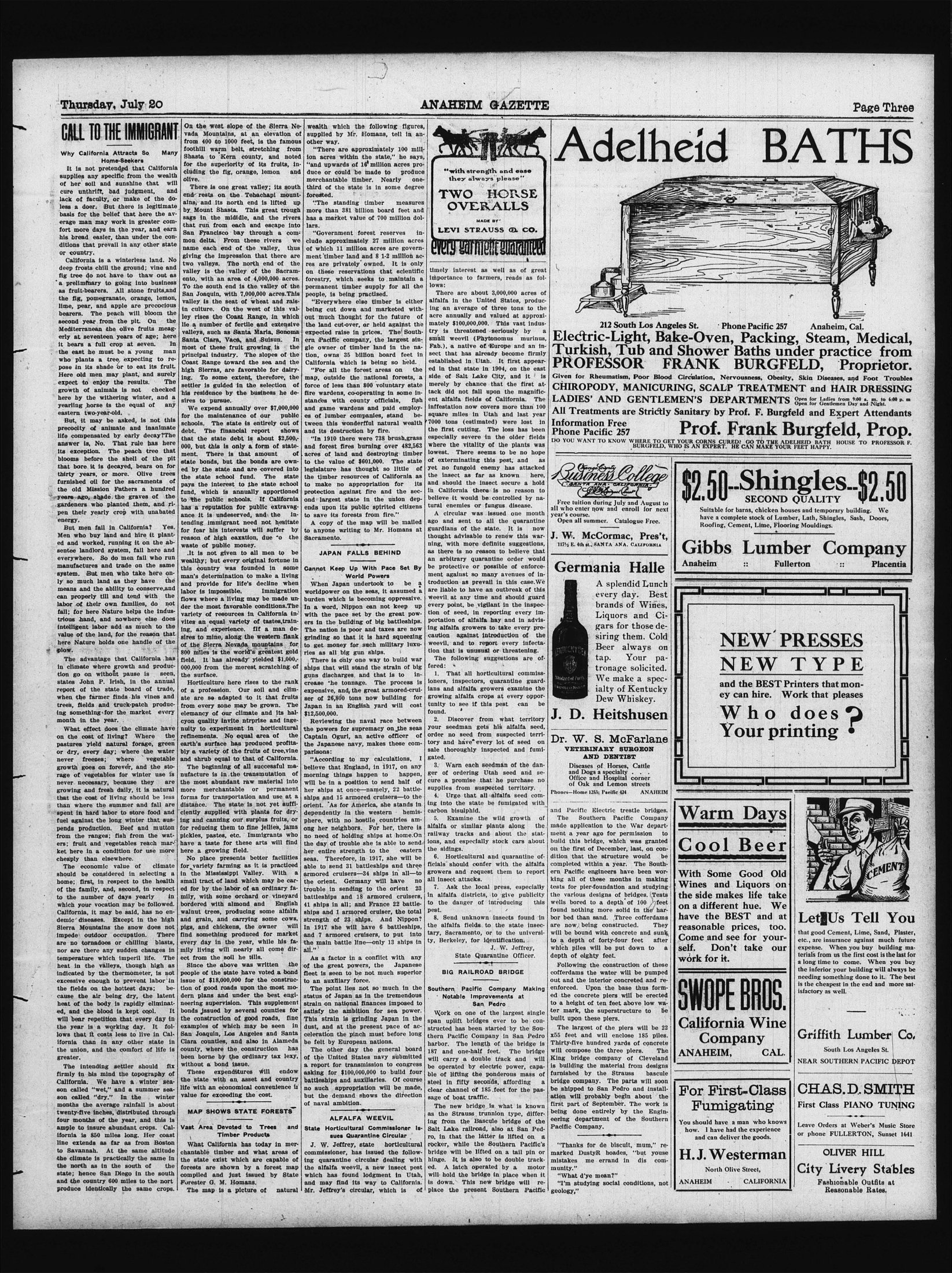
Searchable text
CALL TO THE IMMIGRANT
Why California Attracts So Many Home-Seekers
It is not pretended that California supplies any specific from the wealth of her soil and sunshine that will cure unthrift, bad judgment, and lack of faculty, or make of the doleess a doer. But there is legitimate basis for the belief that here the average man may work in greater comfort more days in the year, and earn his bread easier, than under the conditions that prevail in any other state or country.
California is a winterless land. No deep frosts chill the ground; vine and fig tree do not have to thaw out as a preliminary to going into business as fruit-bearers. All stone fruits, and the fig, pomegranate, orange, lemon, lime, pear, and apple are precocious bearers. The peach will bloom the second year from the pit. On the Mediterranean the olive fruits meagerly at seventeen years of age; here it bears a full crop at seven. In the east he must be a young man who plants a tree, expecting to repose in its shade or to eat its fruit. Here old men may plant, and surely expect to enjoy the results. The growth of animals is not checked here by the withering winter, and a yearling horse is the equal of any eastern two-year-old.
But, it may be asked, is not this precocity of animate and inanimate life compensated by early decay? The answer is, No. That rule has here its exception. The peach tree that blooms before the shell of the pit that bore it is decayed, bears on for thirty years or more. Olive trees
On the west slope of the Sierra Nevada Mountains, at an elevation of from 400 to 1000 feet, is the famous foothill warm belt, stretching from Shasta to Kern county, and noted for the superiority of its fruits, including the fig, orange, lemon and olive.
There is one great valley; its south end rests on the Tehachapi mountains, and its north end is lifted up by Mount Shasta. This great trough sags in the middle, and the rivers that run from each and escape into San Francisco bay through a common delta. From these rivers we name each end of the valley, thus giving the impression that there are two valleys. The north end of the valley is the valley of the Sacramento, with an area of 4,000,000 acres. To the south end is the valley of the San Joaquin, with 7,000,000 acres. This valley is the seat of wheat and raisin culture. On the west of this valley rises the Coast Range, in which lie a number of fertile and extensive valleys, such as Santa Maria, Sonoma Santa Clara, Vaca, and Suisun. In most of these fruit growing is the principal industry. The slopes of the Coast Range toward the sea and the high Sierras, are favorable for dairying. To some extent, therefore, the settler is guided in the selection of his residence by the business he desires to pursue.
We expend annually over $7,000,000 for the maintenance of our public schools. The state is entirely out of debt. The financial report shows that the state debt is about $2,500,-000, but this is only a form of statement. There is that amount of state bonds, but the bonds are owned by the state and are covered into wealth which is supplied by Mr. other way.
“There are advantages within “and upwards o’duce or could be merchantable third of the state forested.
“The standing more than 381 has a market value.
“Government include approximations of which 11 million timber lands are private on these reservoirs forestry, which permanent timber people, is being “Everywhere being cut down out much though the land cut-over expected raise inern Pacific com glete owner of tion, owns 35 California which.
“For all the map, outside ther force of less than fire wardens, co stances with co and game wardees of lumber co tween this wond and its destructi
“In 1910 there and forest fires acres of land ad to the value of legislature has
Here old men may plant, and surely expect to enjoy the results. The growth of animals is not checked here by the withering winter, and a yearling horse is the equal of any eastern two-year-old.
But, it may be asked, is not this precocity of animate and inanimate life compensated by early decay? The answer is, No. That rule has here its exception. The peach tree that blooms before the shell of the pit that bore it is decayed, bears on for thirty years, or more. Olive trees furnished oil for the sacraments of the old Mission Fathers a hundred years ago, shade the graves of the gardeners who planted them, and ripen their yearly crop with unabated energy.
But men fail in California? Yes. Men who buy land and hire it planted and worked, running it on the absentee landlord system, fall here and everywhere. So do men fail who run manufactures and trade on the same system. But men who take here only so much land as they have the means and the ability to conserve, and can properly till and tend with the labor of their own families, do not fall; for here Nature helps the industrious hand, and nowhere else does intelligent labor add as much to the value of the land, for the reason that here Nature holds one handle of the plow.
The advantage that California has in climate where growth and production go on without pause is seen, states John P. Irish, in the annual report of the state board of trade, when the farmer finds his vines and trees, fields and truck-patch producing something for the market every month in the year.
What effect does the climate have on the cost of living? Where the pastures yield natural forage, green or dry, every day; where the water never freezes; where vegetable growth goes on forever, and the storage of vegetables for winter use is never necessary, because they are growing and fresh daily, it is natural that the cost of living should be less than where the summer and fall are spent in hard labor to store food and fuel against the long winter that suspends production. Beef and mutton from the ranges; fish from the waters; fruit and vegetables reach market here in a condition for use more cheaply than elsewhere.
The economic value of climate should be considered in selecting a home; first, in respect to the health of the family, and, second, in respect to the number of days yearly in
To some extent, therefore, the settler is guided in the selection of his residence by the business he desires to pursue.
We expend annually over $7,000,000 for the maintenance of our public schools. The state is entirely out of debt. The financial report shows that the state debt is about $2,500,-000, but this is only a form of statement. There is that amount of state bonds, but the bonds are owned by the state and are covered into the state school fund. The state pays the interest to the state school fund, which is annually apportioned to the public schools. If California has a reputation for public extravagance it is undeserved, and the intending immigrant need not hesitate for fear his interests will suffer by reason of high eaxation, due "o the waste of public money.
It is not given to all men to be wealthy; but every original fortune in this country was founded in some man's determination to make a living and provide for life's decline when labor is impossible. Immigration flows where a living may be made under the most favorable conditions. The variety of resources in California invites an equal variety of tastes,training,and experience. If a man desires to mine, along the western flank of the Sierra Nevada mountains for 800 miles is the world's greatest gold field. It has already yielded $1,000,-000,000 from the merest scratching of the surface.
Horticulture here rises to the rank of a profession. Our soil and climate are so adapted to it that fruits from every zone may be grown. The elegancy of our climate and its halcyon quality invite ntrprise and ingenuity to experiment in horticultural refinements. No equal area of the earth's surface has produced profitably a variety of the fruits of tree,vine and shrub equal to that of California.
The beginning of all successful manufacture is in the transmutation of the most abundant raw material into more merchantable or permanent forms for transportation and use at a distance. The state is not yet sufficiently supplied with plants for drying and canning our surplus fruits, or for reducing them to fine jellies,jams pickles,pastes,etc. Immigrants who have a taste for these arts will find here a growing field.
No place presents better facilities for variety farming as it is practiced in the Mississippi Valley. With a small tract of land which may be carved for by the labor of an ordinary family,with some orchard or vineyard map, outside tha force of less than fire wardens,costances with co- game wardenes of lumber co-tween this wonderand its destruction.
"In 1910 there and forest fires acres of land ad to the value of legislature has the timber resource to make no ap-protection against and largest state ends upon its power to save its forests.
A copy of this to anyone writing Sacramento.
JAPAN FAIR
Cannot Keep Up
When Japan worldpower on ther burden which is In a word,Nippon with the pace sers in the buildi The nation is po grinding so that to get money fo ries as all big g There is only ships that will se guns discharges crease "he tonn expensive,and,the ser of 26,800 to Japan in an En $12,500,000.
Reviewing these the powers for s Captain Oguri,s the Japanese na parisons:
"According to believe that Eng morning things will be in a pos her ships at once ships and 15 arm orient.As for A dependently in pphere,with no oong her neighbor no need of holdi the day of trouble her entire streng seas. Therefore able to send 31 armored cruisersthe orient.Gern trouble in sending battleships and
The economic value of climate should be considered in selecting a home; first, in respect to the health of the family, and, second, in respect to the number of days yearly in which your vocation may be followed. California, it may be said, has no endemic diseases. Except in the high Sierra Mountains the snow does not impede outdoor occupation. There are no tornadoes or chilling blasts, nor are there any sudden changes in temperature which imperil life. The heat in the valleys, though high as indicated by the thermometer, is not excessive enough to prevent labor in the fields on the hottest days; because the air being dry, the latent heat of the body is rapidly eliminated, and the blood is kept cool. It will bear repetition that every day in the year is a working day. It follows that it costs less to live in California than in any other state in the union, and the comfort of life is greater.
The intending settler should fix firmly in his mind the topography of California. We have a winter season called "wet," and a summer season called "dry." In the winter months the average rainfall is about twenty-five inches, distributed through four months of the year, and this is ample to insure abundant crops. California is 850 miles long. Her coast line extends as far as from Boston to Savannah. At the same altitude the climate is practically the same in the north as in the south of the state; hence San Diego in the south and the country 600 miles to the northeast produce identically the same crops.
No place presents better facilities for variety farming as it is practiced in the Mississippi Valley. With a small tract of land which may be cared for by the labor of an ordinary family, with some orchard or vineyard bordered with almond and English walnut trees, producing some alfalfa and grain, and carrying some cows, pigs, and chickens, the owner will find something produced for market every day in the year, while his family living will nearly all come direct from the soil he tills.
Since the above was written the people of the state have voted a bond issue of $18,000,000 for the construction of good roads upon the most modern plans and under the best engineering supervision. This supplement bonds issued by several counties for the construction of good roads, fine examples of which may be seen in San Joaquin, Los Angeles and Santa Clara counties, and also in Alameda county, where the construction has been borne by the ordinary tax levy, without a bond issue.
These expenditures will endow the state with an asset and country life with an economical convenience in value for exceeding the cost.
MAP SHOWS STATE FORESTS
Vast Area Devoted to Trees and Timber Products
What California has today in merchantable timber and what areas of the state exist which are capable of forests are shown by a forest map compiled and just issued by State Forester G. M. Homans.
The map is a picture of natural forms for transportation and use at distance. The state is not yet sufficiently supplied with plants for drying and canning our surplus fruits, or for reducing them to fine jellies, jams pickles, pastes, etc. Immigrants who have a taste for these arts will find here a growing field.
As for A dependently in this sphere, with no long her neighborhood no need of holding her entire strength seas. Therefore able to send 31 armored cruisers to the orient. Germany trouble in sending battleships and 41 ships in all; ships and 1 armored strength of 23 In 1917 she will and 7 armored of the main battle fleet all."
As a factor in of the great power fleet is seen to be an auxiliary force.
The point lies status of Japan on strain on national satisfy the ambition. This strain is given dust, and at the celebration the prize felt by Europe.
The other days of the United States a report for transmitting for $100 battleships and no such appropriation but the demand of naval ambition.
ALFALFA
State Horticulture sues Quail
J. W. Jeffrey commissioner, having quarantined which has found Mr. Jeffrey's cline.
ANAHEIM GAZETTE
wealth which the following figures, supplied by Mr. Homans, tell in another way.
"There are approximately 100 million acres within the state," he says, "and upwards of 16 million acres produce or could be made to produce merchantable timber. Nearly one-third of the state is in some degree forested.
"The standing timber measures more than 381 billion board feet and has a market value of 700 million dollars.
"Government forest reserves include approximately 27 million acres of which 11 million acres are government timber land and 8 1-2 million acres are privately owned. It is only on these reservations that scientific forestry, which seeks to maintain a permanent timber supply for all the people, is being practised.
"Everywhere else timber is either being cut down and marketed without much thought for the future of the land cut-over, or held against the expected raise in prices. The Southern Pacific company, the largest single owner of timber land in the nation, owns 35 billion board feet in California which is being so held.
"For all the forest areas on the map, outside the national forests, a force of less than 800 voluntary state fire wardens, co-operating in some instances with county officials, fish and game wardens and paid employees of lumber companies, stand between this wonderfull natural wealth and its destruction by fire.
"In 1910 there were 738 brush, grass and forest fires burning over 482,563 acres of land and destroying timber to the value of $601,000. The state legislature has thought so little of timely interest as well as of great importance to farmers, reads as follows:
There are about 3,000,000 acres of alfalfa in the United States, producing an average of three tons to the acre annually and valued at approximately $100,000,000. This vast industry is threatened seriously by a small weevil (Phytonomus murinus, Fab.), a native of Europe and an insect that has already become firmly established in Utah. It first appeared in that state in 1904, on the east side of Salt Lake City, and it is merely by chance that the first attack did not fall upon the magnificent alfalfa fields of California. The infestation now covers more than 100 square miles in Utah and last year 7000 tons (estimated) were lost in the first cutting. The loss has been especially severe in the older fields where the vitality of the plants was lowest. There seems to be no hope of exterminating this pest; and as yet no fungoid enemy has attacked the insect as far as known here."
map, outside the national forests, a force of less than 800 voluntary state fire wardens, co-operating in some instances with county officials, fish and game wardens and paid employees of lumber companies, stand between this wonderful natural wealth and its destruction by fire.
"In 1910 there were 738 brush, grass and forest fires burning over 482,563 acres of land and destroying timber to the value of $601,000. The state legislature has thought so little of the timber resources of California as to make no appropriation for its protection against fire and the second largest state in the union depends upon its public spirited citizens to save its forests from fire."
A copy of the map will be mailed to anyone writing to Mr. Homans at Sacramento.
JAPAN FALLS BEHIND
Cannot Keep Up With Pace Set By World Powers
When Japan undertook to be a worldpower on the seas, it assumed a burden which is becoming oppressive. In a word, Nippon can not keep up with the pace set by the great powers in the building of big battleships. The nation is poor and taxes are now grinding so that it is hard squeezing to get money for such military luxuries as all big gun ships.
There is only one way to build war ships that will stand the strain of big guns discharges, and that is to increase the tonnage. The process is expensive, and the great armored-cruiser of 26,800 tons now building for Japan in an English yard will cost $12,500,000.
Reviewing the naval race between the powers for supremacy on the seas Captain Oguri, an active officer of the Japanese navy, makes these comparisons:
"According to my calculations, I believe that England, in 1917, on any morning things happen to happen, will be in a position to send half of her ships at once—namely, 22 battleships and 15 armored cruisers—the orient. As for America, she stands in dependently in the western hemisphere, with no hostile countries among her neighbors. For her, there is no need of holding ships at home. On the day of trouble she is able to send her entire strength to the eastern seas. Therefore, in 1917, she will be able to send 31 battleships and three armored cruisers—34 ships in all—the orient. Germany will have no trouble in sending to the orient 23 battleships and 18 armored cruisers,
side of Salt Lake City, and it is merely by chance that the first attack did not fall upon the magnificent alfalfa fields of California. The infestation now covers more than 100 square miles in Utah and last year 7000 tons (estimated) were lost in the first cutting. The loss has been especially severe in the older fields where the vitality of the plants was lowest. There seems to be no hope of exterminating this pest, and as yet no fungoid enemy has attacked the insect as far as known here, and should the insect secure a hold in California there is no reason to believe it would be controlled by natural enemies or fungus disease.
A circular was issued one month ago and sent to all the quarantine guardians of the state. It is now thought advisable to renew this warning, with more definite suggestions, as there is no reason to believe that an arbitrary quarantine order would be protective or possible of enforcement against so many avenues of introduction as prevail in this case. We are liable to have an outbreak of this weevil, at any time and should guard every point, be vigilant in the inspection of seed, in reporting every importation of alfalfa hay and in advising alfalfa growers to take every precaution against introduction of the weevil, and to report every infection that is unusual or threatening.
The following suggestions are offered:
1. That all horticultural commissioners, inspectors, quarantine guardians and alfalfa growers examine the growing alfalfa crops at every opportunity to see if this pest can be found.
2. Discover from what territory your seedman gets his alfalfa seed, order no seed from suspected territory and have every lot of seed on sale thoroughly inspected and fumigated.
3. Warn each seedman of the danger of ordering Utah seed and secure a promise that he purchase no supplies from suspected territory.
4. Urge that all alfalfa seed coming into the state be fumigated with carbon bisulphid.
5. Examine the wild growth of alfalfa or similar plants along the railway tracks and about the stations, and especially stock cars about the sidings.
6. Horticultural and quarantine officials should confer with the alfalfa growers and request them to report all insect attacks.
7. Ask the local press, especially in alfalfa districts, to give publicity
and Pacific Electric trestle bridges. The Southern Pacific Company made application to the War department a year ago for permission to build this bridge, which was granted on the first of December, last, on condition that the structure would be completed within a year. The Southern Pacific engineers have been working all of these months in making tests for pier-foundation and studying the various designs of bridges. Tests
As for America, she stands in dependently in the western hemisphere, with no hostile countries among her neighbors. For her, there is no need of holding ships at home. On the day of trouble she is able to send her entire strength to the eastern seas. Therefore, in 1917, she will be able to send 31 battleships and three armored cruisers—34 ships in all—to the orient. Germany will have no trouble in sending to the orient 23 battleships and 18 armored cruisers, 41 ships in all; and France 22 battle-ships and 1 armored cruiser, the total strength of 23 ships. And Nippon? In 1917 she will have 6 battleships, and 7 armored cruisers, to put into the main battle line—only 13 ships in all."
As a factor in a conflict with any of the great powers, the Japanese fleet is seen to be not much superior to an auxiliary force.
The point lies not so much in the status of Japan as in the tremendous strain on national finances imposed to satisfy the ambition for sea power. This strain is grinding Japan in the dust, and at the present pace of acceleration the pinch must before long be felt by European nations.
The other day the general board of the United States navy submitted a report for transmission to congress asking for $100,000,000 to build four battleships and auxiliaries. Of course no such appropriation will be made, but the demand shows the direction of naval ambition.
ALFALFA WEEVIL
State Horticultural Commissioner Issues Quarantine Circular
J. W. Jeffrey, state horticultural commissioner, has issued the following quarantine circular dealing with the alfalfa weevil, a new insect pest which has found lodgment in Utah, and may find its way to California. Mr. Jeffrey's circular, which is of ing into the state be fumigated with carbon bisulphid.
5. Examine the wild growth of alfalfa or similar plants along the railway tracks and about the stations, and especially stock cars about the sidings.
6. Horticultural and quarantine officials should confer with the alfalfa growers and request them to report all insect attacks.
7. Ask the local press, especially in alfalfa districts, to give publicity to the danger of introducing this pest.
8. Send unknown insects found in the alfalfa fields to the state insectary, Sacramento, or to the university, Berkeley, for identification.
J. W. Jeffrey,
State Quarantine Officer.
BIG RAILROAD BRIDGE
Southern Pacific Company Making Notable Improvements at San Pedro
Work on one of the largest single span uplift bridges ever to be constructed has been started by the Southern Pacific Company in San Pedro harbor. The length of the bridge is 187 and one-half feet. The bridge will carry a double track and will be operated by electric power, capable of lifting the ponderous mass of steel in fifty seconds, affording a clear channel of 185 feet for the passage of boat traffic.
The new bridge is what is known as the Strauss trunion type, differing from the Bascule bridge of the Salt Lake railroad, also at San Pedro, in that the latter is lifted on a rocker, while the Southern Pacific's bridge will be lifted on a tail pin or hinge. It is also to be double tracked. A latch operated by a motor will hold the bridge in place when it is down. This new bridge will replace the present Southern Pacific and Pacific Electric trestle bridges.
The Southern Pacific Company made application to the War department a year ago for permission to build this bridge, which was granted on the first of December, last, on condition that the structure would be completed within a year. The Southern Pacific engineers have been working all of these months in making tests for pier-foundation and studying the various designs of bridges. Tests well bored to a depth of 100 feet found nothing more solid in the harbor bed than sand. Three cofferdams are now being constructed. They will be bound with concrete and sunk to a depth of forty-four feet after which piles will be put down to a depth of eighty feet.
Following the construction of these cofferdams the water will be pumped out and the interior concreted and reinforced. Upon the base thus formed the concrete piers will be erected to a height of ten feet above low water mark, the superstructure to be built upon these piers.
The largest of the piers will be 22 x55 feet and will enclose 185 piles. Thirty-five hundred yards of concrete will compose the three piers. The King bridge company of Cleveland is building the material from designs furnished by the Strauss bascule bridge company. The parts will soon be shipped to San Pedro and installation will probably begin about the first part of September. The work is being done entirely by the Engineering department of the Southern Pacific Company.
"Thanks for de biscuit, mum," remarked DustyR hoades, "but youse mistakes me errand in dis community."
"What d'ye mean?"
"I'm studying social conditions, not geology,"
DELHEID BATHS
212 South Los Angeles St. Phone Pacific 257 Anaheim, Cal.
c-Light, Bake-Oven, Packing, Steam, Medical,
sh, Tub and Shower Baths under practice from
ESSOR FRANK BURGFELD, Proprietor.
neumatism, Poor Blood Circulation, Nervousness, Obesity, Skin Diseases, and Foot Troubles
DDY, MANICURING, SCALP TREATMENT and HAIR DRESSING
AND GENTLEMEN'S DEPARTMENTS Open for Ladies from 9:00 a.m. to 6:00 p.m.
Open for Gentlemen Day and Night.
ments are Strictly Sanitary by Prof. F. Burgfeld and Expert Attendants
on Free
Specific 257
Prof. Frank Burgfeld, Prop.
TO KNOW WHERE TO GET YOUR CORNS CURED? GO TO THE ADELHEID BATH HOUSE TO PROFESSOR F.
BURGFELD, WHO IS AN EXPERT. HE CAN MAKE YOUR FEET HAPPY.
Neumatism, Poor Blood Circulation, Nervousness, Obesity, Skin Diseases, and Foot Troubles
BODY, MANICURING, SCALP TREATMENT and HAIR DRESSING
AND GENTLEMEN'S DEPARTMENTS Open for Ladies from 9:00 a.m. to 6:00 p.m.
Open for Gentlemen Day and Night.
Items are Strictly Sanitary by Prof. F. Burgfeld and Expert Attendants
Free
Specific 257
Prof. Frank Burgfeld, Prop.
TO KNOW WHERE TO GET YOUR CORNS CURED? GO TO THE ADELHEID BATH HOUSE TO PROFESSOR F.
BURGFELD, WHO IS AN EXPERT. HE CAN MAKE YOUR FEET HAPPY.
Press College
NA: CALIFORNIA
During July and August to
now and enroll for next
mer. Catalogue Free.
Cormac, Pres't,
SANTA ANA, CALIFORNIA
Ania Halle
A splendid Lunch
every day. Best
brands of Wines,
Liquors and Cigars for those desiring them. Cold
Beer always on
tap. Your patronage solicited.
We make a speccialty of Kentucky
Dew Whiskey.
Heitshusen
S. McFarlane
NARY SURGEON
DENTIST
of Horses, Cattle
a specialty ...
and Hospital corner
and Lemon streets
Pacific 424
ANAHEIM
$2.50--Shingles--$2.50
SECOND QUALITY
Suitable for barns, chicken houses and temporary building. We
have a complete stock of Lumber, Lath, Shingles, Sash, Doors,
Roofing, Cement, Lime, Flooring Mouldings.
Gibbs Lumber Company
Anaheim :: Fullerton :: Placentia
NEW PRESSES
NEW TYPE
and the BEST Printers that money can hire. Work that pleases
Who does Your printing?
Warm Days
Cool Beer
With Some Good Old
Wines and Liquors on
the side makes life take
Warm Days
Cool Beer
With Some Good Old Wines and Liquors on the side makes life take on a different hue. We have the BEST and at reasonable prices, too. Come and see for yourself. Don't take our work for it.
SWOPE BROS.
California Wine Company
ANAHEIM, CAL.
For First-Class Fumigating
You should have a man who knows how. I have had the experience and can deliver the goods.
H.J. Westerman
North Olive Street,
ANAHEIM CALIFORNIA
Let Us Tell You
that good Cement, Lime, Sand, Plaster, etc., are insurance against much future expense. When you buy building materials from us the first cost is the last for a long time to come. When you buy the inferior your building will always be needing something done to it. The best is the cheapest in the end and more satisfactory as well.
Griffith Lumber Co.
South Los Angeles St.
NEAR SOUTHERN PACIFIC DEPOT
CHAS.D.SMITH
First Class PIANO TUNING
Leave Orders at Weber's Music Store or phone FULLERTON, Sunset 1641
OLIVER HILL
City Livery Stables
Fashionable Outfits at Reasonable Rates.