anaheim-gazette 1911-06-29
Scanned page
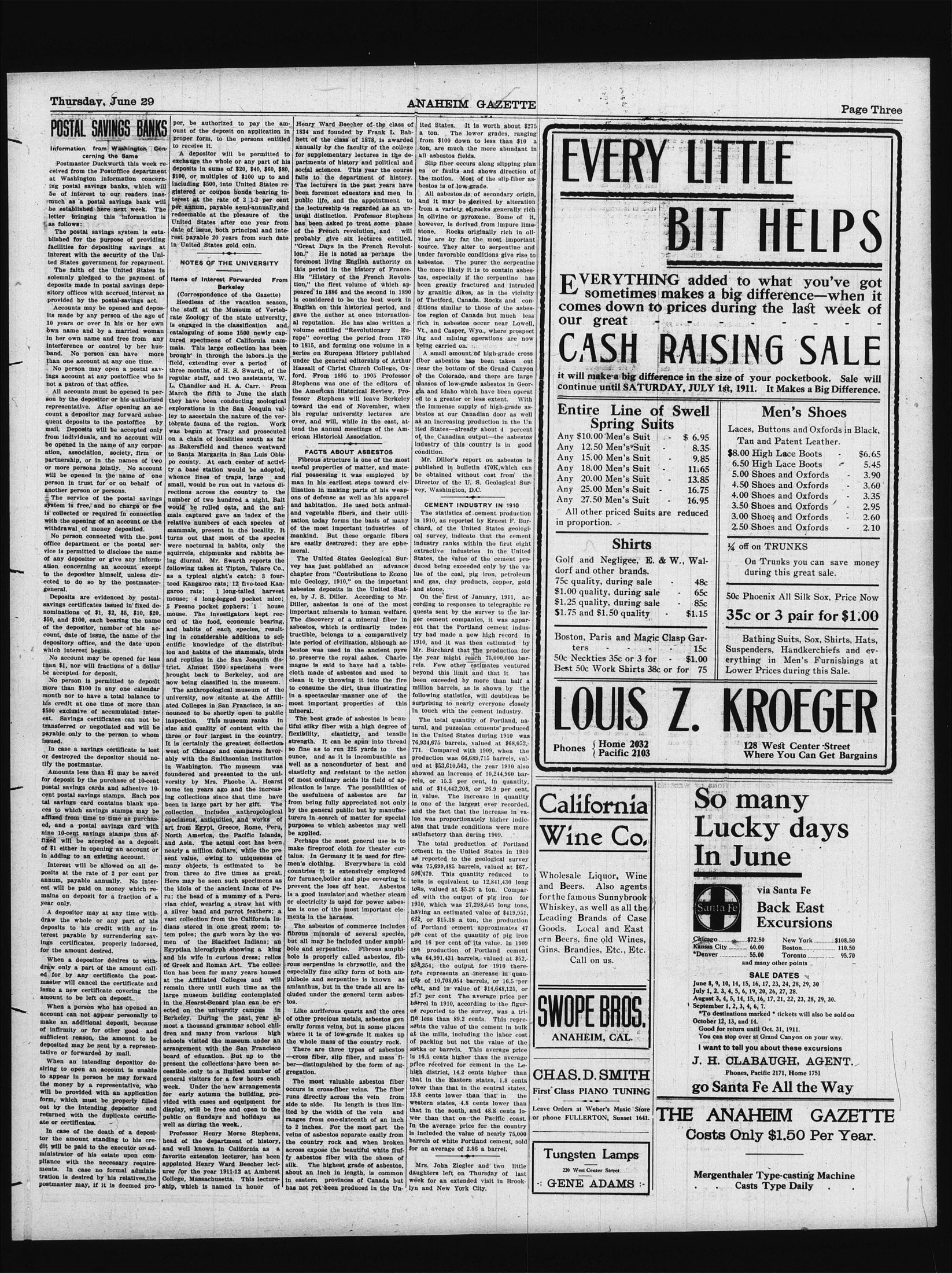
Searchable text
POSTAL SAVINGS BANKS
Information from Washington Concerning the Same
Postmaster Duckworth this week received from the Postoffice department at Washington information concerning postal savings banks, which will be of interest to our readers inasmuch as a postal savings bank will be established here next week. The letter bringing this information is as follows:
The postal savings system is established for the purpose of providing facilities for depositing savings at interest with the security of the United States government for repayment.
The faith of the United States is solemnly pledged to the payment of deposits made in postal savings depositary offices with accrued interest as provided by the postal-savings act.
Accounts may be opened and deposits made by any person of the age of 10 years or over in his or her own name and by a married woman in her own name and free from any interference or control by her husband. No person can have more than one account at any one time.
No person may open a postal savings account at any postoffice who is not a patron of that office.
All accounts must be opened in person by the depositor or his authorized representative. After opening an account a depositor may forward subsequent deposits to the postoffice by mail. Deposits will be accepted only from individuals, and no account will be opened in the name of any corporation, association, society, firm or partnership, or in the names of two or more persons jointly. No account will be opened in the name of one per, be authorized to pay the amount of the deposit on application in proper form, to the persons entitled to receive it.
A depositor will be permitted to exchange the whole or any part of his deposits in sums of $20, $40, $60, $80, $100, or multiples of $100 up to and including $500, into United States registered or coupon bonds bearing interest at the rate of 2 1/2 per cent per annum, payable semi-annually, and redeemable at the pleasure of the United States after one year from date of issue, both principal and interest payable 20 years from such date in United States gold coin.
NOTES OF THE UNIVERSITY
Items of Interest Forwarded From Berkeley
(Correspondence of the Gazette)
Heedless of the vacation season, the staff at the Museum of Vertebrate Zoology of the state university, is engaged in the classification and cataloguing of some 1500 newly captured specimens of California mammals. This large collection has been brought in through the labors in the field, extending over a period of three months, of H. S. Swarth, of the regular staff, and two assistants, W. L. Chandler and H. A. Carr. From March the fifth to June the sixth they have been conducting zoological explorations in the San Joaquin valley to ascertain the nature of the vertebrate fauna of the region. Work was begun at Tracy and prosecuted on a chain of localities south as far as Bakersfield and thence westward to Santa Margarita in San Luis Obispo county. At each center of activity a base station would be adopted,
Henry Ward Beechman 1834 and founded bett of the class o annually by the faculties for supplementary departments of history social sciences. The falls to the department.
The lecturers in this been foremost educated public life, and that the lectureship is rare usual distinction. He has been asked to off of the French revival probably give six "Great Days in the ion." He is noted foremost living English this period in the His "History of thtion," the first volume peared in 1886 and there is considered to be English on this histi gave the author at al reputation. He he volume entitled "Reurope" covering the to 1815, and forming series on European under the general ed Hassall of Christ Church. From 1895 to Stephens was one of the American Historical fessor Stephens wi toward the end of his regular university over, and will, while tend the annual meet american Historical Assoc.
FACTS ABOUT
Fibrous structure is useful properties of n
All accounts must be opened in person by the depositor or his authorized representative. After opening an account a depositor may forward subsequent deposits to the postoffice by mail. Deposits will be accepted only from individuals, and no account will be opened in the name of any corporation, association, society, firm or partnership, or in the names of two or more persons jointly. No account will be opened in the name of one person in trust for or on behalf of another person or persons.
The service of the postal savings system is free, and no charge or fee is collected or required in connection with the opening of an account or the withdrawal of money deposited.
No person connected with the post office department or the postal service is permitted to disclose the name of any depositor or give any information concerning an account except to the depositor himself, unless directed to do so by the postmaster-general.
Deposits are evidenced by postal-savings certificates issued in fixed denominations of $1, $2, $5, $10, $20, $50, and $100, each bearing the name of the depositor, number of his account, date of issue, the name of the depository office, and the date upon which interest begins.
No account may be opened for less than $1, nor will fractions of a dollar be accepted for deposit.
No person is permitted to deposit more than $100 in any one calendar month nor to have a total balance to his credit at one time of more than $500 exclusive of accumulated interest. Savings certificates can not be transferred or negotiated and will be payable only to the person to whom issued.
In case a savings certificate is lost or destroyed the depositor should notify the postmaster.
Amounts less than $1 may be saved for deposit by the purchase of 10-cent postal savings cards and adhesive 10-cent postal savings stamps. Each postal savings card contains blank spaces to which savings stamps may be affixed from time to time as purchased, and a postal savings card with nine 10-cent savings stamps thus affixed will be accepted as a deposit of $1 either in opening an account or in adding to an existing account.
Interest will be allowed on all deposits at the rate of 2 per cent per annum, payable annually. No interest will be paid on money which remains on deposit for a fraction of a regular staff, and two assistants, W. L. Chandler and H. A. Carr. From March the fifth to June the sixth they have been conducting zoological explorations in the San Joaquin valley to ascertain the nature of the vertebrate fauna of the region. Work was begun at Tracy and prosecuted on a chain of localities south as far as Bakersfield and thence westward to Santa Margarita in San Luis Obispo county. At each center of activity a base station would be adopted, whence lines of traps, large and small, would be run out in various directions across the country to the number of two hundred a night. Bait would be rolled oats, and the animals captured gave an index of the relative numbers of each species of mammals, present in the locality. It turns out that most of the species were nocturnal in habits, only the squirrels, chipmunks and rabbits being diurnal. Mr. Swarth reports the following taken at Tipton, Tulare Co., as a typical night's catch: three toed Kangaroo rats; 12 five-toed Kangaroo rats; 1 long-tailed harvest mouse; 4 long-legged pocket mice; 5 Fresno pocket gophers; 1 house mouse. The investigators kept record of the food, economic bearing, and habits of each species, resulting in considerable additions to scientific knowledge of the distribution and habits of the mammals, birds and reptiles in the San Joaquin district. Almost 1500 specimens were brought back to Berkeley, and are now being classified in the museum.
The anthropological museum of the university, now situate at the Affiliated Colleges in San Francisco, is announced to be shortly open to public inspection. This museum ranks in size and quality of content with the three or four largest in the country. It is certainly the greatest collection west of Chicago and compares favorably with the Smithsonian institution in Washington. The museum was founded and presented to the university by Mrs. Phoebe A. Hearst some ten years ago and the increasing collections since that time have been in large part by her gift. The collection includes anthropological specimens, antiquities, and works of art from Egypt, Greece, Rome, Peru, North America, the Pacific Islands, and Asia. The actual cost has been nearly a million dollars, while the present value, owing to uniqueness of many objects, is estimated to be from three to five times as great. Here may be seen such specimens as the idols of the ancient Incas of Peru; the head of a mummy of a Peru-ford. From 1895 to Stephens was one of the American Historical Society's fibrous structure in useful properties of material possessing it well man in his earliest civilization in making provisions of defense as we find habitation. He and vegetable fibersization today forms part of the most important mankind. But these are easily destroyed by mineral.
The United States vey has just published chapter from "Contribucic Geology, 1910," as bestos deposits in eses, by J. S. Diller. Diller, asbestos is one important minerals to The discovery of a asbestos, which is one tructible belongs to late period of civilization bestos was used in tto preserve the royal magne is said to ha cloth made of asbestos clean it by throwing it to consume the dirt; in a spectacular man most important property mineral.
The best grade of its silky fiber with flexibility elasticity strength. It can be so fine as to run 225 ounce, and as it is well as a nonconduct elasticity and resistance of most ordinary acid application is large. Thy usefulness of ash from being fully approved by the general publicurers in search of more purposes to which assists be applied.
Perhaps the most gaseous make fireproof cloth contains. In Germany it men's clothing. Even countries it is extend for furnace,boller and prevent the loss off it is a good insulator and
tal savings card contains blank spaces to which savings stamps may be affixed from time to time as purchased, and a postal savings card with nine 10-cent savings stamps thus affixed will be accepted as a deposit of $1 either in opening an account or in adding to an existing account.
Interest will be allowed on all deposits at the rate of 2 per cent per annum, payable annually. No interest will be paid on money which remains on deposit for a fraction of a year only.
A depositor may at any time withdraw the whole or any part of his deposits to his credit with any interest payable by surrendering savings certificates, properly indorsed, for the amount desired.
When a depositor desires to withdraw only a part of the amount called for by any certificate the postmaster will cancel the certificate and issue a new certificate covering the amount to be left on deposit.
When a person who has opened an account can not appear personally to make an additional deposit, because of infirmity or for other good and sufficient reason, the amount to be deposited may be sent by a representative or forwarded by mail.
When an intending depositor desiring to open an account is unable to appear in person he may forward the money by a representative, who will be provided with an application form, which must be properly filled out by the intending depositor and returned with the duplicate certificate or certificates.
In case of the death of a depositor the amount standing to his credit will be paid to the executor or administrator of his estate upon compliance with the necessary requirements. In case no formal administration is desired by his relatives, the postmaster may, if it is deemed pro-
collection includes anthropological specimens, antiquities, and works of art from Egypt, Greece, Rome, Peru, North America, the Pacific Islands, and Asia. The actual cost has been nearly a million dollars, while the present value, owing to uniqueness of many objects, is estimated to be from three to five times as great. Here may be seen such specimens as the idols of the ancient Incas of Peru; the head of a mummy of a Peruvian chief, wearing a straw hat with a silver band and parrot feathers; a vast collection from the California Indians stored in one great room; totem poles; the garb worn by the women of the Blackfeet Indians; an Egyptian hieroglyph showing a king and his wife in curious dress; relics of Greek and Roman Art. The collection has been for many years housed at the Affiliated Colleges and will remain there until such time as the large museum building contemplated in the Hearst-Benard plan can be erected on the university campus in Berkeley. During the past year almost a thousand grammar school children and many from various high schools visited the museum under an arrangement with the San Francisco board of education. But up to the present the collections have been accessible only to a limited number of general visitors for a few hours each week. Under the new arrangements for early autumn the building, provided with cases and equipment for display, will be free and open to the public on Sundays and holidays as well as during the week.
Professor Henry Morse Stephens, head of the department of history, and well known in California as a favorite extension lecturer, has been appointed Henry Ward Beecher lecturer for the year 1911-12 at Amherst College, Massachusetts. This lecture-ship, which is named in honor of
Henry Ward Beecher of the class of 1834 and founded by Frank L. Babbett of the class of 1878, is awarded annually by the faculty of the college for supplementary lectures in the departments of history and political and social sciences. This year the course falls to the department of history. The lecturers in the past years have been foremost educators and men in public life, and the appointment to the lectureship is regarded as an unusual distinction. Professor Stephens has been asked to treat some phase of the French revolution, and will probably give six lectures entitled, "Great Days in the French Revolution." He is noted as perhaps the foremost living English authority on this period in the history of France. His "History of the French Revolution," the first volume of which appeared in 1886 and the second in 1890 is considered to be the best work in English on this historical period, and gave the author at once international reputation. He has also written a volume entitled "Revolutionary Europe" covering the period from 1789 to 1815, and forming one volume in a series on European History published under the general editorship of Arthur Hassall of Christ Church College, Oxford. From 1895 to 1905 Professor Stephens was one of the editors of the American Historical Review. Professor Stephens will leave Berkeley toward the end of November, when his regular university lectures are over, and will, while in the east, attend the annual meetings of the American Historical Association.
FACTS ABOUT ASBESTOS
Fibrous structure is one of the most useful properties of matter, and material possessing it was employed by United States. It is worth about $275 a ton. The lower grades, ranging from $100 down to less than $10 a ton, are much the more abundant in all asbestos fields.
Slip fiber occurs along slipping planes or faults and shows direction of the motion. Most of the slip-fiber asbestos is of low grade.
All asbestos is of secondary origin, and it may be derived by alteration from a variety of rocks generally rich in olivine or pyroxene. Some of it, however, is derived from impure limestone. Rocks originally rich in olivine are by far the most important source. They alter to serpentine and under favorable conditions give rise to asbestos. The purer the serpentine the more likely it is to contain asbestos, especially if the serpentine has been greatly fractured and intruded by granitic dikes, as in the vicinity of Thetford, Canada. Rocks and conditions similar to those of the asbestos region of Canada but much less rich in asbestos occur near Lowell, Vt., and Casper, Wyo., where prospecting and mining operations are now being carried on.
A small amount of high-grade cross fiber asbestos has been taken out near the bottom of the Grand Canyon of the Colorado, and there are large masses of low-grade asbestos in Georgia and Idaho which have been operated to a greater or less extent. With the immense supply of high-grade asbestos at our Canadian door as well as an increasing production in the United States—already about 4 percent of the Canadian output—the asbestos industry of this country is in good condition.
Mr. Diller's report on asbestos is published in bulletin 470K, which can be obtained without cost from
FACTS ABOUT ASBESTOS
Fibrous structure is one of the most useful properties of matter, and material possessing it was employed by man in his earliest steps toward civilization in making parts of his weapons of defense as well as his apparel and habitation. He used both animal and vegetable fibers, and their utilization today forms the basis of many of the most important industries of mankind. But these organic fibers are easily destroyed; they are ephemeral.
The United States Geological Survey has just published an advance chapter from "Contributions to Economic Geology, 1910," on the important asbestos deposits in the United States, by J. S. Diller. According to Mr. Diller, asbestos is one of the most important minerals to human welfare. The discovery of a mineral fiber in asbestos, which is ordinarily indestructible, belongs to a comparatively late period of civilization, although asbestos was used in the ancient pyre to preserve the royal ashes. Charlemagne is said to have had a table-cloth made of asbestos and used to clean it by throwing it into the fire to consume the dirt, thus illustrating in a spectacular manner one of the most important properties of this mineral.
The best grade of asbestos is beautiful silky fiber with a high degree of flexibility, elasticity, and tensile strength. It can be spun into thread so fine as to run 225 yards to the ounce, and as it is incombustible as well as a nonconductor of heat and elasticity and resistant to the action of most ordinary acids its field of application is large. The possibilities of the usefulness of asbestos are far from being fully appreciated not only by the general public but by manufacturers in search of matter for special purposes to which asbestos may well be applied.
Perhaps the most general use is to make fireproof cloth for theater curtains. In Germany it is used for firemen's clothing. Everywhere in cold countries it is extensively employed for furnace, boiler and pipe covering to prevent the loss off heat. Asbestos is a good insulator and whether steamford. From 1895 to 1905 Professor Stephens was one of the editors of the American Historical Review. Professor Stephens will leave Berkeley toward the end of November, when his regular university lectures are over, and will, while in the east, attend the annual meetings of the American Historical Association.
CEMENT INDUSTRY IN 1910
The statistics of cement production in 1910, as reported by Ernest F. Burchard, of the United States geological survey, indicate that the cement industry ranks within the first eight extractive industries in the United States, the value of the cement produced being exceeded only by the value of the coal, pig iron, petroleum and gas, clay products, copper, gold and stone.
On the first of January, 1911, according to responses to telegraphic requests sent by the survey to the larger cement companies, it was apparent that the Portland cement industry had made a new high record in 1910, and it was then estimated by Mr. Burchard that the production for the year might reach 75,000,000 barrels. Few other estimates ventured beyond this limit and that it has been exceeded by more than half a million barrels, as is shown by the following statistics, will doubtless be surprising to nearly everyone closely in touch with the cement industry.
The total quantity of Portland natural, and puzzolan cements produced in the United States during 1910 was 76,934,675 barrels, valued at $68,052,-771. Compared with 1909, when the production was 66,689,715 barrels, valued at $53,610,563, the year 1910 also showed an increase of 10,244,960 barrels, or 15.3 per cent, in quantity, and of $14,442,208, or 26.9 per cent, in value. The increase in quantity is one of the largest ever recorded, and the fact that the increase in value was proportionately higher indicates that trade conditions were more satisfactory than during 1909.
The total production of Portland cement in the United States in 1910 as reported to the geological survey was 75,699,485 barrels, valued at $67,-506,479. This quantity reduced to tons is equivalent to 12,841,430 long tons, valued at $5.26 a ton. Compared with the output of pig iron for
from being fully appreciated not only by the general public but by manufacturers in search of matter for special purposes to which asbestos may well be applied.
Perhaps the most general use is to make fireproof cloth for theater curtains. In Germany it is used for firemen's clothing. Everywhere in cold countries it is extensively employed for furnace, boiler and pipe covering to prevent the loss off heat. Asbestos is a good insulator and whether steam or electricity is used for power asbestos is one of the most important elements in the harness.
The asbestos of commerce includes fibrous minerals of several species, but all may be included under amphibole and serpentine. Fibrous amphibole is properly called asbestos, fibrous serpentine is chrysotile, and the especially fine silky form of both amphibole and serpentine is known as amianthus, but in the trade all are included under the general term asbestos.
Like auriferous quartz and the ores of other precious metals, asbestos generally forms veins, but in some places where it is of low-grade it makes up the whole mass of the country rock.
There are three types of asbestos—cross fiber, slip fiber, and mass fiber—distinguished by the form of aggregation.
The most valuable asbestos fiber occurs in cross-fiber veins. The fiber runs directly across the vein from side to side. Its length is thus limited by the width of the vein and ranges from one-sixteenth of an inch to 2 inches. For the most part the veins of asbestos separate easily from the country rock and when broken across expose the beautiful white fluffy asbestos fiber with the sheen of silk. The highest grade of asbestos, about an inch in length, is common in eastern provinces of Canada but has not yet been produced in the United States.
The total production of Portland cement in the United States in 1910 as reported to the geological survey was 75,699,485 barrels, valued at $67,-506,479. This quantity reduced to tons is equivalent to 12,841,430 long tons, valued at $5.26 a ton. Compared with the output of pig iron for 1910, which was 27,298,545 long tons, having an estimated value of $419,951,622, or $15.38 a ton, the production of Portland cement approximates 47 per cent of the quantity of pig iron and 16 per cent of its value. In 1909 the production of Portland cement was 64,991,431 barrels, valued at $52,-858,354; the output for 1910 therefore represents an increase in quantity of 10,708,054 barrels, or 16.5 per cent, and in value of $14,648,125, or 27.7 per cent. The average price per barrel in 1910, according to the figures reported to the survey, was a trifle less than 89.2 cents. This represents the value of the cement in bulk at the mills, including the labor cost of packing but not the value of the sacks or barrels. This average price is 16.5 cents higher than the average price received for cement in the Lehigh district, 14.2 cents higher than that in the Eastern states, 1.8 cents lower than that in the central states, 13.8 cents lower than that in the western states, 4.8 cents lower than that in the south, and 48.8 cents lower than that on the Pacific coast. In the average price for the country is included the value of nearly 75,000 barrels of white Portland cement, sold for an average of 2.86 a barrel.
Mrs. John Ziegler and two little daughters left on Thursday of last week for an extended visit in Brooklyn and New York City.
EVERY LITTLE
BIT HELPS
ERYTHING added to what you've got
sometimes makes a big difference—when it
is down to prices during the last week of
great
SH RAISING SALE
make a big difference in the size of your pocketbook. Sale will
until SATURDAY, JULY 1st, 1911. It Makes a Big Difference.
Line of Swell
Spring Suits
0.00 Men's Suit - $ 6.95
0.50 Men's Suit - 8.35
0.00 Men's Suit - 9.85
0.00 Men's Suit - 11.65
Men's Shoes
Laces, Buttons and Oxfords in Black,
Tan and Patent Leather.
$8.00 High Lace Boots - $6.65
6.50 High Lace Boots - 5.45
5.00 Shoes and Oxfords - 3.90
make a big difference in the size of your pocketbook. Sale will
until SATURDAY, JULY 1st, 1911. It Makes a Big Difference.
Line of Swell Spring Suits
$6.95 Men's Suit
8.35 Men's Suit
9.85 Men's Suit
11.65 Men's Suit
13.85 Men's Suit
16.75 Men's Suit
16.95 Men's Suit
Other priced Suits are reduced
ion.
Shirts
Negligee, E. & W., Walther brands.
dry, during sale - 48c
city, during sale - 65c
city, during sale - 85c
$1.50 quality - $1.15
Paris and Magic Clasp Garries 35c or 3 for - $1.00
Work Shirts 38c or for 75
Men's Shoes
Laces, Buttons and Oxfords in Black,
Tan and Patent Leather.
$8.00 High Lace Boots - $6.65
6.50 High Lace Boots - 5.45
5.00 Shoes and Oxfords - 3.90
4.50 Shoes and Oxfords - 3.60
4.00 Shoes and Oxfords - 3.35
3.50 Shoes and Oxfords - 2.95
3.00 Shoes and Oxfords - 2.60
2.50 Shoes and Oxfords - 2.10
¼ off on TRUNKS
On Trunks you can save money
during this great sale.
50c Phoenix All Silk Sox, Price Now
35c or 3 pair for $1.00
Bathing Suits, Sox, Shirts, Hats,
Suspenders, Handkerchiefs and everything in Men's Furnishings at
Lower Prices during this Sale.
UIS Z. KROEGER
Home 2032
Pacific 2103
128 West Center Street
Where You Can Get Bargains
So many Lucky days In June
via Santa Fe
So many Lucky days In June
via Santa Fe
Back East Excursions
Chicago.....$72.50 New York.....$108.50
Kansas City.....60.00 Boston.....110.50
*Denver.....55.00 Toronto.....95.70
and many other points
SALE DATES
June 8, 9, 10, 14, 15, 16, 17, 23, 24, 28, 29, 30
July 1, 2, 3, 4, 5, 6, 19, 20, 26, 27, 28.
August 3, 4, 5, 14, 15, 16, 17, 21, 22, 23, 28, 29, 30.
September 1, 2, 3, 4, 6, 7.
*To destinations marked * tickets will also be sold on October 12, 13, and 14.
Good for return until Oct. 31, 1911.
You can stop over at Grand Canyon on your way.
I want to tell you about these excursions
J. H. CLABAUGH, AGENT.
Phones, Pacific 2171, Home 1751
go Santa Fe All the Way
THE ANAHEIM GAZETTE
Costs Only $1.50 Per Year.
Mergenthaler Type-casting Machine
Casts Type Daily