anaheim-gazette 1911-06-29
Scanned page
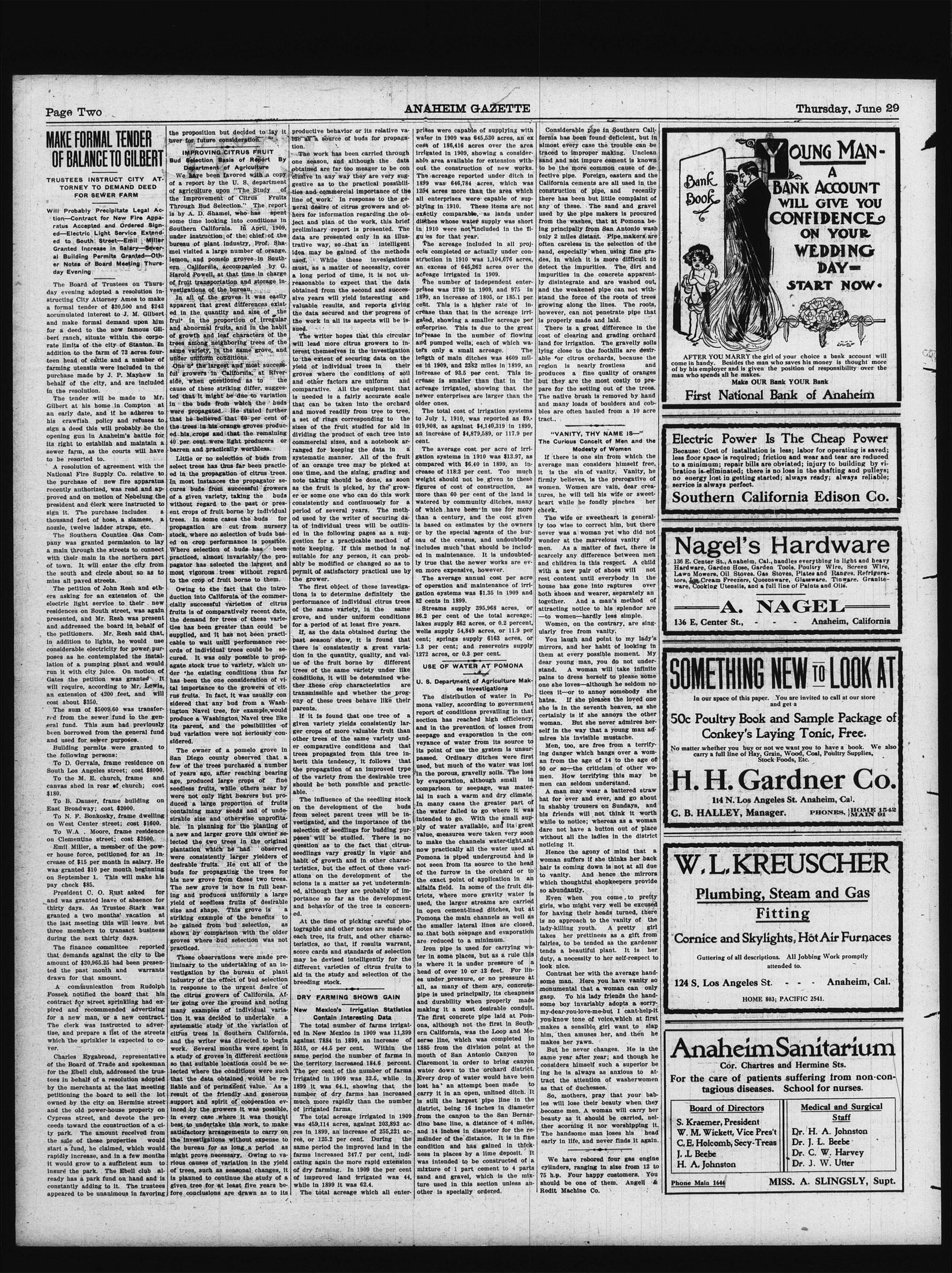
Searchable text
MAKE FORMAL TENDER OF BALANCE TO GILBERT
TRUSTEES INSTRUCT CITY ATTORNEY TO DEMAND DEED FOR SEWER FARM
Will Probably Precipitate Legal Action—Contract for New Fire Apparatus Accepted and Ordered Signed—Electric Light Service Extended to South Street—Emil Miller Granted Increase in Salary—Several Building Permits Granted—Other Notes of Board Meeting Thursday Evening
The Board of Trustees on Thursday evening adopted a resolution instructing City Attorney Ames to make a formal tender of $20,500 and $243 accumulated interest to J. M. Gilbert and make formal demand upon him for a deed to the now famous Gilbert ranch, situate within the corporate limits of the city of Stanton. In addition to the farm of 73 acres fourteen head of cattle and a number of farming utensils were included in the purchase made by J. P. Mayhew in behalf of the city, and are included in the resolution.
The tender will be made to Mr. Gilbert at his home in Compton at an early date, and if he adheres to his crawfish policy and refuses to sign a deed this will probably be the opening gun in Anaheim's battle for its right to establish and maintain a sewer farm, as the courts will have to be resorted to.
A resolution of agreement with the National Fire Supply Co., relative to the proposition but decided to lay it over for future consideration.
IMPROVING CITRUS FRUIT Bud Selection Basis of Report By Department of Agriculture
We have been favored with a copy of a report by the U. S. department of agriculture upon "The Study of the Improvement of Citrus Fruits Through Bud Selection." The report is by A. D. Shamel, who has spent some time looking into conditions in Southern California. In April, 1909, under instruction of the chief of the bureau of plant industry, Prof. Shamel visited a large number of orange, lemon, and pomelo groves in Southern California, accompanied by G. Harold Powell, at that time in charge of fruit transportation and storage investigations of the bureau.
In all of the groves it was easily apparent that great differences existed in the quantity and size of the fruit in the proportion of irregular and abnormal fruits, and in the habit of growth and leaf characters of the trees among neighboring trees of the same variety, in the same grove, and under uniform conditions.
One of the largest and most successful growers in California, at Riverside, when questioned as to the cause of these striking differ, suggested that it might be due to variation in the buds from which the buds were propagated. He stated further that he believed that 60 per cent of the trees in his orange groves produced his crops and that the remaining 40 per cent were light producers or barren and practically worthless.
Little or no selection of buds from select trees has thus far been practiced in the propagation of citrus trees.
productive behavior value as a source of tion.
The work has been one season, and although obtained are far too exclusive in any way to gestive as to the properties and commercial line of work. In general desire of citrus hers for information project and plan of the preliminary report data are presented trative way, so that idea may be gained used. While there must, as a matter of a long period of time reasonable to expect obtained from the severe years will yield valuable results, and the data secured and the work in all its sued.
The writer hopes will lead more citrus terest themselves into the extent of security groves where the old and other factors are comparative. All that is needed is a fair that can be taken and moved readily from a set of rings correct sizes of the fruit s dividing the product commercial sizes, and ranged for keeping systematic manner. Of an orange tree one time, and the sh
The tender will be made to Mr. Gilbert at his home in Compton at an early date, and if he adheres to his crawfish policy and refuses to sign a deed this will probably be the opening gun in Anaheim's battle for its right to establish and maintain a sewer farm, as the courts will have to be resorted to.
A resolution of agreement with the National Fire Supply Co. relative to the purchase of new fire apparatus recently authorized, was read and approved and on motion of Nebelung the president and clerk were instructed to sign it. The purchase includes a thousand feet of hose, a slimee, a nozzle, twelve ladder straps, etc.
The Southern Counties Gas Company was granted permission to lay a main through the streets to connect with their main in the northern part of town. It will enter the city from the south and circle about so as to miss all paved streets.
The petition of John Resh and others asking for an extension of the electric light service to their new residences on South street, was again presented, and Mr. Resh was present and addressed the board in behalf of the petitioners. Mr. Resh said that, in addition to lights, he would use considerable electricity for power purposes as he contemplated the installation of a pumping plant and would run it with city juice. On motion of Gates the petition was granted. It will require, according to Mr. Lewis, an extension of 4200 feet, and will cost about $350.
The sum of $5009.60 was transferred from the sewer fund to the general fund. This sum had previously been borrowed from the general fund and used for sewer purposes.
Building permits were granted to the following persons:
To D. Gervais, frame residence on South Los Angeles street; cost $8000.
To the M. E. church, frame and canvas shed in rear of church; cost $180.
To B. Dauser, frame building on East Broadway; cost $2000.
To N. F. Bonkosky, frame dwelling on West Center street; cost $1600.
To W.A . Moore, frame residence on Clementine street; cost $2500.
Emil Miller, a member of the power house force, petitioned for an increase of $15 per month in salary. He was granted $10 per month beginning on September 1. This will make his pay check $85.
President C. O. Rust asked for and was granted leave of absence for
fun growers in California, at River side, when questioned as to the cause of these striking differ, suggested that it might be due to variation in the buds from which the buds were propagated. He stated further that he believed that 60 per cent of the trees in his orange groves produced his crops and that the remaining 40 per cent were light producers or barren and practically worthless.
Little or no selection of buds from select trees has thus far been practiced in the propagation of citrus trees. In most instances the propagator secures buds from successful growers of a given variety, taking the buds without regard to the past or present crops of fruit borne by individual trees. In some cases the buds for propagation are cut from nursery stock, where no selection of buds based on crop performance is possible. Where selection of buds has been practiced, almost invariably the propagator has selected the largest and most vigorous trees without regard to the crop of fruit borne to them.
Owing to the fact that the introduction into California of the commercially successful varieties of citrus fruits is of comparatively recent date, the demand for trees of these varieties has been greater than could be supplied, and it has not been practicable to wait until performance records of individual trees could be secured. It was only possible to propagate stock true to variety, which under 'the existing conditions thus far has been the one consideration of vital importance to the growers of citrus fruits. In fact, it was usually considered that any bud from a Washington Navel tree, for example, would produce a Washington Navel tree like its parent, and the possibilities of bud variation were not seriously considered.
The owner of a pomelo grove in San Diego county observed that a few of the trees purchased a number of years ago, after reaching bearing age, produced large crops of fine seedless fruits, while others near by were not only light bearers but produced a large proportion of fruits containing many seeds and of undesirable size and otherwise unprofitable. In planning for the planting of a new and larger grove this owner selected the two trees in the original plantation which he had observed were consistently larger yielders of desirable fruits. He cut all of the buds for propagating the trees for his new grove from these two trees. The new grove is now in full bearing and produces uniformly a large groves where the creeks are other factors are comparative. All this is needed is a fair that can be taken and moved readily for a set of rings correct sizes of the fruit so dividing the product commercial sizes, and ranged for keeping systematic manner.
of an orange tree no one time, and the note taking should as the fruit is picked or some one who consistently and period of several yrs used by the writer ta of individual trees ed in the following gestion for a practical note keeping. If this suitable for any periably be modified or permit of satisfactory the grower.
The first object o tions is to determine performance of industry of the same variety grove, and under u nfor a period of at lea f.
If, as the data ob ject past season show, there is consistent tion in the quantity u ne of the fruit born trees of the same w conditions, it will be ther these crop chai transmissible and w eny of these trees parents.
If it is found tha given variety yields larger crops of more w other trees propagated fr e herit this tendency, the propagation o f olf the variety from should be both poss able.
The influence of t o on the development from select parent investigated, and th e selection of seedling poses will be studi question as to th e seedlings vary gre st habit of growth and teristics, but the eff ectations on the dev eloctions is a matter ad ed, although they ar portance so far as
To B. Dauser, frame building on East Broadway; cost $2000.
To N. F. Bonkosky, frame dwelling on West Center street; cost $1600.
To W.A. Moore, frame residence on Clementine street; cost $2500.
Emil Miller, a member of the power house force, petitioned for an increase of $15 per month in salary. He was granted $10 per month beginning on September 1. This will make his pay check $85.
President C. O. Rust asked for and was granted leave of absence for thirty days. As Trustee Stark was granted a two months' vacation at the last meeting this will leave but three members to transact business during the next thirty days.
The finance committee reported that demands against the city to the amount of $20,965.25 had been presented the past month and warrants drawn for that amount.
A communication from Rudolph Fossek notified the board that his contract for street sprinkling had expired and recommended advertising for a new man, or a new contract. The clerk was instructed to advertise, and prepare a list of the streets which the sprinkler is expected to cover.
Charles Eygabroad, representative of the Board of Trade and spokesman for the Ebell club, addressed the trustees in behalf of a resolution adopted by the merchants at the last meeting petitioning the board to sell the lot owned by the city on Hermine street and the old power-house property on Cypress street, and devote the proceeds toward the construction of a city park. The amount received from the sale of these properties would start a fund, he claimed, which would rapidly increase, and in a few months it would grow to a sufficient sum to insure the park. The Ebell club already has a park fund on hand and is constantly adding to it. The trustees appeared to be unanimous in favoring a large proportion of fruits containing many seeds and of undesirable size and otherwise unprofitable. In planning for the planting of a new and larger grove this owner selected the two trees in the original plantation which he had observed were consistently larger yielders of desirable fruits. He cut all of the buds for propagating the trees for his new grove from these two trees. The new grove is now in full bearing and produces uniformly a large yield of seedless fruits of desirable size and shape. This grove is a striking example of the benefits to be gained from bud selection, as shown by comparison with the older groves where bud selection was not practiced.
These observations were made preliminary to the undertaking of an investigation by the bureau of plant industry of the effect of bud selection in response to the urgent desire of the citrus growers of California. After going over the ground and noting many examples of individual variation it was decided to undertake a systematic study of the variation of citrus trees in Southern California, and the writer was directed to begin work. Several months were spent in a study of groves in different sections so that suitable locations could be selected where the conditions were such that the data obtained would be reliable and of permanent value. As a result of the friendly and generous support and spirit of cooperation evinced by the growers it was possible, in every case where it was thought best to undertake this work, to make satisfactory arrangements to carry on the investigations without expense to the bureau for as long a period as might prove necessary. Owing to various causes of variation in the yield of trees, such as seasonal changes, it is planned to continue the study of a given tree for at least five years before conclusions are drawn as to its
The total numbered in New Mexico is against 7884 in 1895, 3515, or 44.5 per cent same period the number the territory increases. The per cent of irrigated in 1909 was 1899 it was 64.1, so number of dry farms much more rapidly of irrigated farms.
The total acreage was 459,114 acres, res in 1899, an increase or 125.2 per cent same period the impact farms increased 347 citing again the mode of dry farming. In of improved land while in 1899 it was The total acreage
productive behavior or its relative value as a source of buds for propagation.
The work has been carried through one season, and although the data obtained are far too meager to be conclusive in any way they are very suggestive as to the practical possibilities and commercial importance of the line of work. In response to the general desire of citrus growers and others for information regarding the object and plan of the work, this brief preliminary report is presented. The data are presented only in an illustrative way, so that an intelligent idea may be gained of the methods used. While these investigations must, as a matter of necessity, cover a long period of time, it is not unreasonable to expect that the data obtained from the second and successive years will yield interesting and valuable results, and reports giving the data secured and the progress of the work in all its aspects will be issued.
The writer hopes that this circular will lead more citrus growers to interest themselves in the investigation to the extent of securing data on the yield of individual trees in their groves where the conditions of soil and other factors are uniform and comparative. All the equipment that is needed is a fairly accurate scale that can be taken into the orchard and moved readily from tree to tree, a set of rings corresponding to the sizes of the fruit studied for aid in dividing the product of each tree into commercial sizes, and a notebook arranged for keeping the data in a systematic manner. All of the fruit of an orange tree may be picked at one time, and the sizing, grading and prises were capable of supplying with water in 1909 was 645,530 acres, an excess of 186,416 acres over the area irrigated in 1909, showing a considerable area available for extension without the construction of new works. The acreage reported under ditch in 1899 was 646,784 acres, which was 1254 acres more than the area which all enterprises were capable of supplying in 1910. These items are not exactly comparable, as lands under ditches whose water supply was short in 1910 were not included in the figures for that year.
The acreage included in all projects completed or actually under construction in 1910 was 1,104,676 acres, an excess of 645,262 acres over the acreage irrigated in 1909.
The number of independent enterprises was 2780 in 1909, and 975 in 1899, an increase of 1805, or 185.1 per cent. This is a higher rate of increase than that in the acreage irrigated, showing a smaller acreage per enterprise. This is due to the great increase in the number of flowing and pumped wells, each of which waters only a small acreage. The length of main ditches was 4609 miles in 1909, and 2382 miles in 1899, an increase of 93.5 per cent. This increase is smaller than that in the acreage irrigated, showing that the newer enterprises are larger than the older ones.
The total cost of irrigation systems to July 1, 1910, was reported as $9,019,908, as against $4,140,319 in 1899, an increase of $4,879,589, or 117.9 per cent.
The average cost per acre of irrigation systems in 1910 was $13.97, as compared with $6.40 in 1899, an increase of 118.3 per cent. Too much
Considerable pipe in Southern California has been found deficient, but in almost every case the trouble can be traced to improper making. Unclean sand and not impure cement is known to be the more common cause of defective pipe. Foreign, eastern and the California cements are all used in the construction of pipe, and recently there has been but little complaint of any of these. The sand and gravel used by the pipe makers is procured from the washes, that at Pomona being principally from San Antonio wash only 2 miles distant. Pipe makers are often careless in the selection of the sand, especially when using fine grades, in which it is more difficult to detect the impurities. The dirt and impurities in the concrete apparently disintegrate and are washed out, and the weakened pipe can not withstand the force of the roots of trees growing along the lines. The roots, however, can not penetrate pipe that is properly made and laid.
There is a great difference in the cost of clearing and grading orchard land for irrigation. The gravelly soils lying close to the foothills are desirable or citrus orchards, because the region is nearly frostless and produces a fine quality of oranges but they are the most costly to prepare for the setting out of the trees. The native brush is removed by hand and many loads of boulders and cobbles are often hauled from a 10 acre tract...
"VANITY, THY NAME IS—"
The Curious Conceit of Men and the Modesty of Women
If there is one sin from which the average man considers himself free, it is the sin of vanity. Vanity, he
groves where the conditions of soil and other factors are uniform and comparative. All the equipment that is needed is a fairly accurate scale that can be taken into the orchard and moved readily from tree to tree, a set of rings corresponding to the sizes of the fruit studied for aid in dividing the product of each tree into commercial sizes, and a notebook arranged for keeping the data in a systematic manner. All of the fruit of an orange tree may be picked at one time, and the sizing, grading and note taking should be done, as soon as the fruit is picked, by the grower or some one who can do this work consistently and continuously for a period of several years. The method used by the writer of securing data of individual trees will be outlined in the following pages as a suggestion for a practicable method of note keeping. If this method is not suitable for any person, it can probably be modified or changed so as to permit of satisfactory practical use by the grower.
The first object of these investigations is to determine definitely the performance of individual citrus trees of the same variety, in the same grove, and under uniform conditions for a period of at least five years.
If, as the data obtained during the past season show, it is found that there is consistently a great variation in the quantity, quality, and value of the fruit borne by different trees of the same variety under like conditions, it will be determined whether these crop characteristics are transmissible and whether the progeny of these trees behave like their parents.
If it is found that one tree of a given variety yields consistently larger crops of more valuable fruit than other trees of the same variety under comparative conditions and that trees propagated from this tree inherit this tendency, it follows that the propagation of an improved type of the variety from the desirable tree should be both possible and practicable.
The influence of the seedling stock on the development of the buds from select parent trees will be investigated, and the importance of the selection of seedlings for budding purposes will be studied. There is no question as to the fact that citrus-seedlings vary greatly in vigor and habit of growth and in other characteristics, but the effect of these variations on the development of the scions is a matter as yet undetermined, although they are probably of importance so far as the development increases or smaller than that in the acreage irrigated, showing that the newer enterprises are larger than the older ones.
The total cost of irrigation systems to July 1, 1910, was reported as $9,019,908, as against $4,140,319 in 1899, an increase of $4,879,589, or 117.9 per cent.
The average cost per acre of irrigation systems in 1910 was $13.97, as compared with $6.40 in 1899, an increase of 118.3 per cent. Too much weight should not be given to these figures of cost of construction, as more than 60 per cent of the land is watered by community ditches, many of which have been in use for more than a century, and the cost given is based on estimates by the owners or by the special agents of the bureau of the census, and undoubtedly includes much that should be included in maintenance. It is undoubtedly true that the newer works are even more expensive, however.
The average annual cost per acre of operation and maintenance of irrigation systems was $1.35 in 1909 and 82 cents in 1899.
Streams supply 395,968 acres, or 86.2 per cent of the total acreage; lakes supply 862 acres, or 0.2 percent; wells supply 54,849 acres, or 11.9 per cent; springs supply 6163 acres, or 1.3 per cent; and reservoirs supply 1272 acres, or 0.3 per cent.
USE OF WATER AT POMONA
U. S. Department of Agriculture Makes Investigations
The distribution of water in Pomona valley, according to government report of conditions prevailing in that section has reached high efficiency, and in the prevention of losses from seepage and evaporation in the conveyance of water from its source to its point of use the system is unsurpassed. Ordinary ditches were first used, but much of the water was lost in the porous, gravelly soils. The loss by evaporation, although small in comparison to seepage, was material in such a warm and dry climate. In many cases the greater part of the water failed to go where it was intended to go. With the small supply of water available, and its great value, measures were taken very soon to make the channels water-tight,and now practically all the water used at Pomona is piped underground and is not seen from its source to the head of the furrow in the orchard or to the exact point of application in an alfalfa field. In some of the fruit districts, where more gravity water is produces a fine quality of oranges but they are the most costly to prepare for the setting out of the trees. The native brush is removed by hand and many loads of boulders and cobles are often hauled from a 10 acre tract...
"VANITY, THY NAME IS—"
The Curious Conceit of Men and the Modesty of Women
If there is one sin from which the average man considers himself free, it is the sin of vanity. Vanity, he firmly believes, is the prerogative of women. Women are vain, dear creatures, he will tell his wife or sweetheart while he fondly pinches her cheek.
The wife or sweetheart is generally too wise to correct him, but there never was a woman yet who did not wonder at the marvelous vanity of men. As a matter of fact, there is scarcely any difference between men and children in this respect. A child with a new pair of shoes will not rest content until everybody in the house has gone into raptures over both shoes and wearer, separately an together. And a man's method of attracting notice to his splendor are—to women—hardly less simple.
Women, on the contrary, are singularly free from vanity.
You laugh and point to my lady's mirrors, and her habit of looking in them at every possible moment. My dear young man, you do not understand. A woman will take infinite pains to dress herself to please some one she loves—although he seldom notices it—or to annoy somebody she hates. If she pleases the loved one she is in the seventh heaven, as she certainly is if she annoys the other woman. But she never admires herself in the way that a young man admires his invisible mustache.
Men, too, are free from a terrifying danger which hangs over a woman from the age of 14 to the age of 90 or so—the criticism of other women. How terrifying this may be men can seldom understand.
A man may wear a battered straw hat for ever and ever, and go about in shabby trousers on Sundays, and his friends will not think it worth while to notice; whereas as a woman dare not have a button out of place without all the ladies in the district noticing it.
Hence the agony of mind that a woman suffers if she thinks her back hair is coming down is not at all due to vanity. And hence the mirrors which thoughtful shopkeepers provide so abundantly.
Even when you come to pretty
The influence of the seedling stock on the development of the buds from select parent trees will be investigated, and the importance of the selection of seedlings for budding purposes will be studied. There is no question as to the fact that citrus-seedlings vary greatly in vigor and habit of growth and in other characteristics, but the effect of these variations on the development of the scions is a matter as yet undetermined, although they are probably of importance so far as the development and behavior of the tree is concerned.
At the time of picking careful photographic and other notes are made of each tree, its fruit, and other characteristics, so that, if results warrant, score cards and standards of selection may be devised intelligently for the different varieties of citrus fruits to aid in the study and selection of the breeding stock.
DRY FARMING SHOWS GAIN
New Mexico's Irrigation Statistics Contain Interesting Data
The total number of farms irrigated in New Mexico in 1909 was 11,399 against 7884 in 1899, an increase of 3515, or 44.5 per cent. Within the same period the number of farms in the territory increased 184.6 percent. The per cent of the number of farms irrigated in 1909 was 32.5, while in 1899 it was 64.1, showing that the number of dry farms has increased much more rapidly than the number of irrigated farms.
The total acreage irrigated in 1909 was 459,114 acres, against 203,893 acres in 1899, an increase of 255,221 acres, or 125.2 per cent. During the same period the improved land in the farms increased 347.7 per cent, indicating again the more rapid extension of dry farming. In 1909 the per cent of improved land irrigated was 44, while in 1899 it was 62.4.
The total acreage which all enter-
In many cases the greater part of the water failed to go where it was intended to go. With the small supply of water available, and its great value, measures were taken very soon to make the channels water-tight, and now practically all the water used at Pomona is piped underground and is not seen from its source to the head of the furrow in the orchard or to the exact point of application in an alfalfa field. In some of the fruit districts, where more gravity water is used, the larger streams are carried in open cement-lined ditches, but at Pomona the main channels as well as the smaller lateral lines are closed, so that both seepage and evaporation are reduced to a minimum.
Iron pipe is used for carrying water in some places, but as a rule this is where it is under pressure of a head of over 10 or 12 feet. For lines under pressure, or no pressure at all, as many of them are, concrete pipe is used principally, its cheapness and durability when properly made making it a most desirable conduit. The first concrete pipe laid at Pomona, although not the first in Southern California, was the Loop and Meserve line, which was completed in 1885 from the division point at the mouth of San Antonio Canyon to Claremont in order to bring canyon water down to the orchard district. Every drop of water would have been lost ha' an attempt been made to carry it in an open, unlined ditch. It is still the largest pipe line in the district, being 16 inches in diameter from the canyon to the San Bernardino base line, a distance of 4 miles, and 14 inches in diameter for the remainder of the distance. It is in fine condition and has gained in thickness in places by a lime deposit. It was intended to be constructed of a mixture of 1 part cement to 4 parts sand and gravel, which is the mixture used in this section unless another is specially ordered.
Hence the agony of mind that a woman suffers if she thinks her back hair is coming down is not at all due to vanity. And hence the mirrors which thoughtful shopkeepers provide so abundantly.
Even when you come to pretty girls, who might very well be excused for having their heads turned, there is no approach to the vanity of the lady-killing youth. A pretty girl takes her prettiness as a gift from fairies, to be tended as the gardener tends a beautiful plant. It is her duty, a necessity to her self-respect to look nice.
Contrast her with the average handsome man. Here you have vanity so monumental that a woman can only gasp. To his lady friends the handsome boy invariably adopts a sorry-my-dear-you-love-me-but I cant-help-it you-know tone of voice, which at first makes a sensible girl want to slap him, then amuses her, and then he makes her yawn.
But he never changes. He is the same year after year; and though he considers himself such a superior being he is always as anxious to attract the attention of washerwomen as that of duchesses.
So, mothers, pray that your babies will lose their beauty when they become men. A woman will carry her beauty as it should be carried, neither scorching it nor worshipping it. The handsome man loses his head early in life, and never finds it again.
We have rebored four gas engine cylinders, ranging in size from 12 to 75 h.p. Four happy customers. You should be one of them. Angell & Redit Machine Co.
Thursday, June 29
YOUNG MANA BANK ACCOUNT
WILL GIVE YOU CONFIDENCE
ON YOUR WEDDING DAY=
START NOW.
AFTER YOU MARRY the girl of your choice a bank account will come in handy. Besides the man who saves his money is thought more of by his employer and is given the position of responsibility over the man who spends all he makes.
Make OUR Bank YOUR Bank
First National Bank of Anaheim
Electric Power Is The Cheap Power
Because: Cost of installation is less; labor for operating is saved; less floor space is required; friction and wear and tear are reduced to a minimum; repair bills are obviated; injury to building by vibration is eliminated; there is no loss in the shafting and pulleys;
Electric Power Is The Cheap Power
Because: Cost of installation is less; labor for operating is saved;
less floor space is required; friction and wear and tear are reduced
to a minimum; repair bills are obviated; injury to building by vibration is eliminated; there is no loss in the shafting and pulleys;
no energy lost in getting started; always ready; always reliable;
service is always perfect.
Southern California Edison Co.
Nagel's Hardware
136 E. Center St., Anaheim, Cal., handles everything in light and heavy
Hardware, Garden Hose, Garden Tools, Poultry Wire, Screen Wire,
Lawn Mowers, Oil Stoves, Gas Stoves, Plates and Ranges. Refrigerators,
Ice Cream Freezers, Queensware, Glassware, Tinware, Graniteware, Cooking Utensils, and a full line of Paints and Oils.
A. NAGEL
136 E. Center St., Anaheim, California
SOMETHING NEW TO LOOK AT
In our space of this paper. You are invited to call at our store
and get a
50c Poultry Book and Sample Package of Conkey's Laying Tonic, Free.
No matter whether you buy or not we want you to have a book. We also
carry a full line of Hay, Grain, Wood, Coal, Poultry Supplies,
Stock Foods, Etc.
H. H. Gardner Co.
114 N. Los Angeles St. Anaheim, Cal.
C. B. HALLEY, Manager.
PHONES: HOME 1542
MAIN 91
W. L. KREUSCHER
Plumbing, Steam and Gas
W.L.KREUSCHER
Plumbing, Steam and Gas
Fitting
Cornice and Skylights, Hot Air Furnaces
Guttering of all descriptions. All Jobbing Work promptly attended to.
124 S. Los Angeles St. - Anaheim, Cal.
HOME 803; PACIFIC 2541.
AnaheimSanitarium
Cor. Chartres and Hermine Sts.
For the care of patients suffering from non-contagious diseases. School for nurses.
Board of Directors
S. Kraemer, President
W. M. Wickett, Vice Pres't
C.E. Holcomb, Secy-Treas
J. L Beebe
H. A. Johnston
Medical and Surgical
Staff
Dr. H. A. Johnston
Dr. J. L Beebe
Dr. C. W. Harvey
Dr. J. W. Utter
Phone Main 1646
MISS. A. SLINGSLY, Supt.