anaheim-gazette 1911-04-20
Scanned page
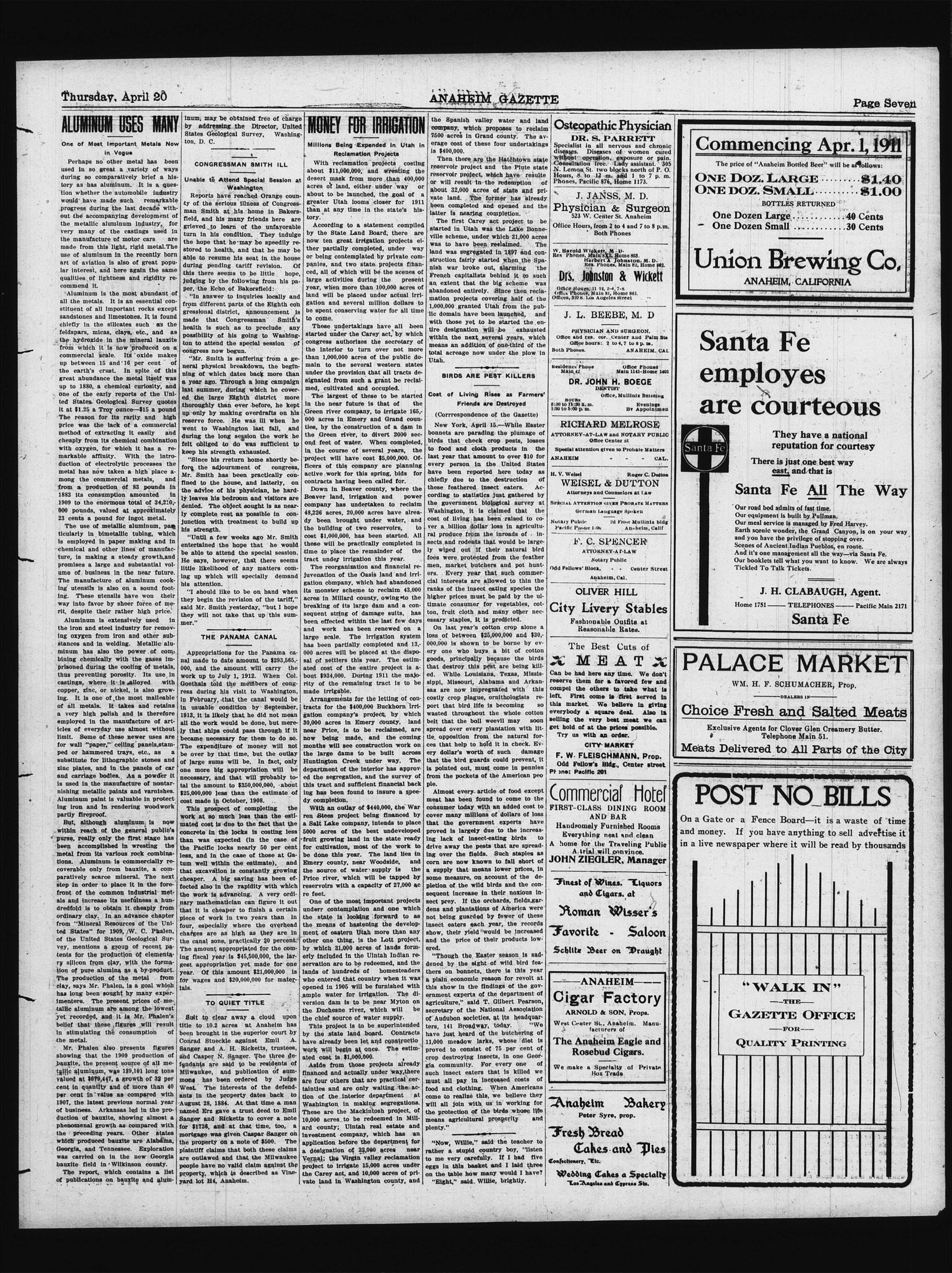
Searchable text
ALUMINUM USES MANY
One of Most Important Metals Now in Vogue
Perhaps no other metal has been used in so great a variety of ways during so comparatively brief a history as has aluminum. It is a question whether the automobile industry would have made such remarkable progress during the last decade without the accompanying development of the metallic aluminum industry, for very many of the castings used in the manufacture of motor cars are made from this light, rigid metal. The use of aluminum in the recently born art of aviation is also of great popular interest, and here again the same qualities of lightness and rigidity recommend it.
Aluminum is the most abundant of all the metals. It is an essential constituent of all important rocks except sandstones and limestones. It is found chiefly in the silicates such as the feldspars, micas, clays, etc., and as the hydroxide in the mineral lauxite from which it is now produced on a commercial scale. Its oxide makes up between 15 and 16 per cent of the earth's crust. In spite of this great abundance the metal itself was up to 1880, a chemical curiosity, and one of the early reports of the United States Geological Survey quotes it at $1.25 a Troy ounce—$15 a pound. The reason for its rarity and high price was the lack of a commercial method of extracting it easily and cheaply from its chemical combination with oxygen, for which it has a remarkable affinity. With the introduction of electrolytic processes the metal has now taken a high place in num, may be obtained free of charge by addressing the Director, United States Geological Survey, Washington, D. C.
CONGRESSMAN SMITH ILL
Unable to Attend Special Session at Washington
Reports have reached Orange county of the serious illness of Congressman Smith at his home in Bakersfield, and his many friends here are grieved to learn of the unfavorable turn in his condition. They indulge the hope that he may be speedily restored to health, and that he may be able to resume his seat in the house during pending tariff revision. Of this there seems to be little hope, judging by the following from his paper, the Echo of Bakersfield:
"In answer to inquiries locally and from different parts of the Eighth congressional district, announcement is made that Congressman Smith's health is such as to preclude any possibility of his going to Washington to attend the special session of congress now begun.
Mr. Smith is suffering from a general physical breakdown, the beginning of which dates back more than a year ago. Through a long campaign last summer, during which he covered the large Eighth district more thoroughly than ever before, he kept up only by making overdrafts on his reserve force. He was ill when he went to Washington last fall, and during the long session the work he felt obliged to do was sufficient to keep his strength exhausted.
Since his return home shortly before the adjournment of congress, Mr. Smith has been practically con-
MONEY FOUND
With reclamation about $11,000,000 desert mask from acres of land, about to be lauched greater Utah less than at any time tory.
According to by the State Law now ten great ther partially co or being contempan panies, and two ced, all of which large activities this year, when more land will be pla gation and several be spent conservi to come.
These undertak started under ther congress authori the interior to than 1,000,000 ad main to the se under the provis signed from su med, cultivated.
The largest o in the near futu Green river com 000 acres in Em ties, by the cons the Green river on feet of water in the course o project will hav ficers of this co active work for
great abundance the metal itself was up to 1880, a chemical curiosity, and one of the early reports of the United States Geological Survey quotes it at $1.25 a Troy ounce—$15 a pound. The reason for its rarity and high price was the lack of a commercial method of extracting it easily and cheaply from its chemical combination with oxygen, for which it has a remarkable affinity. With the introduction of electrolytic processes the metal has now taken a high place among the commercial metals, and from a production of 83 pounds in 1883 its consumption amounted in 1909 to the enormous total of 34,210,000 pounds, valued at approximately 23 cents a pound for ingot metal.
The use of metallic aluminum, particularly in bimetallic tubing, which is employed in paper making and in chemical and other lines of manufacture, is making a steady growth, and promises a large and substantial volume of business in the near future. The manufacture of aluminum cooking utensils is also on a sound footing. These utensils have won their way into favor by sheer force of merit, despite their rather high price.
Aluminum is extensively used in the iron and steel industry for removing oxygen from iron and other substances and in welding. Metallic aluminum has also the power of combining chemically with the gases imprisoned during the cooling of metals, thus preventing porosity. Its use in castings, where it is alloyed with copper, zinc, or nickel, is also growing. It is one of the most malleable of all metals. It takes and retains a very high polish and is therefore employed in the manufacture of articles of everyday use almost without limit. Some of these newer uses are for wall "paper," ceiling panels, stamped or hammered trays, etc., as a substitute for lithographic stones and zinc plates, and in the panels of car and carriage bodies. As a powder it is used in the manufacture of nontarnishing metallic paints and varnishes. Aluminum paint is valuable in protecting iron and in rendering woodwork partly fireproof.
But, although aluminum is now within reach of the general public's purse, really only the first stage has been accomplished in wrestling the metal from its various rock combinations. Aluminum is commercially recoverable only from bauxite, a comparatively scarce mineral. The next step in order to place it in the forefront of the common industrial metal and increase its usefulness is a long campaign last summer, during which he covered the large Eighth district more thoroughly than ever before, he kept up only by making overdrafts on his reserve force. He was ill when he went to Washington last fall, and during the long session the work he felt obliged to do was sufficient to keep his strength exhausted.
"Since his return home shortly before the adjournment of congress, Mr. Smith has been practically confined to the house, and latterly, on the advice of his physician, he hardly leaves his bedroom and visitors are denied. The object sought is as nearly complete rest as possible in conjunction with treatment to build up his strength.
"Until a few weeks ago Mr. Smith entertained the hope that he would be able to attend the special session. He says, however, that there seems little likelihood of any matters coming up which will specially demand his attention.
"I should like to be on hand when they begin the revision of the tariff," said Mr. Smith yesterday, "but I hope they will not take that up this summer."
THE PANAMA CANAL
Appropriations for the Panama canal made to date amount to $293,565,000, and the amount will carry the work up to July 1, 1912. When Col. Goethals told the members of congress during his visit to Washington, in February, that the canal would be in usable condition by September, 1913, it is likely that he did not mean all the work would be done, but merely that ships could pass through if it became necessary for them to do so. The expenditure of money will not be over by that time, but the outlay of large sums will be. In fact, only one more big appropriation will be necessary, and that will probably total the amount to $350,000,000, about $25,000,000 less than the estimate of cost made in October, 1908.
This prospect of completing the work at so much less than the estimated cost is due to the fact that the concrete in the locks is costing less than was expected (in the case of the Pacific locks nearly 50 per cent less, and in the case of those at Gatum well within the estimate), and that excavation is constantly growing cheaper. A big saving has been effected also in the rapidity with which the work is advancing. A very ordi-
Aluminum paint is valuable in protecting iron and in rendering woodwork partly fireproof.
But, although aluminum is now within reach of the general public's purse, really only the first stage has been accomplished in wresting the metal from its various rock combinations. Aluminum is commercially recoverable only from bauxite, a comparatively scarce mineral. The next step in order to place it in the forefront of the common industrial metals and increase its usefulness a hundredfold is to obtain it cheaply from ordinary clay. In an advance chapter from "Mineral Resources of the United States" for 1909, W. C. Phalen, of the United States Geological Survey, mentions a group of recent patents for the production of elementary silicon from clay, with the formation of pure alumina as a by-product. The production of the metal from clay, says Mr. Phalen, is a goal which has long been sought by many experimenters. The present prices of metallic aluminum are among the lowest yet recorded, and it is Mr. Phalen's belief that these figures will result in stimulating the consumption of the metal.
Mr. Phalen also presents figures showing that the 1909 production of bauxite, the present source of all metallic aluminum, was 129,101 long tons valued at $679,447, a growth of 32 per cent in quantity and of more than 40 per cent in value as compared with 1907, the latest previous normal year of business. Arkansas led in the production of bauxite, showing almost a phenomenal growth as compared with the preceding years. Other states which produced bauxite are Alabama, Georgia, and Tennessee. Exploration was carried on in the new Georgia bauxite field in Wilkinson county.
The report, which contains a list of publications on bauxite and aluminum, this prospect of completing the work at so much less than the estimated cost is due to the fact that the concrete in the locks is costing less than was expected (in the case of the Pacific locks nearly 50 per cent less, and in the case of those at Galium well within the estimate), and that excavation is constantly growing cheaper. A big saving has been effected also in the rapidity with which the work is advancing. A very ordinary mathematician can figure it out that it is cheaper to finish a certain piece of work in two years than in four, especially where the overhead charges are as high as they are in the canal zone, practically 20 percent. The amount appropriated for the coming fiscal year is $45,500,000, the largest appropriation yet made for one year. Of this amount $21,000,000 is for wages and $20,000,000 for materials.
TO QUIET TITLE
Suit to clear away a cloud upon title to 10.2 acres at Anaheim has been brought in the superior court by Conrad Stueckle against Emil A. Sanger and A. H. Ricketts, trustees, and Casper N. Sanger. The three defendants are said to be residents of Milwaukee, and publication of summons has been ordered by Judge West. The interests of the defendants in the property dates back to August 28, 1884. At that time a man named Erz gave a trust deed to Emil Sanger and Ricketts to cover a note for $1736, and at that time, too, a mortgage was given Caspar Sanger on the property on a note of $500. The plaintiff claims that both these claims are outlawed and that the Milwaukee people have no valid claim against the property, which is described as Vineyard lot H4, Anaheim.
With an outlay of ren Stees project a Salt Lake company 5000 acres of fruit growing land for cultivation, may be done this year Emery county, near the source of water Price river, which reservoirs with are feet.
One of the most underright contemplations the state is looking at means of hauling other one thing by which 31,000 early included in the serviation are to be lands of hundreds who entered that opened in 1905 with sample water for version dam is to the Duchesne river the chief source of This project is by the state land have already been work will begin at cost is $1,000 Aside from the financed and actual are four others the tainties and are intention of the inter Washington in These are the Mt 10,000 acres to bard county; Ulin investment comp application before a designation of Vernal; the Virginal project to irrigate the Carey act, andivate land in Wa
MONEY FOR IRRIGATION
Millions Being Expended in Utah in Reclamation Projects
With reclamation projects costing about $11,000,000, and wrestling the desert mask from more than 400,000 acres of land, either under way or about to be launched, the goal of a greater Utah looms closer for 1911 than at any time in the state's history.
According to a statement compiled by the State Land Board, there are now ten great irrigation projects either partially completed, under way or being contemplated by private companies, and two state projects financed, all of which will be the scenes of large activities during the present year, when more than 100,000 acres of land will be placed under actual irrigation and several million dollars to be spent conserving water for all time to come.
These undertakings have all been started under the Carey act, by which congress authorizes the secretary of the interior to turn over not more than 1,000,000 acres of the public domain to the several western states under the provision that all tracts designated from such a grant be reclaimed, cultivated and occupied.
The largest of these to be started in the near future is that of the Green river company, to irrigate 165,-000 acres in Emery and Grand counties, by the construction of a dam in the Green river, to divert 2000 second feet of water. When completed, in the course of several years, the project will have cost $5,000,000. Officers of this company are planning active work for this spring, bids for the Spanish valley water and land company, which proposes to reclaim 7500 acres in Grand county. The average cost of these four undertakings is $400,000.
Then there are the Hatchtown state reservoir project and the Plute state reservoir project, which have resulted or will result in the redemption of about 32,000 acres of state and private land. The former has already been completed and opened and the latter is nearing completion.
The first Carey act project to be started in Utah was the Lake Bonneville scheme, under which 21,000 acres was to have been reclaimed. The land was segregated in 1897 and construction fairly started when the Spanish war broke out, alarming the French capitalists behind it to such an extent that the big scheme was abandoned entirely. Since then reclamation projects covering half of the 1,000,000 granted Utah from the public domain have been launched, and with those yet to be started the entire designation will be exhausted within the next several years, which means an addition of one-third of the total acreage now under the plow in Utah.
BIRDS ARE PEST KILLERS
Cost of Living Rises as Farmers' Friends are Destroyed
(Corrrespondence of the Gazette)
New York, April 15.—While Easter bonnets are parading the plumage of birds that check crop pests, losses to food and cloth products in the last year that amount to over $10 for every person in the United States have been reported here today as
BIRDS ARE PEST KILLERS
Cost of Living Rises as Farmers' Friends are Destroyed
(Corrrespondence of the Gazette)
New York, April 15.—While Easter bonnets are parading the plumage of birds that check crop pests, losses to food and cloth products in the last year that amount to over $10 for every person in the United States have been reported here today as chiefly due to the destruction of these feathered insect eaters. According to statistics just gathered by the government biological survey at Washington, it is claimed that the cost of living has been raised to cover a billion dollar loss in agricultural produce from the inroads of insects and rodents that would be largely wiped out if their natural bird foes were protected from the feather men, market butchers and pot hunters. Every year that such commercial interests are allowed to thin the ranks of the insect eating species the higher prices must be paid by the ultimate consumer for vegetables, cotton, fruit cloth and many other necessary staples, it is predicted.
On last year's cotton crop alone a loss of between $25,000,000 and $30,000,000 is shown to be borne by every one who buys a bit of cotton goods, principally because the birds that destroy this pest are being killed. While Louisiana, Texas, Mississippi, Missouri, Alabama and Arkansas are now impregnated with this costly crop plague, ornithologists report that bird life is becoming so wasted throughout the whole cotton belt that the boll weevil may soon spread over every plantation with little opposition from the natural forces that help to hold it in check. Every dollar's worth of such damage that the bird guards could prevent, it is pointed out, must come in pennies from the pockets of the American people.
Almost every article of food except meat has been found to come to the consumer today with an added cost to cover many millions of dollars of loss that the government experts have proved is largely due to the increasing lack of insect-eating birds to drive away the pests that are spreading over the fields. Such staples as corn are now known to fall short of a supply that means lower prices, in some measure, on account of the depletion of the wild birds and the consequent increase in their noxious income.
With an outlay of $440,000, the Warren Stees project being financed by a Salt Lake company, intends to place 5000 acres of the best undeveloped fruit growing land in the state ready for cultivation, most of the work to be done this year. The land lies in Emery county, near Woodside, and the source of water supply is the Price river, which will be tapped by reservoirs with a capacity of 27,000 acre feet.
One of the most important projects underr contemplation and one which the state is looking forward to as the means of hastening the development of eastern Utah more than any other one thing, is the Lott project, by which 31,000 acres of lands formerly included in the Uintah Indian reservation are to be redeemed, and the lands of hundreds of homesteaders who entered that country when it was opened in 1905 will be furnished with ample water for irrigation. The diversion dam is to be near Myton on the Duchesne river, which will be the chief source of water supply.
This project is to be superintended by the state land board. Contracts have already been let and construction work will begin at once. The estimated cost is $1,000,000.
Aside from those projects already financed and actually under way, there are four others that are practical certainties and are only waiting the action of the interior department at Washington in making segregations. These are the Mackintosh project, of 10,000 acres to be redeemed in Millard county; Uintah real estate and investment company, which has an application before the department for a designation of 22,000 acres near Vernal; the Virgin valley reclamation project to irrigate 15,000 acres under the Carey act, and 10,000 acres of private land in Washington county, and
meat has been found to come to the consumer today with an added cost to cover many millions of dollars of loss that the government experts have proved is largely due to the increasing lack of insect-eating birds to drive away the pests that are spreading over the fields. Such staples as corn are now known to fall short of a supply that means lower prices, in some measure, on account of the depletion of the wild birds and the consequent increase in their noxious insect prey. If the orchards, fields, gardens and plantations of America were not being guarded by fewer of these insect eaters each year, the records show, their yield would be increased and the price of their products lowered.
"Though the Easter season is saddened by the sight of wild bird feathers on bonnets, there is this year a plain economic reason for revolt at this show in the findings of the government experts of the department of agriculture," said T. Gilbert Pearson, secretary of the National Association of Audubon societies, at its headquarters, 141 Broadway, today. "We have just heard of the butchering of 11,000 meadow larks, whose diet is proved to consist of 75 per cent of crop destroying insects, in one Georgia community. For every one of such insect eaters that is killed we must all pay in increased costs of food and clothing. When Americans come to realize this, we believe they will all join with us in working for the protection of the birds whose life means agricultural prosperity and plenty."
"Now, Willie," said the teacher to rather a stupid country boy, "listen to me very carefully. If I had five eggs in this basket and I laid three on the table how many would I have? "Eight," said Willie, brightly.
Commencing Apr. 1, 1911
The price of "Anaheim Bottled Beer" will be as follows:
ONE DOZ. LARGE $1.40
ONE DOZ. SMALL $1.00
BOTTLES RETURNED
One Dozen Large 40 Cents
One Dozen Small 30 Cents
Union Brewing Co,
ANAHEIM, CALIFORNIA
Santa Fe employs are courteous
They have a national reputation for courtesy
There is just one best way east, and that is
HN H. BOEGE
DENTIST
Office, Mullinix Building
Evenings
By Appointmen
RD MELROSE
LAW and NOTARY PUBLIC
ice Center St
given to Probate Matters
CAL.
Roger C. Dutton
L & DUTTON
and Counselors at Law
ON GIVEN PROBATE MATTERS
Language Spoken
2d Floor Mullinix bldg
Anneheim, Calif
SPENCER
KERNKEY-AF-LAW
otary Public
Center Street
Anneheim, Cal.
ER HILL
very Stables
able Outfits at
manable Rates.
Best Cuts of
EAT
are any time. We don't
for a favored few and
others to take what is
time is first served in
We believe in giving
square deal. Also in
very best meat we can
the prices possible.
an order.
Y MARKET
SCHMANN, Prop.
Bldg., Center street
201
Special Hotel
S DINING ROOM
ND BAR
by Furnished Rooms
g neat and clean
the Traveling Public
will convince.
OLER, Manager
employes are courteous
They have a national reputation for courtesy
There is just one best way east, and that is
Santa Fe All The Way
Our road bed admits of fast time.
Our equipment is built by Pullman.
Our meal service is managed by Fred Harvey.
Earth scenic wonder, the Grand Canyon, is on your way and you have the privilege of stopping over.
Scenes of Ancient Indian Pueblos, en route.
And it's one management all the way—via Santa Fe.
Our booklets tell what you want to know. We are always Tickled To Talk Tickets.
J. H. CLABAUGH, Agent.
Home 1751——TELEPHONES——Pacific Main 2171
Santa Fe
PALACE MARKET
WM. H. F. SCHUMACHER, Prop.
DEALERS IN
Choice Fresh and Salted Meats
Exclusive Agents for Clover Glen Creamery Butter.
Telephone Main 51.
Meats Delivered to All Parts of the City
POST NO BILLS
On a Gate or a Fence Board—it is a waste of time and money. If you have anything to sell advertise it in a live newspaper where it will be read by thousands
POST NO BILLS
On a Gate or a Fence Board—it is a waste of time and money. If you have anything to sell advertise it in a live newspaper where it will be read by thousands
“WALK IN”
THE
GAZETTE OFFICE
FOR
QUALITY PRINTING