anaheim-gazette 1911-02-23
Scanned page
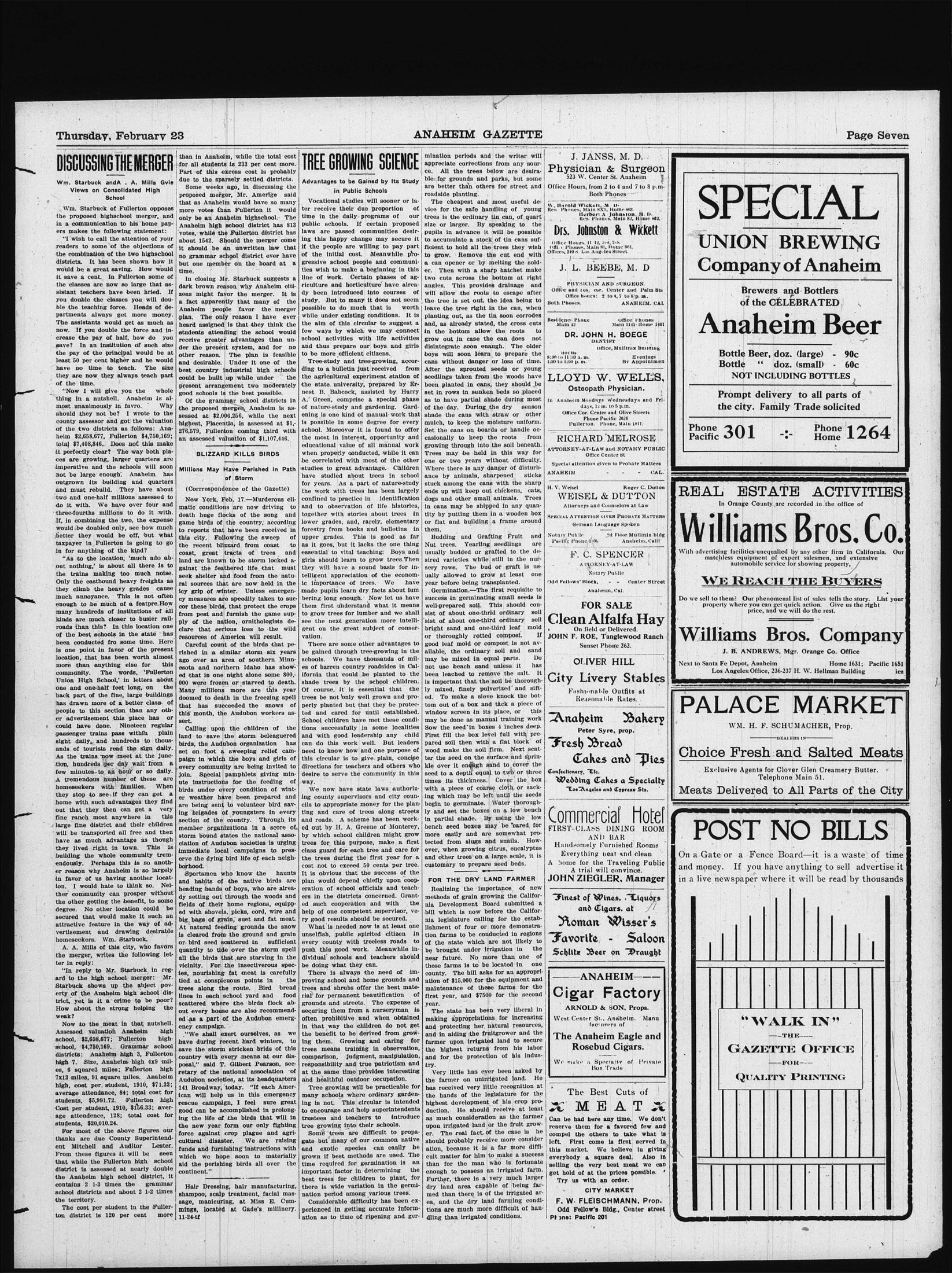
Searchable text
DISCUSSING THE MERGER
Wm. Starbuck and A. A. Mills Gvie Views on Consolidated High School
Wm. Starbuck of Fullerton opposes the proposed highschool merger, and in a communication to his home papers makes the following statement:
"I wish to call the attention of your readers to some of the objections of the combination of the two highschool districts. It has been shown how it would be a great saving. How would it save a cent. In Fullerton some of the classes are now so large that assistant teachers have been hired. If you double the classes you will double the teaching force. Heads of departments always get more money. The assistants would get as much as now. If you double the force and increase the pay of half, how do you save? In an institution of such size the pay of the principal would be at least 50 per cent higher and he would have no time to teach. The size they are now they always teach part of the time.
"Now I will give you the whole thing in a nutshell. Anaheim is almost unanimously in favor. Why should they not be? I wrote to the county assessor and got the valuation of the two districts as follows: Anaheim $2,658,677, Fullerton $4,750,169; total $7,408,846. Does not this make it perfectly clear? The way both places are growing, larger quarters are imperative and the schools will soon not be large enough. Anaheim has than in Anaheim, while the total cost for all students is 233 per cent more. Part of this excess cost is probably due to the sparsely settled districts.
Some weeks ago, in discussing the proposed merger, Mr. Amerige said that as Anaheim would have so many more votes than Fullerton it would only be an Anaheim highschool. The Anaheim high school district has 813 votes, while the Fullerton district has about 1542. Should the merger come it should be an unwritten law that no grammar school district ever have but one member on the board at a time.
In closing Mr. Starbuck suggests a dark brown reason why Anaheim citizens might favor the merger. It is a fact apparently that many of the Anaheim people favor the merger plan. The only reason I have ever heard assigned is that they think the students attending the school would receive greater advantages than under the present system, and for no other reason. The plan is feasible and desirable. Under it one of the best country industrial high schools could be built up while under the present arrangement two moderately good schools is the best possible.
Of the grammar school districts in the proposed merger, Anaheim is assessed at $2,006,256, while the next highest, Placentia, is assessed at $1,276,579, Fullerton coming third with an assessed valuation of $1,107,446."
BLIZZARD KILLS BIRDS
Millions May Have Perished in Path
"Now I will give you the whole thing in a nutshell. Anaheim is almost unanimously in favor. Why should they not be? I wrote to the county assessor and got the valuation of the two districts as follows: Anaheim $2,658,677, Fullerton $4,750,169; total $7,408,846. Does not this make it perfectly clear? The way both places are growing, larger quarters are imperative and the schools will soon not be large enough. Anaheim has outgrown its building and quarters and must rebuild. They have about two and one-half millions assessed to do it with. We have over four and three-fourths millions to do it with. If, in combining the two, the expense would be doubled only, see how much better they would be off, but what taxpayer in Fullerton is going to go in for anything of the kind?
"As to the location, 'much ado about nothing,' is about all there is to the trains making too much noise. Only the eastbound heavy freights as they climb the heavy grades cause much annoyance. This is not often enough to be much of a featpre. How many hundreds of institutions of all kinds are much closer to busier railroads than this? In this location one of the best schools in the state has been conducted fro some time. Here is one point in favor of the present location, that has been worth almost more than anything else for this community. The words, 'Fullerton Union High School,' in letters about one and one-half feet long, on the back part of the fine, large buildings has drawn more of a better class of people to this section than any other advertisement this place has or could have done. Nineteen regular passenger trains pass within plain sight daily, and hundreds to thousands of tourists read the sign daily. As the trains now meet at the junction, hundreds per day wait from a few minutes to an hour or so daily. A tremendous number of these are homeseekers with families. When they stop to see if they can get a home with such advantages they find out that they then can get a very fine ranch most anywhere in this large fine district and their children will be transported all free and then have as much advantage as though they lived right in town. This is building the whole community tremendously. Perhaps this is so another reason why Anaheim is so largely in favor of us having another location. I would hate to think so. Neither community can prosper without could be built up while under the present arrangement two moderately good schools is the best possible.
Of the grammar school districts in the proposed merger Anaheim is assessed at $2,006,256, while the next highest, Placentia, is assessed at $1,276,579, Fullerton coming third with an assessed valuation of $1,107,446.
BLIZZARD KILLS BIRDS
Millions May Have Perished in Path of Storm
(Corrrespondence of the Gazette)
New York, Feb. 17.—Murderous climatic conditions are now driving to death huge flocks of the song and game birds of the country, according to reports that have been received in this city. Following the sweep of the recent blizzard from coast to coast, great tracts of trees and land are known to be storm locked against the feathered life that must seek shelter and food from the natural sources that are now held in the ice grip of winter. Unless emergency measures are speedily taken to succor these birds, that protect the crops from pest and furnish the game supply of the nation, ornithologists declare that serious loss to the wild resources of America will result.
Careful count of the birds that perished in a similar storm six years ago over an area of southern Minnesota and northern Idaho has showed that in one night alone some 800,000 were frozen or starved to death. Many millions more are this year doomed to death in the freezing spell that has succeeded the snows of this month, the Audubon workers assert.
Calling upon the children of the land to save the storm beleaguered birds, the Audubon organization has set on foot a sweeping relief campaign in which the boys and girls of every community are being invited to join. Special pamphlets giving minute instructions for the feeding of birds under every condition of winter weather have been prepared and are being sent to volunteer bird saving brigades of youngsters in every section of the country. Through its member organizations in a score of storm bound states the national association of Audubon societies is urging immediate local campaigns to preserve the dying bird life of each neighborhood.
Sportsmen who know the haunts and habits of the native birds are heading bands of boys, who are already setting out through the woods and could be built up while under the present arrangement two moderately good schools is the best possible.
Of the grammar school districts in the proposed merger Anaheim is assessed at $2,006,256, while the next highest, Placentia, is assessed at $1,276,579, Fullerton coming third with an assessed valuation of $1,107,446.
BLIZZARD KILLS BIRDS
Millions May Have Perished in Path of Storm
(Corrrespondence of the Gazette)
New York, Feb. 17.—Murderous climatic conditions are now driving to death huge flocks of the song and game birds of the country, according to reports that have been received in this city. Following the sweep of the recent blizzard from coast to coast, great tracts of trees and land are known to be storm locked against the feathered life that must seek shelter and food from the natural sources that are now held in the ice grip of winter. Unless emergency measures are speedily taken to succor these birds, that protect the crops from pest and furnish the game supply of the nation, ornithologists declare that serious loss to the wild resources of America will result.
Careful count of the birds that perished in a similar storm six years ago over an area of southern Minnesota and northern Idaho has showed that in one night alone some 800,000 were frozen or starved to death. Many millions more are this year doomed to death in the freezing spell that has succeeded the snows of this month, the Audubon workers assert.
Calling upon the children of the land to save the storm beleaguered birds, the Audubon organization has set on foot a sweeping relief campaign in which the boys and girls of every community are being invited to join. Special pamphlets giving minute instructions for the feeding of birds under every condition of winter weather have been prepared and are being sent to volunteer bird saving brigades of youngsters in every section of the country. Through its member organizations in a score of storm bound states the national association of Audubon societies is urging immediate local campaigns to preserve the dying bird life of each neighborhood.
Sportsmen who know the haunts and habits of the native birds are heading bands of boys, who are already setting out through the woods and could be built up while under the present arrangement two moderately good schools is the best possible.
Of the grammar school districts in the proposed merger Anaheim is assessed at $2,006,256, while the next highest, Placentia, is assessed at $1,276,579, Fullerton coming third with an assessed valuation of $1,107,446.
BLIZZARD KILLS BIRDS
Millions May Have Perished in Path of Storm
(Corrrespondence of the Gazette)
New York, Feb. 17.—Murderous climatic conditions are now driving to death huge flocks of the song and game birds of the country, according to reports that have been received in this city. Following the sweep of the recent blizzard from coast to coast, great tracts of trees and land are known to be storm locked against the feathered life that must seek shelter and food from the natural sources that are now held in the ice grip of winter. Unless emergency measures are speedily taken to succor these birds, that protect the crops from pest and furnish the game supply of the nation, ornithologists declare that serious loss to the wild resources of America will result.
Careful count of the birds that perished in a similar storm six years ago over an area of southern Minnesota and northern Idaho has shown that in one night alone some 800,000 were frozen or starved to death. Many millions more are this year doomed to death in the freezing spell that has succeeded the snows of this month, the Audubon workers assert.
Calling upon the children of the land to save the storm beleaguered birds, the Audubon organization has set on foot a sweeping relief campaign in which the boys and girls of every community are being invited to join. Special pamphlets giving minute instructions for the feeding of birds under every condition of winter weather have been prepared and are being sent to volunteer bird saving brigades of youngsters in every section of the country. Through its member organizations in a score of storm bound states the national association of Audubon societies is urging immediate local campaigns to preserve the dying bird life of each neighborhood.
Sportsmen who know the haunts and habits of the native birds are heading bands of boys, who are already setting out through the woods and could be built up while under the present arrangement two moderately good schools is the best possible.
Of the grammar school districts in the proposed merger Anaheim is assessed at $2,006,256, while the next highest, Placentia, is assessed at $1,276,579, Fullerton coming third with an assessed valuation of $1,107,446.
BLIZZARD KILLS BIRDS
Millions May Have Perished in Path of Storm
(Corrrespondence of the Gazette)
New York, Feb. 17.—Murderous climatic conditions are now driving to death huge flocks of the song and game birds of the country, according to reports that have been received in this city. Following the sweep of the recent blizzard from coast to coast, great tracts of trees and land are known to be storm locked against the feathered life that must seek shelter and food from the natural sources that are now held in the ice grip of winter. Unless emergency measures are speedily taken to succor these birds, that protect the crops from pest and furnish the game supply of the nation, ornithologists declare that serious loss to the wild resources of America will result.
Careful count of the birds that perished in a similar storm six years ago over an area of southern Minnesota and northern Idaho has shown that in one night alone some 800,000 were frozen or starved to death. Many millions more are this year doomed to death in the freezing spell that has succeeded the snows of this month, the Audubon workers assert.
Calling upon the children of the land to save the storm beleaguered birds, the Audubon organization has set on foot a sweeping relief campaign in which the boys and girls of every community are being invited to join. Special pamphlets giving minute instructions for the feeding of birds under every condition of winter weather have been prepared and are being sent to volunteer bird saving brigades of youngsters in every section of the country. Through its member organizations in a score of storm bound states the national association of Audubon societies is urging immediate local campaigns to preserve the dying bird life of each neighborhood.
Sportsmen who knowthe haunts and habitsofthe nativebirdsareheadingbandsofboyswhoarealreadysettingoutthroughthewoodsandcouldbebuiltupwhileunderthepresentarrangementtwomoderatelygoodschoolsisthebestpossible.Atheworkwithtreesshouldlearntheywillhaveaalertengreciationoffmadepupilslearningberlinglongenoughthefirstundersoftreeforsentergentsonthenextgenerationonthegreatvation.
Therearesomebe gainedthroughschools.Wewhavesobarrencountiflorniathatcouldshadetreesbyofcourseitistereallyplantedbuttedandcaresforgchoolchildrentutioussuccessfullyandwithgoodlearntocouldthisworkneedtoknowhowthiscircularisto迪 directionsforteadesiretdestinecostnottoexceedItisobviousthatplanwoulddependorationofschoolersinthedistrict
home with such advantages they find out that they then can get a very fine ranch most anywhere in this large fine district and their children will be transported all free and then have as much advantage as though they lived right in town. This is building the whole community tremendously. Perhaps this is so another reason why Anaheim is so largely in favor of us having another location. I would hate to think so. Neither community can prosper without the other getting the benefit, to some degree. No other location could be secured that would make it such an attractive feature in the way of advertisement and drawing desirable homeseekers. Wm. Starbuck.
A. A. Mills of this city, who favors the merger, writes the following letter in reply:
"In reply to Mr. Starbuck in regard to the high school merger: Mr. Starbuck shows up the abject poverty of the Anaheim high school district, yet is it a crime to be poor? How about the strong helping the weak?
Now to the meat in that nutshell. Assessed valuation Anaheim high school, $2,658,677; Fullerton high school, $4,750,169. Grammar school districts: Anaheim high 3, Fullerton high 7. Size, Anaheim high 4x9 miles, 6 square3 miles; Fullerton high 7x13 miles, 91 square miles. Anaheim high, cost per student, 1910, $71.33; average attendance, 84; total cost for students, $5,991.72. Fullerton high Cost per student, 1910, $156.33; average attendance, 128; total cost for students, $20,010.24.
For most of the above figures our thanks are due County Superintendent Mitchell and Auditor Lester. From these figures it will be seen that while the Fullerton high school district is assessed at nearly double the Anaheim high school district, it contains 2 1-3 times the grammar school districts and about 2 1-2 times the territory.
The cost per student in the Fullerton district is 120 per cent more or weather have been prepared and are being sent to volunteer bird saving brigades of youngsters in every section of the country. Through its member organizations in a score of storm bound states the national association of Audubon societies is urging immediate local campaigns to preserve the dying bird life of each neighborhood.
Sportsmen who know the haunts and habits of the native birds are heading bands of boys, who are already setting out through the woods and fields of their home regions, equipped with shovels, picks, cord, wire and big bags of grain, suet and fat meat. At natural feeding grounds the snow is cleared from the ground and grain or bird seed scattered in sufficient quantity to tide over the storm spell all the birds that are starving in the vicinity. For the insectiverous species, nourishing fat meat is carefully tied at conspicuous points in the trees along the route. Bird bread lines in each school yard and food scattered where the birds flock about every house are also recommended as a part of the Audubon emergency campaign.
"We shall exert ourselves, as we have during recent hard winters, to save the storm stricken birds of this country with every means at our disposal," said T. Gilbert Pearson, secretary of the national association of Audubon societies, at its headquarters 141 Broadway, today. "If each American will help us in this emergency rescue campaign, I feel sure great good can be accomplished in prolonging the life of the birds that will in the new year form our only fighting force against crop plague and agricultural disaster. We are raising funds and furnishing instructions with which we hope soon to materially aid the perishing birds all over the continent."
Hair Dressing, hair manufacturing, shampoo, scalp treatment, facial massage, manicuring, at Miss E. Cummings, located at Gade's millinery.
11-24-tf
TREE GROWING SCIENCE
Advantages to be Gained by Its Study in Public Schools
Vocational studies will sooner or later receive their due proportion of time in the daily programs of our public schools. If certain proposed laws are passed communities desiring this happy change may secure it if the people are willing to pay part of the initial cost. Meanwhile progressive school people and communities wish to make a beginning in this line of work. Certain phases of agriculture and horticulture have already been introduced into courses of study. But to many it does not seem possible to do much that is worth while under existing conditions. It is the aim of this circular to suggest a few ways by which we may connect school activities with life activities and thus prepare our boys and girls to be more efficient citizens.
Tree-study and tree-growing, according to a bulletin just received from the agricultural experiment station of the state university, prepared by Ernest B. Babcock, assisted by Harry A. Green, comprise a special phase of nature-study and gardening. Gardening is one kind of manual work that is possible in some degree for every school. Moreover it is found to offer the most in interest, opportunity and educational value of all manual work when properly conducted, while it can be correlated with most of the other studies to great advantage. Children have studied about trees in school mination periods and the writer will appreciate corrections from any source. All the trees below are desirable for grounds and parks, but some are better than others for street and roadside planting.
The cheapest and most useful device for the safe handling of young trees is the ordinary tin can, of quart size or larger. By speaking to the pupils in advance it will be possible to accumulate a stock of tin cans sufficient to hold all the trees they wish to grow. Remove the cut end with a can opener or by melting the soldier. Then with a sharp hatchet make two cuts across the bottom at right angles. This provides drainage and will allow the roots to escape after the tree is set out, the idea being to leave the tree right in the can, when planting out, as the tin soon corrodes and, as already stated, the cross cuts in the bottom allow the roots to grow out in case the can does not disintegrate soon enough. The older boys will soon learn to prepare the cans without danger or loss of time. After the sprouted seeds or young seedlings taken from the woods have been planted in cans, they should be set in rows in sunken beds so placed as to have partial shade during most of the day. During the dry season shade the cans with straw or other mulch, to keep the moisture uniform. Set the cans on boards or handle occasionally to keep the roots from growing through into the soil beneath. Trees may be held in this way for one or two years without difficulty. Where there is any danger of disturbance by animals, sharpened sticks.
J. JANSS, M. D.
Physician & Surgeon
523 W. Center St. Anaheim
Office Hours, from 2 to 4 and 7 to 8 p.m.
Both Phones
W. Harold Wickett, M. D.
Res Phones, Main 8X8, Home 863.
Herbert A Johnston, M. D.
Res Phones, Main 82, Home 862.
Drs. Johnston & Wickett
Office Hours, 11 12, 2-4, 7-8
Office Phones, Main 81, Home 861.
Offices, 310 S. Los Angeles Street
J. L. BEEBE, M. D
PHYSICIAN AND SURGEON
Office and Res, cor. Center and Palm Sts
Office hours: 2 to 4,7 to 8 p.m.
Both Phones.
ANAHEIM CAL
Residence Phone
Main 42
Office Phones
Main 1141-Home 1401
DR. JOHN H. BOEGE
DENTIST
Office, Multimix Building
HOURS
8:30 to 11:30 a.m.
1:30 to 5:00 p.m.
Evenings
By Appointmen
LLOYD W. WELLS,
Osteopath Physician.
In Anaheim Mondays Wednesdays and Fridays, 12 p.m. to 5 p.m.
Office Cor. Center and Olive Streets
Phone Pacific 2024
Fullerton. Phone, Main 1811.
RICHARD MELROSE
ATTORNEY-AT-LAW and NOTARY PUBLIC
Office Center St
Special attention given to Probate Matters
ANAHEIM
the agricultural experiment station of the state university, prepared by Ernest B. Babcock, assisted by Harry A. Green, comprise a special phase of nature-study and gardening. Gardening is one kind of manual work that is possible in some degree for every school. Moreover it is found to offer the most in interest, opportunity and educational value of all manual work when properly conducted, while it can be correlated with most of the other studies to great advantage. Children have studied about trees in school for years. As a part of nature-study the work with trees has been largely confined to practice in identification and to observation of life histories, together with stories about trees in lower grades, and, rarely, elementary forestry from books and bulletins in upper grades. This is good as far as it goes, but it lacks the one thing essential to vital teaching: Boys and girls should learn to grow trees. Then they will have a sound basis for intelligent appreciation of the economic importance of trees. We have made pupils learn dry facts about lumber long enough. Now let us have them first understand what it means to grow trees for lumber and we shall see the next generation more intelligent on the great subject of conservation.
There are some other advantages to be gained through tree-growing in the schools. We have thousands of miles of barren country roadsides in California that could be planted to the shade trees by the school children. Of course, it is essential that the trees be not only well grown and properly planted but that they be protected and cared for until established. School children have met these conditions successfully in some localities and with good leadership any child can do this work well. But leaders need to know how and one purpose of this circular is to give plain, concise directions for teachers and others who desire to serve the community in this way.
We now have state laws authorizing county supervisors and city councils to appropriate money for the planning and care of trees along streets and roads. A scheme has been worked out by H. A. Greene of Monterey, by which school children might grow trees for this purpose, make a first class guard for each tree and care for the trees during the first year for a cost not to exceed 50 cents per tree. It is obvious that the success of the plan would depend chiefly upon cooperation of school officials and teachers in the districts concerned. Grant-seedlings taken from the woods have been planted in cans, they should be set in rows in sunken beds so placed as to have partial shade during most of the day. During the dry season shade the cans with straw or other mulch, to keep the moisture uniform. Set the cans on boards or handle occasionally to keep the roots from growing through into the soil beneath. Trees may be held in this way for one or two years without difficulty. Where there is any danger of disturbance by animals, sharpened sticks stuck among the cans with the sharp ends up will keep out chickens, cats, dogs and other small animals. Trees in cans may be shipped in any quantity by putting them in a wooden box or flat and building a frame around them.
Budding and Grafting Fruit and Nut trees. Yearling seedlings are usually budded or grafted to the desired varieties while still in the nursery rows. The bud or graft is usually allowed to grow at least one year before being transplanted.
Germination.-The first requisite to success in germinating small seeds is well-prepared soil. This should consist of about one-third ordinary soil sift of about one-third ordinary soil bright sand and one-third leaf mold or thoroughly rotted compost. If good leaf mold or compost is not available, the ordinary soil and sand may be mixed in equal parts. Do not use beach sand unless it has been leached to remove the salt. It is important that the soil be thoroughly mixed, finely pulverized and sifted. To make a sieve knock the bottom out of a box and tack a piece of window screen in its place, or this may be done as manual training work Sow the seed in boxes 4 inches deep. First fill the box level full with prepared soil then with a flat block of wood make the soil firm. Next scatter the seed on the surface and sprinkle over it enough sand to cover the seed to a depth equal to two or three times its thickness. Cover the box with a piece of coarse cloth or sacking which may be left until the seeds begin to germinate. Water thoroughly and set the boxes on a low bench in partial shade. By using the low bench seed boxes may be cared for more easily and are somewhat protected from slugs and snails. However, when growing citrus, eucalyptus and other trees on a large scale, it is customary to prepare seed beds.
FOR THE DRY LAND FARMER
Realizing the importance of new methods of grain growing the Californian agricultural experiment station of the state university, prepared by Ernest B. Babcock, assisted by Harry A. Green, comprise a special phase of nature-study and gardening. Gardening is one kind of manual work that is possible in some degree for every school. Moreover it is found to offer the most in interest, opportunity and educational value of all manual work when properly conducted, while it can be correlated with most of the other studies to great advantage. Children have studied about trees in school for years. As a part of nature-study the work with trees has been largely confined to practice in identification and to observation of life histories, together with stories about trees in lower grades, and, rarely, elementary forestry from books and bulletins in upper grades. This is good as far as it goes, but it lacks the one thing essential to vital teaching: Boys and girls should learn to grow trees. Then they will have a sound basis for intelligent appreciation of the economic importance of trees. We have made pupils learn dry facts about lumber long enough. Now let us have them first understand what it means to grow trees for lumber and we shall see the next generation more intelligent on the great subject of conservation.
There are some other advantages to be gained through tree-growing in the schools. We have thousands of miles of barren country roadside in California that could be planted to the shade trees by the school children. Of course, it is essential that the trees be not only well grown and properly planted but that they be protected and cared for until established. School children have met these conditions successfully in some localities and with good leadership any child can do this work well. But leaders need to know how and one purpose of this circular is to give plain, concise directions for teachers and others who desire to serve the community in this way.
We now have state laws authorizing county supervisors and city councils to appropriate money for the planting and care of trees along streets and roads. A scheme has been worked out by H. A. Greene of Monterey, by which school children might grow trees for this purpose, make a first class guard for each tree and care for the trees during the first year for a cost not to exceed 50 cents per tree. It is obvious that the success of the plan would depend chiefly upon cooperation of school officials and teachers in the districts concerned. Grant-seedlings taken from the woods have been planted in cans, they should be set in rows in sunken beds so placed as to have partial shade during most of the day. During the dry season shade the cans with straw or other mulch, to keep the moisture uniform. Set the cans on boards or handle occasionally to keep the roots from growing through into the soil beneath. Trees may be held in this way for one or two years without difficulty. Where there is any danger of disturbance by animals, sharpened sticks stuck among the cans with the sharp ends up will keep out chickens, cats, dogs and other small animals. Trees in cans may be shipped in any quantity by putting them in a wooden box or flat and building a frame around them.
Budding and Grafting Fruit and Nut trees. Yearling seedlings are usually budded or grafted to the desired varieties while still in the nursery rows. The bud or graft is usually allowed to grow at least one year before being transplanted.
Germination.-The first requisite to success in germinating small seeds is well-prepared soil. This should consist of about one-thrid ordinary soil sift of about one-thrid ordinary soil bright sand and one-third leaf mold or thoroughly rotted compost. If good leaf mold or compost is not available, the ordinary soil and sand may be mixed in equal parts. Do not use beach sand unless it has been leached to remove the salt. It is important that the soil be thoroughly mixed, finely pulverized and sifted. To make a sieve knock the bottom out of a box and tack a piece of window screen in its place, or this may be done as manual training work Sow the seed in boxes 4 inches deep. First fill the box level full with prepared soil then with a flat block of wood make the soil firm. Next scatter the seed on the surface and sprinkle over it enough sand to cover the seed to a depth equal to two or three times its thickness. Cover the box with a piece of coarse cloth or sacking which may be left until the seeds begin to germinate. Water thoroughly and set the boxes on a low bench in partial shade. By using the low bench seed boxes may be cared for more easily and are somewhat protected from slugs and snails. However, when growing citrus, eucalyptus and other trees on a large scale, it is customary to prepare seed beds.
FOR THE DRY LAND FARMER
Realizing the importance of new methods of grain growing the Californian agricultural experiment station of the state university, prepared by Ernest B. Babcock, assisted by Harry A. Green, comprise a special phase of nature-study and gardening. Gardening is one kind of manual work when properly conducted, while it can be correlated with some degree for every school. Moreover it is found to offer the most in interest, opportunity and educational value of all manual work when properly conducted, while it can be correlated with some degree for every school. Moreover it is found to offer the most in interest, opportunity and educational value of all manual work when properly conducted, while it can be correlated with some degree for every school.
There are some other advantages to be gained through tree-growing in the schools. We have thousands of miles of barren country roadside in California that could be planted to the shade trees by the school children. Of course, it is essential that the trees be not only well grown and properly planted but that they be protected and cared for until established. School children have met these conditions successfully in some localities and with good leadership any child can do this work well. But leaders need to know how and one purpose of this circular is to give plain, concise directions for teachers and others who desire to serve the community in this way.
We now have state laws authorizing county supervisors and city councils to appropriate money for the planting and care of trees along streets and roads. A scheme has been worked out by H. A. Greene of Monterey, by which school children might grow trees for this purpose, make a first class guard for each tree and care for the trees during the first year for a cost not to exceed 50 cents per tree. It is obvious that the success of the plan would depend chiefly upon cooperation of school officials and teachers in the districts concerned. Grant-seedlings taken from the woods have been planted in cans, they should be set in rows in sunken beds so placed as to have partial shade during most of the day. During the dry season shade the cans with straw or other mulch, to keep the moisture uniform. Set the cans on boards or handle occasionally to keep the roots from growing through into the soil beneath. Trees may be held in this way for one or two years without difficulty. Where there is any danger of disturbance by animals, sharpened sticks stuck among the cans with the sharp ends up will keep out chickens, cats, dogs and other small animals. Trees in cans may be shipped in any quantity by putting them in a wooden box or flat and building a frame around them.
Budding and Grafting Fruit and Nut trees. Yearling seedlings are usually budded or grafted to the desired varieties while still in the nursery rows. The bud or graft is usually allowed to grow at least one year before being transplanted.
Germination.-The first requisite to success in germinating small seeds is well-prepared soil. This should consist of about one-thrid ordinary soil sift of about one-thrid ordinary soil bright sand and one-third leaf mold or thoroughly rotted compost. If good leaf mold or compost is not available, the ordinary soil and sand may be mixed in equal parts. Do not use beach sand unless it has been leached to remove the salt. It is important that the soil be thoroughly mixed, finely pulverized and sifted. To make a sieve knock the bottom out of a box and tack a piece of window screen in its place, or this may be done as manual training work Sow the seed in boxes 4 inches deep. First fill the box level full with prepared soil then with a flat block of wood make the soil firm. Next scatter the seed on the surface and sprinkle over it enough sand to cover the seed to a depth equal to two or three times its thickness. Cover the box with a piece of coarse cloth or sacking which may be left until the seeds begin to germinate. Water thoroughly and set the boxes on a low bench in partial shade. By using the low bench seed boxes may be cared for more easily and are somewhat protected from slugs and snails. However, when growing citrus, eucalyptus and other trees on a large scale, it is customary to prepare seed beds.
FOR THE DRY LAND FARMER
Realizing the importance of new methods of grain growing the Californian agricultural experiment station of the state university, prepared by Ernest B. Babcock, assisted by Harry A. Green, comprising a special phase of nature-study and gardening. Gardening is one kind of manual work when properly conducted, while it can be correlated with some degree for every school.
There are some other advantages to be gained through tree-growing in the schools. We have thousands of miles of barren country roadside in California that could be planted to the shade trees by the school children. Of course, it is essential that the trees be not only well grown and properly planted but that they be protected and cared for until established. School children have met these conditions successfully in some localities and with good leadership any child can do this work well.
But leaders need to know how和one purpose of this circular is to give plain, concise directions for teachers和others who desire to servethe communityinthisway.
We now have state laws authorizing county supervisors和city councils to appropriate moneyfortheplantingandcareoftreesalongstreetsandroads.AschemehasbeenworkedoutbyH.A.GreeneofMonterey,bytheschoolchildrenmightgrowtreesforgrowthandcareforthetreesduringthefirstyearforacostnottoexceed50centspertree.itobviouslythatthesuccessoftheplanwoulddepend chieflyuponcooperationofschoolofficialsandteachersinthedistrictsconcerned.Grant-seedlingstakenfromthewoodshavebeenplantedincans,theshouldersthatsbeenusedintherowsinunkenbedssoplacedastohavethedayspendingatmostofthedayssinceitmaybeleftuntilthesebeginstogerminate.Waterthoroughlyandsettheboxesonlowbenchinpartialshade.Byusingthelowbenchseedboxesmaybecaredformoreeasilyandaresomewhatprotectedfromslugsandsnails.Hoverwhengrowingcitrus,eucalyptusandothertreesonalargescale.itcustomarytoprepareseedbeds.LoYDWELLS.OsteopathPhysician.InAnaheimMondaysWednesdaysAndFridaySundays12pm.to15pm.MofficeCornerandOliveStreetGardenStreet8OakLawnCalifornia.OakHeimBakeryPeterSyreProp.FreshBreadCakesandPiesConfectioneryEtic.EweddingCakesaSpecialtyLosAngelesandCypressStreets.CommercialHotelFIRST-CLASSDININGROOMANDBARHandsomelyFurnishedRoomsEverythingneatandcleanAhomefortheTravelingPublicA trialwillconvince.JOHNZIEGLER.ManagerFinestofWines.Trioures
FOR THE DRY LAND FARMER
Realizing the importance of new methods of grain growing the California Development Board submitted a bill which is now before the California legislature calling for the establishment of four or more demonstration farms to be conducted in regions of the state which are not likely to be brought under irrigation in the near future. No more than one of these farms is to be located in one county. The bill asks for an appropriation of $15,000 for the equipment and maintenance of these farms for the first year, and $7500 for the second year.
The state has been very liberal in making appropriations for increasing and protecting her natural resources, and in aiding the fruitgrower and the farmer upon irrigated land to secure the highest returns from his labor and for the protection of his industry.
Very little has ever been asked by the farmer on unirrigated land. He has received very little recognition at the hands of the legislature for the highest development of his crop production. He should receive at least as much consideration as the farmer upon irrigated land or the fruit grower. The real fact, of the case is he should probably receive more consideration, because it is a far more difficult matter for him to make a success than for the man who is fortunate enough to possess an irrigated farm. Further, there is a very much larger dry land area capable of being farmed than there is of the irrigated area, and the dry land farming conditions are much more difficult of handling than irrigated conditions.
NSS, M. D.
& Surgeon
Center St. Anaheim
m 2 to 4 and 7 to 8 p.m.
With Phones
Boston & Wickett
2, 2-4, 7-8
81, Home 861.
Angeles Street
EEBE, M. D
AND SURGEON.
Center and Palm Sts
2 to 4, 7 to 8 p.m.
ANAHEIM, CAL
Office Phones
Main 1141-Home 1401
H. BOEGE
ENTIST
Office, Mulitmix Building
Evenings
By Appointmen
W. WELLS,
with Physician.
Wednesdays and Fridays
m. to 5 p.m.
Center and Olive Streets
Pacific 2024
Phone, Main 1811.
D MELROSE
AW and NOTARY PUBLIC
Center St.
given to Probate Matters
Page Seven
SPECIAL
UNION BREWING
Company of Anaheim
Brewers and Bottlers
of the CELEBRATED
Anaheim Beer
Bottle Beer, doz. (large) - 90c
Bottle “doz. (small) - 60c
NOT INCLUDING BOTTLES
Prompt delivery to all parts of
the city. Family Trade solicited
Phone Pacific 301 - Phone Home 1264
W. WELLS,
with Physician.
days Wednesdays and Frim to 5 p.m.
center and Olive Streets
Pacific 2024
Phone, Main 1811.
D MELROSE
LAW and NOTARY PUBLIC
Center St
given to Probate Matters
Roger C. Dutton
& DUTTON
Counselors at Law
GIVEN PROBATE MATTERS
Language Spoken
2d Floor Mullinix bldg
Anaheim, Calif
SPENCER
NEY-AT-LAW
Public Center Street
Anaheim, Cal.
R SALE
Alfalfa Hay
or Delivered.
Tanglewood Ranch
Phone 262.
ER HILL
very Stables
able Outfits at
enable Rates.
m Bakery
Syre, prop.
Bread
es and Pies
Lakes a Specialty
es and Express Sts.
pecial Hotel
DINING ROOM
AND BAR
Furnished Rooms
neat and clean
the Traveling Public
will convince.
ILER, Manager
NOT INCLUDING BOTTLES
Prompt delivery to all parts of the city. Family Trade solicited
Phone Pacific 301 - Phone Home 1264
REAL ESTATE ACTIVITIES
In Orange County are recorded in the office of Williams Bros. Co.
With advertising facilities unequalled by any other firm in California. Our matchless equipment of expert salesmen, and extensive automobile service for showing property,
WE REACH THE BUYERS
Do we sell to them? Our phenomenal list of sales tells the story. List your property where you can get quick action. Give us the right price, and we will do the rest.
Williams Bros. Company
J. B. ANDREWS, Mgr. Orange Co. Office
Next to Santa Fe Depot, Anaheim Home 1631; Pacific 1651
Los Angeles: Office, 236-237 H. W. Hellman Building icz
PALACE MARKET
WM. H. F. SCHUMACHER, Prop.
DEALERS IN
Choice Fresh and Salted Meats
Exclusive Agents for Clover Glen Creamery Butter.
Telephone Main 51.
Meats Delivered to All Parts of the City
POST NO BILLS
On a Gate or a Fence Board—it is a waste of time and money. If you have anything to sell advertise it in a live newspaper where it will be read by thousands
POST NO BILLS
On a Gate or a Fence Board—it is a waste of time and money. If you have anything to sell advertise it in a live newspaper where it will be read by thousands
“WALK IN”
THE
GAZETTE OFFICE
FOR
QUALITY PRINTING