anaheim-gazette 1911-02-02
Scanned page
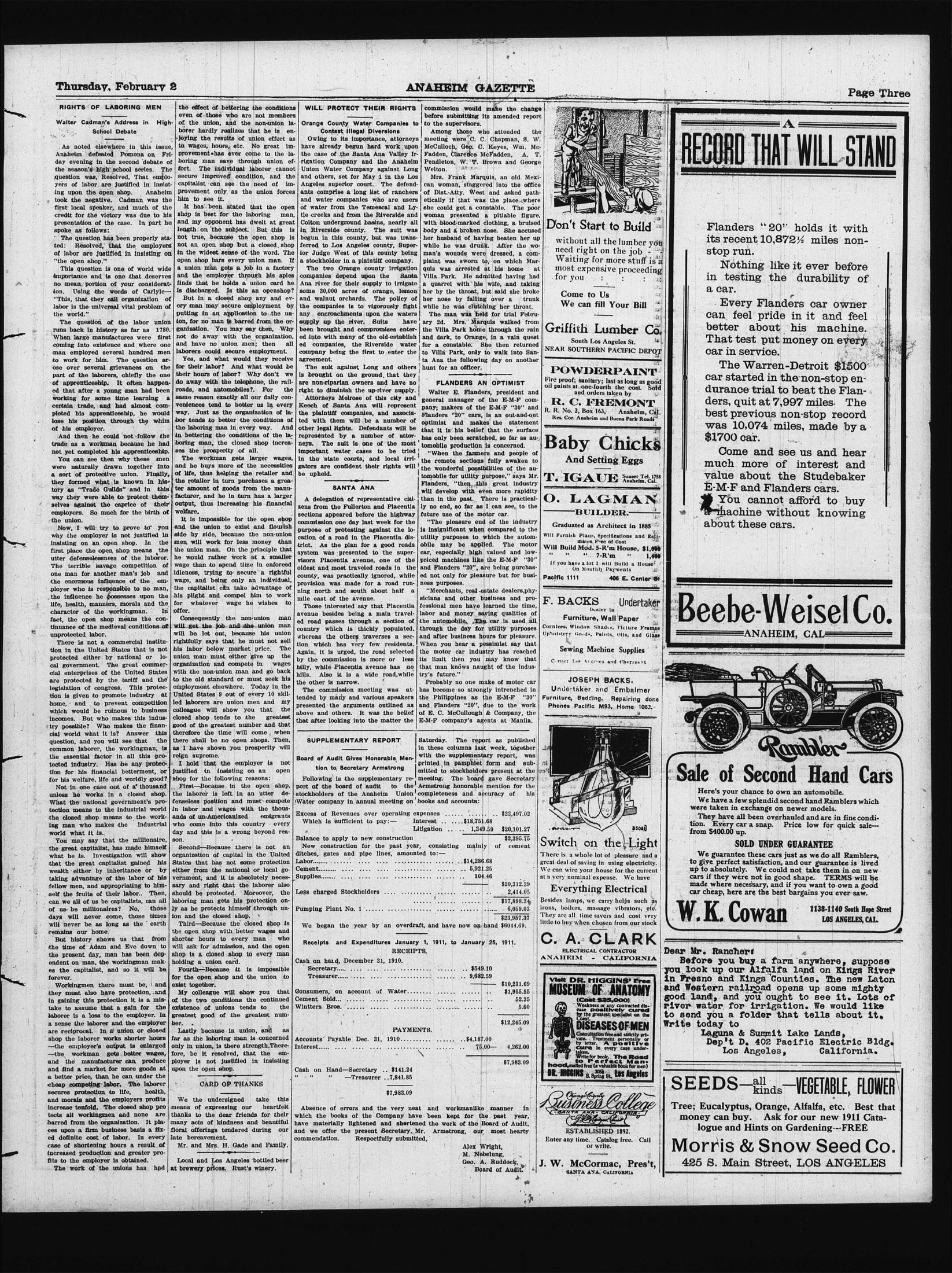
Searchable text
RIGHTS OF LABORING MEN
Walter Cadman's Address in High-School Debate
As noted elsewhere in this issue, Anaheim defeated Pomona on Friday evening in the second debate of the season's high school series. The question was, Resolved, That employers of labor are justified in insisting upon the open shop. Anaheim took the negative. Cadman was the first local speaker, and much of the credit for the victory was due to his presentation of the case. In part he spoke as follows:
The question has been properly stated: Resolved, that the employers of labor are justified in insisting on "the open shop."
This question is one of world wide importance and is one that deserves no mean portion of your consideration. Using the words of Carlyle—"This, that they call organization of labor is the universal vital problem of the world."
The question of the labor union runs back in history as far as 1780. When large manufactures were first coming into existence and where one man employed several hundred men to work for him. The question arose over several grievances on the part of the laborers, chiefly the one of apprenticeship. It often happened that after a young man had been working for some time learning a certain trade, and had almost completed his apprenticeship, he would lose his position through the whim of his employer.
And then he could not follow the trade as a workman because he had not yet completed his apprenticeship.
You can see then why these men were naturally drawn together into a sort of protective union. Finally,
the effect of bettering the conditions even of those who are not members of the union, and the non-union laborer hardly realizes that he is enjoying the results of union effort as to wages, hours, etc. No great improvement has ever come to the laboring man save through union effort. The individual laborer cannot secure improved condition, and the capitalist can see the need of improvement only as the union forces him to see it.
It has been stated that the open shop is best for the laboring man, and my opponent has dwelt at great length on the subject. But this is not true, because the open shop is not an open shop but a closed shop in the widest sense of the word. The open shop bars every union man. If a union man gets a job in a factory and the employer through his spies finds that he holds a union card he is discharged. Is this an openshop?
But in a closed shop any and every man may secure employment by putting in an application to the union, for no man is barred from the organization. You may say then, Why not do away with the organization, and have no union men; then all laborers could secure employment.
Yes, and what would they receive for their labor? And what would be their hours of labor? Why don't we do away with the telephone, the railroads, and automobiles?. For the same reason exactly all our daily conveniences tend to better us in every way. Just as the organization of labor tends to better the conditions of the laboring man in every way. And in bettering the conditions of the laboring man, the closed shop increases the prosperity of all.
The workman gets larger wages, and he buys more of the necessities of life, thus helping the retailer and
WILL PROTECT
Orange County WV Contest Illegible
Owing to its in have already begun the case of the Shrinkage Company Union Water Corp and others, set for Angeles superiorants comprise a land and water company of water from the tittle creeks and from Colton underground in Riverside county begun in this courseferred to Los Angeles for Judge West or a stockholder in an
The two Orange companies depend Ana river for their some 30,000 acres and walnut orchard the companies is any encroachment supply up the river been brought and ed into with many ed companies, tha company being tha agreement.
The suit against is brought on them are non-riparian or right to diminish Attorneys Melrose Keech of Santa Clara the plaintiff completed with them wi other legal lights represented by a neys. The suit is important water in the state count gators are confide be upheld.
part of the laborers, chiefly the one of apprenticeship. It often happened that after a young man had been working for some time learning a certain trade, and had almost completed his apprenticeship, he would lose his position through the whim of his employer.
And then he could not follow the trade as a workman because he had not yet completed his apprenticeship.
You can see then why these men were naturally drawn together into a sort of protective union. Finally, they formed what is known in history as "Trade Guilds" and in this way they were able to protect themselves against the caprice of their employers. So much for the birth of the union.
Now, I will try to prove to you why the employer is not justified in insisting on an open shop. In the first place the open shop means the utter defenselessness of the laborer. The terrible savage competition of one man for another man's job and the enormous influence of the employer who is responsible to no man, the influence he possesses upon the life, health, manners, morals and the character of the workingman. In fact, the open shop means the continuance of the medieval conditions of unprotected labor.
There is not a commercial institution in the United States that is not protected either by national or local government. The great commercial enterprises of the United States are protected by the tariff and the legislation of congress. This protection is given to promote industry at home, and to prevent competition which would be ruinous to business incomes. But who makes this industry possible? Who makes the financial world what it is? Answer this question, and you will see that the common laborer, the workingman, is the essential factor in all this protected industry. Has he any protection for his financial betterment, or for his welfare, life and worldly good?
Not in one case out of a thousand unless he works in a closed shop. What the national government's protection means to the industrial world the closed shop means to the working man who makes the industrial world what it is.
You may say that the millionaire, the great capitalist, has made himself what he is. Investigation will show that the great capitalist gained his wealth either by inheritance or by taking advantage of the labor of his fellow men, and appropriating to himself the fruits of their labor.. Then,
The workman gets larger wages, and he buys more of the necessities of life, thus helping the retailer and the retailer in turn purchases a greater amount of goods from the manufacturer, and he in turn has a larger output, thus increasing his financial welfare.
It is impossible for the open shop and the union to exist and flourish side by side, because the non-union men will work for less money than the union man. On the principle that he would rather work at a smaller wage than to spend time in enforced idleness, trying to secure a rightful wage, and being only an individual, the capitalist can take advantage of his plight and compel him to work for whatever wage he wishes to offer.
Consequently the non-union man will get the job and the union man will be let out, because his union rightfully says that he must not sell his labor below market price. The union man must either give up the organization and compete in wages with the non-union man and go back to the old standard or must seek his employment elsewhere. Today in the United States 9 out of every 10 skilled laborers are union men and my colleague will show you that the closed shop tends to the greatest good of the greatest number and that therefore the time will come when there shall be no open shops. Then, as I have shown you prosperity will reign supreme.
I hold that the employer is not justified in insisting on an open shop for the following reasons:
First—Because in the open shop, the laborer is left in an utter defenseless position and must compete in labor and wages with the thousands of un-Americanized emigrants who come into this country every day and this is a wrong beyond reason.
Second—Because there is not an organization of capital in the United States that has not some protection either from the national or local government, and it is absolutely necessary and right that the laborer also should be protected. Moreover, their hours of labor? Why don't we do away with the telephone, the railroads, and automobiles? For the same reason exactly all our daily convenences tend to better us in every way. Just as the organization of labor tends to better the conditions of the laboring man in every way. And in bettering the conditions of the laboring man, the closed shop increases the prosperity of all.
Attorneys Melrose Keech of Santa Clara are the plaintiff competed with them while other legal lights represented by attorneys. The suit is important water in the state court gators are considered be upheld.
SANTA
A delegation ofzens from the Full sections appeared commission one day purpose of protestcation of a road intrict. As the plan system was present visors Placentia an oldest and most tractic county, was practic provision was made ning north and so mile east of the aThose interested avenue besides be ed road passes tha country which is whereas the other tion which has ve Again, it is urged bythe commission hilly, while Placentia hills. Also it isthe other is narrowThe commission tended by many an presented the argu above and others that after looking i
SUPPLEMENTAL
Board of Audit Givention to Secrete
Following is tha port of tha board stockholders of tha Water company in Excess of Revenue Which is sufficiieBalance to apply toNew construction ditches, gates and Labor...Cement...Supplies...Less charged Stock
What the national government's protection means to the industrial world the closed shop means to the working man who makes the industrial world what it is.
You may say that the millionaire, the great capitalist, has made himself what he is. Investigation will show that the great capitalist gained his wealth either by inheritance or by taking advantage of the labor of his fellow men, and appropriating to himself the fruits of their labor. Then, can we all of us be capitalists, can all of us be millionaires? No, those days will never come, those times will never be as long as the earth remains our home.
But history shows us that from the time of Adam and Eve down to the present day, man has been dependent on man, the workingman makes the capitalist, and so it will be forever.
Workingmen there must be, and they must also have protection, and in gaining this protection it is a mistake to assume that a gain for the laborer is a loss to the employer. In a sense the laborer and the employer are reciprocal. In a union or closed shop the laborer works shorter hours—the employer's output is enlarged—the workman gets better wages, and the manufacturer can produce and find a market for more goods at a better price, than he can under the cheap competing labor. The laborer secures protection to life, health, and morals and the employers profits increase tenfold. The closed shop protects all workingmen and none are barred from the organization. It places upon a firm business basis a fixed definite cost of labor. In every case of shortening hours a result of increased production and greater profits to the employer is obtained.
The work of the unions has had fenseless position and must compete in labor and wages with the thousands of un-Americanized emigrants who come into this country every day and this is a wrong beyond reason.
Second—Because there is not an organization of capital in the United States that has not some protection either from the national or local government, and it is absolutely necessary and right that the laborer also should be protected. Moreover, the laboring man gets his protection only as he protects himself through union and the closed shop.
Third—Because the closed shop is the open shop with better wages and shorter hours to every man who will ask for admission, and the open shop is a closed shop to every man holding a union card.
Fourth—Because it is impossible for the open shop and the union to exist together.
My colleague will show you that of the two conditions the continued existence of unions tends to the greatest good of the greatest number.
Lastly because in union, and as far as the laboring man is concerned only in union, is there strength. Therefore, be it resolved, that the employer is not justified in insisting upon the open shop.
CARD OF THANKS
We the undersigned take this means of expressing our heartfelt thanks to the dear friends for their many acts of kindness and beautiful floral offerings tendered during our late bereavement.
Mr. and Mrs. H. Gade and Family.
Local and Los Angeles bottled beer at brewery prices. Rust's winery.
WILL PROTECT THEIR RIGHTS
Orange County Water Companies to Contest Illegal Diversions
Owing to its importance, attorneys have already begun hard work upon the case of the Santa Ana Valley Irrigation Company and the Anaheim Union Water Company against Long and others, set for May 1 in the Los Angeles superior court. The defendants comprise a long list of ranchers and water companies who are users of water from the Temescal and Lytle creeks and from the Riverside and Colton underground basins, nearly all in Riverside county. The suit was begun in this county, but was transferred to Los Angeles county, Superior Judge West of this county being a stockholder in a plaintiff company.
The two Orange county irrigation companies depend upon the Santa Ana river for their supply to irrigate some 30,000 acres of orange, lemon and walnut orchards. The policy of the companies is to vigorously fight any encroachments upon the waters supply up the river. Suits have been brought and compromises entered into with many of the old-established companies, the Riverside water company being the first to enter the agreement.
The suit against Long and others is brought on the ground that they are non-riparian owners and have no right to diminish the up-river supply.
Attorneys Melrose of this city and Keech of Santa Ana will represent the plaintiff companies, and associated with them will be a number of other legal lights. Defendants will be represented by a number of attorneys. The suit is one of the most important water cases to be tried in the state courts, and local irrigators are confident their rights will be upheld.
commission would make the change before submitting its amended report to the supervisors.
Among those who attended the meeting were C. C. Chapman, S. W. McCulloch, Geo. C. Keyes, Wm. McFadden, Clarence McFadden, A. T. Pendleton, W. T. Brown and George Welton.
Mrs. Frank Marquis, an old Mexican woman, staggered into the office of Dist.-Atty. West and asked pathologically if that was the place where she could get a constable. The poor woman presented a pitiable figure, with blood-marked clothing, a bruised body and a broken nose. She accused her husband of having beaten her up while he was drunk. After the woman's wounds were dressed, a complaint was sworn to, on which Marquis was arrested at his home at Villa Park. He admitted having had a quarrel with his wife, and taking her by the throat, but said she broke her nose by falling over a trunk while he was clutching her throat.
The man was held for trial February 2d. Mrs. Marquis walked from the Villa Park home through the rain and dark, to Orange, in a vain quest for a constable. She then returned to Villa Park, only to walk into Santa Ana the following day on another hunt for an officer.
FLANDERS AN OPTIMIST
Walter E. Flanders, president and general manager of the E-M-F company; makers of the E-M-F "30" and Flanders "20" cars, is an out-and-out optimist and makes the statement that it is his belief that the surface has only been scratched, so far as automobile production is concerned.
"When the farmers and people of the remote sections fully awaken to the wonderful possibilities of the automobile for utility purposes," Mr.
is brought on the ground, that they are non-riparian owners and have no right to diminish the up-river supply.
Attorneys Melrose of this city and Keech of Santa Ana will represent the plaintiff companies, and associated with them will be a number of other legal rights. Defendants will be represented by a number of attorneys. The suit is one of the most important water cases to be tried in the state courts, and local irrigators are confident their rights will be upheld.
SANTA ANA
A delegation of representative citizens from the Fullerton and Placentia sections appeared before the highway commission one day last week for the purpose of protesting against the location of a road in the Placentia district. As the plan for a good roads system was presented to the supervisors Placentia avenue, one of the oldest and most traveled roads in the county, was practically ignored, while provision was made for a road running north and south about half a mile east of the avenue.
Those interested say that Placentia avenue besides being a main travelled road passes through a section of country which is thickly populated, whereas the others traverses a section which has very few residents. Again, it is urged, the road selected by the commission is more or less hilly, while Placentia avenue has no hills. Also it is a wide road, while the other is narrow.
The commission meeting was attended by many and various speakers presented the arguments outlined as above and others. It was the belief that after looking into the matter the FLANDERS AN OPTIMIST
Walter E. Flanders, president and general manager of the E-M-F company, makers of the E-M-F "30" and Flanders "20" cars, is an out-and-out optimist and makes the statement that it is his belief that the surface has only been scratched, so far as automobile production is concerned.
"When the farmers and people of the remote sections fully awaken to the wonderful possibilities of the automobile for utility purpose," says Mr. Flanders, "then this great industry will develop with even more rapidity than in the past. There is practically no end, so far as I can see, to the future use of the motor car.
"The pleasure end of the industry is insignificant when compared to the utility purposes to which the automobile may be applied. The motor car, especially high valued and low-priced machines like the E-M-F "30" and Flanders "20", are being purchased not only for pleasure but for business purposes.
"Merchants, real estate dealers, physicians and other business and professional men have learned the time, labor and money saving qualities of the automobile. The car is used all through the day for utility purposes and after business hours for pleasure. When you hear a pessimist say that the motor car industry has reached its limit then you may know that that man knows naught of the industry's future."
Probably no one make of motor car has become so strongly intrenched in the Philippines as the E-M-F "30" and Flanders "20", due to the work of E. C. McCullough & Company, the E-M-F company's agents at Manila.
SUPPLEMENTARY REPORT
Board of Audit Gives Honorable Mention to Secretary Armstrong
Following is the supplementary report of the board of audit to the stockholders of the Anaheim Union Water company in annual meeting on Saturday. The report as published in these columns last week, together with the supplementary report, was printed in pamphlet form and submitted to stockholders present at the meeting. The board gave Secretary Armstrong honorable mention for the completeness and accuracy of his books and accounts:
Excess of Revenues over operating expenses $22,497.02
Which is sufficient to pay:— Interest $18,751.68
Litigation 1,349.59 $20,101.27
Balance to apply to new construction $2,395.75
New construction for the past year, consisting mainly of cement ditches, gates and pipe lines, amounted to:
Labor $14,286.68
Cement 5,921.25
Supplies 104.46
Less charged Stockholders 2,414.05
Water company in annual meeting on books and accounts:
Excess of Revenues over operating expenses ... $22,497.02
Which is sufficient to pay:— Interest ... $18,751.68
Litigation ... 1,349.59 $20,101.27
Balance to apply to new construction ... $2,395.75
New construction for the past year, consisting mainly of cement ditches, gates and pipe lines, amounted to:
Labor... $14,286.68
Cement... 5,921.25
Supplies... 104.46
$20,312.39
Less charged Stockholders ... 2,414.05
$17,898.34
Pumping Plant No. 1 ... 6,059.03
$23,957.37
We began the year by an overdraft, and have now on hand $6044.69.
Receipts and Expenditures January 1, 1911, to January 25, 1911.
RECEIPTS.
Cash on hand, December 31, 1910.
Secretary... $549.10
Treasurer... 9,682.59
$10,231.69
Consumers, on account of Water... $1,955.55
Cement Sold... 52.35
Wintters Bros. ... 5.50
$12,245.09
PAYMENTS.
Accounts Payable Dec. 31, 1910 ... $4,187.00
Interest ... 75.00— 4,262.00
$7,983.09
Cash on Hand—Secretary ... $141.24
“ “ “ —Treasurer ... 7,841.85
$7,983.09
Absence of errors and the very neat and workmanlike manner in which the books of the Company have been kept for the past year, have materially lightened and shortened the work of the Board of Audit, and we offer the present Secretary, Mr. Armstrong, our most hearty commendation. Respectfully submitted,
Alex Wright,
M. Nebelung,
Geo. A. Ruddock,
Board of Audit.
A RECORD THAT WILL STAND
Flanders “20” holds it with its recent 10,872½ miles non-stop run.
Nothing like it ever before in testing the durability of a car.
Every Flanders car owner can feel pride in it and feel better about his machine. That test put money on every car in service.
The Warren-Detroit $1500 car started in the non-stop endurance trial to beat the Flanders, quit at 7,997 miles. The best previous non-stop record was 10,074 miles, made by a $1700 car.
Come and see us and hear much more of interest and
car started in the non-stop endurance trial to beat the Flanders, quit at 7,997 miles. The best previous non-stop record was 10,074 miles, made by a $1700 car.
Come and see us and hear much more of interest and value about the Studebaker E-M-F and Flanders cars.
You cannot afford to buy a machine without knowing about these cars.
Beebe-Weisel Co.
ANAHEIM, CAL
Rambler
Sale of Second Hand Cars
Here's your chance to own an automobile.
We have a few splendid second hand Ramblers which were taken in exchange on newer models.
They have all been overhauled and are in fine condition. Every car a snap. Price low for quick sale—from $400.00 up.
SOLD UNDER GUARANTEE
We guarantee these cars just as we do all Ramblers, to give perfect satisfaction, and our guarantee is lived up to absolutely. We could not take them in on new cars if they were not in good shape. TERMS will be made where necessary, and if you want to own a good car cheap, here are the best bargains you ever saw.
We have a few splendid second hand Ramblers which were taken in exchange on newer models.
They have all been overhauled and are in fine condition. Every car a snap. Price low for quick sale—from $400.00 up.
SOLD UNDER GUARANTEE
We guarantee these cars just as we do all Ramblers, to give perfect satisfaction, and our guarantee is lived up to absolutely. We could not take them in on new cars if they were not in good shape. TERMS will be made where necessary, and if you want to own a good car cheap, here are the best bargains you ever saw.
W.K. Cowan
1138-1140 South Hope Street
LOS ANGELES, CAL.
Dear Mr. Ranchers:
Before you buy a farm anywhere, suppose you look up our Alfalfa land on Kings River in Fresno and Kings Counties. The new Laton and Western railroad opens up some mighty good land, and you ought to see it. Lots of river water for irrigation. We would like to send you a folder that tells about it.
Write today to
Laguna & Summit Lake Lands,
Dep't D. 402 Pacific Electric Bldg.
Los Angeles, California.
SEEDS—all kinds—VEGETABLE, FLOWER
Tree; Eucalyptus, Orange, Alfalfa, etc. Best that money can buy. Ask for our new 1911 Catalogue and Hints on Gardening---FREE
Morris & Snow Seed Co.
425 S. Main Street, LOS ANGELES