anaheim-gazette 1911-02-02
Scanned page
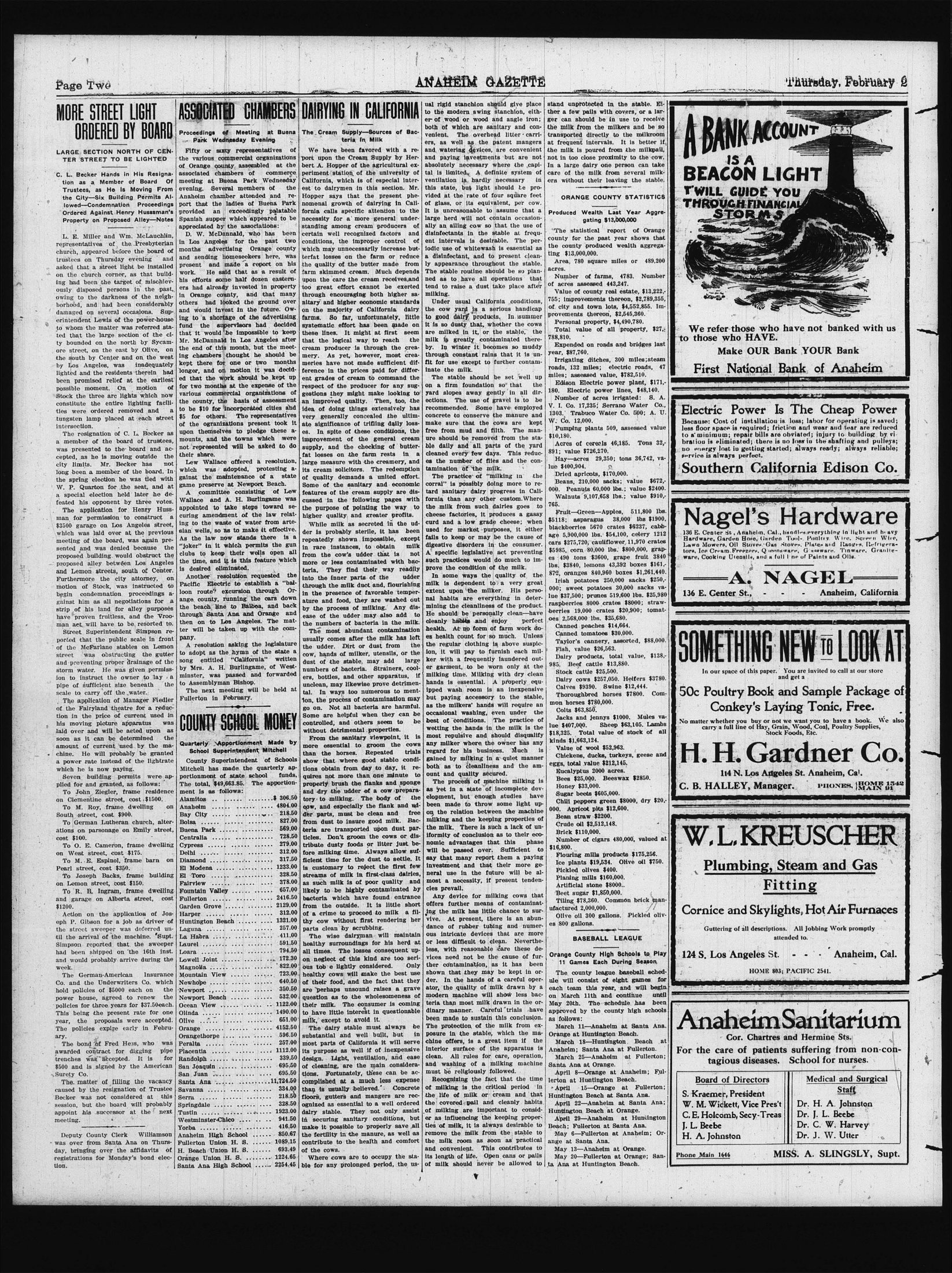
Searchable text
MORE STREET LIGHT ORDERED BY BOARD
LARGE SECTION NORTH OF CENTER STREET TO BE LIGHTED
C. L. Becker Hands in His Resignation as a Member of Board Of Trustees, as He Is Moving From the City—Six Building Permits Allowed—Condemnation Proceedings Ordered Against Henry Husssman's Property on Proposed Alley—Notes
L. E. Miller and Wm. McLauchlin, representatives of the Presbyterian church, appeared before the board of trustees on Thursday evening and asked that a street light be installed on the church corner, as that building had been the target of mischievously disposed persons in the past, owing to the darkness of the neighborhood, and had been considerably damaged on several occasions. Superintendent Lewis of the power-house to whom the matter was referred stated that the large section of the city bounded on the north by Sycamore street, on the east by Olive, on the south by Center and on the west by Los Angeles, was inadequately lighted and the residents therein had been promised relief at the earliest possible moment. On motion of Stock the three arc lights which now constitute the entire lighting facilities were ordered removed and a tungsten lamp placed at each street intersection.
The resignation of C. L. Becker as a member of the board of trustees, was presented to the board and accepted, as he is moving outside the city limits. Mr. Becker has not long been a member of the board. ASSOCIATED CHAMBERS
Proceedings of Meeting at Buena Park Wednesday Evening
Fifty or sixty representatives of the various commercial organizations of Orange county assembled at the associated chambers of commerce meeting at Buena Park Wednesday evening. Several members of the Anaheim chamber attended and report that the ladies of Buena Park provided an exceedingly palatable Spanish supper which appeared to be appreciated by the associations:
D. W. McDannald, who has been in Los Angeles for the past two months advertising Orange county and sending homeseekers here, was present and made a report on his work. He said that as a result of his efforts some half dozen easterners had already invested in property in Orange county, and that many others had looked the ground over and would invest in the future. Owing to a shortage of the advertising fund the supervisors had decided that it would be impossible to keep Mr. McDannald in Los Angeles after the end of this month, but the meeting chambers thought he should be kept there for one or two months longer, and on motion it was decided that the work should be kept up for two months at the expense of the various commercial organizations of the county, the basis of assessment to be $10 for incorporated cities and $5 for others. The representatives of the ogranzations present took it upon themselves to pledge these amounts, and the towns which were not represented will be asked to do their share.
Lew Wallace offered a resolution, which was adopted, protesting a certain well-recorded condition, the if which may unnecessarily fat losses on the quality of the farm skimmed crust upon the care they too great effort through encouragement and higher on the majority farms. So far, systematic efforts these lines. It may that the logical cream producer mery. As yet, meries have not conference in the present grades of creat respect of the progressions they must an improved qua idea of doing thervery generally orate significance es. In spite of improvement of supply, and the fat losses on therlarge measure with its cream solicitor
been promised relief at the earliest possible moment. On motion of Stock the three arc lights which now constitute the entire lighting facilities were ordered removed and a tungsten lamp placed at each street intersection.
The resignation of C. L. Becker as a member of the board of trustees, was presented to the board and accepted, as he is moving outside the city limits. Mr. Becker has not long been a member of the board. In the spring election he was tied with W. P. Quarton for the seat, and at a special election held later he defeated his opponent by three votes.
The application for Henry Hussman for permission to construct a $3500 garage on Los Angeles street, which was laid over at the previous meeting of the board, was again presented and was denied because the proposed building would obstruct the proposed alley between Los Angeles and Lemon streets, south of Center. Furthermore the city attorney, on motion of Stock, was instructed to begin condemnation proceedings against him as all negotiations for a strip of his land for alley purposes have proven fruitless, and the Vrooman act will have to be resorted to.
Street Superintendent Simpson reported that the public scale in front of the McFarlane stables on Lemon street was obstructing the gutter and preventing proper drainage of the storm water. He was given permission to instruct the owner to lay a pipe of sufficient size beneath the scale to carry off the water.
The application of Manager Fiedler of the Fairyland theatre for a reduction in the price of current used in his moving picture apparatus was laid over and will be acted upon as soon as it can be determined the amount of current used by the machine. He will probably be granted a power rate instead of the lightrate which he is now paying.
Seven building permits were applied for and granted, as follows:
To John Ziegler, frame residence on Clementine street, cost $1500.
To M. Roy, frame dwelling on South street, cost $900.
To German Lutheran church, alterations on parsonage on Emily street, cost $100.
To O. E. Cameron, frame dwelling on West street, cost $175.
To M. E. Espinol, frame barn on Pearl street, cost $350.
To Joseph Backs, frame building on Lemon street, cost $150.
To R. B. Ingram, frame dwelling and garage on Alberta street, cost that the work should be kept up for two months at the expense of the various commercial organizations of the county, the basis of assessment to be $10 for incorporated cities and $5 for others. The representatives of the ogranzations present took it upon themselves to pledge these amounts, and the towns which were not represented will be asked to do their share.
Lew Wallace offered a resolution, which was adopted, protesting against the maintenance of a state game preserve at Newport Beach.
A committee consisting of Lew Wallace and A. H. Burlingame was appointed to take steps toward securing amendment of the law relating to the waste of water from artesian wells, so as to make it effective. As the law now stands there is a "joker" in it which permits the gun clubs to keep their wells open all the time, and it is this feature which is desired eliminated.
Another resolution requested the Pacific Electric to establish a "balloon route" excursion through Orange county, running the cars down the beach line to Balboa, and back through Santa Ana and Orange and then on to Los Angeles. The matter will be taken up with the company.
A resolution asking the legislature to adopt as the hymn of the state a song entitled "California" written by Mrs. A. H. Burlingame, of Westminster, was passed and forwarded to Assemblyman Bishop.
The next meeting will be held at Fullerton in February.
COUNTY SCHOOL MONEY
Quarterly Apportionment Made by School Superintendent Mitchell
County Superintendent of Schools Mitchell has made the quarterly apportionment of state school funds, The total, $49,663.85. The apportionment is as follows:
Alamitos ... $306.50
Anaheim ... 4804.00
Bay City ... 218.50
Bolsa ... 827.00
Buena Park ... 569.00
Centralla ... 728.50
Cypress ... 279.00
Delhi ... 312.00
Diamond ... 317.50
El Modena ... 1233.00
El Toro ... 328.50
Fairview ... 378.00
Fountain Valley ... 657.00
Fullerton ... 2416.50
ent grades of creativeness respect of the progressions they might an improved quality idea of doing them very generally or date significance of es. In spite of any improvement of supply, and the fat losses on large measure with its cream solicitor's quality demand Some of the same features of the course discussed in the purpose of providing higher quality archaic material They find into the inner passage through the milk in the presence of nature and food, by the process of ease of the udder the numbers of lime The most abrupt usually comes after the udder. Dirt cow, hands of milk dust of the stable numbers of bacteria, bottles, and unclean may likelier In ways too longe go on. Not all some are helpful controlled, and without detriment From the sanitation more essential than the horses show that where observations obtain from quires not more properly brush thie and dry the udder to milking cow, and especially der parts, must from dust to insteria are transporticles. Don't grow tribute dusty food fore milking time sufficient time for it is customary to streams of milk as such milk is likely to be high bacteria which
To M. Roy, frame dwelling on South street, cost $900.
To German Lutheran church, alterations on parsonage on Emily street, cost $100.
To O. E. Cameron, frame dwelling on West street, cost $175.
To M. E. Espinol, frame barn on Pearl street, cost $350.
To Joseph Backs, frame building on Lemon street, cost $150.
To R. B. Ingram, frame dwelling and garage on Alberta street, cost $1200.
Action on the application of Joseph P. Gibson for a job as driver of the street sweeper was deferred until the arrival of the machine. Supt. Simpson reported that the sweeper had been shipped on the 16th inst. and would probably arrive during the week.
The German-American Insurance Co. and the Underwriters Co. which hold policies of $5000 each on the power house, agreed to renew the policies for three years for $37.50 each. This being the present rate for one year, the proposals were accepted. The policies expire early in February.
The bond of Fred Hess, who was awarded contract for digging pipe trenches was accepted. It is for $500 and is signed by the American Surety Co.
The matter of filling the vacancy caused by the resignation of Trustee Becker was not considered at this session, but the board will probably appoint his successor at the next meeting.
Deputy County Clerk Williamson was over from Santa Ana on Thursday, bringing over the affidavits of registrations for Monday's bond election.
DAIRYING IN CALIFORNIA
The Cream Supply—Sources of Bacteria in Milk
We have been favored with a report upon the Cream Supply by Herbert A. Hopper of the agricultural experiment station of the university of California, which is of especial interest to dairymen in this section. Mr. Hopper says that the present phenomenal growth of dairying in California calls specific attention to the necessity for a more general understanding among cream producers of certain well recognized factors and conditions, the improper control of which may unnecessarily increase butterfat losses on the farm or reduce the quality of the butter made from farm skimmed cream. Much depends upon the care the cream receives and too great effort cannot be exerted through encouraging both higher sanitary and higher economic standards on the majority of California dairy farms. So far, unfortunately, little systematic effort has been made on these lines. It might at first seem that the logical way to reach the cream producer is through the creamery. As yet, however, most creameries have not made sufficient difference in the prices paid for different grades of cream to command the respect of the producer for any suggestions they might make looking to an improved quality. Then, too, the idea of doing things extensively has very generally concealed the ultimate significance of trifling daily losses. In spite of these conditions, the improvement of the general cream supply, and the checking of butterfat losses on the farm rests in a large measure with the creamery, and its cream solicitors. The redemptionual rigid stanchion should give place to the modern swing stanchion, either of wood or wood and angle iron; both of which are sanitary and convenient. The overhead litter carriers, as well as the patent mangers and watering devices, are convenient and paying investments but are not absolutely necessary where the capital is limited. A definite system of ventilation is hardly necessary in this state, but light should be provided at the rate of four square feet of glass, or its equivalent, per cow. It is unreasonable to assume that a large herd will not contain occasionally an alling cow so that the use of disinfectants in the stable at frequent intervals is desirable. The periodic use of whitewash is essential as a disinfectant, and to present cleanly appearance throughout the stable. The stable routine should be so planned as to have all operations that tend to raise a dust take place after milking.
Under usual California conditions, the cow yard is a serious handicap to good dairy products. In summer it is so dusty that, whether the cows are milked in it, or the stable, the milk is greatly contaminated thereby. In winter it becomes so muddy through constant rains that it is unfit for use except to further contaminate the milk.
The stable should be set well up on a firm foundation so that the yard slopes away gently in all directions. The use of gravel is to be recommended. Some have employed concrete to conserve the manure and make sure that the cows are kept free from mud and filth. The manure should be removed from the stable daily and all parts of the yard cleaned every few days. This reduces the number of flies and the contamination of the milk.
stand unprotected in the stable. Either a few pails with covers, or a larger can should be in use to receive the milk from the milkers and be so transported directly to the milkroom at frequent intervals. It is better if the milk is poured from the milkpail, not in too close proximity to the cow. In a large dairy one person can take care of the milk from several milkers without their leaving the stable.
ORANGE COUNTY STATISTICS
Produced Wealth Last Year Aggregating $13,000,000
The statistical report of Orange county for the past year shows that the county produced wealth aggregating $13,000,000.
Area, 780 square miles or 489,200 acres.
Number of farms, 4783. Number of acres assessed 443,247.
Value of county real estate, $13,222,-755; improvements thereon, $2,789,355, of city and town lots, $4,552,855. Improvements thereon, $2,545,360.
Personal property, $4,490,780.
Total value of all property, $27,-788,810.
Expended on roads and bridges last year, $87,760.
Irrigating ditches, 300 miles; steam roads, 132 miles; electric roads, 47 miles; assessed value, $782,510.
Edison Electric power plant, $171,-180. Electric power lines, $48,140.
Number of acres irrigated: S. A. V. I. Co. 17,235; Serrano Water Co., 1303. Trabuco Water Co. 500; A. U. W. Co. 12,000.
Pumping plants 509, assessed value $10,180.
Acres of cereals 46,185. Tons 32,-891; value $726,270.
Hay—acres 29,350; tons 36,742, value $400,904.
Dried apricots, $170,000.
up of the farms of assessment look it these are were to do
uction, being a state such.
Lew was and se relat arte ovective is a gun on all which
the "bal-Ordown back and mat comlature state a written Westwarded field at
NEY
ble by well schools only ap funds, portion306.50 804.00 218.50 827.00 569.00 728.50 279.00 312.00 317.50 233.00 328.50 378.00 657.00 416.50
from the sanitary viewpoint, it is more essential to groom the cows than the horses. Repeated trials show that where good stable conditions obtain from day to day, it requires not more than one minute to properly brush the flanks and sponge and dry the udder of a cow preparatory to milking. The body of the cow, and especially the flank and udder parts, must be clean and free from dust to insure good milk. Bacteria are transported upon dust particles. Don't groom the cows or distribute dusty foods or litter just before milking time. Always allow sufficient time for the dust to settle. It is customary to reject the first few streams of milk in first-class dairies, as such milk is of poor quality and likely to be highly contaminated by bacteria which have found entranceent grades of cream to command the respect of the producer for any suggestions they might make looking to an improved quality. Then, too, the idea of doing things extensively has very generally concealed the ultimate significance of trifling daily losses. In spite of these conditions, the improvement of the general cream supply, and the checking of butter-fat losses on the farm rests in a large measure with the creamery, and its cream solicitors. The redemption of quality demands a united effort. Some of the sanitary and economic features of the cream supply are discussed in the following pages with the purpose of pointing the way to higher quality and greater profits.
While milk as secreted in the udder is probably sterile, it has been repeatedly shown impossible, except in rare instances, to obtain milk from the cow's udder that is not more or less contaminated with bacteria. They find their way readily into the inner parts of the udder through the milk duct and, flourishing in the presence of favorable temperature and food, they are washed out by the process of milking. Any disease of the udder may also add to the numbers of bacteria in the milk.
The most abundant contamination usually comes after the milk has left the udder. Dirt or dust from the cow, hands of milker, utensils, or the dust of the stable, may add large numbers of bacteria. Strainers, coolers, bottles, and other apparatus, if unclean, may likewise prove detrimental. In ways too numerous to mention, the process of contamination may go on. Not all bacteria are harmful. Some are helpful when they can be controlled, and others seem to be without detrimental properties.
From the sanitary viewpoint, it is more essential to groom the cows than the horses. Repeated trials show that where good stable conditions obtain from day to day, it requires not more than one minute to properly brush the flanks and sponge and dry the udder of a cow preparatory to milking. The body of the cow, and especially the flank and udder parts, must be clean and free from dust to insure good milk. Bacteria are transported upon dust particles. Don't groom the cows or distribute dusty foods or litter just before milking time. Always allow sufficient time for the dust to settle. It is customary to reject the first few streams of milk in first-class dairies, as such milk is of poor quality and likely to be highly contaminated by bacteria which have found entranceent grades of cream to command the respect of the producer for any suggestions they might make looking to an improved quality. Then, too, the idea of doing things extensively has very generally concealed the ultimate significance of trifling daily losses. In spite of these conditions, the improvement of the general cream supply, and the checking of butter-fat losses on the farm rests in a large measure with the creamery, and its cream solicitors. The redemption of quality demands a united effort. Some of the sanitary and economic features of the cream supply are discussed in the following pages with the purpose of pointing the way to higher quality and greater profits.
While milk as secreted in the udder is probably sterile, it has been repeatedly shown impossible, except in rare instances, to obtain milk from the cow's udder that is not more or less contaminated with bacteria. They find their way readily into the inner parts of the udder through the milk duct and, flourishing in the presence of favorable temperature and food, they are washed out by the process of milking. Any disease of the udder may also add to the numbers of bacteria in the milk.
The most abundant contamination usually comes after the milk has left the udder. Dirt or dust from the cow, hands of milker, utensils, or the dust of the stable, may add large numbers of bacteria. Strainers, coolers, bottles, and other apparatus, if unclean, may likewise prove detrimental. In ways too numerous to mention, the process of contamination may go on. Not all bacteria are harmful. Some are helpful when they can be controlled, and others seem to be without detrimental properties.
From the sanitary viewpoint, it is more essential to groom the cows than the horses. Repeated trials show that where good stable conditions obtain from day to day, it requires not more than one minute to properly brush the flanks and sponge and dry the udder of a cow preparatory to milking. The body of the cow, and especially the flank and udder parts, must be clean and free from dust to insure good milk. Bacteria are transported upon dust particles. Don't groom the cows or distribute dusty foods or litter just before milking time. Always allow sufficient time for the dust to settle. It is customary to reject the first few streams of milk in first-class dairies, as such milk is of poor quality and likely to be highly contaminated by bacteria which have found entranceent grades of cream to command the respect of the producer for any suggestions they might make looking to an improved quality. Then, too, the idea of doing things extensively has very generally concealed the ultimate significance of trifling daily losses. In spite of these conditions, the improvement of the general cream supply, and the checking of butter-fat losses on the farm rests in a large measure with the creamery, and its cream solicitors. The redemption of quality demands a united effort. Some of the sanitary and economic features of the cream supply are discussed in the following pages with the purpose of pointing the way to higher quality and greater profits.
While milk as secreted in the udder is probably sterile, it has been repeatedly shown impossible, except in rare instances, to obtain milk from the cow's udder that is not more or less contaminated with bacteria. They find their way readily into the inner parts of the udder through the milk duct and, flourishing in the presence of favorable temperature and food, they are washed out by the process of milking. Any disease of the udder may also add to the numbers of bacteria in the milk.
The most abundant contamination usually comes after the milk has left the udder. Dirt or dust from the cow, hands of milker, utensils, or the dust of the stable, may add large numbers of bacteria. Strainers, coolers, bottles, and other apparatus, if unclean, may likewise prove detrimental. In ways too numerous to mention, the process of contamination may go on. Not all bacteria are harmful. Some are helpful when they can be controlled, and others seem to be without detrimental properties.
From the sanitary viewpoint, it is more essential to groom the cows than the horses. Repeated trials show that where good stable conditions obtain from day to day, it requires not more than one minute to properly brush the flanks and sponge and dry the udder of a cow preparatory to milking. The body of the cow, and especially the flank and udder parts, must be clean and free from dust to insure good milk. Bacteria are transported upon dust particles. Don't groom the cows or distribute dusty foods or litter just before milking time. Always allow sufficient time for the dust to settle. It is customary to reject the first few streams of milk in first-class dairies, as such milk is of poor quality and likely to be highly contaminated by bacteria which have found entranceent grades of cream to command the respect of the producer for any suggestions they might make looking to an improved quality. Then, too, the idea of doing things extensively has very generally concealed the ultimate significance of trifling daily losses. In spite of these conditions, the improvement of the general cream supply, and the checking of butter-fat losses on the farm rests in a large measure with the creamery, and its cream solicitors. The redemption of quality demands a united effort. Some of the sanitary and economic features of the cream supply are discussed in the following pages with the purpose of pointing the way to higher quality and greater profits.
While milk as secreted in the udder is probably sterile, it has been repeatedly shown impossible, except in rare instances, to obtain milk from the cow's udder that is not more or less contaminated with bacteria. They find their way readily into the inner parts of the udder through the milk duct and, flourishing in the presence of favorable temperature and food, they are washed out by the process of milking. Any disease of the udder may also add tothe numbersofbacteriainthemilk.
The most abundant contamination usually comes afterthemilkhaslefttheudderDirtordustfromthecow,handsofmilker Utensils,thedustofthestable,mayaddlargenumbersofbacteriaStrainers,coolers,bottles,andotherapparatusIfunclean,maylikewiseprodetrimental.Inwaystoonumeroustomentlon,theprocessofcontaminationmaygoon.Notallbacteriaareharmful.Somearehelpfulwhentheycanbecontrolled,andothersseemtobewithoutdetrimentalproperties.
Fromthe sanitaryviewpoint,它是moreessentialtogroomthecowsthanthehorses。Repeatedtrialsshowthatwheregoodstableconditionsobtainfromdaytoday.itrequiresnotmorethanoneminute治perlybrushtheflanksandspongeanddrytheudderofa CowpreparatorytoMilking.Thebodyofthecow,andespeciallytheflankandudderparts,mustbecleanandfreefromdusttoinsuregoodmilk.Bacteriaaretransportedupondustparticles.Don'tgroomthecowsordistributedustyfoodsorlitertjustbeforemilkingtime.Alwaysallow苏fficienttimeforthedusttosettle。它iscustomarytorejectthefirstfewstreamsofmilkinfirstclassdairies,assuchmilkisofpoorqualityandlikelytobehighlycontaminatedbybacteriawhichhavefoundentranceententgradesofcreamtocommandtherespectoftheproducerforanysuggestionstheymightmakelookingtoanimprovedquality。Then,too,theideaofdoingthingsextensivelyhasverygenerallyconcealedtheultimatesignificanceoftriflingdailylosses.Inspiteoftheconditions,theimprovementofthegeneralcreamsupplyisabovedifficultygoingtowhereuponthemilderandmakinguseofthecowsarekeptfreefrommudandfilth.Themanureshouldberemovedfromthestabledailyandallpartsoftheyardcleanedeveryfewdays。这 reducesthenumberoffilcesandthecontaminationofthemilk。
Thepracticeof"milkinginthecorral"ispossiblydoingmoretoretardsanitarydairyprogressinCaliforniathananyothercustomWherethemilkfromsuchdairliesgotocheesefactories,它producesagassycurdandalowgradecheese;whenusedformarketpurposes,它eitherfallstokeepormaybethecauseofdigestivedisordersinthe consumer.Aspecificlegislativeactpreventingsuchpracticeswoulddo muchtoimprovetheconditionofthemilk。
Insomewaysthequalityofthemilkisdependenttoaverygreatextentuponthemilker.HispersonalhabitsareeverythingindeterminingthecleanlinessoftheproductHe shouldbepersonallyclean—havecleanlyhabitsandenjoyperfecthealth.Antoformoffarmworkdoeshealthcountforso much.Unlesstheregularclothingisabove Suspicion,它willpaytowhishermillerkwithafrequentlylauneredoutergarment,到be wornonlyatthemilkingtime.Milkingwithdrycleanhandsisessential.Aproper equippedwashroomisaninexpensivebutpayingaccessorytothestable,asthemilkers'handswillrequireanoccasionwashing,evenunderthebestofconditions.Thepracticeofwettingthehandsinthemilkisthemostrepulsiveandshoulddisqualifyanymilkerwheretheownerhasanyregardforhisbusiness.Muchisgainedbymilkinginalquietmannerbothastocleanlinessandtheamountandqualitysecured。
Theprocessofmachinemilkingisasyetinainstateofincompletedevelopment,但 enoughstudieshavebeenmade.tothrowsomelightupontherelationbetweenthemachinemilkingandthekeepingpropertiesofthemilkThereissucha lackofuniformityofconclusionasto theireconomicadvantagesthatthisphasewillbepassedover.Sufficientto say that many report thema paying investmentandthat theirmoregeneraluseinthefuturewillbealmosta necessity,fipresenttendenciesprevail。
Anydeviceformilkingcowsthatassistentvalue,$782510.EdisonElectricpowerplant,$171,-180.EdisonElectricpowerlines,$48140.Numberofacres irrigated:S.A.V.I.Co.,17235;SerranoWaterCo.,1303.TrabucoWaterCo.,500;A.U.W.Co.,12000.Pumpingplants509,assessedvalue$1009.Driedapricots,$17000 Beans,210000 Sweets,26563 Walmuts,9107658.Fruit—Green—Apples,511800 lbs.$5118;asparagus38000 lbs $1900 blackberries5670crates$6237 cabbage5,90000 lbs.$54100,celery1212 cars$275720,cauliflower11970crates$5985, corn80000 lbs.$80000,grapes490tons$3600,grape fruit3840 lbs.$3840,lemons43,392boxes$161.-872,oranges840,960boxes$1261,442Irishpotatoes250,000 sweet potatoes30,000 sacks value$37,500;prunes519,600 lbs.$25,980 raspberries8000 crates$8000;strawberries19,000 crates$29,900;tomatoes2,568,000 lbs.$25,680 Canned peaches$14,664 Canned tomatoes$30,000 Taylor'scannery,assorted,$88,000 Fish,value$26,563 Dairy products,总价值$138-985 Beef cattle$13,880 Stock cattle$25,500 Dairy cows$257,050 Helfers$3780 Calves$9390 Swine$12,444 Thoroughbred horses$7800 Common horses$780,000 Colts$63,850 Jacks和jennys$1000.Mulesvalue$407,000 Sheep$63,105.Lambs$18,325.Totalvalueofstockofallkinds$1,663,124 Valueof wool$52,963 Chickens,ducks,turkeys,andgeeseandeggs,总价值$212,145 Rueberryberries19,000 crates$29,900;tomatoes2,568,000 lbs.$25,680 Canned peaches$14,664 Canned tomatoes$30,000 Taylor'scannery,assorted,$88,000 Fish,value$26,563 Dairy products,总价值$138-985 Beef cattle$13,880 Stock cattle$25,500 Dairy cows$257,050 Helfers$3780 Calves$9390 Swine$12,444 Thoroughbred horses$780�Oommonhorses$780 ,OOoColts$63,85O Jacksandjennys$100.Mulesvalue$407,00Omechanicpowerplant,$17ₙ₁₀.Omechanicpowerline,$4ₘ₁₀.Totalvalueofstockofallkinds$1,663,124 Valueof wool$52,963 Chickens,ducks,turkeys,andgeeseandeggs,总价值$212,145 Rueberryberries19,00crates$29,900Tomatoes2,5680Oommonhorses$780 ,OOoColts$63,85O Jacksandjennys$100.Mulesvalue$407,00Omechanicpowerplant,$17ₙ₁₀.Omechanicpowerline,$4ₘ₁₀.Totalvalueofstockofallkinds$1,663,124 Valueof wool$52,963 Chickens,ducks,turkeys,andgeeseandeggs,总价值$212,145 Rueberryberries19,00crates$29,900Tomatoes2,5680Oommonhorses$780 ,OOoColts$63,85O Jacksandjennys$100.Mulesvalue$407,00Omechanicpowerplant,$17ₙ₁₀.Omechanicpowerline,$4ₘ₁₀.Totalvalueofstockofallkinds$1,663,124 Valueof wool$52,963 Chickens,ducks,turkeys,andgeeseandeggs,总价值$212,145 Rueberryberries19,00crates$29,900Tomatoes2,5680Oommonhorses$$780 ,OOoColts$$63,85O Jacksandjennys$$100.Mulesvalue$$407,00Omechanicpowerplant,$17ₙ₁₀.Omechanicpowerline,$4ₘ₁₀.Totalvalueofstockofallkinds$$1,663,124 Valueof wool$$52,963 Chickens,ducks,turkeys,andgeeseandeggs,总价值$$212,145 Rueberryberries19,00crates$$29,900Tomatoes2,5680Oommonhorses$$780 ,OOoColts$$63,85O Jacksandjennys$$100.Mulesvalue$$4۰7,0۰Omechanicpowerplant,$17ₙ₁₀.Omechanicpowerline,$4ₘ₁₀.Totalvalueofstockofallkinds$$1,663,124 Valueof wool$$52,963 Chickens,ducks,turkeys,andgeeseandeggs,总价值$$212,145 Rueberryberries19,00crates$$29,900Tomatoes2,5680Oommonhorses$$78۰ ,OOoColts$$63،85О Jacksandjennys$$1۰۰۰.Omechanicpowerplant,$17ₙ₁₀.Omechanicpowerline,$4ₘ₁₀.Totalvalueofstockofallkinds$$1،663،124 ValueOfWool$$52،963 Chickens,ducks,turkeys,andgeeseandeggs,总价值$$212،145 Rueberryberries19،00crates$$29،900Tomatoes2،568۰Oommonhorses$$78۰ ،OOoColts$$63،八五ValueOfWool$$52،963 Chickens,ducks,turkeys,andgeeseandeggs,总价值$$212،145 Rueberryberries19،00crates$$29،900Tomatoes2،568۰Oommonhorses$$78۰ ,OOoColts$$63،八五ValueOfWool$$52،963 Chickens,ducks,turkeys,andgeeseandeggs,总价值$$212،145 Rueberryberries19،00crates$$29،900Tomatoes2،568۰Oommonhorses$$78۰ ,OOoColts$$63،八五ValueOfWool$$52،963 Chickens,ducks,turkeys,andgeeseandeggs,总价值$$2
tory to milking. The body of the cow, and especially the flank and udder parts, must be clean and free from dust to insure good milk. Bacteria are transported upon dust particles. Don't groom the cows or distribute dusty foods or litter just before milking time. Always allow sufficient time for the dust to settle. It is customary to reject the first few streams of milk in first-class dairies, as such milk is of poor quality and likely to be highly contaminated by bacteria which have found entrance from the outside. It is little short of a crime to proceed to milk a filthy cow without first rendering her parts clean by scrubbing.
The wise dairyman will maintain healthy surroundings for his herd at all times. The losses consequent upon neglect of this kind are too serious to be lightly considered. Only healthy cows will make the best use of their food, and the fact that they are perhaps unsound raises a grave question as to the wholesomeness of their milk. The consumer is coming to have little interest in questionable milk, except to avoid it.
The dairy stable must always be substantial and well built, but in most parts of California it will serve its purpose as well if of inexpensive design. Light, ventilation, and ease of cleaning, are the main considerations. Fortunately, these can be accomplished at a much less expense than is usually believed. Concrete floors, gutters and mangers are recognized as essential to a well ordered dairy stable. They not only assist in securing sanitary conditions, but make it possible to properly save all the fertility in the manure, as well as contribute to the health and comfort of the cows.
Where cows are to occupy the stable for any prolonged period, the us-
Chili peppers green $8000, dry $20,-000. Apricot pits $12,600.
Bean straw $2200.
Crude oil $2,512,148.
Brick $110,000.
Number of cigars 480,000, valued at $16,800.
Flouring mills products $175,256.
Ice plants $19,534. Olive oil $750.
Pickled olives $400.
Planing mills $160,000.
Artificial stone $8000..
Beet sugar $1,850,000.
Tilting $78,360. Common brick manufactured 2,000,000.
Olive oil 300 gallons. Pickled olives 800 gallons.
BASEBALL LEAGUE
Orange County High Schools to Play
11 Games Each During Season
The county league baseball schedule will consist of eight games for each team this year, and will begin on March 11th and continue until May 20th. The schedule has been approved by the county high schools as follows:
March 11—Anaheim at Santa Ana.
Orange at Huntington Beach.
March 18—Huntington Beach at Anaheim; Santa Ana at Fullerton.
March 25—Anaheim at Fullerton; Santa Ana at Orange.
April 8—Orange at Anaheim; Fullerton at Huntington Beach.
April 15—Orange at Fullerton; Huntington Beach at Santa Ana.
April 22—Anaheim at Santa Ana; Huntington Beach at Orange.
April 29—Anaheim at Huntington Beach; Fullerton at Santa Ana.
May 6—Fullerton at Anaheim; Orange at Santa Ana.
May 13—Anaheim at Orange.
May 20—Fullerton at Orange; Santa Ana at Huntington Beach.
THURSDAY, FEBRIARY 2
A BANK ACCOUNT
IS A
BEACON LIGHT
I WILL GUIDE YOU
THROUGH FINANCIAL
STORMS
We refer those who have not banked with us
to those who HAVE.
Make OUR Bank YOUR Bank
First National Bank of Anaheim
Electric Power Is The Cheap Power
Because: Cost of installation is less; labor for operating is saved;
less floor space is required; friction and wear and tear are reduced
to a minimum; repair bills are obviated; injury to building by vibration is eliminated; there is no loss in the shafting and pulleys;
no energy lost in getting started; always ready; always reliable;
service is always perfect.
Southern California Edison Co.
Electric Power Is The Cheap Power
Because: Cost of installation is less; labor for operating is saved;
less floor space is required; friction and wear and tear are reduced
to a minimum; repair bills are obviated; injury to building by vibration is eliminated; there is no loss in the shafting and pulleys;
no energy lost in getting started; always ready; always reliable;
service is always perfect.
Southern California Edison Co.
Nagel's Hardware
136 E. Center St., Anaheim, Cal., handles everything in light and heavy
Hardware, Garden Hose, Garden Tools, Poultry Wire, Screen Wire,
Lawn Mowers, Oil Stoves, Gas Stoves, Plates and Ranges, Refrigerators,
Ice Cream Freezers, Queensware, Glassware, Tinware, Graniteware, Cooking Utensils, and a full line of Paints and Oils.
A. NAGEL
136 E. Center St., Anaheim, California
SOMETHING NEW TO LOOK AT
In our space of this paper. You are invited to call at our store
and get a
50c Poultry Book and Sample Package of Conkey's Laying Tonic, Free.
No matter whether you buy or not we want you to have a book. We also
carry a full line of Hay, Grain, Wood, Coal, Poultry Supplies,
Stock Foods, Etc.
H. H. Gardner Co.
114 N. Los Angeles St. Anaheim, Cal.
C. B. HALLEY, Manager.
PHONES: HOME 1542
MAIN 91
W.L.KREUSCHER
Plumbing, Steam and Gas
Fitting
W.L.KREUSCHER
Plumbing, Steam and Gas
Fitting
Cornice and Skylights, Hot Air Furnaces
Guttering of all descriptions. All Jobbing Work promptly attended to.
124 S. Los Angeles St. Anaheim, Cal.
HOME 803; PACIFIC 2541.
Anaheim Sanitarium
Cor. Chartres and Hermine Sts.
For the care of patients suffering from non-contagious diseases. School for nurses.
Board of Directors
S. Kraemer, President
W. M. Wickett, Vice Pres't
C.E. Holcomb, Secy-Treas
J. L. Beebe
H. A. Johnston
Medical and Surgical Staff
Dr. H. A. Johnston
Dr. J. L. Beebe
Dr. C. W. Harvey
Dr. J. W. Utter
Phone Main 1646
MISS. A. SLINGSLY, Supt.