anaheim-gazette 1910-03-31
Scanned page
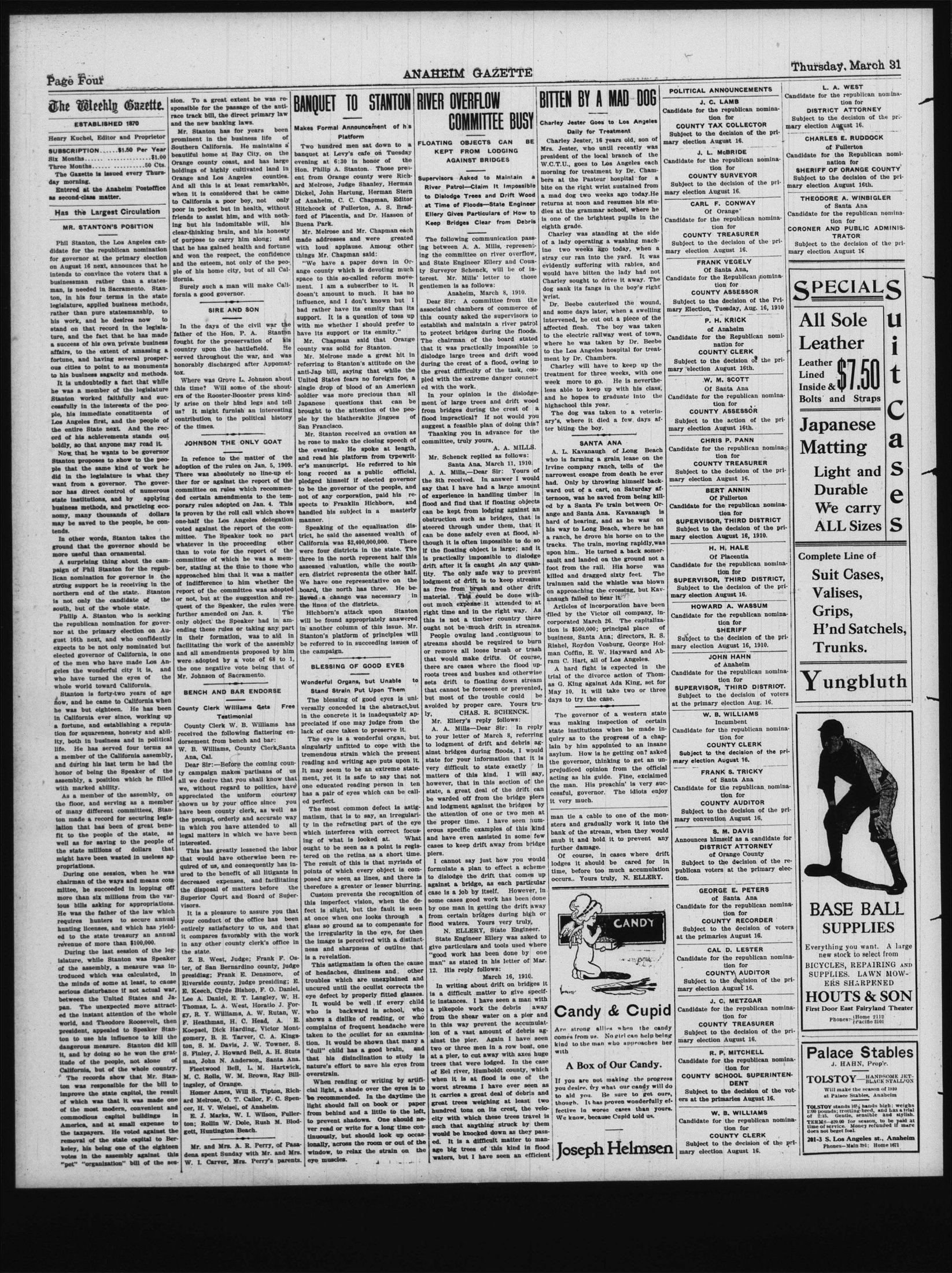
Searchable text
The Weekly Gazette.
ESTABLISHED 1870
Henry Kuchel, Editor and Proprietor
SUBSCRIPTION ... $1.50 Per Year
Six Months ... $1.00
Three Months ... 50 Cts.
The Gazette is issued every Thursday morning.
Entered at the Anaheim Postoffice as second-class matter.
Has the Largest Circulation
MR. STANTON'S POSITION
Phil Stanton, the Los Angeles candidate for the republican nomination for governor at the primary election on August 16 next, announces that he intends to convince the voters that a businessman rather than a statesman, is needed in Sacramento. Stanton, in his four terms in the state legislature, applied business methods, rather than pure statesmanship, to his work, and he desires now to stand on that record in the legislature, and the fact that he has made a success of his own private business affairs, to the extent of amassing a fortune, and having several prosperous cities to point to as monuments to his business sagacity and methods.
It is undoubtedly a fact that while he was a member of the legislature Stanton worked faithfully and successfully in the interests of the people, his immediate constituents of Los Angeles first, and the people of the entire State next. And the record of his achievements stands out boldly, so that anyone may read it.
Now that he wants to be governor Stanton proposes to show to the people that the same kind of work he did in the legislature is what they sion. To a great extent he was responsible for the passage of the anti-race track bill, the direct primary law and the new banking laws.
Mr. Stanton has for years been prominent in the business life of Southern California. He maintains a beautiful home at Bay City, on the Orange county coast, and has large holdings of highly cultivated land in Orange and Los Angeles counties. And all this is at least remarkable, when it is considered that he came to California a poor boy, not only poor in pocket but in health, without friends to assist him, and with nothing but his indomitable will, his clear-thinking brain, and his honesty of purpose to carry him along; and that he has gained health and fortune and won the respect, the confidence and the esteem, not only of the people of his home city, but of all California.
Surely such a man will make California a good governor.
SIRE AND SON
In the days of the civil war the father of the Hon. P. A. Stanton fought for the preservation of his country upon the battlefield. He served throughout the war, and was honorably discharged after Appomattox.
Where was Grove L. Johnson about this time? Will some of the shouters of the Rooster-Booster press kindly arise on their hind legs and tell us? It might furnish an interesting contribution to the political history of the times.
JOHNSON THE ONLY GOAT
In refence to the matter of the adoption of the rules on Jan. 5, 1909. There was absolutely no line-up el-
It is undoubtedly a fact that while he was a member of the legislature Stanton worked faithfully and successfully in the interests of the people, his immediate constituents of Los Angeles first, and the people of the entire State next. And the record of his achievements stands out boldly, so that anyone may read it.
Now that he wants to be governor Stanton proposes to show to the people that the same kind of work he did in the legislature is what they want from a governor. The governor has direct control of numerous state institutions, and by applying business methods, and practicing economy, many thousands of dollars may be saved to the people, he contends.
In other words, Stanton takes the ground that the governor should be more useful than ornamental.
A surprising thing about the campaign of Phil Stanton for the republican nomination for governor is the strong support he is receiving in the northern end of the state. Stanton is not only the candidate of the south, but of the whole state.
Philip A. Stanton who is seeking the republican nomination for governor at the primary election on August 16th next, and who confidently expects to be not only nominated but elected governor of California, is one of the men who have made Los Angeles the wonderful city it is, and who have turned the eyes of the whole world toward California.
Stanton is forty-two years of age now, and he came to California when he was but eighteen. He has been in California ever since, working up a fortune, and establishing a reputation for squareness, honesty and ability, both in business and in political life. He has served four terms as a member of the California assembly, and during his last term he had the honor of being the Speaker of the assembly, a position which he filled with marked ability.
As a member of the assembly, on the floor, and serving as a member of many different committees, Stanton made a record for securing legislation that has been of great benefit to the people of the state, as well as for saving to the people of the state millions of dollars that might have been wasted in useless appropriations.
During one session, when he was chairman of the ways and means committee, he succeeded in lopping off more than six millions from the var-
Where was Grove L. Johnson about this time? Will some of the shouters of the Rooster-Booster press kindly arise on their hind legs and tell us? It might furnish an interesting contribution to the political history of the times.
JOHNSON THE ONLY GOAT
In refence to the matter of the adoption of the rules on Jan. 5, 1909. There was absolutely no line-up either for or against the report of the committee on rules which recommended certain amendments to the temporary rules adopted on Jan. 4. This is proven by the roll call which shows one-half the Los Angeles delegation voted against the report of the committee. The Speaker took no part whatever in the proceeding other than to vote for the report of the committee of which he was a member, stating at the time to those who approached him that it was a matter of indifference to him whether the report of the committee was adopted or not, but at the suggestion and request of the Speaker, the rules were further amended on Jan. 8. The only object the Speaker had in amending these rules or taking any part in their formation, was to aid in facilitating the work of the assembly and all amendments proposed by him were adopted by a vote of 68 to 1, the one negative vote being that of Mr. Johnson of Sacramento.
BENCH AND BAR ENDORSE
County Clerk Williams Gets Free Testimonial
County Clerk W. B. Williams has received the following flattering endorsement from bench and bar: W. B. Williams, County Clerk, Santa Ana, Cal.
Dear Sir:—Before the coming county campaign makes partisans of us all we desire that you shall know that we, without regard to politics, have appreciated the uniform courtesy shown us by your office since you have been county clerk, as well as the prompt, orderly and accurate way in which you have attended to all legal matters in which we have been interested.
This has greatly lessened the labor that would have otherwise been required of us, and consequently has incurred to the benefit of all litigants in decreased expenses, and facilitating the disposal of matters before the Superior Court and Board of Super-
Wonderful Organism
Stand Strain
The blessing o'versally conceded in the concrete it preciated if one lack of care taken.
The eye is a very singularly unfitted tremendous strain reading and writing. It may seem to be ment, yet it is so one educated reader has a pair of eyelids perfect.
The most com-matism, that is true in the refractory which interferes with what is thought to be seen tered on the retina.
The result of this points of which posed are seen as therefore a great Custom prevent-
the floor, and serving as a member of many different committees, Stanton made a record for securing legislation that has been of great benefit to the people of the state, as well as for saving to the people of the state millions of dollars that might have been wasted in useless appropriations.
During one session, when he was chairman of the ways and means committee, he succeeded in lopping off more than six millions from the various bills asking for appropriations. He was the father of the law which requires hunters to secure annual hunting licenses, and which has yielded to the state treasury an annual revenue of more than $100,000.
During the last session of the legislature, while Stanton was Speaker of the assembly, a measure was introduced which was calculated, in the minds of some at least, to cause serious disturbance if not actual war, between the United States and Japan. The unexpected move attracted the instant attention of the whole world, and Theodore Roosevelt, then president, appealed to Speaker Stanton to use his influence to kill the dangerous measure. Stanton did kill it, and by doing so he won the gratitude of the people, not alone of California, but of the whole country.
The records show that Mr. Stanton was responsible for the bill to improve the state capitol, the result of which was that it was made one of the most modern, convenient and commodious capitol buildings in America, and at small expense to the taxpayers. He voted against the removal of the state capital to Berkeley, his being one of the eighteen votes in the assembly against this "pet" "organization" bill of the session shown us by your office since you have been county clerk, as well as the prompt, orderly and accurate way in which you have attended to all legal matters in which we have been interested.
This has greatly lessened the labor that would have otherwise been required of us, and consequently has insured to the benefit of all litigants in decreased expenses, and facilitating the disposal of matters before the Superior Court and Board of Supervisors.
It is a pleasure to assure you that your conduct of the office has been entirely satisfactory to us, and that it compares favorably with the work in any other county clerk's office in the state.
Z. B. West, Judge; Frank F. Oster, of San Bernardino county, judge presiding; Frank E. Densmore, of Riverside county, judge presiding; E. E. Keech, Clyde Bishop, F. O. Daniel, Lee A. Daniel, E. T. Langley, W. H. Thomas, L. A. West, Horatio J. Forgy, R. Y. Williams, A. W. Rutan, W. F. Heathman, H. C. Head, A. E. Koepsel, Dick Harding, Victor Montgomery, B. E. Tarver, C. A. Kingston, S. M. Davis, J. W. Towner, S. S. Finley, J. Howard Bell, A. H. Stutsman, John N. Anderson., Santa Ana.
Fleetwood Bell, L. M. Hartwick, M. C. Rolls, W. M. Brown, Ray Billingsley, of Orange.
Homer Ames, Will S. Tipton, Richard Melrose, O. T. Callor, F. C. Spencer, H. V. Weisel, of Anaheim.
E. J. Marks, W. I. Wilson, Fullerton; Rollin W. Dole, Rush M. Blodgett, Huntington Beach.
Mr. and Mrs. A. R. Perry, of Pasadena spent Sunday with Mr. and Mrs. W. I. Carver, Mrs. Perry's parents.
The most common matism that is true in the refractory which interferes with what is thought to be seen tered on the retardation The result of this points which have posed are seen therefore a great Custom prevent this imperfect effect is slight, but at once when one glass so ground in irregularity the image is pernicious and sharp is a revelation.
This astigmatic of headaches or troubles which are uncured until the eye defect by pain It would be who is backward shows a dislike complains of fright taken to the occlusion It would be "dull" child has that his disinfection nature's effort overstrain.
When reading cial light, a shade be recommended light should fall from behind and to prevent shading ver read or writ tenuously, but ionally across the window, to relate eye muscles.
BANQUET TO STANTON
Makes Formal Announcement of his Platform
Two hundred men sat down to a banquet at Levy's cafe on Tuesday evening at 6:30 in honor of the Hon. Philip A. Stanton. Those present from Orange county were Richard Melrose, Judge Shanley, Herman Dickel, John Hartung, Herman Stern of Anaheim, C. C. Chapman, Editor Hitchcock of Fullerton, A. S. Bradford of Placentia, and Dr. Hasson of Buena Park.
Mr. Melrose and Mr. Chapman each made addresses and were greeted with loud applause. Among other things Mr. Chapman said:
"We have a paper down in Orange county which is devoting much space to this so-called reform movement. I am a subscriber to it. It doesn't amount to much. It has no influence, and I don't known but I had rather have its enmity than its support. It is a question of toss up with me whether I should prefer to have its support or its enmity."
Mr. Chapman said that Orange county was solid for Stanton.
Mr. Melrose made a great hit in referring to Stanton's attitude on the anti-Jap bill, saying that while the United States fears no foreign foe, a single drop of blood of an American soldier was more precious than all Japanese questions that can be brought to the attention of the people by the blatherskite jingoes of San Francisco.
Mr. Stanton received an ovation as he rose to make the closing speech of the evening. He spoke at length, and read his platform from typewriter's manuscript. He referred to his long record as a public official,
RIVER OVERFLOW COMMITTEE BUSY
FLOATING OBJECTS CAN BE KEPT FROM LODGING AGAINST BRIDGES
Supervisors Asked to Maintain a River Patrol—Claim It Impossible to Dislodge Trees and Drift Wood at Time of Floods—State Engineer Ellery Gives Particulars of How to Keep Bridges Clear from Debris
The following communication passing between A. A. Mills, representing the committee on river overflow, and State Engineer Ellery and County Surveyor Schenck, will be of interest. Mr. Mills' letter to those gentlemen is as follows:
Anaheim, March 8, 1910.
Dear Sir: A committee from the associated chambers of commerce of this county asked the supervisors to establish and maintain a river patrol to protect bridges during the floods. The chairman of the board stated that it was practically impossible to dislodge large trees and drift wood during the crest of a flood, owing to the great difficulty of the task, coupled with the extreme danger connected with the work.
In your opinion is the dislodgement of large trees and drift wood from bridges during the crest of a flood impractical? If not would you suggest a feasible plan of doing this?
Thanking you in advance for the committee, truly yours,
A. A. MILLS.
Mr. Schenck replied as follows:
Santa Ana, March 11, 1910.
A. A. Mills,—Dear Sir: Yours of
BITTEN BY A MAD DOG
Charley Jester Goes to Los Angeles Daily for Treatment
Charley Jester, 16 years old, son of Mrs. Jester, who until recently was president of the local branch of the W.C.T.U., goes to Los Angeles each morning for treatment by Dr. Chambers at the Pasteur hospital for a bite on the right wrist sustained from a mad dog two weeks ago today. He returns at noon and resumes his studies at the grammar school, where he is one of the brightest pupils in the eighth grade.
Charley was standing at the side of a lady operating a washing machine two weeks ago today, when a stray cur ran into the yard. It was evidently suffering with rabies, and would have bitten the lady had not Charley sought to drive it away. The dog sank its fangs in the boy's right wrist.
Dr. Beebe cautered the wound, and some days later, when a swelling intervened, he cut out a piece of the affected flesh. The boy was taken to the electric railway west of town, where he was taken by Dr. Beebe to the Los Angeles hospital for treatment by Dr. Chambers.
Charley will have to keep up the treatment for three weeks, with one week more to go. He is nevertheless able to keep up with his class, and he hopes to graduate into the highschool this year.
The dog was taken to a veterinary's, where it died a few days after biting the boy.
SANTA ANA
A. L. Kavanaugh of Long Beach who is farming a grain lease on the Irvine company ranch, tells of the narrowest escape from death he ever
United States fears no foreign foe, a single drop of blood of an American soldier was more precious than all Japanese questions that can be brought to the attention of the people by the blatherskite jingoes of San Francisco.
Mr. Stanton received an ovation as he rose to make the closing speech of the evening. He spoke at length, and read his platform from typewriter's manuscript. He referred to his long record as a public official, pledged himself if elected governor to be the governor of the people, and not of any corporation, paid his respects to Franklin Hichborn, and handled his subject in a masterly manner.
Speaking of the equalization district, he said the assessed wealth of California was $2,400,000,000. There were four districts in the state. The three in the north represent half this assessed valuation, while the southern district represents the other half. We have one representative on the board, the north has three. He believed a change was necessary in the lines of the districts.
Hichborn's attack upon Stanton will be found appropriately answered in another column of this issue. Mr. Stanton's platform of principles will be referred to in succeeding issues of the campaign.
BLESSING OF GOOD EYES
Wonderful Organs, but Unable to Stand Strain Put Upon Them
The blessing of good eyes is universally conceded in the abstract, but in the concrete it is inadequately appreciated if one may judge from the lack of care taken to preserve it.
The eye is a wonderful organ, but singularly unfitted to cope with the tremendous strain which the present reading and writing age puts upon it. It may seem to be an extreme statement, yet it is safe to say that not one educated reading person in ten has a pair of eyes which can be called perfect.
The most common defect is astigmatism, that is to say, an irregularity in the refracting part of the eye which interferes with correct focusing of what is looked at. What ought to be seen as a point is registered on the retina as a short time. The result of this is that myriads of points of which every object is composed are seen as lines, and there is therefore a greater or lesser blurring.
Custom prevents the recognition of plied with the extreme danger connected with the work.
In your opinion is the dislodgement of large trees and drift wood from bridges during the crest of a flood impractical? If not would you suggest a feasible plan of doing this?
Thanking you in advance for the committee, truly yours,
A. A. MILLS.
Mr. Schenck replied as follows:
Santa Ana, March 11, 1910.
A. A. Mills,—Dear Sir: Yours of the 8th received. In answer I would say that I have had a large amount of experience in handling timber in flood and find that if floating objects can be kept from lodging against an obstruction such as bridges, that is steered through under them, that it can be done safely even at flood, although it is often impossible to do so if the floating object is large; and it is practically impossible to dislodge drift after it is caught in any quantity. The only safe way to prevent lodgment of drift is to keep streams as free from brush and other drift material. This could be done without much expense it attended to at right time and in the right way. As this is not a timber country there ought not be much drift in streams.
People owning land contiguous to streams should be required to burn or remove all loose brush or trash that would make drifts. Of course, there are cases where the flood uproots trees and bushes and otherwise sets drift to floating down stream that cannot be foreseen or prevented, but most of the trouble could be avoided by proper care. Yours truly,
CHAS. R. SCHENCK.
Mr. Ellery's reply follows:
A. A. Mills—Dear Sir: In reply to your letter of March 8, referring to lodgment of drift and debris against bridges during floods, I would state for your information that it is very difficult to state exactly in matters of this kind. I will say, however, that in this section of the state, a great deal of the drift can be warded off from the bridge piers and lodgment against the bridges by the attention of one or two men at the proper time. I have seen numerous specific examples of this kind and have even assisted in some few cases to keep drift away from bridge piers.
I cannot say just how you would formulate a plan to effect a scheme to dislodge the drift that comes up against a bridge, as each particular case is a job by itself. However, in some cases good work has been done
SANTA ANA
A. L. Kavanaugh of Long Beach who is farming a grain lease on the Irvine company ranch, tells of the narrowest escape from death he ever had. Only by throwing himself backward out of a cart, on Saturday afternoon, was he saved from being killed by a Santa Fe train between Orange and Santa Ana. Kavanaugh is hard of hearing, and as he was on his way to Long Beach, where he has a ranch, he drove his horse on to the tracks. The train, moving rapidly, was upon him.. He turned a back somersault and landed on the ground not a foot from the rail. His horse was killed and dragged sixty feet. The trainmen said the whistle was blown on approaching the crossing, but Kavanaugh failed to hear it.
Articles of incorporation have been filed by the Victor oil company, incorporated March 26. The capitalization is $500,000; principal place of business, Santa Ana; directors, R. S. Rishel, Roydon Vosburg, George Holman Coffin, E. W. Hayward and Abram C. Hart, all of Los Angeles.
A hard fight is expected in the trial of the divorce action of Thomas G. King against Ada King, set for May 10. It will take two or three days to try the case.
The governor of a western state was making inspection of certain state institutions when he made inquiry as to the progress of a chaplain by him appointed to an insane assylum. How is he getting on? asked the governor, thinking to get an unprejudiced opinion from the official acting as his guide. Fine, exclaimed the man. His preachin' is very successful, governor. The idiots enjoy it very much.
man tie a cable to one of the monsters and gradually work it into the bank of the stream, when they would snub it and hold it to prevent any further damage.
Of course, in cases where drift lodges it should be cared for in time, before too much accumulation occurs... Yours truly, N. ELLERY.
The most common defect is astigmatism, that is to say, an irregularity in the refracting part of the eye which interferes with correct focusing of what is looked at. What ought to be seen as a point is registered on the retina as a short time. The result of this is that myriads of points of which every object is composed are seen as lines, and there is therefore a greater or lesser blurring.
Custom prevents the recognition of this imperfect vision, when the defect is slight, but the fault is seen at once when one looks through a glass so ground as to compensate for the irregularity in the eye, for then the image is perceived with a distinctness and sharpness of outline that is a revelation.
This astigmatism is often the cause of headaches, dizziness and other troubles which are unexplained and uncured until the oculist corrects the eye defect by properly fitted glasses.
It would be well if every child who is backward in school, who shows a dislike of reading, or who complains of frequent headache were taken to the oculist for an examination. It would be shown that many a "dull" child has a good brain, and that his disinclination to study is nature's effort to save his eyes from overstrain.
When reading or writing by artificial light, a shade over the eyes is to be recommended. In the daytime the light should fall on book or paper from behind and a little to the left, to prevent shadows. One should never read or write for a long time continuously, but should look up occasionally, across the room or out of the window, to relax the strain on the eye muscles.
I cannot say just how you would formulate a plan to effect a scheme to dislodge the drift that comes up against a bridge, as each particular case is a job by itself. However, in some cases good work has been done by one man in getting the drift away from certain bridges during high or flood waters. Yours very truly,
N. ELLERY, State Engineer.
State Engineer Ellery was asked to give particulars and tools used where "good work has been done by one man" as stated in his letter of Mar. 12. His reply follows:
March 16, 1910.
In writing about drift on bridges it is a difficult matter to give specific instances. I have seen a man with a pikepole work the debris away from the shear water on a pier and in this way prevent the accumulation of a vast amount of debris against the pier. Again I have seen two or three men in a row boat, one at a pier, to cut away with axes huge trees that were lodged. In the case of Eel river, Humboldt county, which when it is at flood is one of the worst streams I have ever seen as it carries a great deal of debris and great trees weighing at least two hundred tons on its crest, the velocity with which these trees travel is such that anything struck by them would be knocked down as they passed. It is a difficult matter to manage big trees of this kind in flood waters, but I have seen an efficient man tie a cable to one of the monsters and gradually work it into the bank of the stream, when they would snub it and hold it to prevent any further damage.
Of course, in cases where drift lodges it should be cared for in time, before too much accumulation occurs... Yours truly, N. ELLERY.
THURSDAY, MARCH 31
POLITICAL ANNOUNCEMENTS
J. C. LAMB
Candidate for the republican nomination for
COUNTY TAX COLLECTOR
Subject to the decision of the primary election August 16.
J. L. McBRIDE
Candidate for the republican nomination for
COUNTY SURVEYOR
Subject to the decision of the primary election August 16.
CARL F. CONWAY
Of Orange
Candidate for the republican nomination for
COUNTY TREASURER
Subject to the decision of the primary election August 16.
FRANK VEGELY
Of Santa Ana,
Candidate for the Republican nomination for
COUNTY ASSESSOR
Subject to the decision of the Primary Election, Tuesday, Aug. 16, 1910
P. H. KRICK
of Anaheim
Candidate for the Republican nomination for
COUNTY CLERK
Subject to the decision of the primary election August 16th.
W. M. SCOTT
Of Santa Ana
Candidate for the republican nomination for
COUNTY ASSESSOR
Subject to the action of the primary election August 16th.
CHRIS P. PANN
Candidate for the republican nomination for
COUNTY TREASURER
Subject to the decision of the pri-
L. A. WEST
Candidate for the republican nomination for
DISTRICT ATTORNEY
Subject to the decision of the primary election August 16.
CHARLES E. RUDDOCK
of Fullerton
Candidate for the Republican nomination for
SHERIFF OF ORANGE COUNTY
Subject to the decision of the primary election August 16th.
THEODORE A. WINBIGLER
of Santa Ana
Candidate for the republican nomination for
CORONER AND PUBLIC ADMINISTRATOR
Subject to the decision of the primary election August 16
SPECIALS
All Sole Leather
Leather Lined $7.50 Inside & Bolts and Straps
Japanese Matting Light and
W. M. SCOTT
Of Santa Ana
Candidate for the republican nomination for
COUNTY ASSESSOR
Subject to the action of the primary election August 16th.
CHRIS P. PANN
Candidate for the republican nomination for
COUNTY TREASURER
Subject to the decision of the primary election August 16.
BERT ANNIN
Of Fullerton
Candidate for the republican nomination for
SUPERVISOR, THIRD DISTRICT
Subject to the decision of the primary election August 16, 1910.
H. H. HALE
Of Placentia
Candidate for the republican nomination for
SUPERVISOR, THIRD DISTRICT,
Subject to the decision of the primary election August 16.
HOWARD A. WASSUM
Candidate for the republican nomination for
SHERIFF
Subject to the decision of the primary election August 16, 1910.
JOHN HAHN
of Anaheim
Candidate for the republican nomination for
SUPERVISOR, THIRD DISTRICT.
Subject to the decision of voters at the primary election Aug. 16.
W. B. WILLIAMS
Incumbent
Candidate for the republican nomination for
COUNTY CLERK
Subject to the decision of the primary election August 16.
FRANK S. TRICKY
of Santa Ana
Candidate for the republican nomination for
COUNTY AUDITOR
Subject to the decision of the primary convention August 16.
S. M. DAVIS
Announces himself as a candidate for
DISTRICT ATTORNEY
of Orange County
Subject to the decision of the republican voters at the primary election.
GEORGE E. PETERS
of Santa Ana
COUNTY AUDITOR
Subject to the decision of the primary convention August 16.
S. M. DAVIS
Announces himself as a candidate for DISTRICT ATTORNEY of Orange County
Subject to the decision of the republican voters at the primary election.
GEORGE E. PETERS
of Santa Ana
Candidate for the republican nomination for
COUNTY RECORDER
Subject to the decision of voters at the primaries August 16.
CAL D. LESTER
Candidate for the republican nomination for
COUNTY AUDITOR
Subject to the decision of the primary election August 16.
J. C. METZGAR
Candidate for the republican nomination for
COUNTY TREASURER
Subject to the decision of the primary election August 16.
R. P. MITCHELL
Candidate for the republican nomination for
COUNTY SCHOOL SUPERINTENDENT
Subject to the decision of the voters at the primaries August 16.
W. B. WILLIAMS
Candidate for the republican nomination for
COUNTY CLERK
Subject to the decision of the primary election August 16.
BASE BALL SUPPLIES
Everything you want. A large new stock to select from BICYCLES, REPAIRING AND SUPPLIES. LAWN MOWERS SHARPENED
HOUTS & SON
First Door East Fairyland Theater
Phones—(Home 2112)
(Pacific 2101)
Palace Stables
J. HAHN, Prop.'r.
TOLSTOY — HANDSOME JET-BLACK STALLION
Will make the season of 1910 at Palace Stables, Anaheim
TOLSTOY stands 16½ hands high; weighs 1:30 pounds; trotting-bred, and has a trial of 2:15. Gentle, sensible and stylish.
TERMS—$20.00 for season, to be paid at time of service. Money refunded if mare does not beget foal.
201-3 S. Los Angeles st., Anaheim
Phones—Main 391; Home 1671