anaheim-gazette 1910-03-31
Scanned page
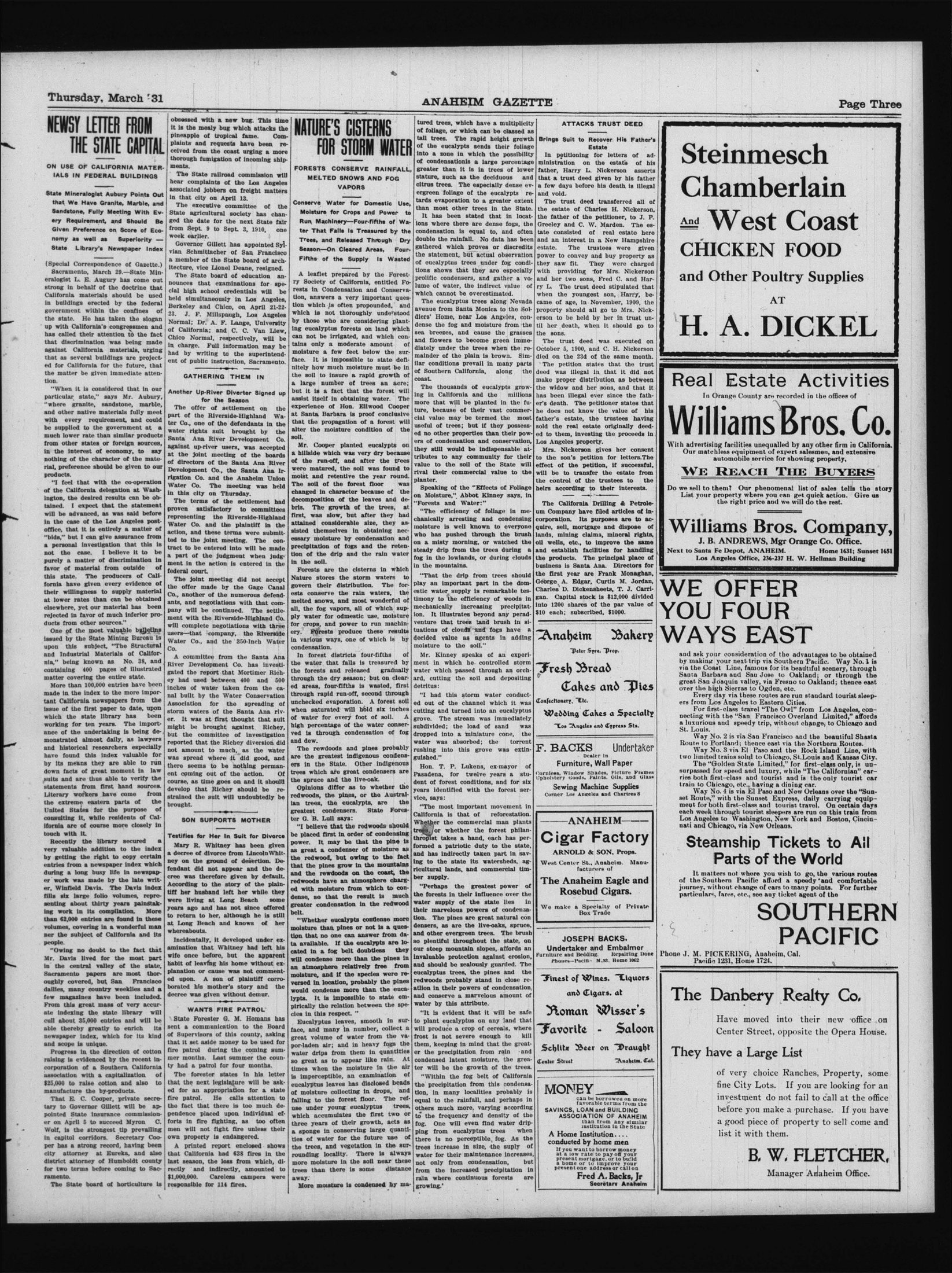
Searchable text
THURSDAY, MARCH 31
NEWSY LETTER FROM THE STATE CAPITAL
ON USE OF CALIFORNIA MATERIALS IN FEDERAL BUILDINGS
State Mineralogist Aubury Points Out that We Have Granite, Marble, and Sandstone, Fully Meeting With Every Requirement, and Should Be Given Preference on Score of Economy as well as Superiority — State Library’s Newspaper Index
(Special Correspondence of Gazette.)
Sacramento, March 29.—State Mineralogist L. E. Augury has come out strong in behalf of the doctrine that California materials should be used in buildings erected by the federal government within the confines of the state. He has taken the slogan up with California’s congressmen and has called their attention to the fact that discrimination was being made against California materials, urging that as several buildings are projected for California for the future, that the matter be given immediate attention.
“When it is considered that in our particular state,” says Mr. Aubury, “where granite, sandstone, marble, and other native materials fully meet with every requirement, and could be supplied to the government at a much lower rate than similar products from other states or foreign sources, in the interest of economy, to say nothing of the character of the material, preference should be given to our products obsessed with a new bug. This time it is the mealy bug which attacks the pineapple of tropical fame. Complaints and requests have been received from the coast urging a more thorough fumigation of incoming shipments.
The State railroad commission will hear complaints of the Los Angeles associated jobbers on freight matters in that city on April 13.
The executive committee of the State agricultural society has changed the date for the next State fair from Sept. 9 to Sept. 3, 1910, one week earlier.
Governor Gillett has appointed Sylvian Schmittacher of San Francisco a member of the State board of architecture, vice Lionel Deane, resigned.
The State board of education announces that examinations for special high school credentials will be held simultaneously in Los Angeles, Berkeley and Chico, on April 21-22-23. J. F. Millspaugh, Los Angeles Normal; Dr. A. F. Lange, University of California; and C. C. Van Liew, Chico Normal, respectively, will be in charge. Full information may be had by writing to the superintendent of public instruction, Sacramento.
GATHERING THEM IN
Another Up-River Diverter Signed up for the Season
The offer of settlement on the part of the Riverside-Highland Water Co., one of the defendants in the water rights suit brought by the Santa Ana River Development Co. against up-river users, was accepted at the joint meeting of the boards of directors of the Santa Ana River Development Co., the Santa Ana Irvine Nature's Choice For Storm Forests Conservation Melted Snow VapoConserve Water for Moisture for Crops Run Machinery—Water That Falls Is Trees, and Releases Season—On Clear Fifths of the Sun
A leaflet prepared by Society of California rests in Condensation, answers a question which is often not thoroughly answered by those who are eing eucalyptus forests can not be irrigated tains only a modern moisture a few feet face. It is impossibly how much moisture the soil to insure a large number of but it is a fact that assist itself in obtai experience of Hon. at Santa Barbara is that the propagation alter the moisture soil.
Mr. Cooper planted a hillside which was of the run-off, and were matured, the
"When it is considered that in our particular state," says Mr. Aubury,
"where granite, sandstone, marble, and other native materials fully meet with every requirement, and could be supplied to the government at a much lower rate than similar products from other states or foreign sources, in the interest of economy, to say nothing of the character of the material, preference should be given to our products.
"I feel that with the co-operation of the California delegation at Washington, the desired results can be obtained. I expect that the statement will be advanced, as was said before in the case of the Los Angeles post-office, that it is entirely a matter of "bids," but I can give assurance from a personal investigation that this is not the case. I believe it to be purely a matter of discrimination in favor of material from outside of this state. The producers of California have given every evidence of their willingness to supply material at lower rates than can be obtained elsewhere, yet our material has been rejected in favor of much inferior products from other sources."
One of the most valuable bulletins issued by the State Mining Bureau is upon this subject, "The Structural and Industrial Materials of California," being known as No. 38, and containing 400 pages of illustrated matter covering the entire state.
More than 100,000 entries have been made in the index to the more important California newspapers from the issue of the first paper to date, upon which the state library has been working for ten years. The importance of the undertaking is being demonstrated almost daily, as lawyers and historical researchers especially have found this index valuable for by its means they are able to run down facts of great moment in law suits and are thus able to verify the statements from first hand sources. Literary workers have come from the extreme eastern parts of the United States for the purpose of consulting it, while residents of California are of course more closely in touch with it.
Recently the library secured a very valuable addition to the index by getting the right to copy certain entries from a newspaper index which during a long busy life in newspaper work was made by the late writer, Winfield Davis. The Davis index fills six large folio volumes, repre-
GATHERING THEM IN
Another Up-River Diverter Signed up for the Season
The offer of settlement on the part of the Riverside-Highland Water Co., one of the defendants in the water rights suit brought by the Santa Ana River Development Co. against up-river users, was accepted at the joint meeting of the boards of directors of the Santa Ana River Development Co., the Santa Ana Irrigation Co. and the Anaheim Union Water Co. The meeting was held in this city on Thursday.
The terms of the settlement had proven satisfactory to committees representing the Riverside-Highland Water Co. and the plaintiff in the action, and these terms were submitted to the joint meeting. The contract to be entered into will be made a part of the judgment when judgment in the action is entered in the federal court.
The joint meeting did not accept the offer made by the Gage Canal Co., another of the numerous defendants, and negotiations with that company will be continued. The settlement with the Riverside-Highland Co. will complete negotiations with three users—that company, the Riverside Water Co., and the 350-Inch Water Co.
A committee from the Santa Ana River Development Co. has investigated the report that Mortimer Richey had used between 400 and 500 inches of water taken from the canal built by the Water Conservation Association for the spreading of storm waters of the Santa Ana river. It was at first thought that suit might be brought against Richey, but the committee of investigation reported that the Richey diversion did not amount to much, as the water was spread where it did good, and there seems to be nothing permanent coming out of the action. Of course, as time goes on and it should develop that Richey should be restrained the suit will undoubtedly be brought.
SON SUPPORTS MOTHER
Testifies for Her In Suit for Divorce
Mary R. Whitney has been given a decree of divorce from LincolnWhitney on the ground of desertion. Defendant did not appear and the decree was therefore given by default. According to the story of the plaintiff her husband left her while they were living at Long Beach some
the soil to insure all but it is a fact that assist itself in obtaining experience of Honesty at Santa Barbara is that the propagation alter the moisture of soil.
Mr. Cooper plants a hillside which was of the run-off, and were matured, the soils moist and retentive. The soil of the form changed in character decomposition of bris. The growth first, was slow, but attained considerably assisted themselves in essential moisture by precipitation of fogs in the soil.
Forests are the nature stores she govern their distribution conserve the melted snows, and many all, the fog vapors, apply water for odess for crops, and powerery. Forests produce in various ways, one condensation.
In forest districts, the water that falls through the dry seasons ed areas, four-fifths through rapid run-off unchecked evaporation when saturated will of water for every high percentage of it veed is through cones and dew.
The rewdoods and are the greatest indiers in the State. O trees which are great spruce and he Opinions differ as redwoods, the pines, lan trees, the eucalyptus condensers ter G. B. Lull says:
"I believe that they be placed first in order power. It may be as great a condensee redwood, but over that the pines grow and the rewdoods o redwoods have an ad ed with moisture fro dense, so that tha
the extreme eastern parts of the United States for the purpose of consulting it, while residents of California are of course more closely in touch with it.
Recently the library secured a very valuable addition to the index by getting the right to copy certain entries from a newspaper index which during a long busy life in newspaper work was made by the late writer, Winfield Davis. The Davis index fills six large folio volumes, representing about thirty years painstaking work in its compilation. More than 62,000 entries are found in these volumes, covering in a wonderful manner the subject of California and its people.
"Owing no doubt to the fact that Mr. Davis lived for the most part in the central valley of the state, Sacramento papers are most thoroughly covered, but San Francisco dailies, many country weeklies and a few magazines have been included. From this great mass of very accurate indexing the state library will cull about 35,000 entries and will be able thereby greatly to enrich its newspaper index, which for its kind and scope is unique.
Progress in the direction of cotton raising is evidenced by the recent incorporation of a Southern California association with a capitalization of $25,000 to raise cotton and also to manufacture the by-products.
That E. C. Cooper, private secretary to Governor Gillett will be appointed State insurance commissioner on April 5 to succeed Myron C. Wolf, is the strongest tip prevailing in capitol corridors. Secretary Cooper has a strong record, having been city attorney at Eureka, and also district attorney of Humboldt county for two terms before coming to Sacramento.
The State board of horticulture is
SON SUPPORTS MOTHER
Testifies for Her In Suit for Divorce
Mary R. Whitney has been given a decree of divorce from LincolnWhitney on the ground of desertion. Defendant did not appear and the decree was therefore given by default. According to the story of the plaintiff her husband left her while they were living at Long Beach some years ago and has not since offered to return to her, although he is still at Long Beach and knows of her whereabouts.
Incidentally, it developed under examination that Whitney had left his wife once before, but the apparent habit of leaving his home without explanation or cause was not commented upon. A son of plaintiff corroborated his mother's story and the decree was given without demur.
WANTS FIRE PATROL
State Forester G. M. Homans has sent a communication to the Board of Supervisors of this county, asking that it set aside money to be used for fire patrol during the coming summer months. Last summer the county had a patrol for four months.
The forester states in his letter that the next legislature will be asked for an appropriation for a state fire patrol. He calls attention to the fact that there is too much dependence placed upon individual efforts in fire fighting, as too often men will not fight fire unless their own property is endangered.
A printed report enclosed shows that California had 638 fires in the last season, the loss from which, directly and indirectly, amounted to $1,000,000. Careless campers were responsible for 114 fires.
"I believe that they be placed first in order power. It may be as great a condense the redwood, but over that the pines grow and the rewdoeds of redwoods have an added with moisture from dense, so that the greater condensation belt."
"Whether eucalypt moisture than pines tion that no one can ta available. If the cated in a fog belt will condense more than an atmosphere relative moisture, and if the versed in location, would condense more lypts. It is impossiplically the relation clies in this respect.
Eucalyptus leaves face, and many in great volume of water-laden air; and in water drips from the so great as to appear times when the moist is imperceptible, and eucalyptus leaves hail of moisture collecting falling to the forest use under young eucalypt which accumulates three years of their a sponge in conserv ties of water for tha trees, and vegeta rounding locality. More moisture in tha trees than there is away:
More moisture is
NATURE'S CISTERNS FOR STORM WATER
FORESTS CONSERVE RAINFALL, MELTED SNOWS AND FOG VAPORS
Conserve Water for Domestic Use, Moisture for Crops and Power to Run Machinery—Four-fifths of Water That Falls is Treasured by the Trees, and Released Through Dry Season—On Cleared Areas, Four-Fifths of the Supply Is Wasted
A leaflet prepared by the Forestry Society of California, entitled Forests in Condensation and Conservation, answers a very important question which is often propounded, and which is not thoroughly understood by those who are considering planting eucalyptus forests on land which can not be irrigated, and which contains only a moderate amount of moisture a few feet below the surface. It is impossible to state definitively how much moisture must be in the soil to insure a rapid growth of a large number of trees an acre; but it is a fact that the forest will assist itself in obtaining water. The experience of Hon. Ellwood Cooper at Santa Barbara is proof conclusive that the propagation of a forest will alter the moisture condition of the soil.
Mr. Cooper planted eucalypts on a hillside which was very dry because of the run-off, and after the trees were matured, the soil was found to tured trees, which have a multiplicity of foliage, or which can be classed as tall trees. The rapid height growth of the eucalypts sends their foliage into a zone in which the possibility of condensation is a large percentage greater than it is in trees of lower stature, such as the deciduous and citrus trees. The especially dense evergreen foliage of the eucalypts retards evaporation to a greater extent than most other trees in the State.
It has been stated that in locations where there are dense fogs, the condensation is equal to, and often double the rainfall. No data has been gathered which proves or discredits the statement, but actual observation of eucalyptus trees under fog conditions shows that they are especially prolific condensers, and gather a volume of water, the indirect value of which cannot be overestimated.
The eucalyptus trees along Nevada avenue from Santa Monica to the Soldiers' Home, near Los Angeles, condense the fog and moisture from the sea breezes, and cause the grasses and flowers to become green immediately under the trees when the remainder of the plain is brown. Similar conditions prevail in many parts of Southern California, along the coast.
The thousands of eucalypts growing in California and the millions more that will be planted in the future, because of their vast commercial value may be termed the most useful of trees; but if they possessed no other properties than their powers of condensation and conservation, they still would be indispensable attributes to any community for their value to the soil of the State will rival their commercial value to the ATTACKS TRUST DEED
Brings Suit to Recover His Father's Estate
In petitioning for letters of administration on the estate of his father, Harry L. Nickerson asserts that a trust deed given by his father a few days before his death is illegal and void.
The trust deed transferred all of the estate of Charles H. Nickerson, the father of the petitioner, to J. P. Greeley and C. W. Marden. The estate consisted of real estate here and an interest in a New Hampshire estate. The trustees were given power to convey and buy property as they saw fit. They were charged with providing for Mrs. Nickerson and her two sons, Fred C. and Harry L. The trust deed stipulated that when the youngest son, Harry, became of age, in November, 1909, the property should all go to Mrs. Nickerson to be held by her in trust until her death, when it should go to the sons.
The trust deed was executed on October 5, 1900, and C. H. Nickerson died on the 23d of the same month.
The petition states that the trust deed was illegal in that it did not make proper distribution as between the widow and her sons, and that it has been illegal ever since the father's death. The petitioner states that he does not know the value of his father's estate, the trustees having sold the real estate originally deeded to them, investing the proceeds in Los Angeles property.
Mrs. Nickerson gives her consent to the son's petition for letters.The effect of the petition, if successful, will be to transfer the estate from
the soil to insure a rapid growth of a large number of trees an acre; but it is a fact that the forest will assist itself in obtaining water. The experience of Hon. Ellwood Cooper at Santa Barbara is proof conclusive that the propagation of a forest will alter the moisture condition of the soil.
Mr. Cooper planted eucalypts on a hillside which was very dry because of the run-off, and after the trees were matured, the soil was found to moist and retentive the year round. The soil of the forest floor was changed in character because of the decomposition of the leaves and debris. The growth of the trees, at first, was slow, but after they had attained considerable size, they assisted themselves in obtaining necessary moisture by condensation and precipitation of fogs and the retention of the drip and the rain water in the soil.
Forests are the cisterns in which Nature stores the storm waters to govern their distribution. The forests conserve the rain waters, the melted snows, and most wonderful of all, the fog vapors, all of which supply water for odmestic use, moisture for crops, and power to run machinery. Forests produce these results in various ways, one of which is by condensation.
In forest districts four-fifths of the water that falls is treasured by the forests and released gradually through the dry season; but on cleared areas, four-fifths is wasted, first through rapid run-off, second through unchecked evaporation. A forest soil when saturated will hold six inches of water for every foot of soil. A high percentage of the water conserved is through condensation of fog and dew.
The rewdoods and pines probably are the greatest indigenous condensers in the State. Other indigenous trees which are great condensers are the spruce and the live-oak.
Opinions differ as to whether the redwoods, the pines, or the Australian trees, the eucalypts, are the greatest condensers. State Forester G. B. Lull says:
"I believe that the redwoods should be placed first in order of condensing power. It may be that the pine is as great a condenser of moisture as the redwood, but owing to the fact that the pines grow in the mountains and the rewdoods on the coast, the redwoods have an atmosphere charged with moisture from which to condense, so that the result is much coast.
The thousands of eucalyptus growing in California and the millions more that will be planted in the future, because of their vast commercial value may be termed the most useful of trees; but if they possessed no other properties than their powers of condensation and conservation, they still would be indispensable attributes to any community for their value to the soil of the State will rival their commercial value to the planter.
Speaking of the "Effects of Foliage on Moisture," Abbot Kinney says, in "Forests and Water:"
"The efficiency of foliage in mechanically arresting and condensing moisture is well known to everyone who has pushed through the brush on a misty morning, or watched the steady drip from the trees during a fog in the lowlands, or during clouds in the mountains.
"That the drip from trees should play an important part in the domestic water supply is remarkable testimony to the efficiency of woods in mechanically increasing precipitation. It illustrates beyond any adventure that trees land brush in situations of clouds and fogs have a decided value as agents in adding moisture to the soil."
Mr. Kinney speaks of an experiment in which he controlled storm water which passed through an orchard, cutting the soil and depositing detritus:
"I had this storm water conducted out of the channel which it was cutting and turned into an eucalypt grove. The stream was immediately subdivided; the load of sand was dropped into a miniature cone, the water was absorbed; the torrent rushing into this grove was extinguished."
Hon. T. P. Lukens, ex-mayor of Pasadena, for twelve years a student of forest conditions, and for six years identified with the forest service, says:
"The most important movement in California is that of reforestation. Whether the commercial man plants trees, or whether the forest philanthropist takes a hand, each has performed a patriotic duty to the state, and has indirectly taken part in saving to the state its watersheds, agricultural lands, and commercial timber supply.
"Perhaps the greatest power of the forests in their influence over the..."
lan trees, the eucalypts, are the greatest condensers. State Forester G. B. Lull says:
"I believe that the redwoods should be placed first in order of condensing power. It may be that the pine is as great a condenser of moisture as the redwood, but owing to the fact that the pines grow in the mountains and the rewdoods on the coast, the redwoods have an atmosphere charged with moisture from which to condense, so that the result is much greater condensation in the redwood belt.
"Whether eucalyptus condense more moisture than pines or not is a question that no one can answer from data available. If the eucalyptus are located in a fog belt doubtless they will condense more than the pines in an atmosphere relatively free from moisture, and if the species were reversed in location, probably the pines would condense more than the eucalyptus. It is impossible to state empirically the relation between the species in this respect."
Eucalyptus leaves, smooth in surface, and many in number, collect a great volume of water from the vapor-laden air; and in heavy fogs the water drips from them in quantities so great as to appear like rain. At times when the moisture in the air is imperceptible, an examination of eucalyptus leaves has disclosed beads of moisture collecting in drops, and falling to the forest floor. The refuse under young eucalyptus trees, which accumulates the first two or three years of their growth, acts as a sponge in conserving large quantities of water for the future use of the trees, and vegetation in the surrounding locality. There is always more moisture in the soil near these trees than there is some distance away:
More moisture is condensed by ma-
"The most important movement in California is that of reforestation. Whether the commercial man plants trees or whether the forest philanthropist takes a hand, each has performed a patriotic duty to the state, and has indirectly taken part in saving to the state its watersheds, agricultural lands, and commercial timber supply.
"Perhaps the greatest power of the forests in their influence over the water supply of the state lies in their marvelous powers of condensation. The pines are great natural condensers, as are the live-oaks, spruce, and other evergreen trees. The brush so plentiful throughout the state, on our steep mountain slopes, affords an invaluable protection against erosion, and should be zealously guarded. The eucalyptus trees, the pines and the redwoods probably stand in close relation in their powers of condensation, and conserve a marvelous amount of water by this attribute.
"It is evident that it will be safe to plant eucalyptus on any land that will produce a crop of cereals, where frost is not severe enough to kill them, keeping in mind that the greater the precipitation from rain and condensed latent moisture, the greater will be the growth of the trees.
"Within the fog belt of California the precipitation from this condensation, in many localities probably is equal to the rainfall, and perhaps in others much more, varying according to the frequency and density of the fog. One will even find water dripping from eucalyptus trees when there is no perceptible fog. As the trees increase in size, the supply of water for their maintenance increases, not only from condensation, but from the increased precipitation in rain where continuous forests are growing."
TRUST DEED
cover His Father's estate
or letters of adthe estate of his
Nickerson asserts
given by his father
his death is illegal
transferred all of
Charles H. Nickerson,
petitioner, to J. P.
Marden. The esreal estate here
a New Hampshire
steees were given
and buy property as
they were charged
for Mrs. Nickerson
Fred C. and Hareed stipulated that
it son, Harry, beovember, 1909, the
go to Mrs. Nickher in trust unit should go to
was executed on
C. H. Nickerson
the same month.
ties that the trust
that it did not
bution as between
sons, and that it
since the fathtitioner states that
the value of his
trustees having
originally deeding the proceeds in
ty.
gives her consent
on for letters.The
union, if successful,
or the estate from
Steinmesch
Chamberlain
And West Coast
CHICKEN FOOD
and Other Poultry Supplies
AT
H. A. DICKEL
Real Estate Activities
In Orange County are recorded in the offices of
Williams Bros. Co.
With advertising facilities unequalled by any other firm in California.
Our matchless equipment of expert salesmen, and extensive
automobile service for showing property,
WE REACH THE BUYERS
Real Estate Activities
In Orange County are recorded in the offices of
Williams Bros. Co.
With advertising facilities unequalled by any other firm in California.
Our matchless equipment of expert salesmen, and extensive automobile service for showing property,
WE REACH THE BUYERS
Do we sell to them? Our phenomenal list of sales tells the story
List your property where you can get quick action. Give us
the right price and we will do the rest.
Williams Bros. Company,
J. B. ANDREWS, Mgr Orange Co. Office.
Next to Santa Fe Depot, ANAHEIM. Home 1631; Sunset 1651
Los Angeles Office, 236-237 H. W. Hellman Building
WE OFFER YOU FOUR WAYS EAST
and ask your consideration of the advantages to be obtained
by making your next trip via Southern Pacific. Way No. 1 is
via the Coast Line, famous for its beautiful scenery, through
Santa Barbara and San Jose to Oakland; or through the
great San Joaquin valley, via Fresno to Oakland; thence east
over the high Sierras to Ogden, etc.
Every day via these routes are run standard tourist sleepers from Los Angeles to Eastern Cities.
For first-class travel "The Owl" from Los Angeles, connecting with the "San Francisco Overland Limited," affords
a luxurious and speedy trip, without change, to Chicago and
St. Louis.
Way No. 2 is via San Francisco and the beautiful Shasta
Route to Portland; thence east via the Northern Routes.
Way No. 3 via El Paso and the Rock Island Line, with
two limited trains solid to Chicago, St.Louis and Kansas City.
The "Golden State Limited," for first-class only, is unsurpassed for speed and luxury, while "The Californian" carries both first-class and tourist and is the only tourist car
train to Chicago, etc., having a dining car.
Way No. 4 is via El Paso and New Orleans over the "Sunset Route," with the Sunset Express, daily carrying equipment for both first-class and tourist travel. On certain days
each week through tourist sleepers are run on this train from
Los Angeles to Washington, New York and Boston, Cincinnati
and Chicago, via New Orleans.
Steamship Tickets to All Parts of the World
It matters not where you wish to go, the various routes
of the Southern Pacific afford a speedy and comfortable
journey, without change of cars to many points. For further
particulars, fares, etc., see any ticket agent of the
Steamship Tickets to All Parts of the World
It matters not where you wish to go, the various routes of the Southern Pacific afford a speedy and comfortable journey, without change of cars to many points. For further particulars, fares, etc., see any ticket agent of the SOUTHERN PACIFIC
Phone J. M. PICKERING, Anaheim, Cal.
Pacific 1231, Home 1724.
The Danbery Realty Co.
Have moved into their new office on Center Street, opposite the Opera House.
They have a Large List
of very choice Ranches, Property, some fine City Lots. If you are looking for an investment do not fail to call at the office before you make a purchase. If you have a good piece of property to sell come and list it with them.
B. W. FLETCHER,
Manager Anaheim Office.