anaheim-gazette 1909-10-28
Scanned page
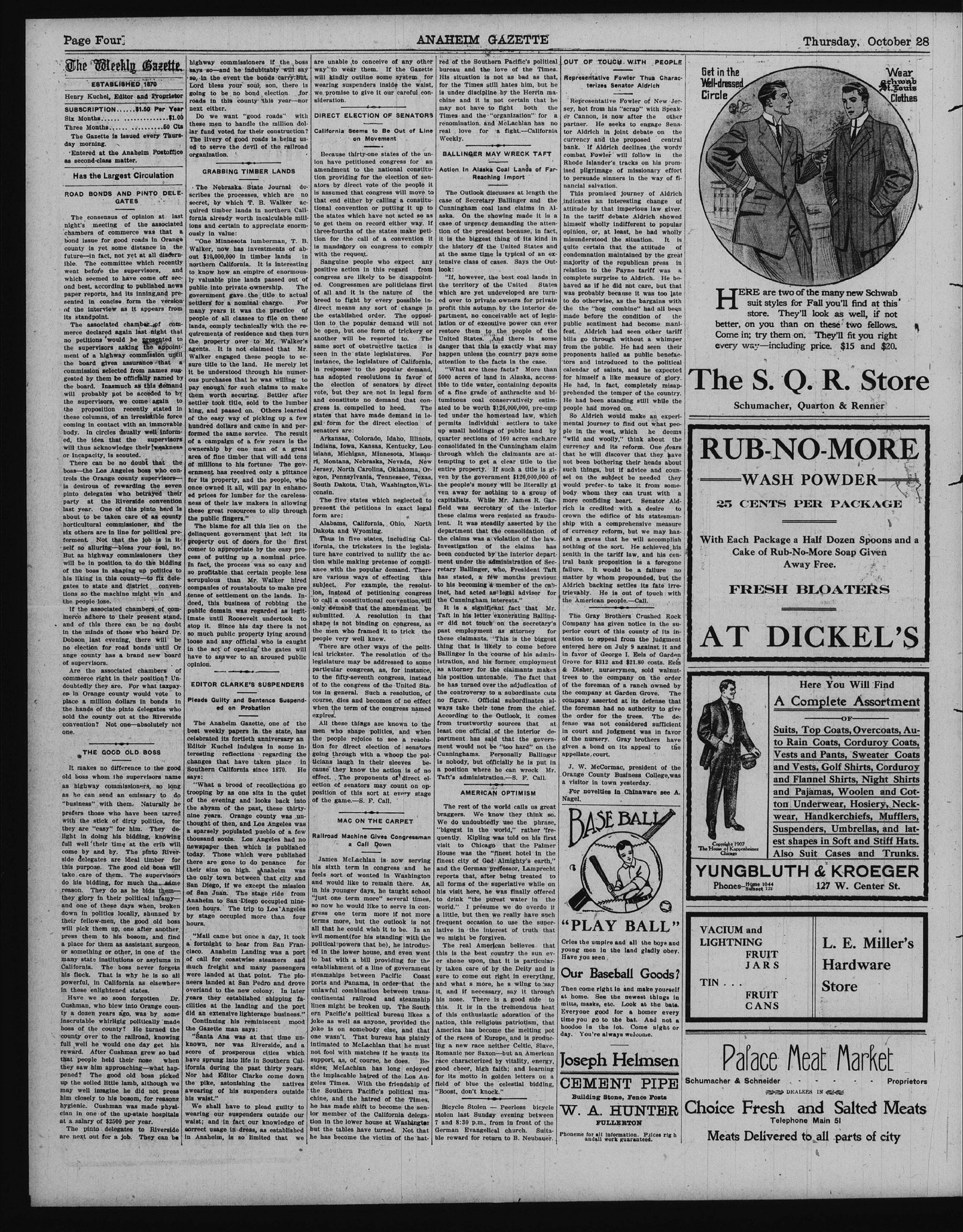
Searchable text
The Weekly Gazette.
ESTABLISHED 1870
Henry Kuchel, Editor and Proprietor
SUBSCRIPTION...$1.50 Per Year
Six Months...$1.00
Three Months...50 Cts
The Gazette is issued every Thursday morning.
Entered at the Anaheim Postoffice as second-class matter.
Has the Largest Circulation
ROAD BONDS AND PINTO DELEGATES
The consensus of opinion at last night's meeting of the associated chambers of commerce was that a bond issue for good roads in Orange county is yet some distance in the future—in fact, not yet at all discernible. The committee which recently went before the supervisors, and which seemed to have come off second best, according to published news paper reports, had its inning,and presented in concise form the version of the interview as it appears from its standpoint.
The associated chamber of commerce declared again last night that no petitions would be presented to the supervisors asking the appointment of a highway commission until the board gives assurance that a commission selected from names suggested by them be officially named by the board. Inasmuch as this demand will probably not be acceded to by the supervisors, we come again to the proposition recently stated in these columns, of an irresistible force coming in contact with an immovable body. In circles usually well informed, the idea that the supervisors will thus acknowledge their weakness or incapacity, is scouted.
highway commissioners if the boss says so—and he indubitably will say so, in the event the bonds carry. But, Lord bless your soul; son, there is going to be no bond election for roads in this county this year—nor next either.
Do we want "good roads" with these men to handle the million dollar fund voted for their construction? The livery of good roads is being used to serve the devil of the railroad organization.
GRABBING TIMBER LANDS
The Nebraska State Journal describes the processes, which are no secret, by which T. B. Walker acquired timber lands in northern California already worth incalculable millions and certain to appreciate enormously in value:
"One Minnesota lumberman, T. B. Walker, now has investments of about $10,000,000 in timber lands in northern California. It is interesting to know how an empire of enormously valuable pine lands passed out of public into private ownership. The government gave the title to actual settlers for a nominal charge. For many years it was the practice of people of all classes to file on these lands, comply technically with the requirements of residence and then turn the property over to Mr. Walker's agents. It is not claimed that Mr. Walker engaged these people to secure title to the land. He merely let it be understood through his numerous purchases that he was willing to pay enough for such claims to make them worth securing. Settler after settler took title, sold to the lumber king, and passed on. Others learned of the easy way of picking up a few hundred dollars and came in and performed the same service. The result of a campaign of a few years is the ownership by one man of a great area of fine timber that will add tens
are unable to way to wear will kindly our wearing suspenders we promise to consideration.
DIRECT ELECTION
California See on
Because threeion have petition amendment to tion providing rators by directiis assumed thaat that end either tional convention the states which to get them o three-fourths o tion for the o is mandatory wiith the requer
Sanguine peo positive action congress are led. Congressmof all and it breed to fight direct means tae the established tion to the po be open, but o another will b same sort of o seen in the st instance, the lo in response to has adopted rethe election n vote, but they and constituted grees is compre states that haw gal form for th senators are:
Arkansas, Co Indiana, Iowa, isiana, Michigan
the board gives assurance that a commission selected from names suggested by them be officially named by the board. Inasmuch as this demand will probably not be acceded to by the supervisors, we come again to the proposition recently stated in these columns, of an irresistible force coming in contact with an immovable body. In circles usually well informed, the idea that the supervisors will thus acknowledge their weakness or incapacity, is scouted.
There can be no doubt that the boss—the Los Angeles boss who controls the Orange county supervisors—is desirous of rewarding the seven pinto delegates who betrayed their party at the Riverside convention last year. One of this pinto herd is about to be taken care of as county horticultural commissioner, and the six others are in line for political preferment. Not that the job is in itself so alluring—bless your soul, no. But as highway commissioners they will be in position to do the bidding of the boss in shaping up politics to his liking in this county—to fix delegates to state and district conventions so the machine might win and the people lose.
If the associated chambers of commerce adhere to their present stand, and of this there can be no doubt in the minds of those who heard Dr. Dobson last evening, there will be no election for road bonds until Orange county has a brand new board of supervisors.
Are the associated chambers of commerce right in their position? Undoubtedly they are. For what taxpayer in Orange county would vote to place a million dollars in bonds in the hands of the pinto delegates who sold the county out at the Riverside convention? Not one—absolutely not one.
THE GOOD OLD BOSS
It makes no difference to the good old boss whom the supervisors name as highway commissioners, so long as he can send an emissary to do "business" with them. Naturally he prefers those who have been tarred with the stick of dirty politics, for they are "easy" for him. They delight in doing his bidding, knowing full well their time at the crib will come by and by. The pinto Riverside delegates are ideal timber for this purpose. The good old boss will sure title to the land. He merely let it be understood through his numerous purchases that he was willing to pay enough for such claims to make them worth securing. Settler after settler took title, sold to the lumber king, and passed on. Others learned of the easy way of picking up a few hundred dollars and came in and performed the same service. The result of a campaign of a few years is the ownership by one man of a great area of fine timber that will add tens of millions to his fortune. The government has received only a pittance for its property, and the people, who once owned it all, will pay in enhanced prices for lumber for the carelessness of their law makers in allowing these great resources to slip through the public fingers."
The blame for all this lies on the delinquent government that left its property out of doors for the first comer to appropriate by the easy process of putting up a nominal price. In fact, the process was so easy and so profitable that certain people less scrupulous than Mr. Walker hired companies of roustabouts to make pretense of settlement on the lands. Indeed, this business of robbing the public domain was regarded as legitimate until Roosevelt undertook to stop it. Since his day there is not so much public property lying around loose and any official who is caught in the act of opening the gates will have to answer to an aroused public opinion.
EDITOR CLARKE'S SUSPENDERS
Pleads Guilty and Sentence Suspended on Probation
The Anaheim Gazette, one of the best weekly papers in the state, has celebrated its fortyth anniversary an Editor Kuchel indulges in some interesting reflections regarding the changes that have taken place in Southern California since 1870. He says:
“What a brood of recollections go trooping by as one sits in the quiet of the evening and looks back into the abysm of the past, these thirty-nine years. Orange county was unthought of then, and Los Angeles was a sparsely populated pueblo of a few thousand souls. Los Angeles had no newspaper then which is published today. Those which were published there are gone to do penance for their sins on high Anaheim.”
old boss whom the supervisors name as highway commissioners, so long as he can send an emissary to do "business" with them. Naturally he prefers those who have been tarred with the stick of dirty politics, for they are "easy" for him. They delight in doing his bidding, knowing full well their time at the crib will come by and by. The pinto River-side delegates are ideal timber for this purpose. The good old boss will take care of them. The supervisors do his bidding, for much the same reason. They do as he bids them—they glory in their political infamy—and one of these days when, broken down in politics locally, shunned by their fellow-men, the good old boss will pick them up, one after another, press them to his bosom, and find a place for them as assistant surgeon, or something or other, in one of the many state institutions or asylums in California. The boss never forgets his flock. That is why he is so all powerful, in California as elsewhere in these enlightened states.
Have we so soon forgotten Dr. Cushman, who blew into Orange county a dozen years ago, was by some inscrutable whirligig politically made boss of the county? He turned the county over to the railroad, knowing full well he would one day get his reward. After Cushman grew so bad that people held their nose when they saw him approaching—what happened? The good old boss picked up the soiled little lamb, although we may well imagine he did not press him closely to his bosom, for reasons hygienic. Cushman was made physician in one of the up-state hospitals at a salary of $2500 per year.
The pinto delegates to Riverside are next out for a job. They can be says:
“What a brood of recollections go trooping by as one sits in the quiet of the evening and looks back into the abyssm of the past, these thirty-nine years. Orange county was unthought of then, and Los Angeles was a sparsely populated pueblo of a few thousand souls. Los Angeles had no newspaper then which is published today. Those which were published there are gone to do penance for their sins on high. Anaheim was the only town between that city and San Diego, if we except the mission of San Juan. The stage ride from Anaheim to San Diego occupied nineteen hours. The trip to Los Angeles by stage occupied more than four hours.
“Mall came but once a day, It took a fortnight to hear from San Francisco. Anaheim Landing was a port of call for coastwise steamers and much freight and many passengers were landed at that point. The pioneers landed at San Pedro and drove overland to the new colony. In later years they established shipping facilities at the landing and the port did an extensive lighterage business.”
Continuing his reminiscent mood the Gazette man says:
“Santa Ana was at that time unknown, nor was Riverside, and a score of prosperous cities which have sprung into life in Southern California during the past thirty years. Nor had Editor Clarke come down the pike, astonishing the natives awearing of his suspenders outside his waist.”
We shall have to plead guilty to wearing our suspenders outside our waist; and in fact our knowledge of correct usage in dress, as established in Anaheim, is so limited that we
ANAHEIM GAZETTE
DIRECT ELECTION OF SENATORS
California Seems to Be Out of Line on Movement
Because thirty-one states of the union have petitioned congress for an amendment to the national constitution providing for the election of senators by direct vote of the people it is assumed that congress will move to that end either by calling a constitutional convention or putting it up to the states which have not acted so as to get them on record either way. If three-fourths of the states make petition for the call of a convention it is mandatory on congress to comply with the request.
Sanguine people who expect any positive action in this regard from congress are likely to be disappointed. Congressmen are politicians first of all and it is the nature of the breed to fight by every possible indirect means any sort of change in the established order. The opposition to the popular demand will not be open, but one form of trickery or another will be resorted to. The same sort of obstructive tactics is seen in the state legislatures. For instance, the legislature of California, in response to the popular demand, has adopted resolutions in favor of the election of senators by direct vote, but they are not in legal form and constitute no demand that congress is compelled to heed. The states that have made demand in legal form for the direct election of senators are:
Arkansas, Colorado, Idaho, Illinois, Indiana, Iowa, Kansas, Kentucky, Louisiana, Michigan, Minnesota, Missouri
are unable to conceive of any other way to wear them. If the Gazette will kindly outline some system for wearing suspenders inside the waist, we promise to give it our careful consideration.
OUT OF TOUCH WITH PEOPLE
Representative Fowler Thus Characterizes Senator Aldrich
Representative Fowler of New Jersey, hot from his "scrap" with Speaker Cannon, is now after the other partner. He seeks to engage Senator Aldrich in joint debate on the currency and the proposed central bank. If Aldrich declines the wordy combat Fowler will follow in the Rhode Islander's tracks on his promised pilgrimage of missionary effort to persuade sinners in the way of financial salvation.
This promised journey of Aldrich indicates an interesting change of attitude by that imperious law given. In the tariff debate Aldrich showed himself wholly indifferent to popular opinion, or, at least, he had wholly misunderstood the situation. It is quite certain that the attitude of condemnation maintained by the great majority of the republican press in relation to the Payne tariff was a complete surprise to Aldrich. He behaved as if he did not care, but that was probably because it was too late to do otherwise, as the bargains with the "hog combine" had all been made before the condition of the public sentiment had become manifest. Aldrich had seen other tariff bills go through without a whimper from the public. He had seen their proponents hailed as public benefactors and introduced to the political calendar of saints, and he expected for himself a like measure of glory. He had, in fact, completely misapprehended the temper of the country. He had been standing still while the people had moved on.
So Aldrich would make an experimental journey to find out what people in the west, which he deems "wild and woolly," think about the currency and its reform. One fears that he will discover that they have
instance, the legislature of California, in response to the popular demand, has adopted resolutions in favor of the election of senators by direct vote, but they are not in legal form and constitute no demand that congress is compelled to heed. The states that have made demand in legal form for the direct election of senators are:
Arkansas, Colorado, Idaho, Illinois, Indiana, Iowa, Kansas, Kentucky, Louisiana, Michigan, Minnesota, Missouri, Montana, Nebraska, Nevada, New Jersey, North Carolina, Oklahoma, Oregon, Pennsylvania, Tennessee, Texas, South Dakota, Utah, Washington, Wisconsin.
The five states which neglected to present the petitions in exact legal form are:
Alabama, California, Ohio, North Dakota and Wyoming.
Thus in five states, including California, the tricksters in the legislature have contrived to nullify the action while making pretense of compliance with the popular demand. There are various ways of effecting this subject. For example, the resolution instead of petitioning congress to call a constitutional convention will only demand that the amendment be submitted. A resolution in that shape is not binding on congress, as the men who framed it to trick the people very well knew.
There are other ways of the political trickster. The resolution of the legislature may be addressed to some particular congress, as, for instance, to the fifty-seventh congress, instead of to the congress of the United States in general. Such a resolution, of course, dies and becomes of no effect when the term of the congress named expires.
All these things are known to the men who shape politics, and when the people rejoice to see a resolution for direct election of senators going through with a whoop the politicians laugh in their sleeves because they know the action is of no effect. The proponents of direct election of senators may count on opposition of this sort at every stage of the game.—S. F. Call.
MAC ON THE CARPET
Railroad Machine Gives Congressman a Call Down
James McLachlan is now serving his sixth term in congress and he attention to the facts in the case.
“What are these facts? More than 5000 acres of land in Alaska, accessible to tide water, containing deposits of a fine grade of anthracite and bituminous coal conservatively estimated to be worth $126,000,000, pre-empted under the homestead law, which permits individual settlers to take up small holdings of public land by quarter sections of 160 acres each, are consolidated in the Cunningham claim through which the claimants are attempting to get a clear title to the entire property. If such a title is given by the government $126,000,000 of the people's money will be literally given away for nothing to a group of capitalists. While Mr. James R. Garfield was secretary of the interior these claims were resisted as fraudulent. It was steadily asserted by the department that the consolidation of the claims was a violation of the law. Investigation of the claims has been conducted by the interior department under the administration of Secretary Ballinger, who, President Taft has stated, a few months previous to his becoming a member of the cabinet, had acted as legal adviser for the Cunningham interests.”
It is a significant fact that Mr. Taft in his letter exonerating Ballinger did not touch on the secretary's past employment as attorney for these claimants. This is the biggest thing that is likely to come before Ballinger in the course of his administration, and his former employment as attorney for the claimants makes his position untenable. The fact that he has turned over the adjudication of the controversy to a subordinate cuts no figure. Official subordinates always take their tone from the chief. According to the Outlook, it comes from trustworthy sources that at least one official of the interior department has said that the government would not be “too hard” on the Cunninghams. Personally Ballinger is nobody, but officially he is put in a position where he can wreck Mr. Taft's administration.—S. F. Call.
AMERICAN OPTIMISM
The rest of the world calls us great braggers. We know they think so. We do undoubtedly use the phrase, "bigegst in the world," rather frequently. Kipling was told on his first visit to Chicago that the Palmer House was the "finest hotel in the finest city of God Almighty's earth," and the German professor, Lamprecht and introduced to the political calendar of saints, and he expected for himself a like measure of glory. He had, in fact, completely misapprehended the temper of the country. He had been standing still while the people had moved on.
So Aldrich would make an experimental journey to find out what people in the west, which he deems "wild and woolly," think about the currency and its reform. One fears that he will discover that they have not been bothering their heads about such things, but if advice and counsel on the subject be needed they would prefer to take it from somebody whom they can trust with a more confiding heart. Senator Aldrich is credited with a desire to crown the edifice of his statesmanship with a comprehensive measure of currency reform, but we may hazard a guess that he will accomplish nothing of the sort. He achieved his zenith in the tariff law, and his central bank proposition is a foregone failure. It would be a failure no matter by whom propounded, but the Aldrich backing settles its fate irretrievably. He is out of touch with the American people.—Call.
The Gray Brothers Crushed Rock Company has given notice in the superior court of this county of its intention to appeal from the judgment entered here on July 9 against it and in favor of George I. Eels of Garden Grove for $312 and $21.80 costs. Eels & Disher, nurserymen, sold walnut trees to the company on the order of the foreman of a ranch owned by the company at Garden Grove. The company asserted at its defense that the foreman had no authority to give the order for the trees. The defense was not considered sufficient in court and judgment was in favor of the nursery. Gray brothers have given a bond on its appeal to the appellate court.
J. W. McCormac, president of the Orange County Business College, was a visitor in town yesterday.
For novelties in Chinaware see A. Nagel.
MAC ON THE CARPET
Railroad Machine Gives Congressman a Call Down
James McLachlan is now serving his sixth term in congress and he feels sort of wonted in Washington and would like to remain there. As, in his younger days, he taught school "just one term more" several times, so now he would like to serve in congress one term more if not more terms more, but the outlook is not all that he could wish it to be. In an evil moment (for his standing with the political powers that be), he introduced in the lower house, and even went to bat with a bill providing for the establishment of a line of government steamships between Pacific Coast ports and Panama, in order that the unlawful combination between transcontinental railroad and steamship lines might be broken up. The Southern Pacific's political bureau likes a joke as well as anyone, provided the joke is on somebody else, and that one wasn't. That bureau has plainly intimated to McLachlan that he must not fool with matches if he wants its support, as, of course, he does. Besides; McLachlan has long enjoyed the implacable hatred of the Los Angeles Times. With the friendship of the Southern Pacific's political machine, and the hatred of the Times, he has made shift to become the senior member of the California delegation in the lower house at Washington but the tables have turned. Not that he has become the victim of the hat-
Taft's administration.—S. F. Call.
AMERICAN OPTIMISM
The rest of the world calls us great braggers. We know they think so. We do undoubtedly use the phrase, "bigegst in the world," rather frequently. Kipling was told on his first visit to Chicago that the Palmer House was the "finest hotel in the finest city of God Almighty's earth," and the German professor, Lamprecht reports that, after being treated to all forms of the superlative while on his visit here, he was finally offered to drink "the purest water in the world." I presume we do overdo it a little, but then we really have such frequent occasion to use the superlative in the interest of truth that we might be forgiven.
The real American believes that this is the best country the sun ever shone upon, that it is particularly taken care of by the Deity and is sure to come out right in everything, and what s more, he s willing to say it, and if necessary, say it through his nose. There is a good side to this. It is in the tremendous heat of this enthusiastic adoration of the nation, this religious patriotism, that America has become the melting pot of the races of Europe, and is producing a new race neither Celtic, Slave, Romanic nor Saxon—but an American race characterized by vitality, energy, good cheer, high faith; and learning for its motto in golden letters on a field of blue the celestial bidding, "Boost, don't knock."
Bicycle Stolen — Peerless bicycle stolen last Sunday evening between 7 and 8:30 p.m., from in front of the German Evangelical church. Suitable reward for return to B. Neubauer.
Orange County Business College was a visitor in town yesterday.
For novelties in Chinaware see A. Nagel.
BASE BALL
"PLAY BALL"
Cries the umpire and all the boys and young men in the land gladly obey. Have you seen?
Our Baseball Goods?
Then come right in and make yourself at home. See the newest things in mitts, masks, etc. Look at the bats. Everyone good for a homer every time you go to the bat. And not a hoodoo in the lot. Come night or day. You're always welcome.
Joseph Helmsen
CEMENT PIPE
Building Stone, Fence Posts
W. A. HUNTER
FULLERTON
Phoneme for all information. Prices rigid and all work guaranteed.
Thursday, October 28
Get in the Well-dressed Circle
Wear Schwab St. Louis Clothes
HERE are two of the many new Schwab suit styles for Fall you'll find at this store. They'll look as well, if not better, on you than on these two fellows. Come in; try them on. They'll fit you right every way—including price. $15 and $20.
The S. Q. R. Store
Schumacher, Quarton & Renner
RUB-NO-MORE
The S. Q. R. Store
Schumacher, Quarton & Renner
RUB-NO-MORE
WASH POWDER
25 CENTS PER PACKAGE
With Each Package a Half Dozen Spoons and a
Cake of Rub-No-More Soap Given
Away Free.
FRESH BLOATERS
AT DICKEL'S
Here You Will Find
A Complete Assortment
Suits, Top Coats, Overcoats, Auto Rain Coats, Corduroy Coats,
Vests and Pants, Sweater Coats and Vests, Golf Shirts, Corduroy and Flannel Shirts, Night Shirts and Pajamas, Woolen and Cotton Underwear, Hosiery, Neckwear, Handkerchiefs, Mufflers, Suspenders, Umbrellas, and latest shapes in Soft and Stiff Hats.
Also Suit Cases and Trunks.
Copyright 1907
The House of Kuppenheimer
Chicago
City Business College, was
known yesterday.
ies in Chinaware see A.
Copyright 1907
The House of Kuppenheimer
Chicago
and Flannel Shirts, Night Shirts
and Pajamas, Woolen and Cotton Underwear, Hosiery, Neckwear, Handkerchiefs, Mufflers,
Suspenders, Umbrellas, and latest shapes in Soft and Stiff Hats.
Also Suit Cases and Trunks.
YUNGBLUTH & KROEGER
Phones—Home 1044
Sunset 122
127 W. Center St.
VACIUM and
LIGHTNING
FRUIT
JARS
TIN ...
FRUIT
CANS
L. E. Miller's
Hardware
Store
Palace Meat Market
Schumacher & Schneider Proprietors
DEALERS IN
Choice Fresh and Salted Meats
Telephone Main 51
Meats Delivered to all parts of city