anaheim-gazette 1909-10-28
Scanned page
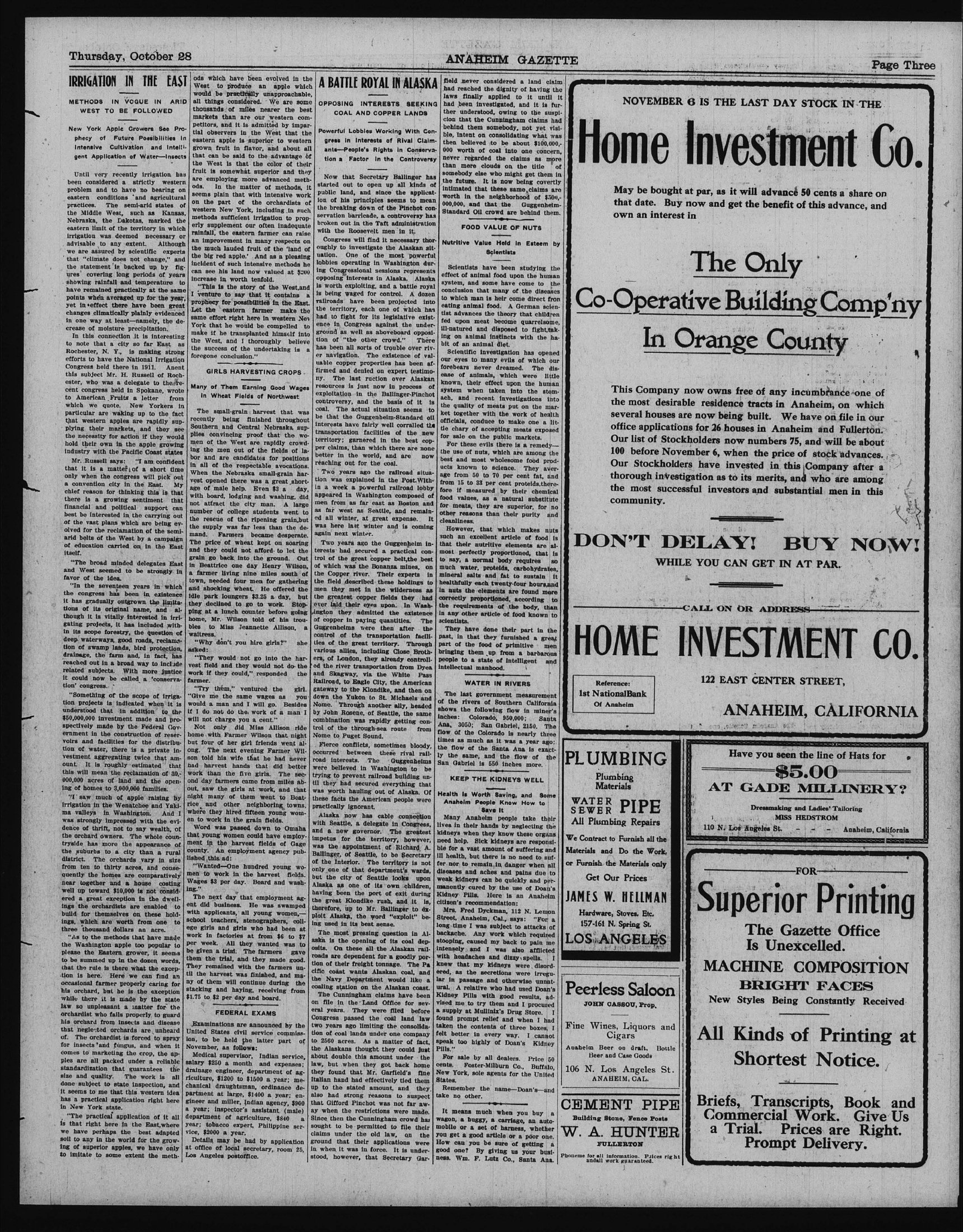
Searchable text
IRRIGATION IN THE EAST
METHODS IN VOGUE IN ARID WEST TO BE FOLLOWED
New York Apple Growers See Prophecy of Future Possibilities in Intensive Cultivation and Intelligent Application of Water—Insects
Until very recently irrigation has been considered a strictly western problem and to have no bearing on eastern conditions and agricultural practices. The semi-arid states of the Middle West, such as Kansas, Nebraska, the Dakotas, marked the eastern limit of the territory in which irrigation was deemed necessary or advisable to any extent. Although we are assured by scientific experts that "climate does not change," and the statement is backed up by figures covering long periods of years showing rainfall and temperature to have remained practically at the same points when averaged up for the year, yet in effect there have been great changes climatically plainly evidenced in one way at least—namely, the decrease of moisture precipitation.
In this connection it is interesting to note that a city so far East as Rochester, N. Y., is making strong efforts to have the National Irrigation Congress held there in 1911. An ent subject Mr. H. Russell of Rochester, who was a delegate to the recent congress held in Spokane, wrote to American Fruits a letter from which we quote. New Yorkers in particular are waking up to the fact that western apples are rapidly supplying their markets, and they see the necessity for action if they would hold their own in the apple growing industry with the Pacific Coast states which have been evolved in the West to produce an apple which would be practically unapproachable, all things considered. We are some thousands of miles nearer the best markets than are our western competitors, and it is admitted by impartial observers in the West that the eastern apple is superior to western grown fruit in flavor, and about all that can be said to the advantage of the West is that the color of their fruit is somewhat superior and they are employing more advanced methods. In the matter of methods, it seems plain that with intensive work on the part of the orchardists of western New York, including in such methods sufficient irrigation to properly supplement our often inadequate rainfall, the eastern farmer can raise an improvement in many respects on the much lauded fruit of the 'land of the big red apple.' And as a pleasing incident of such intensive methods he can see his land now valued at $200 increase in worth tenfold.
"This is the story of the West, and I venture to say that it contains a prophecy for possibilities in the East. Let the eastern farmer make the same effort right here in western New York that he would be compelled to make if he transplanted himself into the West, and I thoroughly believe the success of the undertaking is a foregone conclusion."
GIRLS HARVESTING CROPS
Many of Them Earning Good Wages in Wheat Fields of Northwest
The small-grain harvest that was recently being finished throughout Southern and Central Nebraska supplies convincing proof that the women of the West are rapidly crowding the men out of the fields of labor and are candidates for positions...
Congress held there in 1911. Anent this subject Mr. H. Russell of Rochester, who was a delegate to the recent congress held in Spokane, wrote to American Fruits a letter from which we quote. New Yorkers in particular are waking up to the fact that western apples are rapidly supplying their markets, and they see the necessity for action if they would hold their own in the apple growing industry with the Pacific Coast states.
Mr. Russell says: "I am confident that it is a matter of a short time only when the congress will pick out a convention city in the East. My chief reason for thinking this is that there is a growing sentiment that financial and political support can best be interested in the carrying out of the vast plans which are being evolved for the reclamation of the semi-arid belts of the West by a campaign of education carried on in the East itself.
"The broad minded delegates East and West seemed to be strongly in favor of the idea.
"In the seventeen years in which the congress has been in existence it has gradually outgrown the limitations of its original name, and although it is vitally interested in irrigating projects, it has included within its scope forestry, the question of deep waterways, good roads, reclamation of swamp lands, bird protection, drainage, the farm and, in fact, has reached out in a broad way to include related subjects. With more justice it could now be called a 'conservation' congress.
"Something of the scope of irrigation projects is indicated when it is understood that in addition to the $50,000,000 investment made and prospectively made by the Federal Government in the construction of reservoirs and facilities for the distribution of water, there is a private investment aggregating twice that amount. It is roughly estimated that this will mean the reclamation of 30,000,000 acres of land and the opening of homes to 3,000,000 families.
"I saw much of apple raising by irrigation in the Wenatchee and Yakima valleys in Washington. And I was strongly impressed with the evidence of thrift, not to say wealth, of the orchard owners. The whole countryside has more the appearance of the suburbs to a city than a rural district. The orchards vary in size from ten to thirty acres, and conse-
GIRLS HARVESTING CROPS
Many of Them Earning Good Wages in Wheat Fields of Northwest
The small-grain harvest that was recently being finished throughout Southern and Central Nebraska supplies convincing proof that the women of the West are rapidly crowding the men out of the fields of labor and are candidates for positions in all of the respectable avocations. When the Nebraska small-grain harvest opened there was a great shortage of male help. Even $3 a day, with board, lodging and washing, did not attract the city man. A large number of college students went to the rescue of the ripening grain, but the supply was far less than the demand. Farmers became desperate. The price of wheat kept on soaring and they could not afford to let the grain go back into the ground. Out in Beatrice one day Henry Wilson, a farmer living nine miles south of town, needed four men for gathering and shocking wheat. He offered the idle park loungers $3.25 a day, but they declined to go to work. Stopping at a lunch counter before going home, Mr. Wilson told of his troubles to Miss Jeannette Allison, a waitress.
"Why don't you hire girls?" she asked:
"They would not go into the harvest field and they would not do the work if they could," responded the farmer.
"Try them," ventured the girl. "Give me the same wages as you would a man and I will go. Besides if I do not do the work of a man I will not charge you a cent."
Not only did Miss Allison ride home with Farmer Wilson that night but four of her girl friends went along. The next evening Farmer Wilson told his wife that he had never had harvest hands that did better work than the five girls. The second day farmers came from miles about, saw the girls at work, and that night many of them went to Beatrice and other neighboring towns, where they hired fifteen young women to work in the grain fields.
Word was passed down to Omaha that young women could have employment in the harvest fields of Gage county. An employment agency published this ad:
"Wanted—One hundred young wo-
"I saw much of apple raising by irrigation in the Wenatchee and Yakima valleys in Washington. And I was strongly impressed with the evidence of thrift, not to say wealth, of the orchard owners. The whole countryside has more the appearance of the suburbs to a city than a rural district. The orchards vary in size from ten to thirty acres, and consequently the homes are comparatively near together and a house costing well up toward $10,000 is not considered a great exception in the dwellings the orchardists are enabled to build for themselves on these holdings, which are worth from one to three thousand dollars an acre.
"As to the methods that have made the Washington apple too popular to please the Eastern grower, it seems to be summed up in the dozen words, that the rule is there what the exception is here. Here we can find an occasional farmer properly caring for his orchard, but he is the exception while there it is made by the state law so unpleasant a matter for the orchardist who fails properly to guard his orchard from insects and disease that neglected orchards are unheard of. The orchardist is forced to spray for insects and fungus, and when it comes to marketing the crop, the apples are all packed under a reliable standardization that guarantees the size and quality. The work is all done subject to state inspection, and it seems to me that this western idea has a practical application right here in New York state.
"The practical application of it all is that right here in the East, where we have perhaps the best adapted soil to any in the world for the growing of superior apples, we have only to imitate to some extent the method work than the five girls. The second day farmers came from miles about, saw the girls at work, and that night many of them went to Beatrice and other neighboring towns, where they hired fifteen young women to work in the grain fields.
Word was passed down to Omaha that young women could have employment in the harvest fields of Gage county. An employment agency published this ad:
"Wanted—One hundred young women to work in the harvest fields. Wages $3 per day. Board and washing."
The next day that employment agent did business. He was swamped with applicants, all young women,—school teachers, stenographers, college girls and girls who had been at work in factories at from $6 to $7 per week. All they wanted was to be given a trial: The farmers gave them the trial, and they made good. They remained with the farmers until the harvest was finished, and many of them will continue during the stacking and haying, receiving from $1.75 to $2 per day and board.
FEDERAL EXAMS
Examinations are announced by the United States civil service commission, to be held the latter part of November, as follows:
Medical supervisor, Indian service, salary $250 a month and expenses; drainage engineer, department of agriculture, $1200 to $1500 a year; mechanical draughtsman, ordinance department at large, $1400 a year; engineer and miller, Indian agency, $900 a year; inspector's assistant (male) department of agriculture, $840 a year; tobacco expert, Philippine service, $2000 a year.
Details may be had by application at office of local secretary, room 25, Los Angeles postoffice."
A BATTLE ROYAL IN ALASKA
OPPOSING INTERESTS SEEKING COAL AND COPPER LANDS
Powerful Lobbies Working With Congress in Interests of Rival Claimants—People's Rights in Conservation a Factor in the Controversy
Now that Secretary Ballinger has started out to open up all kinds of public land, and since the application of his principles seems to mean the breaking down of the Pinchot conservation barricade, a controversy has broken out in the Taft administration with the Roosevelt men in it.
Congress will find it necessary thoroughly to investigate the Alaskan situation. One of the most powerful lobbies operating in Washington during Congressional sessions represents opposing interests in Alaska. Alaska is worth exploiting, and a battle royal is being waged for control. A dozen railroads have been projected into the territory, each one of which has had to fight for its legislative existence in Congress against the underground as well as aboveboard opposition of "the other crowd." There has been all sorts of trouble over river navigation. The existence of valuable copper properties has been affirmed and denied on expert testimony. The last ruction over Alaskan resources is just now in process of exploitation in the Ballinger-Pinchot controversy, and the basis of it is coal. The actual situation seems to be that the Guggenheim-Standard oil interests have fairly well corralled the transportation facilities of the new territory; garnered in the best copper claims, than which there are none better in the world, and are now field never considered a land claim had reached the dignity of having the laws finally applied to it until it had been investigated, and it is further understood, owing to the suspicion that the Cunningham claims had behind them somebody, not yet visible, intent on consolidating what was then believed to be about $100,000,-000 worth of coal into one concern, never regarded the claims as more than mere clouds on the title of somebody else who might get them in the future. It is now being covertly intimated that these same claims are worth in the neighborhood of $500,-000,000, and that the Guggenheim-Standard Oil crowd are behind them.
FOOD VALUE OF NUTS
Nutritive Value Held in Esteem by Scientists
Scientists have been studying the effect of animal food upon the human system, and some have come to the conclusion that many of the diseases to which man is heir come direct from eating animal food. A German scientist advances the theory that children fed upon meat become quarrelsome, ill-natured and disposed to fight,taking on animal instincts with the habit of an animal diet.
Scientific investigation has opened our eyes to many evils of which our forebears never dreamed. The disease of animals, which were little known, their effect upon the human system when taken into the stomach, and recent investigations into the quality of meats put on the market together with the work of health officials, conduce to make one a little chary of accepting meats exposed for sale on the public markets.
For these evils there is a remedy—the use of nuts, which are among the best and most wholesome food sources.
The last ruction over Alaskan resources is just now in process of exploitation in the Ballinger-Pinchot controversy, and the basis of it is coal. The actual situation seems to be that the Guggenheim-Standard oil interests have fairly well corralled the transportation facilities of the new territory; garnered in the best copper claims, than which there are none better in the world, and are now reaching out for the coal.
Two years ago the railroad situation was explained in the Post.Within a week a powerful railroad lobby appeared in Washington composed of men from as far east as Boston and as far west as Seattle, and remained all winter, at great expense. It was here last winter and is coming again next winter.
Two years ago the Guggenheim interests had secured a practical control of the great copper belt,the best of which was the Bonanza mines, on the Copper river. Their experts in the field described these holdings to men they met in the wilderness as the greatest copper fields they had ever laid their eyes upon. In Washington they admitted the existence of copper in paying quantities. The Guggenheims were then after the control of the transportation facilities of the great territory. Through various allies, including Close Brothers, of London, they already controlled the river transportation from Dyea and Skagway, via the White Pass Railroad, to Eagle City, the American gateway to the Klondike, and then on down the Yukon to St. Michaels and Nome. Through another ally, headed by John Rosene, of Seattle, the same combination was rapidly getting control of the through-sea route from Nome to Puget Sound.
Fierce conflicts, sometimes bloody, occurred between these rival railroad interests. The Guggenheims were believed in Washington to be trying to prevent railroad building until they had secured everything that was worth hauling out of Alaska. Of these facts the American people were practically ignorant.
Alaska now has cable connection with Seattle, a delegate in Congress, and a new governor. The greatest impetus for the territory, however, was the appointment of Richard A. Ballinger, of Seattle, to be Secretary of the Interior. The territory is not only one of that department's wards but forebears never dreamed. The disease of animals, which were little known, their effect upon the human system when taken into the stomach, and recent investigations into the quality of meats put on the market together with the work of health officials, conduce to make one a little chary of accepting meats exposed for sale on the public markets.
For these evils there is a remedy—the use of nuts, which are among the best and most wholesome food products known to science. They average from 50 to 70 per cent fat, and from 15 to 33 per cent proteids, therefore if measured by their chemical food values, as a natural substitute for meats, they are superior, for no other reasons than their purity and cleanliness.
However, that which makes nuts such an excellent article of food is that their nutritive elements are almost perfectly proportioned, that is to say, a normal body requires so much water, proteins, carbohydrates, mineral salts and fat to sustain it healthfully each twenty-four hours,and in nuts the elements are found more correctly proportioned, according to the requirements of the body, than in any other article of food known to scientists.
They have done their part in the past, in that they furnished a great part of the food of primitive men bringing them up from a barbarous people to a state of intelligent and intellectual manhood.
WATER IN RIVERS
The last government measurement of the rivers of Southern California shows the following flow in miner's inches: Colorado, 950,000; Santa Ana, 3050; San Gabriel, 2150. The flow of the Colorado is nearly three times as much as it was a year ago: the flow of the Santa Ana is exactly the same, and the flow of the San Gabriel is 550 inches more.
KEEP THE KIDNEYS WELL
Health is Worth Saving, and Some Anaheim People Know How to Save It
Many Anaheim people take their lives in their hands by neglecting the kidneys when they know these organs need help. Sick kidneys are responsible for a vast amount of suffering and ill health, but there is no need to suffer nor to remain in danger when all diseases and other complications arise.
trying to prevent railroad building until they had secured everything that was worth hauling out of Alaska. Of these facts the American people were practically ignorant.
Alaska now has cable connection with Seattle, a delegate in Congress, and a new governor. The greatest impetus for the territory, however, was the appointment of Richard A. Ballinger, of Seattle, to be Secretary of the Interior. The territory is not only one of that department's wards, but the city of Seattle looks upon Alaska as one of its own children, having been the port of exit during the great Klondike rush, and it is, therefore, up to Mr. Ballinger to exploit Alaska, the word "exploit" being used in its best sense.
The most pressing question in Alaska is the opening of its coal deposits. On these all the Alaskan railroads are dependent for a good portion of their freight tonnage. The Pacific coast wants Alaskan coal, and the Navy Department would like a coaling station on the Alaskan coast.
The Cunningham claims have been on file in the Land Office for several years. They were filed before Congress passed the coal land law two years ago limiting the consolidation of coal lands under one company to 2560 acres. As a matter of fact, the Alaskans thought they could just about double this amount under the law, but when they got back home they found that Mr. Garfield's fine Italian hand had effectively tied them up to the stated amount, and they also had strong reasons to suspect that Gifford Pinchot was not far away when the restrictions were made. Since then the Cunningham crowd has sought to be permitted to file their claims under the old law, on the ground that their applications were in when it was in force. It is understood, however, that Secretary Gar-
KEEP THE KIDNEYS WELL
Health is Worth Saving, and Some Anaheim People Know How to Save It
Many Anaheim people take their lives in their hands by neglecting the kidneys when they know these organs need help. Sick kidneys are responsible for a vast amount of suffering and ill health, but there is no need to suffer nor to remain in danger when all diseases and aches and pains due to weak kidneys can be quickly and permanently cured by the use of Doan's Kidney Pills. Here is an Anaheim citizen's recommendation:
Mrs. Fred Dyckman, 112 N. Lemon Street, Anaheim, Cal., says: "For a long time I was subject to attacks of backache. Any work which required stooping, caused my back to pain me intensely and I was also afflicted with headaches and dizzy spells. I knew that my kidneys were disordered, as the secretions were irregular in passage and otherwise unnatural. A relative who had used Doan's Kidney Pills with good results, advised me to try them and I procured a supply at Mullinix's Drug Store. I found prompt relief and when I had taken the contents of three boxes, I felt better in every way. I cannot speak too highly of Doan's Kidney Pills."
For sale by all dealers. Price 50 cents. Foster-Milburn Co., Buffalo, New York, sole agents for the United States.
Remember the name—Doan's—and take no other.
It means much when you buy a wagon, a buggy, a carriage, an automobile or a set of harness, whether you get a good article or a poor one. How can you be sure of getting a good one? By giving us your business. Wm. F. Lutz Co., Santa Ana.
NOVEMBER 6 IS THE LAST DAY STOCK IN THE
Home Investment Co.
May be bought at par, as it will advance 50 cents a share on that date. Buy now and get the benefit of this advance, and own an interest in
The Only
Operative Building Comp'ny
In Orange County
This Company now owns free of any incumbrance one of the most desirable residence tracts in Anaheim, on which several houses are now being built. We have on file in our office applications for 26 houses in Anaheim and Fullerton. Our list of Stockholders now numbers 75, and will be about 100 before November 6, when the price of stock advances.
This Company now owns free of any incumbrance one of the most desirable residence tracts in Anaheim, on which several houses are now being built. We have on file in our office applications for 26 houses in Anaheim and Fullerton. Our list of Stockholders now numbers 75, and will be about 100 before November 6, when the price of stock advances. Our Stockholders have invested in this Company after a thorough investigation as to its merits, and who are among the most successful investors and substantial men in this community.
DON'T DELAY! BUY NOW!
WHILE YOU CAN GET IN AT PAR.
CALL ON OR ADDRESS
HOME INVESTMENT CO.
122 EAST CENTER STREET,
ANAHEIM, CALIFORNIA
Have you seen the line of Hats for $5.00 at Gade Millinery?
Dressmaking and Ladies' Tailoring
MISS HEDSTROM
110 N. Los Angeles St. - Anaheim, California
AT GADE MILLINERY?
Dressmaking and Ladies' Tailoring
MISS HEDSTROM
110 N. Los Angeles St. Anaheim, California
FOR
Superior Printing
The Gazette Office Is Unexcelled.
MACHINE COMPOSITION
BRIGHT FACES
New Styles Being Constantly Received
All Kinds of Printing at Shortest Notice.
Briefs, Transcripts, Book and Commercial Work. Give Us a Trial. Prices are Right. Prompt Delivery.