anaheim-gazette 1909-10-28
Scanned page
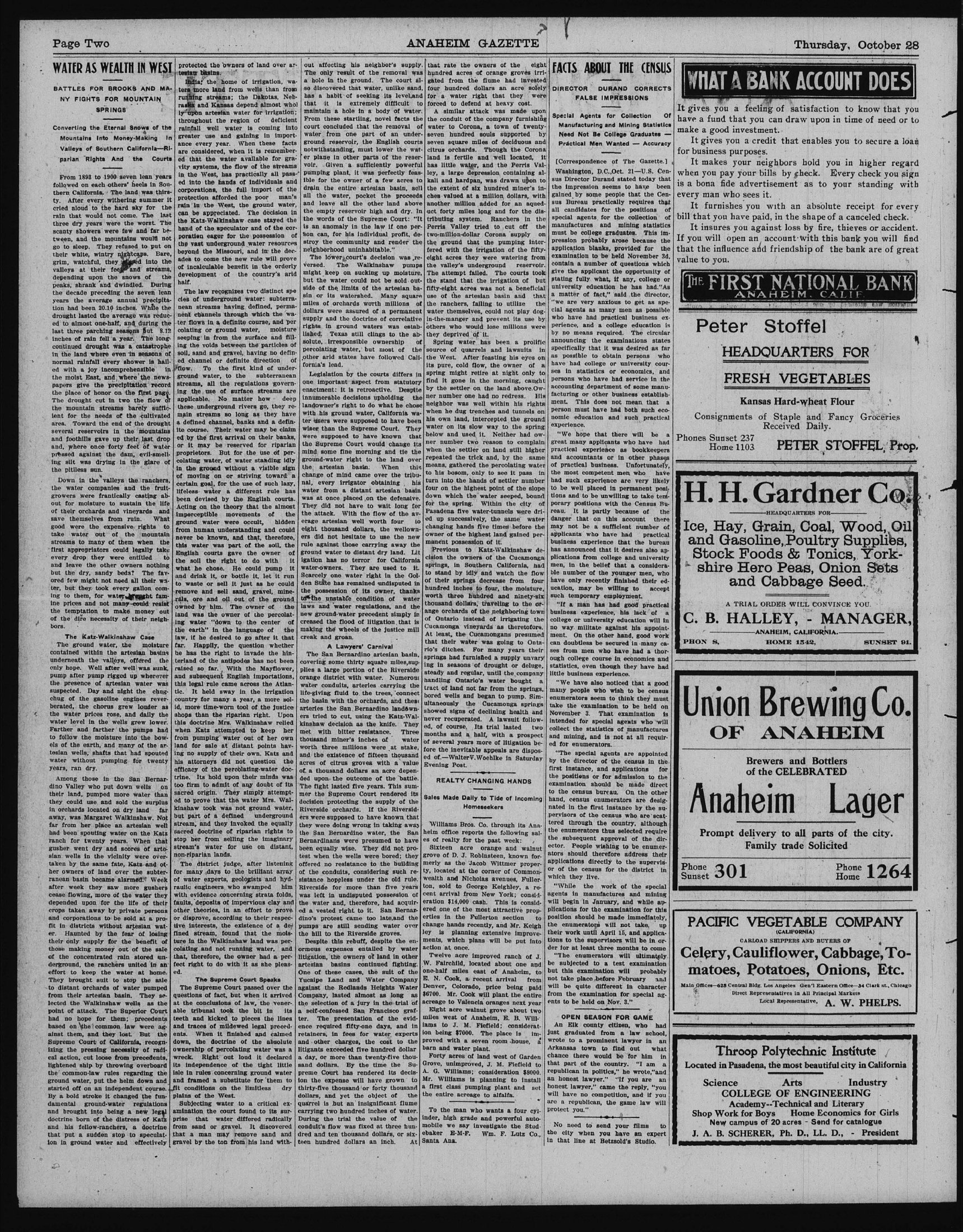
Searchable text
WATER AS WEALTH IN WEST
BATTLES FOR BROOKS AND MANY FIGHTS FOR MOUNTAIN SPRINGS
Converting the Eternal Snows of the Mountains Into Money-Making In Valleys of Southern California—Riparian Rights And the Courts
From 1893 to 1900 seven lean years followed on each others' heels in Southern California. The land was thirsty. After every withering summer it cried aloud to the hard sky for the rain that would not come. The last three dry years were the worst. The scanty showers were few and far between, and the mountains would not go to sleep. They refused to put on their white, wintry nightcaps. Bare, grim, watchful, they moved into the valleys at their feet, and streams, depending upon the snows of the peaks, shrank and dwindled. During the decade preceding the seven lean years the average annual precipitation had been 20.10 inches. While the drought lasted the average was reduced to almost one-half, and during the last three parching seasons but 8.12 inches of rain fell a year. The long-continued drought was a catastrophe in the land where even in seasons of normal rainfall every shower is hailed with a joy incomprehensible in the moist East, and where the newspapers give the precipitation record the place of honor on the first page. The drought cut in two the flow of the mountain streams barely sufficient for the needs of the cultivated area. Toward the end of the drought several reservoirs in the mountains and foothills gave up their last drop and, where once forty feet of water pressed against the dam, evil-smell protected the owners of land over artesian basins.
India; the home of irrigation, waters more land from wells than from running streams; the Dakotas, Nebraska and Kansas depend almost wholly upon artesian water for irrigation; throughout the region of deficient rainfall well water is coming into greater use and gaining in importance every year. When these facts are considered, when it is remembered that the water available for gravity systems, the flow of the streams in the West, has practically all passed into the hands of individuals and corporations, the full import of the protection afforded the poor man's rain in the West, the ground water, can be appreciated. The decision in the Katz-Walkinshaw case stayed the hand of the speculator and of the corporation eager for the possession of the vast underground water resources beyond the Missouri, and in the decades to come the new rule will prove of incalculable benefit in the orderly development of the country's arid half.
The law recognizes two distinct species of underground water: subterranean streams having defined, permanent channels through which the water flows in a definite course, and percolating or ground water, moisture seeping in from the surface and filling the voids between the particles of soil, sand and gravel, having no defined channel or definite direction of flow. To the first kind of underground water, to the subterranean streams, all the regulations governing the use of surface streams are applicable. No matter how deep these underground rivers go, they remain streams so long as they have a defined channel, banks and a definite course. Their water may be claimed by the first arrival on their banks, or it may be reserved for riparian proprietors. But for the use of per-
out affecting his life. The only result of a hole in the ground so discovered that has a habit of sifting that it is extremely maintain a hole in From these startling court concluded that water from one ground reservoir, notwithstanding, no er plane in other voir. Given a safe pumping plant, itsible for the owner to drain the entire all the water, pay and leave all that the empty reservoir words of the is an anomaly in person can, for his interest stroy the community neighborhood united.
The lower courtesies. The W might keep on suiting but the water course side of the limits sin or its waters miles of orchards dollars were assured supply and the do rights in ground lished. Texas still solute, irresponsible percolating water, other arid states formnia's lead.
Legislation by this one important aspect enactment: it is r innumerable decisive landowner's right with his ground w ter users were sup wiser than the Su were supposed to be Supreme Court mind some fine m ground-water right
Down in the valleys the ranchers, the water companies and the fruit-growers were frantically casting about for moisture to sustain the life of their orchards and vineyards and save themselves from ruin. What good were the expensive rights to take water out of the mountain streams to many of them when the first appropriators could legally take every drop they were entitled to and leave the other owners nothing but the dry, sandy beds? The favored few might not need all their water, but they took every gallon coming to them, for water brought famine prices and not many could resist the temptation to make money out of the dire necessity of their neighbors.
The Katz-Walkinshaw Case
The ground water, the moisture contained within the artesian basins underneath the valleys, offered the only hope. Well after well was sunk, pump after pump rigged up wherever the presence of artesian water was suspected. Day and night the chug-chug of the gasoline engines reverberated, the chorus grew louder as the water prices rose, and daily the water level in the wells grew lower. Farther and farther the pumps had to follow the moisture into the bowels of the earth, and many of the artesian wells, shafts that had spouted water without pumping for twenty years, ran dry.
Among those in the San Bernardino Valley who put down wells on their land, pumped more water than they could use and sold the surplus in orchards located on dry land far away, was Margaret Walkinshaw. Not far from her place an artesian well had been spouting water on the Katz ranch for twenty years. When that gusher went dry and scores of artesian wells in the vicinity were overtaken by the same fate, Katz and other owners of land came to know that deep underground water, to the subterranean streams, all the regulations governing the use of surface streams are applicable. No matter how deep these underground rivers go, they remain streams so long as they have a defined channel, banks and a definite course. Their water may be claimed by the first arrival on their banks, or it may be reserved for riparian proprietors. But for the use of percolating water, of water standing idly in the ground without a visible sign of moving on or striving toward a certain goal, for the use of such lazy, lifeless water a different rule has been devised by the English courts. Acting on the theory that the almost imperceptible movements of the ground water were occult, hidden from human understanding and could never be known, and that, therefore, this water was part of the soil, the English courts gave the owner of the soil the right to do with it what he chose. He could pump it and drink it, or bottle it, let it run to waste or sell it just as he could remove and sell sand, gravel, minerals, ore and oil out of the ground owned by him. The owner of the land was the owner of the percolating water "down to the center of the earth" in the language of the law, if he desired to go after it that far. Happily, the question whether he has the right to invade the hinterland of the antipodes has not been raised so far. With the Mayflower, and subsequent English importations, this legal rule came across the Atlantic. It held sway in the irrigation country for many a year, a more solid, more time-worn tool of the justice shops than the riparian right. Upon this doctrine Mrs. Walkinshaw relied when Katz attempted to keep her from pumping water out of her own land for sale at distant points having no supply of their own. Katz and his attorneys did not question the efficacy of the percolating-water doctrine. Its hold upon their minds was too firm to admit of any doubt of its sacred origin. They simply attempted to prove that the water Mrs. Walkinshaw took was not ground water, but part of a defined underground stream, and they invoked the equally sacred doctrine of riparian rights to stop her from selling the imaginary stream's water for use on distant, non-riparian lands.
The district judge, after listening for many days to the brilliant array of channels of definite direction flow. To the first kind of underground water, to the subterranean streams, all the regulations governing the use of surface streams are applicable. No matter how deep these underground rivers go, they remain streams so long as they have a defined channel, banks and a definite course. Their water may be claimed by the first arrival on their banks, or it may be reserved for riparian proprietors. But for the use of percolating water, of water standing idly in the ground without a visible sign of moving on or striving toward a certain goal, for the use of such lazy, lifeless water a different rule has been devised by the English courts. Acting on the theory that the almost imperceptible movements of the ground water were occult, hidden from human understanding and could never be known, and that, therefore, this water was part of the soil, the English courts gave the owner of the soil the right to do with it what he chose. He could pump it and drink it, or bottle it, let it run to waste or sell it just as he could remove and sell sand, gravel, minerals, ore and oil out of the ground owned by him. The owner of the land was the owner of the percolating water "down to the center of the earth" in the language of the law, if he desired to go after it that far. Happily, the question whether he has the right to invade the hinterland of the antipodes has not been raised so far. With the Mayflower, and subsequent English importations, this legal rule came across the Atlantic. It held sway in the irrigation country for many a year, a more solid, more time-worn tool of the justice shops than the riparian right. Upon this doctrine Mrs. Walkinshaw relied when Katz attempted to keep her from pumping water out of her own land for sale at distant points having no supply of their own. Katz and his attorneys did not question the efficacy of the percolating-water doctrine. Its hold upon their minds was too firm to admit of any doubt of its sacred origin. They simply attempted to prove that the water Mrs. Walkinshaw took was not ground water, but part of a defined underground stream, and they invoked the equally sacred doctrine of riparian rights to stop her from selling the imaginary stream's water for use on distant, non-riparian lands.
The district judge, after listening for many days to the brilliant array of channels of definite direction flow. To the first kind of underground water, to the subterranean streams, all the regulations governing the use of surface streams are applicable. No matter how deep these underground rivers go, they remain streams so long as they have a defined channel, banks and a definite course. Their water may be claimed by the first arrival on their banks, or it may be reserved for riparian proprietors. But for the use of percolating water, of water standing idly in the ground without a visible sign of moving on or striving toward a certain goal, for the use of such lazy, lifeless water a different rule has been devised by the English courts. Acting on the theory that the almost imperceptible movements of the ground water were occult, hidden from human understanding and could never be known, and that therefore, this water was part of the soil, the English courts gave the owner of the soil the right to do with it what he chose. He could pump it and drink it, or bottle it, let it run to waste or sell it just as he could remove and sell sand, gravel, minerals, ore and oil out of the ground owned by him. The owner of the land wasthe ownerofthepercolatingwaterdoctrine.ofriparian.right.thebasin.with.thearteries.TheSanBernardinoValleywhoputdownwellsontheirland,pumpedmorewaterthanycoulduseandsoldthesurplusinorchardslocatedondrylandfaraway.wasMargaretWalkinshaw.NotfarfromherplaceanartesianwellhadbeenspoutingwaterontheKatzranchfortwentyyearsWhenthatgusherwentdryandscoresofartesianwellsinthevicinitywereovertakenbythesamefate.Katzandotherownersoflandareoflandownersofdailytheneedsfowateroutofthemountainstreamsbeneaththevalleysoffollowingtheseconditionsalltheregulationsgoverningtheuseofsurfacestreamsareapplicable.Nomatterhowdeeptheseundergroundriversgooselongtheuseofsurfacestreamsareapplicable.No matterhowdeeptheseundergroundriversgooselongtheuseofsurfacestreamsareapplicable.No matterhowdeeptheseundergroundriversgooselongtheuseofsurfacestreamsareapplicable.No matterhowdeeptheseundergroundriversgooselongtheuseofsurfacestreamsareapplicable.No matterhowdeeptheseundergroundriversgooselongtheuseofsurfacestreamsareapplicable.No matterhowdeeptheseundergroundriversgooselongtheuseofsurfacestreamsareapplicable.No matterhowdeeptheseundergroundriversgooselongtheuseofsurfacestreamsareapplicable.No matterhowdeeptheseundergroundriversgooselongtheuseofsurfacestreamsareapplicable.No matterhowdeeptheseundergroundriversgooselongtheuseofsurfacestreamsareapplicable.No matterhowdeeptheseundergroundriversgooselongtheuseofsurfacestreamsareapplicable.No matterhowdeeptheseundergroundriversgooselongtheuseofsurfacestreamsareapplicable.No matterhowdeeptheseundergroundriversgooselongtheuseofsurfacestreamsareapplicable.No matterhowdeeptheseundergroundriversgooselongtheuseofsurfacestreamsareapplicable.No matterhowdeeptheseundergroundriversgooselongtheuseofsurfacestreamsareapplicable.No matterhowdeeptheseundergroundriversgooselongtheuseofsurfacestreamsareapplicable.No matterhowdeeptheseundergroundriversgooselongtheuseofsurfacestreamsareapplicable.No matterhowdeeptheseundergroundriversgooselongtheuseofsurfacestreamsareapplicable.No matterhowdeeptheseundergroundriversgooselongtheuseofsurfacestreamsareapplicable.No matterhowdeeptheseundergroundriversgooselongtheuseofsurfacestreamsareapplicable.No matterhowdeeptheseundergroundriversgooselongtheuseofsurfacestreamsareapplicable.No matterhowdeeptheseundergroundriversgooselongtheuseofsurfacestreamsareapplicable.No matterhowdeeptheseundergroundriversgooselongtheuseofsurfacestreamsareapplicable.No matterhowdeeptheseundergroundriversgooselongtheuseofsurfacestreamsareapplicable.No matterhowdeeptheseundergroundriversgooselongtheuseofsurfacestreamsareapplicable.No matterhowdeeptheseundergroundriversgooselongtheuseofsurfacestreamsareapplicable.No matterhowdeeptheseundergroundriversgooselongtheuseofsurfacestreamsareapplicable.No matterhowdeeptheseundergroundriversgooselongtheuseofsurfacestreamsareapplicable.No matterhowdeeptheseundergroundriversgooselongtheuseofsurfacestreamsareapplicable.No matterhowdeeptheseundergroundriversgooselongtheuseofsurfacestreamsareapplicable.No matterhowdeeptheseundergroundriversgooselongtheuseofsurfacestreamsareapplicable.No matterhowdeeptheseundergroundriversgooselongtheuseofsurfacestreamsareapplicable.No matterhowdeeptheseundergroundriversgooselongtheuseofsurfacestreamsareapplicable.No matterhowdeeptheseundergroundriversgooselongtheuseofsurfacestreamsareapplicable.No matterhowdeeptheseundergroundriversgooselongtheuseofsurfacestreamsareapplicable.No matterhowdeeptheseundergroundriversgooselongtheuseofsurfacestreamsareapplicable.No matterhowdeeptheseundergroundriversgooselongtheuseofsurfacestreamsareapplicable.No matterhowdeeptheseundergroundriversgooselongtheuseofsurfacestreamsareapplicable.No matterhowdeeptheseundergroundriversgooselongtheuseofsurfacestreamsareapplicable.No matterhowdeeptheseundergroundriversgooselongthreatenedbythiseventeveryirritatingwaterfromadiscwasatonceplacedThey did not haveattack.WitheagerartesianwewerightthousanddollarsdidnothesesruleagainthreatenedbythiseventeveryirritatingwaterfromadiscwasatonceplacedThey did not haveattack.WitheagerartesianwewerightthousanddollarsdidnothesesruleagainthreatenedbythiseventeveryirritatingwaterfromadiscwasatonceplacedThey did not haveattack.WitheagerartesianwewerightthousanddollarsdidnothesesruleagainthreatenedbythiseventeveryirritatingwaterfromadiscwasatonceplacedThey did not haveattack.WitheagerartesianwewerightthousanddollarsdidnothesesruleagainthreatenedbythiseventeveryirritatingwaterfromadiscwasatonceplacedThey did not haveattack.WitheagerartesianwewerightthousanddollarsdidnothesesruleagainthreatenedbythiseventeveryirritatingwaterfromadiscwasatonceplacedThey did not haveattack.WitheagerartesianwewerightthousanddollarsdidnothesesruleagainthreatenedbythiseventeveryirritatingwaterfromadiscwasatonceplacedThey did not haveattack.WitheagerartesianwewerightthousanddollarsdidnothesesruleagainthreatenedbythiseventeveryirritatingwaterfromadiscwasatonceplacedThey did not haveattack.WitheagerartesianwewerightthousanddollarsdidnothesesruleagainthreatenedbythiseventeveryirritatingwaterfromadiscwasatonceplacedThey did not haveattack.WitheagerartesianwewerightthousanddollarsdidnothesesruleagainthreatenedbythiseventeveryirritatingwaterfromadiscwasatonceplacedThey did not haveattack.WitheagerartesianwewerightthousanddollarsdidnothesesruleagainthreatenedbythiseventeveryirritatingwaterfromadiscwasatonceplacedThey did not haveattack.WitheagerartesianwewerightthousanddollarsdidnothesesruleagainthreatenedbythiseventeveryirritatingwaterfromadiscwasatonceplacedThey did not haveattack.WitheagerartesianwewerightthousanddollarsdidnothesesruleagainthreatenedbythiseventeveryirritatingwaterfromadiscwasatonceplacedThey did not haveattack.WitheagerartesianwewerightthousanddollarsdidnothesesruleagainthreatenedbythiseventeveryirritatingwaterfromadiscwasatonceplacedThey did not haveattack.WitheagerartesianwewerightthousanddollarsdidnothesesruleagainthreatenedbythiseventeveryirritatingwaterfromadiscwasatonceplacedThey did not haveattack.WitheagerartesianwewerightthousanddollarsdidnothesesruleagainthreatenedbythiseventeveryirritatingwaterfromadiscwasatonceplacedThey did not haveattack.WitheagerartesianwewerightthousanddollarsdidnothesesruleagainthreatenedbythiseventeveryirritatingwaterfromadiscwasatonceplacedThey did not haveattack.Witheagerartesianwewerightthousanddollarsdidnothesesruleagainthreatenedbythis eventeveryirritatingwaterfromadiscwasat onceplacedThey did not haveattack.Witheagerartesianwewerightthousanddollarsdidnothesesruleagainthreatenedbythis eventeveryirritatingwaterfromadiscwasat onceplacedThey did not haveattack.Witheagerartesianwewerightthousanddollarsdidnothesesruleagainthreatenedbythis eventeveryirritatingwaterfromadiscwasat onceplacedThey did not haveattack.Witheagerartesianwewerightthousanddollarsdidnothesesruleagainthreatenedbythis eventeveryirritatingwaterfroma discwasat onceplacedThey did not haveattack.Witheagerartesianwewerightthousanddollarsdidnothesesruleagainthreatenedbythis eventeveryirritatingwaterfroma discwasat onceplacedThey did not haveattack.Witheagerartesianwewerightthousanddollarsdidnothesesruleagainthreatenedbythis eventeveryirritatingwaterfroma discwasat onceplacedThey did not haveattack.Witheagerartesianwewerightthousanddollarsdidnothesesruleagainthreatenedbythis eventeveryirritatingwaterfroma discwasat onceplacedThey did not haveattack.Witheagerartesianwewerightthousanddollarsdidnothesesruleagainthreatenedbythis eventeveryirritatingwaterfroma discwasat onceplacedThey did not haveattack.Witheagerartesianwewerightthousanddollarsdidnothesesruleagainthreatenedbythis eventeveryirritatingwaterfroma discwasat onceplacedThey did not haveattack.Witheagerartesianwewerightthousanddollarsdidnothesesruleagainthreatenedbythis eventeveryirritatingwaterfroma discwasat onceplacedThey did not haveattack.Witheagerartesianwewerightthousanddollarsdidnothesesruleagainthreatenedbythis eventeveryirritatingwaterfroma discwasat onceplacedThey did not haveattack.Witheagerartesianwewerightthousanddollarsdidnothesesruleagainthreatenedbythis eventeveryirritatingwaterfroma discwasat onceplacedThey did not haveattack.Witheagerartesianwewerightthousanddollarsdidnothesesruleagainthreatenedbythis eventEvery irritating water from a disc was at once placed They did not have attack With eager artesian we wer right thou se n d l o w t h e r i t i n g y w e r f o r m e n t o w e r f o r m e n t o w e r f o r m e n t o w e r f o r m e n t o w e r f o r m e n t o w e r f o r m e n t o w e r f o r m e n t o w e r f o r m e n t o w e r f o r m e n t o w e r f o r m e n t o w e r f o r m e n t o w e r f o r m e n t o w e r f o r m e n t o w e r f o r m e n t o w e r f o r m e n t o w e r f o r m e n t o w e r f o r m e n t o w e r f o r m e n t o w e r f o r m e n t o w e r f o r m e n t o w e r f o r m e n t o w e r f o r m e n t o w e r f o r m e n t o w e r f o r m e n t o w e r f o r m e n t o w e r f o r m e n t o w e r f o r m e n t o w e r f o r m e n t o w e r f o r m e n t o w e r f o r m e n t o w e r f o r m e n t o w e r f o r m e n t o w e r f o r m en t o w e r f o r m en t o w e r f o r m en t o w e r f o r m en t o w e r f o r m en t o w e r f o r m en t o w e r f o re m ent to w e re re re re re re re re re re re re re re re re re re re re re re re re re re re re re re re re re re re re re re re re re re re re re re re re re re re re re re re re re re re re re re re re re re re re re re re re re re re re re re re re re re re re re re re re re rererererererererererererererererererererererererererererererererererererererererererererererererererererererererererererererererere.reere.re.re.re.re.re.re.re.re.re.re.re.re.re.re.re.re.re.re.re.re.re.re.re.re.re.re.re.re.re.re.re.re.re.re.re.re.re.re.re.re.re.re.re.re.re.re.re.re.re.re.re.re.re.re.re.re.re.re.re.re.re.re.re.re.re.re.re.re.re.re.re.re.re.re.re-re-re-re-re-re-re-re-re-re-re-re-re-re-re-re-re-re-re-re-re-re-re-re-re-re-re-re-re-re-re-re-re-re-re-re-re-re-re-re-re-re-re-re-re-re-re-re-re-re-re-re-re-re-re-re-re-re-re-re-re-re-re-re-re-re-re-re-re-re-re-re-re-re-re-Re-Re-Re-Re-Re-Re-Re-Re-Re-Re-Re-Re-Re-Re-Re-Re-Re-Re-Re-Re-Re-Re-Re-Re-Re-Re-Re-Re-Re-Re-Re-Re-Re-Re-Re-Re-Re-Re-Re-Re-Re-Re-Re-Re-Re-Re-Re-Re-Re-Re-Re-Re-Re-Re-Re-Re-Re-Re-Re-Re-Re-Re-Re-Re-Re-Re-Re-Re-Re-Re-Re-R-e-R-e-R-e-R-e-R-e-R-e-R-e-R-e-R-e-R-e-R-e-R-e-R-e-R-e-R-e-R-e-R-e-R-e-R-e-R-e-R-e-R-e-R-e-R-e-R-e-R-e-R-e-R-e-R-e-R-e-R-e-R-e-R-e-R-e-R-e-R-e-R-e-R-e-R-e-R-e-R-e-R-e-R-e-R-e-R-e-R-e-R-e-R-e-R-e-R-e-RE-E-E-E-E-E-E-E-E-E-E-E-E-E-E-E-E-E-E-E-E-E-E-E-E-E-E-E-E-E-E-E-E-E-E-E-E-E-E-E-E-E-E-E-E-E-E-E-E-E-E-E-E-E-E-E-E-E-E-E-E-E-E-E-E-E-E-E-E-E-E-E-E-E-E-E-E.E.E.E.E.E.E.E.E.E.E.E.E.E.E.E.E.E.E.E.E.E.E.E.E.E.E.E.E.E.E.E.E.E.E.E.E.E.E.E.E.E.E.E.E.E.E.E.E.E.E.E.E.E.E.E.E.E.E.E.E.E.E.E.E.E.E.E.E.E.E.F-F-F-F-F-F-F-F-F-F-F-F-F-F-F-F-F-F-F-F-F-F-F-F-F-F-F-F-F-F-F-F-F-F-F-F-F-F-F-F-F-F-F-F-F-F-F-F-F-F-F-F-F-F-F-F-F-F-F-F-F-F-F-F-F-Fi-Fi-Fi-Fi-Fi-Fi-Fi-Fi-Fi-Fi-Fi-Fi-Fi-Fi-Fi-Fi-Fi-Fi-Fi-Fi-Fi-Fi-Fi-Fi-Fi-Fi-Fi-Fi-Fi-Fi-Fi-Fi-Fi-Fi-Fi-Fi-Fi-Fi-Fi-Fi-Fi-Fi-Fi-Fi-Fi-Fi-Fi-Fi-Fi-Fi-Fi-Fi-Fi-Fi-Fi-Fi-Fi-Fi-Fi-Fi-Fi-Fi-Fi-Fi-Fi-Fi-Fi-Fi-Fi-Fi-Fi-Fi-Fi-Fi-Fi-Fi-Fi-Fi-Fi-Fi-Fi FiFiFiFiFiFiFiFiFiFiFiFiFiFiFiFiFiFiFiFiFiFiFiFiFiFiFiFiFiFiFiFiFiFiFiFiFiFiFiFiFiFiFiFiFiFiFiFiFiFiFiFiFiFiFiFiFiFiFiFiFiFiFiFiFiFiFiFiFiFiFiFiFiFiFiFiFiFiFiFiFi fi fi fi fi fi fi fi fi fi fi fi fi fi fi fi fi fi fi fi fi fi fi fi fi fi fi fi fi fi fi fi fi fi fi fi fi fi fi fi fi fi fi fi fi fi fi fi fi fi fi fi fi fi fi fi fi fi fi fi fi fi fi fi fi ti ti ti ti ti ti ti ti ti ti ti ti ti ti ti ti ti ti ti ti ti ti ti ti ti ti ti ti ti ti ti ti ti ti ti ti ti ti ti ti ti ti ti ti ti ti ti ti ti ti ti ti ti ti ti ti hi hi hi hi hi hi hi hi hi hi hi hi hi hi hi hi hi hi hi hi hi hi hi hi hi hi hi hi hi hi hi hi hi hi hi hi hi hi hi hi hi hi hi hi hi hi hi hi hi hi hi hi hi hi hiHi Hi Hi Hi Hi Hi Hi Hi Hi Hi Hi Hi Hi Hi Hi Hi Hi Hi Hi Hi Hi Hi Hi Hi Hi Hi Hi Hi Hi Hi Hi Hi Hi Hi Hi Hi Hi Hi Hi Hi Hi Hi Hi Hi Hi Hi Hi Hi Hi Hi Hi Hi Hi Hi Hi Hi Hi Hi High High High High High High High High High High High High High High High High High High High High High High High High High High High High High High High High High High High High High High High High High High High High High High High High High High High High High High High High High High High High High High High High High High High High High High High High High High High High High High High High High HighHighHighHighHighHighHighHighHighHighHighHighHighHighHighHighHighHighHighHighHighHighHighHighHighHighHighHighHighHighHighHighHighHighHighHighHighHighHighHighHighHighHighHighHighHighHighHighHighHighHighHighHighHighHighHighHighHighHighHighHighHighHighHighHighHighHighHighHighHighHighHighHighHighHighHighHighHighHighHighHighHighHighHighHighHighHighHighHighHighHighhighhighhighhighhighhighhighhighhighhighhighhighhighhighhighhighhighhighhighhighhighhighhighhighhighhighhighhighhighhighhighhighhighhighhighhighhighhighhighhighhighhighhighhighhighhighhighhighhighhighhighhighhighhighhighhighhigh high high high high high high high high high high high high high high high high high high high high high high high high high high high high high high high high high high high high high high high high high high high high high high high high high high high high high high high high high high high high high high high high high high high high high high high high高高高高高高高高高高高高高高高高高高高高高高高高高高高高高高高高高高高高高高高高高高高高高高高高高高高
Among those in the San Bernardino Valley who put down wells on their land, pumped more water than they could use and sold the surplus in orchards located on dry land far away, was Margaret Walkinshaw. Not far from her place an artesian well had been spouting water on the Katz ranch for twenty years. When that gusher went dry and scores of artesian wells in the vicinity were overtaken by the same fate, Katz and other owners of land over the subterranean basin became alarmed. Week after week they saw more gushers cease flowing, more of the water they depended upon for the life of their crops taken away by private persons and corporations to be sold at a profit in districts without artesian water. Haunted by the fear of losing their only supply for the benefit of those making money out of the sale of the concentrated rain stored underground, the ranchers united in an effort to keep the water at home. They brought suit to stop the sale to distant orchards of water pumped from their artesian basin. They selected the Walkinshaw wells as the point of attack. The Superior Court had no hope for them; precedents based on the common law were against them, and they lost. But the Supreme Court of California, recognizing the pressing necessity of radical action, cut loose from precedents, lightened ship by throwing overboard the common-law rules regarding the ground water, put the helm down and started off on an independent course. By a bold stroke it changed the fundamental ground-water regulations and brought into being a new legal doctrine born of the distress of Katz and his fellow-ranchers, a doctrine that put a sudden stop to speculation in ground water and effectively trine. Its hold upon their minds was too firm to admit of any doubt of its sacred origin. They simply attempted to prove that the water Mrs. Walkinshaw took was not ground water, but part of a defined underground stream, and they invoked the equally sacred doctrine of riparian rights to stop her from selling the imaginary stream's water for use on distant, non-riparian lands.
The district judge, after listening for many days to the brilliant array of water experts, geologists and hydraulic engineers who swamped him with evidence concerning strata folds, faults, deposits of impervious clay and other theories, in an effort to prove or disprove, according to their respective interests, the existence of a defined stream, found that the moisture in the Walkinshaw land was percolating and not running water, and that, therefore, the owner had a perfect right to do with it as she pleased.
The Supreme Court passed over the questions of fact, but when it arrived at the conclusions of law, the venerable tribunal took the bit in its teeth and kicked to pieces the lines and traces of mildewed legal precedents. When it finished and calmed down, the doctrine of the absolute ownership of percolating water was a wreck. Right out loud it declared its independence of the tight little isle in rules concerning ground water and framed a substitute for them to fit conditions on the limitless dry plains of the West.
Subjecting water to a critical examination the court found to its surprise that water differed radically from sand or gravel. It discovered that a man may remove sand and gravel by the ton from his land with-
The fight lasted five merer the Supreme Court decision protecting Riverside orchards were supposed to they were doing wrong the San Bernardino Bernardinans were been equally wise test when the wells offered no resistance of the conduits, consistance hopeless under Riverside for more was left in undisputed the water and, there ed a vested right thdino's protest came pumps are still seized the hill to the River.
Despite this rebuilormous expenses of litigation, the owner artesian basins o One of these cases Yucaipe Land and against the Redland Company, lasted all the selection of a j self-confessed Sister. The presentance required fifty retainers, in fees and other charges, litigants exceeded for a day, or more than sand dollars. By preme Court has re ion the expense with thirty-five thousand dollars, and yet tha quarrel is but an i carrying two hundred During the trial thd conduit's flow was f dred and ten thousand teen hundred dollars.
ANAHEIM GAZETTE
out affecting his neighbor's supply. The only result of the removal was a hole in the ground. The court also discovered that water, unlike sand, has a habit of seeking its level and that it is extremely difficult to maintain a hole in a body of water. From these startling, novel facts the court concluded that the removal of water from one part of an underground reservoir, the English courts notwithstanding, must lower the water plane in other parts of the reservoir. Given a sufficiently powerful pumping plant, it was perfectly feasible for the owner of a few acres to drain the entire artesian basin, sell all the water, pocket the proceeds and leave all the other land above the empty reservoir high and dry. In the words of the Supreme Court: "It is an anomaly in the law if one person can, for his individual profit, destroy the community and render the neighborhood uninhabitable."
The lower court's decision was reversed. The Walkinshaw pumps might keep on sucking up moisture, but the water could not be sold outside of the limits of the artesian basin or its watershed. Many square miles of orchards worth millions of dollars were assured of a permanent supply and the doctrine of correlative rights in ground waters was established. Texas still clings to the absolute, irresponsible ownership of percolating water, but most of the other arid states have followed California's lead.
Legislation by the courts differs in one important aspect from statutory enactment: it is retroactive. Despite innumerable decisions upholding the landowner's right to do what he chose with his ground water, California water users were supposed to have been wiser than the Supreme Court. They were supposed to have known that the Supreme Court would change its mind some fine morning and tie the groundwater right to the land over that rate the owners of the eight hundred acres of orange groves irrigated from the flume had invested four hundred dollars an acre solely for a water right that they were forced to defend at heavy cost.
A similar attack was made upon the conduit of the company furnishing water to Corona, a town of twenty-seven hundred souls supported by seven square miles of deciduous and citrus orchards. Though the Corona land is fertile and well located, it has little water, and the Perris Valley, a large depression containing alkali and hardpan, was drawn upon to the extent of six hundred miner's inches valued at a million dollars, with another million added for an aqueduct forty miles long and for the distributing system. Ranchers in the Perris Valley tried to cut off the two-million-dollar Corona supply on the ground that the pumping interfered with the irrigation of the fifty-eight acres they were watering from the valley's underground reservoir. The attempt failed. The courts took the stand that the irrigation of but fifty-eight acres was not a beneficial use of the artesian basin and that the ranchers, falling to utilize the water themselves, could not play dog-in-the-manger and prevent its use by others who would lose millions were they deprived of it.
Spring water has been a prolific source of quarrels and lawsuits in the West. After feasting his eyes on its pure, cold flow, the owner of a spring might retire at night only to find it gone in the morning, caught by the settler on the land above. Owner number one had no redress. His neighbor was well within his rights when he dug trenches and tunnels on his own land, intercepted the ground water on its slow way to the spring below and used it. Neither had owner number two reason to complain when the settler on land still higher repeated the trick and, by the same
FACTS ABOUT THE CENSUS
DIRECTOR DURAND CORRECTS FALSE IMPRESSIONS
Special Agents for Collection Of Manufacturing and Mining Statistics Need Not Be College Graduates — Practical Men Wanted — Accuracy
[Correspondence of The Gazette.]
Washington, D.C., Oct. 21—U.S. Census Director Durand stated today that the impression seems to have been gained by some people that the Census Bureau practically requires that all candidates for the positions of special agents for the collection of manufactures and mining statistics must be college graduates. This impression probably arose because the application blanks, provided for the examination to be held November 3d, contain a number of questions which give the applicant the opportunity of stating fully what, if any, college or university education he has had.“As a matter of fact,” said the director, “we are very anxious to get as special agents as many men as possible who have had practical business experience, and a college education is by no means required. The circular announcing the examinations states specifically that it was desired as far as possible to obtain persons who have had college or university courses in statistics or economics, and persons who have had service in the accounting department of some manufacturing or other business establishment. This does not mean that a person must have had both such economic education and such practical experience.
“We hope that there will be a great many applicants who have had practical experience as bookkeepers and accountants or in other phases
Legislation by the courts differs in one important aspect from statutory enactment: it is retroactive. Despite innumerable decisions upholding the landowner's right to do what he chose with his ground water, California water users were supposed to have been wiser than the Supreme Court. They were supposed to have known that the Supreme Court would change its mind some fine morning and tie the ground-water right to the land over the artesian basin. When this change of mind came over the tribunal, every irrigator obtaining his water from a distant artesian basin was at once placed on the defensive. They did not have to wait long for the attack. With the flow of the average artesian well worth four to eight thousand dollars, the wellowners did not hesitate to use the new rule against those carrying away the ground water to distant dry land. Litigation has no terror for California water-owners. They are used to it. Scarcely one water right in the Golden State has remained undisputed in the possession of its owner, thanks to the unstable condition of water laws and water regulations, and the new ground-water precedent simply in creased the flood of litigation that is making the wheels of the justice mill creak and groan.
A Lawyers' Carnival
The San Bernardino artesian basin, covering some thirty square miles, supplies a large portion of the Riverside orange district with water. Numerous water conduits, arteries carrying the life-giving fluid to the trees, connect the basin with the orchards, and these arteries the San Bernardino landowners tried to cut, using the Katz-Walkinshaw decision as the knife. They met with bitter resistance. Three thousand miner's inches of water worth three millions were at stake, and the existence of fifteen thousand acres of citrus groves with a value of a thousand dollars an acre depended upon the outcome of the battle. The fight lasted five years. This summer the Supreme Court rendered its decision protecting the supply of the Riverside orchards. If the Riversiders were supposed to have known that they were doing wrong in taking away the San Bernardino water, the San Bernardinans were presumed to have been equally wise. They did not protest when the wells were bored; they offered no resistance to the building its pure, cold flow, the owner of a spring might retire at night only to find it gone in the morning, caught by the settler on the land above.Owner number one had no redress. His neighbor was well within his rights when he dug trenches and tunnels on his own land, intercepted the ground water on its slow way to the spring below and used it. Neither had owner number two reason to complain when the settler on land still higher repeated the trick and, by the same means, gathered the percolating water to his bosom, only to see it pass in turn into the hands of settler number four on the highest point of the slope down which the water seeped, bound for the spring. Within the city of Pasadena five water-tunnels were drilled up successively, the same water changing hands five times before the owner of the highest land gained permanent possession of it.
Previous to Katz-Walkinshaw decision the owners of the Cucamonga springs, in Southern California, had to stand by idly and watch the flow of their springs decrease from four hundred inches to four, the moisture, worth three hundred and ninety-six thousand dollars, traveling to the orange orchards of the neighboring town of Ontario instead of irrigating the Cucamonga vineyards as theretofore. At least, the Cucamongans presumed that their water was going to Ontario's ditches. For many years their springs had furnished a supply unvarying in seasons of drought or deluge, steady and regular, until the company handling Ontario's water bought a tract of land not far from the springs, bored wells and began to pump. Simultaneously the Cucamonga springs showed signs of declining health and never recuperated. A lawsuit followed, of course. Its trial lasted two months and a half, with a prospect of several years more of litigation before the inevitable appeals are disposed of.—Walter V. Woehlke in Saturday Evening Post.
REALTY CHANGING HANDS
Sales Made Daily to Tide of Incoming Homeseekers
Williams Bros. Co. through its Anaheim office reports the following sales of realty for the past week:
Sixteen acre orange and walnut grove of D. J. Robinsteen, known formerly as the Jacob Wittmer property located at the corner of Campbell have had college or university courses in statistics or economics, and persons who have had service in the accounting department of some manufacturing or other business establishment. This does not mean that a person must have had both such economic education and such practical experience.
"We hope that there will be a great many applicants who have had practical experience as bookkeepers and accountants or in other phases of practical business. Unfortunately, the most competent men who have had such experience are very likely to be well placed in permanent positions and to be unwilling to take temporary positions with the Census Bureau. It is partly because of the danger that on this account there may not be a sufficient number of applicants who have had practical business experience that the bureau has announced that it desires also applications from college and university men, in the belief that a considerable number of the younger men, who have only recently finished their education, may be willing to accept such temporary employment.
"If a man has had good practical business experience, his lack of a college or university education will in no way militate against his appointment. On the other hand, good work can doubtless be secured in many cases from men who have had a thorough college course in economics and statistics, even though they have had little business experience.
"We have also noticed that a good many people who wish to be census enumerators seem to think they must take the examination to be held on November 3. That examination is intended for special agents who will collect the statistics of manufactures and mining, and is not at all required for enumerators.
"The special agents are appointed by the director of the census in the first instance, and applications for the positions or for admission to the examination should be made direct to the census bureau. On the other hand, census enumerators are designated in the first instance by the supervisors of the census who are scattered through the country, although the enumerators thus selected require subsequent approval of the director. People wishing to be enumerators should therefore address their applications directly to the supervisor of the census for the district in..."
REALTY CHANGING HANDS
Sales Made Daily to Tide of Incoming Homeseekers
Williams Bros. Co. through its Anaheim office reports the following sales of realty for the past week:
Sixteen acre orange and walnut grove of D. J. Robinsteen, known formerly as the Jacob Wittmer property, located at the corner of Commonwealth and Nicholas avenues, Fullerton, sold to George Keighley, a recent arrival from New York; consideration $14,000 cash. This is considered one of the most attractive properties in the Fullerton section to change hands recently, and Mr. Keighley is planning extensive improvements, which plans will be put into action at once.
Twelve acre improved ranch of J. W. Fairchild, located about one and one-half miles east of Anaheim, to E. N. Cook, a recent arrival from Denver, Colorado, price being paid $6700. Mr. Cook will plant the entire acreage to Valencia oranges next year.
Eight acre walnut grove about two miles west of Anaheim, E. B. Williams to J. M. Fiefield; consideration being $7000. The place is improved with a seven room house, a barn and water plant.
Forty acres of land west of Garden Grove, unimproved, J. M. Fiefield to A. G. Williams; consideration $8000. Mr. Williams is planning to install a first class pumping plant and set the entire acreage to alfalfa.
To the man who wants a four cylinder, high grade and powerful automobile we say investigate the Studebaker E-M-F. Wm. F. Lutz Co., Santa Ana.
The positions or for admission to the examination should be made direct to the census bureau. On the other hand, census enumerators are designated in the first instance by the supervisors of the census who are scattered through the country, although the enumerators thus selected require the subsequent approval of the director. People wishing to be enumerators should therefore address their applications directly to the supervisor of the census for the district in which they live.
"While the work of the special agents in manufactures and mining will begin in January, and while applications for the examination for this position should be made immediately, the enumerators will not take up their work until April 15, and applications to the supervisors will be in order for at least three months to come."
"The enumerators will ultimately be subjected to a test examination but this examination will probably not take place before February and will be quite different in character from the examination for special agents to be held on Nov. 3."
OPEN SEASON FOR GAME
An Elk county citizen, who had just graduated from a law school, wrote to a prominent lawyer in an Arkansas town to find out what chance there would be for him in that part of the country. "I am a republican in politics," he wrote, "and an honest lawyer." "If you are an honest lawyer," came the reply, "you will have no competition, and if you are a republican, the game law will protect you."
No need to send your films to the city when you have an expert in that line at Betzsold's Studio.
THURSDAY, October 28
WHAT A BANK ACCOUNT DOES
It gives you a feeling of satisfaction to know that you have a fund that you can draw upon in time of need or to make a good investment.
It gives you a credit that enables you to secure a loan for business purposes.
It makes your neighbors hold you in higher regard when you pay your bills by check. Every check you sign is a bona fide advertisement as to your standing with every man who sees it.
It furnishes you with an absolute receipt for every bill that you have paid, in the shape of a canceled check.
It insures you against loss by fire, thieves or accident. If you will open an account with this bank you will find that the influence and friendship of the bank are of great value to you.
THE FIRST NATIONAL BANK
ANAHEIM, CALIF.
Peter Stoffel
HEADQUARTERS FOR
FRESH VEGETABLES
Kansas Hard-wheat Flour
Consignments of Staple and Fancy Groceries Received Daily.
Phones Sunset 237
Home 1103
PETER STOFFEL, Prop.
FRESH VEGETABLES
Kansas Hard-wheat Flour
Consignments of Staple and Fancy Groceries
Received Daily.
Phones Sunset 237
Home 1103 PETER STOFFEL, Prop.
H. H. Gardner Co.
HEADQUARTERS FOR
Ice, Hay, Grain, Coal, Wood, Oil
and Gasoline, Poultry Supplies,
Stock Foods & Tonics, Yorkshire Hero Peas, Onion Sets
and Cabbage Seed.
A TRIAL ORDER WILL CONVINCE YOU.
C. B. HALLEY, - MANAGER,
ANAHEIM, CALIFORNIA.
PHON S, HOME 1542, SUNSET 91.
Union Brewing Co.
OF ANAHEIM
Brewers and Bottlers
of the CELEBRATED
Anaheim Lager
Prompt delivery to all parts of the city.
Family trade Solicited
Phone 301 Phone 1264
Anaheim Lager
Prompt delivery to all parts of the city.
Family trade Solicited
Phone 301
Sunset 1264
PACIFIC VEGETABLE COMPANY
(CALIFORNIA)
CARLOAD SHIPPERS AND BUYERS OF
Celery, Cauliflower, Cabbage, Tomatoes, Potatoes, Onions, Etc.
Main Offices—625 Central Bldg. Los Angeles Gen'l Eastern Office—34 Clark st., Chicago
Direct Representatives in All Principal Markets
Local Representative, A. W. PHELPS.
Throop Polytechnic Institute
Located in Pasadena, the most beautiful city in California
Science Arts Industry
COLLEGE OF ENGINEERING
Academy--Technical and Literary
Shop Work for Boys Home Economics for Girls
New campus of 20 acres - Send for catalogue
J. A. B. SCHERER, Ph. D., LL. D., - President