anaheim-gazette 1909-08-26
Scanned page
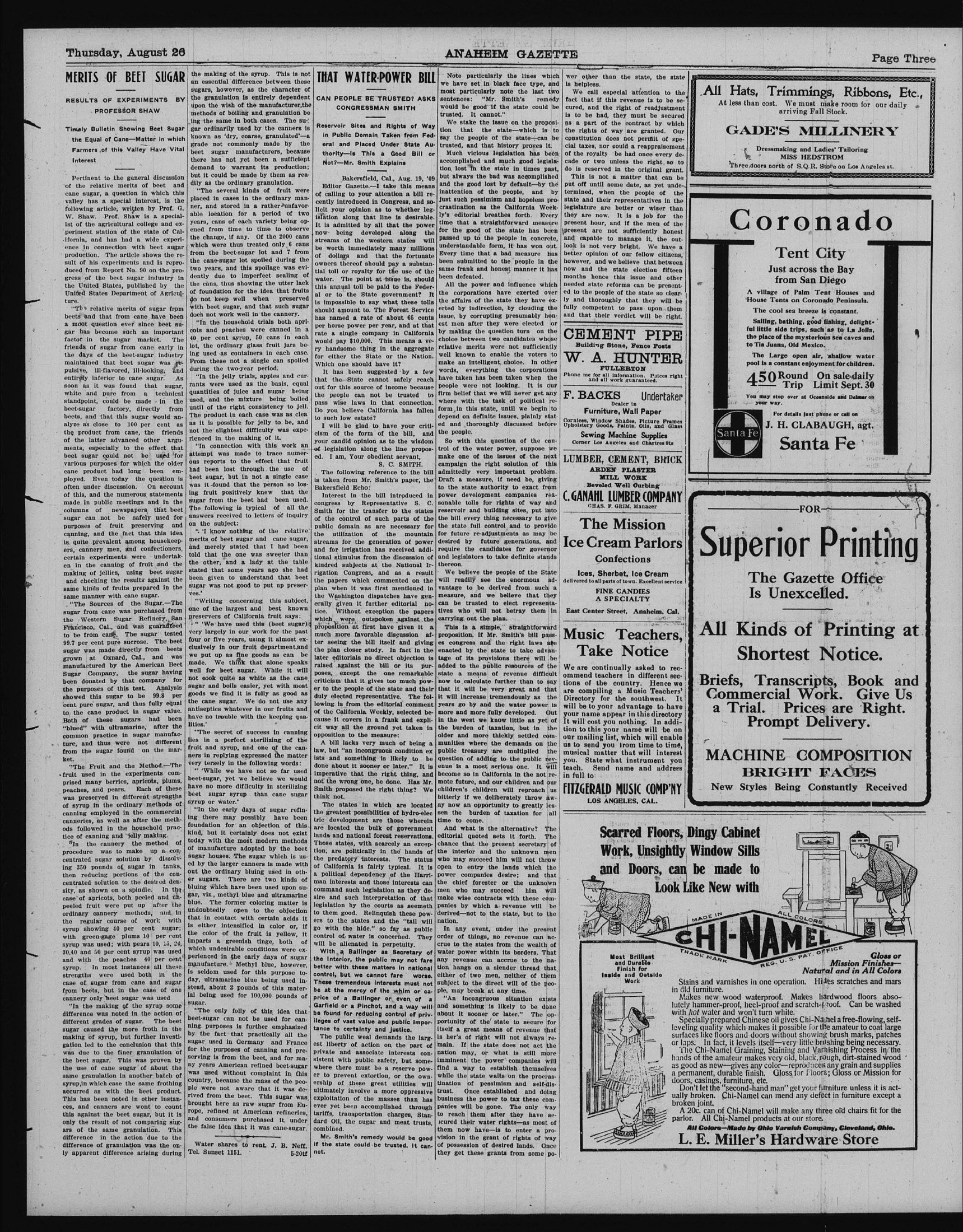
Searchable text
MERITS OF BEET SUGAR
RESULTS OF EXPERIMENTS BY PROFESSOR SHAW
Timely Bulletin Showing Beet Sugar the Equal of Cane—Matter in which Farmers of this Valley Have Vital Interest
Pertinent to the general discussion of the relative merits of beet and cane sugar, a question in which this valley has a special interest, is the following article, written by Prof. G. W. Shaw. Prof. Shaw is a specialist of the agricultural college and experiment station of the state of California, and has had a wide experience in connection with beet sugar production. The article shows the result of his experiments and is reproduced from Report No. 90 on the progress of the beet sugar industry in the United States, published by the United States Department of Agriculture.
"The relative merits of sugar from beets and that from cane have been a moot question ever since beet sugar has become such an important factor in the sugar market. The friends of sugar from cane early in the days of the beet-sugar industry maintained that beet sugar was repulsive, ill-flavored, ill-looking, and entirely inferior to cane sugar. As soon as it was found that sugar, white and pure from a technical standpoint, could be made in the beet-sugar factory, directly from beets, and that this sugar would analyze as close to 100 per cent as the product from cane, the friends of the latter advanced other arguments, especially to the effect that beet sugar could not be used for the making of the syrup. This is not an essential difference between these sugars, however, as the character of the granulation is entirely dependent upon the wish of the manufacturer, the methods of boiling and granulation being the same in both cases. The sugar ordinarily used by the canners is known as 'dry, coarse, granulated'—a grade not commonly made by the beet sugar manufacturers, because there has not yet been a sufficient demand to warrant its production; but it could be made by them as readily as the ordinary granulation.
"The several kinds of fruit were placed in cases in the ordinary manner, and stored in a rather unfavorable location for a period of two years, cans of each variety being opened from time to time to observe the change, if any. Of the 2000 cans which were thus treated only 6 cans from the beet-sugar lot and 7 from the cane-sugar lot spoiled during the two years, and this spoilage was evidently due to imperfect sealing of the cans, thus showing the utter lack of foundation for the idea that fruits do not keep well when preserved with beet sugar, and that such sugar does not work well in the cannery.
"In the household trials both apricots and peaches were canned in a 40 per cent syrup, 50 cans in each lot, the ordinary glass fruit jars being used as containers in each case. From these not a single can spoiled during the two-year period.
"In the jelly trials, apples and currants were used as the basis, equal quantities of juice and sugar being used, and the mixture being boiled until of the right consistency to jell. The product in each case was as clea as it is possible for jelly to be, and not the slightest difficulty was experienced in the making of it.
"In connection with this work an attempt was made to trace numer-
maintained that beet sugar was repulsive, ill-flavored, ill-looking, and entirely inferior to cane sugar. As soon as it was found that sugar, white and pure from a technical standpoint, could be made in the beet-sugar factory, directly from beets, and that this sugar would analyze as close to 100 per cent as the product from cane, the friends of the latter advanced other arguments, especially to the effect that beet sugar could not be used for various purposes for which the older cane product had long been employed. Even today the question is often under discussion. On account of this, and the numerous statements made in public meetings and in the columns of newspapers that beet sugar can not be safely used for purposes of fruit preserving and canning, and the fact that this idea is quite prevalent among housekeepers, cannery men, and confectioners, certain experiments were undertaken in the canning of fruit and the making of jellies, using beet sugar and checking the results against the same kinds of fruits prepared in the same manner with cane sugar.
"The Sources of the Sugar.—The sugar from cane was purchased from the Western Sugar Refinery, San Francisco, Cal., and was guaranteed to be from cane. The sugar tested 99.7 per cent pure sucrose. The beet sugar was made directly from beets grown at Oxnard, Cal., and was manufactured by the American Beet Sugar Company, the sugar having been donated by that company for the purposes of this test. Analysis showed this sugar to be 99.8 per cent pure sugar, and thus fully equal to the cane product in sugar value. Both of these sugars had been "blued" with ultramarine, after the common practice in sugar manufacture, and thus were not different from the sugar found on the market.
"The Fruit and the Method.—The fruit used in the experiments comprised many berries, apricots, plums, peaches, and pears. Each of these was preserved in different strengths of syrup in the ordinary methods of canning employed in the commercial canneries, as well as after the methods followed in the household practice of canning and jelly making.
"In the cannery the method of procedure was to make up a concentrated sugar solution by dissolving 350 pounds of sugar in tanks,
"In the jelly trials, apples and currants were used as the basis, equal quantities of juice and sugar being used, and the mixture being boiled until of the right consistency to jell. The product in each case was as clea as it is possible for jelly to be, and not the slightest difficulty was experienced in the making of it.
"In connection with this work an attempt was made to trace numerous reports to the effect that fruit had been lost through the use of beet sugar, but in not a single case was it-found that the person so losing fruit positively knew that the sugar from the beet had been used. The following is typical of all the answers received to letters of inquiry on the subject:
"'I know nothing of the relative merits of beet sugar and cane sugar, and merely stated that I had been told that the one was sweeter than the other, and a lady at the table stated that some years ago she had been given to understand that beet sugar was not good to put up preserves."
"Writing concerning this subject, one of the largest and best known preservers of California fruit says:
"'We have used this (beet sugar) very largely in our work for the past four or five years, using it almost exclusively in our fruit department,and we put up as fine goods as can be made. We think that alone speaks well for beet sugar. While it will not cook quite as white as the cane sugar and boils easier, yet with most goods we find it is fully as good as the cane sugar. We do not use any antiseptics whatever in our fruits and have no trouble with the keeping qualities."
"The secret of success in canning lies in a perfect sterilizing of the fruit and syrup, and one of the canners in replying expressed the matter very tersely in the following words:
"'While we have not so far used beet-sugar, yet we believe we would have no more difficulty in sterilizing beet sugar syrup than cane sugar syrup or water."
"In the early days of sugar refining there may possibly have been foundation for an objection of this kind, but it certainly does not exist today with the most modern methods of manufacture adopted by the beet sugar houses. The sugar which is used by the larger canners is made with out the ordinary blending used in eth-
Which one should during the two-year period.
"It in the jelly trials, apples and currants were used as the basis, equal quantities of juice and sugar being used, and the mixture being boiled until of the right consistency to jell. The product in each case was as clea as it is possible for jelly to be, and not the slightest difficulty was experienced in the making of it.
"In connection with this work an attempt was made to trace numerous reports to the effect that fruit had been lost through the use of beet sugar, but in not a single case was it-found that the person so losing fruit positively knew that the sugar from the beet had been used. The following is typical of all the answers received to letters of inquiry on the subject:
"'I know nothing of the relative merits of beet sugar and cane sugar, and merely stated that I had been told that the one was sweeter than the other, and a lady at the table stated that some years ago she had been given to understand that beet sugar was not good to put up preserves."
"Writing concerning this subject, one of the largest and best known preservers of California fruit says:
"'We have used this (beet sugar) very largely in our work for the past four or five years, using it almost exclusively in our fruit department,and we put up as fine goods as can be made. We think that alone speaks well for beet sugar. While it will not cook quite as white as the cane sugar and boils easier, yet with most goods we find it is fully as good as the cane sugar. We do not use any antiseptics whatever in our fruits and have no trouble with the keeping qualities."
"The secret of success in canning lies in a perfect sterilizing of the fruit and syrup, and one of the canners in replying expressed the matter very tersely in the following words:
"'While we have not so far used beet-sugar, yet we believe we would have no more difficulty in sterilizing beet sugar syrup than cane sugar syrup or water."
"In the early days of sugar refining there may possibly have been foundation for an objection of this kind, but it certainly does not exist today with the most modern methods of manufacture adopted by the beet sugar houses. The sugar which is used by the larger canners is made with out the ordinary blending used in eth-
Which one should during the two-year period.
"It in the jelly trials, apples and currants were used as the basis, equal quantities of juice and sugar being used, and the mixture being boiled until of the right consistency to jell. The product in each case was as clea as it is possible for jelly to be, and not the slightest difficulty was experienced in the making of it.
"In connection with this work an attempt was made to trace numerous reports to the effect that fruit had been lost through the use of beet sugar, but in not a single case was it-found that the person so losing fruit positively knew that the sugar from the beet had been used. The following is typical of all the answers received to letters of inquiry on the subject:
"'I know nothing of the relative merits of beet sugar and cane sugar, and merely stated that I had been told that the one was sweeter than the other, and a lady at the table stated that some years ago she had been given to understand that beet sugar was not good to put up preserves.'"
"Writing concerning this subject, one of the largest and best known preservers of California fruit says:
"'We have used this (beet sugar) very largely in our work for the past four or five years, using it almost exclusively in our fruit department,and we put up as fine goods as can be made. We think that alone speaks well for beet sugar. While it will not cook quite as white as the cane sugar and boils easier, yet with most goods we find it is fully as good as the cane sugar. We do not use any antiseptics whatever in our fruits and have no trouble with the keeping qualities.""
"The greatest point development are located ther lands and nations Those states,vation are politihe predatory yof California i
fruit used in the experiments comprised many berries, apricots, plums, peaches, and pears. Each of these was preserved in different strengths of syrup in the ordinary methods of canning employed in the commercial canneries, as well as after the methods followed in the household practice of canning and jelly making.
"In the cannery the method of procedure was to make up a concentrated sugar solution by dissolving 350 pounds of sugar in tanks, then reducing portions of the concentrated solution to the desired density, as shown on a spindle. In the case of apricots, both peeled and unpeeled fruit were put up after the ordinary cannery methods, and in the regular course of work with syrup showing 40 per cent sugar; with green-gage plums 10 per cent syrup was used; with pears 10, 15, 20, 30,40 and 50 per cent syrup was used and with the peaches 40 per cent syrup. In most instances all these strengths were used both in the case of sugar from cane and sugar from beets, but in the case of one cannery only beet sugar was used.
"In the making of the syrup some difference was noted in the action of different grades of sugar. The beet sugar caused the more froth in the making of syrup, but further investigation led to the conclusion that this was due to the finer granulation of the beet sugar. This was proven by the use of cane sugar of about the same granulation in another batch of syrup, in which case the same frothing occurred as with the beet product. This has been noted in other instances, and canners are wont to count this against the beet sugar, but it is only the result of not comparing sugars of the same granulation. This difference in the action due to the difference of granulation was the only apparent difference arising during
Water shares to rent. J. B. Neff. Tel. Sunset 1151.
THAT WATER-POWER BILL
CAN PEOPLE BE TRUSTED? ASKS CONGRESSMAN SMITH
Reservoir Sites and Rights of Way in Public Domain Taken from Federal and Placed Under State Authority—Is This a Good Bill or Not?—Mr. Smith Explains
Bakersfield, Cal., Aug. 19, '09
Editor Gazette.—I take this means of calling to your attention a bill recently introduced in Congress, and solicit your opinion as to whether legislation along that line is desirable.
It is admitted by all that the power now being developed along the streams of the western states will be worth immediately many millions of dollars and that the fortunate owners thereof should pay a substantial toll or royalty for the use of the water. The point at issue is, should this annual toll be paid to the Federal or to the State government?
It is impossible to say what these tolls should amount to. The Forest Service has named a rate of about 65 cents per horse power per year, and at that rate a single company in California would pay $10,000. This means a very handsome thing in the aggregate for either the State or the Nation. Which one should have it?
It has been suggested by a few that the State cannot safely reach out for this source of income because the people can not be trusted to pass wise laws in that connection. Do you believe California has fallen to such low estate?
I will be glad to have your criticism of the form of the bill, and your candid opinion as to the wisdom of legislation along the line proposed. I am, Your obedient servant,
Note particularly the lines which we have set in black face type, and most particularly note the last two sentences: "Mr. Smith's remedy would be good If the state could be trusted. It cannot."
We stake the issue on the proposition that the state—which is to say the people of the state—can be trusted, and that history proves it.
Much vicious legislation has been accomplished and much good legislation lost in the state in times past, but always the bad was accomplished and the good lost by default—by the inattention of the people, and by just such pessimism and hopeless procrastination as the California Weekly's editorial breathes forth. Every time that a straightforward measure for the good of the state has been passed up to the people in concrete, understandable form, it has won out. Every time that a bad measure has been submitted to the people in the same frank and honest manner it has defeated.
All the power and influence which the corporations have exerted over the affairs of the state they have exerted by indirection, by clouding the issue, by corrupting presumably honest men after they were elected or by making the question turn on the choice between two candidates whose relative merits were not sufficiently well known to enable the voters to make an intelligent choice. In other words, everything the corporations have taken has been taken when the people were not looking. It is our firm belief that we will never get any where with the task of political reform in this state, until we begin to depend on definite issues, plainly stated and thoroughly discussed before the people.
So with this question of the control of the water power, suppose we make one of the issues of the next war other than the state, the state is helpless.
We call especial attention to the fact that if this revenue is to be secured, and the right of readjustment is to be had, they must be secured as a part of the contract by which the rights of way are granted. Our constitution does not permit special taxes, nor could a reappraisement of the royalty be had once every decade or two unless the right so do is reserved in the original grant.
This is not a matter that can be put off until some date, as yet undetermined, when the people of the state and their representatives in the legislature are better or wiser than they are now. It is a job for the present hour, and if the men of the present are not sufficiently honest and capable to manage it, the outlook is not very bright. We have a better opinion of our fellow citizens however, and we believe that between now and the state election fifteen months hence this issue and other needed state reforms can be presented to the people of the state so clearly and thoroughly that they will be fully competent to pass upon them and that their verdict will be right.
CEMENT PIPE
Building Stone, Fence Posts
W. A. HUNTER
FULLERTON
Phone me for all information. Paices right and all work guaranteed.
F. BACKS Undertaker
Dealer in
Furniture, Wall Paper
Cornices, Window Shades, Picture Frames
Upholstery Goods, Paints, Oilis, and Glass
Sewing Machine Supplies
Corner Los Angeles and Chartres Sts
It has been suggested by a few that the State cannot safely reach out for this source of income because the people can not be trusted to pass wise laws in that connection. Do you believe California has fallen to such low estate?
I will be glad to have your criticism of the form of the bill, and your candid opinion as to the wisdom of legislation along the line proposed. I am, Your obedient servant,
S. C. SMITH.
The following reference to the bill is taken from Mr. Smith's paper, the Bakersfield Echo:
Interest in the bill introduced in congress by Representative S. C. Smith for the transfer to the states of the control of such parts of the public domain as are necessary for the utilization of the mountain streams for the generation of power and for irrigation has received additional stimulus from the discussion of kindred subjects at the National Irrigation Congress, and as a result the papers which commented on the plan when it was first mentioned in the Washington dispatches have generally given it further editorial notice. Without exception the papers which were outspoken against the proposition at first have given it a much more favorable discussion after seeing the bill itself and giving the plan closer study. In fact in the later editorials no direct objection is raised against the bill or its purposes, except the one remarkable criticism that it gives too much power to the people of the state and their duly elected representative. The following is from the editorial comment of the California Weekly, selected because it covers in a frank and explicit way all the ground yet taken in opposition to the measure:
A bill lacks very much of being a law, but "an incongruous condition exists and something is likely to be done about it sooner or later." It is imperative that the right thing, and not the wrong one, be done. Has Mr. Smith proposed the right thing? We think not.
The states in which are located the greatest possibilities of hydro-electric development are those wherein are located the bulk of government lands and national forest reservations. Those states, with scarcely an exception, are politically in the hands of the predatory interests. The status of California is fairly typical. It is make an intelligent choice. In other words, everything the corporations have taken has been taken when the people were not looking. It is our firm belief that we will never get any where with the task of political reform in this state, until we begin to depend on definite issues, plainly stated and thoroughly discussed before the people.
So with this question of the control of the water power, suppose we make one of the issues of the next campaign the right solution of this admittedly very important problem. Draft a measure, if need be, giving to the state authority to exact from power development companies reasonable tolls for rights of way and reservoir and building sites, put into the bill every thing necessary to give the state full control and to provide for future re-adjustments as may be desired by future generations, and require the candidates for governor and legislators to take definite stands thereon.
We believe the people of the State will readily see the enormous advantage to be derived from such a measure, and we believe that they can be trusted to elect representatives who will not betray them in carrying out the plan.
This is a simple, straightforward proposition. If Mr. Smith's bill passes congress and the right laws are enacted by the state to take advantage of its provisions there will be added to the public resources of the state a means of revenue difficult now to calculate further than to say that it will be very great and that it will increase tremendously as the years go by and the water power is more and more fully developed. Out in the west we know little as yet of the burden of taxation, but in the older and more thickly settled communities where the demands on the public treasury are multiplied the question of adding to the public revenue is a most serious one. It will become so in California in the not remote future, and our children and our children's children will reproach us bitterly if we deliberately throw away now an opportunity to greatly lessen the burden of taxation for all time to come.
And what is the alternative? The editorial quoted sets it forth. The chance that the present secretary of the interior and the unknown men who may succeed him will not throw open to entry the lands which
imperative that the right thing, and not the wrong one, be done. Has Mr. Smith proposed the right thing? We think not.
The states in which are located the greatest possibilities of hydro-electric development are those wherein are located the bulk of government lands and national forest reservations. Those states, with scarcely an exception, are politically in the hands of the predatory interests. The status of California is fairly typical. It is a political dependency of the Harriman interests and those interests can command such legislation as they desire and such interpretation of that legislation by the courts as seemeth to them good. Relinquish these powers to the states and the "tall will go with the hide." so far as public control of water is concerned. They will be alienated in perpetuity.
With a Ballinger as Secretary of the Interior, the public may not fare better with these matters in national control, but we cannot fare worse. These tremendous interests must not be at the mercy of the whim or caprice of a Ballinger or even of a Garfield or a Pinchot, and a way will be found for reducing control of privileges of vast value and public importance to certainty and justice.
The public weal demands the largest liberty of action on the part of private and associate interests consistent with public safety, but somewhere there must be a reserve power to prevent extortion, or the ownership of these great utilities will ultimately involve a more oppressive exploitation of the masses than has ever yet been accomplished through tariffs, transportation charges, Standard Oil, the sugar and meat trusts, combined.
Mr. Smith's remedy would be good if the state could be trusted. It cannot.
become so in California in the not remote future, and our children and our children's children will reproach us bitterly if we deliberately throw away now an opportunity to greatly lessen the burden of taxation for all time to come.
And what is the alternative? The editorial quoted sets it forth. The chance that the present secretary of the interior and the unknown men who may succeed him will not throw open to entry the lands which the power companies desire; and that the chief forester or the unknown men who may succeed him will make wise contracts with these companies by which a revenue will be derived—not to the state, but to the nation.
In any event, under the present order of things, no revenue can accrue to the states from the wealth of water power within its borders. That any revenue can accrue to the nation hangs on a slender thread that either of two men, neither of them subject to the direct will of the people, may break at any time.
"An incongruous situation exists and something is likely to be done about it sooner or later." The opportunity of the state to secure for itself a great means of revenue that is her's of right will not always remain. If the state does not act the nation may, or what is still more imminent the power companies will find a way to establish themselves while the state waits on the procrastination of pessimism and self-distrust. Once established and doing business the power to tax these companies will be gone. The only way to reach them after they have secured their water rights—as most of them now have—is to enter a provision in the grant of rights of way of possession of desired lands. Once they get these grants from some po-
All Hats, Trimmings, Ribbons, Etc.,
At less than cost. We must make room for our daily arriving Fall Stock.
GADE'S MILLINERY
Dressmaking and Ladies' Tailoring
MISS HEDSTROM
Three doors north of S.Q.R. Store on Los Angeles st.
Coronado
Tent City
Just across the Bay
from San Diego
A village of Palm Tent Houses and House Tents on Coronado Peninsula.
The cool sea breeze is constant.
Sailing, bathing, good fishing, delightful little side trips, such as to La Jolla, the place of the mysterious sea caves and to Tia Juana, Old Mexico.
The Large open air, shallow water pool is a constant enjoyment for children.
450 Round On sale daily
Trip Limit Sept. 30
You may stop over at Oceanside and Delmar on your way.
For details just phone or call on
J. H. CLABAUGH, agt.
Santa Fe
FOR Superior Printing
The Gazette Office Is Unexcelled.
All Kinds of Printing at Shortest Notice.
Briefs, Transcripts, Book and Commercial Work. Give Us a Trial. Prices are Right. Prompt Delivery.
MACHINE COMPOSITION BRIGHT FACES
New Styles Being Constantly Received
Scarred Floors, Dingy Cabinet Work, Unsightly Window Sills and Doors, can be made to Look Like New with
Gloss or Mission Finishes—Natural and in All Colors
Stains and varnishes in one operation. Hides scratches and mars in old furniture.
Makes new wood waterproof. Makes hardwood floors absolutely hammer-proof, heel-proof and scratch-proof. Can be washed with hot water and won't turn white.
Specially prepared Chinese oil gives Chi-Namel a free-flowing, self-leveling quality which makes it possible for the amateur to coat large surfaces like floors and doors without showing brush marks, patches or laps. In fact, it levels itself—very little brushing being necessary.
The Chi-Namel Graining, Staining and Varnishing Process in the hands of the amateur makes very old, black, rough, dirt-stained wood as good as new—gives any color—reproduces any grain and supplies a permanent, durable finish. Gloss for Floors; Gloss or Mission for doors, casings, furniture, etc.
Don't let the "second-hand man" get your furniture unless it is actually broken. Chi-Namel can mend any defect in furniture except a broken joint.
A 20c. can of Chi-Namel will make any three old chairs fit for the parlor. All Chi-Namel products at our store.
All Colors—Made by Ohio Varnish Company, Cleveland, Ohio.
L. E. Miller's Hardware Store