anaheim-gazette 1909-08-26
Scanned page
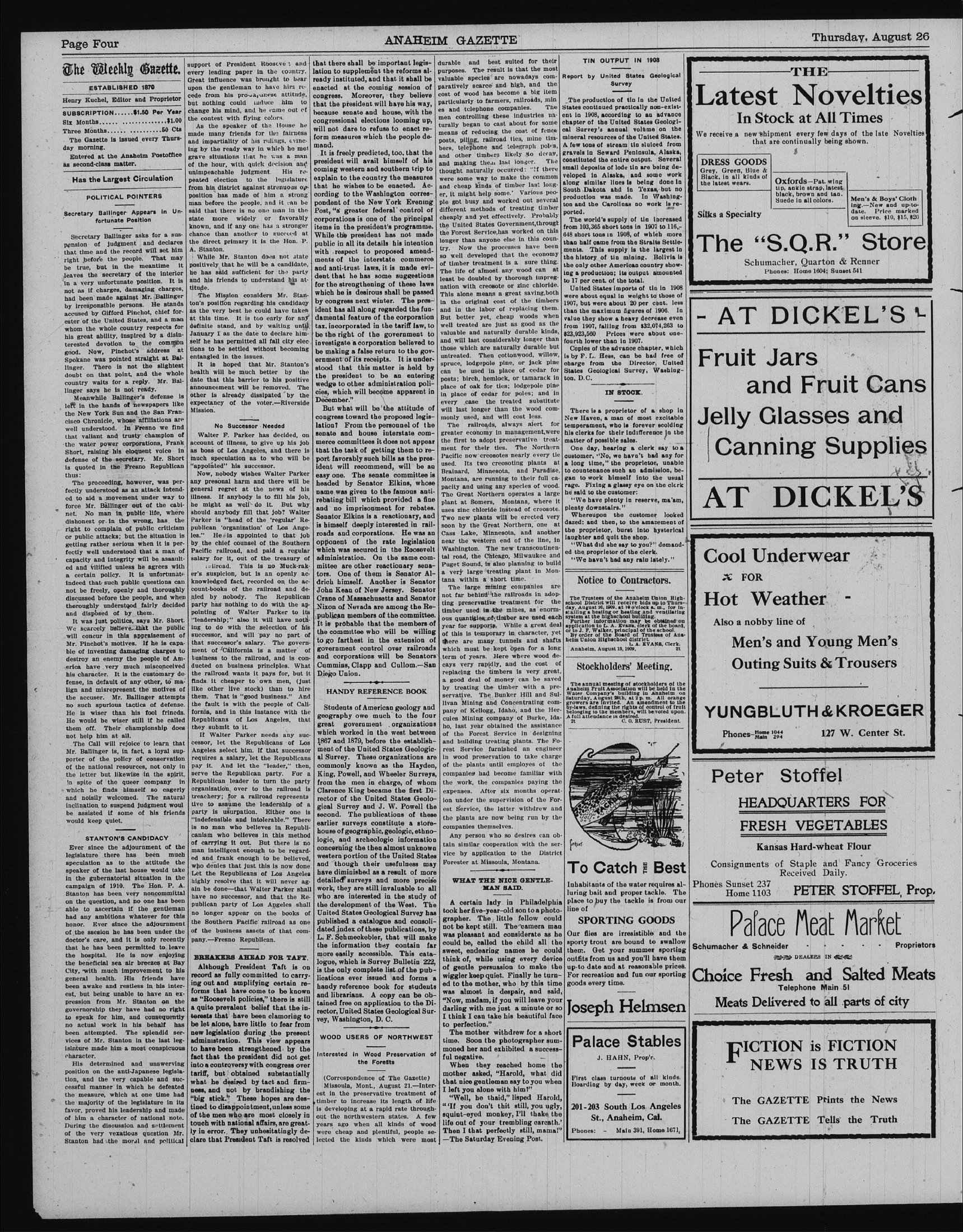
Searchable text
The Weekly Gazette.
ESTABLISHED 1870
Henry Kuchel, Editor and Proprietor
SUBSCRIPTION.....$1.50 Per Year
Six Months.....$1.00
Three Months.....50 Cts
The Gazette is issued every Thursday morning.
Entered at the Anaheim Postoffice as second-class matter.
Has the Largest Circulation
POLITICAL POINTERS
Secretary Ballinger Appears in Unfortunate Position
Secretary Ballinger asks for a suspension of judgment and declares that time and the record will set him right before the people. That may be true, but in the meantime it leaves the secretary of the interior in a very unfortunate position. It is not as if charges, damaging charges, had been made against Mr. Ballinger by irresponsible persons. He stands accused by Gifford Pinchot, chief forester of the United States, and a man whom the whole country respects for his great ability, inspired by a disinterested devotion to the common good. Now, Pinchot's address at Spokane was pointed straight at Ballinger. There is not the slightest doubt on that point, and the whole country waits for a reply. Mr. Ballinger says he is not ready.
Meanwhile Ballinger's defense is left in the hands of newspapers like the New York Sun and the San Francisco Chronicle, whose affiliations are well understood. In Fresno we find that valiant and trusty champion of the water power corporations, Frank Short, raising his eloquent voice in defense of the secretary. Mr. Short support of President Roosevelt and every leading paper in the country. Great influence was brought to bear upon the gentleman to have him recede from his pro-Japanese attitude, but nothing could induce him to change his mind, and he came out of the contest with flying colors.
As the speaker of the House he made many friends for the fairness and impartiality of his rulings, evincing by the ready way in which he met grave situations that he was a man of the hour, with quick decision and unimpeachable judgment. His repeated election to the legislature from his district against strenuous opposition has made of him a strong man before the people, and it can be said that there is no one man in the state more widely or favorably known, and if any one has a stronger chance than another to succeed at the direct primary it is the Hon. P. A. Stanton.
While Mr. Stanton does not state positively that he will be a candidate, he has said sufficient for the party and his friends to understand his attitude.
The Mission considers Mr. Stanton's position regarding his candidacy as the very best he could have taken at this time. It is too early for any definite stand, and by waiting until January I as the date to declare himself he has permitted all fall city elections to be settled without becoming entangled in the issues.
It is hoped that Mr. Stanton's health will be much better by the date that this barrier to his positive announcement will be removed. The other is already dissipated by the expectancy of the voter.—Riverside Mission.
No Successor Needed
Walter F. Parker has decided, on account of illness, to give up his job as boss of Los Angeles, and there is much speculation as to who will be that there shall liaison to supply ready institutes enacted at the congress. Me that the president because senate congressional will not dare form measures mand.
It is freely p president will coming western explain to the that he wishes cording to th pondent of the Post, "a great corporations items in the p While the pre public in all it with respect ments of the and anti-trust dent that he for the strength which he is d by congress n ident has all a damental feat tax, incorpora be the right o investigate a be making a f enernment of its stood that t the presiden wedge to other cies, which w December."
But what w congress towardlation? From senate and b merce commit that the task port favorable
There is not the slightest doubt on that point, and the whole country waits for a reply. Mr. Ballinger says he is not ready.
Meanwhile Ballinger's defense is left in the hands of newspapers like the New York Sun and the San Francisco Chronicle, whose affiliations are well understood. In Fresno we find that valiant and trusty champion of the water power corporations, Frank Short, raising his eloquent voice in defense of the secretary. Mr. Short is quoted in the Fresno Republican thus:
The proceeding, however, was perfectly understood as an attack intended to aid a movement under way to force Mr. Ballinger out of the cabinet. No man in public life, where dishonest or in the wrong, has the right to complain of public criticism or public attacks; but the situation is getting rather serious when it is perfectly well understood that a man of capacity and integrity will be assaulted and vilified unless he agrees with a certain policy. It is unfortunate indeed that such public questions can not be freely, openly and thoroughly discussed before the people, and when thoroughly understood fairly decided and disposed of by them.
It was just politics, says Mr. Short. We scarcely believe that the public will concur in this appraisement of Mr. Pinchot's motives. If he is capable of inventing damaging charges to destroy an enemy the people of America have very much misconceived his character. It is the customary defense, in default of any other, to malign and misrepresent the motives of the accuser. Mr. Ballinger attempts no such spurious tactics of defense. He is wiser than his fool frineds. He would be wiser still if he called them off. Their championship does not help him at all.
The Call will rejoice to learn that Mr. Ballinger is, in fact, a loyal supporter of the policy of conservation of the national resources, not only in the letter but likewise in the spirit, in spite of the queer company in which he finds himself so eagerly and noisily welcomed. The natural inclination to suspend judgment would be assisted if some of his friends would keep quiet.
STANTON'S CANDIDACY
Ever since the adjournment of the legislature there has been much speculation as to the attitude the speaker of the last house would take
It is hoped that Mr. Stanton's health will be much better by the date that this barrier to his positive announcement will be removed. The other is already dissipated by the expectancy of the voter.—Riverside Mission.
No Successor Needed
Walter F. Parker has decided, on account of illness, to give up his job as boss of Los Angeles, and there is much speculation as to who will be "appointed" his successor.
Now, nobody wishes Walter Parker any personal harm and there will be general regret at the news of his illness. If anybody is to fill his job, he might as well do it. But why should anybody fill that job? Walter Parker is "head of the 'regular' Republican 'organization' of Los Angeles." He is appointed to that job by the chief counsel of the Southern Pacific railroad, and paid a regular salary for it, out of the treasury of railroad. This is no Muck-raker's suspicion, but is an openly acknowledged fact, recorded on the account-books of the railroad and denied by nobody. The Republican party has nothing to do with the appointing of Walter Parker to its "leadership;" also it will have nothing to do with the selection of his successor, and will pay no part of that successor's salary. The government of California is a matter of business to the railroad, and is conducted on business principles. What the railroad wants it pays for, but it finds it cheaper to own men, (just like other live stock) than to hire them. That is "good business." And the fault is with the people of California, and in this instance with the Republicans of Los Angeles, that they submit to it.
If Walter Parker needs any successor, let the Republicans of Los Angeles select him. If that successor requires a salary, let the Republicans pay it. And let the "leader," then, serve the Republican party. For a Republican leader to turn the party organization over to the railroad is treachery; for a railroad representative to assume the leadership of a party is usurpation. Either one is "indefensible and intolerable."
There is no man who believes in Republicanism who believes in this method of carrying it out. But there is no man intelligent enough to be regarded and frank enough to be believed, who denies that just this is now done
STANTON'S CANDIDACY
Ever since the adjournment of the legislature there has been much speculation as to the attitude the speaker of the last house would take in the gubernatorial situation in the campaign of 1910. The Hon. P. A. Stanton has been very noncommittal on the question, and no one has been able to ascertain if the gentleman had any ambitions whatever for this honor. Ever since the adjournment of the session he has been under the doctor's care, and it is only recently that he has been permitted to leave the hospital. He is now enjoying the beneficial sea air breezes at Bay City, with much improvement to his general health. His friends have been awake and restless in his interest, but being unable to have an expression from Mr. Stanton on the governorship they have had no right to speak for him, and consequently no actual work in his behalf has been attempted. The splendid services of Mr. Stanton in the last legislature made him a most conspicuous character.
His determined and unswerving position on the anti-Japanese legislation, and the very capable and successful manner in which he defeated the measure, which at one time had the majority of the legislature in its favor, proved his leadership and made of him a character of national note. During the discussion and settlement of the very vexatious question Mr. Stanton had the moral and political serve the Republican party. For a Republican leader to turn the party organization over to the railroad is treachery; for a railroad representative to assume the leadership of a party is usurpation. Either one is "indefensible and intolerable." There is no man who believes in Republicanism who believes in this method of carrying it out. But there is no man intelligent enough to be regarded and frank enough to be believed, who denies that just this is now done. Let the Republicans of Los Angeles highly resolve that it will never again be done—that Walter Parker shall have no successor, and that the Republican party of Los Angeles shall no longer appear on the books of the Southern Pacific railroad as one of the business assets of that company.—Fresno Republican.
BREAKERS AHEAD FOR TAFT.
Although President Taft is on record as fully committed to carrying out and amplifying certain reforms that have come to be known as "Roosevelt policies," there is still a quite prevalent belief that the interests that have been clamoring to be let alone, have little to fear from new legislation during the present administration. This view appears to have been strengthened by the fact that the president did not get into a controversy with congress over tariff, but obtained substantially what he desired by tact and firmness, and not by brandishing the "big stick." These hopes are destined to disappointment, unless some of the men who are most closely in touch with national affairs, are greatly in error. They unhesitatingly declare that President Taft is resolved
ANAHEIM GAZETTE
that there shall be important legislation to supplement the reforms already instituted, and that it shall be enacted at the coming session of congress. Moreover, they believe that the president will have his way, because senate and house, with the congressional elections looming up, will not dare to refuse to enact reform measures which the people demand.
It is freely predicted, too, that the president will avail himself of his coming western and southern trip to explain to the country the measures that he wishes to be enacted. According to the Washington correspondent of the New York Evening Post, "a greater federal control of corporations is one of the principal items in the president's programme. While the president has not made public in all its details his intention with respect to proposed amendments of the interstate commerce and anti-trust laws, it is made evident that he has some suggestions for the strengthening of these laws which he is desirous shall be passed by congress next winter. The president has all along regarded the fundamental feature of the corporation tax, incorporated in the tariff law, to be the right of the government to investigate a corporation believed to be making a false return to the government of its receipts. It is understood that this matter is held by the president to be an entering wedge to other administration policies, which will become apparent in December."
But what will be the attitude of congress toward the proposed legislation? From the personnel of the senate and house interstate commerce committees it does not appear that the task of getting them to report favorably such bills as the pres-
durable and best suited for their purposes. The result is that the most valuable species are nowadays comparatively scarce and high, and the cost of wood has become a big item particularly to farmers, railroads, mines and telephone companies. The men controlling these industries naturally began to cast about for some means of reducing the cost of fence posts, piling, railroad ties, mine timbers, telephone and telegraph poles, and other timber likely to decay, and making them last longer. The thought naturally occurred: "If there were some way to make the common and cheap kinds of timber last longer, it might help some." Various people got busy and worked out several different methods of treating timber cheaply and yet effectively. Probably the United States Government, through the Forest Service, has worked on this longer than anyone else in this country. Now the processes have been so well developed that the economy of timber treatment is a sure thing. The life of almost any wood can at least be doubled by thorough impregnation with creosote or zinc chloride. This alone means a great saving both in the original cost of the timbers and in the labor of replacing them. But better yet, cheap woods when well treated are just as good as the valuable and naturally durable kinds, and will last considerably longer than those which are naturally durable but untreated. Then cottonwood, willow, spruce, lodgepole pine, or jack pine can be used in place of cedar for posts; birch, hemlock, or tamarack in place of oak for ties; lodgepole pine in place of cedar for poles; and in every case the treated substitute will last longer than the wood commonly used, and will cost less.
The railroads, always alert for greater economy in management, were the first to adopt preservative treatment for their ties. The Northern Pacific now creosotes nearly every tie.
TIN OUTPUT IN 1908
Report by United States Geological Survey
The production of tin in the United States continued practically non-existent in 1908, according to an advance chapter of the United States Geological Survey's annual volume on the mineral resources of the United States. A few tons of stream tin sluiced from gravels in Seward Peninsula, Alaska constituted the entire output. Several small deposits of lode tin are being developed in Alaska, and some work along similar lines is being done in South Dakota and in Texas, but no production was made. In Washington and the Carolinas no work is reported.
The world's supply of tin increased from 103,365 short tons in 1907 to 116,-648 short tons in 1908, of which more than half came from the Straits Settlements. This supply is the largest in the history of tin mining. Bolivia is the only other American country showing a production; its output amounted to 17 per cent. of the total.
United States imports of tin in 1909 were about equal in weight to those of 1907, but were about 20 per cent. less than the maximum figures of 1906. In value they show a heavy decrease even from 1907, falling from $32,074,263 to $23,923,560. Prices were about one-fourth lower than in 1907.
Copies of the advance chapter, which is by F. L. Hess, can be had free or charge from the Director. United States Geological Survey, Washington, D.C.
IN STOCK.
There is a proprietor of a shop in New Haven, a man of most excitable temperament, who is forever scolding his clerks for their indifference in the matter of possible sales.
One day, hearing a clerk say to a customer, "No, we haven't had any fo-
stood that this matter is held by the president to be an entering wedge to other administration policies, which will become apparent in December."
But what will be the attitude of congress toward the proposed legislation? From the personnel of the senate and house interstate commerce committees it does not appear that the task of getting them to report favorably such bills as the president will recommend, will be an easy one. The senate committee is headed by Senator Elkins, whose name was given to the famous anti-rebating bill which provided a fine and no imprisonment for rebates. Senator Elkins is a reactionary, and is himself deeply interested in railroads and corporations. He was an opponent of the rate legislation which was secured in the Roosevelt administration. On the same committee are other reactionary senators. One of them is Senator Aldrich himself. Another is Senator John Kean of New Jersey. Senator Crane of Massachusetts and Senator Nixon of Nevada are among the Republican members of the committee.
It is probable that the members of the committee who will be willing to go farthest in the extension of government control over railroads and corporations will be Senators Cummins, Clapp and Cullom.—San Diego Union.
HANDY REFERENCE BOOK
Students of American geology and geography owe much to the four great government organizations which worked in the west between 1867 and 1879, before the establishment of the United States Geological Survey. These organizations are commonly known as the Hayden, King, Powell, and Wheeler Surveys, from the men in charge, of whom Clarence King became the first Director of the United States Geological Survey and J. W. Powell the second. The publications of these earlier surveys constitute a storehouse of geographic, geologic, ethno-logic, and archeologic information concerning the then almost unknown western portion of the United States and though their usefulness may spruce, lodgepole pine, or jack pine can be used in place of cedar for posts; birch, hemlock, or tamarack in place of oak for ties; lodgepole pine in place of cedar for poles; and in every case the treated substitute will last longer than the wood commonly used, and will cost less.
The railroads, always alert for greater economy in management, were the first to adopt preservative treatment for their ties. The Northern Pacific now creosotes nearly every tie used. Its two creosoting plants at Brainard, Minnesota, and Paradise, Montana, are running to their full capacity and using any species of wood. The Great Northern operates a large plant at Somers, Montana, where it uses zinc chloride instead of creosote. Two new plants will be erected very soon by the Great Northern, one at Cass Lake, Minnesota, and another near the western end of the line, in Washington. The new transcontinental road, the Chicago, Milwaukee and Puget Sound, is also planning to build a very large treating plant in Montana within a short time.
The large mining companies are not far behind the railroads in adopting preservative treatment for the timber used in the mines, as enormous quantities of timber are used each year for supports. While a great deal of this is temporary in character, yet there are many tunnels and shafts which must be kept open for a long term of years. Here where wood decays very rapidly, and the cost of replacing the timbers is very great, a good deal of money can be saved by treating the timber with a preservative. The Bunker Hill and Sullivan Mining and Concentrating company of Kellogg, Idaho, and the Hercules Mining company of Burke, Idaho, last year obtained the assistance of the Forest Service in designing and building treating plants. The Forest Service furnished an engineer in wood preservation to take charge of the plants until employes of the companies had become familiar with the work, the companies paying the expenses. After six months operation under the supervision of the Forest Service, the latter withdrew and the plants are now being run by the companies themselves.
Any person who so desires can obtain similar cooperation with the service by application to the District Forester at Missoula, Montana.
IN STOCK.
There is a proprietor of a shop in New Haven, a man of most excitable temperament, who is forever scolding his clerkks for their indifference in the matter of possible sales.
One day, hearing a clerk say to customer, "No, we haven't had any for a long time," the proprietor, unable to countenance such an admission, began to work himself into the usual rage. Fixing a glassy eye on the clerk he said to the customer:
"We have plenty in reserve, ma'am plenty downstairs."
Whereupon the customer looked dazed; and then, to the amazement of the proprietor, burst into hysterical laughter and quit the shop.
"What did she say to you?" demanded the proprietor of the clerk.
"We haven't had any rain lately."
King, Powell, and Wheeler Surveys, from the men in charge, of whom Clarence King became the first Director of the United States Geological Survey and J. W. Powell the second. The publications of these earlier surveys constitute a storehouse of geographic, geologic, ethno-logic, and archeologic information concerning the then almost unknown western portion of the United States and though their usefulness may have diminished as a result of more detailed surveys and more precise work, they are still invaluable to all who are interested in the study of the development of the West. The United States Geological Survey has published a catalogue and consolidated index of these publications, by L. F. Schmeckebier, that will make the information they contain far more easily accessible. This catalogue, which is Survey Bulletin 222, is the only complete list of the publications ever issued and forms a handy reference book for students and librarians. A copy can be obtained free on application to the Director, United States Geological Survey, Washington, D.C.
WOOD USERS OF NORTHWEST
Interested in Wood Preservation of the Forests
(Correspondence of The Gazette)
Missoula, Mont., August 21.—Interest in the preservative treatment of timber to increase its length of life is developing at a rapid rate throughout the northwestern states. A few years ago when all kinds of wood were cheap and plentiful, people selected the kinds which were most companies had become familiar with the work, the companies paying the expenses. After six months operation under the supervision of the Forest Service, the latter withdrew and the plants are now being run by the companies themselves.
Any person who so desires can obtain similar cooperation with the service by application to the District Forester at Missoula, Montana.
WHAT THE NICE GENTLEMAN SAID.
A certain lady in Philadelphia took her five-year-old son to a photographer. The little fellow could not be kept still. The camera man was pleasant and considerate as he could be, called the child all the sweet, endearing names he could think of, while using every device of gentle persuasion to make the wiggler keep quiet. Finally he turned to the mother, who by this time was almost in despair, and said,
"Now, madam, if you will leave your darling with me just a minute or so I think I can take his beautiful face to perfection."
The mother withdrew for a short time. Soon the photographer summoned her and exhibited a successful negative.
When they reached home the mother asked, "Harold, what did that nice gentleman say to you when I left you alone with him?"
"Well, he thaid," lisped Harold,
"‘If you don’t thit still, you ugly, squint-eyed monkey, I’ll thake the life out of your trembling carcath.’ Then I that perfectly still, mamal!’"
—The Saturday Evening Post.
THURSDAY, August 26
THE
Latest Novelties
In Stock at All Times
We receive a new shipment every few days of the late Novelties that are continually being shown.
DRESS GOODS
Grey, Green, Blue & Black, in all kinds of the latest wears.
Oxford's—Pat. wing tip, ankle strap, latest black, brown and tan. Suede in all colors.
Men's & Boys' Clothing.—New and up-to-date. Price marked on sleeve. $10, $15, $20
Silks a Specialty
The "S.Q.R." Store
Schumacher, Quarton & Renner
Phones: Home 1604; Sunset 541
- AT DICKEL'S -
Fruit Jars
and Fruit Cans
Jelly Glasses and
Canning Supplies
and Fruit Cans
Jelly Glasses and
Canning Supplies
AT DICKEL'S
Cool Underwear
FOR
Hot Weather -
Also a nobby line of
Men's and Young Men's
Outing Suits & Trousers
YUNGBLUTH & KROEGER
Phones—Home 1044
Main 294
Peter Stoffel
HEADQUARTERS FOR
FRESH VEGETABLES
Kansas Hard-wheat Flour
Consignments of Staple and Fancy Groceries
Peter Stoffel
HEADQUARTERS FOR
FRESH VEGETABLES
Kansas Hard-wheat Flour
Consignments of Staple and Fancy Groceries
Received Daily.
Phones Sunset 237
Home 1103 PETER STOFFEL, Prop.
Palace Meat Market
Schumacher & Schneider Proprietors
DEALERS IN
Choice Fresh and Salted Meats
Telephone Main 51
Meats Delivered to all parts of city
FICTION is FICTION
NEWS IS TRUTH
The GAZETTE Prints the News
The GAZETTE Tells the Truth