anaheim-gazette 1909-08-19
Scanned page
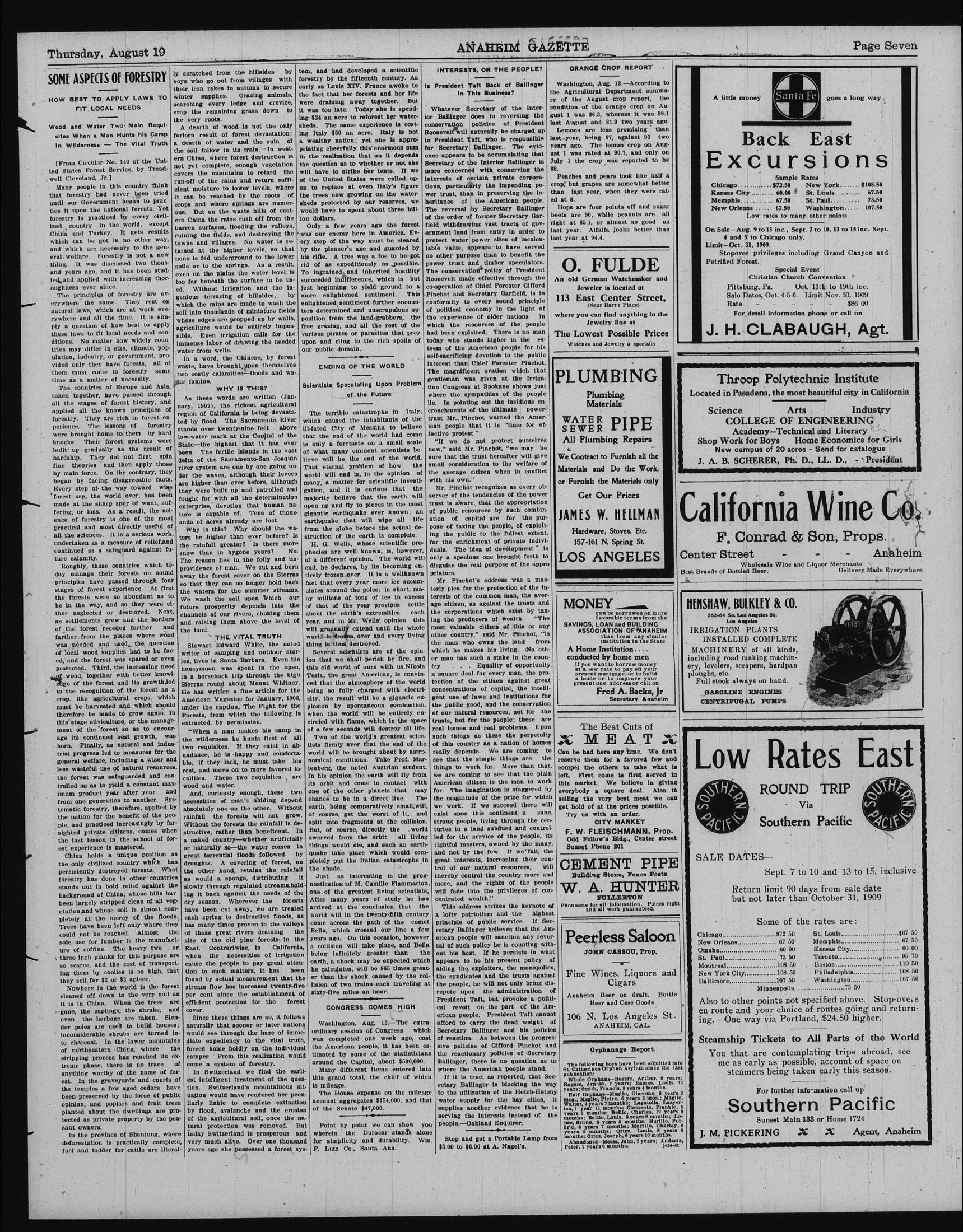
Searchable text
SOME ASPECTS OF FORESTRY
HOW BEST TO APPLY LAWS TO FIT LOCAL NEEDS
Wood and Water Two Main Requirements When a Man Hunts his Camp in Wilderness — The Vital Truth
[From Circular No. 140 of the United States Forest Service, by Treadwell Cleveland, Jr.]
Many people in this country think that forestry had never been tried until our Government began to practice it upon the national forests. Yet forestry is practiced by every civilized country in the world, except China and Turkey. It gets results which can be got in no other way, and which are necessary to the general welfare. Forestry is not a new thing. It was discussed two thousand years ago, and it has been studied and applied with increasing thoroughness ever since.
The principles of forestry are everywhere the same. They rest on natural laws, which are at work everywhere and all the time. It is simply a question of how best to apply these laws to fit local needs and conditions. No matter how widely countries may differ in size, climate, population, industry, or government, provided only they have forests, all of them must come to forestry some time as a matter of necessity.
The countries of Europe and Asia, taken together, have passed through all the stages of forest history, and applied all the known principles of forestry. They are rich in forest experience. The lessons of forestry were brought home to them by hard knocks. Their forest systems were built up gradually as the result of hardship. They did not first spin lily scratched from the hillsides by boys who go out from villages with their iron rakes in autumn to secure winter supplies. Grazing animals, searching every ledge and crevice, crop the remaining grass down to the very roots.
A dearth of wood is not the only forlorn result of forest devastation; a dearth of water and the ruin of the soil follow in its train. In western China, where forest destruction is not yet complete, enough vegetation covers the mountains to retard the run-off of the rains and return sufficient moisture to lower levels, where it can be reached by the roots of crops and where springs are numerous. But on the waste hills of eastern China the rains rush off from the barren surfaces, flooding the valleys, ruining the fields, and destroying the towns and villages. No water is retained at the higher levels, so that none is fed underground to the lower soils or to the springs. As a result, even on the plains the water level is too far beneath the surface to be used. Without irrigation and the ingenious terracing of hillsides, by which the rains are made to wash the soil into thousands of miniature fields whose edges are propped up by walls, agriculture would be entirely impossible. Even irrigation calls for the immense labor of drawing the needed water from wells.
In a word, the Chinese, by forest waste, have brought upon themselves two costly calamities—floods and water famine.
WHY IS THIS?
As these words are written (January, 1909), the richest agricultural region of California is being devastated by flood. The Sacramento River stands over twenty-nine feet above low-water mark at the Capital of the State—the highest that it has ever been. The fertile islands in the vast delta of the Sacramento-San Joaquin tem, and had developed forestry by the fifth early as Louis XIV; the fact that her fores were draining away it was too late. To ing $34 an acre to sheds. The same ing Italy $50 an a wealthy nation; priating cheerfully in the realization that the question as to will have to strike of the United States on to replace at once the trees now grown sheds protected by would have to spend ion dollars.
Only a few years was our enemy here very step of the way by the pioneer's aid his rifle. A tree wird of as expedite To ingrained and succeeded indifferently just beginning to more enlightened enlightened sentiments determined an position from the free grazing, and various pirates or upon and cling to our public domain.
ENDING OF
Scientists Speculate
of t
vided only they have forests, all of them must come to forestry some time as a matter of necessity.
The countries of Europe and Asia, taken together, have passed through all the stages of forest history, and applied all the known principles of forestry. They are rich in forest experience. The lessons of forestry were brought home to them by hard knocks. Their forest systems were built up gradually as the result of hardship. They did not first spin fine theories and then apply those by main force. On the contrary, they began by facing disagreeable facts. Every step of the way toward wise forest use, the world over, has been made at the sharp spur of want, suffering, or loss. As a result, the science of forestry is one of the most practical and most directly useful of all the sciences. It is a serious work, undertaken as a measure of relief, and continued as a safeguard against future calamity.
Roughly, those countries which today manage their forests on sound principles have passed through four stages of forest experience. At first the forests were so abundant as to be in the way, and so they were either neglected or destroyed. Next, as settlements grew and the borders of the forest receded farther and farther from the places where wood was needed and used, the question of local wood supplies had to be faced, and the forest was spared or even protected. Third, the increasing need of wood, together with better knowledge of the forest and its growth, led to the recognition of the forest as a crop like agricultural crops, which must be harvested and which should therefore be made to grow again. In this stage silviculture, or the management of the forest so as to encourage its continued best growth, was born. Finally, as natural and industrial progress led to measures for the general welfare, including a wiser and less wasteful use of natural resources, the forest was safeguarded and controlled so as to yield a constant maximum product year after year and from one generation to another. Systematic forestry, therefore, applied by the nation for the benefit of the people, and practiced increasingly by far sighted private citizens, comes when the last lesson in the school of forest experience is mastered.
China holds a unique position as the only civilized country which has persistently destroyed forests. What waste, have brought upon themselves two costly calamities—floods and water famine.
WHY IS THIS?
As these words are written (January, 1909), the richest agricultural region of California is being devastated by flood. The Sacramento River stands over twenty-nine feet above low-water mark at the Capital of the State—the highest that it has ever been. The fertile islands in the vast delta of the Sacramento-San Joaquin river system are one by one going under the waves, although their levees are higher than ever before, although they were built up and patrolled and fought for with all the determination enterprise, devotion that human nature is capable of. Tens of thousands of acres already are lost.
Why is this? Why should the waters be higher than ever before? Is the rainfall greater? Is there more snow than in bygone years? No. The reason lies in the folly and improvidence of man. We cut and burn away the forest cover on the Sierras so that they can no longer hold back the waters for the summer streams. We wash the soil upon which our future prosperity depends into the channels of our rivers, choking them and raising them above the level of the land.
THE VITAL TRUTH
Stewart Edward White, the noted writer of camping and outdoor stories, lives in Santa Barbara. Even his honeymoon was spent in the open, in a horseback trip through the high Sierras round about Mount Whitney. He has written a fine article for the American Magazine for January, 1908, under the caption, The Fight for the Forests, from which the following is extracted, by permission.
"When a man makes his camp in the wilderness he hunts first of all two requisites. If they exist in abundance, he is happy and comfortable; if they lack, he must take his rest, and move on to more favored localities. These two requisites are wood and water.
And, curiously enough, these two necessities of man's abiding depend absolutely one on the other. Without rainfall the forests will not grow. Without the forests the rainfall is destructive, rather than beneficent. In a naked country—whether artificially or naturally so—the water comes in great torrential floods followed by droughts. A covering of forest, on the other hand retains the rainfall."
The terrible case which caused the ill-fated City of that the end of that is only a foretaste of what many eminent will be the That eternal prowl world will end is many, a matter fugation, and it is majority believe we open up and fly to gigantic earthquake that from the globe bore destruction of the H. G. Wells, whose species are well adapted to different conditions around them millions of times about the earth's year, and in Mr. Will gradually extend thing is thus deserved.
Several scientific that we shall this old world of Tesla, the great inventor that the atmosphere being so fully oiled city, result explosion by sporadism when the world's circled with flame of a few seconds.
Two of the worst trees firmly averaged worldwide will be biological condition lenberg, the not In his opinion their orbit and coarse one of the other chance to be in earth, being composed of course, get split into fragments But, of course, swerved from things would disquake take place plettely put them in shade.
the forest was safeguarded and controlled so as to yield a constant maximum product year after year and from one generation to another. Systematic forestry, therefore, applied by the nation for the benefit of the people, and practiced increasingly by far-sighted private citizens, comes when the last lesson in the school of forest experience is mastered.
China holds a unique position as the only civilized country which has persistently destroyed forests. What forestry has done in other countries stands out in bold relief against the background of China, whose hills have been largely stripped clean of all vegetation, and whose soil is almost completely at the mercy of the floods. Trees have been left only where they could not be reached. Almost the sole use for lumber is the manufacture of coffins. The heavy two or three inch planks for this purpose are so scarce, and the cost of transporting them by coolies is so high, that they sell for $2 or $3 apiece.
Nowhere in the world is the forest cleaned off down to the very soil as it is in China. When the trees are gone, the saplings, the shrubs, and even the herbage are taken. Slender poles are used to build houses; inconsiderable shrubs are turned into charcoal. In the lower mountains of northeastern China, where the stripping process has reached its extreme phase, there is no trace of anything worthy of the name of forest. In the graveyards and courts of the temples a few aged cedars have been preserved by the force of public opinion, and poplars and fruit trees planted about the dwellings are protected as private property by the peasant owners.
In the province of Shantung, where deforestation is practically complete, fuel and fodder for cattle are literal-
And, curiously enough, these two necessities of man's abiding depend absolutely one on the other. Without rainfall the forests will not grow. Without the forests the rainfall is destructive, rather than beneficent. In a naked country—whether artificially or naturally so—the water comes in great torrential floods followed by droughts. A covering of forest, on the other hand, retains the rainfall as would a sponge, distributing it slowly through regulated streams, holding it back against the needs of the dry season. Wherever the forests have been cut away, we are treated each spring to destructive floods, as has many times proven in the valleys of those great rivers draining the site of the old pine forests in the East. Contrariwise, in California, when the necessities of irrigation cause the people to pay great attention to such matters, it has been found by actual measurement that the stream flow has increased twenty-five per cent since the establishment of efficient protection for the forest cover.
Since these things are so, it follows naturally that sooner or later nations would see through the haze of immediate expediency to the vital truth, forced home boldly on the individual camper. From this realization would come a system of forestry.
In Switzerland we find the earliest intelligent treatment of the question. Switzerland's mountainous situation would have rendered her peculiarly liable to complete extinction by flood, avalanche and the erosion of the agricultural soil, once the natural protection was removed. But today Switzerland is prosperous and very much alive. Over one thousand years ago she possessed a forest sys-
In his opinion that its orbit and course one of the other chance to be in earth, being composed of course, get that split into fragment. But, of course, swerved from that things would die quake take place pletely put the shade.
Just as introspection of Mone one of the greatest After many years arrived at the world will in this come across Bella, which crea years ago. On a collision will being infinitely earth, a shock he calculates, werer than the sho llision of two trie sixty-five miles.
CONGRESS
Washington,
ordinary session was completed by American p estimated by some around the Cara
Many different this grand total is mileage.
The House e account aggrega of the Senate
Point by point wherein the for simplicity F. Lutz Co.,
A NAHEIM GAZETTE
tem, and had developed a scientific forestry by the fifteenth century. As early as Louis XIV. France awoke to the fact that her forests and her life were draining away together. But it was too late. Today she is spending $34 an acre to reforest her watersheds. The same experience is costing Italy $50 an acre. Italy is not a wealthy nation; yet she is appropriating cheerfully this enormous sum in the realization that on it depends the question as to whether or not she will have to strike her tents. If we of the United States were called upon to replace at even Italy’s figure the trees now growing on the watersheds protected by our reserves, we would have to spend about three billion dollars.
Only a few years ago the forest was our enemy here in America. Every step of the way must be cleared by the pioneer’s axe and guarded by his rifle. A tree was a foe to be got rid of as expeditiously as possible. To ingrained and inherited hostility succeeded indifference, which is but just beginning to yield ground to a more enlightened sentiment. This enlightened sentiment further encounters determined and unscrupulous opposition from the land-grabbers, the free grazing, and all the rest of the various pirates or parasites that prey upon and cling to the rich spoils of our public domain.
ENDING OF THE WORLD
Scientists Speculating Upon Problem of the Future
The terrible catastrophe in Italy, which caused the inhabitants of the ill-fated City of Messina to believe that the end of the world had come is only a foretaste on a small scale of what many eminent scientists believe will be the end of the world.
INTERESTS, OR THE PEOPLE?
Is President Taft Back of Ballinger In This Business?
Whatever Secretary of the Interior Ballinger does in reversing the conservation policies of President Roosevelt will naturally be charged up to President Taft, who is responsible for Secretary Ballinger. The evidence appears to be accumulating that Secretary of the Interior Ballinger is more concerned with conserving the interests of certain private corporations, particularly the impending power trust, than in preserving the inheritance of the American people. The reversal by Secretary Ballinger of the order of former Secretary Garfield withdrawing vast tracts of government land from entry in order to protect water power sites of incalculable value, appears to have served no other purpose than to benefit the power trust and timber speculators. The conservation policy of President Roosevelt made effective through the co-operation of Chief Forester Gifford Pinchot and Secretary Garfield, is in conformity to every sound principle of political economy in the light of the experience of older nations in which the resources of the people had been exploited. There is no man today who stands higher in the esteem of the American people for his self-sacrificing devotion to the public interest than Chief Forester Pinchot. The magnificent ovation which that gentleman was given at the Irrigation Congress at Spokane shows just where the sympathies of the people lie. In pointing out the insidious encroachments of the ultimate power-trust Mr., Pinchot warned the American people that it is "time for effective protest."
"If we do not protect ourselves now," said Mr. Pinchot, "we may be sure that the trust hereafter will give
ORANGÉ CROP REPORT
Washington, Aug. 12.—According to the Agricultural Department summary of the August crop report, the condition of the orange crop on August 1 was 86.3, whereas it was 89.1 last August and 81.9 two years ago.
Lemons are less promising than last year, being 87, against 93 two years ago. The lemon crop on August 1 was rated at 90.7, and only on July 1 the crop was reported to be 88.
Peaches and pears look like half a crop, but grapes are somewhat better than last year, when they were rated at 8.
Hops are four points off and sugar beets are 90, while peanuts are all right at 85.1, or almost as good as last year. Alfalfa jocks better than last year at 94.4.
O. FULDE
An old German Watchmaker and Jeweler is located at 113 East Center Street, (Near Hart’s Place)
where you can find anything in the Jewelry line at The Lowest Possible Prices Watches and Jewelry a specialty
PLUMBING
Plumbing Materials
WATER SEWER All Plumbing Repairs
We Contract to Furnish all the
ENDING OF THE WORLD
Scientists Speculating Upon Problem of the Future
The terrible catastrophe in Italy, which caused the inhabitants of the ill-fated City of Messina to believe that the end of the world had come is only a foretaste on a small scale of what many eminent scientists believe will be the end of the world. That eternal problem of how the world will end is, in the opinion of many, a matter for scientific investigation, and it is curious that the majority believe that the earth will open up and fly to pieces in the most gigantic earthquake ever known; an earthquake that will wipe all life from the globe before the actual destruction of the earth is complete.
H. G. Wells, whose scientific prophecies are well known, is, however, of a different opinion. The world will end, he declares, by its becoming entirely frozen over. It is a well-known fact that every year more ice accumulates around the poles; in short, many millions of tons of ice in excess of that of the year previous settle about the earth's extremities each year, and in Mr. Wells' opinion this will gradually extend until the whole world is frozen over and every living thing is thus destroyed.
Several scientists are of the opinion that we shall perish by fire, and this old world of ours with us.Nikola Tesla, the great American, is convinced that the atmosphere of the world being so fully charged with electricity, the result will be a gigantic explosion by spontaneous combustion, when the world will be entirely encircled with flame, which in the space of a few seconds will destroy all life.
Two of the world's greatest scientists firmly aver that the end of the world will be brought about by astronomical conditions. Take Prof. Marlenberg, the noted Austrian student. In his opinion the earth will fly from its orbit and come in contact with one of the other planets that may chance to be in a direct line. The earth, being comparatively small, will, of course, get the worst of it, and split into fragments at the collision. But, of course, directly the world swerved from the orbit all living things would die, and such an earthquake take place which would completely put the Italian catastrophe in the shade.
The magnificent ovation which that gentleman was given at the Irrigation Congress at Spokane shows just where the sympathies of the people lie. In pointing out the insidious encroachments of the ultimate power trust Mr., Pinchot warned the American people that it is "time for effective protest."
"If we do not protect ourselves now," said Mr. Pinchot, "we may be sure that the trust hereafter will give small consideration to the welfare of the average citizen when in conflict with his own."
Mr. Pinchot recognizes as every observer of the tendencies of the power trust is aware, that the appropriation of public resources by such combination of capital are for the purpose of taxing the people, of exploiting the public to the fullest extent, for the enrichment of private individuals. The idea of development is only a specious one brought forth to disguise the real purpose of the propriators.
Mr. Pinchot's address was a masterly plea for the protection of the interests of the common man, the average citizen, as against the trusts and corporations which exist by taxing the producers of wealth. "The most valuable citizen of this or any other country," said Mr. Pinchot, "is the man who owns the land from which he makes his living. No other man has such a stake in the country. Equality of opportunity a square deal for every man, the protection of the citizen against great concentrations of capital, the intelligent use of laws and institutions for the public good, and the conservation of our natural resources, not for the trusts, but for the people; these are real issues and real problems. Upon such things as these the perpetuity of this country as a nation of homes really depends. We are coming to see that the simple things are the things to work for. More than that, we are coming to see that the plain American citizen is the man to work for. The imagination is staggered by the magnitude of the prize for which we work. If we succeed there will exist upon this continent a sane, strong people, living through the centuries in a land subdued and controlled for the service of the people, its rightful masters, owned by the many, and not by the few. If we fail, the great interests, increasing their control of our natural resources, will interest than Chief Forester Pinchot.
The magnificent ovation which that gentleman was given at the Irrigation Congress at Spokane shows just where the sympathies of the people lie. In pointing out the insidious encroachments of the ultimate power trust Mr., Pinchot warned the American people that it is "time for effective protest."
"If we do not protect ourselves now," said Mr. Pinchot, "we may be sure that the trust hereafter will give small consideration to the welfare of the average citizen when in conflict with his own."
Mr. Pinchot recognizes as every observer of the tendencies of the power trust is aware, that the appropriation of public resources by such combination of capital are for the purpose of taxing the people, of exploiting the public to the fullest extent, for the enrichment of private individuals. The idea of development is only a specious one brought forth to disguise the real purpose of the propriators.
Mr. Pinchot's address was a masterly plea for the protection of the interests of the common man, the average citizen, as against the trusts and corporations which exist by taxing the producers of wealth. "The most valuable citizen of this or any other country," said Mr. Pinchot, "is the man who owns the land from which he makes his living. No other man has such a stake in the country. Equality of opportunity a square deal for every man, the protection of the citizen against great concentrations of capital, the intelligent use of laws and institutions for the public good, and the conservation of our natural resources, not for the trusts, but for the people; these are real issues and real problems. Upon such things as these the perpetuity of this country as a nation of homes really depends. We are coming to see that the simple things are the things to work for. More than that, we are coming to see that the plain American citizen is the man to work for. The imagination is staggered by the magnitude of the prize for which we work. If we succeed there will exist upon this continent a sane, strong people, living through the centuries in a land subdued and controlled for the service of the people, its rightful masters, owned by the many, and not by the few. If we fail, the great interests, increasing their control of our natural resources, will interest than Chief Forester Pinchot.
The magnificent ovation which that gentleman was given at at Irrigation Congress at Spokane shows just where the sympathies of the people lie. In pointing out the insidious encroachments ofthe ultimate power trust Mr., Pinchot warnedthe American people that it is "time for effective protest."
"If we do not protect ourselves now," said Mr. Pinchot, "we may be sure thatthe trust hereafterwill givesmall considerationtothewelfareoftheaveragecitizenwheninconflictwithhisown."
Mr. Pinchot recognizes as every observerofthe tendenciesofthepowertrustisaware,theappropriationofpublicresourcesbysuchcombinationofcapitalareforthepurposeoftaxingthepeople,ofexploit ingthepublictothefullestextent,fortheenrichmentofprivateindividuals.Theideaofdevelopmentisonlyaspeciousonebroughtforthodisguisetherealpurposeoftheappropiators.
Mr. Pinchot's address was a masterly plea fortheprotectionoftheinterestsofthecommonman,theaveragecitizen,asagainstthetrustsandthecorporationswhichexistbytaxingtheproducersofwealth."Themostvaluablecitizenofthisoranyothercountry,"saidMr.Pinchot,"isthemanwhow ownsthelandfromwhichhemakeshisliving.Noothermanhassuchastakeinthecountry.Equalityofopportunitya-squaredealforeveryman,theprotectionofthecitizenagainstgreatconcentrationsofcapital,theintelligentuseoflawsandinstitutionsforthepublicgood,andtheconservationofournaturalresources,nottorfetrusts,butfordforthepeople;thesearerealissuesandrealproblems.Uponsuchthingsasthesetheperpetuityofthiscountryasan Nationofhomesreallydepends.Wewerecomingtoseethatthesimplethingsarethethingstoworkfor.MorethanthatwearecomingtoseethattheplainAmericancitizenisthemantoworkfor.Theimaginationisstaggeredbythemagnitudeoftheprizeforwhichwework.Ifwe succeedtherewillexistuponthiscontinenta sane,强people,Livingthroughthencurriesinanlandsubduedandcontrolledforthereserviceofthepeople,其rightfulmastersownedbythemany,andnotbythefew.Infewfail,thegreatinterestsincreasing theircontrolofournaturalresources.willinterestthanChiefForesterPinchot.
PLUMBING
WATER PIPE
All Plumbing Repairs
We Contract to Furnish alltheMaterialsandDoTheWork,或FurnishtheMaterialsonlyGetOurPrices
JAMES W.HELLMAN
Hardware,Stoves Etc.
157-161 N.Spring St.
LOS ANGELES
MONEYcanbeborrowedonmorefavorabletermsfromtheSAVINGS,LOANandBUILDINGASSOCIATIONOFANAHEIMthanfromanysimilarinstitutionintheStateAHomeInstitution... conductedbyhomemenIfyouwanttoborrowmoneyataleowratepayoffyourpresentmortgage.ortobuildahomeortoimproveyoupresentoneaddressorcallonFredA.Backs.JrSecretarvAnaheim
The Best CutsofMEATCanbehadhereanytime.Wedontreservethemforafavoredfewandcompeletheotherstotakewhatisleft.Firstcomeisfirstservedinthismarket.Webelieveingiveeverybodya square deal.Alsoin sellingtheverybestmeatwecangetholdofatthepricespossibleTryuswithanorder.CITYMARKETF.W.W.FLEISCHMANN,Prop.OddFellow'sBldg.,CenterstreathSunsetPhone201CEMENTPIPE
In his opinion the earth will fly from its orbit and come in contact with one of the other planets that may chance to be in a direct line. The earth, being comparatively small, will, of course, get the worst of it, and split into fragments at the collision. But, of course, directly the world swerved from the orbit all living things would die, and such an earthquake take place which would completely put the Italian catastrophe in the shade.
Just as interesting is the prognostication of M. Camille Flammarion, one of the greatest living scientists, After many years of study he has arrived at the conclusion that the world will in the twenty-fifth century come across the path of the comet Bella, which crossed our line a few years ago. On this occasion, however a collision will take place, and Bella being infinitely greater than the earth, a shock may be expected which he calculates, will be 865 times greater than the shock caused by the collision of two trains each traveling at sixty-five miles an hour.
CONGRESS COMES HIGH
Washington, Aug. 12.—The extraordinary session of Congress which was completed one week ago, cost the American people, it has been estimated by some of the statisticians around the Capitol, about $500,000.
Many different items entered into this grand total, the chief of which is mileage.
The House expense on the mileage account aggregates $154,000, and that of the Senate $47,000.
Point by point we can show you wherein the Durocar stands alone for simplicity and durability. Wm. F. Lutz Co., Santa Ana.
we are coming to see that the plain American citizen is the man to work for. The imagination is staggered by the magnitude of the prize for which we work. If we succeed there will exist upon this continent a sane, strong people, living through the centuries in a land subdued and controlled for the service of the people, its rightful masters, owned by the many, and not by the few. If we fail, the great interests, increasing their control of our natural resources, will thereby control the country more and more, and the rights of the people will fade into the privileges of concentrated wealth."
This address strikes the keynote of a lofty patriotism and the highest principle of public service. If Secretary Ballinger believes that the American people will sanction any reversal of such policy he is counting without his host. If he persists in what appears to be his present policy of aiding the exploiters, the monopolies, the syndicates and the trusts against the people, he will not only bring disrepute upon the administration of President Taft, but provoke a political revolt on the part of the American people. President Taft cannot afford to carry the dead weight of Secretary Ballinger and his policies of reaction. As between the progressive policies of Gifford Pinchot and the reactionary policies of Secretary Ballinger, there is no question as to where the American people stand.
If it is true, as reported, that Secretary Ballinger is blocking the way to the utilization of the Hetch-Hetchy water supply for the bay cities, it supplies another evidence that he is serving the interests instead of the people.—Oakland Enquirer.
Stop and get a Portable Lamp from $3.00 to $6.00 at A. Nagel's.
A little money goes a long way.
Back East Excursions
Sample Rates
Chicago.....$72.50 New York.....$108.50
Kansas City.....60.00 St. Louis.....67.50
Memphis.....67.50 St. Paul.....73.50
New Orleans.....67.50 Washington.....107.50
Low rates to many other points
On Sale—Aug. 9 to 13 inc., Sept. 7 to 10, 13 to 15 inc. Sept.
4 and 5 to Chicago only.
Limit—Oct. 31, 1909.
Stopover privileges including Grand Canyon and Petrified Forest.
Special Event
Christian Church Convention
Pittsburg, Pa. Oct. 11th to 19th inc.
Sale Dates, Oct. 4-5-6. Limit Nov. 30, 1909
Rate - $86 00
For detail information phone or call on
J. H. CLABAUGH, Agt.
Throop Polytechnic Institute
Located in Pasadena, the most beautiful city in California
Science Arts Industry
COLLEGE OF ENGINEERING
Academy--Technical and Literary
Shop Work for Boys Home Economics for Girls
New campus of 20 acres - Send for catalogue
Throop Polytechnic Institute
Located in Pasadena, the most beautiful city in California
Science Arts Industry
COLLEGE OF ENGINEERING
Academy--Technical and Literary
Shop Work for Boys Home Economics for Girls
New campus of 20 acres - Send for catalogue
J. A. B. SCHERER, Ph. D., LL. D., President
California Wine Co.
F. Conrad & Son, Props.
Center Street Anaheim
Wholesale Wine and Liquor Merchants
Best Brands of Bottled Beer.
Delivery Made Everywhere
HENSHAW, BULKLEY & CO.
262-64 So. Los Angeles St.
Los Angeles
IRRIGATION PLANTS
INSTALLED COMPLETE
MACHINERY of all kinds,
including road making machinery, levelers, scrapers, hardpan ploughs, etc.
Full stock always on hand.
GASOLINE ENGINES
CENTRIFUGAL PUMPS
Low Rates East
ROUND TRIP Via Southern Pacific
SALE DATES—
ROUND TRIP
Via
Southern Pacific
SALE DATES—
Sept. 7 to 10 and 13 to 15, inclusive
Return limit 90 days from sale date
but not later than October 31, 1909
Some of the rates are:
Chicago.....$72 50 St. Louis.....$67 50
New Orleans.....67 50 Memphis.....67 50
Omaha.....60 00 Kansas City.....60 00
St. Paul.....73 50 Toronto.....95 70
Montreal.....108 50 Boston.....110 50
New York City.....108 50 Philadelphia.....108 50
Baltimore.....107 50 Washington.....107 50
Minneapolis.....73 50
Also to other points not specified above. Stop-over en route and your choice of routes going and returning. One way via Portland, $24.50 higher.
Steamship Tickets to All Parts of the World
You that are contemplating trips abroad, see me as early as possible, account of space on steamers being taken early this season.
For further information call up
Southern Pacific
Sunset Main 183 or Home 1724
J. M. PICKERING Agent, Anaheim