anaheim-gazette 1909-08-19
Scanned page
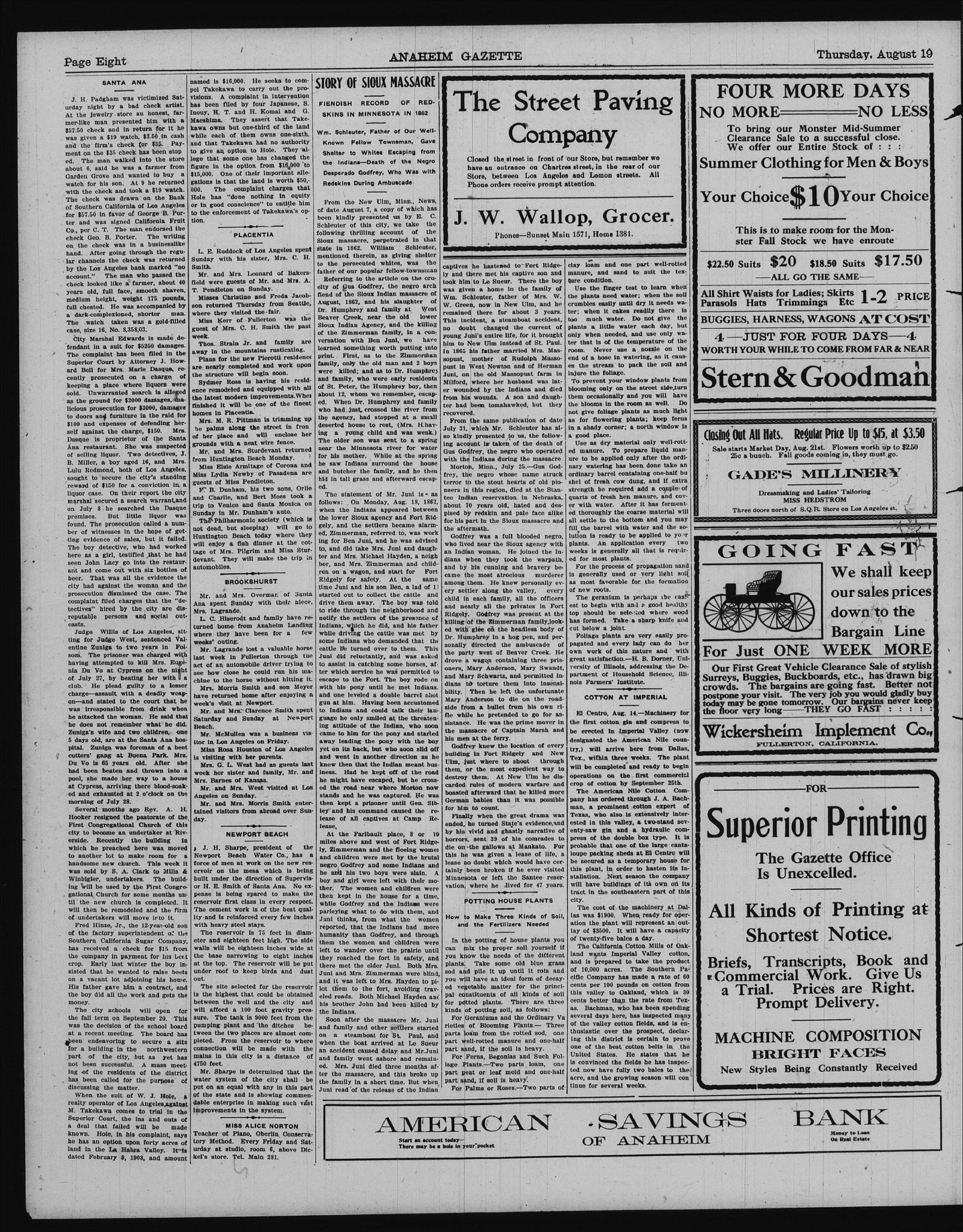
Searchable text
SANTA ANA
J. H. Padgham was victimized Saturday night by a bad check artist. At the jewelry store an honest, farmer-like man presented him with a $57.50 check and in return for it he was given a $19 watch, $3.50 in cash and the firm's check for $35. Payment on the $35 check has been stopped. The man walked into the store about 6, said he was a farmer from Garden Grove and wanted to buy a watch for his son. At 9 he returned with the check and took a $19 watch. The check was drawn on the Bank of Southern California of Los Angeles for $57.50 in favor of George B. Porter and was signed California Fruit Co., per C. T. The man endorsed the check Geo. B. Porter. The writing on the check was in a businesslike hand. After going through the regular channels the check was returned by the Los Angeles bank marked "no account." The man who passed the check looked like a farmer, about 40 years old, full face, smooth shaven, medium height, weight 175 pounds, full chested. He was accompanied by a dark-complexioned, shorter man. The watch taken was a gold-filled case, size 16, No. 8,358,03.
City Marshal Edwards is made defendant in a suit for $5250 damages. The complaint has been filed in the Superior Court by Attorney J. Howard Bell for Mrs. Marie Dasque, recently prosecuted on a charge of keeping a place where liquors were sold. Unwarranted search is alleged as the ground for $2000 damages, malicious prosecution for $3000, damages to doors and furniture in the raid for $100 and expenses of defending herself against the charge, $150. Mrs. Dasque is proprietor of the Santa Ana restaurant. She was suspected of selling liquor. Two detectives, J.
named is $16,000. He seeks to compel Takekawa to carry out the provisions. A complaint in intervention has been filed by four Japanese, S. Inouy, H. T. and H. Komai and G. Maeshima. They assert that Takekawa owns but one-third of the land while each of them owns one-sixth, and that Takekawa had no authority to give an option to Hole. They allege that some one has changed the figure in the option from $16,000 to $15,000. One of their important allegations is that the land is worth $50,-000. The complaint charges that Hole has "done nothing in equity or in good conscience" to entitle him to the enforcement of Takekawa's option.
PLACENTIA
L. E. Ruddock of Los Angeles spent Sunday with his sister, Mrs. C. H. Smith.
Mr. and Mrs. Leonard of Bakersfield were guests of Mr. and Mrs. A. T. Pendleton on Sunday.
Misses Christine and Freda Jacobson returned Thursday from Seattle, where they visited the fair.
Miss Kerr of Fullerton was the guest of Mrs. C. H. Smith the past week.
Thos. Strain Jr. and family are away in the mountains rusticating.
Plans for the new Pierotti residence are nearly completed and work upon the structure will begin soon.
Sydmer Ross is having his residence remodeled and equipped with all the latest modern improvements.Whei finished it will be one of the finest homes in Placentia.
Mrs. M. R. Pittman is trimming up her palms along the street in front of her place and will enclose her grounds with a neat wire fence.
Mr. and Mrs. Sturdevant returned from Huntington Beach Monday.
STORY OF
FIENDISH
SKINS IN N
Wm. Schleuter
Known Fel
Shelter to
the Indians
Desperado O
Redskins Du
From the date August been kindly Schleuter of following three Sioux massacre state in 1862 mentioned there to the persecuted father of our family.
Referring to elty of Gus Flend of the Sioux August, 1862, Dr. Humphrey Beaver Creek Sioux Indian of the Zimmermanversation with learned some print.First,familyonlywere killed;and family,wifeof St.Peter,beyond 12,wheded When D who had justthe agency,deserted housinga youngThe older so near the Minfor his mother
Superior Court by Attorney S. Howard Bell for Mrs. Marie Dasque, recently prosecuted on a charge of keeping a place where liquors were sold. Unwarranted search is alleged as the ground for $2000 damages, malicious prosecution for $3000, damages to doors and furniture in the raid for $100 and expenses of defending herself against the charge, $150. Mrs. Dasque is proprietor of the Santa Ana restaurant. She was suspected of selling liquor. Two detectives, J. B. Miller, a boy aged 16, and Mrs. Lulu Redmond, both of Los Angeles, sought to secure the city's standing reward of $150 for a conviction in a liquor case. On their report the city marshal secured a search warrant, and on July 8 he searched the Dasque premises. But little liquor was found. The prosecution called a number of witnesses in the hope of getting evidence of sales, but it failed. The boy detective, who had worked here as a girl, testified that he had seen John Lacy go into the restaurant and come out with six bottles of beer. That was all the evidence the city had against the woman and the prosecution dismissed the case. The complaint filed charges that the "detectives" hired by the city are disreputable persons and social outcasts.
Judge Willis of Los Angeles, sitting for Judge West, sentenced Valentine Zuniga to two years in Folsom. The prisoner was charged with having attempted to kill Mrs. Eugenia Du Vo at Cypress on the night of July 27, by beating her with a club. He plead guilty to a lesser charge—assault with a deadly weapon—and stated to the court that he was irresponsible from drink when he attacked the woman. He said that he does not remember what he did. Zuniga's wife and two children, one 5 days old, are at the Santa Ana hospital. Zuniga was foreman of a beet cutters' gang at Buena Park. Mrs. Du Vo is 65 years old. After she had been beaten and thrown into a pool, she made her way to a house at Cypress, arriving there blood-soaked and exhausted at 2 o'clock on the morning of July 28.
Several months ago Rev. A. H. Hooker resigned the pastorate of the First Congregational Church of this city to become an undertaker at Riverside. Recently the building in which he preached here was moved to another lot to make room for a handsome new church. This week it was gold by S. A. Clark & Mille are nearly completed and work upon the structure will begin soon.
Sydmer Ross is having his residence remodeled and equipped with all the latest modern improvements. When finished it will be one of the finest homes in Placentia.
Mrs. M. R. Pittman is trimming up the palms along the street in front of her place and will enclose her grounds with a neat wire fence.
Mr. and Mrs. Sturdevant returned from Huntington Beach Monday.
Miss Elsie Armitage of Corona and Miss Lydia Newby of Pasadena are guests of Miss Pendleton.
F. B. Dunham, his two sons, Orlie and Charlie, and Bert Moss took a trip to Venice and Santa Monica on Sunday in Mr. Dunham's auto.
The Philharmonic society (which is not dead, but sleeping) will go to Huntington Beach today where they will enjoy a fish dinner at the cottage of Mrs. Pilgrim and Miss Sturdevant. They will make the trip in automobiles.
BROOKSHURST
Mr. and Mrs. Overman of Santa Ana spent Sunday with their niece, Mrs. Lagrande.
L. C. Hiserodt and family have returned home from Anaheim Landing where they have been for a few weeks' outing.
Mr. Lagrande lost a valuable horse last week in Fullerton through the act of an automobile driver trying to see how close he could run his machine to the horse without hitting it.
Mrs. Morris Smith and son Meyer have returned home after enjoying a week's visit at Newport.
Mr. and Mrs. Clarence Smith spent Saturday and Sunday at Newport Beach.
Mr. McMullen was a business visitor in Los Angeles on Friday.
Miss Rosa Houston of Los Angeles is visiting with her parents.
Mrs. G. L. West had as guests last week her sister and family, Mr. and Mrs. Barnes of Kansas.
Mr. and Mrs. West visited at Los Angeles on Sunday.
Mr. and Mrs. Morris Smith entertained visitors from abroad over Sunday.
NEWPORT BEACH
J. H. Sharpe, president of the Newport Beach Water Co., has a force of men at work on the new reservoir on the mesa which is being
pool, she made her way to a house at Cypress, arriving there blood-soaked and exhausted at 2 o'clock on the morning of July 28.
Several months ago Rev. A. H. Hooker resigned the pastorate of the First Congregational Church of this city to become an undertaker at Riverside. Recently the building in which he preached here was moved to another lot to make room for a handsome new church. This week it was sold by S. A. Clark to Mills & Winbigler, undertakers. The building will be used by the First Congregational Church for some months until the new church is completed. It will then be remodeled and the firm of undertakers will move into it.
Fred Hinze, Jr., the 12-year-old son of the factory superintendent of the Southern California Sugar Company, has received a check for $15 from the company in payment for his beet crop. Early last winter the boy insisted that he wanted to raise beets on a vacant lot adjoining his home. His father gave him a contract, and the boy did all the work and gets the money.
The city schools will open for the fall term on September 20. This was the decision of the school board at a recent meeting. The board has been endeavoring to secure a site for a building in the northwestern part of the city, but as yet has not been successful. A mass meeting of the residents of the district has been called for the purpose of discussing the matter.
When the suit of W. J. Hole, a realty operator of Los Angeles against M. Takekawa comes to trial in the Superior Court, the ins and outs of a deal that failed will be made known. Hole, in his complaint, says he has an option upon forty acres of land in the La Habra Valley. It is dated February 8, 1908, and amount
NEWPORT BEACH
J. H. Sharpe, president of the Newport Beach Water Co., has a force of men at work on the new reservoir on the mesa which is being built under the direction of Supervisor H. E. Smith of Santa Ana. No expense is being spared to make the reservoir first class in every respect. The cement work is of the best quality and is reinforced every few inches with heavy steel stays.
The reservoir is 75 feet in diameter and eighteen feet high. The side walls will be eighteen inches wide at the base narrowing to eight inches at the top. The reservoir will be put under roof to keep birds and dust out.
The site selected for the reservoir is the highest that could be obtained between the well and the city and will afford a 100 foot gravity pressure. The tank is 9000 feet from the pumping plant and the ditches between the two places are almost completed. From the reservoir to where connection will be made with the mains in this city is a distance of 4750 feet.
Mr. Sharpe is determined that the water system of the city shall be put on an equal with any in this part of the state and is showing commendable enterprise in making such vast improvements in the system.
MISS ALICE NORTON
Teacher of Piano, Oberlin Conservatory Method. Every Friday and Saturday at studio, room 6, above Dickel's store. Tel. Main 281.
STORY OF SIOUX MASSACRE
FIENDISH RECORD OF REDSKINS IN MINNESOTA IN 1862
Wm. Schleuter, Father of Our Well-Known Fellow Townsman, Gave Shelter to Whites Escaping from the Indians—Death of the Negro Desperado Godfrey, Who Was with Redskins During Ambuscade
From the New Ulm, Minn., News, of date August 7, a copy of which has been kindly presented us by E. C. Schleuter of this city, we take the following thrilling account of the Sioux massacre, perpetrated in that state in 1862. William Schleuter, mentioned therein, as giving shelter to the persecuted whites, was the father of our popular fellow-townsman.
Referring to the article on the cruelty of Gus Godfrey, the negro arch fiend of the Sioux Indian massacre of August, 1862, and his slaughter of Dr. Humphrey and family at West Beaver Creek, near the old lower Sioux Indian Agency, and the killing of the Zimmerman family, in a conversation with Ben Juni, we have learned something worth putting into print. First, as to the Zimmerman family, only the old man and 2 boys were killed; and as to Dr. Humphrey and family, who were early residents of St. Peter, the Humphrey boy, then about 12, whom we remember, escaped. When Dr. Humphrey and family who had just crossed the river from the agency, had stopped at a small deserted house to rest, (Mrs. H. having a young child and was weak.) The older son was sent to a spring near the Minnesota river for water for his mother. While at the spring captives he hastened to Fort Ridgely and there met his captive son and took him to Le Sueur. There the boy was given a home in the family of Wm. Schleuter, father of Mrs. W. W. Green, now in New Ulm, and he remained there for about 3 years. This incident, a steamboat accident, no doubt changed the current of young Juni's entire life, for it brought him to New Ulm instead of St. Paul. In 1865 his father married Mrs. Massopust, mother of Rudolph Massopust in West Newton and of Herman Juni, on the old Massopust farm in Milford, where her husband was later wounded by the Indians and died from his wounds. A son and daughter had been tomahawked, but they recovered.
From the same publication of date July 31, which Mr. Schleuter has also kindly presented to us, the following account is taken of the death of Gus Godfrey, the negro who operated with the Indians during the massacre.
The Street Paving Company
Closed the street in front of our Store, but remember we have an entrance on Chartres street, in the rear of our Store, between Los Angeles and Lemon streets. All Phone orders receive prompt attention.
J. W. Wallop, Grocer.
Phones—Sunset Main 1571, Home I381.
Use the finger test to learn when the plants need water; when the soil crumbles easily until dry it needs water; when it cakes readily there too much water. Do not give the plants a little water each day, but only when needed, and use only water that is of the temperature of the room. Never use a nozzle on the end of a hose in watering, as it causes the stream to pack the soil and injure the foliage.
To prevent your window plants from blooming only on the street side, turn them occasionally and you will have the blooms in the room as well. Do not give foliage plants as much light as for flowering plants; keep ferns in a shady corner; a north window is a good place.
Use as dry material only well-rooted manure. To prepare liquid manure to be applied only after the orchard is completed.
work upon
his residual with all
events.Whee
the finest
fmming up
in fron
close her
ince.
returned
day.
porona and
dudena are
ons, Orlie
has took a
Monica on
ato.
(which is
will go to
where they
are the cotmiss Sturne trip in
of Santa
neir niece,
have reLanding
a few
stable horse
through the
trying to
on his mahitting it.
von Meyer
enjoying a
with spent
Newport
business visity.
Los Angeles
requests last
Mr. and
ed at Los
with enterover SunH
of the
., has a
new resbeing
family, only the old man and 2 boys were killed; and as to Dr. Humphrey and family, who were early residents of St. Peter, the Humphrey boy, then about 12, whom we remember, escaped. When Dr. Humphrey and family who had just crossed the river from the agency, had stopped at a small deserted house to rest, (Mrs. H.having a young child and was weak.) The older son was sent to a spring near the Minnesota river for water for his mother. While at the spring he saw Indians surround the house and butcher the family, and he then hid in tall grass and afterward escaped.
The statement of Mr. Juni is as follows: On Monday, Aug. 18, 1862, when the Indians appeared between the lower Sioux agency and Fort Ridgely, and the settlers became alarmed, Zimmerman, referred to, was working for Ben Juni, and he was advised to, and did take Mrs. Juni and daughter and Mrs. Michael Hayden, a neighbor, and Mrs. Zimmerman and children on a wagon, and start for Fort Ridgely for safety. At the same time Juni and his son Ben, a lad of 13 started out to collect the cattle and drive them away. The boy was told to ride through the neighborhood and notify the settlers of the presence of Indians, which he did, and his father while driving the cattle was met by some Indians who demanded that the cattle be turned over to them. This Juni did reluctantly, and was asked to assist in catching some horses, after which service he was permitted to escape to the Fort. The boy rode on with his pony until he met Indians, and one leveled a double barrel shot gun at him. Having been accustomed to Indians and could talk their language he only smiled at the threatening attitude of the Indian, who soon came to him for the pony and started away leading the pony with the boy yet on its back, but who soon slid off and went in another direction as he knew then that the Indian meant business. Had he kept off of the road he might have escaped, but he crossed the road near where Morton now stands and he was captured. He was then kept a prisoner until Gen. Sibley and his command caused the release of all captives at Camp Release,
At the Faribault place, 8 or 10 miles above and west of Fort Ridgely, Zimmerman and the fleeing women and children were met by the brutal negro Godfrey and some Indians and pust in West Newton and of Herman Juni, on the old Massopust farm in Milford, where her husband was later wounded by the Indians and died from his wounds. A son and daughter had been tomahawkked, but they recovered.
From the same publication of date July 31, which Mr. Schleuter has also kindly presented to us, the following account is taken of the death of Gus Godfrey, the negro who operated with the Indians during the massacre.
Morton, Minn., July 25.—Gus Godfrey, the negro whose name struck terror to the stout hearts of old pioneers in this region, died at the Stantee Indian reservation in Nebraska, about 70 years old, hated and despised by redskin and pale face alike for his part in the Sioux massacre and the aftermath.
Godfrey was a full blooded negro, who lived near the Sioux agency with an Indian woman. He joined the Indians when they took the warpath, and by his cunning and bravery became the most atrocious murderer among them. He knew personally every settler along the valley, every child in each family, all the officers and nearly all the privates in Fort Ridgely. Godfrey was present at the killing of the Zimmerman family, looked with glee on the headless body of Dr. Humphrey in a hog pen, and personally directed the ambuscade of the party west of Beaver Creek. He drove a wagon containing three prisoners, Mary Anderson, Mary Swandt, and Mary Schwartz, and permitted Indians to torture them into insensibility. Then he left the unfortunate Mary Anderson to die on the roadside from his own rifle while he pretended to go for assistance. He was the prime mover in the massacre of Captain Marsh and his men at the ferry.
Godfrey knew the location of every building in Fort Ridgely and New Ulm, just where to shoot through them, or the most expedient way to destroy them. At New Ulm he discarded rules of modern warfare and boasted afterward that he killed more German babies than it was possible for him to count.
Finally when the great drama was ended, he turned State's evidence,and by his vivid and ghastly narrative of horrors, sent 39 of his comrades to die on-the gallows at Mankato. For this he was given a lease of life,a lease no doubt which would have certainly been broken if he ever visited
To prevent your window plants from blooming only on the street side,tun them occasionally and you will haunt the blooms in the room as well. I do not give foliage plants as much light as for flowering plants; keep ferret in a shady corner; a north window is a good place.
Use as dry material only well-rooted manure to be applied only after the ordinary watering has been done take ordinary barrel containing one-half shelf of fresh cow dung,and if extra strength be required add a couple-quarts of fresh hen manure,and cover with water.After it has fermented thoroughly the coarse material will all settle to the bottom and you fill the barrel with water and the solution is ready to be applied to your plants.An application every two weeks is generally all that is required for most plants.
For the process of propagation say is generally used or very light so as most favorable for the formation of new roots.
The geranium is perhaps easiest to begin with and a good health top should be selected where wo has formed.Take a sharp knife cut below a joint.
Foliage plants are very easily pagated and every lady can do her own work of this nature and great satisfaction.-H. B. Dorner, University of Illinois, addressing the Department of Household Science, Illinois Farmers' Institute.
COTTON AT IMPERIAL
El Centro, Aug. 14.—Machinery to the first cotton gin and compress be erected in Imperial Valley (no designated the American Nile country), will arrive here from Dallam Tex., within three weeks.The plant will be completed and ready to begin operations on the first commercial crop of cotton by September 25th.
The American Nile Cotton Company has ordered through J. A. Bailey man,a prominent cotton expert Texas,who also is extensively interested in this valley,a two-standenty-saw gin and a hydraulic press of the double box type.Its probable that one of the large canneloupe packing sheds at El Centro will be secured as a temporary house this plant,在 order to hasten its
he might have escaped, but he crossed the road near where Morton now stands and he was captured. He was then kept a prisoner until Gen. Sibley and his command caused the release of all captives at Camp Release.
At the Faribault place, 8 or 10 miles above and west of Fort Ridgeley, Zimmerman and the fleeing women and children were met by the brutal negro Godfrey and some Indians and he and his two boys were slain. A boy and girl were left with their mother. The women and children were then kept in the house for a time, while Godfrey and the Indians were parleying what to do with them, and Juni thinks, from what the women reported, that the Indians had more humanity than Godfrey, and through them the women and children were left to wander over the prairie until they reached the fort in safety, and there met the elder Juni. Both Mrs. Juni and Mrs. Zimmerman were blind, and it was left to Mrs. Hayden to pilot them to the fort, avoiding traveled roads. Both Michael Hayden and his brother John had been killed by the Indians.
Soon after the massacre Mr. Juni and family and other settlers started on a steamboat for St. Paul, and when the boat arrived at Le Sueur an accident caused delay and Mr.Juni and family went ashore and remained. Mrs. Juni died three months after the massacre, and this broke up the family in a short time. But when Juni read of the release of the Indian destroy them. At New Ulm he discarded rules of modern warfare and boasted afterward that he killed more German babies than it was possible for him to count.
Finally when the great drama was ended, he turned State's evidence, and by his vivid and ghastly narrative of horrors, sent 39 of his comrades to die on the gallows at Mankato. For this he was given a lease of life, a lease no doubt which would have certainly been broken if he ever visited Minnesota or left the Santee reservation, where he lived for 47 years.
POTTING HOUSE PLANTS
How to Make Three Kinds of Soil, and the Fertilizers Needed
In the potting of house plants you can mix the proper soil yourself if you know the needs of the different plants. Take some old blue grass sod and pile it up until it rots and you will have an ideal form of decayed vegetable matter for the principal constituents of all kinds of soil for potted plants. There are three kinds of potting soil, as follows:
For Geraniums and the Ordinary Varieties of Blooming Plants.—Three parts loam from the rotted sod, one part well-rotted manure and one-half part sand, if the soil is heavy.
For Ferns, Begonias and Such Foliage Plants.—Two parts loam, one part peat or leaf mold and one-half part sand, if soil is heavy.
For Palms or Roses.—Two parts of operations on the first commercial crop of cotton by September 25th.
The American Nile Cotton Company has ordered through J. A. Baldwin, a prominent cotton expert in Texas, who also is extensively interested in this valley, a two-stand twenty-saw gin and a hydraulic press of the double box type. It is probable that one of the large cannery loupe packing sheds at El Centro will be secured as a temporary house this plant, in order to hasten its stallation. Next season the company will have buildings of its own on tract in the southeastern part of the city.
The cost of the machinery at El Las was $1900. When ready for operation the plant will represent an average of $3500. It will have a capacity of twenty-five bales a day.
The California Cotton Mills of Oakland wants Imperial Valley cotton and is prepared to take the produce of 10,000 acres. The Southern Pacific Company has made a rate of cents per 100 pounds on cotton from this valley to Oakland, which is six cents better than the rate from Texas. Bachman, who has been spending several days here, has inspected most of the valley cotton fields, and is thus asiastic over the prospect, declaring this district is certain to preclude one of the best cotton belts in United States. He states that is convinced the fields he has inspected now have fully two bales to the acre, and the growing season will continue for several weeks.
AMERICAN SAVINGS OF ANAHIDA
FOUR MORE DAYS
NO MORE——NO LESS
To bring our Monster Mid-Summer
Clearance Sale to a successful close.
We offer our Entire Stock of ::::
Summer Clothing for Men & Boys
Your Choice $10 Your Choice
This is to make room for the Monster Fall Stock we have enroute
$22.50 Suits $20 $18.50 Suits $17.50
—ALL GO THE SAME—
All Shirt Waists for Ladies; Skirts
Parasols Hats Trimmings Etc 1-2 PRICE
BUGGIES, HARNESS, WAGONS AT COST
4 — JUST FOR FOUR DAYS — 4
WORTH YOUR WHILE TO COME FROM FAR & NEAR
Stern & Goodman
Closing Out All Hats. Regular Price Up to $15, at $3.50
Sale starts Market Day, Aug. 21st. Flowers worth up to $2.50
25c a bunch. Fall goods coming in, they must go.
Stern & Goodman
Closing Out All Hats. Regular Price Up to $15, at $3.50
Sale starts Market Day, Aug. 21st. Flowers worth up to $2.50
25c a bunch. Fall goods coming in, they must go.
GADE'S MILLINERY
Dressmaking and Ladies' Tailoring
MISS HEDSTROM
Three doors north of S.Q.R. Store on Los Angeles st.
GOING FAST
We shall keep our sales prices down to the Bargain Line
For Just ONE WEEK MORE
Our First Great Vehicle Clearance Sale of stylish Surreys, Buggies, Buckboards, etc., has drawn big crowds. The bargains are going fast. Better not postpone your visit. The very job you would gladly buy today may be gone tomorrow. Our bargains never keep the floor very long—THEY GO FAST:
Wickersheim Implement Co., FULLERTON, CALIFORNIA.
FOR
Superior Printing
The Gazette Office
FOR
Superior Printing
The Gazette Office
Is Unexcelled.
All Kinds of Printing at Shortest Notice.
Briefs, Transcripts, Book and Commercial Work. Give Us a Trial. Prices are Right. Prompt Delivery.
MACHINE COMPOSITION
BRIGHT FACES
New Styles Being Constantly Received
SAVINGS BANK
ANAHEIM
Money to Loan
On Real Estate