anaheim-gazette 1909-08-19
Scanned page
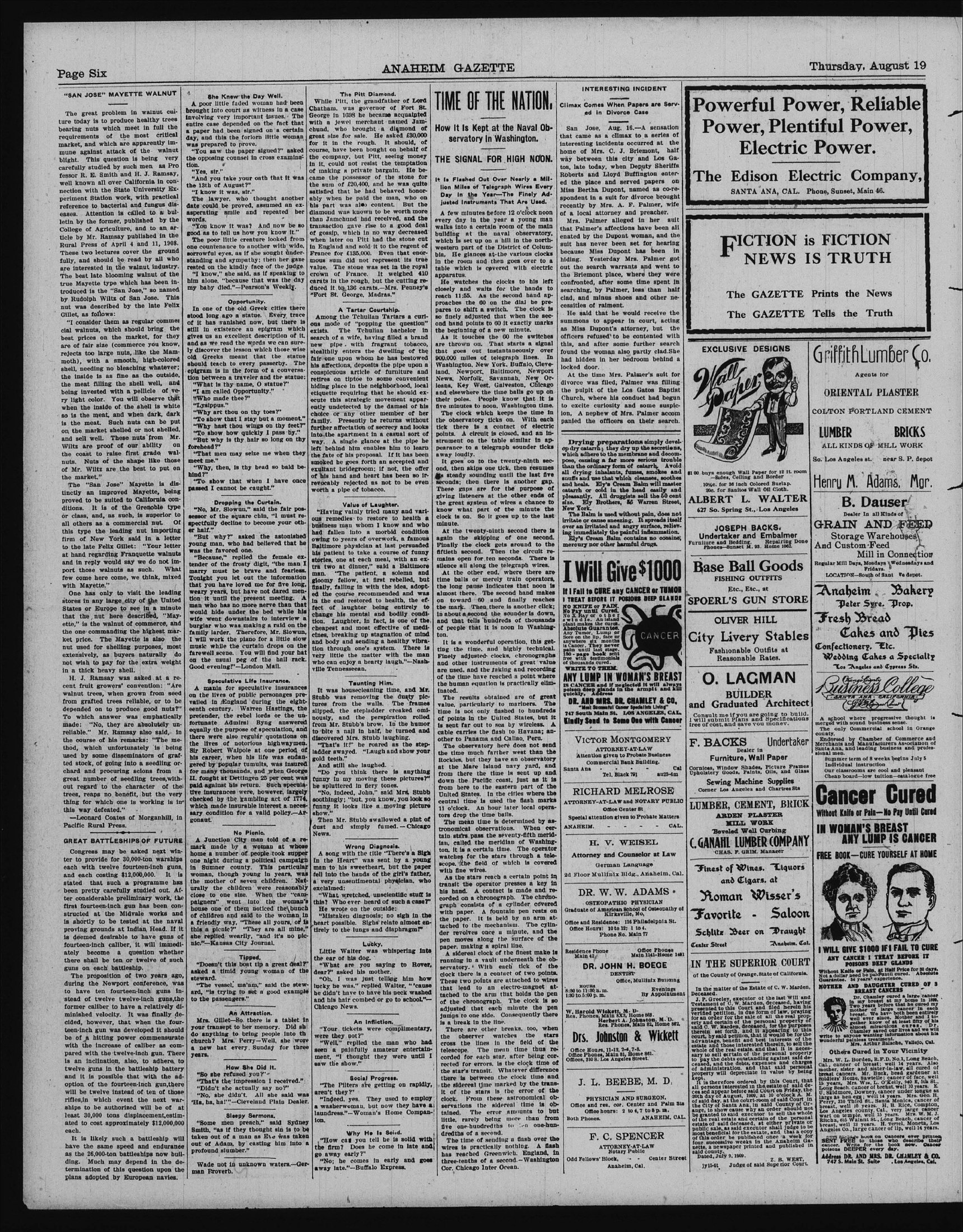
Searchable text
"SAN JOSE" MAYETTE WALNUT
The great problem in walnut culture today is to produce healthy trees bearing nuts which meet in full the requirements of the most critical market, and which are apparently immune against attack of the walnut blight. This question is being very carefully studied by such men as Professor R. E. Smith and H. J. Ramsay, well known all over California in connection with the State University Experiment Station work, with practical reference to bacterial and fungus diseases. Attention is called to a bulletin by the former, published by the College of Agriculture, and to an article by Mr. Ramsay published in the Rural Press of April 4 and 11, 1908. These two lectures cover the ground fully, and should be read by all who are interested in the walnut industry. The best late blooming walnut of the true Mayette type which has been introduced is the "San Jose," so named by Rudolph Wiltz of San Jose. This nut was described by the late Felix Gillet, as follows:
"I consider them as regular commercial walnuts, which should bring the best prices on the market, for they are of fair size (commerce you know, rejects too large nuts, like the Mammoth), with a smooth, high-colored shell, needing no bleaching whatever; the inside is as fine as the outside, the meat filling the shell well, and being invested with a pellicle of very light color. You will observe that when the inside of the shell is white so is the meat, and when dark, dark is the meat. Such nuts can be put on the market shelled or not shelled, and sell well. These nuts from Mr. Wiltz are proof of our ability on the coast to raise first grade walnuts."
She Knew the Day Well.
A poor little faded woman had been brought into court as witness in a case involving very important issues. The entire case depended on the fact that a paper had been signed on a certain day, and this the forlorn little woman was prepared to prove.
"You saw the paper signed?" asked the opposing counsel in cross examination.
"Yes, sir."
"And you take your oath that it was the 13th of August?"
"I know it was, sir."
The lawyer, who thought another date could be proved, assumed an exasperating smile and repeated her words.
"You know it was? And now be so good as to tell us how you know it."
The poor little creature looked from one countenance to another with wide, sorrowful eyes, as if she sought understanding and sympathy; then her gaze rested on the kindly face of the judge.
"I know," she said, as if speaking to him alone. "because that was the day my baby died."—Pearson's Weekly.
Opportunity.
In one of the old Greek cities there stood long ago a statue. Every trace of it has vanished now, but there is still in existence an epigram which gives us an excellent description of it, and as we read the words we can surely discover the lesson which those wise old Greeks meant that the statue should teach to every passerby. The epigram is in the form of a conversation between a traveler and the statue:
"What is thy name, O statue?"
"I am called Opportunity."
"Who made thee?"
"Lysippus."
"Why art thou on thy toes?"
"To show that I stay but a moment."
"Why hast thou wings on thy feet?"
"To show how quickly I pass by."
"But why is thy hair so long on thy forehead?"
"That men may seize me when they meet me."
The Price.
While Pitt, the Chatham, was born George in 1698 with a jewel manschund, who bred great size for sausage for it in the ranch course, have been the company, but in it, could not make a prize satisfied that he probably his part was also diamond was known than Jamchund transaction gave of gossip, which when later on he found in England and France for £135000 sum did not value. The stone crown of Frank carats in the round produced it to 1300 "Fort St. George."
shell, needing no bleaching whatever; the inside is as fine as the outside, the meat filling the shell well, and being invested with a pellicle of very light color. You will observe that when the inside of the shell is white so is the meat, and when dark, dark is the meat. Such nuts can be put on the market shelled or not shelled, and sell well. These nuts from Mr. Wiltz are proof of our ability on the coast to raise first grade walnuts. Nuts of the shape like those of Mr. Wiltz are the best to put on the market."
The "San Jose" Mayette is distinctly an improved Mayette, being proved to be suited to California conditions. It is of the Grenoble type or class, and, as such, is superior to all others as a commercial nut. Of this type the leading nut importing firm of New York said in a letter to the late Felix Gillet: "Your letter at hand regarding Franquette walnuts and in reply would say we do not import those walnuts as such. What few come here come, we think, mixed with Mayette."
One has only to visit the leading stores in any large city of the United States or Europe to see in a minute that the nut here described, "Mayette," is the walnut of commerce, and the one commanding the highest market price. The Mayette is also the nut used for shelling purposes, most extensively, as buyers naturally do not wish to pay for the extra weight in a thick heavy shell.
H. J. Ramsay was asked at a recent fruit growers' convention: "Are walnut trees, when grown from seed from grafted trees reliable, or to be depended on to produce good nuts?" To which answer was emphatically made: "No, they are absolutely unreliable." Mr. Ramsay also said, in the course of his remarks: "The method, which unfortunately is being used by some disseminators of grafted stock, of going into a seedling orchard and procuring scions from a great number of seedling trees, without regard to the character of the trees, reaps no benefit, but the very thing for which one is working is in this way defeated."
—Leonard Coates of Morganhill, in Pacific Rural Press.
GREAT BATTLESHIPS OF FUTURE
Congress may be asked next winter to provide for 30,000-ton warships each with twelve fourteen-inch guns,
should teach to every passerby. The epigram is in the form of a conversation between a traveler and the statue:
"What is thy name, O statue?"
"I am called Opportunity."
"Who made thee?"
"Lysippus."
"Why art thou on thy toes?"
"To show that I stay but a moment."
"Why hast thou wings on thy feet?"
"To show how quickly I pass by."
"But why is thy hair so long on thy forehead?"
"That men may seize me when they meet me."
"Why, then, is thy head so bald behind?"
"To show that when I have once passed I cannot be caught."
Dropping the Curtain.
"No, Mr. Slowun," said the fair possessor of the square chin, "I must respectfully decline to become your other half."
"But why?" asked the astonished young man, who had believed that he was the favored one.
"Because," replied the female extender of the frosty digit, "the man I marry must be brave and fearless. Tonight you let out the information that you have loved me for five long, weary years, but have not dared mention it until the present meeting. A man who has no more nerve than that would hide under the bed while his wife went downstairs to interview a burglar who was making a raid on the family larder. Therefore, Mr. Slowun, I will work the piano for a little slow music while the curtain drops on the farewell scene. You will find your hat on the usual peg of the hall rack. Good evening!"—London Mall.
Speculative Life Insurance.
A mania for speculative insurances on the lives of public personages prevailed in England during the eighteenth century. Warren Hastings, the pretender, the rebel lords or the unfortunate Admiral Byng answered equally the purpose of speculation, and there were also regular quotations on the lives of notorious highwaymen. Sir Robert Walpole at one period of his career, when his life was endangered by popular tumults, was insured for many thousands, and when George II fought at Dettingen 25 per cent was paid against his return. Such speculative insurances were, however, largely checked by the gambling act of 1774, which made insurable interest a necessary condition for a valid policy.—Argonaut.
No Pionic.
A Junction City man told of a remark made by a woman at whose home a number of people took supper one night during a political campaign in Sumner county. This particular
GREAT BATTLESHIPS OF FUTURE
Congress may be asked next winter to provide for 30,000-ton warships each with twelve fourteen-inch guns, and each costing $12,000,000. It is stated that such a programme has been pretty carefully studied out. After considerable preliminary work, the first fourteen-inch gun has been constructed at the Midvale works and is shortly to be tested at the naval proving grounds at Indian Head. If it is deemed desirable to have guns of fourteen-inch caliber, it will immediately become a question whether there shall be ten or twelve of such guns on each battleship.
The proposition of two years ago, during the Newport conference, was to have ten fourteen-inch guns instead of twelve twelve-inch guns, the former caliber to have a relatively diminished velocity. It was finally decided, however, that when the fourteen-inch gun was developed it should be of a hitting power commensurate with the increase of caliber as compared with the twelve-inch gun. There is an inclination, also, to adhere to twelve guns in the battleship battery and it is possible that with the adoption of the fourteen-inch gun, there will be twelve instead of ten of those rifles, in which event the next warships to be authorized will be of at least 30,000 tons displacement, estimated to cost approximately $12,000,000 each.
It is likely such a battleship will have the same speed and endurance as the 26,000-ton battleships now building. Much may depend in the determination of this question upon the plans adopted by European navies.
No Picnic.
A Junction City man told of a remark made by a woman at whose home a number of people took supper one night during a political campaign in Sumner county. This particular woman, though young in years, was the mother of seven children. Naturally the children were reasonably close to one size. When the "campaigners" went into the woman's house one of them noticed the bunch of children and said to the woman in a friendly way, "These all yours, or is this a picnic?" "They are all mine," she replied wearily, "and it's no picnic."—Kansas City Journal.
Tipped.
"Doesn't this boat tip a great deal?" asked a timid young woman of the steward.
"The vessel, ma'am," said the steward, "is trying to set a good example to the passengers."
An Attraction.
Mrs. Gillet—So there is a tablet in your transept to her memory. Did she do anything to bring people into the church? Mrs. Perry—Well, she wore a new hat every Sunday for three years.
How She Did It.
"So she refused you?"
"That's the impression I received."
"Didn't she actually say no?"
"No, she didn't. All she said was 'Ha, ha, ha!'"—Cleveland Plain Dealer.
Sleepy Sermons.
"Some men preach," said Sydney Smith, "as if they thought sin is to be taken out of a man as Eve was taken out of Adam, by casting him into a profound slumber."
Wade not in unknown waters.—German Proverb.
ANAHEIM GAZETTE
The Pitt Diamond.
While Pitt, the grandfather of Lord Chatham, was governor of Fort St. George in 1698 he became acquainted with a jewel merchant named Jamchund, who brought a diamond of great size for sale. He asked £30,000 for it in the rough. It should, of course, have been bought on behalf of the company, but Pitt, seeing money in it, could not resist the temptation of making a private bargain. He became the possessor of the stone for the sum of £20,400, and he was quite satisfied that he had behaved honorably when he paid the man, who on his part was also content. But the diamond was known to be worth more than Jamchund had received, and the transaction gave rise to a good deal of gossip, which in no way decreased when later on Pitt had the stone cut in England and sold it to the regent of France for £135,000. Even that enormous sum did not represent its true value. The stone was set in the royal crown of France. It welghed 410 carats in the rough, but the cutting reduced it to 130 carats.—Mrs. Penney's "Fort St. George, Madras."
A Tartar Courtship.
Among the Tchulian Tartars a curious mode of "popping the question" exists. The Tchulian bachelor in search of a wife, having filled a brand new pipe with fragrant tobacco, stealthily enters the dwelling of the fair one upon whom he has bestowed his affections, deposits the pipe upon a conspicuous article of furniture and retires on tiptoe to some convenient hiding place in the neighborhood, local etiquette requiring that he should execute this strategic movement apparently undetected by the damsel of his choice or any other member of her family. Presently he returns without further affectation of secrecy and looks into the apartment in a casual sort of way. A single glance at the pipe he left behind him enables him to learn the fate of his proposal. If it has been
TIME OF THE NATION.
How It Is Kept at the Naval Observatory In Washington.
THE SIGNAL FOR HIGH NOON.
It is Flashed Out Over Nearly a Million Miles of Telegraph Wires Every Day In the Year—The Finely Adjusted Instruments That Are Used.
A few minutes before 12 o'clock noon every day in the year a young man walks into a certain room of the main building at the naval observatory, which is set up on a hill in the northwestern part of the District of Columbia. He glances at the various clocks in the room and then goes over to a table which is covered with electric apparatus.
He watches the clocks to his left closely and waits for the hands to reach 11:55. As the second hand approaches the 60 on the dial he prepares to shift a switch. The clock is so finely adjusted that when the second hand points to 60 it exactly marks the beginning of a new minute.
As it touches the 60 the switches are thrown on. That starts a signal that goes out instantaneously over 900,000 miles of telegraph lines. In Washington, New York, Buffalo, Cleveland, Newport, Baltimore, Newport News, Norfolk, Savannah, New Orleans, Key West, Galveston, Chicago and elsewhere the time balls go up on their poles. People know that it is five minutes to noon, Washington time.
The clock which keeps the time in the observatory ticks on. With each tick there is a contact of electric points. A circuit is closed, and an instrument on the table similar in appearance to a telegraph sounder ticks away loudly.
INTERESTING INCIDENT
Climax Comes When Papers are Served in Divorce Case
San Jose, Aug. 16.—A sensation that came as a climax to a series of interesting incidents occurred at the home of Mrs. C. J. Briemont, half way between this city and Los Gatos, late today, when Deputy Sheriffs Roberts and Lloyd Buffington entered the place and served papers on Miss Bertha Dupont, named as co-respondent in a suit for divorce brought recently by Mrs. A. F. Palmer, wife of a local attorney and preacher.
Mrs. Palmer alleged in her suit that Palmer's affections have been all enated by the Dupont woman, and the suit has never been set for hearing because Miss Dupont has been in hiding. Yesterday Mrs. Palmer got out the search warrants and went to the Briemont place, where they were confronted, after some time spent in searching, by Palmer, less than half clad, and minus shoes and other necessities of raiment.
He said that he would receive the summons to appear in court, acting as Miss Dupont's attorney, but the officers refused to be contented with this, and after some further search found the woman also partly clad.She had hidden in her bedroom behind a locked door.
At the time Mrs. Palmer's suit for divorce was filed; Palmer was filling the pulpit of the Los Gatos Baptist Church, where his conduct had begun to excite curiosity and some suspicion. A nephew of Mrs. Palmer acco-manied the officers on their search.
Drying preparations simply develop dry catarrh; they dry up the secretions which adhere to the membrane and decompose during their use.
his affections, deposits the pipe upon a conspicuous article of furniture and retires on tiptoe to some convenient hiding place in the neighborhood, local etiquette requiring that he should execute this strategic movement apparently undetected by the damsel of his choice or any other member of her family. Presently he returns without further affectation of secrecy and looks into the apartment in a casual sort of way. A single glance at the pipe he left behind him enables him to learn the fate of his proposal. If it has been smoked he goes forth an accepted and exultant bridegroom; if not, the offer of his hand and heart has been so irrevocably rejected as not to be even worth a pipe of tobacco.
Value of Laughter.
"Having vainly tried many and various remedies to restore to health a business man whom I know and who had fallen into a morbid condition owing to years of overwork, a famous Baltimore physician at last persuaded his patient to take a course of funny stories, one at each meal, with an extra two at dinner," said a Baltimore man. "The patient, a solemn and gloomy fellow, at first rebelled, but finally, falling in with the idea, adopted the course recommended and was in the end restored to health, the effect of laughter being entirely to change his mental and bodily condition. Laughter, in fact, is one of the cheapest and most effective medicines, breaking up stagnation of mind and body and sending a healthy vibration through one's system. There is very little the matter with the man who can enjoy a hearty laugh."—Nashville Tennessee.
Taunting Him.
It was housecleaning time, and Mr. Stubb was removing the dusty pictures from the walls. The frames slipped, the stepladder creaked ominously, and the perspiration rolled from Mr. Stubb's brow. In the humor to bite a nail in half, he turned and discovered Mrs. Stubb laughing.
"That's it!" he roared as the stepladder swayed. "Laugh and show your gold teeth."
And still she laughed.
"Do you think there is anything funny in my moving these pictures?" he spluttered in fiery tones.
"No, indeed, John," said Mrs. Stubb soothingly; "but, you know, you look so funny it looks like a moving picture show."
Then Mr. Stubb swallowed a pint of dust and simply fumed. — Chicago News.
Wrong Diagnosis.
A song with the title "There's a Sigh In the Heart" was sent by a young man to his sweetheart, but the paper Washington, New York, Buffalo, Cleveland, Newport, Baltimore, Newport News, Norfolk, Savannah, New Orleans, Key West, Galveston, Chicago and elsewhere the time balls go up on their poles. People know that it is five minutes to noon, Washington time.
The clock which keeps the time in the observatory ticks on. With each tick there is a contact of electric points. A circuit is closed, and an instrument on the table similar in appearance to a telegraph sounder ticks away loudly.
It goes on to the twenty-ninth second, then skips one tick, then resumes its steady sounding until the last five seconds; then there is another gap. These gaps are for the purpose of giving listeners at the other ends of the great system of wires a chance to know what part of the minute the clock is on. So it goes up to the last minute.
At the twenty-ninth second there is again the skipping of one second. Finally the clock gets around to the fiftyth second. Then the circuit remains open for ten seconds. There is silence all along the telegraph wires.
At the other end, where there are time balls or merely train operators, the long pause indicates that noon is almost there. The second hand makes on toward 60 and finally reaches the mark. Then there is another click; in about a second the sounder is down, and that tells hundreds of thousands of people that it is noon in Washington.
It is a wonderful operation, this getting the time, and highly technical. Finely adjusted clocks, chronographs and other instruments of great value are used, and the taking and recording of the time have reached a point where the human equation is practically eliminated.
The results obtained are of great value, particularly to mariners. The time is not only flashed to hundreds of points in the United States, but it is sent far out to sea by wireless. A cable carries the flash to Havana; another to Panama and Callao, Peru.
The observatory here does not send the time much farther west than Rockles, but they have an observatory at the Mare Island navy yard, and from there the time is sent up and down the Pacific coast, just as it is from here to the eastern part of the United States. In the cities where the central time is used the flash marks 11 o'clock. An hour later local operators drop the time balls.
The mean time is determined by astronomical observations. When certain stars pass the seventy-fifth meridian, called the meridian of Washington, it is a certain time. The operator watches for the stars through a telescope, the field of which is covered with fine wires.
At the time Mrs. Palmer's suit for divorce was filed; Palmer was filling the pulpit of the Los Gatos Baptist Church, where his conduct had begun to excite curiosity and some suspicion. A nephew of Mrs. Palmer accompanied the officers on their search.
Drying preparations simply develop dry catarrh; they dry up the secretions which adhere to the membrane and decompose, causing a far more serious trouble than the ordinary form of catarrh. Avoid all drying inhalants, fumes, smokes and snuffs and use that which cleanses, soothes and heals. Ely's Cream Balm will master catarrh or cold in the head easily and pleasantly. All druggists sell the 50 cent size. Ely Brothers, 86 Warren Street, New York.
The Balm is used without pain, does not irritate or cause sneezing. It spreads itself over an irritated and angry surface, relieving immediately the painful inflammation.
Ely's Cream Balm contains no cosine; mercury nor other harmful drugs.
I Will Give $1000
If I Fall to CURE any CANCER or TUMOR
I TREAT BEFORE IT POSIONS DEEP GLANDS
NO KNIFE or PAIN.
No X Ray or other swindle.
An island plant makes the cure.
Absolute Guarantee.
Any Tumor, Lump or Sore on the lip, face or anywhere six months is Cancer. They never pain until last stage.
130-page book sent free with testimonials of thousands cured.
WRITE TO THEM.
ANY LUMP IN WOMAN'S BREAST IS CANCER and if neglected it will always poison deep glands in the armpit and kill quickly. Address
DR. AND MRS. DR. CHAMLEY & CO,
"Most Successful Cancer Specialists Living"
747 South Main St., LOS ANGELES, CA
Kindly Send to Some One with Cancer
VICTOR MONTGOMERY
ATTORNEY-AT-LAW
Attention given to Probate Business
Commercial Bank Building.
Santa Ana
Tel. Black 791 au23-6m
RICHARD MELROSE
ATTORNEY-AT-LAW and NOTARY PUBLIC
Office Center 8t
Special attention given to Probate Matters
ANAHEIM.
CAL
H. V. WEISEL
Attorney and Counselor at Law
German Language
DO YOU THINK THERE IS ANYTHING funny in my moving these pictures?" he spluttered in fiery tones.
"No, indeed, John," said Mrs. Stubb soothingly; "but, you know, you look so funny it looks like a moving picture show."
Then Mr. Stubb swallowed a pint of dust and simply fumed. — Chicago News.
Wrong Diagnosis.
A song with the title "There's a Sigh In the Heart" was sent by a young man to his sweetheart, but the paper fell into the hands of the girl's father, a very unsentimental physician, who exclaimed:
"What wretched, unscientific stuff is this? Who ever heard of such a case?"
He wrote on the outside:
"Mistaken diagnosis; no sigh in the heart possible. Sights relate almost entirely to the lungs and diaphragm!"
Lucky.
Little Walter was whispering into the ear of his dog.
"What are you saying to Rover, dear?" asked his mother.
"Oh, I was just telling him how lucky he was," replied Walter, "'cause he didn't have to have his neck washed and his hair combed or go to school." — Chicago News.
An Infliction.
"Your tickets were complimentary, were they not?"
"Well," replied the man who had seen a painfully amateur entertainment, "I thought they were until I saw the show."
Social Progress.
"The Pilters are getting on rapidly, aren't they?"
"Iindeed, yes. They used to employ a washerwoman, but now they have a laundress." — Woman's Home Companion.
Why He Is Solid.
"How can you tell he is solid with the firm? Does he come in late and go away early?"
"No; he comes in early and goes away late." — Buffalo Express.
The mean time is determined by astronomical observations. When certain stars pass the seventy-fifth meridian, called the meridian of Washington, it is a certain time. The operator watches for the stars through a telescope, the field of which is covered with fine wires.
As the stars reach a certain point in transit the operator presses a key in his hand. A contact is made and recorded on a chronograph. The chronograph consists of a cylinder covered with paper. A fountain pen rests on the paper. It is held by an arm attached to the mechanism. The cylinder revolves once a minute, and the pen moves along the surface of the paper, making a spiral line.
A sidereal clock of the finest make is running in a vault underneath the observatory. With each tick of the clock there is a contact of two points. These two points are attached to wires that lead to an electro-magnet attached to the arm that holds the pen of the chronograph. The clock is so adjusted that each minute the pen jumps to one side. Consequently there is a break in the line.
There are other breaks, too, when the observer watches the stars cross the lines in the field of the telescope. The mean time thus recorded for each star, after being corrected for errors, is the clock time of the star's transit. Whatever difference there is between the clock time and the sidereal time marked by the transit of the stars is the error of the clock. From these astronomical observations the sidereal time is obtained. The error amounts to but little, rarely being more than from five one-hundredths to ten one-hundredths of a second.
The time of sending a flash over the wires is practically nothing. A flash has reached Greenwich England, in three-tenths of a second. — Washington Cor. Chicago Inter Ocean.
TESTING INCIDENT
When Papers are ServDivorce Case
Aug. 16.—A sensation
a climax to a series of
incidents occurred at the
C. J. Briemont, halfthis city and Los Gar, when Deputy Sheriffs
Lloyd Buffington enterand served papers on
Dupont, named as co-result for divorce brought
Mrs. A. F. Palmer, wife
ororney and preacher.
Or alleged in her suit
affections have been all
Dupont woman, and the
her been set for hearing
Dupont has been in
today Mrs. Palmer got
warrants and went to
place, where they were
after some time spent in
Palmer, less than half
pus shoes and other nement.
At he would receive the
appear in court, acting
Dupont's attorney, but the
need to be contented with
her some further search
man also partly clad.She
in her bedroom behind a
Mrs. Palmer's suit for
filled; Palmer was filling
the Los Gatos Baptist
his conduct had begun
losity and some suspicow of Mrs. Palmer accomofficers on their search.
Powerful Power, Reliable
Power, Plentiful Power,
Electric Power.
The Edison Electric Company,
SANTA ANA, CAL. Phone, Sunset, Main 46.
FICTION is FICTION NEWS IS TRUTH
The GAZETTE Prints the News
The GAZETTE Tells the Truth
EXCLUSIVE DESIGNS
Wall Paper
Griffith Lumber Co.
Agents for
ORIENTAL PLASTER
COLTON PORTLAND CEMENT
LUMBER BRICKS
ALL KINDS OF MILL WORK
Wall Paper
$1 00 buys enough Wall Paper for 12 ft. room—Sides, Ceiling and Border
10½c. for 36 inch Colored Burlap.
20c. for Sanitos Wall Oil Cloth.
ALBERT L. WALTER
627 So. Spring St., Los Angeles
JOSEPH BACKS;
Undertaker and Embalmer
Furniture and Bedding. Repairing Done
Phones—Sunset M. 93. Home 1062.
Base Ball Goods
FISHING OUTFITS
Etc., Etc., at
SPOERL'S GUN STORE
OLIVER HILL
City Livery Stables
Fashionable Outfits at
Reasonable Rates.
O. LAGMAN
BUILDER and Graduated Architect
Consult me if you are going to build.
I will submit Plans and Specifications free of cost, and save you money.
F. BACKS Undertaker
Dealer in
Furniture, Wall Paper
Cornices, Window Shades, Picture Frames
Upholstery Goods, Paints, Oils, and Glass
Sewing Machine Supplies
Corner Los Angeles and Chartres Sts
LUMBER, CEMENT, BRICK
ARDEN PLASTER
MILL WORK
Beveled Well Curbing
C. GANAHL LUMBER COMPANY
CHAS. F. GRIM. Manager
Agents for
ORIENTAL PLASTER
COLTON PORTLAND CEMENT
LUMBER BRICKS
ALL KINDS OF MILL WORK
So. Los Angeles st. near S. P. depot
Henry M. Adams, Mgr.
B. Dauser
Dealer In all Kinds of
GRAIN AND FEED
Storage Warehouses
And Custom Feed
Mill in Connection
Regular Mill Days, Mondays Wednesdays and Fridays.
LOCATION—South of Sant Ve depot.
Anaheim Bakery
Peter Syre. Prop.
Fresh Bread
Cakes and Pies
Confectionery, Etc.
Wedding Cakes a Specialty
Los Angeles and Cypress Sts.
Business College
SANTA ANA-CALIFORNIA
A school where progressive thought is merged with sound business sense.
The only Commercial school in Orange county,
Endorsed by Chamber of Commerce and Merchants and Manufacturers Association of Santa Ana, and leading business and professional men.
Summer term of 8 weeks begins July 5.
Individual instruction.
Our classrooms are cool and pleasant.
Cheap board—low tuition—catalogue free
Cancer Cured
Without Knife or Pain—No Pay Until Cured
IN WOMAN'S BREAST ANY LUMP IS CANCER
FREE BOOK—CURE YOURSELF AT HOME
IN THE SUPERIOR COURT of the County of Orange.State of California.
In the matter of the Estate of C. W. Marden, Deceased.
J. P. Greeley, executor of the last Will and Testament of C. W. Marden, deceased, having presented to this Court and filed herein his verified petition, in due form of law, praying for an order for the sale of all the real property and certain of the personal property of said C. W. Marden, deceased, for the purposes therein set forth, and it appearing to this court, by said petition, that it would be for the advantage, benefit and best interests of the estate and those interested therein, to sell the whole of the real estate, and that it is necessary to sell certain of the personal property to pay the debts outstanding against said deceased, and the debts, expenses and charges of administration, and that said personal property will depreciate in value by being kept.
It is therefore ordered by this Court, that all persons interested in the estate of said deceased appear before said Court on Friday, the 20th day of August, 1909, at 10 o'clock A.M. of said day, at the court-room of said Court in the City of Santa Ana, in said County of Orange, to show cause why an order should not be granted to said executor to sell the whole of the real estate and certain of the personal estate of said deceased, at either private or public sale, as said executor shall judge to be most beneficial for the estate, and that a copy of this order be published once a week for four successive weeks in the Anaheim Gazette, a newspaper printed and published in said county.
Dated, July 9, 1909.
Z. B. WEST,
jy15-6t
Judge of said Superior Court.
Cancer Cured
Without Knife or Pain—No Pay Until Cured
IN WOMAN'S BREAST ANY LUMP IS CANCER
FREE BOOK—CURE YOURSELF AT HOME
I WILL GIVE $1000 IF I FAIL TO CURE ANY CANCER I TREAT BEFORE IT POISONS DEEP GLANDS
Without Knife or Pain, at Half Price for 30 days. Not a dollar need be paid until cured. Absolute Guarantee. 34 years' experience.
MOTHER AND DAUGHTER CURED OF 3 BREAST CANCERS
Dr. Chamley cured a large cancer in my breast at my home in 1899. Two years before that he cured my mother of large cancer in each breast. We have both been entirely well ever since. Mother and I together know of at least fifty of his almost miraculous cures. Dr. Chamley saved our lives and we will write to anyone wanting information about his wonderful painless treatment.
Mrs. Arthur Balsche, Vallejo, Cal.
Others Cured in Your Vicinity
Mrs. W. L. Borden, R.F.D.No.1, Long Beach, Cal., cancer of breast; well 14 years. Also mother, sister and sister-in-law, all cured of breast cancers. Mr. Buck, head gardener at Soldiers' Home, Sawtelle; cancer of face, well 15 years. Mrs. Win, L. O'Kelly, 940 E., 5th St., Long Beach, cancer of breast, well 10 years. E. U. Skidmore, Downey, cancer under tongue as large as hen egg; well 14 years. Mrs. Geo. H. Perry, 310 Third St., Santa Monica, cancer of breast, well 10 years. H. B. Rice, Compton, Los Angeles county, Cal., very large cancer wart on temple, well 15 years. Mrs. W. M.J. Ritcha, 615 Walnut St., Long Beach, cancer of breast, well 13 years. H. Terrel, Moneta, Los Angeles Co., large cancer of lip, well 14 years.
SENT FREE to those who describe their cancer. Write for the book now. Cancer poisons DEEPER every day.
Address DR. AND MRS. DR. CHAMLEY & CO.
747 S. Main St. Suite . Los Angeles, Cal.