anaheim-gazette 1909-06-03
Scanned page
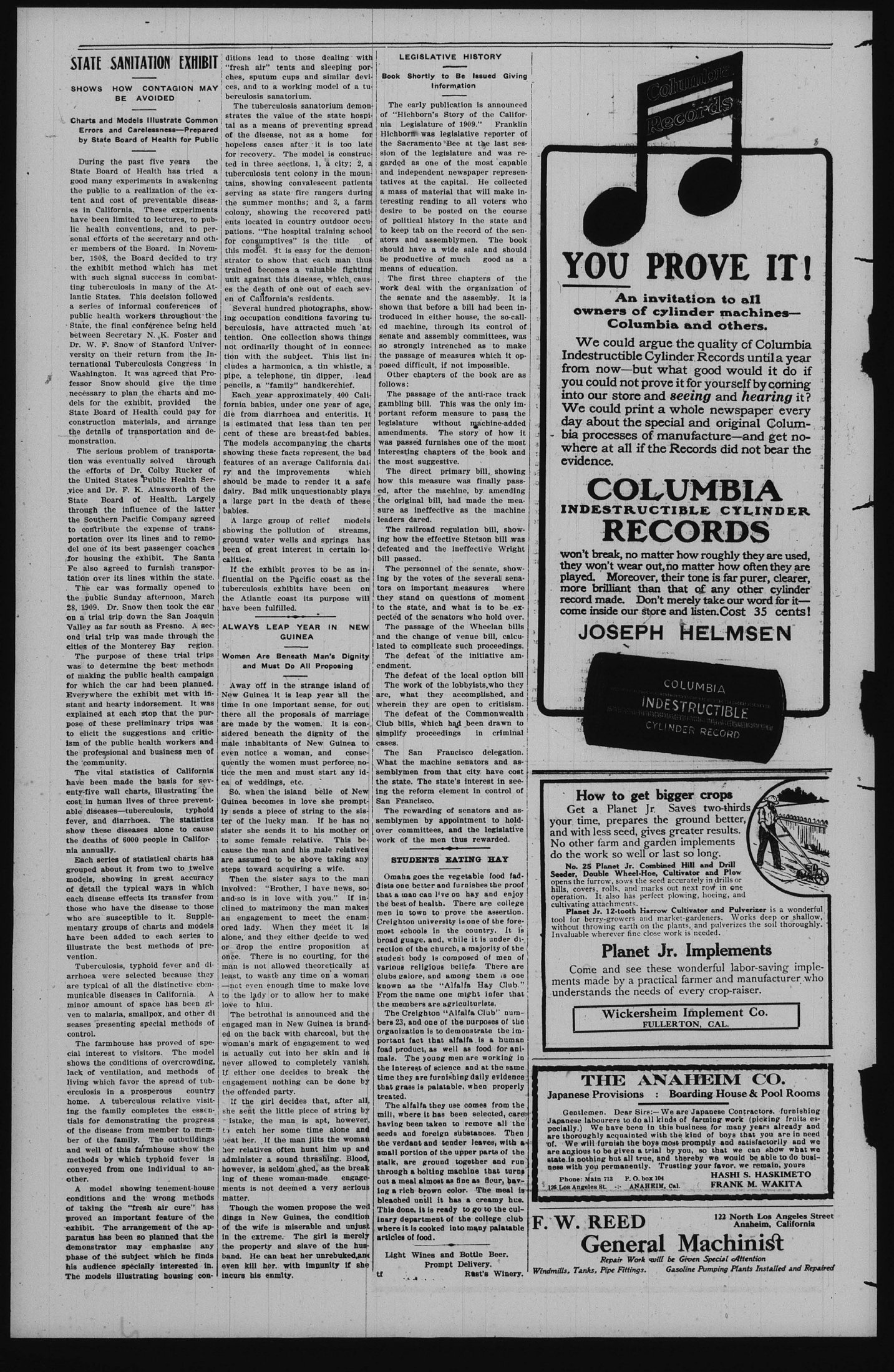
Searchable text
STATE SANITATION EXHIBIT
SHOWS HOW CONTAGION MAY BE AVOIDED
Charts and Models Illustrate Common Errors and Carelessness—Prepared by State Board of Health for Public
During the past five years the State Board of Health has tried a good many experiments in awakening the public to a realization of the extent and cost of preventable diseases in California. These experiments have been limited to lectures, to public health conventions, and to personal efforts of the secretary and other members of the Board. In November, 1908, the Board decided to try the exhibit method which has met with such signal success in combatting tuberculosis in many of the Atlantic States. This decision followed a series of informal conferences of public health workers throughout the State, the final conference being held between Secretary N. K. Foster and Dr. W. F. Snow of Stanford University on their return from the International Tuberculosis Congress in Washington. It was agreed that Professor Snow should give the time necessary to plan the charts and models for the exhibit, provided the State Board of Health could pay for construction materials, and arrange the details of transportation and demonstration.
The serious problem of transportation was eventually solved through the efforts of Dr. Colby Rucker of the United States Public Health Service and Dr. F. K. Ainsworth of the State Board of Health. Largely through the influence of the latterditions lead to those deaths "fresh air" tents and sleeps, sputum cups and similar services, and to a working model berculosis sanatorium.
The tuberculosis sanatorium strates the value of the stent as a means of prevention of the disease, not as a hopeless case after it is for recovery. The model is tested in three sections, 1, a tuberculosis tent colony in its contents, showing convalescence serving as state fire range during summer months; and a colony, showing the recoveries located in country outpatients. "The hospital training for consumptives" is the basis this model. It is easy for the strator to show that each trained becomes a valuable unit against this disease, whereas the death of one out of ten of California's residents.
Several hundred photographs occupying conditions fairly berculosis, have attracted attention. One collection shows not ordinarily thought of information with the subject. This includes a harmonica, a tin pipe, a telephone, tin dipper pencils, a "family" handkerchief.
Each year approximately 400 ornia babies, under one year old die from diarrhoea and encephalitis is estimated that less than 20% of these are breast-feeding. The models accompanying them showing these facts represent features of an average California and the improvements should be made to render dairy. Bad milk unquestionably a large part in the death of babies.
The serious problem of transportation was eventually solved through the efforts of Dr. Colby Rucker of the United States Public Health Service and Dr. F. K. Ainsworth of the State Board of Health. Largely through the influence of the latter the Southern Pacific Company agreed to contribute the expense of transportation over its lines and to remodel one of its best passenger coaches for housing the exhibit. The Santa Fe also agreed to furnish transportation over its lines within the state.
The car was formally opened to the public Sunday afternoon, March 28, 1909. Dr. Snow then took the car on a trial trip down the San Joaquin Valley as far south as Fresno. A second trial trip was made through the cities of the Monterey Bay region.
The purpose of these trial trips was to determine the best methods of making the public health campaign for which the car had been planned. Everywhere the exhibit met with instant and hearty indorsement. It was explained at each stop that the purpose of these preliminary trips was to elicit the suggestions and criticism of the public health workers and the professional and business men of the community.
The vital statistics of California have been made the basis for seventy-five wall charts, illustrating the cost in human lives of three preventable diseases—tuberculosis, typhoid fever, and diarrhoea. The statistics show these diseases alone to cause the deaths of 6000 people in California annually.
Each series of statistical charts has grouped about it from two to twelve models, showing in great accuracy of detail the typical ways in which each disease effects its transfer from those who have the disease to those who are susceptible to it. Supplementary groups of charts and models have been added to each series to illustrate the best methods of prevention.
Tuberculosis, typhoid fever and diarrhea, provided the State Board of Health could pay for construction materials, and arrange the details of transportation and demonstration.
The serious problem of transportation was eventually solved through the efforts of Dr. Colby Rucker of the United States Public Health Service and Dr. F. K. Ainsworth of the State Board of Health. Largely through the influence of the latter the Southern Pacific Company agreed to contribute the expense of transportation over its lines and to remodel one of its best passenger coaches for housing the exhibit. The Santa Fe also agreed to furnish transportation over its lines within the state.
The car was formally opened to the public Sunday afternoon, March 28, 1909. Dr. Snow then took the car on a trial trip down the San Joaquin Valley as far south as Fresno. A second trial trip was made through the cities of the Monterey Bay region.
The purpose of these trial trips was to determine the best methods of making the public health campaign for which the car had been planned. Everywhere the exhibit met with instant and hearty indorsement. It was explained at each stop that the purpose of these preliminary trips was to elicit the suggestions and criticism of the public health workers and the professional and business men of the community.
The vital statistics of California have been made the basis for seventy-five wall charts, illustrating the cost in human lives of three preventable diseases—tuberculosis, typhoid fever, and diarrhoea. The statistics show these diseases alone to cause the deaths of 6000 people in California annually.
Each series of statistical charts has grouped about it from two to twelve models, showing in great accuracy of detail each disease affects its transfer from those who have the disease to those who are susceptible to it. Supplementary groups of charts and models have been added to each series to illustrate the best methods of prevention.
Tuberculosis, typhoid fever and diarrhea, provided the State Board of Health could pay for construction materials, and arrange the details of transportation and demonstration.
The serious problem of transportation was eventually solved through the efforts of Dr. Colby Rucker of the United States Public Health Service and Dr. F. K. Ainsworth of the State Board of Health. Largely through the influence of the latter the Southern Pacific Company agreed to contribute the expense of transportation over its lines and to remodel one of its best passenger coaches for housing the exhibit. The Santa Fe also agreed to furnish transportation over its lines within the state.
The car was formally opened to the public Sunday afternoon, March 28, 1909. Dr. Snow then took the car on a trial trip down the San Joaquin Valley as far south as Fresno. A second trial trip was made through the cities of the Monterey Bay region.
The purpose of these trial trips was to determine the best methods of making the public health campaign for which the car had been planned. Everywhere the exhibit met with instant and hearty indorsement. It was explained at each stop that the purpose of these preliminary trips was to elicit the suggestions and criticism of the public health workers and the professional and business men of the community.
The vital statistics of California have been made the basis for seventy-five wall charts, illustrating the cost in human lives of three preventable diseases—tuberculosis, typhoid fever, and diarrhoea. The statistics show these diseases alone to cause the deaths of 6000 people in California annually.
Each series of statistical charts has grouped about it from two to twelve models, showing in great accuracy of detail each disease affects its transfer from those who have the disease to those who are susceptible to it. Supplementary groups of charts and models have been added to each series to illustrate the best methods of prevention.
Tuberculosis, typhoid fever and diarrhea, provided the State Board of Health could pay for construction materials, and arrange the details of transportation and demonstration.
The serious problem of transportation was eventually solved through the efforts of Dr. Colby Rucker of the United States Public Health Service and Dr. F. K. Ainsworth of the State Board of Health. Largely through the influence of the latter the Southern Pacific Company agreed to contribute the expense of transportation over its lines and to remodel one of its best passenger coaches for housing the exhibit. The Santa Fe also agreed to furnish transportation over its lines within the state.
The car was formally opened to the public Sunday afternoon, March 28, 1909. Dr. Snow then took the car on a trial trip down the San Joaquin Valley as far south as Fresno. A second trial trip was made through the cities of the Monterey Bay region.
The purpose of these trial trips was to determine the best methods of making the public health campaign for which the car had been planned. Everywhere the exhibit met with instant and hearty indorsement. It was explained at each stop that the purpose of these preliminary trips was to elicit the suggestions and criticism of the public health workers and the professional and business men of the community.
The vital statistics of California have been made the basis for seventy-five wall charts, illustrating the cost in human lives of three preventable diseases—tuberculosis, typhoid fever, and diarrhoea. The statistics show these diseases alone to cause the deaths of 6000 people in California annually.
Each series of statistical charts has grouped about it from two to twelve models, showing in great accuracy of detail each disease affects its transfer from those who have the disease to those who are susceptible to it. Supplementary groups of charts and models have been added to each series to illustrate the best methods of prevention.
Tuberculosis, typhoid fever and diarrhea, provided the State Board of Health could pay for construction materials, and arrange the details of transportation and demonstration.
The serious problem of transportation was eventually solved through the efforts of Dr. Colby Rucker of the United States Public Health Service and Dr. F. K. Ainsworth of the State Board of Health. Largely through the influence of the latter the Southern Pacific Company agreed to contribute the expense of transportation over its lines and to remodel one of its best passenger coaches for housingthe exhibit. The Santa Fe also agreed to furnish transportation over its lines withinthe state.
The car was formally opened tothe public Sunday afternoon,March 28,1909.Dr.Snow then tookthe car on a trial trip downtheSanJoaquinValleyasfar southasFresno.Asecond trial tripwasmadethroughthecitiesoftheMontereyBayregion.
The purposeofthese trialtripswoulddeterminethebestmethodsofmakingthepublichealthcampaignforwhichthecarhadbeenplanned.Everywheretheexhibitmetwithinstantandheartyindorsement.Inthepurposeofthesepreliminarytripswouldelicitethesuggestionsandcriticismofthepublichealthworkersandtheprofessionalandbusinessmenofthecommunity.
ThevitalstatisticsofCaliforniahavebeenmadethebasisforseverty-fivewallcharts illustratingthecostinhumanlivesofthreepreventablediseases—tuberculosis,typhoidfever,anddiarrhoea.Thestatisticsshowthesediseasesalonetocausethedeathsof6000peopleinCaliforniaannually.
Eachseriesofstatisticalchartshassgroupedaboutitfromtwotwelvemodels,showingingreataccuracyofdetaileachdiseaseffectsitstransferfromthosewhohavethediseasetothosewhoaresusceptibletoit.Supplementarygroupsofchartssandmodelshavebeenaddedtoceachseriestoillustratethebestmethodsoprevention.
Tuberculosis,typhoidfeveranddiarrhoea.providedtheStateBoardOfHealthcouldpayforconstructionmaterials,andarrangethedetailsoftransportationanddemonstration.
The serious problemoftransportationwaseventuallysolvedthroughtheeffortsofDr.ColbyRuckeroftheUnitedStatesPublicHealthServiceandDr.F.K.AinsworthoftheStateBoardOfHealth.LargelythroughtheinfluenceofthePacificCoasttuberculosisexhibitshavebeenofgreatinterestincocalities.
IftheexhibitprovestobfluentialonthePacificCoasttuberculosisexhibitshavebeenatheAtlanticcoastitspurplehavebeenfulfilled.
ALWAYS LEAP YEAR IN GUINEA
Women Are Beneath Man'sand Must Do All Properties
Away off inthe strangeNewGuineaitisleapyeartimeinoneimportantsensetherealltheproposalsofforemadebymewherealldesigninhuman inhabitantsofNewGuineaevennoticeawoman,andquifectlythewomenmustperfectthemenandmuststarteaafoeweddings,eetc.
So whenthe island belleGuineabecomesinloveshely sendsapieceofstringtotherofthe luckyman.Iffhissister she sendsittohismomenttosomefemalerelative.causethemanandhismaleareassumedtobeabaltaxstepstowardacquiringawithinvolved:“Brother,Ihaveandsoisinlovewithyou.claimedinmatrimonythemananengagementtomeetthored lady.Whentheymealalone,andtheyeitherdecideordroptheentireproposalonceThereisnocourtingmanisnotallowedtheoretically
Each series of statistical charts has grouped about it from two to twelve models, showing in great accuracy of detail the typical ways in which each disease effects its transfer from those who have the disease to those who are susceptible to it. Supplementary groups of charts and models have been added to each series to illustrate the best methods of prevention.
Tuberculosis, typhoid fever and diarrhoea were selected because they are typical of all the distinctive communicable diseases in California. A minor amount of space has been given to malaria, smallpox, and other diseases presenting special methods of control.
The farmhouse has proved of special interest to visitors. The model shows the conditions of overcrowding, lack of ventilation, and methods of living which favor the spread of tuberculosis in a prosperous country home. A tuberculous relative visiting the family completes the essentials for demonstrating the progress of the disease from member to member of the family. The outbuildings and well of this farmhouse show the methods by which typhoid fever is conveyed from one individual to another.
A model showing tenement-house conditions and the wrong methods of taking the "fresh air cure" has proved an important feature of the exhibit. The arrangement of the apparatus has been so planned that the demonstrator may emphasize any phase of the subject which he finds his audience specially interested in. The models illustrating housing con-
Then the sister says to her involved: "Brother, I have and-so is in love with you. Clined to matrimony the man an engagement to meet the ored lady. When they meet alone, and they either decide or drop the entire proposal once. There is no courting man is not allowed theoretically, to waste any time on—not even enough time to mote to the lady or to allow her love to him.
The betrothal is announced engaged man in New Guinea ed on the back with charcoal woman's mark of engagement is actually cut into her skin never allowed to completely If either one decides to bring engagement nothing can be the offended party.
If the girl decides that, she sent the little piece of mistake, the man is apt, to catch her some time after her. If the man jilts ther relatives often hunt him administer a sound thrashing however, is seldom shed, as ing of these woman-madeiments is not deemed a very matter.
Though the women proposed dings in New Guinea, the wife is miserable and in the extreme. The girl is the property and slave of band. He can beat her unrelieven kill her. with impunity incurs his enmlty.
LEGISLATIVE HISTORY
Book Shortly to Be Issued Giving Information
The early publication is announced of "Hichborn's Story of the California Legislature of 1909." Franklin Hichborn was legislative reporter of the Sacramento Bee at the last session of the legislature and was regarded as one of the most capable and independent newspaper representatives at the capital. He collected a mass of material that will make interesting reading to all voters who desire to be posted on the course of political history in the state and to keep tab on the record of the senators and assemblymen. The book should have a wide sale and should be productive of much good as a means of education.
The first three chapters of the work deal with the organization of the senate and the assembly. It is shown that before a bill had been introduced in either house, the so-called machine, through its control of senate and assembly committees, was so strongly intrenched as to make the passage of measures which it opposed difficult, if not impossible.
Other chapters of the book are as follows:
The passage of the anti-race track gambling bill. This was the only important reform measure to pass the legislature without machine-added amendments. The story of how it was passed furnishes one of the most interesting chapters of the book and the most suggestive.
The direct primary bill, showing how this measure was finally passed, after the machine, by amending the original bill, had made the measure as ineffective as the machine.
LEAP YEAR IN NEW GUINEA
Are Beneath Man's Dignity Must Do All Proposing
If in the strange island of New Guinea it is leap year all the important sense, for out the proposals of marriage by the women. It is conneceth the dignity of the inhabitants of New Guinea to be a woman, and conse-
the women must perforce no men and must start any iddings, etc.
In the island belle of New comes in love she prompt piece of string to the sis-s lucky man. If he has no sends it to his mother or female relative. This be-man and his male relatives need to be above taking any ward acquiring a wife.
The sister says to the man "Brother, I have news, so in love with you." If in matrimony the man makesement to meet the enam-
When they meet it is they either decide to wed the entire proposition at here is no courting, for the not allowed theoretically at gambling bill. This was the only important reform measure to pass the legislature without machine-added amendments. The story of how it was passed furnishes one of the most interesting chapters of the book and the most suggestive.
The direct primary bill, showing how this measure was finally passed, after the machine, by amending the original bill, had made the measure as ineffective as the machine leaders dared.
The railroad regulation bill, showing how the effective Stetson bill was defeated and the ineffective Wright bill passed.
The personnel of the senate, showing by the votes of the several senators on important measures where they stand on questions of moment to the state, and what is to be expected of the senators who hold over.
The passage of the Wheelan bills and the change of venue bill, calculated to complicate such proceedings.
The defeat of the initiative amendment.
The defeat of the local option bill
The work of the lobbyists, who they are, what they accomplished, and wherein they are open to criticism.
The defeat of the Commonwealth Club bills, which had been drawn to simplify proceedings in criminal cases.
The San Francisco delegation. What the machine senators and assemblymen from that city have cost the state. The state's interest in seeing the reform element in control of San Francisco.
The rewarding of senators and assemblymen by appointment to hold-over committees, and the legislative work of the men thus rewarded.
STUDENTS EATING HAY
Omaha goes the vegetable food fad-dists one better and furnishes the proof that a man can live on hay and enjoy the best of health. There are college men in town to prove the assertion. Creighton university is one of the fore-most schools in the country. It is broad guage, and, while it is under direction of the church, a majority of the student body is composed of men of various religious beliefs. There are
Omaha goes the vegetable food districts one better and furnishes the proof that a man can live on hay and enjoy the best of health. There are college men in town to prove the assertion. Creighton university is one of the foremost schools in the country. It is broad guage, and, while it is under direction of the church, a majority of the student body is composed of men of various religious beliefs. There are clubs galore, and among them is one known as the "Alfalfa Hay Club." From the name one might infer that the members are agriculturists.
The Creighton "Alfalfa Club" numbers 23, and one of the purposes of the organization is to demonstrate the important fact that alfalfa is a human food product, as well as food for animals. The young men are working in the interest of science and at the same time they are furnishing daily evidence that grass is palatable, when properly treated.
The alfalfa they use comes from the mill, where it has been selected, care having been taken to remove all the seeds and foreign substances. Then the verdant and tender leaves, with a small portion of the upper parts of the stalk, are ground together and run through a bolting machine that turns out a meal almost as fine as flour, having a rich brown color. The meal is bleached until it has a creamy hue. This done, it is ready to go to the culinary department of the college club where it is cooked into many palatable articles of food.
Light Wines and Bottle Beer.
Prompt Delivery.
Rust's Winery.
Columbia Records
YOU PROVE IT!
An invitation to all owners of cylinder machines—Columbia and others.
We could argue the quality of Columbia Indestructible Cylinder Records until a year from now—but what good would it do if you could not prove it for yourself by coming into our store and seeing and hearing it? We could print a whole newspaper every day about the special and original Columbia processes of manufacture—and get nowhere at all if the Records did not bear the evidence.
COLUMBIA
INDESTRICTIBLE CYLINDER
We could print a whole newspaper every day about the special and original Columbia processes of manufacture—and get nowhere at all if the Records did not bear the evidence.
COLUMBIA INDESTRUCTIBLE CYLINDER RECORDS
won't break, no matter how roughly they are used, they won't wear out, no matter how often they are played. Moreover, their tone is far purer, clearer, more brilliant than that of any other cylinder record made. Don't merely take our word for it—come inside our store and listen. Cost 35 cents!
JOSEPH HELMSEN
COLUMBIA
INDESTRUCTIBLE
CYLINDER RECORD
How to get bigger crops
Get a Planet Jr. Saves two-thirds your time, prepares the ground better, and with less seed, gives greater results. Do other farm and garden implements so the work so well or last so long.
No. 25 Planet Jr. Combined Hill and Drill Feder, Double Wheel-Hoe, Cultivator and Plowens the furrow, sows the seed accurately in drills or rolls, covers, rolls, and marks out next row in one operation. It also has perfect plowing, hoeing, and cultivating attachments.
Planet Jr. 12-tooth Harrow Cultivator and Pulverizer is a wonderful tool for berry-growers and market-gardeners. Works deep or shallow, without throwing earth on the plants, and pulverizes the soil thoroughly. Valuable wherever fine close work is needed.
Planet Jr. Implements
No. 25 Planet Jr. Combined Hill and Drill Meder, Double Wheel-Hoe, Cultivator and Plow opens the furrow, sows the seed accurately in drills or rolls, covers, rolls, and marks out next row in one operation. It also has perfect plowing, hoeing, and cultivating attachments.
Planet Jr. 12-tooth Harrow Cultivator and Pulverizer is a wonderful tool for berry-growers and market-gardeners. Works deep or shallow, without throwing earth on the plants, and pulverizes the soil thoroughly. Valuable wherever fine close work is needed.
Planet Jr. Implements
Come and see these wonderful labor-saving implements made by a practical farmer and manufacturer who understands the needs of every crop-raiser.
Wickersheim Implement Co.
FULLERTON, CAL.
THE ANAHEIM CO.
Japanese Provisions: Boarding House & Pool Rooms
Gentlemen. Dear Sirs:—We are Japanese Contractors, furnishing Japanese labourers to do all kinds of farming work (picking fruits especially.) We have been in this business for many years already and thoroughly acquainted with the kind of boys that you are in need. We will furnish the boys most promptly and satisfactorily and we anxious to be given a trial by you, so that we can show what we are nothing but all true, and thereby we would be able to do business with you permanently. Trusting your favor, we remain, yours
Phone: Main 713 P.O. box 104 Los Angeles St. ANAHEIM, Cal.
HASHI S. HASKIMETO FRANK M. WAKITA
W. REED
122 North Los Angeles Street Anaheim, California
General Machinist
Repair Work will be Given Special Attention
Tills, Tanks, Pipe Fittings. Gasoline Pumping Plants Installed and Repaired