anaheim-gazette 1909-03-18
Scanned page
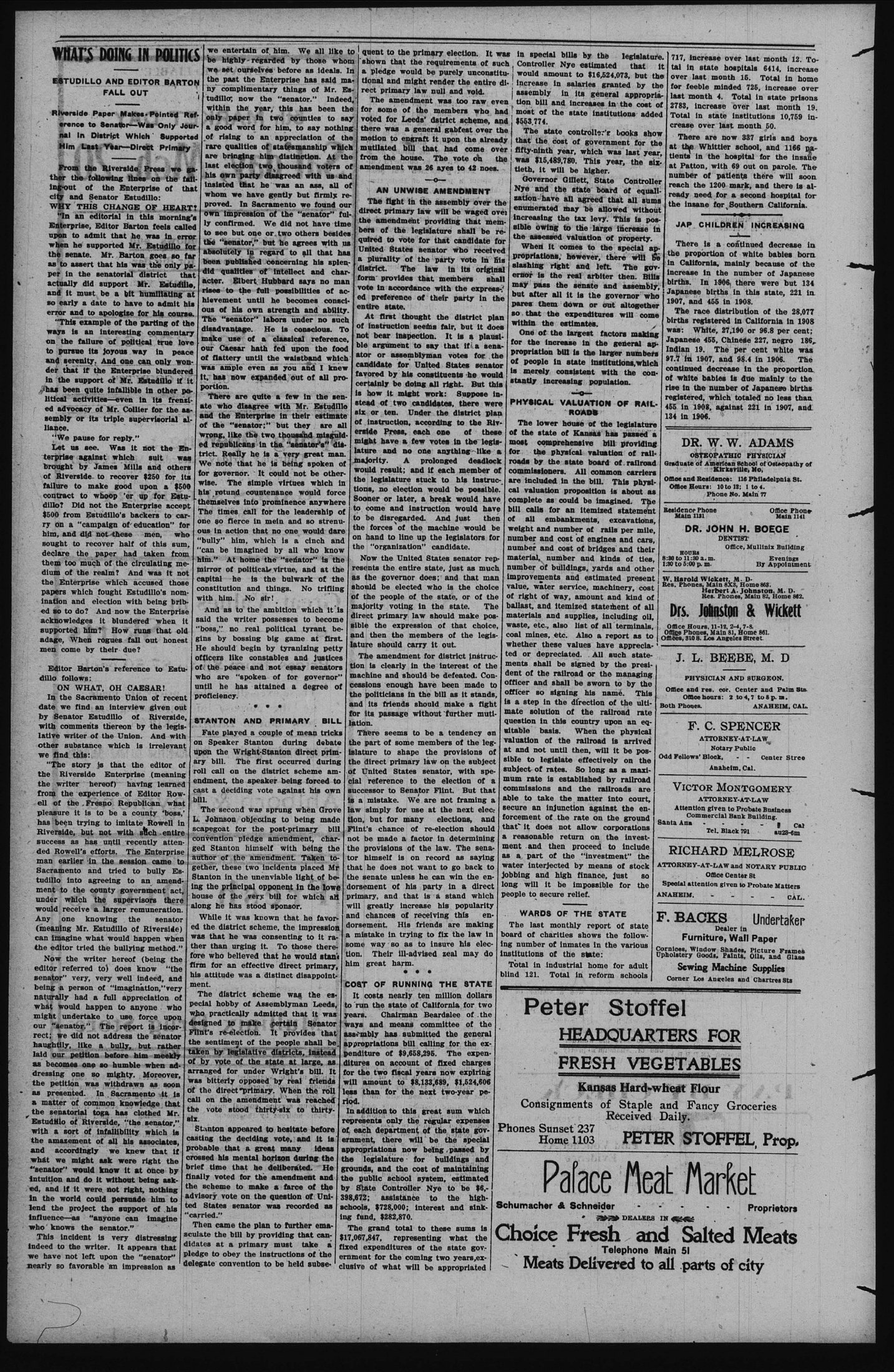
Searchable text
WHAT'S DOING IN POLITICS
ESTUDILLO AND EDITOR BARTON
FALL OUT
Riverside Paper Makes Pointed Reference to Senator—Was Only Journal in District Which Supported Him Last Year—Direct Primary
From the Riverside Press we gather the following lines on the falling-out of the Enterprise of that city and Senator Estudillo:
WHY THIS CHANGE OF HEART?
"In an editorial in this morning's Enterprise, Editor Barton feels called upon to admit that he was in error when he supported Mr. Estudillo for the senate. Mr. Barton goes so far as to assert that his was the only paper in the senatorial district that actually did support Mr. Estudillo, and it must be a bit humiliating at so early a date to have to admit his error and to apologize for his course.
'This example of the parting of the ways is an interesting commentary on the failure of political true love to pursue its joyous way in peace and serenity. And one can only wonder that if the Enterprise blundered in the support of Mr. Estudillo if it has been quite infallible in other political activities—even in its frenzied advocacy of Mr. Collier for the assembly or its triple supervisorial alliance.
"We pause for reply."
Let us see. Was it not the Enterprise against which suit was brought by James Mills and others of Riverside to recover $250 for its failure to make good upon a $500 contract to whoop 'er up for Estudillo? Did not the Enterprise accept we entertain of him. We all like be highly-regarded by those we set ourselves before as ideal, the past the Enterprise has said any complimentary things of Mr. Estudillo, now the "senator." In within the year, this has been only paper in two counties to a good word for him, to say no of rising to an appreciation of rare qualities of statesmanship we are bringing him distinction. At last election two thousand voters his own party disagreed with us insisted that he was an ass, and whom we have gently but firmly proved. In Sacramento we found own impression of the "senator" only confirmed. We did not have to see but one or two others beset the "senator," but he agrees absolutely in regard to all that been published concerning his spid qualities of intellect and character. Elbert Hubbard says no rises to the full possibilities of achievement until he becomes conscious of his own strength and ability. The "senator" labors under no disadvantage. He is conscious.
make use of a classical reference our Caesar hath fed upon the fiftieth flattery until the waistband wha was ample even as you and I knew it, has now expanded out of all portion.
There are quite a few in the state who disagree with Mr. Estudillo and the Enterprise in their estimation of the "senator;" but they are wrong, like the two thousand misgled republicans in the "senator's" trict. Really he is a very great man. We note that he is being spoken for governor. It could not be otherwise. The simple virtues which his rotund countenance would for themselves into prominence anywhere. The times call for the leadership
ed advocacy of Mr. Collier for the assembly or its triple supervisorial alliance.
"We pause for reply."
Let us see. Was it not the Enterprise against which suit was brought by James Mills and others of Riverside to recover $250 for its failure to make good upon a $500 contract to whoop 'er up for Estudillo? Did not the Enterprise accept $500 from Estudillo's backers to carry on a "campaign of education" for him, and did not these men, who sought to recover half of this sum, declare the paper had taken from them too much of the circulating medium of the realm? And was it not the Enterprise which accused those papers which fought Estudillo's nomination and election with being bribed so to do? And now the Enterprise acknowledges it blundered when it supported him? How runs that old adage, When rogues fall out honest men come by their due?
Editor Barton's reference to Estudillo follows:
ON WHAT, OH CAESAR!
In the Sacramento Union of recent date we find an interview given out by Senator Estudillo of Riverside, with comments thereon by the legislative writer of the Union. And with other substance which is irrelevant we find this:
"The story is that the editor of the Riverside Enterprise (meaning the writer hereof) having learned from the experience of Editor Rowell of the Fresno Republican what pleasure it is to be a county 'boss,' has been trying to imitate Rowell in Riverside, but not with such entire success as has until recently attended Rowell's efforts. The Enterprise man earlier in the session came to Sacramento and tried to bully Estudillo into agreeing to an amendment to the county government act, under which the supervisors there would receive a larger remuneration. Any one knowing the senator (meaning Mr. Estudillo of Riverside) can imagine what would happen when the editor tried the bullying method."
Now the writer hereof (being the editor referred to) does know "the
ate who disagree with Mr. Estudillo and the Enterprise in their estimation of the "senator;" but they are wrong, like the two thousand misgled republicans in the "senator's" district. Really he is a very great man. We note that he is being spoken for governor. It could not be otherwise. The simple virtues which his rotund countenance would force themselves into prominence anywhere. The times call for the leadership; one so fierce in mein and so strenuous in action that no one would da "bully" him, which is a cinch and "can be imagined by all who knn him." At home the "senator" is the mirror of political virtue, and at the capital he is the bulwark of the constitution and things. No trifling with him. No sir!
And as to the ambition which it said the writer possesses to become "boss," no real political tyrant bins by bossing big game at first. He should begin by tyranizing pet officers like constables and justice of the peace and not essay senators who are "spoken of for governor until he has attained a degree proficiency.
STANTON AND PRIMARY BILL
Fate played a couple of mean tricks on Speaker Stanton during debate upon the Wright-Stanton direct primary bill. The first occurred during roll call on the district scheme and endment, the speaker being forced cast a deciding vote against his own bill.
The second was sprung when Grow L. Johnson objecting to being made scapegoat for the post-primary bid convention pledge amendment, charged Stanton himself with being the author of the amendment. Taken together, these two incidents placed Mr. Stanton in the unenviable light of being the principal opponent in the low house of the very bill for which along he has stood sponsor.
While it was known that he favored the district scheme, the impression was that he was consenting to it rather than urging it. To those there fore who believed that he would stand firm for an effective direct primary
man earlier in the session came to Sacramento and tried to bully Estudillo into agreeing to an amendment to the county government act, under which the supervisors there would receive a larger remuneration. Any one knowing the senator (meaning Mr. Estudillo of Riverside) can imagine what would happen when the editor tried the bullying method."
Now the writer hereof (being the editor referred to) does know "the senator" very, very well indeed, and being a person of "imagination," very naturally had a full appreciation of what would happen to anyone who might undertake to use force upon our "senator." The report is incorrect; we did not address the senator haughtily, like a bully, but rather laid our petition before him meekly as becomes one so humble when addressing one so mighty. Moreover, the petition was withdrawn as soon as presented. In Sacramento it is a matter of common knowledge that the senatorial toga has clothed Mr. Estudillo of Riverside, "the senator," with a sort of infallibility which is the amazement of all his associates, and accordingly we knew that if what we might ask were right the "senator" would know it at once by intuition and do it without being asked, and if it were not right, nothing in the world could persuade him to lend the project the support of his influence—as "anyone can imagine who knows the senator."
This incident is very distressing indeed to the writer. It appears that we have not left upon the "senator" nearly so favorable an impression as
gether, these two incidents placed Mr. Stanton in the unenviable light of being the principal opponent in the low house of the very bill for which along he has stood sponsor.
While it was known that he favored the district scheme, the impression was that he was consenting to it rather than urging it. To those there fore who believed that he would stay firm for an effective direct primary his attitude was a distinct disappointment.
The district scheme was the especial hobby of Assemblyman Leeds who practically admitted that it was designed to make certain Senator Flint's re-election. It provides that the sentiment of the people shall be taken by legislative districts, instead of by vote of the state at large, as arranged for under Wright's bill. It was bitterly opposed by real friends of the direct primary. When the roll call on the amendment was reached the vote stood thirty-six to thirty-six.
Stanton appeared to hesitate before casting the deciding vote, and it is probable that a great many ideas crossed his mental horizon during the brief time that he deliberated. He finally voted for the amendment and the scheme to make a farce of the advisory vote on the question of United States senator was recorded as "carried."
Then came the plan to further emasculate the bill by providing that candidates at a primary must take a pledge to obey the instructions of the delegate convention to be held subse-
of him. We all like to regarded by those whom lives before as ideals. In Enterprise has said military things of Mr. Eshe "senator." Indeed, dear, this has been the two counties to say for him, to say nothing an appreciation of the of statesmanship which him distinction. At the two thousand voters of disagreed with us and he was an ass, all of the gently but firmly recramento we found our of the "senator" fulWe did not have time or two others besides but he agrees with us regard to all that has concerning his splen-of intellect and charHubbard says no man full possibilities of ac- he becomes consci- strength and ability. labors under no such He is conscious. To a classical reference, fed upon the food of the waistband which as you and I knew handed out of all prowrite a few in the sense with Mr. Estudillo rise in their estimate;" but they are all two thousand misguid- on the "senator's" dis- is a very great man. He is being spoken of it could not be other-ple virtues which in tenance would force prominence anywhere for the leadership of
quent to the primary election. It was shown that the requirements of such a pledge would be purely unconstitutional and might render the entire direct primary law null and void.
The amendment was too raw even for some of the members who had voted for Leeds' district scheme, and there was a general gabfest over the motion to engraft it upon the already mutilated bill that had come over from the house. The vote on the amendment was 26 ayes to 42 noes.
AN UNWISE AMENDMENT
The fight in the assembly over the direct primary law will be waged over the amendment providing that members of the legislature shall be required to vote for that candidate for United States senator who received a plurality of the party vote in his district. The law in its original form provides that members shall vote in accordance with the express- ed preference of their party in the entire state.
At first thought the district plan of instruction seems fair, but it does not bear inspection. It is a plausible argument to say that if a senator or assemblyman votes for the candidate for United States senator favored by his constituents he would certainly be doing all right. But this is how it might work: Suppose instead of two candidates, there were six or ten. Under the district plan of instruction, according to the Riverside Press, each one of these might have a few votes in the legislature and no one anything like a majority. A prolonged deadlock would result; and if each member of the legislature stuck to his instructions, no election would be possible. Sooner or later, a break would have to come and instruction would have in special bills by the legal Controller Nye estimated that would amount to $16,524,073, increase in salaries granted assembly in its general application bill and increases in the most of the state institutions $553,774.
The state controller's look at that the cost of government fifty-ninth year, which was last was $15,489,780. This year, it will be higher.
Governor Gillett, State Co-Nye and the state board ofization-have all agreed that an enumerated may be allowed increasing the tax levy. This issible owing to the large increase the assessed valuation of property.
When it comes to the speed propriations, however, there is slashing right and left. The error is the real arbiter there may pass the senate and assent but after all it is the governor pares them down or out altogether so that the expenditures will within the estimates.
One of the largest factors for the increase in the general propriation bill is the larger number of people in state institutions is merely consistent with the stantly increasing population.
PHYSICAL VALUATION OF ROADS
The lower house of the legislature of the state of Kansas has paid most comprehensive bill pro- for the physical valuation of roads by the state board of ra commissioners. All common ca- are included in the bill. This local valuation proposition is abo complete as could be imagined. bill calls for an itemized stat-
PRIMARY BILL
couple of mean tricks
ton during debate
Stanton direct primirst occurred during
district scheme amaker being forced to
vote against his own
sprung when Grove
tending to being made
the post-primary bill
amendment, charself with the amendment.
Taken to incidents placed Mr.
enviable light of bespponent in the lowe
bill for which all
sponsor.
known that he favoreme, the impression
consenting to it rat. To those therethat he would stanlive direct primary,
stead of two candidates, there were six or ten. Under the district plan of instruction, according to the Riverside Press, each one of these might have a few votes in the legislature and no one anything like a majority. A prolonged deadlock would result; and if each member of the legislature stuck to his instructions, no election would be possible. Sooner or later, a break would have to come and instruction would have to be disregarded. And just then the forces of the machine would be on hand to line up the legislators for the "organization" candidate.
Now the United States senator represents the entire state, just as much as the governor does; and that man should be elected who is the choice of the people of the state, or of the majority voting in the state. The direct primary law should make possible the expression of that choice, and then the members of the legislature should carry it out.
The amendment for district instruction is clearly in the interest of the machine and should be defeated. Concessions enough have been made to the politicians in the bill as it stands, and its friends should make a fight for its passage without further mutilation.
There seems to be a tendency on the part of some members of the legislature to shape the provisions of the direct primary law on the subject of United States senator, with special reference to the election of a successor to Senator Flint. But that is a mistake. We are not framing a law simply for use at the next election, but for many elections, and Flint's chance of re-election should not be made a factor in determining the provisions of the law. The senator himself is on record as saying that he does not want to go back to the senate unless he can win the endorsement of his party in a direct primary, and that is a stand which will greatly increase his popularity and chances of receiving this endorsement. His friends are making a mistake in trying to fix the law in some way so as to insure his election. Their ill-advised zeal may do him great harm.
PHYSICAL VALUATION OF ROADS
The lower house of the legislature of the state of Kansas has passed most comprehensive bill profor the physical valuation of roads by the state board of rail commissioners. All common care are included in the bill. This cal valuation proposition is abocomplete as could be imagined. Bill calls for an itemized state of all embankments, excavaweight and number of rails per number and cost of engines and number and cost of bridges and material, number and kinds of number of buildings, yards and improvements and estimated价值, water service, machinery of right of way, amount and kind ballast, and itemized statement materials and supplies, including waste, etc., also list of all termi- coal mines, etc. Also a report whether these values have appted or depreciated. All such ments shall be signed by the di- dent of the railroad or the man- officer and shall be sworn to by b- officer so signing his name. It is a step in the direction of the mate solution of the railroad question in this country upon a suitable basis. When the physivaluation of the railroad is arraat and not until then, will it be able to legislate effectively on subject of rates. So long as a numm rate is established by rail commissions and the railroads able to take the matter into csecure an injunction against ther forcement of the rate on the grievance that it does not allow corpora- a reasonable return on the im- ment and then proceed to inc- as a part of the "investment" water interjected by means of s- jobbing and high finance, just long will it be impossible for people to secure relief.
WARDS OF THE STATE
The last monthly report of a board of charities shows the folling number of inmates in the var- institutions of the state:
Total in industrial home for a
COST OF RUNNING THE STATE
It costs nearly ten million dollars to run the state of California for two years. Chairman Beardslee of the ways and means committee of the assembly has submitted the general appropriations bill calling for the expenditure of $9,658,295. The expenditures on account of fixed charges for the two fiscal years now expiring will amount to $8,133,689, $1,524,606 less than for the next two-year period.
In addition to this great sum which represents only the regular expenses of each department of the state government, there will be the special appropriations now being passed by the legislature for buildings and grounds, and the cost of maintaining the public school system, estimated by State Controller Nye to be $6,-398,672; assistance to the high schools, $728,000; interest and sinking fund, $282,870.
The grand total to these sums is $17,067,847, representing what the fixed expenditures of the state government for the coming two years exclusive of what will be appropriated
bills by the legislature. Nye estimated that it amount to $16,524,073, but the salaries granted by the state in its general appropriations increases in the cost of state institutions added.
The controller's books show cost of government for the year, which was last year, 1978. This year, the six will be higher.
Gillett, State Controller, the state board of equallity all agreed that all sums may be allowed without the tax levy. This is posed to the large increase in real valuation of property.
comes to the special application however, there will be right and left. The governor real arbiter then. Bills the senate and assembly, and it is the governor who down or out altogether expenditures will come estimates.
the largest factors making decrease in the general appillis is the larger numbers in state institutions, which consistent with the decreasing population.
VALUATION OF RAILROADS
House of the legislature of Kansas has passed a rehensive bill providing physical valuation of railroad state board of railroads. All common carriers in the bill. This physi proposition is about as could be imagined. The itemized statement
717, increase over last month 12. Total in state hospitals 6414, increase over last month 15. Total in home for feeble minded 725, increase over last month 4. Total in state prisons 2783, increase over last month 19. Total in state institutions 10,759 increase over last month 50.
There are now 337 girls and boys at the Whittier school, and 1166 patients in the hospital for the insane at Patton, with 69 out on parole. The number of patients there will soon reach the 1200 mark, and there is already need for a second hospital for the insane for Southern California.
JAP CHILDREN INCREASING
There is a continued decrease in the proportion of white babies born in California, mainly because of the increase in the number of Japanese births. In 1906 there were but 134 Japanese births in this state, 221 in 1907, and 455 in 1908.
The race distribution of the 28,077 births registered in California in 1908 was: White, 27,190 or 96.8 per cent; Japanese 455, Chinese 227, negro 186, Indian 19. The per cent white was 97.7 in 1907, and 98.4 in 1906. The continued decrease in the proportion of white babies is due mainly to the rise in the number of Japanese births registered, which totaled no less than 455 in 1908, against 221 in 1907, and 134 in 1906.
DR. W. W. ADAMS
OSTEOPATHIC PHYSICIAN
Graduate of American School of Osteopathy of Kirksville, Mo.
Office and Residence: 116 Philadelphia St.
Office Hours: 10 to 12; 1 to 4.
Phone No. Main 77
DR. W. W. ADAMS
OSTEOPATHIC PHYSICIAN
Graduate of American School of Osteopathy of Kirksville, Mo.
Office and Residence: 116 Philadelphia St.
Office Hours: 10 to 12; 1 to 4.
Phone No. Main 77
Residence Phone
Main 1131
Office Phone
Main 1141
DR. JOHN H. BOEGE
DENTIST
Office, Mullinix Building
HOURS
8:30 to 11:30 a.m.
Evenings
1:30 to 5:00 p.m.
By Appointment
W. Harold Wickett, M. D.
Res. Phones, Main 8X8, Home 863.
Herbert A. Johnston, M. D.
Res. Phones, Main 82, Home 862.
Drs. Johnston & Wickett
Office Hours, 11-12, 2-4, 7-8.
Office Phones, Main 81, Home 861.
Offices, 310 S. Los Angeles Street.
J. L. BEEBE, M. D
PHYSICIAN AND SURGEON.
Office and res. cor. Center and Palm Sts.
Office hours: 2 to 4, 7 to 8 p.m.
Both Phones.
ANAHEIM, CAL.
F. C. SPENCER
ATTORNEY-AT-LAW
Notary Public
Odd Fellows' Block,
Center Stree
Anaheim, Cal.
VICTOR MONTGOMERY
ATTORNEY-AT-LAW
Attention given to Probate Business
Commercial Bank Building.
Santa Ana - - - - Cal
Tel. Black 791 au23-6m
RICHARD MELROSE
ATTORNEY-AT-LAW and NOTARY PUBLIC
Office Center St
Special attention given to Probate Matters
ANAHEIM, - - - - CAL.
F. BACKS Undertaker
Dealer in
Furniture, Wall Paper
Cornices, Window Shades, Picture Frames
Upholstery Goods, Paints, Oils, and Glass
Sewing Machine Supplies
ATTORNEY-AT-LAW and NOTARY PUBLIC
Office Center St
Special attention given to Probate Matters
ANAHEIM. - - - - CAL.
F. BACKS Undertaker
Dealer in
Furniture, Wall Paper
Cornices, Window Shades, Picture Frames
Upholstery Goods, Palnts, Olls, and Glass
Sewing Machine Supplies
Corner Los Angeles and Chartres Sts
Peter Stoffel
HEADQUARTERS FOR
FRESH VEGETABLES
Kansas Hard-wheat Flour
Documents of Staple and Fancy Groceries
Received Daily.
Set 237
Line 1103 PETER STOFFEL, Prop.
Palace Meat Market
& Schneider Proprietors
DEALEPS IN
Fresh and Salted Meats
Telephone Main 51
Delivered to all parts of city