anaheim-gazette 1908-07-09
Scanned page
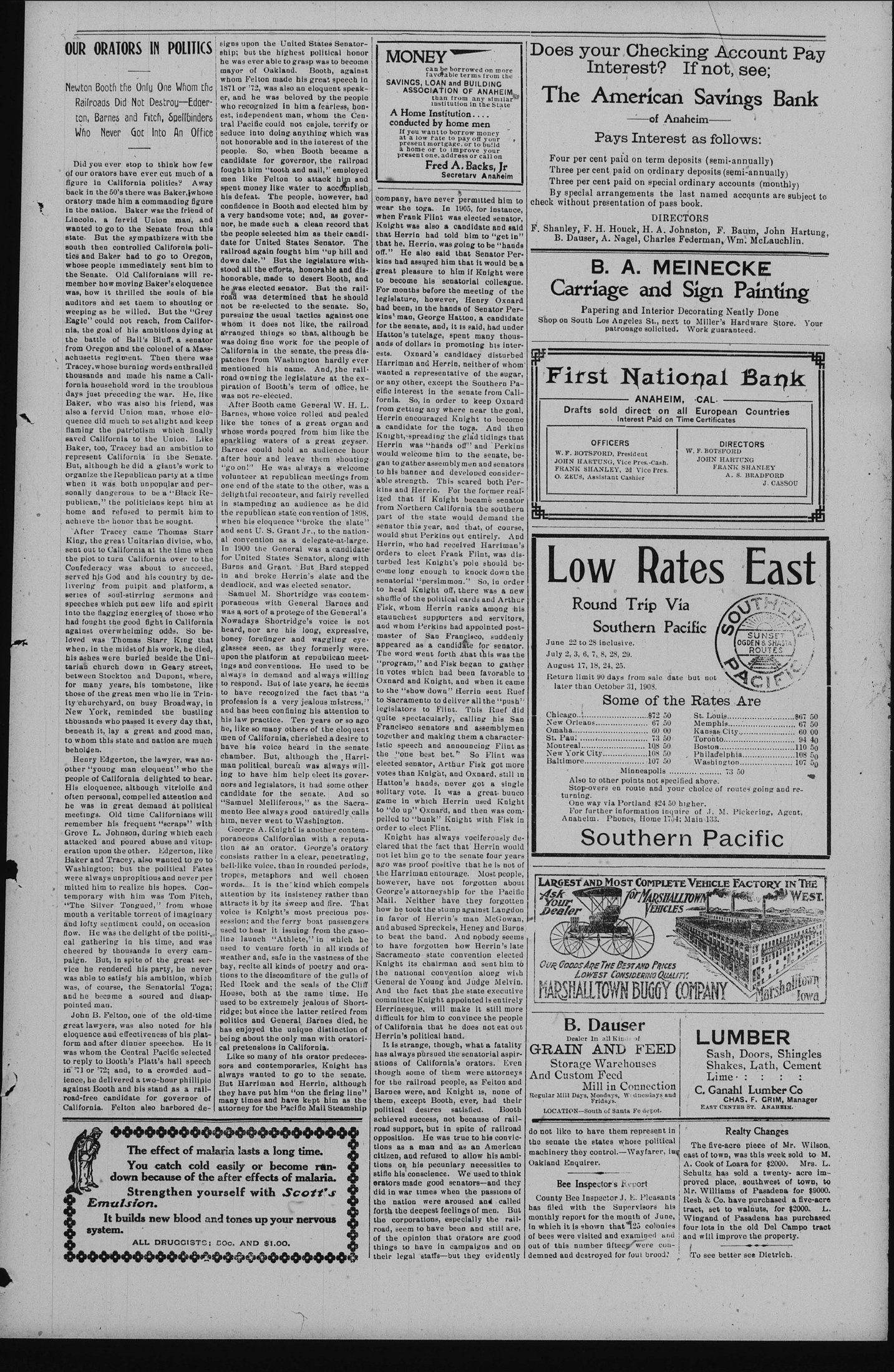
Searchable text
OUR ORATORS IN POLITICS
Newton Booth the Only One Whom the Railroads Did Not Destroy—Edgerton, Barnes and Fitch, Spellbinders Who Never Got Into An Office
Did you ever stop to think how few of our orators have ever cut much of a figure in California politics? Away back in the 50’s there was Baker, whose oratory made him a commanding figure in the nation. Baker was the friend of Lincoln, a fervid Union man, and wanted to go to the Senate from this state. But the sympathizers with the south then controlled California politics and Baker had to go to Oregon, whose people immediately sent him to the Senate. Old Californians will remember how moving Baker’s eloquence was, how it thrilled the souls of his auditors and set them to shouting or weeping as he willed. But the “Grey Eagle” could not reach, from California, the goal of his ambitions dying at the battle of Ball’s Bluff, a senator from Oregon and the colonel of a Massachusetts regiment. Then there was Tracey, whose burning words enthralled thousands and made his name a California household word in the troublous days just preceding the war. He, like Baker, who was also his friend, was also a fervid Union man, whose eloquence did much to set alight and keep flaming the patriotism which finally saved California to the Union. Like Baker, too, Tracey had an ambition to represent California in the Senate. But, although he did a giant’s work to organize the Republican party at a time when it was both unpopular and personally dangerous to be a “Black Republican,” the politicians kept him at home and refused to permit him to signs upon the United States ship; but the highest political he was ever able to grasp was the mayor of Oakland. Booth, whom Felton made his great son 1871 or ’72, was also an eloquenter, and he was beloved by those who recognized in him a fearless, independent man, whom central Pacific could not cajole, seduce into doing anything we not honorable and in the interest of people. So, when Booth became candidate for governor, the men like Felton to attack spent money like water to accuse his defeat. The people, however, confidence in Booth and elected a very handsome vote; and, after he made such a clean reelection the people selected him as the date for United States Senate railroad again fought him “up down dale.” But the legislature stood all the efforts, honorable, honorable, made to desert Booth he was elected senator. But road was determined that he not be re-elected to the senate pursuing the usual tactics against whom it does not like, the arranged things so that, although was doing fine work for the California in the senate, the patches from Washington had mentioned his name. And, road owning the legislature and inspiration of Booth’s term of office was not re-elected.
After Booth came General Barnes, whose voice rolled out like the tones of a great cow whose words poured from him sparkling waters of a great Barnes could hold an audience after hour and leave them “go on!” He was always a volunteer at republican meeting one end of the state to the other delightful reconteur, and fairly in stampeding an audience in the republican state conventions.
Baker, who was also his friend, was also a fervid Union man, whose eloquence did much to set alight and keep flaming the patriotism which finally saved California to the Union. Like Baker, too, Tracey had an ambition to represent California in the Senate. But, although he did a giant's work to organize the Republican party at a time when it was both unpopular and personally dangerous to be a "Black Republican," the politicians kept him at home and refused to permit him to achieve the honor that he sought.
After Tracey came Thomas Starr King, the great Unitarian divine, who sent out to California at the time when the plot to turn California over to the Confederacy was about to succeed, served his God and his country by delivering from pulpit and platform, a series of soul-stirring sermons and speeches which put new life and spirit into the flagging energies of those who had fought the good fight in California against overwhelming odds. So beloved was Thomas Starr King that when, in the midst of his work, he died, his ashes were buried beside the Unitarian church down in Geary street, between Stockton and Dupont, where, for many years, his tombstone, like those of the great men who lie in Trinity churchyard, on busy Broadway, in New York, reminded the bustling thousands who passed it every day that, beneath it, lay a great and good man, to whom this state and nation are much beholden.
Henry Edgerton, the lawyer, was another "young man eloquent" who the people of California delighted to hear. His eloquence, although vitriolic and often personal, compelled attention and he was in great demand at political meetings. Old time Californians will remember his frequent "scraps" with Grove L. Johnson, during which each attacked and poured abuse and vituperation upon the other. Edgerton, like Baker and Tracey, also wanted to go to Washington; but the political Fates were always unpropitious and never permitted him to realize his hopes. Contemporary with him was Tom Fitch, "The Silver Tongued," from whose mouth a veritable torrent of imaginary and lofty sentiment could, on occasion flow. He was the delight of the political gathering in his time, and was cheered by thousands in every campaign. But, in spite of the great service he rendered his party, he never
After Booth came General Barnes, whose voice rolled and like the tones of a great one whose words poured from him sparkling waters of a great Barnes could hold an audience after hour and leave them "go on!" He was always a volunteer at republican meeting one end of the state to the other delightful reconteur, and fairly in stampeding an audience at the republican state convention when his eloquence "broke thru and sent U. S. Grant Jr., to the al convention as a delegate." In 1900 the General was elected for United States Senator, and Burns and Grant. But Barnes in and broke Herrin's slate deadlock, and was elected senator.
Samuel M. Shortridge was poraneous with General Barnes was a sort of a protege of the C Nowadays Shortridge's voice heard, nor are his long, exhoney forefinger and waggle glasses seen, as they formerly upon the platform at republications and conventions. He uses always in demand and always to respond. But of late years, he to have recognized the fact profession is a very jealous man and has been confining his attention his law practice. Ten years ago he, like so many others of the men of California, cherished and have his voice heard in the chamber. But, although the man political bureau was alive to have him help elect its nors and legislators, it had so candidate for the senate.
"Samuel Melliferous," as the mento Bee always good natured him, never went to Washington.
George A. Knight is another poraneous Californian with a tion as an orator. George's consists rather in a clear, pen bell-like voice, than in rounded tropes, metaphors and well-words. It is the kind which attention by its insistency rays attracts it by its sweep and fine voice is Knight's most precise session; and the ferry boat paused to hear it issuing from a line launch "Athlete," in which used to venture forth in all weather and safe in the vast bay, recite all kinds of poetry.
Washington; but the political Fates were always unpropitious and never permitted him to realize his hopes. Contemporary with him was Tom Fitch, "The Silver Tongued," from whose mouth a veritable torrent of imaginary and lofty sentiment could, on occasion flow. He was the delight of the political gathering in his time, and was cheered by thousands in every campaign. But, in spite of the great service he rendered his party, he never was able to satisfy his ambition, which was, of course, the Senatorial Toga; and he became a soured and disappointed man.
John B. Felton, one of the old-time great lawyers, was also noted for his eloquence and effectiveness of his platform and after dinner speeches. He it was whom the Central Pacific selected to reply to Booth's Platt's hall speech in '71 or '72; and, to a crowded audience, he delivered a two-hour phillipic against Booth and his stand as a railroad-free candidate for governor of California. Felton also harbored de-
The effect of malaria lasts a long time.
You catch cold easily or become run-down because of the after effects of malaria.
Strengthen yourself with Scott's Emulsion.
It builds new blood and tones up your nervous system.
ALL DRUGGISTS: 50c. AND $1.00.
in the United States Senatorthe highest political honor
able to grasp was to become
Oakland. Booth, against
on made his great speech in
was also an eloquent speakwas beloved by the people
ized in him a fearless, hondent man, whom the Cencould not cajole, terrify or
do anything which was
able and in the interest of the
so, when Booth became a
for governor, the railroad
"tooth and nail," employed
Felton to attack him and
like water to accomplish
The people, however, had
in Booth and elected him by
some vote; and, as goverde such a clean record that
selected him as their candinited States Senator. The
main fought him "up hill and"
But the legislature withe efforts, honorable and dismmade to desert Booth, and
ed senator. But the raildetermined that he should
selected to the senate. So,
the usual tactics against one
does not like, the railroad
things so that, although he
dine work for the people of
in the senate, the press dism Washington hardly ever
his name. And, the railging the legislature at the exBooth's term of office, he
selected.
Both came General W. H. L.
rose voice rolled and pealed
ones of a great organ and
is poured from him like the
waters of a great geyser.
hold hold an audience hour
and leave them shouting
He was always a welcome
at republican meetings from
the state to the other, was a
reconteur, and fairly revelled
ing an audience as he did
MONEY
can be borrowed on more
favorable terms from the
SAVINGS, LOAN and BUILDING
ASSOCIATION OF ANAHEIM
than from any similar
institution in the State
A Home Institution...
conducted by home men
If you want to borrow money
at a low rate to pay off your
present mortgage, or to build
a home or to improve your
present one, address or call on
Fred A. Backs, Jr
Secretary Anaheim
company, have never permitted him to
wear the toga. In 1905, for instance,
when Frank Flint was elected senator,
Knight was also a candidate and said
that Herrin had told him to "get in"
that he. Herrin, was going to be "hands
off." He also said that Senator Perkins had assured him that it would be a great pleasure to him if Knight were to become his senatorial colleague.
For months before the meeting of the legislature, however, Henry Oxnard had been, in the hands of Senator Perkins' man, George Hatton, a candidate for the senate, and, it is said, had under Hatton's tutelage, spent many thousands of dollars in promoting his interests. Oxnard's candidacy disturbed Harriman and Herrin, neither of whom wanted a representative of the sugar,
or any other, except the Southern Pacific interest in the senate from California. So, in order to keep Oxnard from getting any where near the goal,
Herrin encouraged Knight to become a candidate for the toga. And then Knight, spreading the glad tidings that Herrin was "hands off" and Perkins would welcome him to the senate, began to gather assemblymen and senators to his banner and developed consider- able strength. This scared both Perkins and Herrin. For the former real- ized that if Knight became senator from Northern California the southern
Does your Coin?
Interest
The Amer
Pays
Four per cent paid
Three per cent paid
Three per cent paid
By special arrangecheck without presentat
F. Shanley, F. H. HoucB. Dauser, A. Nage
B. A
Carriage
Papering anShop on South Los Angle
patrona
First N
Drafts sold diinter
OFFICERS
W.F.BOTSFORD, PresiJOHN HARTUNG,ViceFRANK SHANLEY, 2d
O.ZEUS, Assistant Cas
both came General W. H. L.
rose voice rolled and pealed
ones of a great organ and
was poured from him like the
waters of a great geyser.
hold an audience hour
and leave them shouting.
He was always a welcome
at republican meetings from
the state to the other, was a
reconteur, and fairly revelled
ing an audience as he did
can state convention of 1898,
loquence "broke the slate"
S. Grant Jr., to the nationion as a delegate-at-large.
General was a candidate
States Senator, along with
Grant. But Bard stepped
Herrin's slate and the
and was elected senator.
M. Shortridge was contemwith General Barnes and
of a protege of the General's
Shortridge's voice is not
are his long, expressive,
finger and waggling eyeen, as they formerly were,
platform at republican meetventions. He used to be
demand and always willing
But of late years, he seems
recognized the fact that "a
is a very jealous mistress,"
en confining his attention to
actice. Ten years or so ago
many others of the eloquent
california, cherished a desire to
voice heard in the senate
But, although the Harriral bureau was always wille him help elect its goverligators, it had some other
for the senate. And so
Melliferous," as the Sacraalways good naturedly calls
went to Washington.
Knight is another contemCalifornian with a reputaorator. George's oratory
ther in a clear, penetrating,
rice, than in rounded periods,
staphors and well chosen
is the kind which compels
by its insistency rather than
by its sweep and fire. That
night's most precious posl the ferry boat passengers
or it issuing from the gasoh "Athlete," in which he
enture forth in all kinds of
safe, safe in the vastness of the
all kinds of poetry and ora-
from getting any where near the goal,
Herrin encouraged Knight to become
a candidate for the toga. And then
Knight, spreading the glad tidings that
Herrin was "hands off" and Perkins
would welcome him to the senate, began to gather assemblymen and senators
to his banner and developed considerable strength. This scared both Perkins and Herrin. For the former realized that if Knight became senator
from Northern California the southern part of the state would demand the senator this year, and that, of course,
would shut Perkins out entirely. And
Herrin, who had received Harriman's orders to elect Frank Flint, was disturbed lest Knight's pole should become long enough to knock down the senatorial "persimmon." So, in order to head Knight off, there was a new shuffle of the political cards and Arthur Fisk, whom Herrin ranks among his staunchest supporters and servitors,
and whom Perkins had appointed postmaster of San Francisco, suddenly appeared as a candidate for senator.
The word went forth that this was the "program," and Fisk began to gather in votes which had been favorable to Oxnard and Knight, and when it came to the "show down" Herrin sent Ruef to Sacramento to deliver all the "push" legislators to Flint. This Ruef did quite spectacularly, calling his San Francisco senators and assemblymen together and making them a characteristic speech and announcing Flint as the "one best bet." So Flint was elected senator, Arthur Fisk got more votes than Knight, and Oxnard, still in Hatton's hands, never got a single solitary vote. It was a great bunco game in which Herrin used Knight to "do up" Oxnard, and then was compelled to "bunk" Knight with Fisk in order to elect Flint.
Knight has always vociferously declared that the fact that Herrin would not let him go to the senate four years ago was proof positive that he is not of the Harriman entourage. Most people, however, have not forgotten about George's attorneyship for the Pacific Mail. Neither have they forgotten how he took the stump against Langdon in favor of Herrin's man McGowan, and abused Spreckels, Heney and Burns to beat the band. And nobody seems to have forgotten how Herrin's late Sacramento state convention elected Knight its chairman and sent him to
ice, than in rounded periods,
staphors and well chosen
is the kind which compels
by its insistency rather than
by its sweep and fire. That
night's most precious possail the ferry boat passengers
for it issuing from the gasoth "Athlete," in which he
venture forth in all kinds of
aid, safe in the vastness of the
small kinds of poetry and oradiscomfiture of the gulls of
and the seals of the Cliff
ath at the same time. He
extremely jealous of Shortsince the latter retired from
and General Barnes died, he
and the unique distinction of
at the only man with oratoriions in California.
Many of his orator predecescontemporaries, Knight has
attended to go to the senate.
man and Herrin, although
but him "on the firing line"
and have kept him as the
for the Pacific Mail Steamship
ago was proof positive that he is not of
the Harriman entourage. Most people,
however, have not forgotten about
George's attorneyship for the Pacific
Mail. Neither have they forgotten
how he took the stump against Langdon
in favor of Herrin's man McGowan,
and abused Spreckels, Heney and Burns
to beat the band. And nobody seems
to have forgotten how Herrin's late
Sacramento state convention elected
Knight its chairman and sent him to
the national convention along with
General de Young and Judge Melvin.
And the fact that the state executive committee Knight appointed is entirely Herrinesque, will make it still more difficult for him to convince the people of California that he does not eat out Herrin's political hand.
It is strange, though, what a fatality has always pursued the senatorial aspirations of California's orators. Even though some of them were attorneys for the railroad people, as Felton and Barnes were, and Knight is, none of them, except Booth, ever, had their political desires satisfied. Booth achieved success, not because of railroad support, but in spite of railroad opposition. He was true to his convictions as a man and as an American citizen, and refused to allow his ambitions or his pecuniary necessities to stifle his conscience. We used to think orators made good senators—and they did in war times when the passions of the nation were aroused and called forth the deepest feelings of men. But the corporations, especially the railroad, seem to have been and still are, of the opinion that orators are good things to have in campaigns and on their legal staffs—but they evidently
LARGEST AND MOST
Ask Your Dealer
OUR GOODS ARE THE BEST
LOWEST CONSUME
B. Dause
Dealer In all Kind
GRAIN AND
Storage Warehouse
And Custom Feed
Mill in Co
Regular Mill Days, Mondays, W
Fridays.
LOCATION—South of Santa
do not like to have them r
the senate the states who
machinery they control.—W
Oakland Enquirer.
Bee Inspector's Re
County Bee Inspector J. H.
has filed with the Supermonthly report for the monin which it is shown that T
of bees were visited and exaout of this number fifteen
demned and destroyed for fo
Does your Checking Account Pay Interest? If not, see;
The American Savings Bank
of Anaheim
Pays Interest as follows:
Four per cent paid on term deposits (semi-annually)
Three per cent paid on ordinary deposits (semi-annually)
Three per cent paid on special ordinary accounts (monthly)
Any special arrangements the last named account are subject to without presentation of pass book.
DIRECTORS
Hanley, F. H. Houck, H. A. Johnston, F. Baum, John Hartung,
L. Dauser, A. Nagel, Charles Federman, Wm. McLauchlin.
B. A. MEINECKE
Carriage and Sign Painting
Papering and Interior Decorating Neatly Done
on South Los Angeles St., next to Miller's Hardware Store. Your patronage solicited. Work guaranteed.
First National Bank
ANAHEIM, CAL.
Drafts sold direct on all European Countries
Interest Paid on Time Certificates
OFFICERS
W. F. BOTSFORD, President
JOHN HARTUNG, Vice Pres.-Cash.
FRANK SHANLEY, 2d Vice Pres.
A. ZEUS, Assistant Cashier
DIRECTORS
W. F. BOTSFORD
JOHN HARTUNG
FRANK SHANLEY
A. S. BRADFORD
J. CASSOU
Drafts sold direct on all European Countries
Interest Paid on Time Certificates
OFFICERS
W. F. BOTSFORD, President
JOHN HARTUNG, Vice Pres.-Cash.
FRANK SHANLEY, 2d Vice Pres.
ZEUS, Assistant Cashier
DIRECTORS
W. F. BOTSFORD
JOHN HARTUNG
FRANK SHANLEY
A. S. BRADFORD
J. CASSOU
Low Rates East
Round Trip Via
Southern Pacific
e 22 to 28 inclusive.
July 2, 3, 6, 7, 8, 28, 29.
August 17, 18, 24, 25.
Return limit 90 days from sale date but not later than October 31, 1908.
Some of the Rates Are
Chicago.....$72 50 St. Louis.....$67 50
New Orleans.....67 50 Memphis.....67 50
Omaha.....60 00 Kansas City.....60 00
Paul.....73 50 Toronto.....94 40
Montreal.....108 50 Boston.....110 50
New York City.....108 50 Philadelphia.....108 50
Timore.....107 50 Washington.....107 50
Minneapolis ..... 73 50
Also to other points not specified above.
Stop-overs en route and your choice of routes going and returning.
One way via Portland $24 50 higher.
For further information inquire of J. M. Pickering, Agent,
Anaheim. Phones, Home 1754; Main 133.
Southern Pacific
B. Dauser
Dealer In all kinds of
MAIN AND FEED
Storage Warehouses
Custom Feed
Mill in Connection
Mill Days, Mondays, Wednesdays and Fridays.
TION—South of Santa Fe depot.
LUMBER
Sash, Doors, Shingles
Shakes, Lath, Cement
Lime:
C. Ganahl Lumber Co
CHAS. F. GRIM, Manager
EAST CENTER ST. ANAHEIM.
Bee Inspector's Report
By Bee Inspector J. E. Pleasants
with the Supervisors his
report for the month of June,
it is shown that 125 colonies
were visited and examined and
his number fifteen were conand destroyed for four brood.
Realty Changes
The five-acre piece of Mr. Wilson,
east of town, was this week sold to M.
A. Cook of Loara for $2000. Mrs. L.
Schultz has sold a twenty-acre improved place, southwest of town, to
Mr. Williams of Pasadena for $9000.
Resh & Co. have purchased a five-acre
tract, set to walnuts, for $2000. L.
Wingand of Pasadena has purchased
four lots in the old Del Campo tract
and will improve the property.
To see better see Dietrich.