anaheim-gazette 1908-03-26
Scanned page
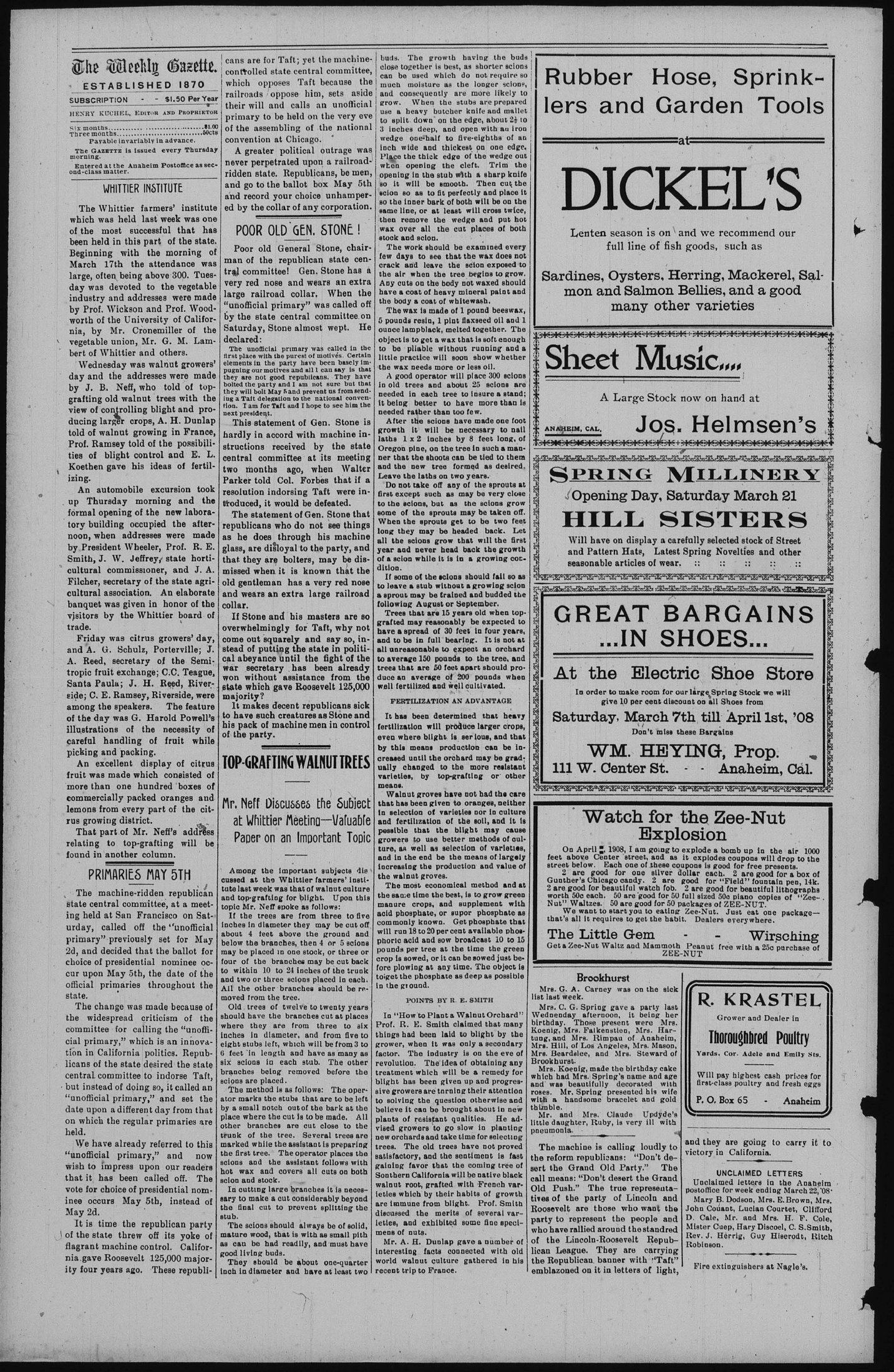
Searchable text
The Weekly Gazette.
ESTABLISHED 1870
SUBSCRIPTION - $1.50 Per Year
HENRY KUCHEL, EDITOR AND PROPRIETOR
Six months...$1.00
Three months...50cts
Payable invariably in advance.
The Gazette is issued every Thursday morning.
Entered at the Anaheim Postoffice as second-class matter.
WHITTIER INSTITUTE
The Whittier farmers' institute which was held last week was one of the most successful that has been held in this part of the state. Beginning with the morning of March 17th the attendance was large, often being above 300. Tuesday was devoted to the vegetable industry and addresses were made by Prof. Wickson and Prof. Woodworth of the University of California, by Mr. Cronemiller of the vegetable union, Mr. G. M. Lambert of Whittier and others.
Wednesday was walnut growers' day and the addresses were made by J. B. Neff, who told of top-grafting old walnut trees with the view of controlling blight and producing larger crops, A. H. Dunlap told of walnut growing in France, Prof. Ramsey told of the possibilities of blight control and E. L. Koethen gave his ideas of fertilizing.
An automobile excursion took up Thursday morning and the formal opening of the new labor cans are for Taft; yet the controlled state central colony which opposes Taft because railroads oppose him, sees their will and calls an primary to be held on the of the assembling of the convention at Chicago.
A greater political outcry never perpetrated upon a ridden state. Republicans and go to the ballot box and record your choice united by the collar of any corp.
POOR OLD GEN. STATE
Poor old General Stone man of the republican central committee! Gen. Stone very red nose and wears a large railroad collar. We "unofficial primary" was declared by the state central committee Saturday, Stone almost willed:
The unofficial primary was called first place with the purest of motive elements in the party have been pugnuring our motives and all I can they are not good republicans. Bolted the party and I am not sure they will bolt May 5 and prevent using a Taft delegation to the nation. I am for Taft and I hope to next president.
This statement of Gen. hardly in accord with main instructions received by the central committee at its two months ago, when Parker told Col. Forbes resolution indorsing Taft produced, it would be defensible.
view of controlling blight and producing larger crops, A. H. Dunlap told of walnut growing in France, Prof. Ramsey told of the possibilities of blight control and E. L. Koethen gave his ideas of fertilizing.
An automobile excursion took up Thursday morning and the formal opening of the new laboratory building occupied the afternoon, when addresses were made by President Wheeler, Prof. R. E. Smith, J. W. Jeffrey, state horticultural commissioner, and J. A. Filcher, secretary of the state agricultural association. An elaborate banquet was given in honor of the visitors by the Whittier board of trade.
Friday was citrus growers' day, and A. G. Schulz, Porterville; J. A. Reed, secretary of the Semitropic fruit exchange; C.C. Teague, Santa Paula; J. H. Reed, Riverside; C. E. Ramsey, Riverside, were among the speakers. The feature of the day was G. Harold Powell's illustrations of the necessity of careful handling of fruit while picking and packing.
An excellent display of citrus fruit was made which consisted of more than one hundred boxes of commercially packed oranges and lemons from every part of the citrus growing district.
That part of Mr. Neff's address relating to top-grafting will be found in another column.
PRIMARIES MAY 5TH
The machine-ridden republican state central committee, at a meeting held at San Francisco on Saturday, called off the "unofficial primary" previously set for May 2d, and decided that the ballot for choice of presidential nominee oc-
PRIMARIES MAY 5TH
The machine-ridden republican state central committee, at a meeting held at San Francisco on Saturday, called off the "unofficial primary" previously set for May 2d, and decided that the ballot for choice of presidential nominee occur upon May 5th, the date of the official primaries throughout the state.
The change was made because of the widespread criticism of the committee for calling the "unofficial primary," which is an innovation in California politics. Republicans of the state desired the state central committee to indorse Taft, but instead of doing so, it called an "unofficial primary," and set the date upon a different day from that on which the regular primaries are held.
We have already referred to this "unofficial primary," and now wish to impress upon our readers that it has been called off. The vote for choice of presidential nominee occurs May 5th, instead of May 2d.
It is time the republican party of the state threw off its yoke of flagrant machine control. California gave Roosevelt 125,000 majority four years ago. These republi-
Among the important subcussed at the Whittier farmstitute last week was that of walnuts and top-grafting for blight. Topic Mr. Neff spoke as follow:
If the trees are from three inches in diameter they may be about 4 feet above the ground below the branches, then 4 or may be placed in one stock, or four of the branches may be to within 10 to 24 inches of the tree and two or three scions placed. All the other branches should moved from the tree.
Old trees of twelve to twenty should have the branches cut where they are from three inches in diameter, and from eight stubs left, which will be 6 feet in length and have as six scions in each stub. The branches being removed be scions are placed.
The method is as follows: The operator marks the stubs that are by a small notch out of the base place where the cut is to be made; other branches are cut close trunk of the tree. Several marked while the assistant is plying the first tree. The operator presses and the assistant fold hot wax and covers all cuts scion and stock.
In cutting large branches it sary to make a cut considerable the final cut to prevent splitting stub.
The scions should always be mature wood, that is with as as can be had readily, and good living buds.
They should be about one inch in diameter and have at
for Taft; yet the machineed state central committee,
supposes Taft because the
oppose him, sets aside
and calls an unofficial
to be held on the very eve
assembling of the national
on at Chicago.
After political outrage was
perpetrated upon a railroadstate. Republicans, be men,
to the ballot box May 5th
and your choice unhamperthe collar of any corporation.
OLD GEN. STONE!
Old General Stone, chairthe republican state cenmittee! Gen. Stone has a
nose and wears an extra
railroad collar. When the
"final primary" was called off
state central committee on
Stone almost wept. He
Official primary was called in the
with the purest of motives. Certain
the party have been basely immotives and all I can say is that
not good republicans. They have
party and I am not sure but that
it May 5 and prevent us from sendrelegation to the national convenor Taft and I hope to see him the
ent.
Statement of Gen. Stone is
accord with machine ins received by the state
committee at its meeting
aths ago, when Walter
Col. Forbes that if a
indorsing Taft were init would be defeated.
buds. The growth having the buds
close together is best, as shorter scions
can be used which do not require so
much moisture as the longer scions,
and consequently are more likely to
grow. When the stubs are prepared
use a heavy butcher knife and mallet
to split down on the edge, about 21 to
3 inches deep, and open with an iron
wedge one-half to five-eighths of an
inch wide and thickest on one edge.
Place the thick edge of the wedge out
when opening the cleft. Trim the
opening in the stub with a sharp knife
so it will be smooth. Then cut the
scion so as to fit perfectly and place it
so the inner bark of both will be on the
same line, or at least will cross twice,
then remove the wedge and put hot wax over all the cut places of both stock and scion.
The work should be examined every few days to see that the wax does not crack and leave the scion exposed to the air when the tree begins to grow. Any cuts on the body not waxed should have a coat of heavy mineral paint and the body a coat of whitewash.
The wax is made of 1 pound beeswax,
5 pounds resin, 1 pint flaxseed oil and 1 ounce lampblack, melted together. The object is to get a wax that is soft enough to be pliable without running and a little practice will soon show whether the wax needs more or less oil.
A good operator will place 300 scions in old trees and about 25 scions are needed in each tree to insure a stand; it being better to have more than is needed rather than too few.
After the scions have made one foot growth it will be necessary to nail laths 1 x 2 inches by 8 feet long, of Oregon pine, on the tree in such a manner that the shoots can be tied to them and the new tree formed as desired. Leave the laths on two years.
Do not take off any of the sprouts at first except such as may be very close to the scions, but as the scions grow some of the sprouts may be taken off.
Statement of Gen. Stone is accord with machine in-works received by the state committee at its meeting years ago, when Walter Wald Col. Forbes that if a man indorsing Taft were in it would be defeated.
Statement of Gen. Stone that men who do not see things goes through his machine disloyal to the party, and are bolters, may be disheen it is known that the woman has a very red nose is an extra large railroad
and his masters are so sinningly for Taft, why not squarely and say so, insulting the state in politi-ance until the fight of the dietary has been already out assistance from the which gave Roosevelt 125,000
descent republicans sick such creatures as Stone and of machine men in control city.
AFTING WALNUT TREES
Discusses the Subject Better Meeting—Valuable on an Important Topic
the important subjects dis the Whittier farmers' institek was that of walnut cultureafting for blight. Upon this Neff spoke as follows:
trees are from three to five diameter they may be cut off feet above the ground and branches, then 4 or 5 scions ced in one stock, or three or branches may be cut back 10 to 24 inches of the trunk
It being better to have more than is needed rather than too few.
After the scions have made one foot growth it will be necessary to nail laths 1 x 2 inches by 8 feet long, of Oregon pine, on the tree in such a manner that the shoots can be tied to them and the new tree formed as desired. Leave the laths on two years.
Do not take off any of the sprouts at first except such as may be very close to the scions, but as the scions grow some of the sprouts may be taken off. When the sprouts get to be two feet long they may be headed back. Let all the scions grow that will the first year and never head back the growth of a scion while it is in a growing condition.
If some of the scions should fail so as to leave a stub without a growing scion a sprout may be trained and budded the following August or September.
Trees that are 15 years old when top-grafted may reasonably be expected to have a spread of 30 feet in four years, and to be in full bearing. It is not at all unreasonable to expect an orchard to average 150 pounds to the tree, and trees that are 50 feet apart should produce an average of 200 pounds when well fertilized and well cultivated.
FERTILIZATION AN ADVANTAGE
It has been determined that heavy fertilization will produce larger crops, even where blight is serious, and that by this means production can be increased until the orchard may be gradually changed to the more resistant varieties, by top-grafting or other means.
Walnut groves have not had the care that has been given to oranges, neither in selection of varieties nor in culture and fertilization of the soil, and it is possible that the blight may cause growers to use better methods of culture, as well as selection of varieties, and in the end be the means of largely increasing the production and value of the walnut groves.
The most economical method and at the same time the best, is to grow green manure crops, and supplement with acid phosphate, or supor phosphate as commonly known. Get phosphate that will run 18 to 20 per cent available phosphoric acid and sow broadcast 10 to 15 pounds per tree at the time the green crop is sowed, or it can be sowed just before plowing at any time. The object is
the important subjects discussed in the Whittier farmers' institute was that of walnut culture, grafting for blight. Upon this Neff spoke as follows:
trees are from three to five diameters they may be cut off from above the ground and branches, then 4 or 5 scions placed in one stock, or three or four branches may be cut back 10 to 24 inches of the trunk three scions placed in each other branches should be re-placed.
of twelve to twenty years the branches cut at places they are from three to six diameters, and from five to eight left, which will be from 3 to length and have as many as nine in each stub. The other being removed before the replaced.
good is as follows: The operator the stubs that are to be left notch out of the bark at the time the cut is to be made. All branches are cut close to the tree. Several trees are still the assistant is preparing tree. The operator places the assistant follows with hand covers all cuts on both stock.
large branches it is necessary a cut considerably beyond but to prevent splitting the branches should always be of solid wood, that is with as small pith had readily, and must have buds.
should be about one-quarter diameter and have at least two increasing the production and value of the walnut groves.
The most economical method and at the same time the best, is to grow green manure crops, and supplement with acid phosphate, or supor phosphate as commonly known. Get phosphate that will run 18 to 20 per cent available phosphoric acid and sow broadcast 10 to 15 pounds per tree at the time the green crop is sowed, or it can be sowed just before plowing at any time. The object is to get the phosphate as deep as possible in the ground.
POINTS BY R. E. SMITH
In "How to Plant a Walnut Orchard" Prof. R. E. Smith claimed that many things had been laid to blight by the grower, when it was only a secondary factor. The industry is on the eve of revolution. The idea of obtaining any treatment which will be a remedy for blight has been given up and progressive growers are turning their attention to solving the question otherwise and believe it can be brought about in new plants of resistant qualities. He advised growers to go slow in planting new orchards and take time for selecting trees. The old trees have not proved satisfactory, and the sentiment is fast gaining favor that the coming tree of Southern California will be native black walnut root, grafted with French varieties which by their habits of growth are immune from blight. Prof. Smith discussed the merits of several varieties, and exhibited some fine specimens of nuts.
Mr. A. H. Dunlap gave a number of interesting facts connected with old world walnut culture gathered in his recent trip to France.
Rubber Hose, Sprinklers and Garden Tools
at
DICKEL'S
Lenten season is on and we recommend our full line of fish goods, such as
Cardines, Oysters, Herring, Mackerel, Salmon and Salmon Bellies, and a good many other varieties
Sheet Music...
A Large Stock now on hand at
Jos. Helmsen's
SPRING MILLINERY
Opening Day, Saturday March 21
Jos. Helmsen's
SPRING MILLINERY
Opening Day, Saturday March 21
HILL SISTERS
Will have on display a carefully selected stock of Street and Pattern Hats, Latest Spring Novelties and other seasonable articles of wear.
GREAT BARGAINS ... IN SHOES...
At the Electric Shoe Store
In order to make room for our large Spring Stock we will give 10 per cent discount on all Shoes from Saturday, March 7th till April 1st, '08
Don't miss these Bargains
WM. HEYING, Prop.
11 W. Center St. - Anaheim, Cal.
Watch for the Zee-Nut Explosion
On April 1, 1908, I am going to explode a bomb up in the air 1000 feet above Center street, and as it explodes coupons will drop to the street below. Each one of these coupons is good for free presents.
2 are good for one silver dollar each. 2 are good for a box of Father’s Chicago candy. 2 are good for “Field” fountain pen, 14k. 2 are good for beautiful lithographs with 50c each. 50 are good for 50 full sized 50c piano copies of “Zee-Nut” Waltzes. 50 are good for 50 packages of ZEE-NUT.
We want to start you to eating Zee-Nut. Just eat one package—it’s all it requires to get the habit. Dealers everywhere.
The Little Gem - Wirsching
a Zee-Nut Waltz and Mammoth Peanut free with a 25c purchase of ZEE-NUT
Brookhurst
G. A. Carney was on the sick week.
C. G. Spring gave a party last Sunday afternoon, it being her day. Those present were Mrs. Mrs. Falkenstien, Mrs. Hard-Mrs. Rimpau of Anaheim, all, of Los Angeles, Mrs. Mason, Gardslee, and Mrs. Steward of Hurst.
Koenig, made the birthday cake and Mrs. Spring's name and age is beautifully decorated with Mr. Spring presented his wife handsome bracelet and gold and Mrs. Claude Updyde's daughter, Ruby, is very ill withonia.
Machine is calling loudly to form republicans: "Don't de- the Grand Old Party." The ans: "Don't desert the Grand rush." The true representa- the party of Lincoln and Celt are those who want the to represent the people and we rallied around the standred Lincoln-Roosevelt Repub-League. They are carrying publican banner with "Taft"oned on it in letters of light,
R. KRASTEL
Grower and Dealer in
Thoroughbred Poultry
Yards, Cor. Adele and Emily Sts.
Will pay highest cash prices for first-class poultry and fresh eggs
P. O. Box 65 - Anaheim
and they are going to carry it to victory in California.
UNCLAIMED LETTERS
Unclaimed letters in the Anaheim postoffice for week ending March 22, '08.
Mary B. Dodson, Mrs. E. Brown, Mrs. John Couant, Lucian Courtet, Clifford D. Cale, Mr. and Mrs. H. F. Cole, Mister Cuep, Hary Discoel, C. S.Smith, Rev. J. Herrig, Guy Hiserodt, Ritch Robinson.
Fire extinguishers at Nagle's.