anaheim-gazette 1906-08-09
Scanned page
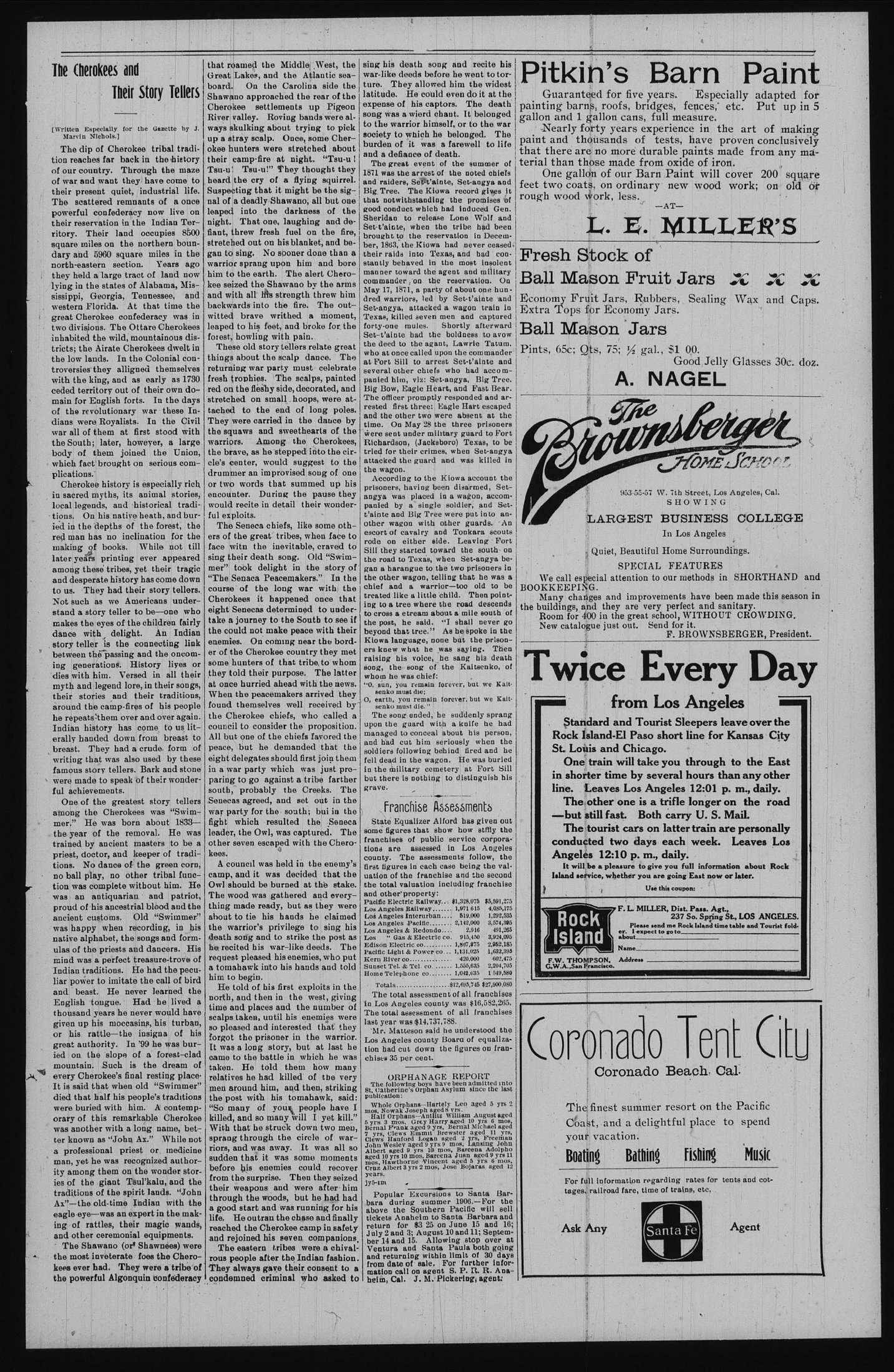
Searchable text
The Cherokees and Their Story Tellers
[Written Especially for the Gazette by J. Marvin Nichols.]
The dip of Cherokee tribal tradition reaches far back in the history of our country. Through the maze of war and want they have come to their present quiet, industrial life. The scattered remnants of a once powerful confederacy now live on their reservation in the Indian Territory. Their land occupies 8500 square miles on the northern boundary and 5960 square miles in the north-eastern section. Years ago they held a large tract of land now lying in the states of Alabama, Mississippi, Georgia, Tennessee, and western Florida. At that time the great Cherokee confederacy was in two divisions. The Ottare Cherokees inhabited the wild, mountainous districts; the Airate Cherokees dwelt in the low lands. In the Colonial controversies they alligned themselves with the king, and as early as 1730 ceded territory out of their own domain for English forts. In the days of the revolutionary war these Indians were Royalists. In the Civil war all of them at first stood with the South; later, however, a large body of them joined the Union, which fact brought on serious complications.
Cherokee history is especially rich in sacred myths, its animal stories, local legends, and historical traditions that roamed the Middle West Great Lakes, and the Atlantic board. On the Carolina side Shawano approached the rear of Cherokee settlements up Pine River valley. Roving bands were ways skulking about trying to up a stray scalp. Once, some Cherokee hunters were stretched at their camp-fire at night. "The Tsu-u! Tsu-u!" They thought heard the cry of a flying squirrel of a deadly Shawano, all but leaped into the darkness of night. That one, laughing and fiant, threw fresh fuel on their stretched out on his blanket, and gan to sing. No sooner done than warrior sprang upon him and him to the earth. The alert Cherokee seized the Shawano by their hand with all his strength threw backwards into the fire. They witted brave writhed a moan leaped to his feet, and broke for forest, howling with pain.
These old story tellers relate things about the scalp dance, returning war party must celebrate fresh trophies. The scalps, painted on the fleshy side, decorated stretched on small hoops, were tached to the end of long They were carried in the dance the squaws and sweethearts of warriors. Among the Cherokee the brave, as he stepped into the cle's center, would suggest the drummer an improvised song or two words that summed up encounter. During the pause would recite in detail their wor
of the revolutionary war these Indians were Royalists. In the Civil war all of them at first stood with the South; later, however, a large body of them joined the Union, which fact brought on serious complications.
Cherokee history is especially rich in sacred myths, its animal stories, local legends, and historical traditions. On his native heath, and buried in the depths of the forest, the red man has no inclination for the making of books. While not till later years printing ever appeared among these tribes, yet their tragic and desperate history has come down to us. They had their story tellers. Not such as we Americans understand a story teller to be—one who makes the eyes of the children fairly dance with delight. An Indian story teller is the connecting link between the passing and the oncoming generations. History lives or dies with him. Versed in all their myth and legend lore, in their songs, their stories and their traditions, around the camp-fires of his people he repeats them over and over again. Indian history has come to us literally handed down from breast to breast. They had a crude form of writing that was also used by these famous story tellers. Bark and stone were made to speak of their wonderful achievements.
One of the greatest story tellers among the Cherokees was "Swimmer." He was born about 1833—the year of the removal. He was trained by ancient masters to be a priest, doctor, and keeper of traditions. No dance of the green corn, no ball play, no other tribal function was complete without him. He was an antiquarian and patriot, proud of his ancestrial blood and the ancient customs. Old "Swimmer" was happy when recording, in his native alphabet, the songs and formulas of the priests and dancers. His mind was a perfect treasure-trove of Indian traditions. He had the nee
tached to the end of long hair. They were carried in the dance floor, the squaws and sweethearts of warriors. Among the Cherokee the brave, as he stepped into the cle's center, would suggest the drummer an improvised song or two words that summed up encounter. During the pause, would recite in detail their wonderful exploits.
The Seneca chiefs, like some others of the great tribes, when faced with the inevitable, craving their death song. Old "Sumer" took delight in the story "The Senaca Peacemakers." In course of the long war with Cherokees it happened once eight Senecas determined to take a journey to the South to find the could not make peace with enemies. On coming near the er of the Cherokee country they some hunters of that tribe to they told their purpose. The at once hurried ahead with the When the peacemakers arrived found themselves well receive the Cherokee chiefs, who called council to consider the proposal All but one of the chiefs favored peace, but he demanded that eight delegates should first join in a war party which was just paring to go against a tribe far south, probably the Creeks. Senecas agreed, and set out in war party for the south; bui in fight which resulted the S leader, the Owl, was captured. Other seven escaped with the Okees.
A council was held in the en camp, and it was decided that Owl should be burned at the The wood was gathered and everything made ready, but as they about to tie his hands he clashed the warrior's privilege to sing death song and to strike the phe recited his war-like deeds. request pleased his enemies, wha a tomahawk into his hands and
No dance of the green corn,
no ball play, no other tribal function was complete without him. He was an antiquarian and patriot,
proud of his ancestral blood and the ancient customs. Old "Swimmer" was happy when recording, in his native alphabet, the songs and formulas of the priests and dancers. His mind was a perfect treasure-trove of Indian traditions. He had the peculiar power to imitate the call of bird and beast. He never learned the English tongue. Had he lived a thousand years he never would have given up his moccasins, his turban, or his rattle—the insigna of his great authority. In '99 he was buried on the slope of a forest-clad mountain. Such is the dream of every Cherokee's final resting place. It is said that when old "Swimmer" died that half his people's traditions were buried with him. A contemporary of this remarkable Cherokee was another with a long name, better known as "John Ax." While not a professional priest or medicine man, yet he was recognized authority among them on the wonder stories of the giant Tsul'kalu, and the traditions of the spirit lands. "John Ax"—the old-time Indian with the eagle-eye—was an expert in the making of rattles, their magic wands, and other ceremonial equipments.
The Shawano (or Shawnees) were the most inveterate foes the Cherokees ever had. They were a tribe of the powerful Algonquin confederacy
A council was held in the encamp, and it was decided that Owl should be burned at the fire. The wood was gathered and everything made ready, but as they about to tie his hands he clamped the warrior's privilege to simulate death song and to strike the point he recited his war-like deeds. Request pleased his enemies, who a tomahawk into his hands and him to begin.
He told of his first exploits in north, and then in the west, giving time and places and the number of scalps taken, until his enemies so pleased and interested that forgot the prisoner in the waist. It was a long story, but at last came to the battle in which he took. He told them how relatives he had killed of the men around him, and then, strung the post with his tomahawk, "So many of your people have killed, and so many will I yet." With that he struck down two sprang through the circle of riors, and was away. It was sudden that it was some more before his enemies could re-emerge from the surprise. Then they fired their weapons and were after through the woods, but he had a good start and was running free life. He outran the chase and reached the Cherokee camp in and rejoined his seven companions.
The eastern tribes were a curious people after the Indian fall. They always gave their consent condemned criminal who asked
In the Middle West, the Middle and the Atlantic seas, the Carolina side the troached the rear of the settlements up Pigeon Rock. Roving bands were alighting about trying to pick upulp. Once, some Cherokee were stretched about fire at night. "Tsu-u! suu!" They thought they saw of a flying squirrel. That it might be the sig-sy Shawano, all but one in the darkness of the stone, laughing and defresh fuel on the fire, on his blanket, and being no sooner done than a dog upon him and bore earth. The alert Cherokee Shawano by the arms this strength threw him into the fire. The out-weir writhed a moment, feet, and broke for the dog with pain.
History tellers relate great scald dance. The party must celebrate. The scalps, painted shy side, decorated, and small hoops, were at the end of long poles. Carried in the dance by and sweethearts of the among the Cherokees, he stepped into the cir- would suggest to the improvised song of one that summed up his During the pause they in detail their wonder-sing his death song and recite his war-like deeds before he went to torture. They allowed him the widest latitude. He could even do it at the expense of his captors. The death song was a wierd chant. It belonged to the warrior himself, or to the war society to which he belonged. The burden of it was a farewell to life and a defiance of death.
The great event of the summer of 1871 was the arrest of the noted chiefs and raiders, Set-t'ainte, Set-angya and Big Tree. The Kiowa record gives it that notwithstanding the promises of good conduct which had induced Gen. Sheridan to release Lone Wolf and Set-t'ainte, when the tribe had been brought to the reservation in December, 1863, the Kiowa had never ceased their raids into Texas, and had constantly behaved in the most insolent manner toward the agent and military commander on the reservation. On May 17, 1871, a party of about one hundred warriors, led by Set-t'ainte and Set-angya, attacked a wagon train in Texas, killed seven men and captured forty-one mules. Shortly afterward Set-t'ainte had the boldness to avow the deed to the agant, Lawrie Tatum, who at once called upon the commander at Fort Sill to arrest Set-t'ainte and several other chiefs who had accompanied him, viz: Set-angya, Big Tree. Big Bow, Eagle Heart, and Fast Bear. The officer promptly responded and arrested first three: Eagle Hart escaped and the other two were absent at the time. On May 28 the three prisoners were sent under military guard to Fort Richardson, (Jacksboro) Texas, to be tried for their crimes, when Set-angya attacked the guard and was killed in the wagon.
According to the Kiowa account the prisoners, having been disarmed, Set-angya was placed in a wagon, accompanied by a single soldier, and Set-
the end of long poles. carried in the dance by and sweethearts of the among the Cherokees, he stepped into the cir- would suggest to the improvised song of one that summed up his During the pause they in detail their wonder-chiefs, like some oth- at tribes, when face to be inevitable, craved to death song. Old "Swim- elight in the story of Peacemakers." In the long war with the happened once that determined to under- to the South to see if make peace with their coming near the bord- rokee country they met of that tribe to whom their purpose. The latter led ahead with the news. Peacemakers arrived they selves well received by chiefs, who called a consider the proposition. Of the chiefs favored the demanded that the should first join them which was just pre- against a tribe farther ably the Creeks. The led, and set out in the south; bui in the resulted the Senecaowl, was captured. The escaped with the Chero-was held in the enemy's was decided that the burned at the stake. is gathered and every- ready, but as they were his hands he claimed privilege to sing his and to strike the post as war-like deeds. The died his enemies, who put into his hands and told rested first three: Eagle Hart escaped and the other two were absent at the time. On May 28 the three prisoners were sent under military guard to Fort Richardson, (Jacksboro) Texas, to be tried for their crimes, when Set-angya attacked the guard and was killed in the wagon.
According to the Kiowa account the prisoners, having been disarmed, Set-angya was placed in a wagon, accompanied by a single soldier, and Set-tainte and Big Tree were put into another wagon with other guards. An escort of cavalry and Tonkara scouts rode on either side. Leaving Fort Sill they started toward the south on the road to Texas, when Set-angya began a harangue to the two prisoners in the other wagon, telling that he was a chief and a warrior—too old to be treated like a little child. Then pointing to a tree where the road descends to cross a etream about a mile south of the post, he said. "I shall never go beyond that tree." As he spoke in the Kiowa language, none but the prisoners knew what he was saying. Then raising his voice, he sang his death song, the song of the Kaitsenko, of whom he was chief:
"O, sun, you remain forever, but we Kait-senko must die;
O, earth, you remain forever, but we Kait-senko must die."
The song ended, he suddenly sprang upon the guard with a knife he had managed to conceal about his person, and had cut him seriously when the soldiers following behind fired and he fell dead in the wagon. He was buried in the military cemetery at Fort Sill but there is nothing to distinguish his grave.
Franchise Assessments
State Equalizer Alford has given out some figures that show how stiffly the franchises of public service corporations are assessed in Los Angeles county. The assessments follow, the first figures in each case being the valuation of the franchise and the second the total valuation including franchise and other property:
Pacific Electric Railway... $1,328,075 $5,591,275
Los Angeles Railway... 1,971 615 4,085,175
Los Angeles Interurban... 519,000 1,292,535
Los Angeles Pacific... 2,142,000 3,574,395
Los Angeles & Redondo... 2,916 491,265
Los "Gas & Electric co... 915,410 3,924,095
Edison Electric co... 1,867,875 2,952,185
Pacific Light & Power co... 1,131,025 1,632,393
Kern River co... 420,000 602,475
Sunset Tel. & Tel. co... 1,555,635 2,204,705
was held in the enemy's hands and gathered at the stake. He was decided that the enemy burned at the stake.
first figures in each case being the valuation of the franchise and the second the total valuation including franchise and other property:
Pacific Electric Railway... $1,328,075
Los Angeles Railway... 1,971,615
Los Angeles Interurban... 519,000
Los Angeles Pacific... 2,142,000
Los Angeles & Redondo... 2,916
Los "Gas & Electric Co." 915,450
Edison Electric Co... 1,867,875
Pacific Light & Power Co... 1,131,025
Kern River Co... 420,000
Sunset Tel. & Tel. Co... 1,555,635
Home Telephone Co... 1,042,635
Totals... $12,695,745 $27,900,080
The total assessment of all franchises in Los Angeles county was $16,582,265. The total assessment of all franchises last year was $14,737,788.
Mr. Matteson said he understood the Los Angeles county Board of equalization had cut down the figures on franchises 35 per cent.
ORPHANAGE REPORT
The following boys have been admitted into St. Catherine's Orphan Asylum since the last publication:
Whole Orphans—Hartely Leo aged 5 yrs 2 mos, Nowak Joseph aged 8 yrs.
Half Orphans—Antlitz William August aged 5 yrs 3 mos, Grey Harry aged 10 yrs 6 mos, Bernal Frank aged 9 yrs, Bernal Michael aged 7 yrs, Clews Emmit Brewster aged 11 yrs, Clews Hanford Logan aged 2 yrs, Freeman John Wesley aged 9 yrs 9 mos, Lansing John Albert aged 9 yrs 10 mos, Barcena Adolpho aged 10 yrs 10 mos, Barcena Juan aged 9 yrs 11 mos, Hawthorne Vincent aged 5 yrs 6 mos, Cruz Albert 3 yrs 2 mos, Jose Bojaras aged 12 years.
Popular Excursions to Santa Barbara during summer 1906. For the above the Southern Pacific will sell tickets Anaheim to Santa Barbara and return for $3 25 on June 15 and 16; July 2 and 3; August 10 and 11; September 14 and 15. Allowing stop over at Ventura and Santa Paula both going and returning within limit of 30 days from date of sale. For further information call on agent S. P. R. R. Anaheim, Cal. J. M. Pickering, agent:
Kin's Barn Paint
guaranteed for five years. Especially adapted for
ply barns, roofs, bridges, fences, etc. Put up in 5
and 1 gallon cans, full measure.
Early forty years experience in the art of making
and thousands of tests, have proven conclusively
there are no more durable paints made from any maman those made from oxide of iron.
The gallon of our Barn Paint will cover 200 square
to coats, on ordinary new wood work; on old or
wood work, less.
AT—
L. E. MILLER'S
H Stock of
Mason Fruit Jars
Fruit Jars, Rubbers, Sealing Wax and Caps.
Ops for Economy Jars.
Mason Jars
5c; Qts, 75; ½ gal., $1 00.
Good Jelly Glasses 30c. doz.
A. NAGEL
The Brownsberger
HOME SCHOOL
953-55-57 W. 7th Street, Los Angeles, Cal.
SHOWING
The Brownsberger Home School
953-55-57 W. 7th Street, Los Angeles, Cal.
SHOWING
LARGEST BUSINESS COLLEGE
In Los Angeles
Quiet, Beautiful Home Surroundings.
SPECIAL FEATURES
All especial attention to our methods in SHORTHAND and SEEPING.
Any changes and improvements have been made this season in things, and they are very perfect and sanitary.
In for 400 in the great school, WITHOUT CROWDING.
Catalogue just out. Send for it.
F. BROWNSBERGER, President.
Twice Every Day
from Los Angeles
Standard and Tourist Sleepers leave over the Rock Island-El Paso short line for Kansas City St. Louis and Chicago.
One train will take you through to the East shorter time by several hours than any other one. Leaves Los Angeles 12:01 p. m., daily.
The other one is a trifle longer on the road but still fast. Both carry U. S. Mail.
The tourist cars on latter train are personally conducted two days each week. Leaves Los Angeles 12:10 p. m., daily.
It will be a pleasure to give you full information about Rock Island service, whether you are going East now or later.
Use this coupon:
F. L. MILLER, Dist. Pass. Agt.,
237 So. Spring St., LOS ANGELES.
Please send me Rock Island time table and Tourist folder. I expect to go to about Name
W. THOMPSON,
A., San Francisco.
It will be a pleasure to give you full information about Rock Island service, whether you are going East now or later.
Use this coupon:
F. L. MILLER, Dist. Pass. Agt., 237 So. Spring St., LOS ANGELES.
Please send me Rock Island time table and Tourist folder.
I expect to go to ___ about ___
Name___
V. THOMPSON, A., San Francisco.
Coronado Tent City
Coronado Beach, Cal.
The finest summer resort on the Pacific Coast, and a delightful place to spend your vacation.
Boating Bathing Fishing Music
For full information regarding rates for tents and cottages, railroad fare, time of trains, etc,
Ask Any Santa Fe Agent