anaheim-gazette 1880-07-17
Scanned page
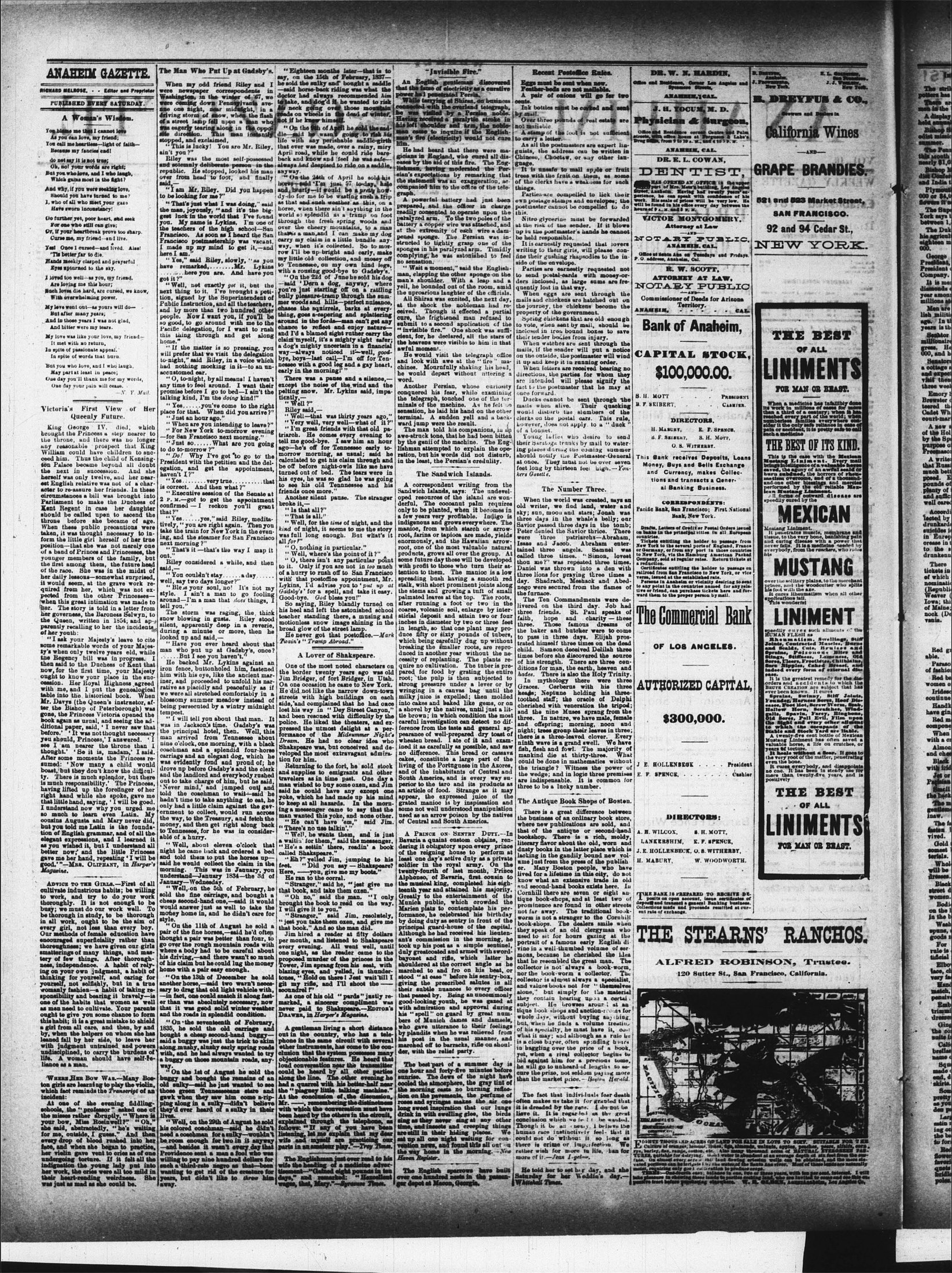
Searchable text
ANAHEIM GAZETTE.
RICHARD MELROSE, Editor and Proprietor
PUBLISHED EVERY SATURDAY.
A Woman's Wisdom.
You blame me thus I cannot love
As you can love, my friend;
You call me heartless—light of faith—
Because my fancies end!
do not say it is not true;
Oh, no! your words are right;
But you who love, and I who laugh,
Which gains most in the sight?
And why, if you were seeking love,
Should you have turned to me?
I, who of all who meet your gaze
Have sworn inconstancy!
Go further yet, poor heart, and seek
For one who still can give;
Or, if your heartbreak prove too sharp.
Curse me, my friend—and live.
Yes! Once I cursed—and lived. Alas!
"Tis better far to die.
Hands meekly clasped and prayerful
Eyes upturned to the sky.
I loved too well—as you, my friend,
Are loving me this hour;
Much loves die hard, are cursed, we know,
With overwhelming power.
My love went out—as yours will do—
But after many years;
And in those years I was not glad,
And bitter were my tears.
My love was like your love, my friend—
It met with no return,
In spite of passionate appeal.
In spite of words that burn.
But you who love, and I who laugh,
May part at least in peace;
One day you'll thank me for my words,
One day your pain will cease.
N. Y. Mail.
Victoria's First View of Her Queenly Future.
King George IV. died, which brought the Princess a step nearer to the throne, and there was no longer any reasonable prospect that King William could have children to succeed him. Thus the child of Kensington Palace became beyond all doubt the next in succession. And she
The Man Who Put Up at Gadsby's.
When my odd friend Riley and I were newspaper correspondents in Washington, in the winter of 1677, we were coming down Pennsylvania avenue one night, near midnight, in a driving storm of snow, when the flash of a street lamp fell upon a man who was eagerly tearing along in the opposite direction. This man instantly stopped, and exclaimed,
"This is lucky! You are Mr. Riley, ain't you?"
Riley was the most self-possessed and solemnly deliberate person in the republic. He stopped, looked his man over from head to foot, and finally said,
"I am Mr. Riley. Did you happen to be looking for me?"
"That's just what I was doing," said the man, joyously, "and it's the biggest luck in the world that I've found you. My name is Lykins. I'm one of the teachers of the high school—San Francisco. As soon as I heard the San Francisco postmastership was vacant, I made up my mind to get it—and here I am."
"Yes," said Riley, slowly, "as you have remarked,...Mr. Lykins...here you are. And have you got it?"
"Well, not exactly got it, but the next thing to it. I've brought a petition, signed by the Superintendent of Public Instruction, and all the teachers, and by more than two hundred other people. Now I want you, if you'll be so good, to go around with me to the Pacific delegation, for I want to rush this thing through and get along home."
"If the matter is so pressing, you will prefer that we visit the delegation to-night," said Riley, in a voice which had nothing mocking in it—to an unaccustomed ear.
"O, to-night, by all means! I haven't any time to feel around. I want their promise before I go to bed—I ain't the talking kind, I'm the doing kind!"
"Yes....you've come to the right place for that. When did you arrive?"
"Just an hour ago."
"When are you intending to leave?"
"For New York to-morrow evening—for San Francisco next morning."
"Just so.....What are you going to do to-morrow?"
"Do! Why I've got to go to the President with the petition and the delegation, and get the appointment, haven't I?"
"Eighteen months later say, on the 15th of February he sold the sulky and bong-he sold horse-back riding wi doctor had always recommended to take, and dog'd it. He was His neck going over those roads on wheels in the dead not if he knew himself.
"On the 9th of April he died—aid he wasn't going life with any perishable that ever was made, over a April road, while he could back and know and feel he always had despised to ride anyway.
"On the 24th of April horse—aid 'I'm just 57 and hearty—it would be dy-do for me to be wasting as that and such weather as horse, when there ain't any world so splendid as a trench through the fresh spring over the cheery mountain that is a man,and I can carry my claim in a little way, when it's collected. row I'll be up bright and my little old collection, and to Tennessee, on my own with a rousing good-bye to
"On the 22d of June he—aid 'Dern a dog, anyone you're just starting off on bully pleasure-tramp through woods and hills-perf chases the squirrels, barb thing, goes a-capering and around in the fords—man chance to reflect and enjoy and I'd a blamed sight ruth claim myself, it's a mighty dog's mighty uncertain way—always noticed it bye, boys—last call-I'm nessee with a good leg and early in the morning!"
There was a pause and except the noise of the w pelting snow. Mr. Lykins tiently,
"Well?" Riley said,
"Well—that was thirty." Very well, very well—I'm great friends with triarch. He comes every tell me good-bye. I saw b ago—he's off for Tennesson morrow morning, as usual calculated to get his claim be off before night-owls turned out of bed. The
Victoria's First View of Her Queenly Future.
King George IV. died, which brought the Princess a step nearer to the throne, and there was no longer any reasonable prospect that King William could have children to succeed him. Thus the child of Kensington Palace became beyond all doubt the next in succession. And she herself was only twelve, and her nearest English relative was not of a character to re-assure her friends. In these circumstances a bill was brought into Parliament to make the Duchess of Kent Regent in case her daughter should be called upon to ascend the throne before she became of age. When these public precautions were taken, it was thought necessary to inform the little girl herself of her true position—that she was not merely one of a band of Princes and Princesses, the younger members of the family, but the first among them, the future head of the race. She was in the midst of her daily lessons—somewhat surprised, it would seem, at the grave work required from her, which was not expected from the other Princesses—when this great intimation was made to her. The story is told in a letter from her governess, the Baroness Selwyn, to the Queen, written in 1854, and apparently recalling to her the incidents of her youth:
"I ask your Majesty's leave to cite some remarkable words of your Majesty's when only twelve years old, while the Regency bill was in progress. I then said to the Duchess of Kent that now, for the first time, your Majesty ought to know your place in the succession. Her Royal Highness agreed with me, and I put the genealogical table into the historical book. When Mr. Davys (the Queen's instructor, after the Bishop of Peterborough) was gone, the Princess Victoria opened the book again as usual, and seeing the additional paper, said, 'I never saw that before.' It was not thought necessary you should, Princess,' I answered. 'I see I am nearer the throne than I thought.' 'So it is, madam,' I said. After some moments the Princess resumed: 'Now many a child would boast, but they don't know the difficulty. There is much splendor, but there is much responsibility.' The Princess, having lifted up the forefinger of her right hand while she spoke, gave me that little hand, saying, 'I will be good. I understand now why you urged me so much to learn even Latin. My cousins Augusta and Mary never did, but you told me Latin is the foundation of English grammar, and of all the elegant expressions, and I learned it as you wished it, but I understand all better now; and the little Princess gave me her hand, repeating 'I will be good.'"—MRS. OLIFHANT, in Harper's Magazine.
ADVICE TO THE GIRLS.—First of all cultivate industrious habits; be willing to work, and try to do your work
"O, to-night, by all means! I haven't any time to feel around. I want their promise before I go to bed—I ain't the talking kind, I'm the doing kind."
"Yes...you've come to the right place for that. When did you arrive?"
"Just an hour ago."
"When are you intending to leave?"
"For New York to-morrow evening—for San Francisco next morning."
"Just so....What are you going to do to-morrow?"
"Do! Why I've got to go to the President with the petition and the delegation, and get the appointment, haven't I?"
"Yes.....very true.....that is correct. And then what?"
"Executive session of the Senate at 2 P.M.—got to get the appointment confirmed—I reckon you'll grant that?"
"Yes.....yes," said Riley, meditatively, "you are right again. Then you take the train for New York in the evening, and the steamer for San Francisco next morning?"
"That's it—that's the way I map it out."
Riley considered a while, and then said,
"You couldn't stay...a day well, say two days longer?"
Bless your soul, no! It's not my style. I ain't a man to go fooling around—I'm a man that does things, I tell you."
The storm was raging, the thick snow blowing in gusts. Riley stood silent, apparently deep in a reverie, during a minute or more, then he looked up and said,
"Have you ever heard about that man who put up at Gadsby's, once? But I see you haven't."
He backed Mr. Lykins against an iron fence, buttonholed him, fastened him with his eye, like the ancient mariner, and proceeded to unfold his narrative as placidly and peacefully as if we were all stretched comfortably in a blossomy summer meadow instead of being persecuted by a wintry midnight tempest.
"I will tell you about that man. It was in Jackson's time. Gadsby's was the principal hotel, then. Well, this man arrived from Tennessee about nine o'clock, one morning, with a black coachman and a splendid four-horse carriage and an elegant dog, which he was evidently fond and proud of; he drove up before Gadsby's and the clerk and the landlord and everybody rushed out to take charge of him, but he said, 'Never mind,' and jumped out and told the coachman to wait—said he hadn't time to take anything to eat, he only had a little claim against the government to collect, would run across the way, to the Treasury, and fetch the money, and then get right along back to Tennessee, for he was in considerable of a hurry.
"Well, about eleven o'clock that night he came back and ordered a bed and told them to put the horses up—said he would collect the claim in the morning. This was in January, you understand—January 1834—the 3d of January—Wednesday."
"Well on the 5th of February, he sold the fine carriage, and bought a mansion."
ADVICE TO THE GIRLS.—First of all cultivate industrious habits; be willing to work, and try to do your work thoroughly. It is not enough to be busy; we must do our work well. To be thorough in study, to be thorough in all work, ought to be the aim of every girl, not less than every boy. Our methods of female education have encouraged superficiality rather than thoroughness; we have given our girls matterings of many things, and mastery of few things. After thoroughness, independence. A habit of relying on your own judgment, a habit of thinking for yourself, and caring for yourself, not selfishly, but in a true womanly fashion—a habit of taking responsibility and bearing it bravely—is one of the habits that women as well as men need to cultivate. Your parents ought to give you some chance to form this habit; it is a great mistake to shield a girl from all care, and then, by and by, when the helpers on whom she has leaned fall by her side, to leave her with judgment untrained and powers undisciplined, to carry the burdens of life. A woman should have self-reliance as a man.
WHERE HER BOW WAS.—Many Boston girls are learning to play the violin, which fact reminds the Transcript of an incident:
At one of the evening fiddling schools, the "professor" asked one of the misses rather abruptly. "Where is your bow, Miss Rosinwell?" "Oh," she said, abstractedly, "he's waiting for me, outside, I guess." And then every drop of blood rushed into her face, and when she began to practice, her violin gave vent to cries as of one undergoing torture. If it felt all the indignation the young lady put into her work, the cries were all too mild in their heart-rending weirdness. She was just as mad as she could be.
Well, about eleven o'clock that night he came back and ordered a bed and told them to put the horses up—and he would collect the claim in the morning. This was in January, you understand—January 1834—the 3d of January—Wednesday.
Well, on the 5th of February, he sold the fine carriage, and bought a cheap second-hand one,—said it would answer just as well to take the money home in, and he didn't care for style.
On the 11th of August he sold a pair of the fine horses,—said he'd often thought a pair was better than four, to go over the rough mountain roads with where a body had to be careful about his driving,—and there wasn't so much of his claim but he could lug the money home with a pair easy enough.
On the 13th of December he sold another horse,—said two warnn't necessary to drag that old light vehicle with—in fact, one could snatch it along faster than was absolutely necessary, now that it was good solid winter weather and the roads in splendid condition.
On the seventeenth of February, 1835, he sold the old carriage and bought a cheap second-hand buggy—said a buggy was just the trick to skim along mushy, alushy early spring roads with, and he had always wanted to try a buggy on those mountain roads, anyway.
On the 1st of August he sold the buggy and bought the remains of an old sulky—said he just wanted to see those green Tennesseeans stare and gawk when they saw him come a-ripping along in a sulky—didn't believe they'd ever heard of a sulky in their lives.
Well, on the 29th of August he sold his colored coachman—said he didn't need a coachman for a sulky—wouldn't be room enough for two in it anyway—and besides it wasn't every day that Providence sent a man a fool who was willing to pay nine hundred dollars for such a third-rate negro as that—been wanting to get rid of the creature for years, but didn't like to throw him away.
INGRESS ON THE HEART-RENDING WEIRDNESS. In keeping with all hazards, I ing a messenger came to my man wanted this yoke, and He can't have 'em," There's no use talkin'."
Well, he wants them, a waitin' for them," said the He's a settin' there, re-called Shakespeare."
Eh? yelled Jim, jumping feet. "Did you say—Here, you give me my He ran to the corral.
Stranger," said he, "jumped that book, and take them out. Oh no," said the maiden brought the book to read I will give it to you."
Stranger," said Jim, "just you take them oxen, that book." And so the maiden Jim hired a reader at per month, and listened to every evening. All went one night, as the reader proposed murder of the p Tower, Jim sprang from his blazing eyes, and yelled, tones," Hold on there! Je git my rifle, and I'll shooundrel!"
As one of his old "paradigm," a sincerer comma never paid to Shakespeare Drawer, in Harper's Magazine.
A gentleman living a short out in the country, who phone in the same circuit other instruments, has conclusion that the system posjectionable features. He loud conversation near the could be heard by all or along the line. The other had a quarrel with his best the "plagney little talking At the conclusion of the Mr.——remembering that with which the conversation been heard by the others in explained through the follows: "If any of you listening let me explain to wife and myself are parts in an amateur play."
The Englishman just over wife the heading of a meditement—"Gained eight p days," and remarked: wages that Mary."—Sgrass
"Eighteen months later—that is to say, on the 15th of February, 1837—he sold the sulky and bought a saddle—said horse-back riding was what the doctor had always recommended him to take, and dog'd if he wanted to risk his neck going over those mountain roads on wheels in the dead of winter, not if he knew himself.
"On the 9th of April he sold the saddle—said he wasn't going to risk his life with any perishable saddle-girth that ever was made, over a rainy, miry April road, while he could ride bareback and know and feel he was safe—always had despised to ride on a saddle, anyway.
"On the 24th of April he sold his horse—said 'I'm just 57 to-day, half and hearty'—it would be a pretty howly-do for me to be wasting such a trip as that and such weather as this, on a horse, when there isn't anything in the world so splendid as a tramp on foot through the fresh spring woods and over the cheery mountains, to a man that's a man, and I can make my dog carry my claim in a little bundle anyway, when it's collected. So to morrow I'll be up-bright and early, make my little old collection, and mosey off no Tennessee, on my own hind legs, with a rousing good-bye to Gadsby's."
"On the 22d of June he sold his dog—said 'Dern a dog, anyway, where you're just starting off on a rattling fully pleasure-trump through the summer woods and hills—perfect nuisance, chases the squirrels, barks at everything, goes a-capering and splattering around in the fords—man can't get any chance to reflect and enjoy nature—and I'd a blamed sight ruther carry the claim myself, it's a mighty sight safer; a dog's mighty uncertain in a financial way—always noticed it—well, good-bye, boys—last call—I'm off for Tennessee with a good leg and a gay heart, early in the morning!"
There was a pause and a silence, except the noise of the wind and the pelting snow. Mr. Lykins said, impatiently,
"Well?"
Riley said,
"Well—that was thirty years ago," "Very well, very well—what of it?"
"I'm great friends with that old patriarch. He comes every evening to tell me good-bye. I saw him an hour ago—he's off for Tennessee early tomorrow morning, as usual; said he calculated to get his claim through and be off before night-owls like me have turned out of bed. The tears were in
"Javisible Fire."
An English gentleman discovered that the fame of electricity as a curative power had penetrated Persia.
While tarrying at Shiraz, on business connected with the overland telegraph, he was visited by a Persian noble. Having received a paralytic stroke in his left shoulder and arm, the nobleman came to inquire if the Englishman's fire (electricity) would not cure him.
He had heard that there were magicians in England, who cured all diseases by the aid of this fire. The Englishman, having moderated the Persian's expectations by remarking that the statement was an exaggeration, accompanied him to the office of the telegraph.
A powerful battery had just been prepared, and the officer in charge readily consented to operate upon the paralyzed arm. To the two poles of the battery a copper wire was attached, and at the extremity of each wire a dampened sponge. The Persian was instructed to tightly grasp one of the sponges in his paralyzed arm. Timidly complying, he was astonished to feel no sensation.
"Wait a moment," said the Englishman, elapping the other sponge on the man's shoulder. With a leap and a yell, he bounded out of the room, amid the uproarious laughter of the officials.
All Shiraz was excited, the next day, at the shock the nobleman had received. Though it effected a partial cure, the frightened man refused to submit to a second application of the "invisible fire." One shock was sufficient, for, he declared, all the stars of the heavens were visible to him in that awful moment.
He would visit the telegraph office and look with awe at the "fire" machines. Mournfully shaking his head, he would depart without uttering a word.
Another Persian, whose curiosity conquered his fear, while examining the telegraph, touched one of the terminals of the machine. As he felt no sensation, he laid his hand on the other terminal. A sudden yell and a backward jump were the result.
The man told his companions, in an awe-struck tone, that he had been bitten by the genii of the machine. The Englishman attempted to explain the operation, but his words did not disturb, in the least, the Persian's credulity.
Recent Postoffice Rules.
Eggs must be sent when new. Feather-beds are not mailable. A pair of onions will go for two cents.
Ink bottles must be corked and sent by mail.
Over three pounds of real estate are not mailable.
A stamp of the foot is not sufficient to carry a letter.
As all the postmasters are expert linguists, the address can be written in Chinese. Choctaw, or any other language.
It is unsafe to mail apple or fruit trees with the fruit on them, as some of the clerks have a weakness for such things.
Parties are compelled to lick their own postage stamps and envelopes; the postmaster cannot be compelled to do this.
Nitro glycerine must be forwarded at the risk of the sender. If it blows up in the postmaster's hands he cannot be held responsible.
It is earnestly requested that lovers writing to their girls will please continue their gushing rhapsodies to the inside of the envelope.
Parties are earnestly requested not to send postal-cards with money-order inclosed, as large sums are frequently lost in that way.
When eggs are sent through the mails and chickens are hatched out on the journey, the chickens become the property of the government.
Spring chickens that are old enough to vote, when sent by mail, should be included in iron bound boxes to save their tender bodies from injury.
When watches are sent through the mails, if the sender will put a notice on the outside, the postmaster will wind it up and keep it in running order.
When letters are received bearing no directions, the parties for whom they are intended will please signify the fact to the postmaster that he may at once forward.
Ducks cannot be sent through the mails when alive. Their quacking would disturb the slumbers of the clerks on the postal cars. This rule, however, does not apply to a "duck" of a bonnet.
Young ladies who desire to send their Saratoga trunks by mail to watering places during the coming summer should notify the Postmaster-General at once. They must not be over seven feet long by thirteen feet high. —Yankees Gazette
There was a pause and a silence—except the noise of the wind and the pelting snow. Mr. Lykins said, impatiently,
"Well?"
Riley said,
"Well—that was thirty years ago," "Very well, very well—what of it?"
"I'm great friends with that old patriarch. He comes every evening to tell me good-bye. I saw him an hour ago—he's off for Tennessee early tomorrow morning, as usual; said he calculated to get his claim through and be off before night-owls like me have turned out of bed. The tears were in his eyes, he was so glad he was going to see his old Tennessee and his friends once more."
Another silent pause. The stranger broke it,
"Is that all?"
That is all."
Well, for the time of night, it seems to me the story was full long enough. But what's it all for?
"O, nothing in particular."
Well, where's the point of it?
"O, there isn't any particular point to it. Only if you are not in too much of a hurry to rush off to San Francisco with that postoffice appointment, Mr. Lykins, I'd advise you to 'put up at Gadaby's' for a spell, and take it easy. Good-bye. God bless you!"
So saying, Riley blandly turned on his heel and left the astonished school teacher standing there, a musing and motionless snow image shining in the broad glow of the street lamp.
He never got that postoffice. —Mark Twain's "Tramp Abroad."
A Lover of Shakspeare.
One of the most noted characters on the border twenty years ago was old Jim Bridger, of fort Bridger, in Utah. On one occasion he came to New York. He did not like the narrow down-town streets with high buildings on each side, and complained that he had once lost his way in "Dey Street Canyon," and been rescued with difficulty by the police. He liked the theater, and expressed the utmost delight at a performance of the Midsummer Night's Dream. He had no clear idea who Shakspeare was, but conceived and developed the most extravagant admiration for him.
Returning to the fort, he sold stock and supplies to emigrants and other travelers as in time past. One day a man wished to buy some oxen, and Jim said he could have any except one yoke, which he had made up his mind to keep at all hazards. In the morning a messenger came to say that the man wanted this yoke, and none other.
"He can't have 'em," said Jim. "There's no use talkin'."
Well, he wants them, and is just a waitin' for them," said the messenger. "He's a settin' there, readin' a book called Shakspeare."
"Eh?" yelled Jim, jumping to his feet. "Did you say — Shakspeare? Here, —you, give me my boots."
He ran to the corral.
"Stranger," said he, "just give me that book, and take them oxen."
"Oh no," said the man. "I only another Persian, whose curiosity conquered his fear, while examining the telegraph, tonched one of the terminals of the machine. As he felt no sensation, he laid his hand on the other terminal. A sudden yell and a backward jump were the result.
The man told his companions, in an awake-struck tone, that he had been bitten by the genii of the machine. The Englishman attempted to explain the operation, but his words did not disturb, in the least, the Persian's credulity.
The Sandwich Islands.
A correspondent writing from the Sandwich Islands, says: The undeveloped resources of the island are wonderful. The coconut palm requires only to be planted, when it becomes in a few years very profitable. Indigo is indigenous and grows everywhere. The maniac, from which starch or arrowroot, farina or tapioca are made, yields enormously, and the Hawaiian arrowroot, one of the most valuable natural products, grows all over the group. At some future day these will be developed with profit to those who turn their attention to them. The maniac is a low spreading bush having a smooth red stalk, with short prominent joints along the stems and growing a tuft of small palmated leaves at the top. The roots after running a foot or two in the coarse, volcanic soil, enlarge by interstitial deposit and attain two or four inches in diameter by two or three feet in length, so that one plant may produce fifty or sixty pounds of tubers, which being carefully dug up without breaking the smaller roots, are reproduced in another year without the necessity of replanting. The plants require no cultivation. The tuber is prepared for food by grating the entire root; the pulp is then subjected to strong pressure under a lever or by wringing in a canvas bag until the milky juice is expelled; then molded into cakes and baked like gems, or on a shovel by the natives, until just a little brown; in which condition the most careful investigation can detect no difference from the taste and general appearance of well-prepared dry toast of wheaten bread. I ate of it and examined it as carefully as possible, and saw no difference. This bread or cassava cakes constitute a large part of the living of the Portuguese in the Azores, and of the inhabitants of Central and South America, and is every way superior to the taro and its products as an article of food. Strange as it may appear, the expressed juice of the grated maniac is by inspissation and some not well understood manipulation used as an arrow poison by the natives of Central and South America.
A PRINCE ON SENTRY DUTY.—In Bavaria a quaint custom obtains, rendering it obligatory upon every prince of the reigning house to perform at least one day's active duty as a private soldier in the royal army. On the twenty-fourth of last month, Prince Alphonse, of Bavaria, first cousin to the musical king, completed his eighteenth year and attained his majority. Greatly to the entertainment of the other antique book-shops of Boston.
There is a great difference between the business of an ordinary book store, where new publications are sold, and that of the antique or second-hand bookshop. There is a rich, moldy, literary flavor about the old, worn and dusty books in the latter place which is lacking in the gaudily bound new volume just from the press of the publisher. Many Boston people, who have lived for a lifetime in this city, do not know what an extensive trade in old and second-hand books exists here. In Cornhill there are seven or eight antique book-shops and at least two of them are on banks in the country.
Tickets entitle New York to the or Germany, or to New York, vip company, sold a reduction. Certificates from Seville verses issued at Paris are in Amsterdam to any point in its life or friend and ward them to thence.
The Number Three.
When the world was created, says an old writer, we find land, water and sky; sun, moon and stars; Jonah was three days in the whale's belly; our Savior passed three days in the tomb; Peter denied the Savior thrice. There were three patriarchs—Abraham, Isaac and Jacob. Abraham entertained three angels. Samuel was called three times. "Simon, lovest thou me?" was repeated three times. Daniel was thrown into a den with three lions for praying three times a day. Shadrach, Mesack and Abdnego were secured from the flames of the furnace.
The Ten Commandments were delivered on the third day. Job had three friends. St. Paul speaks of faith, hope and charity—these three. Those famous dreams of the baker and butcher were to come to pass in three days. Elijah prostrated himself three times on the dead child. Samson deceived Delilah three times before she discovered the source of his strength. There are three conditions for man, the earth, heaven and hades. There is also the Holy Trinity.
In mythology there were three Graces. Cerberus with his three heads; Neptune holding his three-toothed staff; the oracle of Delphi cherished with veneration the tripod; and the nine Muses sprang from the three. In nature, we have male, female and offspring; morning, noon and night; trees group their leaves in three; there is a three-leaved clover. Every ninth wave is a grand swell. We have fish, flesh and fowl. The majority of mankind die at thirty-three. What could be done in mathematics without the triangle? Witness the power of the wedge; and in logic three premises are indispensable. It is common for three to be a lucky number.
The Antique Book Shops of Boston.
There is a great difference between the business of an ordinary book store, where new publications are sold, and that of the antique or second-hand bookshop. There is a rich, moldy, literary flavor about the old, worn and dusty books in the latter place which is lacking in the gaudily bound new volume just from the press of the publisher. Many Boston people who have lived for a lifetime in this city do not know what an extensive trade in old and second-hand books exists here. In Cornhill there are seven or eight antique book-shops and at least two of them are on banks in the country.
Tickets entitle New York to the or Germany, or to New York,vip company,sold a reduction.Certificates from Seville verses issued at Paris are in Amsterdam to any point in its life or friend and ward them to thence.
The Number Three.
When the world was created,says an old writer,the find land,水and sky; sun,moon,and stars;Jonah was three days inthe whale's belly;our Savior passedthree daysinthetomb;PeterdeniedtheSaviorthrice.Thetherewerethreepatriarchs—Abraham,IssaecandJacob.Abrahamentertainedthreeangels.Samuelwascalledthreetimes.“Simon,lovestthoume?”wasrepeatedthreetimes.Danielwashentintoadenwiththreelionsforprayingthreetimesaday.Shadrach,MesackandAbdnegoweresecuredfromtheflamesofthefurnace.
TheTenCommandmentsweredeliveredonthethirdday.Jobhadthreefriends。St.Patrickspeaksofs faith,hopeandcharity—thesethreeThosefamousdreamsofthebakerandbutcherweretocompassinthreedays.Elijahprostratedhimselfthreetimesonthedeathchild.SamsonsdeceivedDelilahthreetimesbeforeshediscoveredthesourceofhisstrength.Thetherewerethreeconditionsforman,theearth,heaven和hades.GreatlytotheentertainmentoftheotherantiquesbookshopsofBoston.
Thereisagreatdifferencebetweenthebusinessofanordinarybookstorewherenewpublicationsaresold,andthatoftheantiquerecordshomebanksonthecountry.TicketsentitleNewYorktotheorGermany.ortoNewYork,vipcompany,solda reduction.CertificatesfromSevilleversesissuedatParisareinAmsterdamtoanypointintheselflifeorfriendandwardthemtothence.
TheAntiqueBookShopsofBoston.
Thereisagreatdifferencebetweenthebusinessofanordinarybookstorewherenewpublicationsaresold,andthatoftheantiquerecordshomebanksonthecountry.TicketsentitleNewYorktotheorGermany.ortoNewYork,vipcompany,solda reduction.CertificatesfromSevilleversesissuedatParisareinAmsterdamtoanypointintheselflifeorfriendandwardthemtothence.
TheNumberThree.
Whentheworldwascreated,saysanoldwriter,thefindland,水andsky;sun,moon,andstars;jonahwasthreedaysinthewhale'sbelly;oursaviorpassedthreedaysinthetomb; PeterdeniedtheSaviorthrice.Thetherewerethreepatriarchs—Abraham,IssaecandJacob.Abrahamentertainedthreeangels.Samuelwascalledthreetimes.“Simon,lovestthoume?”wasrepeatedthreetimes.Danielwashentintoadenwiththreelionsforprayingthreetimesaday.Shadrach,MesackandAbdnegoweresecuredfromtheflamesofthefurnance.
TheTenCommandmentsweredeliveredonthethirdday.Jobhadthreefriends。St.Patrickspeaksofs faith,hopeandcharity—thesethreeThosefamousdreamsofthebakerandbutcherweretocompassinthreedays.Elijahprostratedhimselfthreetimesonthedeathchild.SamsonsdeceivedDelilahthreetimesbeforeshediscoveredthesourceofhisstrength.Thetherewerethreepatriarchs—Abraham,IssaecandJacob.Abrahamentertaintedthreeangels.Samuelwascalledthreetimes.“Simon,lovestthoume?”wasrepeatedthreetimes.Danielwashentintoadenwiththreelionsforprayingthreetimesaday.Shadrach,MesackandAbdnegoweresecuredfromtheflamesofthefurnance.
TheAntiqueBookShopsofBoston.
Thereisagreatdifferencebetweenthebusinessofanordinarybookstorewherenewpublicationsaresold,andthatoftheantiquerecordshomebanksonthecountry.TicketsentitleNewYorktotheorGermany.ortoNewYork,vipcompany,solda reduction.CertificatesfromSevilleversesissuedatParisareinAmsterdamtoanypointintheselflifeorfriendandwardthemtothence.
TheNumberThree.
Whentheworldwascreated,saysanoldwriter,thefindland,水和sky;sun,moon,andstars;jonahwasthreedaysinthewhale'sbelly;oursaviorpassedthreedaysinthetomb; PeterdeniedtheSaviorthrice.Thetherewere三个patriarchs—Abraham,IssaecandJacob.Abrahamentertaintedthreeangels.Samuelwascalled三个times.“Simon,lovestthoume?”wasrepeated三个times.Danielwashentintoadenwith三个lionsforpraying三个timesaday.Shadrach,MesackandAbdnegoweresecuredfromtheflamesofthefurnance.
TheTenCommandmentsweredeliveredonthethirdday.Jobhad三个friends。St.Patrickspeaksofs faith,hopeandcharity—these三个Thosefamousdreamsofthebakerandbutcherweretocompassin三个days.Elijahprostratedhimself三个timesonthedeathchild.SamsonsdeceivedDelilah三个timesbeforeshediscoveredthesourceofhisstrength.Thetherewere三个patriarchs—Abraham,IssaecandJacob.Abrahamentertainted三个angels.Samuelwascalled三个times.“Simon,lovestthoume?”wasrepeated三个times.Danielwashentintoadenwith三个lionsforpraying三个timesaday.Shadrach,MesackandAbdnegoweresecuredfromtheflamesofthefurnance.
TheAntiqueBookShopsofBoston.
Thereisagreatdifferencebetweenthebusinessofanordinarybookstorewherenewpublicationsaresold,andthatoftheantiquerecordshomebanksonthecountry.TicketsentitleNewYorktotheorGermany.ortoNewYork,vipcompany,solda reduction.CertificatesfromSevilleversesissuedatParisareinAmsterdamtoanypointintheselflifeorfriendandwardthemtothence.
TheNumberThree.
Whentheworldwascreated,saysanoldwriter,thefindland,水和sky;sun,moon,andstars;jonahwasthreedaysinthewhale'sbelly;oursaviorpassedthreedaysinthetomb; PeterdeniedtheSaviorthrice.Thetherewere三个patriarchs—Abraham,IssaecandJacob.Abrahamentertainted三个angels.Samuelwascalled三个times.“Simon,lovestthoume?”wasrepeated三个times.Danielwashentintoadenwith三个lionsforpraying三个timesaday.Shadrach,MesackandAbdnegoweresecuredfromtheflamesofthefurnance.
TheTenCommandmentsweredeliveredonthethirdday.Jobhad三个friends。St.Patrickspeaksofs faith,hopeandcharity—these三个Thosefamousdreamsofthebakerandbutcherweretocompassin三个days.Elijahprostratedhimself三个timesonthedeathchild.SamsonsdeceivedDelilah三个timesbeforeshediscoveredthesourceofhisstrength.Thetherewere三个patriarchs—Abraham,IssaecandJacob.Abrahamentertainted三个angels.Samuelwascalled三个times.“Simon,lovestthoume?”wasrepeated三个times.Danielwashentintoadenwith三个lionsforpraying三个timesaday.Shadrach,MesackandAbdnegoweresecuredfromtheflamesofthefurnance.
TheAntiqueBookShopsofBoston.
Thereisagreatdifferencebetweenthebusinessofanordinarybookstorewherenewpublicationsaresold,andthatoftheantiquerecordshomebanksonthecountry.TicketsentitleNewYorktotheorGermany.ortoNewYork,vipcompany,solda reduction.CertificatesfromSevilleversesissuedatParisareinAmsterdamtoanypointintheselflifeorfriendandwardthemtothence.
TheNumberThree.
Whentheworldwascreated,saysanoldwriter,thefindland,水和sky;sun,moon,andstars;jonahwasthreedaysinthewhale'sbelly;oursaviorpassedthreedaysinthetomb; PeterdeniedtheSaviorthrice.Thetherewere三个patriarchs—Abraham,IssaecandJacob.Abrahamentertainted三个angels.Samuelwascalled三个times.“Simon,lovestthoume?”wasrepeated三个times.Danielwashentintoadenwith三个lionsforpraying三个timesaday.Shadrach,MesackandAbdnegoweresecuredfromtheflamesofthefurnance.
TheTenCommandmentsweredeliveredonthethirdday.Jobhad三个friends。St.Patrickspeaksofs faith,hopeandcharity—these三个Thosefamousdreamsofthebakerandbutcherweretocompassin三个月days.Elijahprostratedhimself三个timesonthedeathchild.SamsonsdeceivedDelilah三个月daysBeforeSheDiscoveredThe SourceOfHis Strength.In This World To The Post Office And Postal Service As An Important Admission For Him.More Than A Few Years After His Death From The Post Office And Postal Service As An Important Admission For Him.More Than A Few Years After His Death From The Post Office And Postal Service As An Important Admission For Him.More Than A Few Years After His Death From The Post Office And Postal Service As An Important Admission For Him.More Than A Few Years After His Death From The Post Office And Postal Service As An Important Admission For Him.More Than A Few Years After His Death From The Post Office And Postal Service As An Important Admission For Him.More Than A Few Years After His Death From The Post Office And Postal Service As An Important Admission For Him.More Than A Few Years After His Death From The Post Office And Postal Service As An Important Admission For Him.More Than A Few Years After His Death From The Post Office And Postal Service As An Important Admission For Him.More Than A Few Years After His Death From The Post Office And Postal Service As An Important Admission For Him.More Than A Few Years After His Death From The Post Office And Postal Service As An Important Admission For Him.More Than A Few Years After His Death From The Post Office And Postal Service As An Important Admission For Him.More Than A Few Years After His Death From The Post Office And Postal Service As An Important Admission For Him.More Than A Few Years After His Death From The Post Office And Postal Service As An Important Admission For Him.More Than A Few Years After His Death From The Post Office And Postal Service As An Important Admission For Him.More Than A Few Years After His Death From The Post Office And Postal Service As An Important Admission For Him.More Than A Few Years After His Death From The Post Office And Postal Service As An Important Admission For Him.More Than A Few Years After His Death From The Post Office And Postal Service As An Important Admission For Him.More Than A Few Years After His Death From The Post Office And Postal Service As An Important Admission For him.More Than A Few Years After His Death From The Post Office And Postal Service As An Important Admission For him.More Th than A Few Years After His Death From The Post Office And Postal Service As An Important Admission For him.More Th than A Few Years After His Death From The Post Office And Postal Service As An Important Admission For him.More Th than A Few Years After His Death From The Post Office And Postal Service As An Important Admission For him.More Th than A Few Years After His Death From The Post Office And Postal Service As An Important Admission For him.More Th than A Few Years After His Death From The Post Office And Postal Service As An Important Admission For him.More Th than A Few Years After His Death From The Post Office And Postal Service As An Important Admission For him.More Th than A Few Years After His Death From The Post Office And Postal Service As An Important Admission For him.More Th than A Few Years After His Death From The Post Office And Postal Service As An Important Admission For him.More Th than A Few Years After His Death From The Post Office And Postal Service As An Important Admission For him.More Th than A Few Years After His Death From The Post Office And Postal Service As An Important Admission For him.More Th than A Few Years After His Death From The Post Office And Postal Service As An Important Admission For him.More Th than A Few Years After他的 deathFrom他死From他死From他死From他死From他死From他死From他死From他死From他死From他死From他死From他死From他死From他死From他死From他死From他死From他死From他死From他死From他死From他死From他死From他死From他死From他死From他死From他死From他死From他死From他死From他死From他死From他死From他死From他死From他死From他死From他死From他死From他死From他死From他死From他死From他死From他死From他死From他死From他死From他死From他死From他死From他死From他死From他死From他死From他死From他死From他死From他死From他死From他死From他死From他死From他死From他死。从他是重要的贸易伙伴。在纽约市,有许多独特的商品,包括咖啡、茶、果酒、葡萄酒、啤酒、牛奶、面包、蛋糕、甜点、冰淇淋、奶油、糖果、巧克力、草莓、蓝莓、葡萄、柠檬、香蕉、菠萝、水蜜桃、草莓、苹果、梨、桃子、杏、李、柚子、橘子、梨子、苹果、梨子、苹果、梨子、苹果、梨子、苹果、梨子、苹果、梨子、苹果、梨子、苹果、梨子、苹果、梨子、苹果、梨子、苹果、梨子、苹果、梨子、苹果、梨子、苹果、梨子、苹果、梨子、苹果、梨子、苹果、梨子、苹果、梨子、苹果、梨子、苹果、梨子、苹果、
苹果、
苹果、
苹果、
苹果、
苹果、
苹果、
苹果、
苹果、
苹果、
苹果、
苹果、
苹果、
苹果、
苹果、
苹果、
苹果、
苹果、
苹果、
苹果、
苹果、
苹果、
苹果、
苹果、
苹果、
苹果、
苹果、
苹果、
苹果、
苹果、
苹果、
苹果、
苹果、
苹果、
苹果、
苹果、
苹果、
苹果、
apple,
apple,
apple,
apple,
apple,
apple,
apple,
apple,
apple,
apple,
apple,
apple,
apple,
apple,
apple,
apple,
apple,
apple,
apple,
apple,
apple,
apple,
apple,
apple,
apple,
apple,
apple,
apple,
apple,
apple,
apple,
apple,
apple,
apple,
apple,
apple,
apple,
apple,
apple,
apple,
apple,
apple,
apple,
apple,
apple,
apple,
apple,
apple,
apple,
apple,
apple,
apple,
apple,
apple,
apple,
apple,
apple,
apple,
apple,
apple,
apple,
apple,
apple,
apple,
apple,
apple,
apple,
apple,
apple,
apple,
apple,
apple,
apple,
apple,
apple,
apple,
apple,
apple,
apple,
apple,
apple,
apple,
apple,
apple,
apple,
apple,
apple,
apple,
apple,
apple,
apple,
apple,
apple,
apple
, Apple
, Apple
, Apple
, Apple
, Apple
, Apple
, Apple
, Apple
, Apple
, Apple
, Apple
, Apple
, Apple
, Apple
, Apple
, Apple
, Apple
, Apple
, Apple
, Apple
, Apple
, Apple
, Apple
, Apple
, Apple
, Apple
, Apple
,
Apple
,
Apple
,
Apple
,
Apple
,
Apple
,
Apple
,
Apple
,
Apple
,
Apple
,
Apple
,
Apple
,
Apple
,
Apple
,
Apple
,
Apple
,
Apple
,
Apple
,
Apple
,
Apple
,
Apple
,
Apple
,
Apple
,
Apple
,
Apple
,
Apple
,
Apple
,
Apple
,
Apple
,
Apple
,
Apple
,
Apple
,
Apple
,
Apple
,
Apple
,
Apple
,
Apple
These are great differences between these business entities (An ordinary book store) where new publications are sold—and that of an antique or second-hand book shop). These are great differences between these business entities (An ordinary book store) where new publications are sold—and that of an antique or second-hand book shop). These are great differences between these business entities (An ordinary book store) where new publications are sold—and that of an antique or second-hand book shop). These are great differences between these business entities (An ordinary book store) where new publications are sold—and that of an antique or second-hand book shop). These are great differences between these business entities (An ordinary book store) where new publications are sold—and that of an antique or second-hand book shop). These are great differences between these business entities (An ordinary book store) where new publications are sold—and that of an
to keep at all hazards. In the morning a messenger came to say that the man wanted this yoke, and none other.
"He can't have 'em," said Jim.
"There's no use talkin'."
"Well, he wants them, and is just a waitin' for them," said the messenger.
"He's a settin' there, readin' a book called Shakspeare."
"Eh?" velled Jim, jumping to his feet.
"Did you say — Shakspeare? Here, — you, give me my boots."
He ran to the corral.
"Stranger," said he, "just give me that book, and take them oxen."
"Oh no," said the man. "I only brought the book to read on the way. I will give it to you."
"Stranger," said Jim, resolutely,
"just you take them oxen, and give me that book." And so the man did.
Jim hired a reader at fifty dollars per month, and listened to Shakspeare every evening. All went well, until one night, as the reader came to the proposed murder of the princes in the Tower, Jim sprang from his seat, with blazing eyes, and yelled, in thunderstones, "Hold on there! Jest wait till I git my rifle, and I'll shoot the — scoundrel!"
As one of his old "pards" justly remarked, a sincerer compliment was never paid to Shakspeare. Edron's Drawer, in Harper's Magasine.
A gentleman living a short distance out in the country, who has a telephone in the same circuit with several other instruments, has come to the conclusion that the system possesses many objectionable features. He heard that loud conversation near the transmitter could be heard by all other parties along the line. The other evening he had a quarrel with his better-half near the "plagney little talking machine."
At the conclusion of, the discussion, Mr. ——, remembering the distinctness with which the conversation must have been heard by the others in the circuit, explained through the telephone, as follows: "If any of you have been listening, let me explain that my dear wife and myself are practicing our parts in an amateur play."—Trey Times.
The Englishman just over read to his wife the heading of a medicine advertisement—"Gained eight pounds in ten days," and remarked: "Hancellant wages, that, Mary."—Syracuse Times.
A PRINCE ON SENTRY DUTY.—In Bavaria a quaint custom obtains, rendering it obligatory upon every prince of the reigning house to perform at least one day's active duty as a private soldier in the royal army. On the twenty-fourth of last month, Prince Alphonso, of Bavaria, first cousin to the musical king, completed his eighteenth year and attained his majority. Greatly to the entertainment of the Munich public, which crowded the Marion plats to contemplate his performance, he celebrated his birthday by doing duty as sentry in front of the principal guard-house of the capital. Although he had received his lieutenant's commission in the morning, he took up his post as a simple sentinel, duly greatcoated and armed with sword-bayonet and rifle, which latter he shouldered at the correct angle as he marched to and fro on his beat, or stood "at ease" before his sentry-box, giving the prescribed salutes in all their subtle nuances to every officer that passed by. Being an uncommonly good-looking youth, he was gazed at with admiration and approval during his "spell" on guard by great numbers of Munich dames and damsels, who gave utterance to their feelings by plaudits when he was relieved from his post in the usual manner, and marched off to barracks, rifle on shoulder, with the relief party.
The best part of a summer day is one hour and forty-five minutes before sunrise. The dews of the night have cooled the atmosphere, the gray tint of the morning casts no burning reflection on the pavements, the perfume of roses and syringes makes the air one long sweet inspiration that our lungs drink in with swelling gles, the birds sing as they never sing at any other time, and insects and creeping things are still in their hiding places. We sat up all one night waiting for convention news, and found this all out on the way home in the morning.—New Haven Register.
The English sparrows have built over one hundred nests in the passenger depot at Macon, Georgia.
There is a great difference between the business of an ordinary book store, where new publications are sold, and that of the antique or second-hand bookshop. There is a rich, moldy literary flavor about the old, worn and dusty books in the latter place which is lacking in the gaudily bound new volume just from the press of the publisher. Many Boston people, who have lived for a lifetime in this city, do not know what an extensive trade in old and second-hand books exists here. In Cornhill there are seven or eight antique book-shops, and at least two of prominence are found in other streets not far away. The traditional book-worm is not a stranger to the Cornhill book-shops. The dealers smile when they speak of an old clergyman who used to sit for hours gazing at the portrait of a famous early English divine in a well-thumbed volume of sermons, because he cherished the idea that he resembled the great man. The collector is not always a book-worm, nor the book-worm a collector. The collector is almost always a specialist, and values books not for "themselves alone," but simply for the material they contain bearing upon a certain subject. He browses around at antique book shops and auction rooms for whole days without buying anything but when he finds a volume treating of his specialty; he must have it, cost what it may; and although as a rule he is a close buyer often spending hours in baggling over the price of a book yet, when a rival collector begins to bid against him for a precious tome, he will go to unheard-of lengths to secure the prize, not seldom paying more than the market price.—Boston Herald.
The fact that individuals fear death often makes us take it for granted that it is dreaded by the race. I do not be lieve it. It is regarded as the greatest conclusion which we feel it be wanted. Though it be an enemy I believe the human race instinctively feel that it could not do without it so long as there is crime or imperfection. We rather wish for more in life than for more of it.—Sean Logue.
He told her to set her day, and she Saturday for her Wedding's day.—Whitehall Times.
DR. W. N. HARDIN,
Office and Residence, Corner Los Angeles and Sycamore Street,
ANAHEIM, CAL.
J. H. YOCUM, M. D.
Physician & Surgeon.
Office and Residence corner Centre and Palm streets, with office houses at Pergamon & Lake's Drug Store, from 9 to 10 A.M., and 4 to 5 P.M.
ANAHEIM, CAL.
DR. E. L. COWAN,
DENTIST,
Has opened an office in the upper part of Mrs. Meer's building, Los Angeles street, Anaheim. Having had twenty years' experience, he can speak with confidence of his work. His scale of prices will be very low. He will be found in his office every day between the hours of 9 A.M. and 5 P.M.
VICTOR MONTGOMERY,
Attorney at Law
AND
NOTARY PUBLIC,
ANAHEIM, CAL.
Office at Santa Ana on Tuesdays and Fridays.
P.O. address, Anaheim, Cal.
R. W. SCOTT,
ATTORNEY AT LAW,
NOTARY PUBLIC
And Commissioner of Deeds for Arizona Territory.
ANAHEIM, CAL.
Bank of Anaheim,
CAPITAL STOCK,
$100,000.00.
S. H. MOTT
President
B. F. SKIBERT,
Cashier.
DIRECTORS.
H. MABURY,
K. F. SPENCE.
S. F. SKIBERT,
S. H. MOTT,
O. S. WITHERBY.
This Bank receives Deposits, Loans Money, Buys and Sells Exchange and Currency, makes Collect-
R. DREYFUS & CO.
Newmen and Dealers in
California Wines
AND
GRAPE BRANDIES.
521 and 523 Market Street,
SAN FRANCISCO.
92 and 94 Cedar St., NEW YORK.
THE BEST
OF ALL
LINIMENTS
FOR MAN OR BEAST.
When a medicine has infiltribly done its work in millions of cases for more than a third of a century; when it has reached every part of the world; when numberless families everywhere consider it the only safe reliance in case of pain or accident, it is pretty safe to call such a medicine.
THE BEST OF ITS KIND.
This is the case with the Mexican Meeting Limiment. Every mail brings intelligence of a valuable horse saved, the agony of an awful scald or burn subdued, the horrors of rheumatic diseases.
B. H. MOTT
PRESIDENT
B. F. SKIBERT,
CASHIER.
DIRECTORS.
H. MABURY,
E. F. SPENCE,
S. H. MOTT,
O. S. WITHERBY.
This Bank receives Deposits, Loans Money, Buys and Sells Exchange and Currency, makes Collections and transacts a General Banking Business.
CORRESPONDENTS:
Pacific Bank, San Francisco; First National Bank, New York.
Drafts, Letters of Credit or Postal Orders issued on banks in the principal cities in all European countries.
Tickets entitling the holder to passage from New York to the several ports of England, France or Germany, or from any port in those countries to New York, via the Hamburg American Packed Company, sold at regular rates. Return tickets at a reduction.
Certificates entitling the holder to passage on railroad from San Francisco to New York, or vice versa, issued at the established rate.
Persons in Anaheim or vicinity desiring to sent to any point in the countries named for any relative or friend, can purchase tickets here and forward them to the proper person by mail.
The Commercial Bank
OF LOS ANGELES.
AUTHORIZED CAPITAL,
$300,000.
J. E. HOLLENBEGK . . . President
E. F. SPENCE, . . . Cashier
DIRECTORS:
A. H. WILCOX, S. H. MOTT,
LANKERSHIM, E. F. SPENCE,
J. E. HOLLENBECK, O. S. WITHERBY,
H. MABURY, W. WOODWORTH.
THE BANK IS PREPARED TO RECEIVE DEPOSITS ON OPEN ACCOUNT, issue certificates of LINIMENTS FOR MAN OR BEAST.
When a medicine has infailibly done its work in millions of cases for more than a third of a century; when it has reached every part of the world; when numberless families everywhere consider it the only safe reliance in case of pain or accident, it is pretty safe to call each a medicine.
THE BEST OF ITS KIND.
This is the case with the Mexican Mustang Liniment. Every mail brings intelligence of a valuable horse saved, the agony of an awful soiled or burn subsided, the horrors of rheumatism overcome, and of a thousand-and-one other blessings and merries performed by the old reliable Mexican Mustang Liniment.
All forms of outward disease are speedily cured by the MEXICAN Mustang Liniment.
It penetrates muscle, membrane and tissue, to the very bone, banishing pain and curing disease with a power that never fails. It is a medicine needed by everybody, from the rancher, who rules his MUSTANG over the solitary plains, to the merchant prince, and the woodcutter who splits his foot with the axe.
It cares Rheumatism when all other applications fail.
This wonderful LINIMENT speedily cures such ailments of the HUMAN FLESH as Rheumatism, Swellings, Stiff Joints, Contracted Muscles, Burns and Scalds, Cuts, Bruises and Sprains, Poisonous Bites and Stings, Stiffness, Lameness, Old Sores, Fleas, Frostides, Chilblains, Sore Nipples, Caked Breast, and indeed every form of external disease.
It is the greatest remedy for the disorders and accidents to which the Burru Creation are subject that have ever been known. It cure's Spreads, Swimmy, Stiff Jolts, Founder, Harness Sore, Hoof Diseases, Foot Not, Screw Worm, Seab Hollow Horn, Seratches, Windgalls, Spavin, Parey, Ringbone, Old Sores, Poll Evil, Film upon the sight and every other element to which the occupants of the Stable and Stock Yard are liable.
A twenty-five cent bottle of Mexican Mustang Liniment has often saved a valuable horse, a life on crutches, or years of torture.
It heals without a Scar. It goes to the very root of the matter, penetrating even the bone.
It cures everybody, and disappoints no one. It has been in steady use for more than twenty-five years, and is positively THE BEST OF ALL LINIMENTS FOR MAN OR BEAST.
DIRECTORS:
A. H. WILCOX, S. H. MOTT,
LANKERSHIM, E. F. SPENCE,
J. E. HOLLENBECK, O. S. WITHERBY,
H. MABURY, W. WOODWORTH.
THE BANK IS PREPARED TO RECEIVE DEPOSITS ON OPEN ACCOUNT, ISSUE CERTIFICATES OF DEPOSIT AND TRANSACT A GENERAL BANKING BUSINESS. Collections made and proceeds remitted at current rate of exchange.
THE STEARNS' RANCHOS.
ALFRED ROBINSON, Trustee.
120 Sutter St., San Francisco, California.
EIGHTY THOUSAND ACRES OF LAND FOR SALE IN LOTS TO SUITABLE FOR THE CULTURE OF ORANGES, LEMONS, THUSE, FIG, ALMONDS, WALNUTS, APPLES, PACCHES, PEARS, ALFALFA, CORN, Rye, Barley, Flax, Ramie, cotton, etc. Also many thousand acres of NATURAL EVEGREEN PARTURES suitable for drying. That water is abundant at an average depth of six feet from the surface. On almost every acres of this land flowing artesian wells can be obtained, and the more elevated portions can be irrigated by the waters of the Santa Ana river. Most of these lands are naturally moist, requiring only good cultivation to produce crops.
THREE—One-fourth ease; balance in one, two or three years, with five per cent. interest. I will take plannings in showing these lands to partition making land, who are invited to come and see this entire treat before purchasing elsewhere. W. H. GLENN, Amherst Botanical, Los Angeles Co.