anaheim-gazette 1880-07-17
Scanned page
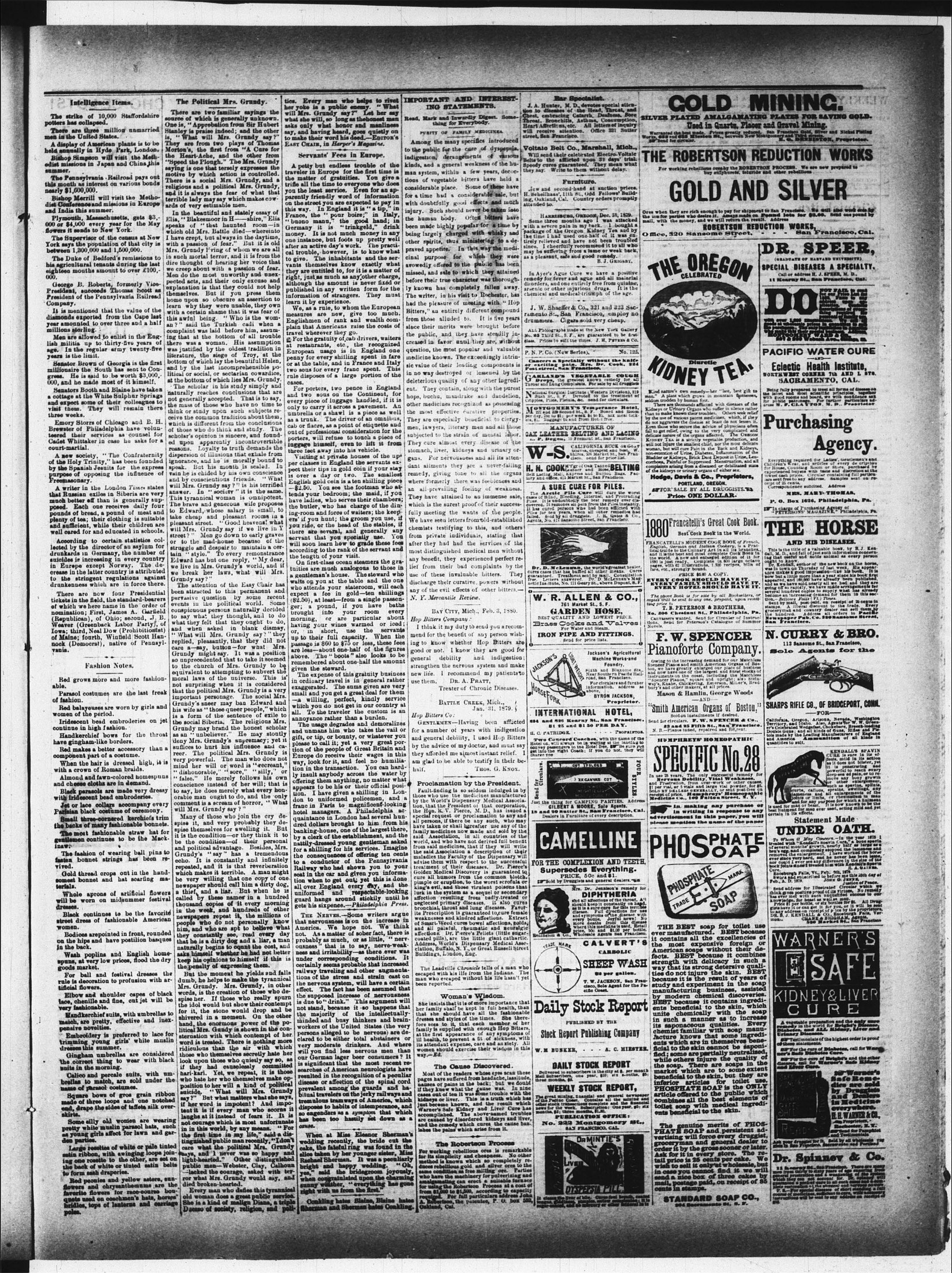
Searchable text
Intelligence Items.
The strike of 10,000 Staffordshire potters has collapsed.
There are three million unmarried men in the United States.
A display of American plants is to be held annually in Hyde Park, London.
Bishop Simpson will visit the Methodist missions in Japan and China this summer.
The Pennsylvania Railroad pays out this month as interest on various bonds nearly $1,600,000.
Bishop Merrill will visit the Methodist Conference and missions in Europe and India this summer.
Plymouth, Massachusetts, gets $3,-000 or $4,000 every year for the May flowers it sends to New York.
The Supervisor of the census at New York says the population of that city is between 1,300,000 and 1,500,000.
The Duke of Bedford's remissions to his agricultural tenants during the last eighteen months amount to over £100,-000.
George B. Roberts, formerly Vice-President, succeeds Thomas Scott as President of the Pennsylvania Railread Company.
It is mentioned that the value of the diamonds exported from the Cape last year amounted to over three and a half millions sterling.
Men are allowed to enlist in the English militia up to thirty-five years of age. In the regular army twenty-five years is the limit.
Senator Brown of Georgia is the first millionaire the South has sent to Congress. He is said to be worth $3,000,-000, and he made most of it himself.
Senators Booth and Blaine have taken a cottage at the White Sulphur Springs and expect some of their colleagues to visit them. They will remain there three weeks.
Emory Storrs of Chicago and B. H. Brewster of Philadelphia have volunteered their services as counsel for Cadet Whittaker in case he asks for a court-martial.
A new society, "The Confraternity of the Holy Trinity," has been founded by the Spanish Jesuits for the express purpose of opposing the influence of
The Political Mrs. Grundy.
There are two familiar sayings the source of which is generally unknown. One is, "Approbation from Sir Hubert Stanley is praise indeed; and the other is, 'What will Mrs. Grundy say?' They are from two plays of Thomas Morton's, the first from "A Cure for the Heart-Ache, and the other from 'Speed the Plough.'" The Mrs. Grundy saying is one that tersely expresses the motive by which action is controlled. There is a social Mrs. Grundy, and a religious and a political Mrs. Grundy, and it is always the fear of what that terrible lady may say which makes cowards of very estimable men.
In the beautiful and stately essay of Elia, "Blakesmoor in H——shire," Elia speaks of "that haunted room—in which old Mrs. Battle died—whereinto I have crept, but always in the daytime, with a passion of fear." But it is old Mrs. Grundy living of whom we are all in such mortal terror, and it is from the dire thought of hearing her voice that we creep about with a passion of fear. Men do the most unworthy and unexpected acts, and their only excuse and explanation is that they could not help themselves. But if you press them home upon so obscure an assertion to learn why they were unable, they own with a certain shame that it was fear of this awful being. "Who is the woman?" said the Turkish cadi when a complaint was laid before him, assuming that at the bottom of all trouble there was a woman. His assumption was justified by the oldest tradition in literature, the siege of Troy, at the bottom of which lay the beautiful Helen, and by the last incomprehensible political or social, or sectarian cowardice, at the bottom of which lies Mrs. Grundy.
The scholar in his study simply and naturally reaches conclusions that are not generally accepted. That is to say, the mass of those who have no time to think or study upon such subjects receive the common tradition about them, which is different from the conclusions of those who do think and study. The scholar's opinion is sincere, and founded upon apparently incontrovertible reasons. Loyalty to truth demands the dispersion of illusions that exhale from ignorance, and he is morally bound to speak. But his mouth is sealed. In vain he is chided by his own conscience
Every man who her yoke is a public entitlement will Mrs. Grundy say? What she will, so long as asks only what honor she say, and having heard, goes to make their word his dearest East Chair, in Harper's
Servants' Fees in
A petty but endless traveler in Europe for the matter of gratuities trifle all the time to even you the least service. It parently friendly word on on the street you are expelled this way. In England in France, the "pour boe" "buono manu," the German it is "trim money. It is not much one instance, but foots after an active day's workal trouble, however, in to give. The inhabitant vents themselves know they are entitled to, for right, just as much as an although the amount is published in any written information of stranger learn it by experience.
We, as a rule, to whom measures are new, give Englishmen of rank and plain that Americans travel wherever they go. For the gratuity of cab at restaurants, etc., European usage is in penny for every shilling or at the table, and in two sous for every franc rule disposes of a large cases.
For porters, two pens and two sous on the every piece of luggage only to carry it across an umbrella or a shawl is as a trunk. The driver cab or flacute, as a point out of professional consortors, will refuse to luggage himself, even three feet away into his visiting at private hotel per classes in England except their tips in gold or silver or dawn or day.
Senators Booth and Blaine have taken a cottage at the White Sulphur Springs and expect some of their colleagues to visit them. They will remain there three weeks.
Emory Storrs of Chicago and B. H. Brewster of Philadelphia have volunteered their services as counsel for Cadet Whittaker in case he asks for a court-martial.
A new society, "The Confraternity of the Holy Trinity," has been founded by the Spanish Jesuits for the express purpose of opposing the influence of Freemasonary.
A writer in the London Times states that Russian exiles in Siberia are very much better off than is generally supposed. Each one receives daily four pounds of bread, a pound of meat and plenty of tea; their clothing is suitable and sufficient, while their children are well cared for and educated in schools.
According to certain statistics collected by the director of an asylum for drunkards in Germany, the number of suicides is increasing in every country in Europe except Norway. The decrease in the latter country is attributed to the stringent regulations against drunkenness which are in force there.
There are now four Presidential tickets in the field, the standard-bearers of which we here name in the order of nomination; First, James A. Garfield (Republican), of Ohio; second, J. B. Weaver (Greenback Labor Party), of Iowa; third, Neal Dow (Prohibitionist) of Maine; fourth, Winfield Scott Hannock (Democrat), native of Pennsylvania.
Fashion Notes.
Red grows more and more fashionable.
Parasol costumes are the last freak of fashion.
Red balayeuses are worn by girls and women of the period.
Iridescent bead embroideries on jet continue in high fashion.
Handkerchief bows for the throat have gingham-like borders.
Red makes a better accessory than a component part of a costume.
When the hair is dressed high, it is with a crown of Roman braids.
Almond and fawn-colored homespuns and cheese cloths are in demand.
Black parasols are made very dressy with iridescent bead embroideries.
Jet or lace collars accompany every Parisian black costume of ceremony.
Small three-cornered kerchiefs trim the backs of many fashionable bonnets.
The most fashionable straw hat for gentlemen continues to be the Mackinaw:
The fashion of wearing ball pins to fasten bonnet strings has been revived.
Gold thread crops out in the hand-somest bonnet and hat scarfing materials.
Whole aprons of artificial flowers are made most of it himself.
Senators Booth and Blaine have taken a cottage at the White Sulphur Springs and expect some of their colleagues to visit them. They will remain there three weeks.
Emory Storrs of Chicago and B. H. Brewster of Philadelphia have volunteered their services as counsel for Cadet Whittaker in case he asks for a court-martial.
A new society, "The Confraternity of the Holy Trinity," has been founded by the Spanish Jesuits for the express purpose of opposing the influence of Freemasonary.
A writer in the London Times states that Russian exiles in Siberia are very much better off than is generally supposed. Each one receives daily four pounds of bread, a pound of meat and plenty of tea; their clothing is suitable and sufficient, while their children are well cared for and educated in schools.
According to certain statistics collected by the director of an asylum for drunkards in Germany, the number of suicides is increasing in every country in Europe except Norway. The decrease in the latter country is attributed to the stringent regulations against drunkenness which are in force there.
There are now four Presidential tickets in the field, the standard-bearers of which we here name in the order of nomination; First, James A. Garfield (Republican), of Ohio; second, J. B. Weaver (Greenback Labor Party), of Iowa; third, Neal Dow (Prohibitionist) of Maine; fourth, Winfield Scott Hannock (Democrat), native of Pennsylvania.
Fashion Notes.
Red grows more and more fashionable.
Parasol costumes are the last freak of fashion.
Red balayeuses are worn by girls and women of the period.
Iridescent bead embroideries on jet continue in high fashion.
Handkerchief bows for the throat have gingham-like borders.
Red makes a better accessory than a component part of a costume.
When the hair is dressed high, it is with a crown of Roman braids.
Almond and fawn-colored homespuns and cheese cloths are in demand.
Black parasols are made very dressy with iridescent bead embroideries.
Jet or lace collars accompany every Parisian black costume of ceremony.
Small three-cornered kerchiefs trim the backs of many fashionable bonnets.
The most fashionable straw hat for gentlemen continues to be the Mackinaw:
The fashion of wearing ball pins to fasten bonnet strings has been revived.
Gold thread crops out in the hand-somest bonnet and hat scarfing materials.
Whole aprons of artificial flowers are made most of it himself.
Jet or lace collars accompany every Parisian black costume of ceremony.
Small three-cornered kerchiefs trim the backs of many fashionable bonnets.
The most fashionable straw hat for gentlemen continues to be the Mackinaw:
The fashion of wearing ball pins to fasten bonnet strings has been revived.
Gold thread crops out in the hand-somest bonnet and hat scarfing materials.
Whole aprons of artificial flowers will be worn on midsummer festival dresses.
Black continues to be the favorite street dress of fashionable American women.
Bodices are pointed in front, rounded on the hips and have postilion basques in the back.
Wash poplins and English home-spuns, at very low prices, flood the dry goods market.
For ball and festival dresses the rule is decoration to profusion with artificial flowers.
Elbow and shoulder capes of black lace, chenille and fine, cut jet will be very fashionable.
Handkerchief suits, with umbrellas to match, are pretty, effective and inexpensive novelties.
Embroidery is preferred to lace for trimming young girls' white muslin dresses this summer.
Gingham umbrellas are considered the correct thing to wear with black suits in the morning.
Calico and percale suits, with umbrellas to match, are sold under the name of parasol costumes.
Square bows of gros grain ribbon made of three loops and one notched end, drape the sides of taffeta silk over skirts.
Some silly old women are wearing pretty white muslin parasol hats, such as young girls affect for lawn and garden parties.
Large recesses of white or pale tinted satin ribbon, with swinging loops joining one rosette to the other, are set on the back of white or tinted satin belts to form cash draperies.
Red peonies and yellow asters, sunflowers and chrysanthemums are the favorite flowers for racecourse bouquets used on coachmen's hats, horses' bridles, tops of lanterns and carriage poles.
Every man who helps to rivet her yoke is a public enemy. "What will Mrs. Grundy say?" Let her say what she will, so long as the honest man asks only what honor and manliness say, and having heard, goes quietly on to make their word his deed.—Editor's Easy Chair, in Harper's Magazine.
Servants' Fees in Europe.
A petty but endless trouble of the traveler in Europe for the first time is the matter of gratuities. You give a trifle all the time to everyone who does you the least service. Even for an apparently friendly word of information on the street you are expected to pay in this way. In England it is "a tip," in France, the "pour boire," in Italy, "buono manu," the good hand; in Germany it is "trinkgeld," drink money. It is not much money in any one instance, but foots up pretty well after an active day's work. The practical trouble, however, is to know what to give. The inhabitants and the servants themselves know exactly what they are entitled to, for it is a matter of right, just as much as any other charge, although the amount is never fixed or published in any written form for the information of strangers. They must learn it by experience.
We, as a rule, to whom the European measures are new, give too much. Englishmen of rank and wealth complain that Americans raise the costs of travel wherever they go.
For the gratuity of cab drivers, waiters at restaurants, etc., the recognized European usage is in England one penny for every shilling spent in fare or at the table, and in France and Italy two sous for every franc spent. This rule disposes of a large portion of the cases.
For porters, two pence in England and two sous on the Continent, for every piece of luggage handled, if it is only to carry it across a pavement. An umbrella or a shawl is a piece as well as a trunk. The driver of an omnibus, cab or flacre, as a point of etiquette and out of professional consideration for the porters, will refuse to touch a piece of luggage himself, even to lift it from three feet away into his vehicle.
Visiting at private houses of the upper classes in England the servants expect their tips in gold coin if your stay is smallest...
For porters, two pence in England and two sous on the Continent, for every piece of luggage handled, it is only to carry it across a pavement. An umbrella or a shawl is a piece as well as a trunk. The driver of an omnibus, cab or flare, as a point of etiquette and out of professional consideration for the porters, will refuse to touch a piece of luggage himself, even to lift it from three feet away into his vehicle.
Visiting at private houses of the upper classes in England the servants expect their tips in gold coin if your stay is over a day or two. The smallest English gold coin is a ten shilling piece—$2.50. You see the footman who attends your bedroom; the maid, if you have ladies, who serves their chambers; the butler, who has charge of the dining-room and force of waiters; the keepers' if you hunt; the groom you use, if you ride, or the head of the stables, if there are several, and generally any servant that you specially use. You will soon learn how to grade these fees according to the rank of the servant and the length of your visit.
On first-class ocean steamers the gratuities are much analogous to those in a gentleman's house. The steward who waits on you at the table and the one who attends your stateroom, will each expect a fee in gold—ten shillings ($2.50), at least—from a single passenger; a pound, if you have baths brought into your room every morning, or are particular about having your wines warmed or iced; or, in short, use the servants up to their full capacity. When the passage is $60 to $75 or less, these fees are less—about one-half of the figures above. The "boots" also looks to be remembered about one-half the amount given the steward.
The expense of this gratuity business in ordinary travel is in general rather exaggerated. The sums given are very small and you get a great deal for them—a willing, perfect, kindly service which you do not get in our country at all. To the traveler the custom is an annoyance rather than a burden.
The usage degrades and demoralizes and unmans him who takes the vail or gift, or tip, or bounty, or whatever you please to call it; yet a very great portion of the people of Great Britain and Europe do receive their wages in this way, look for it, and feel no humiliation in the transaction. You can hardly insult anybody across the water by offering them anything, no matter what appears to be his or their official position. I have given a shilling in London to uniformed policemen, and a franc in Paris to magnificent-looking hotel managers. A Philadelphia acquaintance in London had several hundred dollars brought to him from his banking-house, one of the largest there, by a clerk of the establishment, and the nattily-dressed young gentleman asked for a shilling for his services. Imagine the consequences of offering ten cents to a conductor of the Pennsylvania Railway who had shown you to your seat in the car and given you information when to get out; yet this is done all over England every day, and the uniformed and respectable-looking guard hangs around stickily until he no way destroyed by the deleterious quality of any other ingredient. They contain, along with the purest hops, buchu, mandrake and dandelion, other medicines recognized as possessing the most effective curative properties. They are especially beneficial to clergy-men, lawyers, literary men and all those subjected to the strain of mental labor. They cure almost every disease of the stomach, liver, kidneys and urinary organs. For nervousness and all its attendant ailments they are a never-failing remedy, giving tone to all the organs where formerly there was feebleness and an all-prevailing feeling of weakness. They have attained to an immense sale, which is the surest proof of their successfully meeting the wants of the people. We have seen letters from old-established chemists testifying to this, and others from private individuals, stating that after they had had the services of the most distinguished medical men without any benefit, they experienced perfect relief from their bad complaints by the use of these invaluable bitters. They discharge their curative powers without any of the evil effects of other bitters.
N.Y.Mercantile Review.
Bay City, Mich., Feb. 3, 1880.
Hop Bitters Company:
I think it my duty to send you a recommend for the benefit of any person wishing to know whether Hop Bitters are good or not. I know they are good for general debility and indigestion; strengthen the nervous system and make new life. I recommend my patients to use them.
Dr. A. Pratt,
Treater of Chronic Diseases.
Battle Creek, Mich., Jan. 31, 1879.
Hop Bitters Co:
GENTLEMEN—Having been afflicted for a number of years with indigestion and general debility, I used Hop Bitters by the advice of my doctor, and must say they afforded me almost instant relief. I am glad to be able to testify in their behalf.
Thos. G. Knox.
Proclamation by the President.
Fault-finding is so seldom indulged in by those who use the medicines manufactured by the World's Dispensary Medical Association, that the President or that corporation, the Hon. K.V. Pierce, M.D., has issued a special request or proclamation to any and all persons, if there be any such, who may have taken or shall greeter use any of the family medicines now made and sold by the said Association, in all countries of the world, and who have not derived full benefit from said medicines, that if they will write the said Association a description of their maladies the Faculty of the Dispensary will advise them with respect to the successful treatment of their diseases. Dr. Pierce's Golden Medical Discovery is guaranteed to cure all humors from the common blotch, pimple or eruption, to the worst scrofula or king's evil, and those virulent poisons that lurk in the system as a sequel or secondary affection resulting from badly-treated or
The Nerves.—Some writers argue that nervousness is on the increase in America. We hope not. We think not. As a matter of sober fact, there is probably as much, or as little, "nervousness" that is to say, nerve-weakness and irritability—as there ever was under corresponding conditions. It certainly seems probable that increased railway traveling and other augmentations of the stress and strain cast on the nervous system, will have a certain effect. The fact has been assumed that the supposed increase of nervousness is due to "drink." This argument will not stand, because it so happens that the majority of the intellectually-minded and busy thinkers and brain-workers of the United States (the very persons alleged to be nervous) are declared to be either total abstainers or very moderate drinkers. And where will you find less nervous men than our German lager beer consumers? It is significant that the most recent researches of American neurologists have resulted in the recognition of a peculiar disease or affection of the spinal cord prevalent among the guards and habitual travelers on the jerky railways and tremulous tramways of America, which disposes to habits of intemperance, and so engenders as a symptom that which has been too hastily set down as a cause.
When at Miss Eleanor Sherman's wedding recently, the bride cut the cake, the falseful ring was found in the alcoa taken by her younger sister, Miss Rachael Sherman. It was a peculiarly bright and happy wedding. "Oh, yes," said the bridegroom joyously, when congratulated upon the charming sunny weather, "everything has gone right with us from the first."
Conkling hates Blaine, Blaine hates Sherman and Sherman hates Conkling.
GOLD MINING.
SILVER PLATED AMALGAMATING PLATES FOR SAVING GOLD.
Used in Quartz, Placer and Gravel Mining.
Warranted the best made. Prices greatly reduced. San Francisco Gold, Silver and Nickel Fitting Works, 653 and 658 Mission St., between New Montgomery and Third streets.
M. H. BENHISTON, Prepiston.
THE ROBERTSON REDUCTION WORKS
For working rebellious ore by the ROBERTSON PROCESS. We are now prepared to buy sulfurets, telluride and other rebellious
GOLD AND SILVER
Ores when they are rich enough to pay for shipment to San Francisco. We will also work on the iron for partion who desire it. Assays made on Pound Iota for $2.00. Send one pound by mail, with the money, and we will return the result.
ROBERTSON REDUCTION WORKS,
Office, 320 Sansome Street, San Francisco, Cal.
THE OREGON CELEBRATED
Diuretic KIDNEY TEA.
Kind nature's own remedy—her "last, best gift to man." A plant which grows in mountain fritures, seldom trodden by human foot.
There are thousands afflicted with diseases of the Kidneys or Urinary Organs who suffer in silence rather than to make known their troubles. Others seek relief by the use of various patent medicines, which, if they do not aggravate the disease at least do not lessen it.
Even those who secure the advice of physicians often fail to get relief, owing to the very complicated and delicate nature of the organs affected. The Oregon Kidney Tea is a strictly vegetable production, and will not injure the smallest child, nor the most delicate woman, but will cure Pain in the Back and Kidneys, non-restention of Urine, Diabetes, Inflammation of the Bladder or Kidneys, Brick Dust Deposit in Urine, Leucorrhoea, Painful or Suppressed Menstruation, and all complaints arising from a diseased or debilitated state of the kidneys or urinary organs of either sex.
DR. SPEER,
(GRADUATE OF HARVARD UNIVERSITY)
SPECIAL DISEASES A SPECIALTY.
Call or address H. J. SPEER, M. D.
11 Kearny St., San Francisco, Cal.
DO NOT PAY FOR our price Las Vegas. Please contact us immediately.
PACIFIC WATER CURE
AND
Eclectic Health Institute,
NORTHWEST CORNER 7th AND LST8th SACRAMENTO, CAL.
Being fully prepared to treat all forms of diarrhea on the latest and most scientific principles, together with good rooms and board, we with confidence ask for public patronage. For further information address H. F. CLAYTON, M. D., Prepiston.
Purchasing Agency.
Everything required for Ladies', Gentlemen's and Children's Wear, and articles of every decripition for House, Counting Room or Store, purchased by experienced buyers with taste and discretion at the experienced buyer's place.
Kind nature's own remedy—her "last, best gift to man." A plant which grows in mountain squares, seldom trodden by human foot.
There are thousands affected with diseases of the Kidneys or Urinary Organs who suffer in silence rather than to make known their troubles. Others seek relief by the use of various patent medicines, which, if they do not aggravate the disease at least do not lessen it.
Even those who secure the advice of physicians often fail to get relief, owing to the very complicated and delicate nature of the organs affected. The Orbison Kidney Tea is a strictly vegetable production, and will not injure the smallest child, nor the most delicate woman, but will cure Pain in the Back and Kidneys, non-retention of Urine, Diabetes, Inflammation of the Bladder or Kidneys, Brick Dust Deposit in Urine, Leucorrhoea, Painful or Suppressed Menstruation, and all complaints arising from a diseased or debilitated state of the kidneys or urinary organs of either sex.
Hodge, Davis & Co., Proprietors,
PORTLAND, OREGON.
FOR SALE BY ALL DRUGGISTS.
Price: ONE DOLLAR.
1880 Francatelli's Great Cook Book.
Best Cook Book in the World.
FRANCATELLI'S MODERN COOK BOOK of French, English, German and Italian Cookery, is a Practical Guide to the Culinary Art in all its branches, and it is the best and most complete Cook Book that would be an enlarged edition of it for 1880 is just ready. Complete in 600 large octavo pages, with 62 illustrations, 1,500 recipes, bills of fare, etc., strongly bound.
PRICE $5.00 A COPY.
EVERY COOK SHOULD HAVE IT.
EVERY FAMILY SHOULD HAVE IT.
EVERY HOTEL SHOULD HAVE IT.
The above Book is for sale by all Booksellers, or copies will be sent to any one, prepaid, upon remitting price to:
T. B. PETERSON & BROTHERS,
No. 300 Chestnut St., Philadelphia, Pa.
Canvassers wanted. Send for Circular of Instructions. Send for Peterson's Catalogue of Summer Novels.
F. W. SPENCER
Pianoforte Company.
Owing to the increasing demand for our Matchless Spencer Piano and American Organs of Boston we have greatly enlarged our place of business and now have one of the largest and finest stocks of instruments on the coast, including the Matchless "Spencer Piano," square and upright; also Steinway's Knabe, Chickering, Emerson, Miller's Bradbury's and other makers, at all prices.
Mason & Hamlin, George Woods
AND
"Smith American Organs of Boston," Sold on installments if desired.
Send for circulars. F. W. SPENCER & Co., 22 and 25 Fifth St., San Francisco.
N. B.-Planos tuned, repaired and for rent.
HUMPHREY'S HOMEOPATHIC SPECIFIC No.28
In use 25 years. The only successful remedy for Nervous Debility, Vital Weakness, and Prostration, from over-work or other causes. It per vial, or 5 vials and large vial powder, for $5. Sold by DEALER GENERALLY, or sent post-free on receipt of price. Humphrey's Homeopathic Medicine Co., 100 Falton Street, N.Y.
In making any purchase or in writing in response to any advertisement in this paper, you will please mention the name of the paper PHOSPHATE SOAP
KENDALL'S SPAVIN CURE is sure in its effects, mild in its action as it does not blister, yet it is penetrating powerful to reach every deep-seed pain, or to remove any bony growth or other enlargement, such as spavina, splinthe, swelling and enlargements of the joints or limbs, or rheumatism in man and for any purpose for which a liniment is used for man or bear. It is now known to be the best liniment for man ever used, acting mild and yet certain in its effects.
Statement Made UNDER OATH.
To Whom It May Concern—In the year 1873 I treated with "Kendall's noavin Cure," a bone spina of several months' growth, nearly half as large as hen's egg, and completely stopped the laceworm removed the enlargement. I have worked the horse ever more hard, and he never has been loose; could I ever see any difference in the size of the book joint since I treated him with Kendall's Spavin Cure.
Enosburgh Falls, Vt., Feb. 5th, 1879.
Swora and subscribed to before me this 4th day of Feb. A.D. 1879.
John G. JENNEZ.
Justice of Peace.
Send address for Illustrated Circular which we think gives positive proof of its virtues. No remedy has ever met with such unqualified success to our aid.
THE BEST soap for toilet use ever manufactured. BEST because it contains all the excellencies of the most expensive foreign or American soaps without their defects. BEST because it combines strength with delicacy in such a way that its strong deterrive qualities do not injure the skin. BEST because it is the result of years of study and experiment in the soap manufacturing business, assisted by modern chemical discoveries. BEST because it contains ingredients beneficial to the skin, which unite chemically with the soap in such a manner as to increase its saponaceous qualities. Every chemist familiar with soap manufacture knows that some ingredients which are in themselves beneficial to the skin cannot be saponified; some are partially neutralized, while others injure the quality of the soap. There are soaps in the market which are to some extent beneficial to the skin, but they are inferior articles for toilet use. PHOSPHATE SOAP is the ONLY article offered to the public which combines all the best elements of toilet soap with medical ingredients beneficial to the skin.
The genuine merits of PHOSPHATE SOAP and persistent advertising will force every druggist, groceryman and general dealer to order it by the gross sooner or later. Ask for it in every store. The retail price is 25 cents per cake. We wish to sell it only at wholesale, but in case you cannot find it we will send a nice box of three cakes by mail, postage paid, on receipt of 85 cents in stamps.
STANDARD SOAP CO., 904 Sacramento St. N.W.