anaheim-gazette 1880-07-17
Scanned page
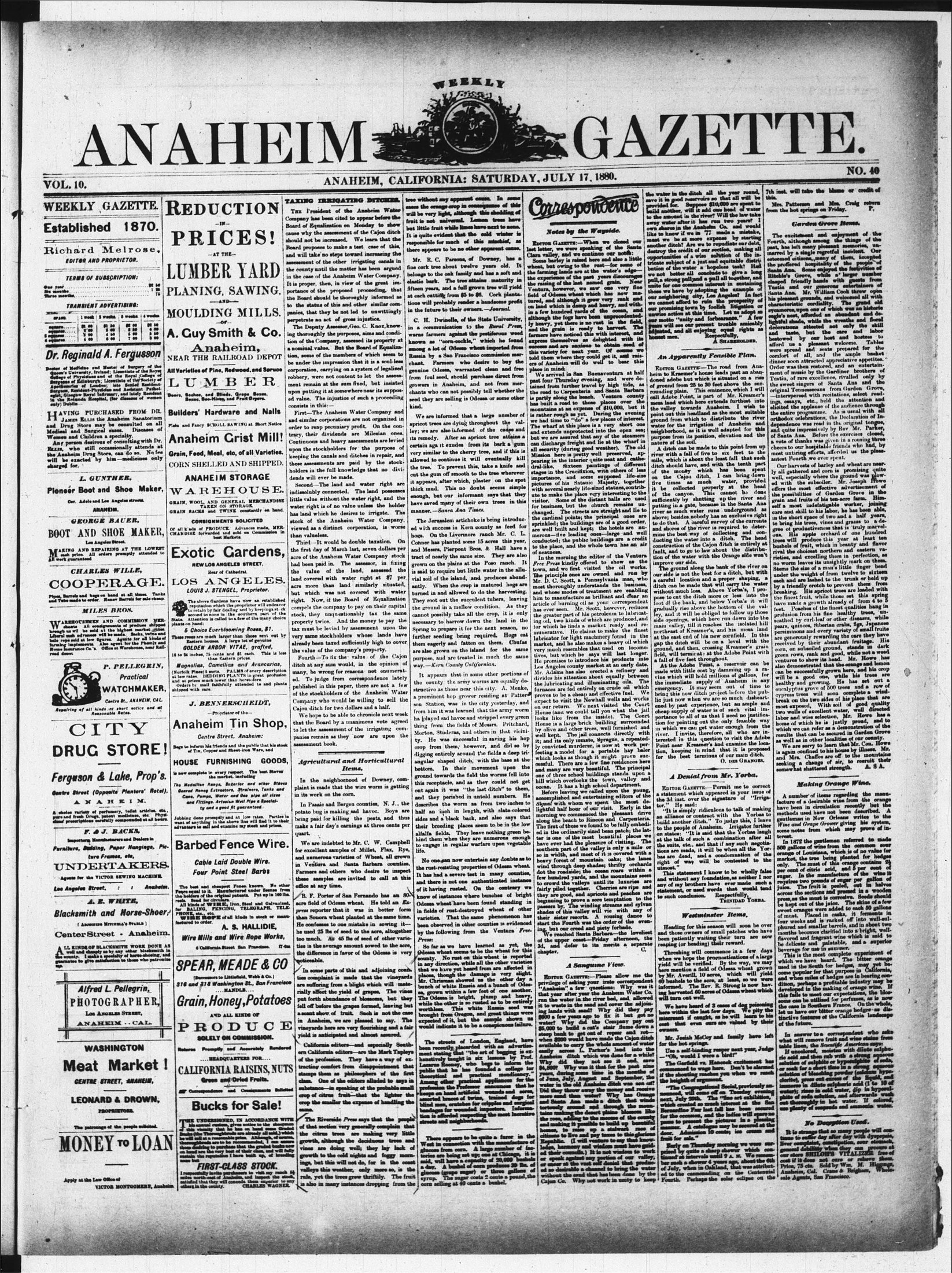
Searchable text
ANAHEIM
VOL. 10.
WEEKLY GAZETTE.
Established 1870.
Richard Melrose,
EDITOR AND PROPRIETOR.
TERMS OF SUBSCRIPTION:
One year.....$2.50
Six months.....1.25
Three months.....75
TRANSIENT ADVERTISING:
SPACE.
1 week
2 weeks
3 weeks
4 weeks
square.....$2.00
$1.50
$2.00
$2.50
$3.00
square.....2.00
2.00
2.50
5.00
5.50
square.....3.00
4.00
5.00
5.50
square.....6.00
6.00
7.00
8.00
Dr. Reginald A. Fergu88on
Doctor of Medicine and Master of Surgery of the Queen's University, Ireland; Licentiate of the Royal College of Physicians and of the Royal College of Surgeons of Edinburgh; Licentiate of the Society of Apothecaries of London; late Sentinel Resident-Surgery, Resident-Physician and Assistant Pathologist, Glasgow Royal Infirmary, and lately Rendent in the Rotunda Hospital, (for diseases of women only) Dublin.
HAVING PURCHASED FROM DR. JAMES ELLIS the Anaheim Sanatorium and Drug Store may be consulted on all Medical and Surgical cases. Diseases of Women and Children a specialty.
Any person desirous of consulting with Dr. Ellis, who still occasionally attends at the Anaheim Drug Store, can do so. No fee will be exacted by him—medicines only charged for.
REDUCTION IN PRICES!
AT THE LUMBER YARD PLANING, SAWING, AND MOULDING MILLS.
OF A. Guy Smith & Co.
Anaheim,
NEAR THE RAILROAD DEPOT
All Varieties of Pine, Redwood, and Spruce LUMBER
Doors, Bees, and Blinds, Grape Boxes, Boxes, Bee-Hiven, and Fruit Dryers.
Builders' Hardware and Nails
Plain and Fancy SCROLL SAWING at Short Notice
Anaheim Crist Mill!
Grain, Feed, Meal, etc., of all Varieties.
CORN SHELLED AND SHIPPED.
TAXING IRRIGATION
The President of the Company has been cited to Board of Equalization on cause why the assessment should not be increased. Board proposes to make a tax and will take no steps toward assessment of the other irrigated county until the matter is in the case of the Anaheim It is proper, then, in view of importance of the proposed Board should be thorough to the status of this and other panies, that they be not left perpetrate an act of grossness.
The Deputy Assecrator, going thoroughly the purpose of the Company, assesses a nominal value. But the intention, some of the members be under the impression that corporation, carrying on a robbery, were not contentment remain at the sum upon putting it at somewhat ed value. The injustice consists in this:
First—The Anaheim W and similar corporations order to reap pecuniary prtrary, their dividends and Continuous and heavy assa upon the stockholders for keeping the canals and di these assessments are paid holders in the full knowledge
HAVING PURCHASED FROM DR. JAMES ELLIS the Anaheim Sanatorium and Drug Store may be consulted on all Medical and Surgical cases. Diseases of Women and Children a specialty. Any person desirous of consulting with Dr. Ellis, who still occasionally attends at the Anaheim Drug Store, can do so. No fee will be exacted by him—medicines only charged for.
L. GUNTHER,
Pioneer Boot and Shoe Maker,
Cor. Adele and Los Angeles streets.
ANAHEIM.
GEORGE BAUER,
BOOT AND SHOE MAKER,
Los Angeles Street.
MAKING AND REPAIRING AT THE LOWEST cash price. All orders promptly attended to all work guaranteed.
CHARLES WILLE,
COOPERAGE.
Pipe, Barrels and kegs on hand at all times. Tanks and Tubes made to order. Honeoy Barrels for sale cheap.
MILES BROS.
WAREHOUSEMEN AND COMMISSION MERCHANTS. All conglomerates of produce shipped through us will be sold at the highest market prices. Liberal cash advances will be made. Snacks, twine and hale reps sold at low figures. Agents for all kinds of farming implements. Also agent for the Phenix and Home Insurance Co.'s. Office at Warehouse, near Railroad district.
P. PELLEGRIN,
Practical WATCHMAKER,
Centre St., ANAHEIM, CAL.
Repairing of all kinds at short notice and at reasonable rates.
CITY DRUG STORE!
Ferguson & Lake, Prop's.
Centre Street (Opposite Planters' Hotel).
ANAHEIM.
A choice variety of perfumery, toilet articles, etc., pure and fresh Drugs, patent medicines, etc. Physiological prescriptions carefully compounded at all hours.
F. J. BACKS,
Important Manufacturers and Dealers in Furniture, Building, Paper Nangings, Picture Frames, etc.
UNDERTAKERS,
Agents for the VICTOR SEWING MACHINE.
Los Angeles Street.: Anaheim.
LUMBER
Doors, Beaches, and Blinds, Grape Boxes,
Boxes, Bee-Hives, and Fruit Dryers.
Builders' Hardware and Nails
Plain and Fancy SCROLL SAWING at Short Notice
Anaheim Crist Mill!
Grain, Feed, Meal, eto, of all Varieties.
CORN SHELLED AND SHIPPED.
ANAHEIM STORAGE
WAREHOUSE.
GRAIN, WOOL, AND GENERAL MERCHANDISE TAKEN ON STORAGE.
GRAIN RACKS and TWINE constantly en hand.
CONSIGNMENTS SOLICITED
Of all kinds of PRODUCE. Advances made, MERCHANTABILITY forwarded and sold on Commission in best Markets.
Exotic Gardens,
NEW LOS ANGELES STREET,
Rear of Cathedral.
LOS ANGELES.
LOUIS J. STENGEL, Proprietor.
The above Gardens have now an established reputation which the proprietor will endeavor to retain by fair dealing and by keeping at ck second to none in the southern part of the State. Attention is called to a few of the many choice plants on hand:
5 Choice Everblooming Roses, $1.
These roses are much larger than those sent out by Eastern houses. A large lot of genuine GOLDEN ARBOR VITAE, grafted, 18 to 24 inches, 75 cents and $1 each. This is less than Eastern prices.
Magnolias, Camellias and Arancarias,
(Nortfolk Pines) 5 sorts. PALMS of every description at low rates. BEDDING PLANTS in great profusion and at prices much lower than heretofore. Orders by mail faithfully attended to and plants shipped with care.
J. BENNERSCHEIDT,
Proprietor of the Anaheim Tin Shop,
Centre Street, Anaheim:
Begs to inform his friends and the public that his stock of Tin, Copper and Sheet-iron Ware, and HOUSE FURNISHING GOODS,
is now complete in every respect. The best Stoves the market, including
The Medallion Range, Superler and other Stevens Geared Noney Extractors, Strainers, Tanks and Canes, Pumps, Water and Gas pipe all sizes and Fittings. Artesian Well Pipe a Specialty and a good fit guaranteed.
Jobbing done promptly and at low rates. Parties in want of anything in the above line will find it to their advantage to call and examine my stock and prizes.
Barbed Fence Wire.
Cable Laid Double Wire.
Four Point Steel Barbs
The best and cheapest Fence known. No other fence equal to it. Manufactured under license from the holders of the original patents. Put up in 100 lbs.
robbery were not contentment remain at the sum upon putting it at somewhose value. The injustice of consists in this:
First—The Anaheim Ward and similar corporations order to reap pecuniary property, their dividends are continuous and heavy assists upon the stockholders for keeping the canals and di these assessments are paid holders in the full knowledge dends will ever be made.
Second—The land and indissolubility connected little value without the water right is of no value has land which he desire stock of the Anaheim viewed as a distinct corner than valueless.
Third—It would be done the first day of March last acre of the Anaheim Ward had been paid in. The value of the land covered with water acre more than land but which was not correct. Now, if the Board compels the company to stock they unquestionable property twice. And the tax must be levied by as very same stockholders already been taxed sufficient the value of the company.
Fourth—To fix the ditch at any sum would many, be wrong for reasoned To judge from published in this paper, of the stockholders of the Company who would be Cajon ditch for two dollars We hope to be able to that the Board by a unaffected to let the assessment of panies remain as they assessment book.
Agricultural and Item
In the neighborhood plant is made that the in its work on the corn.
In Passaic and Bergen potato bug is making sa being paid for killing make a fair day's earning quart.
We are indebted to M for excellent samples of and numerous varieties in Ventura and Santa Farmers and others w these samples are inv office at any time.
B. F. Porter of San
ANAHEIM.
A choice variety of perfumery, toilet articles, etc., pure and fresh Drugs, patent medicines, etc. Phytolene' prescriptions carefully compounded at all hours.
F. & J. BACKS,
Important Manufacturers and Dealers in
Purniture, Building, Paper Nangings, Picture Frames, etc,
UNDERTAKERS,
Agents for the VICTOR SEWING MACHINE.
Lee Angeles Street, Anaheim.
A. E. WHITE,
Blacksmith and Horse-Shoer,
[ ADJUSTING MITCHELL'S STABLE ]
Center Street - Anaheim.
ALL KINDS OF BLACKSMITH WORK DONE AS well and cheaply as by any other blacksmith in the county. I make a specialty of horse-shooting, and guarantee to give satisfaction to those who patronize up.
Alfred L. Pellegrin,
PHOTOGRAPHER,
Los Angeles Street,
ANAHEIM..CAL.
WASHINGTON
Meat Market!
GENTRE STREET, ANAHEIM,
LEONARD & DROWN,
PROPRIETORS.
The patronage of the people collected.
MONEY TO LOAN
Apply at the Law Office of
VICTOR MONTGOMERY, Anaheim.
and Fittings. Artesian Well Pipe a Specialty and a good fit guaranteed.
Jobbing done promptly and at low rates. Parties in want of anything in the above line will find it to their advantage to call and examine my steek and prizes.
Barbed Fence Wire.
Cable Laid Double Wire.
Four Point Steel Barbs
The best and cheapest Fence known. No other Fence equal to it. Manufactured under license from the holders of the original patents. Put up in 100 lbs. resins. Send for circulars.
All kinds of WIRE, Iron, Steel and Galvanized, for BALING, FENCING, TELEGRAPH, TELEPHONE, etc., etc.
WIRE ROPE of all kinds in stock or manufactured to order.
A. S. HALLIDIE,
Wire Mills and Wire Rope Works,
6 California Street San Francisco.
SPEAR, MEADE & CO
(Successors to Littlefield, Webb & Co.)
316 and 218 Washington St., San Francisco....HANDLE....
Grain, Honey, Potatoes
AND ALL KINDS OF PRODUCE SOLELY ON COMMISSION.
Retires Promptly and Accurately Rendered ....HEADQUARTERS FOR....
CALIFORNIA RAISINS, NUTS Green and Dried Fruits.
Correspondence and Consequences Solicited
Bucks for Sale!
THE UNDERSIGNED, IN ACCORDANCE WITH his annual custom, given notice to the shoppers of this vicinity that he has on hand some Graded Bucks (the Thoroughbreds are already all sold) which he will sell at a reasonable price. Although, of course, thoroughbreds are to be recommended, I can ensure them drinking to purchase that the graded bucks now on hand are the very best of their class, and will fully maintain the reputation I have built up, of breeding name but.
FIRST-CLASS STOCK.
I respectfully invite purchasers to visit my ranch 45 miles north-east of Anaheim, and import the stock, satisfied that they will concede them superior to any others in the county.
CHARLES WAGNER.
In Passacic and Bergen potato bug is making san being paid for killing the make a fair day's earning quart.
We are indebted to M for excellent samples of and numerous varieties in Ventura and Santa Farmers and others where these samples are invoiced office at any time.
B. F. Porter of San Acre field of Odessa who press reporter that it was than Sonora wheat plant He confesses to one minute he used 25 lbs of seed too much. As 45 lbs ties is the average amount the difference in favor noticeable.
In some parts of this ties complaint is made are suffering from a blitially affect the yield put forth abundance of fell off before the grape a scant show of fruit. In Anaheim, we are p vineyards here are very yield is anticipated and California editors—ern California editors—of the profession. The tracting comfort from stamps them as phil class. One of the edi substance—in speaking crop of citrus fruit—crop the smaller the name.
The Riverside Press of that section very great the citrus trees and growth, although the vines are doing we growth to the cold nigts, but this will not valleys this weather, rule, yet the trees grow is also in many instances
TAXING IRRIGATING DITCHES.
The President of the Anaheim Water Company has been cited to appear before the Board of Equalization on Monday to show cause why the assessment of the Cajon ditch should not be increased. We learn that the Board proposes to make a test case of this, and will take no steps toward increasing the assessment of the other irrigating canals in the county until the matter has been argued in the case of the Anaheim Water Company. It is proper, then, in view of the great importance of the proposed proceeding, that the Board should be thoroughly informed as to the status of this and other similar companies, that they be not led to unwittingly perpetrate an act of gross injustice.
The Deputy Assessor, Geo. C. Knox, knowing thoroughly the purposes, aims and condition of the Company, assessed its property at a nominal value. But the Board of Equalization, some of the members of which seem to be under the impression that it is a soul-less corporation, carrying on a system of legalized robbery, were not content to let the assessment remain at the sum fixed, but insisted upon putting it at somewhere near its supposed value. The injustice of such a proceeding consists in this:
First—The Anaheim Water Company and similar corporations are not organized in order to reap pecuniary profit. On the contrary, their dividends are Milesian ones. Continuous and heavy assessments are levied upon the stockholders for the purpose of keeping the canals and ditches in repair, and these assessments are paid by the stockholders in the full knowledge that no tree without any apparent cause. In some cases the orange crop in consequence of this will be very light, although this shedding of fruit is not universal. Lemon trees have but little fruit while limes have next to none. It is quite evident that the cold winter is responsible for much of this mischief, as there appears to be no other apparent cause.
Mr. R. C. Parsons, of Downey, has a fine cork tree about twelve years old. It belongs to the oak family and has a soft and elastic bark. The tree attains maturity in fifteen years, and a full grown tree will yield at each cuttings from $5 to $6. Cork plantations will probably render a handsome profit in the future to their owners. — Journal.
C. H. Dwinelle, of the State University, in a communication to the Rural Press, warns farmers against the pestiferous weed known as "corn-cockle," which he found among a lot of Odessa wheat imported from Russia by a San Francisco commission merchant. Farmers who desire to buy the genuine Odessa, warranted clean and free from foul seed, should purchase direct from growers in Anaheim, and not from merchants who can not possibly tell whether the seed they are selling is Odessa or some other kind.
We are informed that a large number of apricot trees are dying throughout the valley; we are also informed of the cause and its remedy. After an apricot tree attains a certain age it exudes from its bark a gum very similar to the cherry tree, and if this is allowed to continue it will eventually kill the tree. To prevent this, take a knife and cut the gum off smooth to the tree wherever
Correspondence
Notes by the Wayside.
EDITOR GAZETTE:—When we closed our last letter, we were speaking of the Santa Clara valley, and we continue our note:
Some barley is raised here and also a little wheat, but owing to the rust—for some of the farming lands are at the water's edge—the experience of the past years discourages the raising of the last named grain. Near Ventura, however, we saw one very fine field of Odessa wheat which has now matured, and although it grew very rank and on land which is damp and heavy, and with in a few hundred yards of the ocean, and although the fogs have been unprecedentedly heavy, yet there is no rust in the field, and the grain is ready to harvest. The farmers have noticed this with interest, and express themselves as delighted with its success and are anxious to obtain seed of this variety for next year. Of course we told them where they could get it, and raisers of Anaheim will do well to bear this place in mind.
We arrived in San Buenaventura at half past four Thursday evening, and were detained from further travel by high tide, as the road to Carpenteria and Santa Barbara is partly along the beach. Ventura county has built a road to those places over the mountains at an expense of $10,000, but it is rather rough as yet. During the evening we had time to "do" a few places of interest. The wharf at this place is a very short one and extends unprotected into the open sea; but we are assured that any of the steamers can discharge freight and lie at the wharf in all security (during good weather). The old Mission here is pretty well preserved, appearing in the interior quite neat and cathedral-like. Sixteen paintings of different stages in the Crucifixion, with others of less water we save it in ponds provided for building another destroy opportunities tricate suburbation of we not pull, a strong unite for those we cannot our promise unwise acclimate our motto years will adjust me.
An A
EDITOR heim to done ad of ground rounding; call Adolme messa lasse; the valleys point out ground for water for neighbor's purpose nature A ditch river with mile, whit ditch of the
Agricultural and Horticultural Items.
In the neighborhood of Downey, complaint is made that the wire worm is getting in its work on the corn.
In Pasaic and Bergen counties, N. J., the potato bug is making sad havoc. Boys are being paid for killing the pests, and thus make a fair day's earnings at three cents per quart.
We are indebted to Mr. C. W. Campbell for excellent samples of Millet, Flax, Rye, and numerous varieties of Wheat, all grown in Ventura and Santa Barbara counties. Farmers and others who desire to inspect these samples are invited to call at this office at any time.
B. F. Porter of San Fernando has an 80-
from foul seed, should purchase direct from growers in Anaheim, and not from merchants who can not possibly tell whether the seed they are selling is Odessa or some other kind.
We are informed that a large number of apricot trees are dying throughout the valley; we are also informed of the cause and its remedy. After an apricot tree attains a certain age it exudes from its bark a gum very similar to the cherry tree, and if this is allowed to continue it will eventually kill the tree. To prevent this, take a knife and cut the gum off smooth to the tree wherever it appears, after which, plaster on the spot thick mud. This no doubt seems simple enough, but our informant says that they have saved many of their own trees in this manner.—Sanca Ana Times.
The Jerusalem artichoke is being introduced with success in Kern county as feed for hogs. On the Livermore ranch Mr. C. L. Conner has planted some 15 acres this year, and Messrs. Pierpont Bros. & Hall have a tract of nearly the same size. They are also grown on the plains at the Poso ranch. It is said to require but little water in the alluvial soil of the island, and produces abundantly. When the crop is matured hogs are turned in and allowed to do the harvesting. They root out the succulent tubers, leaving the ground in a mellow condition. As they cannot possibly take all the crop, it is only necessary to harrow down the land in the Spring to prepare it for the next season, no further seeding being required. Hogs eat them eagerly and fatten on them. Chufas are also grown on the island for the same purpose, and are treated in much the same way.—Kern County Californian.
It appears that in some other portions of the county the army worms are equally destructive as those near this city. A. Menke, a prominent hop grower residing at Patterson Station, was in the city yesterday, and from him it was learned that the army worm played sad havoc and stripped every green thing from the fields of Messrs. Pritchard, Morton, Studeras, and others in that vicinity. He was successful in saving his hop crop from them, however, and did so by digging entirely around the fields a deep triangular shaped ditch, with the base at the bottom. In their movement upon the ground towards the field the worms fell into this receptacle, and as they could not get out again it was "the last ditch" to them, and they perished in untold numbers. He describes the worm as from two inches to half an inch in length, with slate-colored sides and a black back, and also says that their breeding places seem to be in the low alfalfa fields. They leave nothing green behind them when they are numerous enough to engage in regular warfare upon vegetable life.
No one can now entertain any doubts as to the rust-resisting properties of Odessa wheat. It has had a severe test in many counties, and there is not one authenticated instance of it having rusted. On the contrary we know of instances where bunches of bright from foul seed, should purchase direct from growers in Anaheim, and not from merchants who can not possibly tell whether the seed they are selling is Odessa or some other kind.
We are informed that a large number of apricot trees are dying throughout the valley; we are also informed of the cause and its remedy. After an apricot tree attains a certain age it exudes from its bark a gum very similar to the cherry tree, and if this is allowed to continue it will eventually kill the tree. To prevent this, take a knife and cut the gum off smooth to the tree wherever it appears, after which, plaster on the spot thick mud. This no doubt seems simple enough, but our informant says that they have saved many of their own trees in this manner.—Sanca Ana Times.
The Jerusalem artichoke is being introduced with success in Kern county as feed for hogs. On the Livermore ranch Mr. C. L. Conner has planted some 15 acres this year, and Messrs. Pierpont Bros. & Hall have a tract of nearly the same size. They are also grown on the plains at the Poso ranch. It is said to require but little water in the alluvial soil of the island, and produces abundantly. When the crop is matured hogs are turned in and allowed to do the harvesting. They root out the succulent tubers, leaving the ground in a mellow condition. As they cannot possibly take all the crop, it is only necessary to harrow down the land in the Spring to prepare it for the next season, no further seeding being required. Hogs eat them eagerly and fatten on them. Chufas are also grown on the island for the same purpose, and are treated in much the same way.—Kern County Californian.
It appears that in some other portions of the county the army worms are equally destructive as those near this city. A. Menke, a prominent hop grower residing at Patterson Station, was in the city yesterday, and from him it was learned that the army worm played sad havoc and stripped every green thing from the fields of Messrs. Pritchard, Morton, Studeras, and others in that vicinity. He was successful in saving his hop crop from them, however, and did so by digging entirely around the fields a deep triangular shaped ditch, with the base at the bottom. In their movement upon the ground towards the field the worms fell into this receptacle, and as they could not get out again it was "the last ditch" to them, and they perished in untold numbers. He describes the worm as from two inches to half an inch in length, with slate-colored sides and a black back, and also says that their breeding places seem to be in the low alfalfa fields. They leave nothing green behind them when they are numerous enough to engage in regular warfare upon vegetable life.
No one can now entertain any doubts as to the rust-resisting properties of Odessa wheat. It has had a severe test in many counties, and there is not one authenticated instance of it having rusted. On the contrary we know of instances where bunches of bright from foul seed, should purchase direct from growers in Anaheim, and not from merchants who can not possibly tell whether the seed they are selling is Odessa or some other kind.
We are informed that a large number of apricot trees are dying throughout the valley; we are also informed of the cause and its remedy. After an apricot tree attains a certain age it exudes from its bark a gum very similar to the cherry tree, and if this is allowed to continue it will eventually kill the tree. To prevent this, take a knife and cut the gum off smooth to the tree wherever it appears, after which, plaster on the spot thick mud. This no doubt seems simple enough, but our informant says that they have saved many of their own trees in this manner.—Sanca Ana Times.
The Jerusalem artichoke is being introduced with success in Kern county as feed for hogs. On the Livermore ranch Mr. C. L. Conner has planted some 15 acres this year, and Messrs. Pierpont Bros. & Hall have a tract of nearly the same size. They are also grown on the plains at the Poso ranch. It is said to require but little water in the alluvial soil of the island, and produces abundantly. When the crop is matured hogs are turned in and allowed to do the harvesting. They root out the succulent tubers, leaving the ground in a mellow condition. As they cannot possibly take all the crop, it is only necessary to harrow down the land in the Spring to prepare it for the next season, no further seeding being required. Hogs eat them eagerly and fatten on them. Chufas are also grown on the island for the same purpose, and are treated in much the same way.—Kern County Californian.
It appears that in some other portions of the county the army worms are equally destructive as those near this city. A. Menke, a prominent hop grower residing at Patterson Station, was in the city yesterday, and from him it was learned that the army worm played sad havoc and stripped every green thing from the fields of Messrs. Pritchard, Morton, Studeras, and others in that vicinity. He was successful in saving his hop crop from them, however, and did so by digging entirely around the fields a deep triangular shaped ditch, with the base at the bottom. In their movement upon the ground towards the field the worms fell into this receptacle, and as they could not get out again it was "the last ditch" to them, and they perished in untold numbers. He describes the worm as from two inches to half an inch in length, with slate-colored sides and a black back, and also says that their breeding places seem to be in the low alfalfa fields. They leave nothing green behind them when they are numerous enough to engage in regular warfare upon vegetable life.
No one can now entertain any doubts as to the rust-resisting properties of Odessa wheat. It has had a severe test in many counties, and there is not one authenticated instance of it having rusted. On the contrary we know of instances where bunches of bright from foul seed, should purchase direct from growers in Anaheim, and not from merchants who can not possibly tell whether the seed they are selling is Odessa or some other kind.
We are informed that a large number of apricot trees are dying throughout the valley; we are also informed of the cause and its remedy. After an apricot tree attains a certain age it exudes from its bark a gum very similar to the cherry tree, and if this is allowed to continue it will eventually kill the tree. To prevent this, take a knife and cut the gum off smooth to the tree wherever it appears, after which, plaster on the spot thick mud. This no doubt seems simple enough, but our informant says that they have saved many of their own trees in this manner.—Sanca Ana Times.
The Jerusalem artichoke is being introduced with success in Kern county as feed for hogs. On the Livermore ranch Mr. C. L. Conner has planted some 15 acres this year, and Messrs. Pierpont Bros. & Hall have a tract of nearly the same size. They are also grown on the plains at the Poso ranch. It is said to require but little water in the alluvial soil of the island, and produces abundantly. When the crop is matured hogs are turned in and allowed to do the harvesting. They root out the succulent tubers, leaving the ground in a mellow condition. As they cannot possibly take all the crop, it is only necessary to harrow down the land in the Spring to prepare it for the next season, no further seeding being required. Hogs eat them eagerly and fatten on them. Chufas are also grown on the island for the same purpose, and are treated in much the same way.—Kern County Californian.
It appears that in some other portions of the county The army worms are equally destructive as those near this city.A.Menke,a prominent hop grower residing at Patterson Station was in city yesterday,and from him it was learned that The army worm played sad havoc and stripped every green thing fromthe fields of Messrs.Pritchard,Morton,Pstuderas,and othersinthatvicinity.Hewassuccessfulin savinghishopcropfromthemhowever,anddidsobydiggingentirelyaroundthefieldsadeptriangularshapedditchwiththebaseatthebottom.Intheirmovementupidensthegroundtowardsthefieldthewormsfellinthisreceptacle,andastheycouldnotgetoutagainitwas“thelastditch”tohem,theyperishedinuntoldnumbers.Hewdescribesthewormasfromtwoweenthightidealhourbeyondthelurkingandilluminatingoil.Thefurnacesarefedentirelyoncrudeoilwhichprovesbetweentheseveralnearlylife-sizedstatues contributetothemakeveryinterestingtothevisitor.Someofthedistincthallowsremainedunchanged.Thestreetsarestraightandlietothecardinalpoints;theprincipalonesaresprinkled;thebuildingsareofagoodorder,andwellbuiltandkept;thehotelsarewellandbeautifulleyandsideopentoseofthelandvaporthevineormainvinefornorthatatthegapgroundfield.wallefalloffairimprovement.ThegivetheoursideawearthwhileemergingbringtheliejustenedbycheapportioningtotheierrestingPoint,tionfortheofficeatanytime.B.F.PorterofSanFernandohasan80-
In Passic and Bergen counties, N. J., the potato bug is making sad havoc. Boys are being paid for killing the pests, and thus make a fair day's earnings at three cents per quart.
We are indebted to Mr. C. W. Campbell for excellent samples of Millet, Flax, Rye, and numerous varieties of Wheat, all grown in Ventura and Santa Barbara counties. Farmers and others who desire to inspect these samples are invited to call at this office at any time.
B. F. Porter of San Fernando has an 80-acre field of Odessa wheat. He told an Express reporter that it was in better form than Sonora wheat planted at the same time. He confesses to one mistake in sowing it—he used 25 lbs of seed to the acre, altogether too much. At 45 lbs of seed of other varieties is the average amount sowed to the acre, the difference in favor of the Odessa is very noticeable.
In some parts of this and adjoining counties complaint is made that the vineyards are suffering from a blight which will materially affect the yield of grapes. The vines put forth abundance of blossoms, but they fell off before the grapes formed, leaving but a scant show of fruit. Such is not the case in Anaheim, we are pleased to say. The vineyards here are very flourishing and a fair yield is anticipated and almost assured.
California editors—and especially Southern California editors—are the Mark Tupleys of the profession. They have a way of extracting comfort from disappointment that stamps them as philosophers of the first class. One of the editors alluded to says in substance—in speaking of the probable small crop of citrus fruit—that the lighter the crop the smaller the expense of handling the same.
The Riverside Press says that the people of that section very generally complain that the citrus trees are making very little growth, although the deciduous trees and vines are doing well; they lay lack of growth to the cold nights and foggy mornings, but this will not do, for in the coast valleys this weather, only more so, is the rule, yet the trees grow thriftily. The fruit is also in many instances dropping from the
No one can now entertain any doubts as to the rust-resisting properties of Odessa wheat. It has had a severe test in many counties, and there is not one authenticated instance of it having rusted. On the contrary we know of instances where bunches of bright Odessa wheat have been found standing in fields of rust-destroyed wheat of other varieties. That the same phenomenon has been observed in other counties is evidenced by the following from the Ventura Free Press:
So far as we have learned as yet, the Odessa wheat seems to be the wheat for this county. No rust on this wheat is reported in any direction, while all the other varieties that we have yet heard from are affected in places, though the damage is very slight. Mr. Christman showed us the other day a bunch of white Russia and a bunch of Odessa, grown within a few feet of one another. The Odessa is bright, plump and heavy, while the other is so rusted as to be entirely worthless. This white Russia seed was brought from Oregon, and great things were expected of it, but the sample shown us would indicate it to be a conspicuous failure.
The streets of London, England, have been recently placarded with an advertisement stating that "the art of begging is exhanatively taught in six lessons by Prof. Lazurus Rooney, who begs to inform the public that he has founded a college for theoretical and practical medicine." Among other practical appliances for the profession the Professor announces that he keeps on hand artificial wounds and sore, asserted bruises of twins, trained dogs for blind men, crutches for cripples and surgical bandages for wounded impostors. Information is afforded respecting the most lucrative streets and neighborhoods.
There appears to be quite a furor in the West in connection with the manufacture of glucose from corn. A large number of factories are being set up; one at Chicago, it is said, will have a capacity of 20,000 bushels a day. A bushel of corn produces 30 lb. of glucose (grape sugar) or three gallons of syrup. The sugar costs 2 cents a pound, the corn selling at 40 cents a bushel.
Signal with whom we spent the most delightful half hour of our visit. Early in the morning we commenced the pleasant drive along the beach to Rincon and Carpenteria. The first of those we found to be fully embodied in the ordinarily sized bean patch; the latter is one of the most beautiful places we have ever had the pleasure of visiting. The southern part of the valley is only a mile or so in width, and most of it is covered with a heavy forest of mountain oaks; the lance wind through deep shades; thrifty orchards dot the roadside; the ocean roars within a few hundred yards, and the mountains seem to crowd the valleys until its luxuries are fairly piled together. Cherries are ripe and they are good, and apricots and peaches are beginning to prove a sore temptation to the passers by. The winding streams and sylvan shades of this valley will vie with any of their sister resorts. A roaring dance to start the Fourth was the order of the evening, but our creed and piety forbade.
We reached Santa Barbara—the loveliest of the upper coast—Friday afternoon, the 3d, and defer to its merits a separate chapter.
A Sangune View.
EDITOR GAZETTE:—Please allow me the privilege of asking your irate correspondent "Annaheim" a few questions: Why was it that year after year the Annaheim Water Co., run the water in the river bed, and allowed it to waste in the sand and cover the adjoining lands with sand? Why did they pay $600 a few years ago to fix it but got no water? Why did the Company pay out $5,000 to build a cat's stair flume down a steep bank to get out of repair and rot—when $200 would have made the Cajen ditch available to carry the whole amount of water easily across L. Parker's land into the Annaheim ditch which was done for a while? Why did they not see it and save $4,800? Why was it that for the past nine years, during some time in the months of June, July, August and September, the water in the old Annaheim ditch was not cut? Did they throw away the money and receive more砂 than water? Why has Orange and Santa Ana made a ditch that winds tortuously around and through the mountains making the desert plains bloom like rose, adding to the moose of the county and making it possible to build up beautiful homes, to raise up a stalwart race of citizens to live and pay taxes to this glorious Republic. (I will venture to say that knowledge, harmony and wisdom must have guided their comrades.) It is not wisdom to work or speak against any portion of our valley, or unearth at the vast self denial that produced so desirable a channel to bring the water without the sand that has been done by the Cajen Co. Why not work in unity to keep
GAZETTE.
NO. 40
the water in the ditch all the year round,
save it in good reservoirs so that all will be
provided for. Suppose $10,000 are spent to
build another, will it add one head of water
to the amount in the river? Will the law take
away water after it has run two years?
I own shares in the Anaheim Co., and would
like to know if we in 77 made a mistake,
must we be at more expense by starting
another ditch? Are we to repudiate our debt,
destroy the credit of our section, making all
opportunities of a wise solution of the intricate subject of a just and equitable distribution of the water a hopeless task?
Had we not better all conclude to give a long pull, a strong pully and a pull all together, and unite for one common interest in sustaining those we have by adopting the example of our neighboring city, Los Angeles? In fact we cannot afford to ruin the prosperity of our promising town by foolish litigation or unwise action at this time. Let us adopt an our motto "unity and forbearance." A few years will see our present trouble amicably adjusted, and all enjoying equal rights as honest men.
Respectfully,
A SHAREHOLDER.
An Apparently Feasible Plan.
EDITOR GAZETTE:—The road from Anaheim to Kraemer's house leads past an abandoned adobe hut which is situated on a rise of ground from 25 to 30 feet above the surrounding plain. This eminence, which I will call Adobe Point, is part of Mr. Kreamer's mea land which here extends furthest into the valley towards Anaheim. I wish to point out this headland as the most suitable ground from which to distribute the river water for the irrigation of Anaheim and neighborhood, as it is well adapted for this purpose from its position, elevation and the nature of the soil.
A ditch can be made to this point from up river with a fall of five to six feet to the mile, which is about the least fall that such ditch should have, and with the tenth part of the money which has been spent
7th inst. will take the blame or credit of this.
Mrs. Patterson and Mrs. Craig return from the hot springs on Friday.
Garden Grove Items.
The excitement and enjoyment of the Fourth, although among the things of the past, has left many pleasant memories, unmarred by a single regretful incident. Our esteemed citizens, many of them, accepted the proffered hospitality of the people of Santa Ana. Some enjoyed the festivities of Ritchie's Grove, while a larger number clasped friendly hands with guests from Tustin and our generous entertainers of Santa Ana. Mr. William Cook threw open his pleasant grounds, and welcomed all with characteristic cordiality. The grand old sycamore, upon one of which was an historic eagle's nest, afforded an abundant and delightful shade, while the wreaths and floral decorations attested not only the skill and taste, but the care and labor bestowed by our host and hostess to afford us a pleasant welcome. Tables were spread and seats prepared for the comfort of all, and the ample basket dinner soon attracted appreciative appetites. Order was then restored, and an entertainment of music by the Gardiner brothers of Tustin, of rare excellence, rivalled only by the sweet singers of Santa Ana and the original Tennesseeans from Garden Grove—interspersed with recitations, select readings, essays, etc., held the attention and elicited the applause of the audience through the entire programme. As is usual with all orthodox celebrations, the Declaration of Independence was read in the original tongue, and quite impressively by Rev Mr. Parker, of Santa Ana. Before the exercises closed, a vote of thanks was given in a rousing three cheers to our hospitable friends who had, by most untiring efforts, afforded us the pleasantest Fourth we ever spent.
Our harvests of barley and wheat are nearly all gathered and corn is promising quite
The old oil works owned and run by Pennsylvania man, who handles the business, are enabling brilliant and clear an eye to your correspondent, however, reduces petroleum to lubrication which are produced, and market ready and ready to make the finestinery found in the area is heavy oil which was used on locomotives that will last longer. His products into the market at an early date, detected a refinery and not equally between eminating oils. The crude oil which is effective fuel. We shall well and works visit the Court tell you what the jail inside). The Court building surrounded well furnished and connects directly with Sprague, a repeated site now at work per portable hay baler that might prove successful. The principal buildings stand upon a town, valley and school department.
Edited upon the young, containing editors of the report the most recent visit. Early in the pleasant drive Jason and Carpenteria, and to be fully embodied bean patch; the latest beautiful places we secure of visiting. The valley is only a mile or so covered with a lanes oaks; the lanes cliffs; thrifty orchards ocean roars within a field the mountains seem until its luxuries are Cherries are ripe and peaches are sweet temptation to the Ventura county places over the city of $10,000, but it during the evening new places of interest. A very short one pint to the open sea; any of the steamers lie at the wharf in weather). The old oil preserved, apples nest and cathestige of different with others of less supposed life-size Majesty, together sized statue, contrib- interesting to the instant halls areurch remains unseen straight and lie to principal ones are care of a good order, the hotels are nuuses—large and well builtings are a creditable town has an air
A ditch can be made to this point from up river with a fall of five to six feet to the mile, which is about the least fall that such ditch should have, and with the tenth part of the money which has been spent on the Cajon ditch, I can bring down five times as much water, provided it be collected properly at the head of the canyon. This cannot be done sufficiently by shutting up the river and putting in a gate, because in the Santa Ana river as much water runs underground as above; besides nobody has an exclusive right to do that. A careful survey of the currents and shores of the river is required to determine the best way of collecting and conducting the water into a ditch. The head construction of the Cajon ditch is entirely at fault, and to go to law about the distribution of the water with the Orange side won't improve our side.
The ground along the bank of the river on our side is not the best for a ditch, but with a careful location and a proper shaping, a ditch can be made that will carry the water without much loss. Above Yorba's, I propose to cut the ditch more or less into the foot of the bank, and below Yorba's it will gradually rise above the bottom of the valley, and it will be obliged to follow up those openings, which here run down into the main valley, till it reaches the isolated hill northeast of Kreamer's, and his mesa land at the east end of his new cornfield. In this gap the ditch will be on a level with the ground, and then, crossing Kreamer's grain field, will terminate at the Adobe Point with a fall of five feet throughout.
At the Adobe Point, a reservoir can be made with little cost by damming up a ravine which will hold millions of gallons, for immediate supply of Anaheim in any emergency. It may seem out of time to bring this new ditch project before the public just now when we are so much dusheartened by past experience, but an ample and cheap supply of water is of such vital importance to all of us that I need no justification for pointing out that the only feasible way in which we can get water enough from the river. I invite, therefore, all who are interested in this question to visit the Adobe Point near Kreamer's and examine the location, keeping in mind that it is proposed for the best terminus of our main ditch.
O. DES GRANGES.
A Dental from Mr. Yorba.
EDITOR GAZETTE:—Permit me to correct a statement which appeared in your issue of the 3d inst. over the signature of "Irrigator." He said:
"It is simply ridiculous to talk of making an alliance or contract with the Yorbas to build another ditch." To judge this, I leave to the people of Anaheim. Irrigator further on states: "It is said that the Yorbas laugh at the talk of such a combination after all suits, etc., and that if any such negotiations are made, it will be when all the Yorbas are dead, and a condemnation of the right of way will be contested to the utmost."
This statement I know to be wholly false and without any foundation, as neither I nor any of my brothers have ever made such a statement, or used words that would tend to such conclusion. Respectfully,
Tustin, of rare excellence, rivalled only by the sweet singers of Santa Ana and the original Tennesseeans from Garden Grove—interspersed with recitations, select readings, essays, etc., held the attention and elicited the applause of the audience through the entire programme. As is usual with all orthodox celebrations, the Declaration of Independence was read in the original tongue, and quite impressively by Rev Mr. Parker, of Santa Ana. Before the exercises closed, a vote of thanks was given in arousing three cheers to our hospitable friends who had, by most uniring efforts, afforded us the pleasant Fourth we ever spent.
Our harvests of barley and wheat are nearly all gathered and corn is promising quite well, especially where the ground was plowed with the subsoiler. Mr. Joseph Howe offers the most effective advertisement of the possibilities of Garden Grove in the grain and fruits of his ten-acre farm. Himself a most indefatigable worker, joining care and skill to his labor, he has been able in the short space of two and a half years, to bring his trees, vines and grains to a degree of productiveness that is truly marvelous. His apple orchard of one hundred trees will produce this year at least ten bushels of fruit, which in beauty and flavor rival the choice northern and eastern varieties, and excelling them in perfection, as no worm leaves its unsightly mark on them. Stems size of a man's little finger bend under the weight of from twelve to sixteen each and are lashed to the trunk or held up by a friendly crotch to prevent them from breaking. His apricot trees are loaded with the finest fruit, while those set this spring have made a growth already of from 4 to 5 feet. Peaches of the finest qualities hang in profusion from his fine healthy trees, unseated by curl-leaf or other diseases, while pears, quinces, Siberian crabs, figs, Japanese persimmons and every variety of small fruits are generously rewarding the care they have received by their abundant fruitage. His corn, on subsouiled ground, stands in dark green rows, rank and good, while not a weed ventures to show its head. Mr. Howe has also demonstrated that the orange and lemon can be successfully grown here, and his crop will be a good one, while his trees are healthy and growing. He has set out an enecyptus grove of 500 trees and a row of cypress trees will soon complete a windbreak on the two sides of his place that are most exposed. With soil of good quality two wells of excellent water, well directed labor and wise selection, Mr. Howe has a home of which he is justly proud, and to which we can refer as a demonstration of the results that can be secured in Garden Grove as well as in other localities of our county.
We are sorry to learn that Mr. Con. Howe is again confined to his house by illness. Mr. and Mrs. Chaffee are off to the mountains seeking a change of air, to recruit their somewhat shattered strength.
A Dental from Mr. Yorba.
Making Orange Wine.
A number of items regarding the manufacture of a desirable wine from the orange have been in circulation recently but the methods used have not been described. A gentleman in New Orleans writes to the Wine and Grape Grower giving his system, some notes from which may prove of interest.
In 1872 the gentleman referred to made 500 gallons of wine from the common sour orange of Louisiana, which is of no value for market; the tree being planted for hedges only. The must of this orange contains 2½ per cent of citric acid, and 5 per cent of sugar. In the manufacture of the wine it requires two pounds of sugar per gallon of juice. The fruit is peeled, cut in halves across the sections and pressed in a wooden press as must be corrosive. Seeds should
Westminster Items.
Heading for this season will soon be over and those owners of small patches who have been patiently waiting their turn are now reaping (or heading) their reward.
Threshing will commence in a few days when we hope the prognostications of a large yield will be verified. By the way, we may here mention a field of Odessa wheat grown by Mr. Averill, 10 acres, which will yield 60 bushels to the acre, at least, so we were informed. The Rev. R. Strong is now having harvested 60 acres of Odessa wheat which will turn out well.
We have heard of 3 cases of dog poisoning within the last few days. We pity the miscreant if caught, as he will learn to his cost that even cures are valued by their owners.
Mr. Jesiah McCoy and family have left for the hot springs.
Use a self-binding reser next year, Judge — "Oh, would I were a bird!"
The Garfield va. Hancock excitement has commenced to wage here. Don't be alarmed if the shouting reaches you when we reach the height of argument.
"The Congregational Social, previously announced, will come off on Thursday evening next, July 20th. The fine art exhibition," which created so much interest at the San Bernardino Fair last fall has been secured for the occasion, and the ladies will spare no pains to present the pictures in a pleasing manner. A catalogue may be secured at the door. Admission 10 cents; ice cream and fruit for sale."
Early on Thursday morning we were surprised by quite a sharp shower which continued at intervals until 9 a.m. We remember such a shower 4 years ago, about the 6th of July, when in Oakland, that was attributed to the cannonading on the Centennial Fourth. Perhaps the solar eclipse on the facture of a desirable wine from the orange have been in circulation recently but the methods used have not been described. A gentleman in New Orleans writes to the Wine and Grape Grower giving his system, some notes from which may prove of interest.
In 1872 the gentleman referred to made 500 gallons of wine from the common sour orange of Louisiana, which is of no value for market, the tree being planted for hedges only. The must of this orange contains 2½ per cent of citric acid, and 5 per cent of sugar. In the manufacture of the wine it requires two pounds of sugar per gallon of juice. The fruit is peeled, cut in halves across the sections and pressed in a wooden press, as the must is corrosive. Seeds should be kept out of the juice. The skins of a few sweet oranges were added to each 50 gallons of must. Placed in casks, it ferments in four weeks and is racked off into well-sulphured and smaller barrels, and in about two months becomes clarified into a bright, well-flavored and fragrant wine which is said to be delicate and palatable, and a superior beverage for use in summer.
This is the most complete experiment of which we have heard. The bitter orange used in the South for hedges, may yet become popular for that purpose in California, and when miles of hedges are in bearing condition, perhaps a profitable industry may be developed in the making of orange wine. If this fails to meet our expectations, the blooms can be utilized for perfumes, as is now the case in Southern France. On the whole, let us have our bitter orange hedges as distinctive features of the California landscape of the future.
In answer to a correspondent who asks what will remove fruit and wine stains from table linen, the Scientific American says:
If uncolored, moisten with dilute sulphuric acid and then rub with a strong aqueous solution of sulphite or hypothalite of soda, or soak for a short time in a strong aqueous solution of blanching powder (calcium hypochlorite), press out excess of the liquid, and immerse in dilute sulphuric acid (1 to 10 of water); rinse in cold water, dip in hyposalphite of soda solution, and afterwards wash out thoroughly in hot water. If colored, use plenty of ampoules and ammonia water.
No Decryption Used.
It is strange that so many people will continue to suffer day after day with dyspepsia, liver complaint, constipation, sour stomach, general debility when they can procure at our store SHILOR'S VITALIZER free of cost if it does not care or relieve them. Price, 75 ctn. Sold by Wm. M. Higgins, Anaheim, Cal. Crane & Brigham, Wholesale Agents, San Francisco.