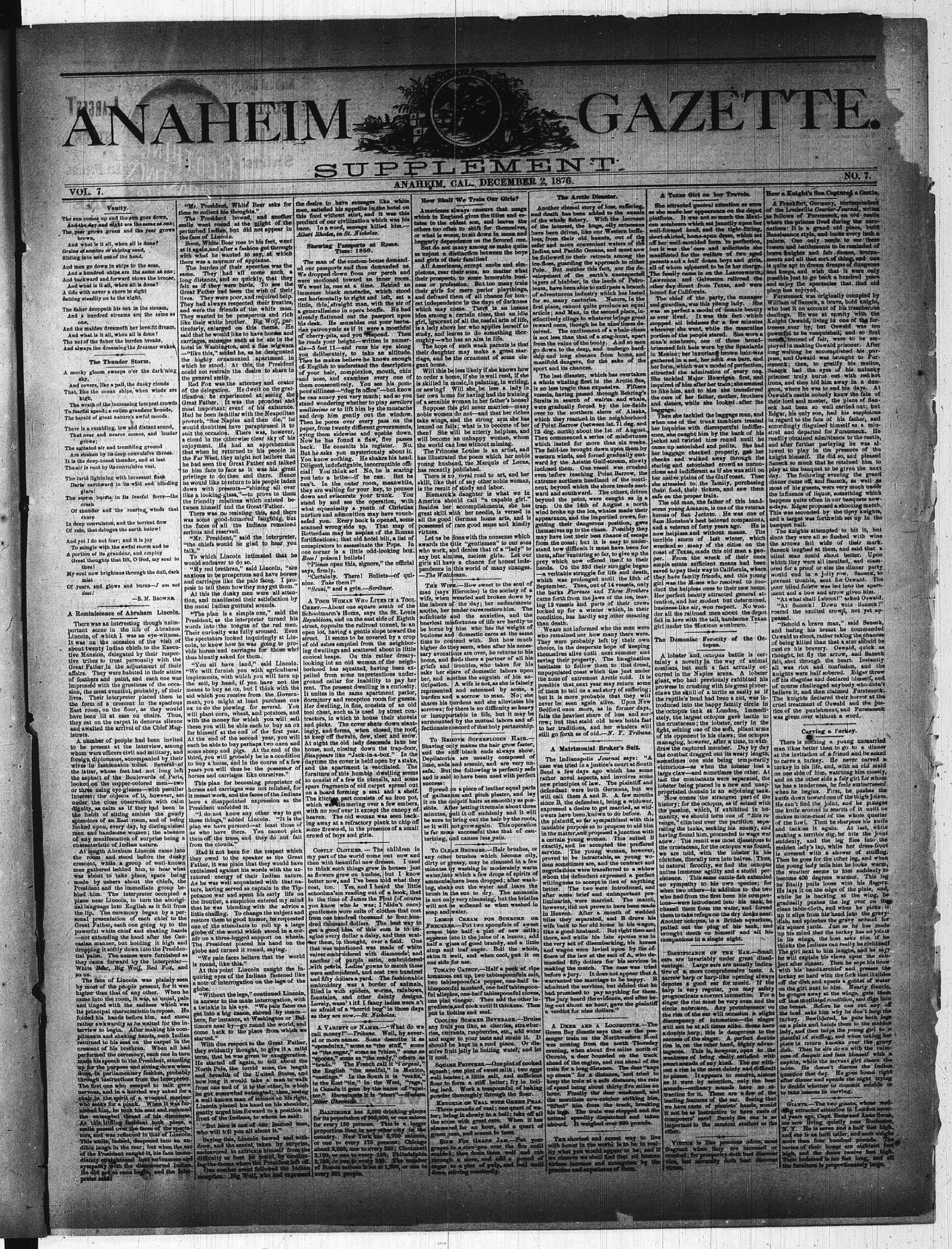
anaheim-gazette 1876-12-02
Scanned page
Searchable text
ANAHEIM
VOL. 7.
Vanity.
The sun comes up and the sun goes down,
And the day and night are the same as one;
The year grows green and the year grows brown,
And what is it all, when all is done?
Grains of sombre or shining sand,
Sliding into and out of the hand.
And men go down in ships to the seas,
And a hundred ships are the same as one;
And backward and forward blows the breese,
And what is it all, when all is done?
A tide with never a shore in sight
Settling steadily on to the night.
The fisher droppeth his net in the stream,
And a hundred streams are the same as one,
And the malden dreameth her love-lit dream,
And what is it all, when all is done?
The net of the fisher the burden breaks,
And always the dreaming the dreamer wakes.
The Thunder Storm.
A murky gloom sweeps o'er the dark'ning sky,
And covers, like a pall, the dusky clouds
That, like the ocean ships, when winds are high,
The wrath of the increasing tempest crowds
To fearful speed; a sullen grandeur broods,
The herald of great nature's awful moods.
There is a rumbling, low and distant sound,
That near and nearer comes, and louder grows;
The agitated air and trembling ground
Are shaken by its deep convulsive throes.
It is the deep-toned thunder, and at last
"Mr. President, White Bear asks for time to collect his thoughts."
The President bowed, and another smile went round at the plight of the perturbed Indian, but did not appear in the face of Lincoln.
Soon, White Bear rose to his feet, went at it again, and after a fashion got through with what he wanted to say, at which there was a murmur of applause.
The burden of their speeches was the same. They had all come such a long distance, and so quickly, that they felt as if they were birds. To see the Great Father had been the wish of their lives. They were poor, and required help. They had always respected their treaties, and were the friends of the white man. They wanted to be prosperous and rich like their white brother. Big Wolf, particularly enlarged on this theme. He said that he would like to have horses and carriages, saunas such as he ate in the hotel in Washington, and a fine wigwam—"like this," added he, as he designated the highly ornamented apartment in which he stood. At this, the President could not restrain the desire to share in the general smile.
Red Fox was the attorney and orator of the delegation. He dwelt on the gratification he experienced at seeing the Great Father. It was the proudest and most important event of his existence. Had he been familiar with the Neapolitan proverb, "See Naples and then die," he would doubtless have paraphrased it to suit the occasion. There was, however, a cloud in the otherwise clear sky of his enjoyment. He had an apprehension that when he returned to his people in the Far West, they might not believe that he had seen the Great Father and talked
the desire to have men, satisfied his appetite this food without stifle product of our civilization. In a word, san Albert Rhodes, in St. Louis.
Showing Passport Time:
The man of the crowd ed our passports and We dropped down fraternity motioned toward We went in, one at a immense black muscled horizontally to rile little, thin, straight a generalissimo in open already flattened out his desk. He mumbled patronymic as if of cherry-pits, and ye reads your height als—5 feet 11—and you deliberately, to Then he makes belief of English to undermine of your hair, compand nose, and exam them consecutively. pous silliness—"dog" he can annoy you we stand wondering where umilissimo or to lift and drop him gently Then he pores over paper, from twenty dyeing them sidewise Now he has found back. He consults But he asks you my You know nothing.
Diligent indoafish
A murky gloom sweeps o'er the dark'ning sky,
And covers, like a pall, the dusky clouds
That, like the ocean ships, when winds are high,
The wrath of the increasing tempest crowds
To fearful speed; a sullen grandeur broods,
The herald of great nature's awful moods.
There is a rumbling, low and distant sound,
That near and nearer comes, and louder grows;
The agitated air and trembling ground
Are shaken by its deep convulsive throes.
It is the deep-toned thunder, and at last
The air is rent by its convulsive vast.
The lurid lightning with incessant flash
Darts earthward in its wild and blinding glare!
The storm bursts in its fearful force—the crash
Of thunder and the roaring winds that share
In deep convulsion, and the torrent flow
Of rain, that deluges the earth below!
And yet I do not fear; and it is joy
To mingle with the awful storm and be
A portion of its grandeur, and employ
Great thoughts that lift, O God, my soul to thee!
My soul now brightens through the dull, dark mist
Of years, and glows and burns—I am not dust!
—B. M. BROWN.
A Reminiscence of Abraham Lincoln.
There was an interesting though unimportant scene in the life of Abraham Lincoln, of which I was an eye-witness. It was on the occasion of the visit of about twenty Indian chiefs to the Executive Mansion, delegated by their respective tribes to treat personally with the Great Father in the adjustment of their affairs. They were habited in their attire of feathers and paint, and each one was impressed with the greatness of the occasion, the most eventful, probably, of their lives. Their interpreter placed them in the form of a crescent in the apacious East room, on the floor, as they would have been ill at ease on chairs. Thus, they sat on the carpet in decorus silence and awaited the arrival of the Chief Magistrate.
A number of people had been invited to be present at the interview, among whom were officers civil and military, and foreign diplomats, accompanied by their wives in fashionable toilet. Several of the latter, whose feet had not long left the asphalt of the Boulevards of Paris, looked on the copper-colored men—two or three using eye-glasses—with peculiar interest; the objects of it, however, sat under the close observation with calm dignity, as calm as if they had been in the habit of sitting amidst the gaudy splendors of an East room, and of being looked upon every day, by distinguished men and handsome women; the absence of any manifestation of surprise being a characteristic of Indian nature.
At length Abraham Lincoln came into the room and stood before the dusky crescent, while a group of well-known men gathered behind him, to hear what was about to take place, space being made by ushers about the chiefs, the Red Fox was the attorney and orator of the delegation. He dwelt on the gratification he experienced at seeing the Great Father. It was the proudest and most important event of his existence. Had he been familiar with the Neapolitan proverb, "See Naples and then die," he would doubtless have paraphrased it to suit the occasion. There was, however, a cloud in the otherwise clear sky of his enjoyment. He had an apprehension that when he returned to his people laden down with presents—"shining all over like a looking glass,"—to prove to them the friendly relations which existed between himself and the Great Father.
There was no resisting this, and there was some good-humored laughing, but the faces of all the Indians remained serious and reserved.
"Mr. President," said the interpreter, "the chiefs would be glad to hear you talk."
To which Lincoln intimated that he would endeavor to do so.
"My red brethren," said Lincoln, "are anxious to be prosperous and have horses and carriages like the pale faces. I propose to tell them how they may get them."
At this the dusky men were all attention, and manifested their satisfaction by the usual Indian guttural sounds.
"The plan is a simple one," said the President, as the interpreter turned his words into the tongue of the red men. Their curiosity was fully aroused. Even the spectators looked inquiringly at Lincoln, to know how he was going to provide horses and carriages for those who thus bluntly asked for them.
"You all have land," said Lincoln. "We will furnish you with agricultural implements, with which you will turn up the soil, by hand, if you have not the means to buy an ox, but I think with the aid which you receive from the Government, you might at least purchase one ox to do the plowing for several. You will plant corn, wheat, and potatoes, and with the money for which you will sell these you will be able each to buy an ox for himself at the end of the first year. At the end of the second year, you will each be able to buy perhaps two oxen and some sheep and pigs. At the end of the third, you will probably be in a condition to buy a horse, and in the course of a few years you will thus be the possessor of horses and carriages like ourselves."
This plan for becoming proprietor of horses and carriages was not relished, for it meant work, and the faces of the Indians bore a disappointed expression as the President unfolded it.
"I do not know any other way to get these things," added Lincoln. "It is the plan we have pursued—at least those of us who have them. You cannot pick them off the trees, and they do not fall from the clouds."
Had it not been for the respect which they owed to the speaker as the Great Father, it was plain that they would have exclaimed against his words with the unutored energy of their Indian nature.
Costly Clothes: my part of the world then with beautiflory to think such thing as flowers grew on better now, and
At length Abraham Lincoln came into the room and stood before the dusky crescent, while a group of well-known men gathered behind him, to hear what was about to take place, space being made by ushers about the chiefs, the President and the immediate group behind him. The interpreter occupied a place near Lincoln, to turn the aboriginal language into English as it fell from the lip. The ceremony began by a personal presentation of each chief to the Great Father, each one going up to the powerful white chief and shaking hands—not extending the hand after the Caucasian manner, but holding it high and dropping it softly down into the Presidential palm. The names were furnished as they came forward by the interpreter—White Bear, Big Wolf, Red Fox, and so on.
The face of Lincoln was plainly seen by most of the people present, for it was higher than that of any other. When he came into the room, it was, as usual, pale and tinged with the sadness which was its principal characteristic in repose. He folded his hands before him, and stood rather awkwardly as he waited for the interview to begin. After making his compliments and shaking hands, each Indian returned to his seat on the carpet in the crescent of his brethren. When all had performed the ceremony, each one in turn made his speech to the President, standing up for the purpose and sitting down when done, in parliamentary fashion, probably through instructions from the interpreter. The first one who essayed to talk grew nervous, and in a hurried way asked for a chair in the spirit of a wrecked mariner who seeks for a plank. When it was furnished him, he took his seat and resumed the entangled thread of his discourse. As this trifling incident took place, a smile passed over the faces of the spectators, and was reflected in that of Lincoln. This smile, indeed, deepened into an audible laugh in the rear; but when the ear of the President caught it, his face immediately straightened Into seriousness and sympathy with the disheardted Indian. He did not at once begin, and the interpreter said:
"I do not know any other way to get these things," added Lincoln. "It is the plan we have pursued—at least those of us who have them. You cannot pick them off the trees, and they do not fall from the clouds."
Had it not been for the respect which they owed to the speaker as the Great Father, it was plain that they would have exclaimed against his words with the unutored energy of their Indian nature. As he was well acquainted with that nature, having served as captain in the Tippecanoe war and spent his early life on the frontier, a suspicion entered my mind that he was blending with the advice a little chaffing. To change the subject and restore them to good humor, he requested one of the attendants to roll up a large globe of the world which stood in a corner on a three-legged support on wheels. The President placed his hand on the globe and turned it round, saying.
"We pale faces believe that the world is round, like this."
At this point Lincoln caught the inquiring eyes of the Indians fastened like a note of interrogation on the logs of the globe.
"Without the legs," continued Lincoln, in answer to the mute interrogation, with a twinkle in his eye. "We pale faces can get into a big canoe, shoved by steam—here, for instance, at Washington or Baltimore near by—go round the world, and come back to the place from which we started."
With due respect to the Great Father, they evidently thought, to give it a mild term, that he was given to exaggeration. He started off again, to tell about the North Pole, the torrid zone, the length and breadth of the United States, and how long it would take a man to walk from one end of it to the other, in which he got somewhat entangled; then, seeing a well-known man of science on his right, Lincoln placed his hand on his shoulder, gently urged him forward to a position in front of the Indiana, to whom he said:
"But here is one of our learned men, who will toll you all about it."
Saying this, Lincoln bowed and withdrew, and the assent, taken by surprise, enunciated to extricate himself from the difficulty as best he could, by continuing the theme where the President left off.
One somber event followed the Indian reception: Big Wolf, who had expressed spare fragments of horses and carriages was not relished, for it meant work, and the faces of the Indians bore a disappointed expression as the President unfolded it.
"I do not know any other way to get these things," added Lincoln. "It is the plan we have pursued—at least those of us who have them. You cannot pick them off the trees, and they do not fall from the clouds."
Had it not been for the respect which they owed to the speaker as the Great Father, it was plain that they would have exclaimed against his words with the unutored energy of their Indian nature. As he was well acquainted with that nature, having served as captain in the Tippecanoe war and spent his early life on the frontier, a suspicion entered my mind that he was blending with the advice a little chaffing. To change the subject and restore them to good humor, he requested one of the attendants to roll up a large globe of the world which stood in a corner on a three-legged support on wheels. The President placed his hand on the globe and turned it round, saying.
"We pale faces believe that the world is round, like this."
At this point Lincoln caught the inquiring eyes of the Indians fastened like a note of interrogation on the logs of the globe.
"Without the legs," continued Lincoln, in answer to the mute interrogation, with a twinkle in his eye. "We pale faces can get into a big canoe, shoved by steam—here, for instance, at Washington or Baltimore near by—go round the world, and come back to the place from which we started."
With due respect to the Great Father, they evidently thought, to give it a mild term, that he was given to exaggeration. He started off again, to tell about the North Pole, the torrid zone, the length and breadth of the United States, and how long it would take a man to walk from one end of it to the other, in which he got somewhat entangled; then, seeing a well-known man of science on his right, Lincoln placed his hand on his shoulder, gently urged him forward to a position in front of the Indiana, to whom he said:
"But here is one of our learned men, who will toll you all about it."
Saying this, Lincoln bowed and withdrew, and the assent, taken by surprise, enunciated to extricate himself from the difficulty as best he could, by continuing the theme where the President left off.
One somber event followed the Indian reception: Big Wolf, who had expressed spare fragments of horses and carriages was not relished, for it meant work, and the faces of the Indians bore a disappointed expression as the President unfolded it.
"I do not know any other way to get these things," added Lincoln. "It is the plan we have pursued—at least those of us who have them. You cannot pick them off the trees, and they do not fall from the clouds."
Had it not been for the respect which they owed to the speaker as the Great Father, it was plain that they would have exclaimed against his words with the unutored energy of their Indian nature. As he was well acquainted with that nature, having served as captain in the Tippecanoe war and spent his early life on the frontier, a suspicion entered my mind that he was blending with the advice a little chaffing. To change the subject and restore them to good humor, he requested one of the attendants to roll up a large globe of the world which stood in a corner on a three-legged support on wheels. The President placed his hand on the globe and turned it round, saying.
"We pale faces believe that the world is round, like this."
At this point Lincoln caught the inquiring eyes of the Indians fastened like a note of interrogation on the logs of the globe.
"Without the legs," continued Lincoln, in answer to the mute interrogation, with a twinkle in his eye. "We pale faces can get into a big canoe, shoved by steam—here, for instance, at Washington or Baltimore near by—go round the world, and come back to the place from which we started."
With due respect to the Great Father, they evidently thought, to give it a mild term, that he was given to exaggeration. He started off again, to tell about the North Pole, the torrid zone, the length and breadth of the United States, and how long it would take a man to walk from one end of it to the other, in which he got somewhat entangled; then seeing a well-known man of science on his right,Lincoln placed his hand on his shoulder,gently urged him forward to a position in front ofthe Indiana,to whom he said:
"But here is one of our learned men,who will toll you all about it."
Saying this,Lincoln bowed and withdrew,andthe assent,takenbysurprise,enunciatedtoextricatehimselffromthedifficultyasbesthecould,bynointainingthethemewherethePresidentleftoff.
One somber event followedtheIndianreception:BigWolf,hohengexpressedsparefragmentsofhornsandcarriageswasnotrelishedforitmeantwork,andthefacesoftheIndiansborea disappointmentasthePresidentunfoldedit.
"I do not know any other way to get these things," added Lincoln. "It istheplanwehavepursued—atleastthoseofuswhowethavemovedovertheroadwhichwouldbeamimpetwithnorooftovertheroadwhichwouldbeamimpetwithnorooftovertheroadwhichwouldbeamimpetwithnorooftovertheroadwhichwouldbeamimpetwithnoroftovertheroadwhichwouldbeamimpetwithnoroftovertheroadwhichwouldbeamimpetwithnoroftovertheroadwhichwouldbeamimpetwithnoroftovertheroadwhichwouldbeamimpetwithnoroftovertheroadwhichwouldbeamimpetwithnoroftovertheroadwhichwouldbeamimpetwithnoroftovertheroadwhichwouldbeamimpetwithnoroftovertheroadwhichwouldbeamimpetwithnoroftovertheroadwhichwouldbeamimpetwithnoroftovertheroadwhichwouldbeamimpetwithnoroftovertheroadwhichwouldbeamimpetwithnoroftovertheroadwhichwouldbeamimpetwithnoroftovertheroadwhichwouldbeamimpetwithnoroftovertheroadwhichwouldbeamimpetwithnoroftovertheroadwhichwouldbeamimpetwithnoroftovertheroadwhichwouldbeamimpetwithnoroftovertheroadwhichwouldbeamimpetwithnoroftovertheroadwhichwouldbeamimpetwithnoroftovertheroadwhichwouldbeamimpetwithnoroftovertheroadwhichwouldbeamimpetwithnoroftovertheroadwhichwouldbeamimpetwithnoroftovertheroadwhichwouldbeamimpetwithnoroftovertheroadwhichwouldbeamimpetwithnoroftovertheroadwhichwouldbeamimpetwithnoroftovertheroadwhichwouldbeamimpetwithnoroftovertheroadwhichwouldbeamimpetwithnoroftovertheroadwhichwouldbeamimpetwithnoroftovertheroadwhichwouldbeamimpetwithnoroftovertheroadwhichwouldbeamimpetwithnoroftovertheroadwhichwouldbeamimpetwithnoroftovertheroadwhichwouldbeamimpetwithnoroftovertheroadwhichwouldbeamimpetwithnoroftovertheroadwhichwouldbeamimpetwithnoroftovertheroadwhichwould beamimpetwithnoroftovertheroadwhichwould beamimpetwith no roft overtheroad whichwould be am im pet with no roft overtheroad whichwould be am im pet with no roft overtheroad whichwould be am im pet with no roft overtheroad whichwould be am im pet with no roft overtheroad whichwould be am im pet with no roft overtheroad whichwould be am im pet with no roft overtheroad whichwould be am im pet with no roft overtheroad whichwould be am im pet with no roft overtheroad whichwould be am im pet with no roft overtheroad whichwould be am im pet with no roft overtheroad whichwould be am im pet with no roft overtheroad whichwould be am im pet with no roft overtheroad whichwould be am im pet with no roft overtherad whichwould be am im pet with no roft overtherad whichwould be am im pet with no roft overtherad whichwould be am im pet with no roft overtherad whichwould be am im pet with no roft overtherad whichwould be am im pet with no roft overherad whichwould be am im pet with no roft overherad whichwould be am im pet with no roft overherad whichwould be am im pet with no roft overherad whichwould be am im pet with no roft overherad whichwould be am im pet with no roft overherad whichwould be am im pet with no roft overherad whichwould be am im pet with no roft overherad whichwould be am im pet with no roft overherad whichwould be am im pet with no roft overherad whichwould be am im pet with no roft overherad whichwould be am im pet with no roft overherad whichwould be am im pet with no roft overherad whichwould be am im pet with no roft overherad whichwould be am im pet with no roft overherad whichwould be am im pet with no roft overherad whichwould be am im pet with no roft overherad whichwould be am im pet with no roft overherad whichwould be am im pet with no roft overherad whichwould be am im pet with no roft overherad whichwould be am im pet with no roft overherad whichwould be am im pet with no roft overherad whichwould be am im pet with no roft overherad whichwould be am im pet with no roft overherad whichwould be am im pet with no roft overherad whichwould be am im pet with no roft overherad whichwould be am im pet with no roft overherad whichwould be am im pet with no roft overherad whichwould be am im pet with no roft overherad whichwould be am im pet with no roft overherad whichwould be am im pet with no roft overherad whichwould be am im pet with no roft overherad whichwould be am im pet with no roft overherad whichwould be am im pet with no roft overherad whichwould be am im pet with no roft overherad whichwould be am im pet with no roft overherad whichwould be am im pet with no roft overherad whichwould be am im pet with no roft overherad Whichwillbewrittenonthispagebecauseitisnecessarytoascertainwhatisbeingwrittenonthispagebecauseitisnecessarytoascertainwhatisbeingwrittenonthispagebecauseitisnecessarytoascertainwhatisbeingwrittenonthispagebecauseitisnecessarytoascertainwhatisbeingwrittenonthispagebecauseitisnecessarytoascertainwhatisbeingwrittenonthispagebecauseitisnecessarytoascertainwhatisbeingwrittenonthispagebecauseitisnecessarytoascertainwhatisbeingwrittenonthispagebecauseitisnecessarytoascertainwhatisbeingwrittenonthispagebecauseitisnecessarytoascertainwhatisbeingwrittenonthispagebecauseitisnecessarytoascertainwhatisbeingwrittenonthispagebecauseitisnecessarytoascertainwhatisbeingwrittenonthispagebecauseitisnecessarytoascertainwhatisbeingwrittenonthispagebecauseitisnecessarytoascertainwhatisbeingwrittenonthispagebecauseitisnecessarytoascertainwhatisbeingwrittenonthispagebecauseitisnecessarytoascertainwhatisbeingwrittenonthispagebecauseitisnecessarytoascertainwhatisbeingwrittenonthispagebecauseitisnecessarytoascertainwhatisbeingwrittenonthispagebecauseitisnecessarytoascertainwhatisbeingwrittenonthispagebecauseitisnecessarytoascertainwhatisbeingwrittenonthispagebecauseitisnecessarytoascertainwhatisbeing writtenonthispage becauseitisnecessarytoascertainwhatisbeing writtenonthispage becauseitisnecessarytoascertainwhatisbeing writtenonthis page becauseit isnecessarytoascertainwhatis being written on this page because it is necessary to ascertain what is being written on this page because it is necessary to ascertain what is being written on this page because it is necessary to ascertain what is being written on this page because it is necessary to ascertain what is being written on this page because it is necessary to ascertain what is being written on this page because it is necessary to ascertain what is being written on this page because it is necessary to ascertain what is being written on this page because it is necessary to ascertain what is being written on this page because it is necessary to ascertain what is being written on this page because it is necessary to ascertain what is being written on this page because it is necessary to ascertain what is being written on this page because it is necessary to ascertain what is being written on this page because it is necessary to ascertain what is being written on this page because it is necessary to ascertain what is being written on this page because it is necessary to ascertain what is being written on this page because it is necessary to ascertain what is being written on this page because it is necessary to ascertain what is being written on this page because it is necessary to ascertain what is being written on this page because it is necessary to ascertain what is being written on this page because it is necessary to ascertain what is being written on this page because it is necessary to ascertain what is being written on this page because it is necessary to ascertain what is being written on this page because it is necessary to ascertain what is being written on this page because it is necessary to ascertain what is being written on this page because it is necessary to ascertain what is being written on this page because it is necessary to ascertain what is being written on this page because it is necessary to ascertain what is being written on this page because it is necessary to ascertain what is being written on this page because it is necessary to ascertain what is being written on this page because它是必要到ascertain什么是必要到ascertain什么是必要到ascertain什么是必要到ascertain什么是必要到ascertain什么是必要到ascertain什么是必要到ascertain什么是必要到ascertain什么是必要到ascertain什么是必要到ascertain什么是必要到ascertain什么是必要到ascertain什么是必要到ascertain什么是必要到ascertain什么是必要到ascertain什么是必要到ascertain什么是必要到asc certainty的必要性
the desire to have sausages like white men, satisfied his appetite in the hotel on this food without stint, and it was this product of our civilization which was his bane. In a word, sausage killed him.—Albert Rhodes, in St. Nicholas.
Showing Passports at Rome.
Time: 1850.
The man of the custom-house demanded our passports and then demanded us. We dropped down from our perch and were motioned toward an inner room. We went in, one at a time. Behind an immense black mustache, which stood out horizontally to right and left, sat a little, thin, straight man, with the air of a generalissimo in opera bouffe. He had already flattened out the passport upon his desk. He mumbles out your barbarian patronymic as if it were a mouthful of cherry-pits, and you respond. Then he reads your height—written in numerals—5 feet 11—and runs his eye along you deliberately, to take an altitude. Then he makes believe he knows enough of English to understand the description of your hair, complexion, mouth, chin and nose, and examines every one of them consecutively. You see his pompous silliness—"dog in office"—but know he can annoy you very much; and so you stand wondering whether to play servitore umilissimo or to lift him by the mustache and drop him gently out the window. Then he pores over every pass on the paper, from twenty different governments, eying them sidewise and upside down. Now he has found a flaw, five passes back. He consults his register. No. But he asks you mysteriously about it. You know nothing. He shakes his head. Diligent indefatigable incorruptible offender.
How Shall We Train Our Girls?
Americans always censure that usage which in England gives the titles and estates to the oldest son, and leaves the others too often to shift for themselves, or what is worse, to sit down in mean and beggarly dependence on the favored one.
But do not many among us make quite as unjust a distinction between the boys and girls of their families!
All Americans except anobs and simpletons, rear their sons, no matter what their prospects, to some honorable business or profession. But too many train their girls for mere parlor playthings, and defraud them of all chance for honest independence in the days of darkness which may come. There is an insane idea among a certain class, that an idle girl, ignorant of all the useful arts of life, is a lady above her who applies herself to study, and learns to do something thoroughly—who has an aim in life.
The hope of such weak parents is that their daughter may make a great marriage, and be the ornament of some elegant home.
Will this be less likely if she knows how to order a home, if she is well read, if she is skilled in music, in painting, in writing, or sewing? Will she be less a lady in her own home for having had the training of a sensible woman in her father's house?
Suppose this girl never marries—many noble women do not—and that her riches take wings, and the strong arm she has leaned on fails; what is to become of her then? She will be utterly helpless, and will become an unhappy woman, whom the world can lose without missing.
The Princess Louise is an artist, and has illustrated the poem which her noble young husband, the Marquis of Lorne,
The Arctic Dimater.
Another dismal story of loss, suffering, and death has been added to the annals of the whale fishery. With the increase of the interest, the huge, oily cetaceans have been driven, like our Western buffalo, from their old haunts, out of the safer and more convenient waters of the Indian and Pacific Oceans, and must now be followed to their retreats among the ice-floes, guarding the approach to either Pole. But neither this fact, nor the development of the earth's unsuspected layers of blubber, in the lands of Petroleum, have been able to extirpate a branch of adventurous industry which has lasted for so many centuries. Nature, in the first place, cannot quite produce an equal article; and Man, in the second place, instinctively clings to whatever brings great reward once, though he be nine times deceived. The excitement of a whale-chase is not less than that of a stag-hunt, apart from the value of the booty. And so men go down to the deep, and undergo hardship and long absence from home, and manifold dangers, for the sake of the sport and its chances.
The last disaster, which has overtaken a whole whaling fleet in the Arctic Sea, is no less tragic than expensive. Fifteen vessels, having passed through Behring's Straits in search of walrus and whale, were gradually forced by the ice-fields over to the northern shore of Alaska, which they reached in the neighborhood of Point Barrow (between lat. 71 deg. and 73 deg. north) about the 1st of August. Then commenced a series of misfortunes which lasted for more than six weeks. The field-ice brought down upon them by western winds, and forced gradually eastward by the Asiatic Gulf-stream, slowly
A T
She attaches as she may platform can someshort-ski off her wrist but it manifests parents all of what The family Lawrence other day bound for.
The cliff and guard was as ever stopped wherever portion of man's arm brimmed in Mexico gathered her form attracts She tack inquired to like her carriage and sister baggage.
Then when on her inquiry she jacket up came up her bag checks starting.
A Poor Woman Who Lives in a Tool Chest.—About one square south of the Schoolmarm's Home, says the St. Louis Republian, and on the east side of Eighth Street, opposite the railroad tunnel, is an open lot, having a gentle slope toward the street. It seems to be covered by a crop of old ashes emptied from the neighboring dwellings and scattered about in little conical heaps. On this rather dreary-looking lot an old woman of the neighborhood has squatted, having been expelled from some unpretentious underground cellar for inability to pay her rent. The present dwelling is a curiosity. It unites in the same apartment parlor, dormitory and reception room for guests. Her dwelling, in fine, consists of an old tool chest, such as is used by street contractors, in which to house their shovels and picks. The cover shuts down slantingly, and forms, when closed, the roof, to keep off the rain, dew, sleet and snow.
At night the old lady descends into her house, and closing down the trap-door, disappears like "Jack-in-a-box." In the daytime the cover is held open by a stake, and the apartment is ventilated. The furniture of this humble dwelling seems to consist of a few tin utensils, and some spare fragments of old carpet spread out on a board forming a seat and a shelf. The kitchen part consists of an iron pot, which was dimmering over a few embers, with no roof over it except the canopy of heaven. The old woman was seen hacking away at a refractory plank to chip off some firewood, in the presence of a small crowd of boys and girls.
Costly Clothes.—The children in my part of the world come out now and then with beautiful new dresses. I used to think such things grew in houses just as flowers grew on bushes, but I know better now, and I've been told what they will this be less likely if she knows how to order a home, if she is well read, if she is skilled in music, in painting, in writing, or sewing? Will she be less a lady in her own home for having had the training of a sensible woman in her father's house?
Suppose this girl never marries—many noble women do not—and that her riches take wings, and the strong arm she has leaned on fails; what is to become of her then? She will be utterly helpless, and will become an unhappy woman, whom the world can lose without missing.
The Princess Louise is an artist, and has illustrated the poem which her noble young husband, the Marquis of Lorne, has recently published.
There is no royal road to art, and her skill, like that of any other noble woman, is the result of study and labor.
Bismarck's daughter is what we in America should call "a capable girl." Besides her accomplishments, she has great skill with her needle, is versed in all the good German home arts, and is possessed of rare good sense and kindly virtues.
Let us be done with the nonsense which awards the title "gentlemen" to our sons who work, and denies that of a "lady" to any but similes, useless girls. Let our girls all have a chance for honest independence in this world of many changes.
The Watchman.
The Wife.—How sweet to the soul of man (says Hierocles) is the society of a wife, when wearied and broken down by the labors of the day; her endeavors soothe her tender cares restore him. The solicitude and the anxieties, and the heaviest misfortunes of life are hardly to be borne by him who has the weight of business and domestic cares at the same time to contend with. But how much higher do they seem, when after his necessary avocations are over, he returns to his home, and finds there a partner of all his griefs and troubles, who takes for his sake her share of domestic labors upon her, and smothers the anguish of his anticipation. A wife is not, as she is falsely represented and esteemed by some, a burden and a sorrow to man. No; she shares his burdens and she alleviates his sorrows; for there is no difficulty so heavy or insupportable in life, but it may be surmounted by the mutual labors and affectionate concord of that holy partnership.
To Remove Superfluous Hair.—Shaving only makes the hair grow faster, and the stiff black ends always show. Depilatories are usually composed of lime, soda and arsenic, and are very unsafe. But the following is perfectly safe and is said to have been used with perfect success:
Spread on a piece of leather equal parts of galbanum and pitch plaster, and lay it on the culprit hairs as smoothly as possible. After letting it remain about three minutes, pull it off suddenly and it will be sure to bring out the hair by the roots, so it will not grow again. This operation is far more successful than that of cauterizing, and causes less pain.
To Clean Brushes.—Hair brushes, or any other brushes which become oily, dirty or greasy, may be cleansed in a few minutes by washing in moderately warm water; into which a few drops of spirits of ammonia have been dropped; after wash-
The last disaster, which has overtaken a whole whaling fleet in the Arctic Sea, is no less tragic than expensive. Fifteen vessels, having passed through Behring's Straits in search of walrus and whale, were gradually forced by the ice-fields over to the northern shore of Alaska, which they reached in the neighborhood of Point Barrow (between lat. 71 deg. and 73 deg. north) about the 1st of August. Then commenced a series of misfortunes which lasted for more than six weeks. The field-ice brought down upon them by western winds, and forced gradually eastward by the Asiatic Gulf-stream, slowly inclosed them. One vessel was crushed even before reaching Point Barrow, the extreme northern headland of the continent beyond which the shore trends eastward and southward. The others driven beyond the point were caught as in a trap. On the 14th of August a north wind broke up the ice, whales made their appearance, and the imperiled crews, forgetting their dangerous position, gave themselves up to the chase. Possibly they may have lost their best chance of escape from the coast; but it is easy to understand how difficult it must have been for them, after venturing so far, to give up the prey which now offered itself to their hands. On the 23d their struggle began—a veritable struggle for life and death, which was prolonged until the 18th of September. Then, out of 14 vessels, only the barks Florence and Three Brothers came forth from the jaws of the ice, leaving 12 vessels and parts of their crews locked up for a winter which, in their condition, has hardly any other meaning than death.
Weare not informed who the men were who remained nor how many there were. They were probably left by their own choice, in the desperate hope of keeping themselves alive until next summer and saving their property. The imagination hesitates to follow them to that dread, unpopulated coast which lies just under the zone of extremest Arctic cold. It is possible that next year may return some to them tell us a sad story of suffering; but it is more probable that they will never be seen again alive. Upon New Bedford once more, as in former days, falls the heaviest share of loss and sorrow; but that staid old town holds fast to her traditions, and her whalers will still go forth as of old.
N.Y.Tribune.
A Matrimonial Broker's Suit.
The Indianapolis Journal says: "A case was tried in a justice's court at South Bend a few days ago which has some rather novel aspects, and involves some new principles of law. The plaintiff and defendant were both Germans, but we will call them A and B. A few months since B, the defendant being a widower expressed a desire to get married; as widowers have been known to do before. A, the plaintiff, so far sympathized with this laudable purpose as to propose to aid him in the matter; and proposed a junction with a certain young woman. This suited B exactly, and he accepted the proffered service. The young woman however proved to be intractable as young women sometimes are; and the contract and negotiations were transferred to a widow whom the defendant expressed a perfect willingness to accept in lieu of anything..."
Costly Clothes. — The children in my part of the world come out now and then with beautiful new dresses. I used to think such things grew in houses just as flowers grew on bushes, but I know better now, and I've been told what they cost, too. Yes, and I heard the little schoolma'am reading out of a book, that in the time of James the First (of course you know who he was; I didn't once) gentlemen wore suits of clothes that cost from one hundred thousand to four hundred thousand dollars. The best way to get a good idea of this sum is to imagine every dollar a daisy, and then scatter them, in thought, over a field. One that was mentioned was made of white velvet embroidered with diamonds; another of purple satin, embroidered with pearls. Ladies' gowns to match these were embroidered, and cost two hundred and fifty dollars a yard. The fashionable embroidery was a border of animals, filled in with spiders, worms, rainbows, fountains, and other dainty designs. Lovely, wasn't it! I fancy ladies weren't so afraid of a "horrid bug" in those days as they are now.—St. Nicholas.
A Variety of Names. — What do we call money? — Tribune. Well, by several or more names. Some describe it as "spondulux," some as "the stuff," some as "the sugar," some as "rhino," some as "spoons," some as "the ready," others as "brads." The French call it "Vargent," the English "the needful," in Mexico, "castings." In the South it is "rocks," in the East "tin," in the West, "rags," in Canada it goes by the name of "spelter." Heresbonts it is "short."—Hudson River Chronicle.
Baltimore has 2,000 drinking-places for its population of 300,000; or one saloon for every 150 persons. This is a larger proportion than in any other city in the country. New York has 4,700 saloons, or one to every 175 persons; Chicago about 2,000, one to every 280; Cincinnati 2,100, one to every 155; Philadelphia 2,700, or one to every 220. The number of Boston saloons is set at 1,200, or one to every 291 people.
Spread on a piece of leather equal parts of galbanum and pitch plaster, and lay it on the caliprit hairs as smoothly as possible. After letting it remain about three minutes, pull it off suddenly and it will be sure to bring out the hair by the roots, so it will not grow again. This operation is far more successful than that of cautering, and causes less pain.
To Clean Brushes. — Hair brushes, or any other brushs which become oily, dirty or greasy, may be cleansed in a few minutes by washing in moderately warm water, into which a few drops of spirits of ammonia have been dropped; after washing, shake out the water and leave the brush in the sun to dry. The ammonia is not only very cleansing, but the bristles will not be softened as when washed in soap and water.
Lemon Cream for Sunburn or Freckles. — Put two spoonsfuls of sweet cream into half a pint of new milk; squeeze into it the juice of a lemon; add half a glass of good brandy, and a little alum and loaf sugar. Boil the whole, skim it well, and when cool, put it on one side for use.
Tomato Catsup. — Half a peek of ripe tomatoes cut up, two tablespoonfuls salt, two tablespoonfuls pepper, one-half tablespoonful mustard, one-half tablespoonful allspice, one-half tablespoonful cloves, one pint vinegar. Then add the other ingredients and cook until it thickens. Then put in bottles and seal.
Cooling Summer Beverage. — Bruise any fruit you like, as cherries, strawberries, currants, raspberries, etc., add water and sugar to your taste and strain it. It should be kept in a cool place. Or dissolve fruit jelly in boiling water, and let it cool.
Squash Fritters. — One pint of cooked squash; one pint of sweet milk; two eggs well beaten; a little salt, and sufficient flour to form a stiff batter; fry in boiling lard. Work a teaspoonful of baking powder thoroughly through the flour.
Knuckle or Veal with Green Peas. — Three pounds of veal; one quart of water; bring it slowly to a boil; take off all the scum with grate care. When it has slammed for an hour, add a quart of green peas, and season to taste.
Rye Fox Grape Jam. — Put your grape in a stew-pan over the fire until scalded; then drain them well and rub through a sieve, and add a pound of sugar to a pint of pulp, and boil until done, stirring constantly.
The shortest and surest way to live with honor in the world is to be in reality what you would appear to be; and if we observe we shall find that all human virtues increase and strengthen by the principles of law. The plaintiff and defendant were both Germans, but we will call them A and B. A few months since B, the defendant being a widower, expressed a desire to get married, as widowers have been known to do before. A, the plaintiff, so far sympathized with this laudable purpose as to propose to aid him in the matter,and proposed a junction with a certain young woman. This suited B exactly,and he accepted the proffered service.The young woman,however,p proved to be intractable,a young women sometimes are,and the contract and negotiations were transferred to a wilow whom the defendant expressed a perfect willingness to accept in lieu of anything better.The two were introduced,and after some brief and unimportant preliminaries were married.The matchhow,did not prove to have been made in Heaven.After a month of wedded bliss they separated,and B drove his wife back to her old home in his wagon,如a good husband.But right then and there,and while his late spouse was in the very act of disembarking,his horses and wagon were levied upon by the officers of the law at the suit of A,the demanded fifty dollars for his services in making the match.The case was tried before a jury.It does not appear that A warranted the marriage to be happy.B admitted the services,bat dehied that he had promised to pay anything for them.The jury heard the evidence,and after being out about an hour,gave the plaintiff a verdict for nine dollars."
A Deer and A Locomotive. — The Green Bay Gazette says that as the passenger train on the Northwestern Railway was coming from the north Thursday evening,when about five miles north of Oconto,a deer bounded on the track ahead of the engine,and ran ahead of the train for a long distance.The deer "kept up steam"for a distance,and tried to keep the train at a safe distance,the rate of speed being about thirty-five miles an hour.Finally the deer weakened,and the merciless cow-catcher striking him,"lifted"him from the track,breaking his legs.The train was stoppedand the animal speedily dispatched and taken aboard.It weighed over 200 pounds.
The shortest and surest way to live with honor in the world is to be in reality what you would appear to be;and if we observe we shall find that all human virtues increase and strengthen by the principles and experience of them.
GAZETTE.
NO. 7.
A Texas Girl on her Travels.
She attracted general attention as soon as she made her appearance on the depot platform. It was not so much the Mexican sombrero which sat jasmatily upon her well-formed head, and the tight-fitting short-skirted home-spun dress, which set off her well-moulded form to perfection, but it was the care and solicitude she manifested for the welfare of two aged parents and a half dozen boys and girls, all of whom appeared to be in her charge. The family came in on the Leavenworth, Lawrence and Galveston railroad the other day direct from Texas, and were bound for California.
The chief of the party, the manager and guardian, was this young lady. She was as perfect a model of female beauty as ever lived. It was this fact which stopped all business for a few minutes wherever she went, while the masculine portion of the people stared. She wore a man's sombrero, one of those broad-brimmed felt hats worn by the Spaniards in Mexico; her luxuriant brown hair was gathered in a net, her neck was bare, and her form, which was a model of perfection, attracted the admiration of every one. She tackled Major Howrigan first, and inquired of him after her train; she seemed to like him, and to him she transferred the care of her father, mother, brothers and sisters, while she looked after the baggage.
Then she tackled the baggage man, and when one of the trunk tamblers treated her inquiries with disrespectful indifference, she caught him by the back of his jacket and twirled him round until he came up astonished and polite. She had her baggage checked properly, gave her checks and walked away through the stairing and astonished crowd as uncon-
How a Knight's Son Captured a Castle.
A Frankfort, Germany, correspondent of the Louisville Courrier-Journal, writes as follows of Fursteneck, an old castle where the princes lived during the coronations: It is a grand old place, built Renaissance style, and looks every inch a palace. One only needs to see these towers and battlements to be reminded of brave knights and fair dames, tournaments and all that sort of thing, and one is quite apt to dream dreams of dungeons and keeps, and wish that it were only possible just to go back a hundred years and enjoy the spectacles that that old place has enjoyed.
Fursteneck was originally occupied by William of Saneck, a brave, bold knight, who lost it on account of his treacherous dealings. He was at enmity with the Knight Oswald, living in one of the fortresses near by, but Oswald was too powerful to be vanquished; and so foul means, instead of fair, were to be employed in making Oswald prisoner. After long waiting he accomplished his purpose, and Oswald was brought to Fursteneck; then, to gratify his malice, Saneck had the eyes of his unlucky prisoner truly burn out with red hot irons, and then hid him away in a dungeon, where he was to end his days. At Oswald's castle nobody knew the fate of their lord and master, the plans of Saneck had been so well carried out; but Edgar, his only son, had his suspicions in regard to the fate of his father, and accordingly disguised himself as a minstrel and departed for Fursteneck. He readily obtained admittance to the castle, and after further parleying he was allowed to play in the presence of the knight himself. He did so, and pleased Saneck so much that he retained him to
which has overtaken
in the Arctic Sea,
expensive. Fifteen
through Behring's
valrus and whale,
by the ice-fields
shore of Alaska,
the neighborhood
been lat. 71 deg. and
the 1st of August.
less of misfortunes
than six weeks.
known upon them by
gradually eastgulf-stream, slowly
was crushed
Point Barrow, the
land of the continental shore trends eastward. The others, driven
are caught as in a
of August a north
whales made their
superilied crews, forous position, gave
case. Possibly they
est is easy to undermust have been for
so far, to give up the
treated itself to their
struggle began
for life and death,
until the 18th of
14 vessels, only
and Three Brothers
awes of the ice, leaarts of their crews
winter which, in their
any other meaning
who the men were
now many there were.
left by their own
the hope of keeping
next summer and
The imagination
them to that dread,
which lies just under
Arctic cold. It is
may return some
and story of suffering;
able that they will
alive. Upon New
as in former days,
care of loss and sorhold town holds fast
and her whalers will
—N. Y. Tribune.
Broker's Suit.
Journal says: "A justice's court at South
go which has some,
and involves some
war. The plaintiff and
Germans, but we
and B. A few months
unt, being a widower,
get married, as widown to do before. A,
sympathized with this to propose to aid him,
proposed a junction with man. This suited B.
accepted the proffered dog woman, however,
stable, as young woand the contract and transferred to a widow expressed a perfect in lieu of anything attracted the admiration of every one.
She tackled Major Howrigan first, and inquired of him after her train; she seemed to like him, and to him she transferred the care of her father, mother, brothers and sisters, while she looked after the baggage.
Then she tackled the baggage man, and when one of the trunk tumblers treated her inquiries with diarespectful indifference, she caught him by the back of his jacket and twirled him round until he came up astonished and polite. She had her baggage checked properly, gas her checks and walked away through the staring and astonished crowd as unconscious and indifferent as if she was still on her native plains of the Gulf coast. Then she attended to the family, purchasing their food, their tickets, and saw them safe on the proper train.
The old man, the father of this handsome young Amazon, is one of the veteran heroes of San Jacinto. He was one of Sam Houston's best beloved companions, and a veteran of forty years ago. He is now helpless and without means. The terrible storm of last winter, which wrecked so many of the cities on the coast of Texas, made this old man a pauper. From the wreck of their once ample estate sufficient means had been saved to pay their way to California, where they have family friends, and this young girl was the Moses who resolved to conduct the helpless ones to their new home. Her perfect beauty attracted general attention, and her modest but determined business-like air, won respect. No wonder all the railroad men about the depot fell in love with the tall, handsome Texan girl under the Mexican sombrero.
The Demoniac Ferocity of the Octopus.
A lobster and octopus battle is certainly a novelty in the way of animal combats, but such a fact actually occurred in the Naples arena. A lobster giant, who had previously exhibited his prowess in crushing with his great pincer claws the skull of a turtle as easily as if the reptile's head had been a nut, was introduced into the happy family circle in the octopus tank at London. Immediately, the largest octopus gave battle to the crustacean; the lobster, early in the fight, seizing one of the soft, pliant arms of his opponent in his claws; the octopus managing, however, after a time, to withdraw the captured member. Day by day the combat dragged out its weary length, sometimes one side being temporarily victorious—as when the lobster lost a large chaw—and sometimes the other. At last the combatants were separated, the lobster being placed in a new and unappropriated domain in an adjoining tank.
Now comes the strangest part of the history: for the octopus, as if seized with the passion, which, if exhibited in humanity, we should term one of "fire revenge," climbed over the partition separating the tanks, seeking his enemy, and having found him, proceeded to wage war anew. The result was most disastrous to the crustacean, for the octopus was found, we are told, with the lobster in his clutches, literally torn into halves. Thus, to natural ferocity, we find the octopus unites immense agility and a stolid persistence. This same cuttlefish extended attracted the admiration of every one.
She tackled Major Howrigan first, and inquired of him after her train; she seemed to like him, and to him she transferred the care of her father, mother, brothers and sisters, while she looked after the baggage.
Then she tackled the baggage man, and when one of the trunk tumblers treated her inquiries with diarespectful indifference, she caught him by the back of his jacket and twirled him round until he came up astonished and polite. She had her baggage checked properly, gas her checks and walked away through the staring and astonished crowd as unconcious and indifferent as if she was still on her native plains of the Gulf coast. Then she attended to the family, purchasing their food, their tickets, and saw them safe on the proper train.
The old man, the father of this handsome young Amazon, is one of the veteran heroes of San Jacinto. He was one of Sam Houston's best beloved companions, and a veteran of forty years ago. He is now helpless and without means. The terrible storm of last winter, which wrecked so many of the cities on the coast of Texas, made this old man a pauper. From the wreck of their once ample estate sufficient means had been saved to pay their way to California, where they have family friends, and this young girl was the Moses who resolved to conduct the helpless ones to their new home. Her perfect beauty attracted general attention, and her modest but determined business-like air, won respect. No wonder all the railroad men about the depot fell in love with the tall, handsome Texan girl under the Mexican sombrero.
The Demoniac Ferocity of the Octopus.
A lobster and octopus battle is certainly a novelty in the way of animal combats, but such a fact actually occurred in the Naples arena. A lobster giant, who had previously exhibited his prowess in crushing with his great pincer claws the skull of a turtle as easily as if the reptile's head had been a nut, was introduced into the happy family circle in the octopus tank at London. Immediately, the largest octopus gave battle to the crustacean; the lobster, early in the fight, seizing one of the soft, pliant arms of his opponent in his claws; the octopus managing, however, after a time, to withdraw the captured member. Day by day the combat dragged out its weary length, sometimes one side being temporarily victorious—as when the lobster lost a large chaw—and sometimes the other. At last the combatants were separated, the lobster being placed in a new and unappropriated domain in an adjoining tank.
Now comes the strangest part of the history: for the octopus, as if seized with the passion which if exhibited in humanity we should term one of "fire revenge," climbed over the partition separating the tanks, seeking his enemy, and having found him, proceeded to wage war anew. The result was most disastrous to the crustacean; for the octopus was found, we are told, with the lobster in his clutches, literally torn into halves. Thus to natural ferocity, we find the octopus unites immense agility and a stolid persistence. This same cuttlefish extended attracted the admiration of every one.
She tackled Major Howrigan first, and inquired of him after her train; she seemed to like him by the back of his jacket and twirled him round until he came up astonished and polite. She had her baggage checked properly, gas her checks and walked away through the staring and astonished crowd as unconcious and indifferent as if she was still on her native plains of the Gulf coast. Then she attended to the family, purchasing their food, their tickets, and saw them safe on the proper train.
The old man, the father of this handsome young Amazon is one of the veteran heroes of San Jacinto. He was one of Sam Houston's best beloved companions, and a veteran of forty years ago. He is now helpless and without means. The terrible storm of last winter, which wrecked so many of the cities on the coast of Texas, made this old man a pauper. From the wreck of their once ample estate sufficient means had been saved to pay their way to California, where they have family friends, and this young girl was the Moses who resolved to conduct the helpless ones to their new home. Her perfect beauty attracted general attention, and her modest but determined business-like air, won respect. No wonder all the railroad men about the depot fell in love with the tall, handsome Texan girl under the Mexican sombrero.
The Demoniac Ferocity of the Octopus.
A lobster and octopus battle is certainly a novelty in the way of animal combats, but such a fact actually occurred in the Naples arena. A lobster giant, who had previously exhibited his prowess in crushing with his great pincer claws the skull of a turtle as easily as if the reptile's head had been a nut, was introduced into the happy family circle in the octopus tank at London. Immediately, the largest octopus gave battle to the crustacean; for the octopus was found,we are told,with the lobster in his clutches,literally torn into halves. Thus to natural ferocity,we findthe octopus unites immense agility和a stolid persistence.This same cuttlefish extended attractedtheadmirationofeveryone.
She tackled Major Howrigan first,andinquiredofhimafterhertrain;sheseemedtoallurebattethechanceofbeingkilledthanthata slurshouldbecastonhisbravery.Oswaldquickasthoughtletflythearrow,andSaneekfellshotthroughtheheart.Ininstantlyallwasriotandconfusion,andtheknightswerahalfsobered.Edgarthrowoffhisdisguiseanddeclaredhimself,andofcoursechallengedanybodywho didn'tbelieveit,andthenclaimedFursteneck.TheknightsdeclaredthehorroratthecrueltreatmentOswaldandthejusticeofthepunishment,andthejusticeofthepunishmentwasgivenoverwithoutaword.
Carving a turkey.
Thereis nothingayoungmarriedmanlikefetterattheinvitationofafriendandhesaskedtocarveaTurkey.He never carvedaTurkeyinhislife,andwithanoldmaidononeasideofhimwatchinghimclosely,andonothersideafairgirlfors whomhehas tenderness,thefeelsembarrassedwhenhebegins.First,hiepushestheknifedowntowardoneofthethighjointHecan'tfindthejoint,andhepunchestheknifearoundinsearchofitilentheminicmeatofthewholequarterofthewowl.Thehemensharpeasheknifeandtackiesitagain.Atlast,makingaterribledig,herehitsthejoint suddenly,andthelegfliesintothemaiden lady'slap,而her dress-frontiscoveredwitha showerofstuffingThenhegoesfortheotherleg,andwhenyoung lady tells himhe looks warm,theweatherseemstohim suddenlytobecome400degreeswarmerThisleglegivesoverwithoutaword.
Now comes the strangest part of the history; for the octopus, as if seized with the passion, which, if exhibited in humanity, we should term one of "dire revenge," climbed over the partition separating the tanks, seeking his enemy, and having found him, proceeded to wage war anew. The result was most djastrous to the crustacean, for the octopus was found, we are told, with the lobster in his clutches, literally torn into halves. Thus, to natural ferocity, we find the octopus unites immense agility and a stolid persistence. This same cuttlefish extended no sympathy to his own species; for when two others—in addition to the two who had from the first been his companions—were introduced into his tank, he chased them from the water, and forced them to take refuge on the dry dooks near Another octopus, in a British aquarium, pulled out the plug of his tank, and brought death on himself and all his companions in a single night.
Significance of the Ear—Small ears are invariably under great disadvantage. Large ears are usually indicative of a more comprehensive taste. A narrow harp or harp-like opening always depotes a good ear for music. If the harp is very regular, you may safely prognosticate a correct intonation. For a singer the rim must be very even and the circle unbroken. Any protuberance on the rim of the ear will occasion a slight discrepancy of intonation—the singer will not be at all times alike. Some have a double harp; this is dangerous to the success of the singer. A perfect double rim is, on the other hand, highly advantageous. This is, however, open to the weakness of being deadly satisfied with sweet sounds of any kind. The ear without a rim is the most daisyy and difficult to please. It appears to receive, almost as it were by selection, only the best sounds—ordinary sounds have no attraction for it. These are a few of the leading features of the ear. Seeing that we have casts of pianists' hands, would it not be as instructive to have casts of composers' ears? Surely the one is as important to the musical student as the other.
Virtue is like precious odors, most fragrant when they are incensed or crushed; for prosperity doth best discover virtue, but adversity doth best discover virtue.
Giant: The two giants, whose wedding attracted attention in London several years ago, Capt. Hates and Anna Swan, are now living quietly near Bochester, N.Y. He is serven and a half feet high, and she is as inch taller, and each weighs more than four hundred pounds. The rooms of their house are eighteen feet high, and the doors twelve feet high. Their bedstead is ten feet long, and all the furniture is proportionately large.