anaheim-gazette 1875-12-18
Scanned page
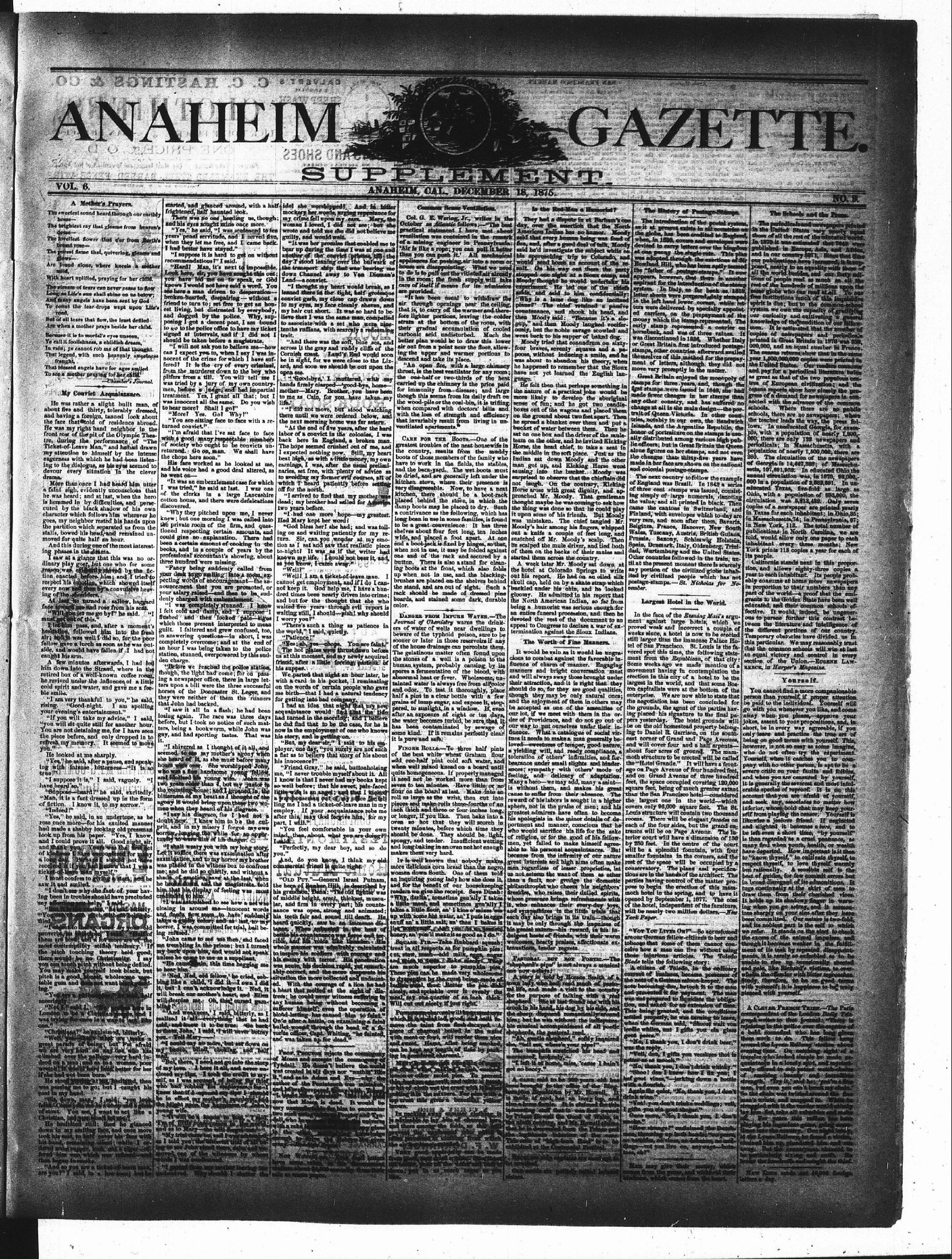
Searchable text
ANAHEIM
VOL. 6.
A Mother's Prayer.
The sweetest sound heard through our earthly home—
The brightest ray that gleams from heaven's dome—
The loveliest flower that ear from Earth's breast rose—
The poorest flame that quivering, gleams and glows—
Are found alone, where kneels a mother mild,
With heart uplifted, praying for her child.
The stream of tears can never come to flow
Long as Life's sun shall shine on us below;
And many angels have been sent by God
To count the tear-drops wept upon Life's road,
But of all tears that flow, the least defiled
Are when a mother prays beside her child.
Because it is to mortal's eyes unseen,
Ye call it foolishness, a childish dream,
In vain; ye cannot rob me of that thought.
That legend, with such heavenly sweetness fraught,
That blessed angels have for ages smiled
To see a mother praying for her child.
Uhumber's Journal.
My Convict Acquaintance.
He was rather a slight built man, of about five and thirty, tolerably dressed, and having a foreign, tanned look about the face that told of residence abroad.
He was my right hand neighbor in the front row of the pit of the Olympic Theatre, during the performance of "The Ticket-of-Leave Man," and had drawn my attention to himself by the intense eagerness with which he had been listening to the dialogue, as his eyes seemed to startled, and glanced around, with a half-frightened, half haunted look.
There was no one heading us, though; and his eyes sought mids once more.
"Yes," he said, "I was sentenced to ten years' penal servitude, and I moved five, when they let me free, and I came back. I had better have stayed."
"I suppose it is hard to get on without recommendations?" I said.
"Hard! Man, it's next to impossible. Look here, air, you have caught this out; you have led me on to speak, or God knows I would not have said a word. You see here a man driven to desperation—broken-hearted, despairing—without a friend to turn to; set free to get an honest living, but distrusted by everybody, and dogged by the police. Why, supposing I got a decent post, I am bound to go to the police office to have my ticket signed at intervals, and if I did not I should be taken before a magistrate.
"I will not ask you to believe me—how can I expect you to, when I say I was innocent of the crime for which I have suffered? It is the cry of every criminal, from the murderer down to the boy who pilfers from a till. You will tell me I was tried by a jury of my own country-men, before a judge and had impartial treatment. Yes, I grant all that; but I was innocent all the same. Do you wish to hear more? Shall I go?"
"More? Yes. Go! Why!"
"You are sitting face to face with a returned convict."
"I'm afraid that I've sat face to face with a good many respectable members of society who ought to be convicts unreturned. Go on, man. We shall have the chops here soon."
His face worked as he looked at me, and his voice had a good deal altered.
idol she worshipped?
mockery her words, urging my crime fell upon my woman I loved, I did not wrote and told me she did guilty, and would wait.
"It was her promise that bear up during the time I another of the convict put day I stood leaning over the transport ship that went down Channel away to Land—a convict.
"I thought my heart wooed there in the tight, convict garb, my close cap to my eyes, my face cleanly my hair cut short. It was lieve that I was the same men to associate with a set of tenths ruffians, with scarce trait.
"And there was the soft across it the gray and ruddle Cornish coast. Land's Rain be in sight, for we were close ard, and soon we should be open sea."
"Good-bye," I muttered hands firmly clasped—good mother—Mary. Brother, yea to me as Cain, for you have life."
"I did not move, but stood there until we were ordered the next morning home was."
"At the end of five years, labor of a convict in the back here in England, a The hope seemed crushed owe I expected nothing now. So beat high, as with a little me earnings, I was, after the
He was rather a slight built man, of about five and thirty, tolerably dressed, and having a foreign tanned look about the face that told of residence abroad. He was my right hand neighbor in the front row of the pit of the Olympic Theatre, during the performance of "The Ticket-of-Leave Man," and he had drawn my attention to himself by the intense eagerness with which he had been listening to the dialogue, as his eyes seemed to devour every situation. In the clever drama.
More than once I had heard him utter a faint sigh, evidently unconscious that he was heard; and at last, when the hero is hummed in by difficulties, and persecuted by the black shadow of his own character which follows him wherever he goes, my neighbor rested his hands upon the partition which separated us from the stalls, bowed his head, and remained unmoved for quite half an hour.
And this during one of the most interesting phases in the drama.
I saw at a glance that this was no ordinary play goer, but one who for some reason was extremely removed by the fiction enacted before him; and I tried to respect his emotion, which showed itself every now and then by a convulsive heaving of the shoulders.
At last he turned a sallow, haggard face toward me and rose from his seat.
"Will you let me go by?" he said.
"I must get out of this."
I leased him pass, and after a moment's hesitation, followed him into the fresh air; and it was well I did so, for the poor fellow gave a lurch as soon as he was outside, and would have fallen if I had not caught his arm.
A few minutes afterwards, I had led him down into the Strand, where in the retired box of a well-known coffee room, he revived under the influence of a little cold spirit and water, and gave me a feeble smile.
"I am very thankful to you," he said, rising, "Good-night. I am spoiling your evening's entertainment."
"If you will take my advice," I said, "you will sit quite still for another hour. You are not detaining me, for I have seen the piece before, and only dropped in to refresh my memory. It seemed to move you."
He looked at me sharply.
"Yes," he said after a pause, and speaking with intense bitterness—"It is so true."
"I suppose it is," I said, vaguely. "I have heard so."
"Suppose—heard!" he said, excitedly. "Man is it a fact dressed up in the form of fiction. I know it, to my sorrow."
"Indeed!"
"Yes," he said, in an undertone, as he rose once more—for his excited manner had made a shabby looking old pressman look up from his paper. "Yes, I know, and I could prove it all. Good night, sir, and thank you. You're the first act of kindness I have encountered for many a long day." Perhaps I should not have received it if you had known that I was a alderman man myself."
I must confess to giving a start; and he saw it and smiled.
from the murderer down to the boy who pliffers from a till. You will tell me I was tried by a jury of my own country-men, before a judge, and had impartial treatment. Yes, I grant all that; but I was innocent all the same. Do you wish to hear more? Shall I go?
"More? Yes. Go! Why!"
"You are sitting face to face with a returned convict."
"I'm afraid that I've sat face to face with a good many respectable members of society who ought to be convicts unreturned. Go on, man. We shall have the chops here soon."
His face worked as he looked at me, and his voice had a good deal altered, as he went on—
"It was an embezzlement case for which I was tried," he said at last. I was one of the clerks in a large Lancashire cotton house, and there were defalcations discovered.
"Why they pitched upon me, I never knew; but one morning I was called into the private room of the firm, and questioned respecting certain amounts, and could give no explanation. There had been a certain amount of cooking in the books, and in a couple of years by the professional accountant's showing, about three hundred were missing."
Fancy being suddenly called from your desk to go smiling into a room, expecting words of encouragement—the announcement that you are promoted, or your salary raised—and then to his suddenly charged with embarrassment.
"I was completely stunned. I know I felt cold and damp, and I suppose I flushed and then looked pale—signs which those present interpreted to mean guilt. I faltered and grew confused, too, in answering questions—in short, I was completely overcome; and at the end of an hour I was being taken to the police station, stunned, overpowered by this sudden charge.
"Before we reached the police station, though, the light had come; for on passing a newspaper office, there in large letters upon a bill were the three successful horses of the Doncaster St. Leger, and they were neither of them the runners that John had backed."
"I saw it all in a flash; he had been losing again. The race was three days before, but I took no notice of such matters, being a bookworm, while John was gray, and had sporting tastes. That was it."
"I shivered as I thought of it all, and seemed to see my mother's agony when she heard of it, as she must before many hours were over. She worshipped John, who was a fine handsome young fellow, and弘和 his young wife. John was two years older than I, but my junior in the counting-house; and I groaned in the bitterness of my beat; I thought of the agony it would bring upon these two women when they heard of his disgrace.
"I say his disgrace; for I had not a doubt now. I knew him to be the culprit, and in my misery I forgot my own borrowing while for an opportunity to warn him of his danger."
"I shall weary you with my long story. Let it suffice there was examination after examination, and to my horror my brother was placed in the witness box to confront me; and he did so quietly, and without a shade of emotion save as the last, when he broke down, and the magistrate told him that his display of foolishness down to the boy who pliffers from a till. You will tell me I was tried by a jury of my own country-men, before a judge, and had impartial treatment. Yes, I grant all that; but I was innocent all the same. Do you wish to hear more? Shall I go!
"More? Yes. Go! Why!"
"You are sitting face to face with a returned convict."
"I'm afraid that I've sat face to face with a good many respectable members of society who ought to be convicts unreturned. Go on, man. We shall have the chops here soon."
His face worked as he looked at me, and his voice had a good deal altered, as he went on—
"It was an embezzlement case for which I was tried," he said at last. I was one of the clerks in a large Lancashire cotton house, and there were defalcations discovered.
"Why they pitched upon me, I never knew; but one morning I was called into the private room of the firm, and questioned respecting certain amounts, and could give no explanation. There had been a certain amount of cooking in the books, and in a couple of years by the professional accountant's showing, about three hundred were missing."
Fancy being suddenly called from your desk to go smiling into a room, expecting words of encouragement—the announcement that you are promoted, or your salary raised—and then to his suddenly charged with embarrassment.
"I was completely stunned. I know I felt cold and damp, and I suppose I flushed and then looked pale—signs which those present interpreted to mean guilt. I faltered and grew confused, too, in answering questions—in short, I was completely overcome; and at the end of an hour I was being taken to the police station, stunned, overpowered by this sudden charge.
"Before we reached the police station, though, the light had come; for on passing a newspaper office, there in large letters upon a bill were the three successful horses of the Doncaster St. Leger, and they were neither of them the runners that John had backed."
"I saw it all in a flash; he had been losing again. The race was three days before, but I took no notice of such matters, being a bookworm, while John was gray, and had sporting tastes. That was it."
"I shivered as I thought of it all, and seemed to see my mother's agony when she heard of it, as she must before many hours were over. She worshipped John, who was a fine handsome young fellow, and弘和 his young wife. John was two years older than I, but my junior in the counting-house; and I groaned in the bitterness of my beat; I thought of the agony it would bring upon these two women when they heard of his disgrace.
"I say his disgrace; for I had not a doubt now. I knew him to be the culprit, and in my misery I forgot my own borrowing while for an opportunity to warn him of his danger."
"I shall weary you with my long story. Let it suffice there was examination after examination, and to my horror my brother was placed in the witness box to confront me; and he did so quietly, and without a shade of emotion save as the last, when he broke down, and the magistrate told him that his display of foolishness down to the boy who pliffers from a till. You will tell me I was tried by a jury of my own country-men, before a judge, and had impartial treatment. Yes, I grant all that; but I was innocent all the same. Do you wish to hear more? Shall I go!
"More? Yes. Go! Why!"
"You are sitting face to face with a returned convict."
"I'm afraid that I've sat face to face with a good many respectable members of society who ought to be convicts unreturned. Go on,man. We shall have the chops here soon."
His face worked as he looked at me,and his voice had a good deal altered,as he went on—
"It was an embezzlement case for which I was tried," he said at last. I was one of the clerks in a large Lancashire cotton house,and there were defalcations discovered.
"Why they pitched upon me,I never knew;but one morning I was called into the private room of the firm,and questioned respecting certain amounts,and could give no explanation. There had been a certain amount of cooking in the books,and in a couple of years by the professional accountant's showing,about three hundred were missing."
Fancy being suddenly called from your desk to go smiling into a room,expecting words of encouragement—the announcement that you are promoted,or your salary raised—and then to his suddenly charged with embarrassment.
"I was completely stunned. I know I felt cold and damp,and I suppose I flushed and then looked pale—signs which those present interpreted to mean guilt. I faltered and grew confused,too,in answering questions—in short,I was completely overcome;and at the end of an hour I was being taken to the police station,stunned,overpowered by this sudden charge.
"Before we reached the police station,though,the light had come;for on passing a newspaper office,there in large letters upon a bill were the three successful horses of the Doncaster St. Leger,and they were neither of them the runners that John had backed."
"I saw it all in a flash;he had been losing again. The race was three days before,but I took no notice of such matters,being a bookworm,while John was gray,and had sporting tastes. That was it."
"I shivered as I thought of it all,and seemed to see my mother's agony when she heard of it,as she must before many hours were over. She worshipped John,who was a fine handsome young fellow,弘和 his young wife。John was two years older than I,但 my junior in the counting-house;and I groaned in the bitterness of my beat;I thought of the agony it would bring upon these two women when they heard of his disgrace.
"I say his disgrace;for I had not a doubt now. I knew him to be the culprit,and in my misery I forgot my own borrowing while for an opportunity to warn him of his danger."
"I shall weary you with my long story. Let it suffice there was examination after examination,and to my horror my brother was placed in the witness box to confront me;and he did so quietly,and without a shade of emotion save as the last,when he broke down,and the magistrate told him that his display of foolishness down to the boy who pliffers from a till. You will tell me I was tried by a jury of my own country-men,before a judge,and had impartial treatment. Yes,I grant all that;but我was innocent all the same. Do you wish to hear more? Shall I go!
"More? Yes. Go! Why!"
"You are sitting face to face with a returned convict."
"I'm afraid that I've sat face to face with a good many respectable members of society who ought to be convicts unreturned. Go on,man. We shall have the chops here soon."
His face worked as he looked at me,and his voice had a good deal altered,as he went on—
"It was an embezzlement case for which I was tried," he said at last. I was one of the clerks in a large Lancashire cotton house,and there were defalcations discovered.
"Why they pitched upon me,I never knew;but one morning I was called into the private room of the firm,and questioned respecting certain amounts,and could give no explanation. There had been a certain amount of cooking in the books,and in a couple of years by the professional accountant's showing,about three hundred were missing."
Fancy being suddenly called from your desk to go smiling into a room,expecting words of encouragement—the announcement that you are promoted,or your salary raised—and then to his suddenly charged with embarrassment.
"I shall weary you with my long story. Let it suffice there was examination after examination,and to my horror my brother was placed in the witness box to confront me;and he did so quietly,and without a shade of emotion save as the last,when he broke down,and the magistrate told him that his display of foolishness down to the boy who pliffers from a till."
"Suppose—heard!" he said, excitedly.
"Man, it is a fact dressed up in the form of fiction. I know it, to my sorrow."
"Indeed!"
"Yes," he said, in an undertone, as he rose once more—for his excited manner had made a shabby looking old pressman look up from his paper. "Yes, I know, and I could prove it all. Good night, sir, and thank you. You're the first act of kindness I have encountered for many a long day. Perhaps I should not have received it if you had known that I was a ticket-of-leave man myself."
I must confess to giving a start; and he saw it and smiled.
"I don't see why the fact of your having been in trouble should have precluded my affection and help." I said.
"But I am not with pitch without being delilled."
"I select to insult rather than my own old unpleasantness on principle." He said bitterly.
"You can touch pitch without being defiled. You may make yourself look black, but pitch is a good honest, wholesome vegetable gum and does not want blacksmithing."
"You are a shillish man who told half sneezingly."
"Not I?" said I. "We present here in Louden to be a Christian gentleman, and I was trying for once in a way to not like one."
"Christian!" he exclaimed, bitterly.
"Well, you shall take what we make a great parade of being; but I'm afraid we are very hard on any that who has elicited over the galling—very hard indeed on a man; and as to a woman, poor wretch! It would have held better for her if she had not been born."
He stood standing at his desk, then was passing me to go; but I caught his pout in my hand.
"His down man," I said; "you look faint. Chance you need a shirt and a pair of stout. You see, I want to act like a Christian, but you shall not."
He hesitated still; then he glanced down in my smiling face, and once more took his seat, to half cover his face with his hand, remaining silent; while I ordered some sugar, milk and a tiger—offered him one which was whipped—and then began to smoke.
"And so you are a ticket-of-leave man, are you!" I said, in a low tone, but in the contemptuous house; and I grunted in the bitterness of my heart as I thought of the agony it would bring upon these two women when they heard of his disgrace.
"I say his disgrace, for I had not a doubt now. I knew him to be the culprit, and in my misery I forgot my own borrow, longing the while for an opportunity to warn him of his danger.
"I shall weary you with my long story. Let it suffice there was examination after examination, and to my horror my brother was placed in the witness box to confront me; and he did so quietly, and without a shade of emotion save at the last, when he broke down, and the magistrate fold him that his display of feeling was most credible to him.
"I was astonished to see how a net was closing in around me—innocent words and deeds now seem to have suddenly taken a gravely yellow; and as last, to my horror, I was committed for trial, ball being refused.
"John came to see me then, and faced me trembling in the prison; but I turned my back upon him, and would not speak unless he came to me as a suppliant.
"He came again, this time begging me to hear him.
"Ned, Ned, old fellow,' he cried, sobbing like a child, 'I did it—I own I did it, but I can't acknowledge it. Ned, it will break one mother's heart, and Ellen will despair me. Oh this cursed grambling!"
"And weakness," I said bitterly, as I realized it all—everything that he had said, and knew it to be true: "Go back to them, John," I said, "I will never betray you. Tell Mary—"
"I could say no more, but sat down on my bench, blind, choking, and half mad."
"But there, I need not go into the story of my loan. I have it all, and never unclosed my lips. I took the credit to myself, as I was accused of being the thief who had robbed his employer; for I knew that if I opened my tips I should be in effect my mother's guardry; did the light upon the happiness of John's young wife.
"It will be a handsome to him." I said.
"Tom of little continuation in the world—and as to Mary—the will anger me."
My trial came out, and I was instructed as I told you: the bitter trial of all things to me John found there, salute and moved out of the witnesses by whose words I was condemned.
"I pointed from my mother hearing her undeniable. Why should I shelter the little wife is an angel; and the watchhouse man out of my pity me I had a ticket-of-leave employ. If your acquaintance after this may God forgive him part, I will."
"You feel comfortable in mind, then about what you are.Iuld."
"Perfectly, my dear boy," you."
And, do you know, I think commercial friend is quite right.
"OLD PUT."—General Israel the horn of Bashan Hill; in his grandson; Dana: "The old of middle height; erect; thick lar; and firm in every part; finance was open; strong and his teeth fair and sound till he heard quickly; saw to an imminence. When animated in the battle his commendation was fair ribbble; like whole manner was admirably to inspire his soldiers with pen his enemy with terror. His paw scute his decision rapid; yu ably correct; and the more an situation the more collected and With the courage of a heart that mollied at the sight tree; he could never witness any human being without be sufferer himself; even the op blood-lesting has caused him. Once after a battle, on examin ballet-wound through the hawk vorite office; Capt. Whiting," and was taken up for dead."
idel she worshipped! And in bitter mockery her words, arguing repentance for my crime fell upon my ears. Mary, the woman I loved, I did not see; but she wrote and told me she did not believe me guilty, and would wait.
"It was her promise that enabled me to bear up during the time I was at one and another of the convict prison till the day I stood leaning over the bullwark of the transport ship that was bearing me down Channel away to Van Dieman's Land—a convict.
"I thought my heart would break, as I leaned there in the tight, half grotesque convict garb, my close cap drawn down to my eyes, my face cleanly shaven, and my hair cut short. It was so hard to believe that I was the same man, compelled to associate with a set who were nineteenth ruffians, with scarcely a redeeming trait.
"And there was the soft, blue sea, and across it the gray and ruddy cliffs of the Cornish coast. Land's End would soon be in sight, for we were close to the Lizard, and soon we should be out upon the open sea.
"'Good-bye,' I muttered, with my hands firmly clasped—'good-bye, home—mother—Mary. Brother, you have been to me as Cain, for you have taken my life.'"
"I did not move, but afraid watching there until we were ordered below, and the next morning home was far astern.
"At the end of five years, after the hard labor of a convict in the colonies, I was back here in England, a broken man. The hope seemed crushed out of me, and I expected nothing now. Still, my heart beat high, as with a little money, my own earnings, I was, after the usual preliminaries."
Common Sense Ventilation.
Col. G. E. Waring Jr., writes in the October as Attendie follows: "The best practical statement I have met about ventilation was contained in the remark of a mining engineer in Pennsylvania: 'Air is like a rope; you can pull it better than you can push it.' All mechanical appliances for pushing air into a room or house are disappointing. What we need to do is to pull out the vitilified air already in the room; the fresh supply will take care of itself if means for its administration are provided.
"It has been usual to withdraw the air through openings near the ceiling, that is, to carry off the warmer and therefore lighter portions, leaving the colder strata at the bottom of the room, with their gradual accumulation of cooled carbonic acid undisturbed. Much the better plan would be to draw this lower air out from a point near the floor, allowing the upper and warmer portions to descend and take its place.
"An open fire, with a large chimney throat, in the heat ventilator for any room; the one-half or two-thirds of the heat carried up the chimney is the price paid for immunity from disease; and large though this seems from its daily draft on the wood-pile or the coal-bin, it is trifling when compared with doctor's bills and with the loss of strength and efficiency that invariably result from living in unventilated apartments."
CARE FOR THE HOOTS.—One of the greatest troubles of the neat housewife in the country, results from the muddy boots of those members of the family who have to work in the fields, the stables, and the barnyard. The wet huts are provided.
Is the Red Man a Humorist?
They had a dispute in Barham's one day, over the assertion that the North American Indian has no humor. Moody said that every human being was fond of fun, and after a good deal of talk Moody said he'd investigate the subject while on his approaching trip to Colorado, and would send home an account of the result. On his way out there the party stopped one night at a Sloux camp, and Moody thought he would undertake his experiment. He led one of the chiefs aside, and said to him confidentially:
"Why is a lame dog like an inclined plane?" The chief retained a passive countenance, and shook his head, and then Moody said: "Because it's a sleup-up," and then Moody laughed vodiferously, but the noble savage scowled and went back to his supper of baked dog.
Moody tried that conundrum on alxyfour braves, seventy aquawa and a paoosea without inducing a smile, and he was about to abandon his theory, when he happened to remember that the Sloux have not yet learned the English language.
He felt that perhaps something in the nature of a practical joke would be more likely to develop the aboriginal sense of fun; and he got two candle-boxes out of the wagons and placed them on the ground about two feet apart. Then he spread a blanket over them and put a bucket of water between them. Then he sat on one box and the driver of the mule-team on the other, and he invited Klicking Horse, the head chief, to take a seat in the middle in the soft place. Just as the Indian sat down Moody and the other man got up, and Klicking Horse went
The Minters
The introduction as it at presentthe globe,hardwhen.in 1600d devised at scarletat one pennywas adopted theromland Hillthe"fatherofappearshowasapplirforthesystem.InLettersheetswinthelefthandertweredeliveredcarriers,coneywhichtearly stamphorneback,andwasdiscontinuorgreatBritishstampsotherofthemeaslesofthementoflettersmoveveryprog
Great British stamps for threefirst stampswe made fewer changeany other countchangeatalltraitofQueenVriesnotablyinIslands,andthehonorofportraitallydistributedlieofficers;butalonefiguresonthechangesthimadeinherfaceandcolonialpoi
"Good-bye,' I muttered, with my hands clasped—good-bye, home—mother—Mary. Brother, you have been to me as Cain, for you have taken my life."
"I did not move, but stood watching there until we were ordered below, and the next morning home was far astern.
"At the end of five years, after the hard labor of a convict in the colonies, I was back here in England, a broken man. The hope seemed crushed out of me, and I expected nothing now. Still, my heart beat high, as with a little money, my own earnings, I was, after the usual preliminaries, set free, with plenty of advice as to avoiding my former evil courses, all of which I heard patiently before setting off for the north.
"I arrived to find that my mother was dead; my brother had smiled for America two years before.
"I had one more hope—my greatest. Had Mary kept her word!
"God bless her! She had; and was tolling on and waiting patiently for my return. Sir, can you wonder at my emotion as I sat and saw that realistic piece no-night? It was as if the writer had known my life. I could not bear it, and so you know, I came away."
"Well! I am a ticket-of-leave man. I cannot get employment, and if I do I cannot keep it. God help me, I have a hundred times been nearly driven into crime; and but for the thought that she who waited five years through evil report is waiting still, I should—pish! why should worry you?
"There's such a thing as patience in the world," I said, quietly.
"Patience!"
"Yes; ah, yes—chops. You are faint!
The hot plates were thrust down before at this moment, and my newly acquired friend, after a little forcing, parted of his supper.
We parted that night an hour later, he with a card in his pocket. I ruminating in the words of certain people who gave me birth—that I had a natural tendency or getting into bad company.
He had an idea that night that my new acquaintance would find that she tide had turned in the morning; and I believe he did find that to be the case, for he is now in the employment of one who knows a story, and is getting on.
But, my dear sir," I said to his employer, one day, "you surely are not such flat as to believe that story of his about a innocence!"
"Friend Gray," he said, buttonholing me. "I never trouble myself about it. All know is that I never had my books kept well before; that his sweet, pale-faced wife is an angel; and that I kicked warehouseman out of my office for taking me I had a ticket-of-leave man in my employ. If your acquaintance robe me later this, may God forgive him, for my art, I will."
"You feel comfortable in your own mind, then, about what you are doing?" said.
"Perfectly, my dear boy, and so do you."
And, do you know I think my old memorial friend is quite right.
"Old PUT."—General Israel Putnam, he hopes of Bakers Hill, is described by
"It is well known that nobody makes more delicious corn bread than the negro women down South. One of them told an inquiry young lady how she does it, and for the benefit of our housekeeping throat, is the heat ventilator for any room; the one-half or two-thirds of the heat carried up the chimney is the price paid for immunity from disease; and large though this seems from its daily draft on the wood-pile or the coal-bin, it is trifling when compared with doctora' billa and with the loss of strength and efficiency that invariably result from living in unventilated apartments."
CARE FOR THE BOOTS.—One of the greatest troubles of the neat housewife in the country, results from the muddy boots of those members of the family who have to work in the fields, the stables, and the barnyard. The wet boots must be dried, and are generally left under the kitchen stove, where their presence is very disagreeable. Now, to have a neat kitchen, there should be a boot-rack placed behind the stove, in which the damp boots may be placed to dry. Such a contrivance as the following, which has long bean in use in some families, is found to be a great convenience. It has three shelves about four feet long, ten inches wide, and placed a foot apart. At one end a boot-jack is fixed by hinges, so that when not in use, it may be folded against one end of the rack and secured by a button. There is also a stand for cleaning boots at the front, which also folds up when not in use, and the blacking-brushes are placed on the shelves behind the stand, and are out of sight. Such a rack should be made of dressed pine boards, and stained some dark, durable color.
DANGER FROM IMPURE WATER.—The Journal of Chemistry warns the drinkers of water of wells near dwellings to beware of the typhoid poison, sure to be sooner or later in those reservoirs if any of the house drainage can percolate them. The gelatinous matter often found upon the stones of a well is a poison to the human system, probably causing by its spores a fermentation of the blood, with abnormal heat or fever. Wholesome, unaintended water is always free from all color and odor. To test it thoroughly, place half a pint in a clear bottle with a few grains of lump sugar, and expose it, stoppered, to sunlight in a window. If even after an exposure of eight or ten days, the water becomes turbid, be sure that it has been contaminated by sewage of some kind. It remains perfectly clear it is pure and safe.
FINGER ROLL.—To three half pints of the best white wheat Graham flour add one-half pint cold soft water, and when well mixed knead on a board until quite homogeneous. If properly managed it need not be worked more than from seven to ten minutes. Have little or no flour on the board at last. Make into an roll as large as the wrist; then cut into pieces and make rolls three-fourths of an inch thick and three or four inches long or longer. If you like. Then bake into a oven so hot that they will scorch in twenty minutes before which time they should be done. They should be light, spongy, and tender. Insufficient wetting and long baking in an oven not hot enough makes them very hard.
It is well known that nobody makes more delicious corn bread than the negro women down South. One of them told an inquiry young lady how she does it, and for the benefit of our housekeeping He felt then that perhaps something in the nature of a practical joke would be more likely to develop the aboriginal sense of fun; and he got two candle-boxes out of the wagons and placed them on the ground about two feet apart. Then he spread a blanket over them and put a bucket of water between them. Then he sat on one box and the driver of the mule team on the other, and he invited Kicking Horse, the head chief, to take a seat in the middle in the soft place. Just as the Indian sat down Moody and the other man got up, and Kicking Horse went sausing into the bucket. Moody was surprised to observe that the chief did not laugh. On the contrary, Kicking Horse arose with great dignity, and approached Mr. Moody. That gentleman thought maybe he was coming to ask how the thing was done so that he could play it upon some of his friends. But Moody was mistaken. The chief tangled Mr. Moody's hair among his fingers, whipped out a knife a couple of feet long, and snatched off Mr. Moody's scalp. Then he scaled the mule driver, and tied both on them on the backs of their mules and started them across the country.
A week later Mr. Moody sat down at the hotel at Colorado Springs to write out his report. He had on an oiled silk skull cap, held on by a skate strap which buckled under his chin, and he looked gloomy. He admitted in his report that the North American Indian, so far from being a humorist was serious enough for an entire funeral procession, and then he devoted the rest of the document to an appeal to Congress to declare a war of extermination against the Sioux Indians.
The Worth of Fine Manners.
It would be vain as it would be ungracious to combat against the favorable influence of charm of manner. Engaging manners and bright conversation must and will always sway those brought under their attraction, and it is right that they should do so; for they are good qualities though they may be only natural ones; and the enjoyment of them in others may be accepted as one of the amenities of our lot; if we meet with them in the order of Providence, and do not go out of our way to put ourselves under their influence. What a catalogue of social virtues it needs to make a man generally beloved—sweetness of temper, good nature, a yielding will, and ready compliance, a toleration of others' infirmities, and for bearance under small slights and hinderness; sympathy with others' mode of feeling, and delicacy of adaptation. Many a hero—we may add many a saint—is without them, and makes his great cause to suffer from their absence. The reward of his labors is sought in a higher sphere, not In the praise of men; and his greatest admirers have often to become his apologists in the minor details of department and manner; conscious that he who would sacrifice his life for the sake of religion, or for the good of his fellowmen, yet failed to make himself agreeable to his personal acquaintances. But because from the infirmity of our nature great interests and high aims often make men regardless of lesser proprieties let us not esteem them want of them as other than a fault; nor grudge the domestic philanthropist who cheers his neighbors'
Great Britains stamp for three first stamps were made fewer charts any other count change at all inscriptions notably in Queen Victoria's treaty of Queen Anne tried; notably in Islands; and notably in Ireland; and notably in alone figures on the changes tha made in her faction and colonial power.
The next count of England was of three cent sailing like this value; and came the canton Finland with very rare; and Belgium; France; Wales; Tuscany; Prussia; Saxony; Spain; Denmark; Dad; Warwick; Dartmouth: Other countries till at the present: it is noted by civilized postage-stamps:ember.
Largest Houses
In the face of ment against him proved weak and weeks since a half larger than toul San Francisco vowed spot from this month. Some weeks ago movement having erection in this largest in the western ton capitalists were enterprise. We then negotiated hie grounds,the places open placed his shers yesterday.be on the old honoring to Daniel East corner of Grassand will cover forth about four acres moth structure tothe "Hotel Grand Avenida on Page Avenueand on Grand Ave.feet,the space open square feet,the space open square feet,the space open square feet,the space open square feet,the space open square feet,the space open square feet,the space open square feet,the space open square feet,the space open square feet,the space open square feet,the space open square feet,the space open square feet,the space open square feet,the space open square feet,the space open square feet,the space open square feet,the space open square feet,the space open square feet,the space open square feet,the space open square feet,the space open square feet,the space open square feet,the space open square feet,the space open square feet,the space open square feet,the space open square feet,the space open square feet,the space open square feet,the space open square feet,the space open square feet,the space open square feet,the space open square feet,the space open square feet,the space open square feet,the space open square feet,the space open square feet,the space open square feet,the space open square feet,the space open square feet,the space open square feet,the space open square feet,the space open square feet,the space open square feet,the space open square feet,the space open square feet,the space open square feet,the space open square feet,the space open square fthespaceopensquarefthespaceopensquarefthespaceopensquarefthespaceopensquarefthespaceopensquarefthespaceopensquarefthespaceopensquarefthespaceopensquarefthespaceopensquarefthespaceopensquarefthespaceopensquarefthespaceopensquarefthespaceopensquarefthespaceopensquarefthespaceopensquarefthespaceopensquarefthespaceopensquarefthespaceopensquarefthespaceopensquarefthespaceopensquarefthespaceopensquarefthespaceopensquarefthespaceopensquarefthespaceopenssquarefthespaceopenssquarefthespaceopenssquarefthespaceopenssquarefthespaceopenssquarefthespaceopenssquarefthespaceopenssquarefthespaceopenssquarefthespaceopenssquarefthespaceopenssquarefthespaceopenssquarefthespaceopenssquarefthespaceopenssquarefthespaceopenssquarefthespaceopenssquarefthespaceopenssquarefthespaceopenssquareftthespaceopenssquareftthespaceopenssquareftthespaceopenssquareftthespaceopenssquareftthespaceopenssquareftthespace.openssquareftthespace.openssquareftthespace.openssquareftthespace.openssquareftthespace.openssquareftthespace.openssquareftthespace.openssquareftthespace.openssquareftthespace.openssquareftthespace.openss SquareFTHESPACEOPENSSQUAREFTHESPACEOPENSSQUAREFTHESPACEOPENSSQUAREFTHESPACEOPENSSQUAREFTHESPACEOPENSSQUAREFTHESPACEOPENSSQUAREFTHESPACEOPENSSQUAREFTHESPACEOPENSSQUAREFTHESPACEOPENSSQUAREFTHESPACEOPENSSQUAREFTHESPACEOPENSSQUAREFTHESPACEOPENSSQUAREFTHESPACEOPENSSQUAREFTHESPACEOPENSSQUAREFTHESPACEOPENSSQUAREFTHESPACEOPENSSQUAREFTHESPACEOPENSSQUAREFTHESPACEOPENSSQUAREFTHESPACEOPENSSQUAREFTHESPACEOPENSSQUAREFTHESPACEOPENSSQUAREFTHESPACEOPENSSQUAREFTHESPACEOPENSSQUAREFTHESPACEOPENSSQUAREFTHESPACEOPENSSQUAREFTTHESPACEOPENSSQUAREFTHESPACEOPENSSQUAREFTHESPACEOPENSSQUAREFTHESPACEOPENSSQUAREFTHESPACEOPENSSQUAREFTHESPACEOPENSSQUAREFTHESPACEOPENSSQUAREFTHESPACEOPENSSQUAREFTHESPACEOPENSSQUAREFTHESPACEOPENSSQUAREFTHESPACEOPENSSQUAREFTHESPACEOPENSSQUAREFTHESPACEOPENSSQUAREFTHESPACEOPENSSQUAREFTHESPACEOPENSSQUAREFTHESPACEOPENSSQUAREFTHESPACEOPENSSQUAREFTHESPACEOPENSSQUAREFTHESPACEOPENSSQUAREFTHESPACEOPENSSQUAREFTHESPACEOPENSSQUAREFTHESPACEOPENSSQUAREFTHESPACEOPENSSQUAREFTHESPACEOPENSSQUAREFTHESPACEOPENSSQUAREFTHESPACEOPENSSQUAREFTHESPACEOPENSSQUAREFTHESPACEOPENSSQUAREFTHESPACEOPENSSQUAREFTHESPACEOPENSSQUAREFTHESPACEOPENSSQuareFTHESPACEOPENSSQuareFTHESPaceOpenSSQuareFTHESpaceOpenSSQuareFTHESpaceOpenSSQuareFTHESpaceOpenSSQuareFTHESpaceOpenSSQuareFTHESpaceOpenSSQuareFTHESpaceOpenSSQuare FTHESpaceOpenSSQuare FTHESpaceOpenSSQuare FTHESpaceOpenSSQuare FTHESpaceOpenSSQuare FTHESpaceOpenSSQuare FTHESpaceOpenSSQuare FTHESpaceOpenSSQuare FTHESpaceOpenSSQuare FTHESpaceOpenSSQuare FTHESpaceOpenSSQuare FTHESpaceOpenSSQuare FTHESpaceOpenSSQuare FTHESpaceOpenSSQuare FTHESpaceOpenSSQuare FTHESpaceOpenSSQuare FTHESpaceOpenSSQuare FTHESpaceOpenSSQuare FTHESpaceOpenSSQuare FTHESpaceOpen SSQuare FTHESpaceOpen SSQuare FTHESpaceOpen SSQuare FTHESpaceOpen SSQuare FTHESpaceOpen SSQuare FTHESpaceOpen SSQuare FTHESpaceOpen SSQuare FTHESpaceOpen SSQuare FTHESpaceOpen SSQuare FTHESpaceOpen SSQuare FTHESpaceOpen SSQuare FTHESpaceOpen SSQuare FTHESpaceOpen SSQuare FTHESpaceOpen SSQuare FTHESpaceOpen SSQuare FTHESpaceOpen SSQuare FTHESpaceOpen SSQuare FTHESpaceOpen SSQuare FTHESpaceOpen SSQuare FTHESpaceOpen SSQuare FTHESpaceOpen SSQuare FTHESpaceOpen SSQuare FTHESpaceOpen SSQuare FTHESpaceOpen SSQuare FTHESpaceOpen SSQuare FTHESpaceOpen SS Quare FTHEspace.Open SS Quare FTHEspace.Open SS Quare FTHEspace.Open SS Quared FTHEspace.Open SS Quared FTHEspace.Open SS Quared FTHEspace.Open SS Quared FTHEspace.Open SS Quared FTHEspace.Open SS Quared FTHEspace.Open SSD Quared SSD Quared SSD Quared SSD Quared SSD Quared SSD Quared SSD Quared SSD Quared SSD Quared SSD Quared SSD Quared SSD Quared SSD Quared SSD Quared SSD Quared SSD Quared SSD Quared SSD Quared SSD Quared SSD Quared SSD Quared SSD Quared SSD Quared SSD Quared SSD Quared SSD Quared SSD Quared SSD Quared SSD Quared SSD Quared SSD Quared SSD Quared SSD Quared SSD Quared SSD Quared SSD Quared SSD Quared SSD Quared SSD Quared SSD Quared SSD Quared SSD Quared SSD Quared SSD Quared SSD Quared SSD Quared SSD Quared SSD Quared SSD Quared SSD Quared SSD Quared SSD Quared SSD Quared SSD Quared SSD Quared SSD Quared SSD Quared SSD Quared SSD Quared SSD Quared SSD Quared SSD Quared SSD Quared SSD QuaraFD QUARRAFD QUARRAFD QUARRAFD QUARRAFD QUARRAFD QUARRAFD QUARRAFD QUARRAFD QUARRAFD QUARRAFD QUARRAFD QUARRAFD QUARRAFD QUARRAFD QUARRAFD QUARRAFD QUARRAFD QUARRAFD QUARRAFD QUARRAFD QUARRAFD QUARRAFD QUARRAFD QUARRAFD QUARRAFD QUARRAFD QUARRAFD QUARRAFD QUARRAFD QUARRAFD QUARRAFD QUARRAFD QUARRAFD QUARRAFD QUARRAFD QUARRAFD QUARRAFD QUARRAFD QUARRAFD QUARRAFD QUARRAFD QUARRAFD QUARRAFD QUARRAFD QUARRAFD QUARRAFD QUARRAFD QUARRAFD QUARRAFD QUARRAFD QUARRAFD QUARRAFD QUARRAFD QUARRAFD QUARRAFD QUARRAFD QUARRAFD QUARRAFD QUARRAFD QUARRAFD QUARRAFD_QUARRAFD_QUARRAFD_QUARRAFD_QUARRAFD_QUARRAFD_QUARRAFD_QUarraFD_QUarraFD_QUarraFD_QUarraFD_QUarraFD_QUarraFD_QUarraFD_QUarraFD_QUarraFD_QUarraFD_QUarraFD_QUarraFD_QUarraFD_QUarraFD_QUarraFD_QUarraFD_QUarraFD_QUarraFD_QUarraFD_QUarraFD_QUarraFD_QUarraFD_QUarraFD_QUarraFD_QUarraFD_QUarraFD_QUarraFD_QUarraFD_QUarraFD_QUarraFD_QUarraFD_QUarraFD_QUarraFD_QUarraFD_QUarraFD_QUarraFD_QUarraFD_QUarraFD_QUarraFD_QUarraFD_QUarraFD_QUarraFD_QUarraFD_QUarraFDD_quarraFDD_quarraFDD_quarraFDD_quarraFDD_quarraFDD_quarraFDD_quarraFDD_quarraFDD_quarraFDD_quarraFDD_quarraFDD_quarraFDD_quarraFDD_quarraFDD_quarraFDD_quarraFDD_quarraFDD_quarraFDD_quarraFDD_quarraFDD_quarraFDD_quarraFDD_quarraFDD_quarraFDD_quarraFDD_quarraFDD_quarraFDD_quarraFDD_quarraFDD_quarraFDD_quarraFDD_quarraFDD_quarraFDD_quarraFDD_quarraFDD_quarraFDD_quarraFDD_quarraFDD_quarraFDD_quarraFDD_quarraFDD_quarray_FDD_quarry_FDD_quarry_FDD_quarry_FDD_quarry_FDD_quarry_FDD_quarry_FDD_quarry_FDD_quarry_FDD_quarry_FDD_quarry_FDD_quarry_FDD_quarry_FDD_quarry_FDD_quarry_FDD_quarry_FDD_quarry_FDD_quarry_FDD_quarry_FDD_quarry_FDD_ quarry_FDD_ quarry_FDD_ quarry_FDD_ quarry_FDD_ quarry_FDD_ quarry_FDD_ quarry_FDD_ quarry_FDD_ quarry_FDD_ quarry_FDD_ quarry_FDD_ quarry_FDD_ quarry_FDD_ quarry_FDD_ quarry_FDD_ quarry_FDD_ quarry_FDD_ quarry_FDD _ quarry FDD _ quarry FDD _ quarry FDD _ quarry FDD _ quarry FDD _ quarry FDD _ quarry FDD _ quarry FDD _ quarry FDD _ quarry FDD _ quarry FDD _ quarry FDD _ quarry FDD _ quarry FDD _ quarry FDD _ quarry FDD _ quarry FDD _ quarry FDD _ quarry FDD _ quarry Fdd _ quarry Fdd _ quarry Fdd _ quarry Fdd _ quarry Fdd _ quarry Fdd _ quary Fdd _ quary Fdd _ quary Fdd _ quary Fdd _ quary Fdd _ quary Fdd _ quary Fdd _ quary Fdd _ quary Fdd _ quary Fdd _ quary Fdd _ quary Fdd _ quary Fdd _ quary Fdd _ quary Fdd _ quary Fdd _ quary Fdd _ quary Fdd _ quary Fdd _ quary Fdd _ quary Fdd _ quary Fdd _ quary Fdd _ quary Fdd _ quary Fdd _ quary Fdd _ quary Fdd _ quary Fdd _ quary Fdd _ quary Fdd _ quary Fdd _ quary Fdd _ quary Fdd _ quary Fdd _ quary Fdd _ quary Fdd _ quary Fdd _ quary Fdd _ quary Fdd _ quary Fdd _ quotry.Fdd._quotry.Fdd._quotry.Fdd._quotry.Fdd._quotry.Fdd._quotry.Fdd._quotry.Fdd._quotry.Fdd._quotry.Fdd._quotry.Fdd._quotry.Fdd._quotry.Fdd._quotry.Fdd._quotry.Fdd._quotry.Fdd._quotry.Fdd._quotry.Fdd._quotry.Fdd._quotry.Fdd._quotry.Fdd._quotry.Fdd._quotry.Fdd._quotry.Fdd._quotry.Fdd._quotry.Fdd._quotry.Fdd._quotry.Fdd._quotry.Fdd._quotry.F dd._quotry.F dd._quotry.F dd._quotry.F dd._quotry.F dd._quotRY.F dd._quotRY.F dd._quotRY.F dd._quotRY.F dd._quotRY.F dd._quotRY.F dd._quotRY.F dd._quotRY.F dd._quotRY.F dd._quotRY.F dd._quotRY.F dd._quotRY.F dd._quotRY.F dd._quotRY.F dd._quotRY.F dd._quotRY.F dd._quotRY.F dd._quotRY.F dd._quotRY.F dd._quotRY.F dd._quotRY.F dd._quotRY.F dd._quotRY.F dd._quotRY.F dd.__quotRY.F dd.__quotRY.F dd.__quotRY.F dd.__ quotedRY.F dd.__ quotedRY.F dd.__ quotedRY.F dd.__ quotedRY.F dd.__ quotedRY.F dd.__ quotedRY.F dd.__ quotedRY.F dd.__ quotedRY.F dd.__ quotedRY.F dd.__ quotedRY.F dd.__ quotedRY.F dd.__ quotedRY.F dd.__ quotedRY.F dd.__ quotedRY.F dd.__ quotedRY.F dd.__ quotedRY.F dd.__ quotedRY.F dd.__ quotedRY.F dd.__ quotedRY.F dd.__ quotedRY.F dd.__ quotedRY,F dd.__ quotedRY,F dd.__ quotedRY,F dd.__ quotedRY,F dd.__ quotedRY,F dd.__ quotedRY,F dd.__ quotedRY,F dd.__ quotedRY,F dd.__ quotedRY,F dd.__ quotedRY,F dd.__ quotedRY,F dd.__ quotedRY,F dd.__ quotedRY,F dd.__ quotedRY,F dd.__ quotedRY,F dd.__ quotedRY,F dd.__ quotedRY,F dd.__ quotedRY,F dd.__ quotedRY,F dd.__ quotedRY,F dd.__ quotedRY,F dd.__ quotedRY,F dd.__ quotedRY,F dd.__ quotedRY,F dd.__ quoted ry .F dd.__ quoted ry .F dd.__ quoted ry .F dd.__ quoted ry .F dd.__ quoted ry .F dd.__ quoted ry .F dd__.
"Old Put."—General Israel Putnam, the hope of Bunker Hill, is described by a grandson, Dana: "The old fighter was middle height, erect, thickest muscular, and firm in every part; his countenance was open, strong and animated; a teeth fair and sound till death. He had quickly, saw to an immense distance. When attacked in the heat of his countenance was fierce and naught, and his face like limbism. His sole manner was admirably calculated to inspire his soldiers with courage and a enemy with terror. His penetration was acute, his decision rapid, yet remarkably correct, and the more desperate his situation the more collected and undaunted.
With the courage of a lion he had heart that melted at the sight of disease; he could never witness suffering in any human being without becoming a fiercer himself; even the operation of God-lasting has caused him to feal."
After a battle, on examining a fatallict-wound through the head of a firefight officer, Capt. Whiting, "heainted, and was taken up for dead."
Punxon Panoron rejects the conspiracy Moses and accepts the cosmogony of Adam. He doesn't believe the world created in six days nor "authin' life" and as to Adam and Eve—why the author of the Pentistuch was mistaken how to interpret Gay with Teresa and John that Moses is dead. It would be very unacceptable for him to encounter such using animals, Pronoun and Syllabal who have been misunderstood universally as a rake in their own place—the other—misunderstanding knowledge much to drive the Holocaust given my own insight."
Nor Woolsey can—true dual attentions on some events about this immensely frivolous as white paper.
It is well known that nobody makes more delicious corn bread than the negro women down South. One of them told an inquiry young lady how she does it, and for the benefit of our housekeeping readers we give the receipt. Says Dinah: "Why, darling, sometime gen'ally I take a little meal, and sometimes gen'ally I take a little flour, an' I kine o'mines 'em with some hot water, an' I puts in eggs enuff an'a little salt, an' then I bakes it just right."
Squamley—Take Habbard squash; treat in all respects as for pumpkin pie; cut, stew, mash—add milk, eggs, sugar and wine to water. Make slowly. There are much superior to pumpkin pie. These pies can be made very wholesome to dysplasia by the crust being made of Indian meal, thus. Butter the pie dish slowly, and sprinkle over it evenly. The meal say one quarter of an inch think Will cut out nicely if just right.
Powdery charcoal will keep your meat which is smokeless good, and will remove the taint from flesh decay. A piece of charcoal boiled in the water with must or foul will render them nice and sweet. Hamna, after being smoked, can be kept any length of time by packing in powdered charcoal.
Mary's mother came into town with Mary's cousin and uncle other moist pies. To prevent them from getting wet and muddy at the crest with it, she put them in the mixture. For past with a top crust this gives a beautiful yellow known.
In peeling away summer clothing, it is advisable to lay chaffed hair and there among the folds, as this will prevent the suppression of piles within instant in clothing from within the oranges popped.
Very good appliance can be made from pure corn dough without further mixing than the batter and tail of milk; but in so much longer you like it.
cause to suffer from their absence. The reward of his labors is sought in a higher sphere, not In the praise of men; and his greatest admirers have often to become his apologists in the minor details of deportment and manner, conscious that he who would sacrifice his life for the sake of religion, or for the good of his fellow-men, yet failed to make himself agreeable to his personal acquaintances. But because from the infirmity of our nature great interests and high aims often make men regardless of lesser proprieties, let us not esteem the want of them as other than a fault, nor grudge the domestic philanthropist who chooses his neighbors' tresides, who raises their dulled spirits whose presence brings refreshments with it, who enhances their every-day joys, and sympathizes in the little trials that each day also brings in its train—though it may be only through the impulse of his general nature—his reward, in his indulgent hosts of friends, with their warm welcome, hearty praises, affectionate extensions, tender regrets.
Pastoral motive not morto—The sheepard's pipe" is not always a musical one now-a-day:
A story is told by Horace Smith of a woman lady who had read much of pastoral life, and made a visit to the country for the purpose of talking with a real sheepard. She at last found one with his crook in his hand, his dog by his side, and the sheep disgusted romantically around him; but he was without the indispensable musical accompaniment of all poetic sheepards, the pastoral reed.
"Ah gentle sheepard," softly invigured also, "tell me where you're going!"
The humility ennounced his head and murmured harkingly,
"I left it at home, miss 'cause I hain't got no bacey."
A causer said to her 200 years-old husband to the office of the Bishop's Reformation by Mr. Howell. It is made of wood, has an ivory top, and also a brass female. It is obtained from intestinal stuff that was found by Prince Howard the Good of Wales in the thirtieth century and Mr. Howell claims that he is descended from the Kinsman family. Lightmate abdication of these men This note of "high-born Real" is so he established at the Cincinnati Festival.
Nature who contains are mankind in their wrath.
Our minds are politely called beholden causes to suffer from their absence. The reward of his labors is sought in a higher sphere, not In the praise of men; and his greatest admirers have often to become his apologists in the minor details of deportment and manner, conscious that he who would sacrifice his life for the sake of religion, or for the good of his fellow-men, yet failed to make himself agreeable to his personal acquaintances. But because from the infirmity of our nature great interests and high aims often make men regardless of lesser proprieties, let us not esteem the want of them as other than a fault, nor grudge the domestic philanthropist who chooses his neighbors' tresides, who raises their dulled spirits whose presence brings refreshments with it, who enhances their everyday joys, and sympathizes in the little trials that each day also brings in its train—though it may be only through the impulse of his general nature—his reward, in his indulgent hosts of friends, with their warm welcome, hearty praises, affectionate extensions.
Tensions are in the hard parties having come to begin the moth hotel in the opened by September of the hotel, indeed will be nearly two York Paper.
"Vot You Live" are our German folio tobacco that somehow injurious Blade tells the folio.
A citizen of current business the note of a Gentian note becoming due and presented due was not proposed till this being granted settled properly when the clermann leisure whiles untreat great poems."
No, I thank you was the reply.
"Well dan I get petticoat as an maid."
No; thank you "Shoo! dan I hit good vinai."—with a flourish.
Again the quiet drink wine."
Yes! you don't give you gin.
Once more," No smoke."
Now smoke that thundering spoon vanishes; all vanishes; not you lives—not you lives—not you lives—not you lives—not you lives—not you lives—not you lives—not you lives—not you lives—not you lives—not you lives—not you lives—not you lives—not you lives—not you lives—not you lives—not you lives—not you lives—not you lives—not you lives—not you lives—not you lives—not you lives—not you lives—not you lives—not
GAZETTE.
NO. 9
The History of Postage Stamps.
The introduction of the postal system, as it at present exists in all countries on the globe, has been credited to England, when, in 1600, cartons and envelopes were devised to carry letters over the kingdom at one penny the single rate. This plan was adopted through the enactions of Sir Rowland Hill, who has been aptly termed the "father of postage stamps." It now appears, however, that there is another applicant for the introduction of the stamp system. In Italy, as far back as 1810, letter sheets were prepared daily stamped in the left hand lower corner, while letters were delivered by specially appointed carriers, on the prepayment of the money which the stamp represented. The early stamp represented a courier on horseback, and was of three values. It was discontinued in 1834. Whether Italy or Great Britain first introduced postage stamps, other countries afterward sniffed themselves of this method for the prepayment of letters, although they did not move very promptly in the matter.
Great Britain enjoyed the monopoly of stamps for three years, and though the first stamps were issued in 1840, she had made fewer changes in her stamps than any other country, and has suffered no change at all in the main design—the portrait of Queen Victoria. In other countries, notably in our own, the Sandwich Islands, and the Argentine Republic, the honor of portraiture on the stamps is usually distributed among various high public officers; but in Great Britain the Queen alone figures on her stamps, and not even the changes that thirty-five years have made in her faces are shown on the national and colonial postage stamps.
The Schools and the Press.
The periodicals and newspapers printed in the United States vary nearly equal those of all the rest of the continent world. In 1870 it was estimated that 7640 were published in Europe, Asia, and Africa, and in our country 5871. Since that time our publications have increased in number to an equality with them of all the world leaders, and our forty-million people read as much as all the rest of the hundreds of millions upon the same globe who can read at all. To our free institutions much of this inquisitive spirit is due; but to the common school system we owe the capacity of gratifying our curiosity and cultivating a general knowledge of the condition of our fellowmen. It is estimated that the number of copies of newspapers and periodicals printed in Great Britain in 1870 was 829,000,000, and an equal number in France. The censors returns show that in the same year 1,800,000,000 copies were printed in the United States. Our readers consume and pay for a periodical literature twice as great as that of the two populous centres of European civilization; and the censors reports show how closely the progress of a demand for newspapers is connected with the advance of the common schools. Where there are no public schools, there are no newspapers; where the teacher leads the way, the press follows. In uneducated Georgia, for example, with a population of nearly 1,900,000, there are only 123 newspapers and periodicals; in Massachusetts, with a population of nearly 1,500,000, there are 280. The circulation of the newspapers of Georgia is 14,447,989; of Massachusetts 107,891,958. In educated
Great Britain enjoyed the monopoly of stamps for three years, and though the first stamps were issued in 1840, she had made fewer changes in her stamps than any other country, and has suffered no change at all in the main design—the portrait of Queen Victoria. In other countries, notably in our own, the Sandwich Islands, and the Argentine Republic, the honor of portraiture on the stamps is usually distributed among various high public officers; but in Great Britain the Queen alone figures on her stamps, and not even the changes that thirty-five years have made in her face are shown on the national and colonial postage-stamps.
The next country to follow the example of England was Brazil. In 1842 a series of three cent stamp was issued, consisting simply of large numerals, denoting the value; and all printed in black. Then came the cantons in Switzerland; and Finland, with envelopes which to-day are very rare, and soon after them, Bavaria, Belgium, France, Hanover, New South Wales, Tuscany, Austria, British Gulaisin, Prussia, Sanony, Schleswig Holstein, Spain, Denmark, Italy, Oldenburg, Trinidad, Wurtemburg and the United States. Other countries followed in the train, until at the present moment there is scarcely any portion of the civilized globe inhabited by civilized people which has not postage-stamps. — St. Nicholas for November.
Largest Hotel in the World.
In the face of the Evening Mail's argument against large hotels, which we proved weak and incorrect a couple of weeks since, a hotel is now to be erected still larger than the immense Palace Hotel of San Francisco. St. Louis is the favored spot this time, the following statement from the Republican, of that city: Some weeks ago we made mention of a movement having in contemplation the erection in this city of a hotel to be the largest in the world, and that some Boston capitalists were at the bottom of the enterprise. We are now able to state that the negotiation has been concluded for the grounds, the agent of the parties having placed his signature to the final papers yesterday. The hotel grounds will be on the old homestead property belonging to Daniel R. Garrison, on the southeast corner of Grand and Page Avenues, and will cover four and a half acres—about four acres of ground. The mammoth structure to be erected will be called "Hotel Grande." It will have a frontage on Page Avenue of four hundred feet, and on Grand Avenue of three hundred feet, the space occupied covering 120,000 square feet, being of much greater extent than the San Francisco hotel—considered the largest one in the world—which covers only 96,000 square feet. The St. Louis structure will contain two thousand rooms. There will be elegant facades on each of the four sides, but the grand entrance will be on Page Avenue. The interior court will have a dimension of 150 by 250 feet. In the centre of the court will be a splendid fountain, with smaller fountains in the corners, and the rest of the space will be occupied by a conservatory. The plans and specifications are in the hands of the architect. The parties having control of the matter propose to begin the erection of this man-made pay for a particular literature biennial as great as that of the two populous centres of European civilization; and the censors reports show how closely the progress of a demand for newspapers is connected with the advance of the common schools. Where there are no public schools, there are no newspapers; where the teacher leads the way, the press follows. In uneducated Georgia, for example, with a population of nearly 1,200,000 there are only 123 newspapers and periodicals; in Massachusetts, with a population of nearly 1,500,000 there are 280. The circulation of the newspapers of Georgia is 14,447,988; of Massachusetts, 107,691,952. In educated Ohio the annual circulation was, in 1870, 98,000-1000 in a population of 2,962,691. In uneducated Texas, five-fold as large as Ohio, with a population of 835,000, the circulation was 5,813,432. Only seven copies of a newspaper are printed yearly in Texas for each inhabitant; in Ohio 35; in Massachusetts 74; in Pennsylvania 67; in New York 113. The total number of publications in North Carolina we are told would allow only one paper to each inhabitant every three months; New York prints 113 copies a year for each of its people.
California stands next in this proportion, and allows eighty-three copies a year to each inhabitant. Its people probably consume at home more newspapers in proportion to their numbers than any part of the world—a proof that the emigrants to the Golden State have been well educated; and their common schools effective. It would indeed be ungenerous to pursue further this contrast between the literature and intelligence of the different portions of our country. Temporary obstacles have divided us in this particular. We may reasonably trust that the common schools will win at last an equal victory and control in every section of the Union—Eugene Lawrence, in Harper's Magazine.
Yourself.
You cannot find a more companionable person than yourself if proper attention be paid to the individual. Yourself will go with you whenever you like, and come away when you please—approve your jokes, assent to your propositions, and in short, be in every way agreeable; if you only leave and practice the true art of being on good terms with yourself. This however, is not so easy as some imagines who do not often try the experiment. Yourself, when it catches you in company with no other person, is apt to be a severe orbite on your faults and folblies, and when you are censured by yourself it is generally the severest and most intolerable species of reproof. It is on this account that you are afraid of yourself, and seek any associates no matter how inferior; whose bold chat may keep yourself from playing the censor. Yourself is likewise a jealous friend. If neglected and alighted it becomes a bore; and to be left even a short time,"by yourself" is then regarded as a cruel penance; as many find when youth health or wealth have departed. How important is it then to "know thyself," to cultivate thyself to respect thyself; to love thyself warmly but rationally. A sensible self is the best of guides for few commit errors but in broad disregard of its admonitions. It turns continually at the skirt of men to
"VOT YOU LIVES ON!"—So accustomed are our German fellow-citizens to beer and tobacco that some of them cannot conceive how a man can live without using these injurious articles. The Toledo Blade tells the following story:
A citizen of Toledo, in the ordinary current of business, became possessor of the note of a German saloon-keeper. The note becoming due, he took it to the man and presented it for payment. The man was not prepared to liquidate the obligation, and asked for an extension of time. This being granted, and the conditions settled properly, he was turning to leave when the German said, "Shoot wait von needle whiles, unt I gifts you ein glass gout peas."
"No; I thank you, I don't drink beer," was the reply.
"Well, dan, I gifts you weakness that is meant as an omen."
"No, thank you, I don't drink whiskey."
"Shoot! dan I know how I'm you; I had good vines,"—jarking down a bottle with a flourish.
Again the quirk, "No, thank you, I don't drink wine."
"Not! you don't drink middlings; well, I gifts you ein good singer."
Once more, "No, I thank you, I don't make."
"How strange!" enclaimed the Dutchman, thrusting up both hands two primes no variation; no vines; no defiance; no middles—not you live on, anyways—hotness, oh!"
Man may give their money, which comes from the prize, and withhold their business, which comes from the heart.
Yourself is likewise a jealous friend. If neglected and alighted, it becomes a bore, and to be left even a short time, "by yourself" is then regarded as a cruel punishment, as many find when youth health or wealth have departed. How important is it then to "know thyself," to cultivate thyself, to respect thyself, to love thyself warmly but rationally. A sensible self is the heat of guides for few commit errors but in broad disregard of its admonitions. It tugs continually at the skirt of men to draw them from their charished veins. It holds up its shadowy finger in warring when you go seating, and it sensitizes sharply on your side after they have been committed. Our nature is two-fold, and its noble part is the self to which we refer. It stands on the alert to check the excess of the animal impulses, and though it becomes weaker in the fulfillment of its task by repeated disappointments, it is rarely so enflicted as to be unable to rise up occasionally shattered and pale, like Richard's victims, to overwhelm the offender with bitter reproaches. Study, therefore, to be an good sense with yourself; it is happiness to help truly pleased with yourself.
A CLEVER FRIEND THING—The Paris correspondent of the London Daily Telegraph writes to that journal: "There is rejoicing in the police over the negation of a hold commanded who has long given them work to do. This follows around the Lyme Hallway almost evening time. On matching eight of a trussier who looked simple he made acquaintance in a lonely spot, and mystically offered to sell patent watch chains of amusing beauty and insoluble strength." "Try it," said he: "you're a fine man, but unless you can't break my chain." So this chain was twisted around the man's wrists, and magged it. While he struggled with it the vanilla would calm him fast, take all valleys and make off. For quite this million has been playing his ingenious game, giving amusements into the country. One night later at the Lyme Hallway, he found a wrist clipped him up plundered him and mined. But the innkeepers channel to be particularly sting and sniff. He hinder the handwife and caught the third.
New York reads and 40/00 foreign letters a day.