anaheim-gazette 1875-10-02
Scanned page
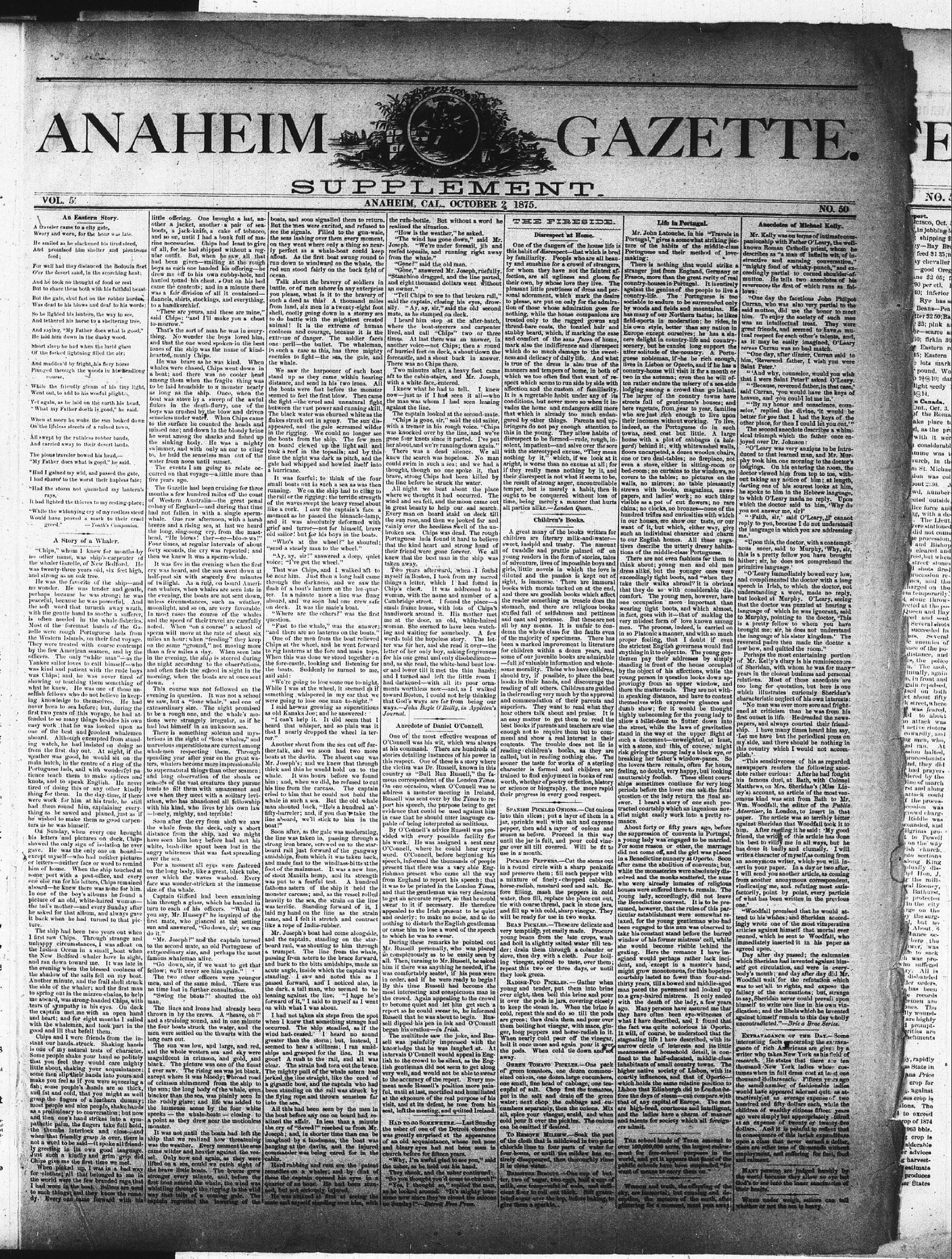
Searchable text
ANAHEIM
VOL. 5:
An Eastern Story.
A traveler came to a city gate,
Weary and worn, for the hour was late.
He smiled as he slackened his tired steed,
And promised him shelter and plenteous feed;
For well had they distanced the Bedouin fleet
O'er the desert sand, in the scorching heat;
And he took no thought of food or rest
But to share them both with his faithful beast.
But the gate, shut fast on the robber hordes,
Was dead to his blows and deaf to his words;
So he lighted his lantern, the way to see,
And tethered his horse to a sheltering tree,
And saying, "My Father does what is good,"
He laid him down in the dusky wood.
Short sleep he had when the lurid glare
Of the forked lightning filled the air;
And madden'd by fright, his fiery horse
Plunged through the woods in his headlong course,
While the friendly gleam of his tiny light,
Went out, to add to his woeful plight.
Yet again, as he laid on the earth his head,
"What my Father doeth is good," he said.
When at morn he woke the sun looked down
On the lifeless streets of a ruined town,
All swept by the ruthless robber bands,
And carried away to their desert lands.
The plous traveler bowed his head,
"My Father does what is good," he said.
little offering. One brought a hat, another a jacket, another a pair of sea-boots, a jack-knife, a cake of tobacco, and so on, until I had a bunk full of marine necessaries. Chips had least to give of all, for he had shipped without a regular outfit. But, when he saw all that had been given—smiling at the rough boys as each one handed his offering—he drew me off to his own cubby-hole, and hauled round his chest. Out on his bed came the contents; and in a minute there was a fair division of all it contained—flannels, shirts, stockings, and everything, to a handkerchief.
"These are yours, and these are mine," said Chips: "and I'll make you a chest to-morrow."
That's the sort of man he was in everything. No wonder the boys loved him, and that the one word spoken-in the best tones of the ship was the name of kind-hearted, manly Chips.
He was brave as he was kind. When whales were chased, Chips went down in a boat; and there was no cooler head among them when the fragile thing was to be laid broadside to a monster nearly as long as the ship. Once, when the boat was stove by a sweep of the awful flukes in the death-flurry, one of the boys was crushed by the blow and driven senseless under water. When Chips came to the surface he counted the heads and missed one; and down in the bloody brine he went among the sharks and fished up the sinking body. He was a mighty swimmer, and with only an oar to cling to, he held the senseless man out of the water from noon until sunset.
The events I am going to relate oc boats, and soon signalled them. But the men were excited, and see the signals. Filled to the seas lashing over them even on they went where only a thinly perfect as a whale-boat caffloat. As the first boat swung run down to windward on the red sun stood fairly on the back ocean.
Talk about the bravery of s battle, or of men ashore in any you please, what is it to the such a deed as this? A thousand from land, six men in a twenty-shell, coolly going down in a s to do battle with the mightiest animal! It is the extreme coolness and courage, because extreme of danger. The soldier one peril—the bullet. The w in such a case as this, has three enemies to fight—the sea, the whale.
We saw the harpooner of o stand up as they came within distance, and send in his two in the boats were fast before they seemed to feel the first blow. The fight—the cruel and unnature between the vast power and cunning. The black water was churned with flukes struck out in agony. They appeared, and the gale screamed in the rigging. We could no lose the boats from the ship. The on board clew up the light took a reef in the topsails; and time the night was dark as pitch gale had whipped and howled i
While the friendly gleam of his tiny light,
Went out, to add to his woeful plight.
Yet again, as he laid on the earth his head,
"What my Father doeth is good," he said.
When at morn he woke the sun looked down
On the lifeless streets of a ruined town,
All swept by the ruthless robber bands,
And carried away to their desert lands.
The plous traveler bowed his head,
— "My Father does what is good," he said.
Had I gained my will, and passed the gate,
I had shared to the worst their hapless fate;
Had the storm not quenched my lantern's rays,
It had lighted the thieves to my resting place;
While the whinnying cry of my restless steed
Would have proved a mark to their cruel greed."
A Story of a Whaler.
"Chips," whom I knew for months by no other name, was ship's carpenter of the whaler Gazelle, of New Bedford. He was twenty-three years old, six feet high, and strong as an oak tree.
He was the favorite of the ship—and no wonder. He was tender and gentle, perhaps because he was strong; he was peaceful, because he was powerful. And the soft word that turneth away wrath, with the gentle hand to soothe a sufferer, is often needed in the whale-fisheries.
Most of the foremast hands of the Gazelle were rough Portuguese lads from the Western Islands, on their first voyage. They were treated with coarse contempt by the few American seamen, and by the officers. The only "white man"—as the Yankee sailor loves to call himself—who was kind and patient with the rude boys was Chips; and he was never tired of showing or teaching them something of what he knew. He was one of those unseffish fellows who do not believe in keeping knowledge to themselves. He had never been to sea before; but, during the first two years of this voyage, he had attended to so many things besides his own easy work that he was looked upon as one of the best and coolest whalemen aboard.
Although exempted from standing watch, he had insisted on doing so from the first day out. At night, if the weather was good, he would sit on the main hatch, in the centre of a ring of the Portuguese lads, and with wonderful patience teach them to make splices and knots, and to speak English. He never tired of doing this or any other kindly thing for them. In the day-time, if there were work for him at his trade, he still had them round him, explaining everything as he sawed and planed, just as if he wished to make them as good carpenters as he was himself.
On Sunday, when every one brought his letters and pictures on deck, Chips showed the only sign of isolation he ever gave. He was the only one on board—except myself—who had neither pictures or letters—neither face or word to remind him of home. When the ship touched at some port with a post-office, and every one else ran for his letters, Chips remained aboard—he knew there was none for him.
a boat; and there was no cooler head among them when the fragile thing was to be laid broadside to a monster nearly as long as the ship. Once, when the boat was stove by a sweep of the awful flukes in the death-flurry, one of the boys was crushed by the blow and driven senseless under water. When Chips came to the surface he counted the heads and missed one; and down in the bloody brine he went among the sharks and fished up the sinking body. He was a mighty swimmer, and with only an oar to cling to, he held the senseless man out of the water from noon until sunset.
The events I am going to relate occurred on that voyage—a little more than five years ago.
The Gazelle had been cruising for three months a few hundred miles off the coast of Western Australia—the great penal colony of England—and during that time had not fallen in with a single spermwhale. One raw afternoon, with a harsh breeze and a rising sea, at last we heard the long, sing-song cry, from the masthead, "He blows! ther—ce—bloo-oes!" Four times, at regular intervals of about forty seconds, the cry was repeated; and then we knew it was a spermwhale.
It was five in the evening when the first cry was heard, and the sun went down at half-past six with scarcely five minutes of twilight. As a rule, on board American whalers, when whales are seen late in the evening, the boats are not sent down, unless circumstances such as weather, moonlight, and so on, are very favorable. In most cases the course of the whales and the speed of their travel are carefully noted. When "on a course" a school of sperm will move at the rate of about six miles an hour; when "feeding" they keep on the same "ground," not moving more than a few miles a day. When seen late in the evening, the ship is steered during the night according to the observations, and often finds the school in sight in the morning, when the boats are at once sent down.
This course was not followed on the evening in question. It was not a school we saw, but a "lone whale," and one of extraordinary size. The night promised to be a rough one, and the whale's motions were strangely irregular, as if he had lost himself in an unknown sea.
There is something solemn and mysterious in the sight of "lone whales," and marvelous superstitions are current among whalemen respecting them. Through spending year after year on the great waters, whalers become more impressionable to supernatural things than other seamen; and long observation of the shoals or schools of the vast creatures they pursue tends to fill them with amazement and awe when they meet with a solitary leviathan, who has abandoned all fellowship with his kind, who lives by his own law—lonely, mighty, and terrible!
Soon after the cry from aloft we saw the whale from the deck, only a short distance from the ship, and we might have seen him long before had not his white, bush-like spout been lost in the angry whiteness that was fast spreading over the sea.
For a moment all eyes were fastened on the long body, like a great, black tube, over which the waves washed. Every face was wonder-streken at the immense size of the whale.
We saw the harpooner of our stand up as they came within distance, and send in his two inches seemed to feel the first blow. The fight—the cruel and unnattive between the vast power and cunning. The black water was churned with flukes struck out in agony. The appeared, and the gale screamed in the rigging. We could no longer be the boats from the ship. The on board clew up the light took a reef in the topsails; and time the night was dark as pitch gale had whipped and howled in a hurricane.
It was fearful; to think of small boats out in such a sea as running. We on the ship had to rail or the rigging; the terrific of the waves swept the heavy vev like a cork. I saw the captain moment as he passed the binnacle and it was absolutely deform grief and terror—not for himself old sailor! but for his boys in this "Who's at the wheel?" he "send a steady man to the wheel."
"Ay, ay, sir!" answered a deer voice; "I've got the wheel."
That was Chips, and I walked near him. Just then a long line through the darkness, and we flash of a boat's lantern on her ter. In a minute more a line aboard, and we soon had one on deck. It was the mate's boat.
"Where are the others?" was question.
"Fast to the whale," was she—the end there are no lunarens on this One of the men from the boats Chips at the wheel, and he went to rig lanterns at the fore and mid When this was done we stood together fore-castle, looking and listingthe boats. Suddenly he turned and said:
"We're going to lose some one while I was at the wheel, it seems something whispered in my ear were going to lose one man to-mi I said he was growing as superior as old Kanaka Joe; and he answer I can't help it. It did seem heard that whisper, and so plain that I nearly dropped the wheel ror."
Another shout from the sea cutter talk, and we soon had two boats at the davits. The absent Mr. Joseph's; and we knew that thick and thin he would hold one whale. It was hours before we him; and when we did, he refused his line from the carcass. The cried to him that he could not hawle in such a sea. But the old man shouted back, "He's a hundred fifty-barreler; and if you don't line aboard, we'll stick to him boat!"
Soon after, as the gale was mooredthe line was taken in, passing through iron brace, screwed on to board rail just forward of the gaw amidships, from which it was taken and made fast to the windlass-bird foot of the mainstay. It was a mile of stout Manilla hemp, and its was put to a fearful test. A fathoms astern of the ship it h
On Sunday, when every one brought his letters and pictures on deck, Chips showed the only sign of isolation he ever gave. He was the only one on board—except myself—who had neither pictures or letters—neither face or word to remind him of home. When the ship touched at some port with a post-office, and every one else ran for his letters, Chips remained aboard—the knew there was none for him. In one of the boy's albums he found a picture of an old, white-haired woman—the lad's mother—and every Sunday after he asked for that album, and always gave it back when he had turned to that picture.
The ship had been two years out when I first saw Chips. Through strange and unhappy circumstances, I was afloat on the Indian Ocean in a small boat when the New Bedford whaler hove in sight, and ran down toward me. It was late in the evening when the blessed coolness of the shadow of the sails fell on my boat. Another minute, and the frail shell struck the side of the whaler; and the first man to spring out in the mizzen-chains, to help me aboard, was strong-handed Chips, with tears of sympathy in his eyes. On deck the captain met me with an open hand and heart; and for eight months I sailed with the whalemen, and took part in the good and ill that befell them.
Chips and I were friends from the instant our hands-struck. Shaking hands is one of my natural tests of character. Some people shake your hand so politely that you feel they would care mighty little about shaking your acquaintance; some men slip their hands into yours and make you feel as if you were squeezing a fish; some people's hands are so thick, and fat and cold, that you might as well grasp the fingers of a leathern dummy; most people and nice people, shake hands as a preliminary to conversation; but now and then one's hand strikes into a sympathetic palm, the fingers take full hold, the thumbs interlock and close—and when that friendly grasp is over, there is not a word to be said—it spoke all/friendly greeting in its own good language. Just such a kindly and grim grip did Chips give me the first time we met.
When picked up, I was in a bad way for clothes; all that belonged to me in the world were the few branded rags that I had worn in the boat. Sailors are used to such things; and they know the remedy. Every one came forward with his aid when they meet with a solitary leviathan, who has abandoned all fellowship with his kind, who lives by his own law—lonely, mighty, and terrible!
Soon after the cry from aloft we saw the whale from the deck, only a short distance from the ship, and we might have seen him long before had not his white, bush-like spout been lost in the angry whiteness that was fast spreading over the sea.
For a moment all eyes were fastened on the long body, like a great, black tube, over which the waves washed. Every face was wonder-striken at the immense size of the whale.
Captain Gifford had been examining him through a glass, which he handed in turn to each of his officers. "What do you say, Mr. Hussey?" he inquired of the first mate, who glanced at the setting sun and answered, "Go down, sir; we can do it."
"Mr. Joseph?" and the captain turned to the second mate, an old Portuguese of extraordinary size, and perhaps the most famous whaleman alive.
"Go down, sir, if we want to get that fellow; we'll never see him again."
The two other officers were younger men, and of the same mind. There was no time lost in further consultation.
"Swing the boats!" shouted the old man.
The lings and irons had already been thrown in by the crews. A "heave, oh!" and a straining sound, and in one minute the four boats struck the water, and the men were settled on the thwarts with the long oars out.
The sun was low, and large, and red, and the whole western sea and sky were magnificent in crimson, and gold, and black. The picture was one of the finest I ever saw.
The rising sea was jet black, except where it was bloody; broad road of crimson shimmered from the ship to the sun; the long body of the whale, even blacker than the sea, was plainly seen in the ruddy glare; and life was added to the immense scene by the four white specks—the whale-boat—closing to a point as they drew near the motionless monster.
It was not until the boats had left the ship that we realized how threatening was the weather. Every moment the seas came wilder and heavier against the vessel. Only now and again, as they were lifted on a sea, could we catch sight of the brave little boats. The breeze grew stronger every minute, and before the first boat neared the whale, the wind was whisling through the rigging in the wild way that tells of a coming gale. The captain regretted the lowering of the aid when they meet with a solitary leviathan, who has abandoned all fellowship with his kind, who lives by his own law—lonely, mighty, and terrible!
Soon after, as the gale was moored on the line was taken in, passing through strong iron brace, screwed on to board rail just forward of the gate amidships, from which it was taken and made fast to the windlass-bird foot of the mainmast. It was a new stunt of stout Manilla hemp, and its purpose put to a fearful test.
A fathoms astern of the ship it had monster carcass; and, as the vessels heavily to the sea, the strain on it was terrific. Standing forward on laid my hand on the line as this came, and I felt it stretch and like a rope of India-rubber.
Mr. Joseph's boat had come along and the captain, standing on the board rail, was shouting to him as a trumpet. The line from this passing from astern to the brace and back to the bits amidships, with acute angle, inside which she caped standing. I saw and noted that passed forward, and I noticed that dark a tall man, who seemed leaning against the line. "I hope forward of it," I said to myself as soon as I was about.
I had not taken six steps from when I knew that something strained occurred. The ship steadied, a wind had ceased. I heard no greater than the storm; but, in seeming to hear a stillness; I ran ships and grasped for the line. gone! A rush to the rail, and clear. The strain had torn out this mighty pull of the whale astern jerked the line straight, like the gigantic bow, and the captain been standing on the rail was stirring the flying rope and thrown senses into the sea.
All this had been seen by these boats before any one on board analyzed the affair. In less than an hour of cry of "Saved!" reached us far Joseph; and in shorter time than imagined by a landsman, he hanging at the davits, and the commander was being cared for cabin.
Hard rubbing and rum are these remedies on a whaler; and by these the captain opened his eye quarter of an hour. He had been bedded but not seriously injured.
He was amazed at first at someone standing over his mate and myself standing over him
M GAZ
SUPPLEMENT.
ANAHEIM, CAL., OCTOBER 2, 1875.
tats, and soon signalled them to return.
at the men were excited, and refused to
the signals. Filled to the gun-wale,
seas lashing over them every moment,
they went where only a thing so nearperfect as a whale-boat could keep
sat. As the first boat swung round to
down to windward in the whale, the
sun stood fairly on the back field of
man.
Talk about the bravery of soldiers in
tale, or of men ashore in any enterprise
please, what is it to the bravery of
a deed as this? A thousand miles in
land, six men in a twenty-eight foot
rail, coolly going down in a stormy sea
to battle with the mightiest created
final! It is the extreme of human
ness and courage, because it is the
mee of danger. The soldier faces
peril—the bullet. The whaleman,
such a case as this, has three mighty
miles to fight—the sea, the gale, and
whale.
We saw the harpooner of each boat
and up as they came within hearing
ance, and send in his two irons. All
boats were fast before the monster
needed to feel the first blow. Then came
fight—the cruel and unnatural fight,
even the vast power and cunning skill.
The black water was churned white as the
sea struck out in agony. The sun disheared,
and the gale screamed wilder
the rigging. We could no longer see
boats from the ship. The few men
board clewed up the light sail and
a reef in the topsails; and by this
the night was dark as pitch, and the
had whipped and howled itself into
the ruin-bottle. But without a word he realized the situation.
"How is the weather," he asked.
"The wind has gone down," said Mr.
Joseph. "We're under foresail, jib and reefed topsails, and running right away from the whale."
"Gone?" said the old man.
"Gone," answered Mr. Joseph, ruefully.
"Stanchion dragged, and the line parted,
and eight thousand dollars went without an owner."
"Tell Chips to see to that broken rail," said the captain, closing his eyes, drowsily. "Ay, ay, sir," said the old second mate, as he stamped on deck.
I heard him stop at the after-hatch,
where the boat-steersers and carpenter lived, and call "Chips" two or three times. At last there was an answer, in another voice—not Chips; then a round of hurried feet on deck, a shout down the forecastle, and a shout back in answer. There was no Chips there.
Two minutes after, a heavy foot cameaft to the cabin-stairs, and Mr. Joseph, with a white face, entered.
I knew what he had to tell. I knew now—just as if I had seen it all—who the man was whom I had seen leaning against the line.
The captain looked at the second-mate.
"Chips is gone, sir," said the old sailor, with a tremor in his rough voice. "Chips was knocked over by the line, and we've gone four knots since it parted. I've put her about, and we're running down again."
There was a dead silence. We all knew the search was hopeless. No man could swim in such a sea; and we had a thought though no one spoke it that
THE FIRESIDE.
Disrespect at Home.
One of the dangers of the house life is this habit of disrespect—that which is bred by familiarity. People who are all beauty and sunshine for a crowd of strangers, for whom they have not the faintest affection, are all ugliiness and gloom for their own, by whose love they live. The pleasant little prettiness of dress and personal adornment, which mark the desire to please, are put on only for the admiration of those whose admiration goes for nothing, while the house companions are treated only to the ragged gowns and thread-bare coats, the tonzled hair and stubby beard, which, if marking the ease and comfort of the sana fazon of home, mark also the indifference and disrespect which do so much damage to the sweetness and delicacy of daily life. And what is true of the dress is also true of the manners and tempera of home, in both of which we too often find that want of respect which seems to run side by side with affection and the custom of familiarity.
It is a regretable habit under any of its conditions, but never more so when it invades the home and endangers still more that which is already too much endangered by other things. Parents and up-bringers do not pay enough attention to this in the young. They allow habits of disrespect to be formed—rude, rough, insolent, impatient—and salve over the sore with the stereotyped excuse, "They mean nothing by it," which, if we look at it aright, is worse than no excuse at all; for if they really mean nothing at all even a stove, either...
We saw the harpooner of each boat up as they came within hearingrance, and send in his two irons. All boats were fast before the monstercame to feel the first blow. Then came fight—the cruel and unnatural fight between the vast power and cunning skill. Black water was churned white as the fires struck out in agony. The sun disheared, and the gale screamed wilder one rigging. We could no longer see boats from the ship. The few men board clewed up the light sail and a reef in the topsails; and by this night was dark as pitch, and the had whipped and howled itself into hurricane.
We was fearful; to think of the four full boats out in such a sea as was then going. We on the ship had to cling to rail or the rigging; the terrific strength of the waves swept the heavy vessel about a cork. I saw the captain's face a moment as he passed the binnacle-lamp, it was absolutely deformed with "and terror—not for himself, brave sailor!" but for his boys in the boats. Who at the wheel?" he shouted; and a steady man to the wheel."
Ivy, ay, sir!" answered a deep, quiet问:“I've got the wheel.”
What was Chips, and I walked aft to hear him. Just then a long hail came through the darkness, and we saw the boat's lantern on the lee-quarter. In a minute more a line was flung, and we soon had one crew safe deck. It was the mate's boat.
Where are the others?" was the first question.
Just as the whale," was the answer; there are no lanterns on the boats." One of the men from the boat relieved us at the wheel, and he went forward lanters at the fore and main tops. This was done we stood together on ore-castle, looking and listening for boats. Suddenly he turned to me, said:
"We're going to lose some one to-night. He I was at the wheel, it seemed if thing, whispered in my ear that we going to lose one man to-night." And he was growing as superstitious I Kanaka Joe; and he answered: "can't help it. It did seem that I that whisper, and so plain was it I nearly dropped the wheel in ter-other shout from the sea cut off furalk, and we soon had two more at the davits. The absent one was Joseph's; and we knew that through and thin he would hold on to the sea. It was hours before we found and, when we did, he refused to cut one from the carecass. The captain to him that he could not hold the seabird in such a sea. But the old whale shouted back, "He's a hundred an-parreler; and, if you don't take the board, we'll stick to him in the ocean after, as the gale was moderating, one was taken in, passing through a big iron brace, screwed on to the starrail just forward of the gangway ships, from which it was taken back, made fast to the windlass-bitts at the of the mainmast. It was a new hine, but Manilla hemp, and its strength out to a fearful test. A hundred assms of the ship held the two minutes after, a heavy foot cameaft to the cabin-stairs, and Mr. Joseph, with a white face, entered.
I knew what he had to tell. I knew now—just as if I had seen it all—who the man was whom I had seen leaning against the line.
The captain looked at the second-mate. "Chips is gone, sir," said the old sailor, with a tremor in his rough voice. "Chips was knocked over by the line, and we've gone four knots since it parted. I've put her about,and we're running down again."
There was a dead silence. We all knew the search was hopeless. No man could swim in such a sea; and we had a thought, though no one spoke it, that brave, strong Chips had been killed by the line before he struck the water.
All night we beat about the place where we thought it had occurred. The wind and sea fell, and the moon came out in great beauty to help our sad search. Everyman on board staid on deck till the sun rose, and then we looked far and vainly over the headless swell of the unbroken sea. Chips was dead. The rough Portuguese lads found it hard to believe that the kind heart and strong hand of their friend were gone forever. We all knew that the best man in the ship was taken away.
Two years afterward, when I found myself in Boston, I took from my sacred things a letter, which I had found in Chip's chest. It was addressed to a woman, with the name and number of a Cambridge street. I found the place—a small frame house, with lots of Chip's handwork around it. His mother met me at the door, an old, white-haired woman. She seemed to have been watching and waiting for somebody. A few words told the hopeless story. The letter was for her, and she read it over—the letter of her only boy, asking forgiveness for his one great and only disobedience—and, as she read, the white-head bent lower and lower till it met the thin hands; and I turned and left the little room I had darkened—with all its poor ornaments worthless now—and, as I walked toward Boston, I could not help thinking that God's ways are far from being our ways.—John Boyle O'Reilly, in Appleton's Journal.
Ancedote of Daniel O'Connell.
One of the most effective weapons of O'Connell was his wit, which was always at his command. There are hundreds of stories detailing instances of his power in this respect. One of these is a story where the victim was Dr. Russell, known in this country as "Bull Run Russell,"the famous correspondent of the London Times.On one occasion, when O'Connell was to address a monster meeting in Ireland,Russell was sent over by the Times to report his speech, the purpose being to get evidence that could be used against him in case that he should utter language capable of being interpreted as seditions.
By O'Connell's advice Russell was provided with every possible facility for his work. He was assigned a seat near O'Connell, where he could hear every word.O'Connell, before beginning his speech, informed the thousands of people present that there was a very able Engrishman present who came all way from England to report his speech; that it was to be printed in the London Times,
Two minutes after, a heavy foot cameaft to the cabin-stairs, and Mr. Joseph, with a white face, entered.
I knew what he had to tell. I knew now—just as if I had seen it all—who the man was whom I had seen leaning against the line.
The captain looked at the second-mate. "Chips is gone, sir," said the old sailor, with a tremor in his rough voice. "Chips was knocked over by the line,and we've gone four knots since it parted.I've put her about,and we're running down again."
There was a dead silence. We all knew the search was hopeless. No man could swim in such a sea; and we had a thought, though no one spoke it, that brave, strong Chips had been killed by the line before he struck the water.
All night we beat about the place where we thought it had occurred. The wind and sea fell, and the moon came out in great beauty to help our sad search. Everyman on board staid on deck till the sun rose, and then we looked far and vainly over the headless swell of the unbroken sea. Chips was dead. The rough Portuguese lads found it hard to believe that the kind heart and strong hand of their friend were gone forever. We all knew that the best man in the ship was taken away.
Two years afterward, when I found myself in Boston, I took from my sacred things a letter, which I had found in Chip's chest. It was addressed to a woman with the name and number of a Cambridge street. I found the place—a small frame house, with lots of Chip's handwork around it. His mother met me at the door, an old, white-haired woman. She seemed to have been watching and waiting for somebody.A few words told the hopeless story.The letter was for her,and she read it over—the letter of her only boy,aasking forgiveness for his one great and only disobedience—andas she read,the white-head bent lower and lower till it met the thin hands;and I turned and left the little room I had darkened—with all its poor ornaments worthless now—andas I walked toward Boston,i could not help thinking that God's ways are far from being our ways.-John Boyle O'Reilly ,in Appleton's Journal.
Spanish Pickled Onions.-Cut onions into thin slices; put a layer of them in a jar,sprinkle well with salt and cayenne pepper; then add a layer of onions and season as before.In proceed this way until the jar is full,and pour cold vinegar over all till covered.Will be fit to use in a month.
Pickled Peppers.-Cut the stems out in a round circle with a sharp penknife and preserve them; fill each pepper with a mixture of finely-chopped cabbage,horse-radish,mustard seed and salt.Be want of it,but with such an individualto our English homestives describe their tions ofthe middle.
There are not ever think about;young dress alike,但the exceedingly tight bodytake their walksthat they do sow comfort.The young one occupationmewearing tight booinkin fact,goes with itvery mildest form omen.The process.in so Platonica mansproper feeling,thestrictest English anythingin to objectteen pay theirstanding in frontofbythe objectofhisyoung personin querc provingly from antherethe matter endin speaking distancethemselfswith exumbowshow;forithighly unbecomingallowa billet-douxtothe street,whilethestandinthe wayoftuchsucha document-witha stone,andthe risk givingtheyouthernbreakingherfatherthe lovers thereremelieeingno doubt,veneretunnyfoolishshipships sometimescooperateperiodsbeforethelqestionorthe ladyswer.I heard astracted courtshipwhileelist might easilywance.
About forty or fillethe suppressionofa young ladywas enFor some reasonorin did not come off,andinA Benedictine nunafter camethe abolliwhilethe monasteriesolvedandthemoniwho were alreadyhouseswere suffered
on after, as the gale was moderating, one was taken in, passing through a big iron brace, screwed on to the star rail just forward of the gangway ships, from which it was taken back, made fast to the windlass-bitts at the of the mainmast. It was a new hine, out Manilla hemp, and its strength out to a fearful test. A hundred tons astern of the ship it held the water carcass; and, as the vessel rolled by the sea, the strain on the line terrific. Standing forward of it, I my hand on the line as the strain and I felt it stretch and contract a rope of India-rubber.
Joseph's boat had come alongside, the captain, standing on the star rail, was shouting to him through impet. The line from the whale, long from astern to the brace forward, back to the bits amidships, made an angle, inside which the captain was ing. I saw and noted this as I did forward, and I noticed also, inark, a tall man, who seemed to be going against the line. "I hope he's hard of it," I said to myself as I went with what I was about.
I had not taken six steps from the spot I knew that something strange had occurred. The ship steadied, as if the had ceased. I heard no sound over than the storm; but, instead, I led to hear a stillness; I ran amid- and grasped for the line. It was A rush to the rail, and all was The strain had torn out the brace. Nightly pull of the whale astern had dived the line straight, like the cord of snort bow, and the captain who had standing on the rail was struck by lying rope and thrown senseless far the sea.
This had been seen by the men in boat before any one on board had read the affair. In less than a minute cry of "Saved!" reached us from Mr. Smith; and, in shorter time than can be bined by a landsman, the boat was being at the davits, and the injured man was being cared for in the ward rubbing and rum are the patent dies on a whaler; and by dint of the captain opened his eyes in a ter of an hour. He had been stun-but not seriously injured.
was amazed at first at seeing the and myself standing over him, with address a monster meeting in Ireland, Russell was sent over by the Times to report his speech, the purpose being to get evidence that could be used against him in case that he should utter language capable of being interpreted as seditious.
By O'Connell's advice Russell was provided with every possible facility for his work. He was assigned a seat near O'Connell, where he could hear every word. O'Connell, before beginning his speech, informed the thousands of people present that there was a very able Engrishman present who came all the way from England to report his speech; that it was to be printed in the London Times, and that the gentleman was very desirous to get an accurate report, so that he could swear to it if necessary. He therefore appealed to the Irish present to be quiet and orderly; to make no noise, and to do nothing to disturb the English gentleman or cause him to lose a word of the speech to which he was to swear.
During these remarks he pointed out Mr. Russell personally, who was placed so conspicuously as to be easily seen by all. Then, turning to Mr. Russell, he asked him if there was anything he needed, if he was comfortably seated, if his pens were in order, and if he were ready to begin? By this time Russell had become the most interesting and conspicuous man in the crowd. Again appealing to the crowd to become quiet and let him get such a report as he could swear to, he informed Russell that he was about to begin. Russell dipped his pen in ink and O'Connell began his oration—in Irish.
The multitude saw the joke, and Russell was painfully impressed with the knowledge that he was laughed at. At intervals O'Connell would appeal in English to the crowd to be silent, as the English gentleman did not seem to get along very well, and would not be able to swear to the accuracy of the report. Every moment made Russell's position more painful, until at last, mortified and humiliated at the exposure of the real purpose of his visit, and at its defeat, he rose from his seat, left the meeting, and quitted Ireland.
Had to go somewhere—Last Sunday the usher of one of the Detroit churches was greatly surprised at the appearance of an old acquaintance, whose red nose and bleary eyes had not been seen in church before for fifteen years.
"Why I'm awful glad to see you," said the usher, as he held out his hand.
They shook, and the usher continued: "So you thought you'd come to church!"
"Yes, I thought so," replied the man, as he looked around. "It's mighty loose now since they've closed the saloons on Sunday!"—Detroit Free Press.
Spanish Pickled Onions—Cut onions into thin slices; put a layer of them in a jar, sprinkle well with salt and cayenne pepper, then add a layer of onions and season as before. Proceed in this way until the jar is full, and pour cold vinegar over all till covered. Will be fit to use in a month.
Pickled Peppers—Cut the stems out in a round circle with a sharp penknife and preserve them; fill each pepper with a mixture of finely-chopped cabbage, horse-radish, mustard seed and salt. Before filling, mash the peppers in cold water, then fill, replace the piece cut out, tie with coarse thread, pack in stone jars, and fill up with cold, sharp vinegar. They will be ready for use in two weeks.
Bean Pickles—These are delicate and very tempting yet easily made. Procure young beans from the late crops, wash and boil in slightly salted water till tender; drain them through a colander or sieve, then dry with a cloth. Pour boiling vinegar, spiced to taste, over them; repeat this two or three days, or until they look green.
Radish-Pod Pickles—Gather when young and tender, put them into brine over night, then boil this brine and pour it over the pods in jars, covering closely to keep the steam in. When the brine is cold, repeat this and do so till the pods are green; then drain them and pour over them boiling hot vinegar, with mace, ginger, long peppers and horse-radish in it. When nearly cold pour off the vinegar, boil it once more and again pour it over the pods. When cold tie down and set away.
Green Tomato Pickles—One pack of green tomatoes, one dozen common-sized onions, one dozen large cucumbers, one small fine head of cabbage, one ten-cupful of salt. Chop first the tomatoes, put in the salt and drain off the green water; next chop the cabbage and cucumbers separately; then the onions. Mix all spice your vinegar, scald, and when cold pour it over the pickles. The onions can be omitted if desired.
To Remove Mildew—Soak the part of the cloth that is mildewed in two parts chloride lime to four parts of water for four hours, or until the mildew has entirely disappeared, then thoroughly rinse it in clean water.
Banana Raisins—One cup of butter, two of sugar, two eggs, half a cup of milk one teaspoonful of soda, and sufficient flour to roll out thick. Sift granulated sugar over the top before baking to give them a sparkle...
The school lands over 100,000 square feet for free-school world, and yet it appears public schools have want of means for society admit.
Winnos and truth sky are immortal; caption,the manner glittering for a man
AZETTE.
NO. 50
DE.
Life in Portugal.
Mr. John Latouche, in his "Travels in Portugal," gives a somewhat striking picture of the habits of the middle-class Portuguese and their method of love-making:
There is nothing that would strike a stranger just from England, Germany or France, more than the great rarity of real country-houses in Portugal. It is entirely against the genius of the people to live a country-life. The Portuguese is too sociable to endure to be surrounded only by woods and fields and mountains. He has many of our Northern tastes; he likes field-sports in moderation; he rides in his own style, better than any nation in Europe except ourselves; he has a sincere delight in country-life and country-scenery, but he cannot long support the utter solitude of the country. A Portuguese nobleman, if he be rich enough, lives in Lisbon or Oporto, and if he has a country-house will visit it for a month or two in the autumn; even then he will often rather endure the misery of a sea-side lodging among a crowd than go inland. The larger of the country towns have streets full of gentlemen's houses; and here vegetate, from year to year, families who are just rich enough to live upon their incomes without working. To live, indeed, as the Portuguese do in such towns, need cost but little. A large house with a plot of cabbages (a kale-yard) behind it; with whitewashed walls, floors uncarpeted, a dozen wooden chairs, one or two deal-tables; no fireplace, not even a stove, either in sitting-room or bedroom.
Anecdotes of Michael Kelly.
Mr. Kelly was on terms of intimate companionship with Father O'Leary, the well-known Roman Catholic priest, whom he describes as "a man of infinite wit, of instructive and amusing conversation." "Mighty fond of whisky-punch," and exceedingly partial to corned shoulder-of-mutton. He tells two anecdotes of his reverence: the first of which runs as follows:
"One day the facetious John Philpot Curran, who was also very partial to the said mutton, did me the honor to meet him. To enjoy the society of such men was an intellectual treat. They were great friends, and seemed to have a mutual respect for each other's talents, and, as it may be easily imagined, O'Leary versus Curran was no bad match.
"One day, after dinner, Curran said to him, 'Reverend father, I wish you were Saint Peter.'"
"And why, counselor, would you wish that I were Saint Peter?" asked O'Leary.
"Because, reverend father, in that case," said Curran, "you would have the keys of heaven, and you could let me in."
"By my honor and conscience, counselor," replied the divine, "it would be better for you that I had the keys of the other place, for then I could let you out."
The second anecdote describes a whimsical triumph which the father once enjoyed over Dr. Johnson:
"O'Leary was very anxious to be introduced to that learned man, and Mr. Murphy took him one morning to the doctor's lodgings. On his entering the room, the
"And why, counselor, would you wish that I were Saint Peter?" asked O'Leary.
"Because, reverend father, in that case," said Curran, "you would have the keys of heaven, and you could let me in."
By my honor and conscience, counselor,' replied the divine, 'it would be better for you that I had the keys of the other place, for then I could let you out.'
The second anecdote describes a whimsical triumph which the father once enjoyed over Dr. Johnson:
"O'Leary was very anxious to be introduced to that learned man, and Mr. Murphy took him one morning to the doctor's lodgings. On his entering the room, the doctor viewed him from top to toe, without taking any notice of him; at length, darting one of his sourest looks at him, he spoke to him in the Hebrew language, to which O'Leary mada no reply. Upon which the doctor said to him, 'Why do you not answer me, sir?'
"Faith, sir," said O'Leary, "I cannot reply to you, because I do not understand the language in which you are addressing me."
Upon this, the doctor, with a contemptuous sneer, said to Murphy, 'Why, sir, this is a pretty fellow you have brought hither; sir, he does not comprehend the primitive language.'
O'Leary immediately bowed very low, and complimented the doctor with a long speech in Irish, to which the doctor, not understanding a word, made no reply, but looked at Murphy. O'Leary seeing that the doctor was puzzled at hearing a language of which he was ignorant, said to Murphy, pointing to the doctor. This is a pretty fellow to whom you have brought me; sir, he does not understand the language of his sister kingdom." The reverend padre then made the doctor a low bow, and quitted the room.
Perhaps the most entertaining portion of Mr. Kelly's diary is his reminiscences of Sheridan, with whom he was for many years in the closest business and personal relations. Most of these anecdotes are too long for quotation, but here is one which illustrates curiously Sheridan's characteristic neglect of his own interests:
"No man was ever more sore and frightened at criticism than he was from his first outset in life. He dreaded the newspapers, and always courted their friendship. I have many times heard him say, 'Let me have but the periodical press on my side, and there should be nothing in this country which I would not accomplish.'"
This sensitiveness of his as regarded newspapers renders the following anecdote rather curious: After he had fought his famous duel, at Bath, with Colonel Matthews, on Mrs. Sheridan's (Miss Linley's) account, an article of the most venomous kind was sent from Bath to Mr. Wm. Woodfall, the editor of the Public Advertiser, in London, to insert in that paper. The article was so terribly bitter against Sheridan that Woodfall took it to him. After reading it he said: 'My good friend, the writer of this article has done his best to vilify me in all ways, but he has done it badly and clumsily. I will write a character of myself, as coming from an anonymous writer, which you will insert in your paper. In a day or two after, I will send you another article, as coming from another anonymous correspondent, vindicating me, and refuting most satis-
Canada.
Outt., Oct. 3.
of the Roma
take place to
Canada.
In Canada.
considerably
with it were
considerable
with it were
considerable
with it were
considerable
with it were
considerable
with it were
considerable
with it were
considerable
with it were
considerable
with it were
considerable
with it were
considerable
with it were
considerable
with it were
considerable
with it were
considerable
with it were
considerable
with it were
considerable
with it were
considerable
with it were
considerable
with it were
considerable
with it were
considerable
with it were
considerable
with it were
considerable
with it were
considerable
with it were
considerable
with it were
considerable
with it were
considerable
with it were
considerable
with it were
considerable
with it were
considerable
with it were
considerable
with it were
considerable
with it were
considerable
with它
considerable
with它
considerable
with它
considerable
with它
considerable
with它
considerable
with它
considerable
with它
considerable
with它
considerable
with它
considerable
with它
considerable
with它
considerable
with它
considerable
with它
considerable
with它
considerable
with它
considerable
with它
considerable
with它
considerable
with它
considerable
with它
considerable
with它
considerable
with它
considerable
with它
considerable
with它
considerable
with它
considerable
with它
considerable
with它
considerable
with它
considerable
with它
considerable
with它
Considerable
Considerable
Considerable
Considerable
ConsiderABLE ConsiderABLE ConsiderABLE ConsiderABLE ConsiderABLE ConsiderABLE ConsiderABLE ConsiderABLE ConsiderABLE ConsiderABLE ConsiderABLE ConsiderABLE ConsiderABLE ConsiderABLE ConsiderABLE ConsiderABLE ConsiderABLE ConsiderABLE ConsiderABLE ConsiderABLE ConsiderABLE ConsiderABLE ConsiderABLE ConsiderABLE ConsiderABLE ConsiderABLE ConsiderABLE ConsiderABLE ConsiderABLE ConsiderABLE ConsiderABLE ConsiderABLE ConsiderABLE ConsiderABLE ConsiderABLE ConsiderABLE ConsiderABLE ConsiderABLE ConsiderABLE ConsiderABLE ConsiderABLE ConsiderABLE ConsiderABLE ConsiderABLE ConsiderABLE ConsiderABLE ConsiderABLE ConsiderABLE ConsiderABLE ConsiderABLE ConsiderABLE ConsiderABLE ConsiderABLE ConsiderABLE ConsiderABLE ConsiderABLE ConsiderABLE ConsiderABLE ConsiderABLE ConsiderABLE ConsiderABLE ConsiderABLE ConsiderABLE ConsiderABLE ConsiderABLE ConsiderABLE ConsiderABLE ConsiderABLEConsiderABLEConsiderabileConsiderabileConsiderabileConsiderabileConsiderabileConsiderabileConsiderabileConsiderabileConsiderabileConsiderabileConsiderabileConsiderabileConsiderabileConsiderabileConsiderabileConsiderabileConsiderabileConsiderabileConsiderabileConsiderabileConsiderabileConsiderabileConsiderabileConsiderabileConsiderabileConsiderabileConsiderabileConsiderabileConsiderabileConsiderabileConsiderabileConsiderabileConsiderabileConsiderabileConsiderabileConsiderabileConsiderabileConsiderabileConsiderabileConsiderabileConsiderabileConsiderabileConsiderabileConsiderabileConsiderabileConsiderabileConsideribileConsideribileConsideribileConsideribileConsideribileConsideribileConsideribileConsideribileConsideribileConsideribileConsideribileConsideribileConsideribileConsideribileConsideribileConsideribileConsideribileConsideribileConsideribileConsideribileConsideribileConsideribileConsideribileConsideribileConsideribileConsideribileConsideribileConsideribileReferrableReferrableReferrableReferrableReferrableReferrableReferrableReferrableReferrableReferrableReferrableReferrableReferrableReferrableReferrableReferrableReferrableReferrableReferrableReferrableReferrableReferrableReferrableReferrableReferrableReferrableReferrableReferrableReferrableReferrableRefernableReferrableRefernableRefernableRefernableRefernableRefernableRefernableRefernableRefernableRefernableRefernableRefernableRefernableRefernableRefernableRefernableRefernableRefernableRefernableRefernableRefernableRefernableRefernableRefernableRefernableRefernableRefernableRefernableRefernableRefernableRefernableRefernableRefernable ReferrableReferrableReferrableReferrableReferrableReferrableReferrableReferrableReferrableReferrableReferrableReferrableReferrableReferrableReferrableReferrableReferrable Referrable Referrable Referrable Referrable Referrable Referurable Referurable Referurable Referurable Referurable Referurable Referurable Referurable Referurable Referurable Referurable Referurable Referurable Referurable Referurable Referurable Referurable Referurable Referurable Referurable Referurable Referurable Referurable Referurable Referurable Referurable Referurable Referurable Referurable Referurable Referurable Referurable Referurable Referurable Referurable Referurable Referurable Referurable Referurable Referurable Referurable Referurable Referurable Referurable Referurable Referurable Referurable Referurable Referurable Referurable Referurable Referurable Referurable Referurable Referurable Referurable Referurable Referurable Referurable Referurable Referurable Referurable Referurable Referurable Referurable Referurable ReferenceReferenceReferenceReferenceReferenceReferenceReferenceReferenceReferenceReferenceReferenceReferenceReferenceReferenceReferenceReferenceReferenceReferenceReferenceReferenceReferenceReferenceReferenceReferenceReferenceReferenceReferenceReferenceReferenceReferenceReferenceReferenceReferenceReferenceReferenceReferenceReferenceReferenceReferenceReferenceReferenceReferenceReferenceReferenceReferenceReferenceReferenceReferenceReferenceReferenceReferenceReferenceReferenceReferenceReferenceReferenceReferenceReferenceReferenceReferenceReferenceReferenceReferenceReferenceReferenceReferenceReferenceReferenceReferenceReferenceReferenceReferenceReferenceReferenceReferenceReferenceReferenceReferenceReferenceReferenceReferenceReferencesReferencesReferencesReferencesReferencesReferencesReferencesReferencesReferencesReferencesReferencesReferencesReferencesReferencesReferencesReferencesReferencesReferencesReferencesReferencesReferencesReferencesReferencesReferencesReferencesReferencesReferencesReferencesReferencesReferencesReferencesReferencesReferencesReferencesReferencesReferencesReferencesExtensionsExtensionsExtensionsExtensionsExtensionsExtensionsExtensionsExtensionsExtensionsExtensionsExtensionsExtensionsExtensionsExtensionsExtensionsExtensionsExtensionsExtensionsExtensionsExtensionsExtensionsExtensionsExtensionsExtensionsExtensionsExtensionsExtensionsExtensionsExtensionsExtensionsExtensionsExtensionsExtensionsExtensionsExtensionsExtensionsExtensionsExtensionsExtensionsExtensionsExtensionsExtensionsExtensionsExtensionsExtensionsExtensionsExtensionsExtensionsExtensionsExtensionsExtensionsExtensionsExtensionsExtensionsExtensionsExtensionsExtensionsExtensionsExtensionsExtensionsExtensionsExtensionsExtensionsExtensionsExtensionsExtensionsExtensionsExtensionsExtensionsExtensionsExtensionsExtensionsExtensionsExtensionsExtensionsPermissionsPermissionsPermissionsPermissionsPermissionsPermissionsPermissionsPermissionsPermissionsPermissionsPermissionsPermissionsPermissionsPermissionsPermissionsPermissionsPermissionsPermissionsPermissionsPermissionsPermissionsPermissionsPermissionsPermissionsPermissionsPermissionsPermissionsPermissionsPermissionsPermissionsPermissionsPermissionsPermissionsPermissionsPermissionsPermissionsPermissionsPermissionsPermissionsPermissionsPermissionsPermissionsPermissionsPermissionsPermissionsPermissionsPermissionsPermissionsPermissionsPermissionsPermissionsPermissionsPermissionsPermissionsPermissionsPermissionsPermissionsPermissionsPermissions permissions permissions permissions permissions permissions permissions permissions permissions permissions permissions permissions permissions permissions permissions permissions permissions permissions permissions permissions permissions permissions permissions permissions permissions permissions permissions permissions permissions permissions permissions permissions permissions permissions permissions permissions permissions permissions permissions permissions permissions permissions permissions permissions permissions permissions permissions permissions permissions permissions permissions permissions permissions permissions permissions permissions permissions permissions permissions permissions permissions permissions permissions permissions permissions permissions permissions permissions permissions permissions permissions permissions permission permission permission permission permission permission permission permission permission permission permission permission permission permission permission permission permission permission permission permission permission permission permission permission permission permission permission permission permission permission permission permission permission permission permission permission permission permission Permission Permission Permission Permission Permission Permission Permission Permission Permission Permission Permission Permission Permission Permission Permission Permission Permission Permission Permission Permission Permission Permission Permission Permission Permission Permission Permission Permission Permission Permission Permission Permission Permission Permission Permission Permission Permission Permission Permission Permission Permission Permission Permission Permission Permission Permission Permission Permission Permission PermissionPermissionPermissionPermissionPermissionPermissionPermissionPermissionPermissionPermissionPermissionPermissionPermissionPermissionPermissionPermissionPermissionPermissionPermissionPermissionPermissionPermissionPermissionPermissionPermissionPermissionPermissionPermissionPermissionPermissionPermissionPermissionPermissionPermissionPermissionPermissionPermissionPermissionPermissionPermissionPermissionPermissionPermissionPermissionPermissionPermissionPermissionPermissionPermissionPermissionPermissionPermissionPermissionPermissionPermissionPermissionPermissionPermissionPermissionPermissionPermissionPermissionPermissionPermissionPermissionPermissionPermissionPermissionPermissionPermissionPermissionPermissionPermissionPermissionPermissionPermutationPermutationPermutationPermutationPermutationPermutationPermutationPermutationPermutationPermutationPermutationPermutationPermutationPermutationPermutationPermutationPermutationPermutationPermutationPermutationPermutationPermutationPermutationPermutationPermutationPermutationPermutationPermutationPermutationPermutationPermutationPermutationPermutationPermutationPermutationPermutationPermutationPermutationPermutationPermutationPermutationPermutationPermutationPermutationPermutationPermutationPermutationPermutationPermutationPermutationPermutationPermutationPermutationPermutationPermutationPermutationPermutationPermutationPermutationPermutationPermutationPermutationPermutationPermutationPermutationPermutationPermutationPermutationPermutationPermutationPermutationPermutationPermutationPermutationPermutationPermutationPermutationPermutationPermutationPermutationPermutationPermutationPermutationPermutationPermutationPermutationPermutationPermutationPermutationPermutationPermutationPermutationPermutationPermutationPermutationPermutationPermutationPermutationPermutationPermutationPermutationPermutationPermutationPermutationPermutationPermutationPermutationPermutationPermutationPermutationPermutationPermutationPermutationPermutationPermittionPermittionPermittionPermittionPermittionPermittionPermittionPermittionPermittionPermittionPermittionPermittionPermittionPermittionPermittionPermittionPermittionPermittionPermittionPermittionPermittionPermittionPermittionPermittionPermittionPermittionPermittion Permittion Permittion Permittion Permittion Permittion Permittion Permittion Permittion Permittion Per mittention Permittition Permittition Permittition Permittition Permittition Permittition Permittition Per mittention Permittition Per mittention Per mittention Per mittention Per mittention Per mittention Per mittention Per mittention Per mittention Per mittention Per mittention Per mittention Per mittention Per mittention Per mittention Per mittention Per mittention Per mittention Per mittention Per mittention Per mittention Per mittention Per mittention Per mittention Per mittention PERMITION PERMITION PERMITION PERMITION PERMITION PERMITION PERMITION PERMITION PERMITION PERMITION PERMITION PERMITION PERMITION PERMITION PERMITION PERMITION PERMITION PERMITION PERMITION PERMITION PERMITION PERMITION PERMITION PERMITION PERMITION PERMITION PERMITION PERMITION PERMITION PERMITION PERMITION PERMITION PERMITION PERMITIONPERMITIONPERMITIONPERMITIONPERMITIONPERMITIONPERMITIONPERMITIONPERMITIONPERMITIONPERMITIONPERMITIONPERMITIONPERMITIONPERMITIONPERMITIONPERMITIONPERMITIONPERMITIONPERMITIONPERMITIONPERMITIONPERMITIONPERMITIONPERMITIONPERMITIONSEREMITIONSEREMITIONSEREMITIONSEREMITIONSEREMITIONSEREMITIONSEREMITIONSEREMITIONSEREMITIONSEREMITIONSEREMITIONSEREMITIONSEREMITIONSEREMITIONSEREMITIONSEREMITIONSEREMITIONSEREMITIONSEREMITIONSEREMITIONSEREMITIONSEREMITIONSEREMITIONSEREMITIONSEREMITONSEREMITIONSEREMITIONSEREMITIONSEREMITIONSEREMITIONSEREMITIONSEREMITIONSEREMITIONSEREMITIONSEREMITIONSEREMITIONSEREMITIONSEREMITIONSEREMITIONSEREMITIONSEREMITIONSEREMITIONSEREMITIONSEREMITIONSEREMITIONSEREMITIONSEREMITIONSEREMITIONSEREMITONSEREMITONSEREMITONSEREMITONS SEREMITONS SEREMITONS SEREMITONS SEREMITONS SEREMITONS SEREMITONS SEREMITONS SEREMITONS SEREMITONS SEREMITONS SEREMITONS SEREMITONS SEREMITONS SEREMITONS SEREMITONS SER EMITTONS SER EMITTONS SER EMITTONS SER EMITTONS SER EMITTONS SER EMITTONS SER EMITTONS SER EMITTONS SER EMITTONS SER EMITTONS SER EMITTONS SER EMITTONS SER EMITTONS SER EMITTONS SER EMITTONS SER EM ITTONS SER EM ITTONS SER EM ITTONS SER EM ITTONS SER EM ITTONS SER EM ITTONS SER EM ITTONS SER EM ITTONS SER EM ITTONS SER EM ITTONS SER EM ITTONS SER EM ITTONS SER EM ITTONS SER EM ITTONS SER EM ITTONS SER EM ITTONS SER EM ITTONTONS SER EM ITTONTONS SER EM ITTONTONS SER EM ITTONTONS SER EM ITTONTONS SER EM ITTONTONS SER EM ITTONTONS SER EM ITTONTONS SER EM ITTONTONS SER EM ITTONTONS SER EM ITTONTONS SER EM ITTONTON S Ser Em ItTONTON S ser Em ItTONTON S ser Em ItTONTON S ser Em ItTONTON S ser Em ItTONTON S ser Em ItTONTON S ser Em ItTONTON S ser Em ItTONTON S ser Em ItTONTON S ser Em ItTONTON S ser Em ItTONTON S ser Em ItTONTON S ser Em ItTONTON S ser Em ItTONTON S ser Em It TONTON S ser Em ItTONTON S ser Em ItTONTON S ser Em ItTONTON S ser Em ItTONTON S ser Em ItTONTON S ser Em ItTONTON S ser Em ItTONTON S ser Em ItTONTON S ser Em ItTONTON S ser Em ItTONTON S ser Em ItTONTON S ser Em ItTONTON S ser Em ItTONTON S ser Em It TONTON S ser Em It TONTON S ser Em It TONTÓN S ser Em It TUNTÓN S ser Em It TUNTÓN S ser Em It TUNTÓN S ser Em It TUNTÓN S ser Em It TUNTÓN S ser Em It TUNTÓN S ser Em It TUNTÓN S ser Em It TUNTÓN S ser Em It TUNTÓN S ser Em It TUNTÓN S ser Em It TUNTÓN S ser Em It TUNTÓN S ser Em It TUNTÓN S ser Em It TUNTÓN S ser Em It TUNTÓN S serEmIt TUNTÓN S serEmIt TUNTÓN S serEmIt TUNTÓN S serEmIt TUNTÓN S serEmIt TUNTÓN S serEmIt TUNTÓN S serEmIt TUNTÓN S serEmIt TUNTÓN S serEmIt TUNTÓN S serEmIt TUNTIÓN S serEmIt TUNTIÓN S serEmIt TUNTIÓN S serEmIt TUNTIÓN S serEmIt TUNTIÓN S serEmIt TUNTIÓN S serEmIt TUNTIÓN S serEmIt TUNTIÓN S serEmIt TUNTIÓN S serEmIt TUNTIÓN S serEmIt TUNTIÓN S serEmIt TUNTIÓN S serEmIt TUNTIÓN S serEmIt TUNTIÓN SserEmIt TUNTIÓN SserEmIt TUNTIÓN SserEmIt TUNTIÓN SserEmIt TUNTIÓN SserEmIt TUNTIÓN SserEmIt TUNTIÓN SserEmIt TUNTIÓN SserEmIt TUNTIÓN SserEmIt TUNTIÓN SserEmIt TUNTIÓN SserEmIt TUNTIÓN SserEmIt TUNTIÓN SserEmIt TUNTIÓN SserEmIt TUNTIÓN SSerEmIt TSerEmIt TSerEmIt TSerEmInit TSerEmInit TSerEmInit TSerEmInit TSerEmInit TSerEmInit TSerEmInit TSerEmInit TSerEmInit TSerEmInit TSerEmInit TSerEmInit TSerEmInit TSerEmInit TSerEmInit TSerEmInit TSerEmInit TSerEmInit TSerEmInit TSerEmInit TSerEmInit TSerEmInit TSerEmInit TSerEmInit TSerEm Init TSerEm Init TSerEm Init TSerEm Init TSerEm Init TSerEm Init TSerEm Init TSerEm Init TSerEm Init TSerEm Init TSerEm Init TSerEm Init TSerEmpinit TSerEmpinit TSerEmpinitTSerEmpinitTSerEmpinitTSerEmpinitTSerEmpinitTSerEmpinitTSerEmpinitTSerEmpinitTSerEmpinitTSerEmpinitTSerEmpinitTSerEmpinitTSerEmpinitTSerEmpinitTSerEmpinitTSerEmpinitTSerEmpinitTSerEmpinitTSerEmpinitTSerEmpinitTSerEmpinitTSerEmpinitTSterEmpinitTSterEmpinitTSterEmpinitTSterEmpinitTSterEmpinitTSterEmpinitTSterEmpinitTSterEmpinitTSterEmpinitTSterEmpinitTSterEmpinitTSterEmpinitTSterEmpinitTSterEmpinitTSterEmpinitTSterEmpinitTSterEmpinitTSterEmpinitTSterEmpinitTSterEmpinitTSterEMPinitTSterEMPinitTSterEMPinitTSterEMPinitTSterEMPinitTSterEMPinitTSterEMPinitTSterEMP.initTSter Emp initTSter Emp initTSter Emp initTSter Emp initTSter Emp initTSter Emp initTSter Emp initTSter Emp initTSter Emp initTSter Emp initTSter Emp initTSter Emp initTSter Emp initTSter Emp initTSter Emp initTSter Emp initTSter Emp initTSter Emp initTSter Emp initTSter Emp initTSter Emp initTSter Emp initTSter Emp initITSter Emp initITSter Emp initITSter Emp initITSter Emp initITSter Emp initITSter Emp initITSter Emp initITSter Emp initITSter Emp initITSter Emp initITSter Emp.initITSter Emp.initITSter Emp.initITSter Emp.initITSter Emp.initITSter Emp.initITSter Emp.initITSter Emp.initITSter Emp.initITSter Emp.initITSter Emp.initITSter Emp.initITSter Emp.initITSter Emp.initITSter Emp.initITSter Emp.initITSter Emp.initITSter Emp.initITSster Empire.initITSster Empire.initITSster Empire.initITSster Empire.initITSster Empire.initITSster Empire.initITSster Empire.initITSster Empire.initITSster Empire.initITSster Empire.initITSster Empire.initITSster Empire.initITSster Empire.initITSster Empire.initITSster Empire.initITSster Empire.initITSster Empire.initITSster Empire.initITSster Empire.initITSster Empire.initITSster Empire.initITSster Empire.initITSster Empire.initITSster Empire.initITSster Empire.initsister Empire.initsister Empire.initsister Empire.initsister Empire.initsister Empire.initsister Empire.initsister Empire.initsister Empire.initsister Empire.initsister Empire.initsister Empire.initsister Empire.initsister Empire.initsister Empire.initsister Empire.initsister Empire.initsister Empire.initsister Empire.initsister Empire.initsister Empire.initsister Empire.initsister Empire.initsister Empire.initsister Empire.initsister Empire.initsiter Empire.initsister Empire.initsister Empire.initsister Empire.initsister Empire.initsister Empire.initsister Empire.initsister Empire.initsister Empire.initsister Empire.initsister Empire.initsister Empire.initsister Empire.initsister Empire.initsister Empire.initsister Empire.initsister Empire.initsister Empire.initsister Empire.initsister Empire.initsister Empire.initsister Empire.initsister Empire.initsitter Empire.initorsiter Empire.initorsiter帝国.iniitorsiter帝国.iniitorsiter帝国.iniitorsiter帝国.iniitorsiter帝国.iniitorsiter帝国.iniitorsiter帝国.iniitorsiter帝国.iniitorsiter帝国.iniitorsiter帝国.iniitorsiter帝国.iniitorsiter帝国.iniitorsiter帝国.iniitorsiter帝国.iniitorsiter帝国.iniitorsiter帝国.iniitorsiter帝国.iniitorsiter帝国.iniitorsiter帝国.iniitorsiter帝国.iniitorsiter帝国.iniitorsiter帝国.iniitorsiter帝国.iniitorsiter帝国.iniitorsiter帝国.iniitorisiter帝国.iniitorisiter帝国.iniitorisiter帝国.iniitorisiter帝国.iniitorisiter帝国.iniitorisiter帝国.iniitorisiter帝国.iniitorisiter帝国.iniitorisiter帝国.iniitorisiter帝国.iniitorisiter帝国.iniitorisiter帝国.iniitorisiter帝国.iniitorisiter帝国.iniitorisiter帝国.iniitorisiter帝国.iniitoris iter帝国.iniitoris iter帝国.iniitoris iter帝国.iniitoris iter帝国.iniitoris iter帝国.iniitoris iter帝国.iniitoris iter帝国.iniitoris iter帝国.iniitoris iter帝国.iniitoris iter帝国.iniitoris iter帝国.iniitoris iter帝国.iniitoris iter帝国.iniitoris iter帝国.iniitoris iter帝国.iniitoris iter帝国.iniitoris iter帝国.iniitoris iter帝国.iniitoris iter帝国.iniitoris iter德国iniitoris iter德国iniatoris iter德国iniatoris iter德国iniatoris iter德国iniatoris iter德国iniatoris iter德国iniatoris iter德国iniatoris iter德国iniatoris iter德国iniatoris iter德国iniatoris iter德国iniatoris iter德国iniatoris iter德国iniatoris iter德国iniatoris iter德国iniatoris iter德国iniatoris iter德国iniatoris iter德国iniatoris iter德国iniatori is iter德国iniatori is iter德国iniatori isIter德国iniatori isIter德国iniatori isIter德国iniatori isIter德国iniatori isIter德国iniatori isIter德国iniatori isIter德国iniatori isIter德国iniatori isIter德国iniatori isIter德国iniatori isIter德国iniatori isIter德国iniatori isIter德国iniatori isIter德国iniatori isIter德国iniatori isIter德国iniatori isIter德国iniatori isIter德国iniatori是Iter德国iniatori是Iter德国inciutorii是Iter德国inciutorii是Iter德国inciutorii是Iter德国inciutorii是Iter德国inciutorii是Iter德国inciutorii是Iter德国inciutorii是Iter德国inciutorii是Iter德国inciutorii是Iter Germaninciutorii是Iter Germaninciutorii是Iter Germaninciutorii是Iter Germaninciutorii是Iter Germaninciutorii是Iter Germaninciutorii是Iter Germaninciutorii是Iter Germaninciutorii是Iter Germaninciutorii是Iter Germaninciutorii是Iter Germaninciutorii是Iter Germaninciutorii是Iter Germaninciutorii是Iter Germaninciutorii是Iter Germaninciutorii是Iter Germaninciutorii是Iter Germaninciutorii是 Iter Germaninciutorii是Iter Germaninciutorii是Iter Germaninciutorii是Iter Germaninciutorii是Iter Germaninciutorii是Iter Germaninciutorii是Iter Germaninciutorii是Iter Germaninciutorii是Iter Germaninciutorii是Iter Germaninciutorii是Iter Germaninciutorii是Iter Germaninciutorii是Iter Germaninciutorii是Iter Germaninciutorii是Iter Germaninciutorii是Iter Germaninciutorii是 Iter Germaninciutorii是 Iter Germaninciutorii是 Iter Germaninciutorii是 Iter Germaninciutorii是 Iter Germaninciutorii是 Iter GermaninciutorII是 Iter GermaninciutorII是 Iter GermaninciutorII是 Iter GermaninciutorII是 Iter GermaninciutorII是 Iter GermaninciutorII是 Iter GermaninciutorII是 Iter GermaninciutorII是 Iter GermaninciutorII是 Iter GermaninciutorII是 Iter GermaninciutorII是 Iter GermaninciutorII是 Iter GermaninciutorII是 Iter GermaninciutorII是 Iter GermaninciutorII是 Iter GermaninciutorII是 Iter GermaninciutorII的 Iter GermaninciutorII的 Iter GermaninciutorII的 Iter GermanenciotorII的 Iter GermeniotorII的 Iter GermeniotorII的 Iter GermeniotorII的 Iter GermeniotorII的 Iter GermeniotorII的 Iter GermeniotorII的 Iter GermeniotorII的 Iter GermeniotorII的 Iter GermeniotorII的 Iter GermeniotorII的 Iter GermeniotorII的 Iter GermeniotorII的 Iter GermeniotorII的 Iter GermeniotorII的 Iter GermeniotorII的 Iter Germeniotor II的 Iter Germeniotor II的 Iter Germeniotor II的 Iter Germeniotor II的 Iter Germeniotor II的 Iter Germeniotor II的 Iter Germeniotor II的 Iter Germeniotor II的 Iter Germeniotor II的 Iter Germeniotor II的 Iter Germeniotor II的 Iter Germeniotor II的 Iter Germeniotor II的 Iter Germeniotor II的 Iter Germeniotor II的 Iter Germeniotor II 的 Iter Germeniotor II的 Iter Germeniotor II的 Iter Germeniotor II的 Iter Germeniotor II的 Iter Germeniotor II的 Iter Germeniotor II的 Iter Germeniotor II的 Iter Germeniotor II的 Iter Germeniotor II的 Iter Germeniotor II的 Iter Germeniotor II的 Iter Germeniotor II的 Iter Germeniotor II的 Iter germeniotor II的_iter germениотрйййййййййййййййййййййй
About forty or fifty years ago, before the suppression of convents in Portugal, a young lady was engaged to be married. For some reason or other, the marriage did not come off, and the girl was placed in a Benedictine nunnery at Oporto. Soon after came the abolition of convents; but, while the monasteries were absolutely dissolved and the monks scattered, the nuns who were already inmates of religious houses were suffered there to remain. The young lady, accordingly, did not leave the Benedictine convent. It is to be presumed, however, that the rules of this particular establishment were somewhat relaxed, for the young gentleman who had been engaged to this nun was observed to take his constant stand before the barred window of his former mistress' cell, while she would become visible behind the grating. Here the romance I have imagined would perhaps rather lack incident, and, except in a master's hand, might grow monotonous, for this hopeless courtship lasted no fewer than four-and-thirty years, till a bowed and middle-aged man paced the pavement and looked up to a gray-haired mistress. It only ended with the death of the lady, a few years ago. Many persons have assured me that they have often been eye-witnesses of what I have described, and I found that the fact was quite notorious in Oporto. It will, of course, be understood that the stagnating life I have described, with its narrow circle of interests and its little meannesses of household detail, is confined to the half-educated, middle-class inhabitants of small country towns. The higher native society of Lisbon, with its courtly influences, and that of Oporto—which holds the same relative position to Lisbon that Edinburgh did to London before the days of steam—can compare with that of any capital of Europe. The men are high-bred, courteous and intelligent, and the ladies have a charm of manner and talents for society which all foreigners admit.
The school lands of Texas amount to over 100,000,000 acres, the largest endowment for free-school purposes in the world, and yet it appears that most of the public schools have been suspended "for want of means to carry them on."
Winnow and truth, the offspring of the sky, are immortal; but cursing and deceitting, the motions of the earth, after glittering for a moment, must pass away.
The article was so terribly bitter against Sheridan that Woodfall took it to him. After reading it he said: "My good friend, the writing of this article has done his best to vilify me in all ways, but he has done it badly and clumsily. I will write a character of myself, as coming from an anonymous writer, which you will insert in your paper. In a day or two after, I will send you another article, as coming from another anonymous correspondent, vindicating me, and refuting most satisfactorily, point by point, every particle of what has been written in the previous one."
"Woodfall promised that he would attend to his wishes; and Sheridan accordingly wrote one of the most vituperative articles against himself that mortal ever opened, which he sent to Woodfall, who immediately inserted it in his paper as agreed upon.
Day after day passed; the calumnies which Sheridan had invented against himself got circulation, and were in everybody's mouth; and day after day did Mr. Woodfall wait for the refutation which was to set all to rights, and expose the fallacy of the accusations; but, strange to say, Sheridan never could prevail upon himself to write one line in his own vindication; and the libels which he invented against himself remain to this day wholly uncontradicted." — Eric a Brae Series.
EXTRAVAGANCE OF THE DAY—Some interesting facts concerning the extravagance of rich Americans are given by a writer who takes New York as his field of research. He states that there are ten thousand New York ladies whose costumes when in full dress cost at least one thousand dollars each. Fifteen years ago the same number of fashionable ladies would have appeared adorned quit as attractively at an average expense of two hundred and fifty dollars each, while the children of wealthy citizens fifteen years ago were simply but appropriately tired at an expense of twenty or twenty-five dollars. And it is painful to reflect that in consequence of this lavish expenditure upon a class that never earned a dollar, there are other tens of thousands without employment, and suffering for fuel, food and saliment.
Many persons are judged harshly by the world because they allow no eye but God's to see into the inner sanctuaries of their hearts.
Whose under weigh sailors can tell whether or not the sea is heavy.