anaheim-gazette 1875-05-29
Scanned page
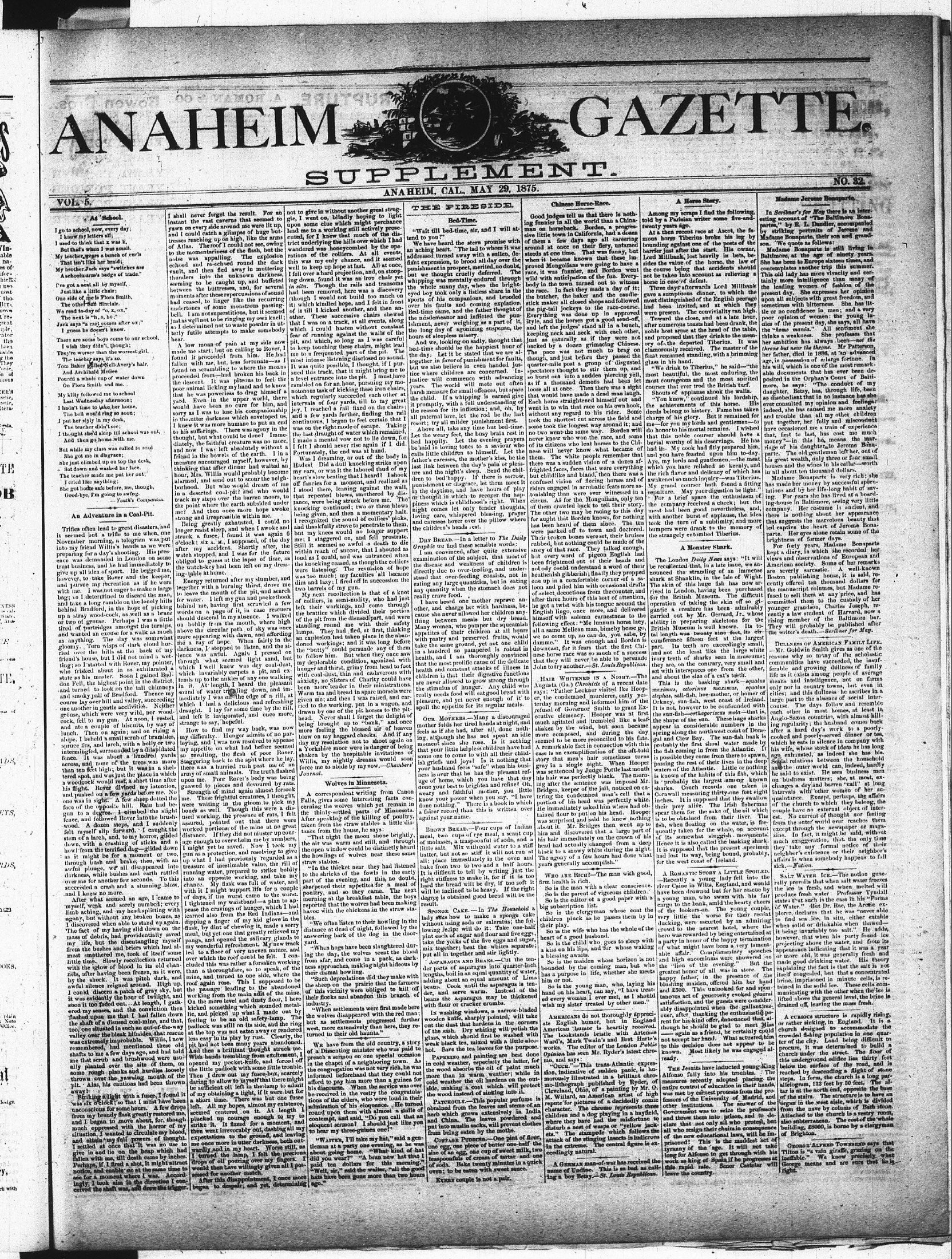
Searchable text
ANAHEIM
VOL. 5.
At School.
I go to school, now, every day;
I know my letters all;
I used to think that x was k,
But that's when I was small.
My teacher, wears a bunch of curls
That isn't like her braid;
My brother Jack says "switches are
A schoolmarm's badge of trade."
I've got a seat all by myself,
Just like a little chair;
One side of me is Flora Smith,
The other Sut Sinclair.
We read to-day of "o, x, ox;"
The next is "h, o, ho;"
Jack says "a cart comes after ox;"
I guess he doesn't know.
There are some boys come to our school,
I wish they didn't, though;
They're worse than the worstest girl,
The teacher says it's so.
Tom Baker pulled Nell-Avery's hair,
And Archibald Metee.
Poured a whole cup of water down
On Flora Smith and me.
My kitty followed me to school
Last Wednesday afternoon;
I hadn't time to take her home,
The bell would ring so soon;
I put her slyly in my desk,
The teacher didn't see;
I thought she'd sleep till school was out,
And then go home with me.
But while my class was called to read
She got me in disgrace;
She just climbed up on top the desk,
Sat down and washed her face.
I shall never forget the result. For an instant the vast caverns that seemed to yawn on every side around me were lit up,
and I could catch a glimpse of huge buttresses reaching up on high, like the arms of Atlas. The roof I could not see, owing to the momentariness of the flash, but the noise was appalling. The explosion echoed and re-echoed round the dark vault, and then fled away in muttering thunders into the unknown darkness, seeming to be caught up, and buffeted between the buttresses, and, for several moments after these repercussions of sound had ceased, to linger like the recurring undertones of some monstrous passing-bell. I am not superstitious, but it seemed just as well not to be ringing my own knell; so I determined not to waste powder in utterly futile attempts to make somebody hear.
A low moan of pain at my side now made me start; but on calling to Rover, I found it proceeded from him. He had fallen with me, but, less fortunate—as I found on scrambling to where the moans proceeded from—had broken his back in the descent. It was piteous to feel the poor animallicking my hand and to know that he was powerless to drag himself a yard. Even in the upper world, there would have been no cure for him, and sorry as I was to lose his companionship in the utter darkness which enveloped us, I knew it was more humane to put an end to his sufferings. There was agony in the thought, but what could be done? Immediately, the faithful creature was no more, and now I was left absolutely without a friend in the bowels of the earth. In a measure encouraged myself, however, by thinking that after dinner had waited annot to give in without and gle, I went on, blindly upon some clue which led me to a working stitched, for I knew that trict underlying the hills wandered was honeycombs of the colliers. this was my only chance well to keep up hope at L I fell over a hard projecting down, found it was in situ. Though the raid had been removed, here (though I would not but it) which kindled hope, of it till I kicked another. These successive that I was on a track, at which I could hasten fear of running against pit, and which, so long to keep touching these me to a frequent parapoint most intense listening did. It was quite possible, I sued this track, that it a level entrance into the rambled on for an hour, notonous task of kicking which regularly succeed intervals of four yards joy, I reached a rail and a few yards further continuous, I began to was on the right mode of the last draught of water I made a mental vow r I felt I should never r Fortunately, the end w Was I dreaming, or Hades? Did a dull kn
An Adventure in a Coal-Pit.
Trifles often lead to great disasters, and it seemed but a trifle to me when, one November morning, a telegram was put into my friend Willis's hands as we were preparing for a day's shooting. His presence was demanded in London on some trust business, and he had immediately to give up all idea of sport. He begged me, however, to take Rover and the keeper, and pursue my recreation as if he were with me. I was not eager to make a large bag; so I determined to discard the man, and take a long ramble on the lonely hills behind Bradford, in the hope of picking up a stray wood-cock, as well as a brace or two of grouse. Perhaps I was a little tired of partridges amongst the turnips, and wanted an excuse for a walk as much as anything. The day was somewhat gloomy. Torn wisps of dark cloud hurried over the hills at the back of my friend's house, but I did not mind a wetting; so I started with Rover, my pointer, who frisked about in as exhilarated a state as his master. Soon I gained Baddon Fell, the highest point in the district, and turned to look on the tall chimneys and smoky pall of Bradford. Thence my course lay over hill and valley, succeeding one another in gentle acclivities. Neither grouse, which were very wild, nor woodcock, fell to my gun. At noon, I rested, and ate a couple of biscuits, by way of lunch. Then on again; and on rising a slope. I beheld a small scrub of brambles, spruce firs, and larch, with a holly or two intermingled, surrounded by a dilapidated fence. It was about a hundred yards across, and none of the trees was more than ten feet high; but it was in a sheltered spot, and was just the place in which a woodcock would rest, a short time after his flight. Rover divined my intention, and pushed on a few yards before me. No one was in sight. A few sheep dotted the face of the opposite hill. Rain had begun to a degree. I climbed the slight fence, and followed Rover into the brushwood. A dozen steps, and I suddenly felt myself slip forward. I caught the stem of a larch, and, to my horror, glided down, with a crashing of sticks and a howl from the terrified dog—glided down as it might be for a moment or two, through bush and brake; then, with an awful plunge, we all disappeared into darkness, while bushes and earth rattled over me for another few seconds. To this succeeded a crash and a stunning blow,
And Archibald Metee
Poured a whole cup of water down
On Flora Smith and me.
My kitty followed me to school
Last Wednesday afternoon;
I hadn't time to take her home,
The bell would ring so soon;
I put her slyly in my desk,
The teacher didn't see;
I thought she'd sleep till school was out,
And then go home with me.
But while my class was called to read
She got me in disgrace;
She just climbed up on top the desk,
Sat down and washed her face.
The teacher made me put her out;
I cried like anything;
She got home safe before me, though,
Good-bye, I'm going to swift.
— Youth's Companion.
An Adventure in a Coal-Pit.
Being greatly exhausted, I could no longer resist sleep, and when I awoke and struck a fusee, I found it was again 6 o'clock; six A.M., I supposed, of the day after my accident. Shortly after, the watch stopped, and I was for the future obliged to guess at the lapse of time, as the watch-key had been left on my dressing-table at home.
Energy returned after my slumber, and together with a burning thirst, drove me to leave the mouth of the pit, and search for water. I left my gun and pocketbook behind me, having first scrawled a few words on a page of it, in case rescues should descend in my absence. I walked on boldly from the mouth, where high above the circular path of sky was once appearing with dawn, and affording me a ray of hope. When fairly in the darkness, I stopped to listen, and the silence was awful. Again I pressed on through what seemed light sand, but which I well knew was dry coal-dust, which invariably carpets a pit, and extends up to the ankles of any one walking in it. At length, I heard the pleasant sound of water trailing down, and immediately I was on the edge of a rill, at which I had a delicious and refreshing draught. I lay for some time by the rill, and left it invigorated, and once more, strange to say, hopeful.
How to find my way back, was now my difficulty. Hunger admits of no parleying, and I was now resolved to appease my appetite on what had before seemed so revolting, the flesh of poor Rover. Staggering back to the spot where he lay, there was a hurried rush past me of an army of small animals. The truth flashed upon me. Poor Rover's body was being guawed to pieces and devoured by rats.
Strength of mind again almost forsook me. These frightful creatures, I thought, were waiting in the gloom to pick my bones as well. Though this were a disused working, the presence of rats, I felt assured, pointed out that there were worked portions/of the mine at no great distance. If they did not muster up courage enough to overwhelm me by numbers, I might yet be saved. Now I took my gun as a protection, and resolving to give up what I had previously regarded as a treasure of inestimable value, the rill of running water, prepared to strike boldly into an opposite working, and take my chance. My flask was full of water, and it might support life for a couple
sued this track, that it is level entrance into the rambled on for an hour, notonoous task of kicking which regularly succeed intervals of four yards joy, I reached a rail fi fand a few yards further continuous. I began to wear on the right mode of the last draught of water. I made a mental vow to feel I should never rise Fortunately, the end wilt Was dreaming, or Hades? Did a dull knot my ears; or was it the heart's slow beating that off fancies for a moment. I stood there, leaning that repeated blows tance, were being struck knocking continued; being given, and then I recognized the sound and thankfully strove to but my knees would bend me; I staggered on; Still it seemed so awake within reach of success loud as it could, and wilt the knocking ceased; as were listening: The head was too much; my fast dim and lazy; fired on two barrels of my gun.
My next recollection of colliers, in semi-night left their workings; the brattice which dicted of the pit from the dis-standing round me lamps. They had fleeced an explosion had taken done workings; and "butty" could peep to follow him. But my deplorable condition hunger and thirst grind with coal-dust, thin an anxiety; no Sisters of been more tender in Warm tea and bread given me; and then I ried to the working drawn by one of the head. Never shall I be brought up to more feeling the blower on my haggard day my resolution near Yorkshire moor was shaken by the hospice Willis, my nightly force to abide by Journal.
Wolves in
A correspondent Falls gives some information concerning the wolves in the thinly-settled After speaking of the taken from the tawning from the house "That night they the air was warm at the open window cooing the howlings of wo-straw stables."
In the thicket n'to the shrieks of tha part of the evening sharpened their app
After what seemed an age, I came to myself, weak and sorely numbed; every limb aching, and my head splitting with agony, but without any broken bones, as I discovered when able to stand up again. The fact of my having slid down on the mass of debris, had providentially saved my life, but the disentangling myself from the bushes and briers which had almost amputered me, took of itself some little time. Slowly recollection returned with the glow of blood in its old channels, after having been frozen, as it were, by the shock. It was pitch dark, and awful silence reigned around. High up, I could discern a patch of gray sky, but it was evidently the hour of twilight, and soon it too faded out. At length, I gathered my senses, and the conviction then flashed upon me that I had fallen down the shaft of a disused coal-mine, and that, too, one situated in such an out-of-the-way valley over the bleak hillsides, that rescue was extremely improbable. Willis, I now remembered, had mentioned these old shafts to me a few days ago, and had told me that scrub and brushwood were usually planted over the site of them, on some rough planks and hurdles loosely thrown over the yawning mouth of the pit. Alas, his cautions had been thrown away!
Striking a light with a fusee, I found it was six o'clock; so that I must have been unconscious for some hours. A few drops from my brandy flask greatly restored me, and I began to move about, for though much oppressed with the horror of my situation, I wanted to circulate my blood, and attain my full powers of thought. I settled at once that it was no use to give in and lie on the heap which had fallen with me, till death came by inches. Perhaps, if I fired a shot, it might attract notice, and enable me at the same time to see for a moment where I was. Accordingly, I took aim in the direction conceived the shaft was, and drew the trigger.
Strength of mind again almost took me. These frightful creatures, I thought, were waiting in the gloom to pick my bones as well. Though this were a disused working, the presence of rats, I felt assured, pointed out that there were worked portions of the mine at no great distance. If they did not muster up courage enough to overwhelm me by numbers, I might yet be saved. Now I took my gun as a protection, and resolving to give up what I had previously regarded as a treasure of inestimable value, the rill of running water, prepared to strike boldly into an opposite working, and take my chance. My flask was full of water, and with it I might support life for a couple of days, if the worst came to the worst. I tightened my waistband—a plan to appease the cravings of hunger, which I had learned also from the Red Indians—and dipping a finger of my kid glove in the flask, by dint of chewing it, made a sorry meal, but yet one that greatly relieved my pangs, and opened the salivary glands to my wonderful refreshment. My new track led to a floor of very uneven nature, and over which the roof could be felt. I concluded this was rather a forsaken working than a thoroughfare, so to speak, of the mine, and turned to one side, where the roof again rose. This I supposed to be the passage leading to the abandoned working from the main adit of the mine. On the more level and dusty floor, I here kicked something which sounded metallic, and picked up what I made out by feeling to be an old safety-lamp. The padlock was still on its side, and the ring at the top was not eaten away or rendered less easy in its play by rust. Clearly, the pit had not been many years abandoned. And then a brilliant thought struck me. With hands trembling from excitement, I opened my pocket-knife, and forced off the little padlock with some little trouble. Then I drew out my fusce-box, scarcely daring to allow to myself that there might be sufficient oil left in the lamp to admit of my obtaining a light, if it were but for a short time. There was but one fuscee left. All my hopes, almost my existence, seemed centered on it. At length I plucked up courage enough to try to strike it. It fizzed for a moment, and then went irrevocably out, dashing all my expectations to the ground, and leaving me once more in utter darkness both outwardly and in my heart. Worse still, as I turned the lamp, I felt the precious drops of oil pouring over my fingers. I would then have willingly given all I possessed for another match.
After this disappointment, I once more began to despair; and yet, determining
NOT TO GIVE IN WITHOUT ANOTHER GREAT STRUGGLE, I WENT ON, BLINDLY HOPING TO LIGHT UPON SOME CLUE WHICH MIGHT PERCHANCE LEAD ME TO A WORKING STILL ACTIVELY PROSECUTED, FOR I KNEW THAT MUCH OF THE DISTRICT UNDERLYING THE HILLS OVER WHICH I HAD WANDERED WAS HONEYCOMBED BY THE OPERATIONS OF THE COLLIERS. AT ALL EVENTS, THIS WAS MY ONLY CHANCE, AND IT SEEMED WELL TO KEEP UP HOPE AT LAST. ALL AT ONCE, I FELL OVER A HARD PROJECT, AND, ON STOOPING DOWN, FOUND IT WAS AN IRON CHAIR YET IN SITU. THOUGH THE RAILS AND TRANSOMS HAD BEEN REMOVED, HERE WAS A DISCOVERY (THOUGH I Would not Build too much On It) which Kindled Hope, AND I Felt In Front Of It Till I Kicked Another, AND THEN ANOTHER. THESE SUCCESSIVE CHAIRS SHEWED That I Was On A Track, At All Events, ALONG WHICH I Could Hasten Without Constant fear Of Running Against The Walls Of The Pit, AND, WHICH SO Long As I WAS Careful To Keep Touching These Chairs, Might Lead Me To A Frequented Part Of The Pit. THE MOST INTENSE LISTENING DISCLOSED NO Sound. IT WAS QUITE POSSIBLE, I Thought, IF I PURSUED THIS TRACK, THAT IT MIGHT Bring Me To A Level Entrance Into The Pit. I MUST HAVE RAMBLED ON FOR AN HOUR, PURSUING MY MOUNTONOUS TASK OF KICKING THESE IRON CHAIRS, WHICH REGULARLY SUCCEEDED EACH OTHER AT INTERVALS OF FOUR Yards, TILL TO MY GREAT JOY, I REACHED A RAIL FIXED ON THE CHAIRS; AND A FEW YARDS FURTHER, FINDING THE RAIL CONTINUOUS, I BEGAN TO FEEL CERTAIN THAT I WAS ON THE RIGHT MODE OF Escape. TAKING THE LAST DRAGHT OF WATER WHICH REMAINED, I MADE A MENTAL VOW NOT TO LIE DOWN, FOR I FELT I Should Never Rise Again If I Did. Fortunately, The End Was At Hand.
Was I Dreaming, or Out of the Body in Hades? Did A Dull Knocking Strike Upon
THE FIRESIDE.
Bed-Time.
"Wait till bed-time, sir, and I will attend to you!"
We have heard the stern promise with an aching heart. "The lad to whom it was addressed turned away with a sullen, defiant expression, to brood all day over the punishment in prospect, merited no doubt, but we thought cruelly deferred. The whipping was mentally endured through the whole sunny day, when the bright-eyed boy took only a listless share in the sports of his companions, and brooded over his faults and coming expiation. Bed-time came, and the father thought of the misdemeanor and inflicted the punishment, never weighing as a part of it, the long day of agonizing suspense, the hours of sleepless misery.
And we, looking on sadly, thought that bed-time should be the happiest hour of the day. Let it be stated that we are altogether in favor of punishment for faults, but we also believe in even handed justice where children are concerned. Justice will commence with advancing years. The world will mete out often harsh measure for small offences, but spare the child. If a whipping is earned give it promptly, with a full understanding of the reason for its infliction; and, oh, by all paternal love, let the rod be the last resort; try all milder punishment first.
Above all, take any time but bed-time. Let the weary feet, the busy brain rest in bed happily. Let the evening prayers be said in loving tones to a saviour who calls little children to himself. Let the father's caresses, the mother's kiss, be the last link between the day's pain or pleasures.
Chinese Horse-Race.
Good judges tell us that there is nothing funnier in all the world than a China-man on horseback. Borden, a progressive little town in California, had a dozen of them a few days ago all careering around at once on their fiery, untamed steeds at one time. That was funny, but when it became known that these improved Mongolians were going to have a race, it was funnier, and Borden went wild with anticipation of the fun. Everybody in the town turned out to witness the race. In fact they made a day of it; the butcher, the baker and the candle-stick maker all closed shops and followed the pig-tail jockeys to the race-course. Everything was done up in approved style, and the horses got a good send-off, and left the judges' stand all in a bunch, keeping neck and neck with each other, just as naturally as if they were not backed by a dozen grimacing Chinese. The pace was not much to brag on though, and just before they passed the quarter-mile post a group of disgusted spectators thought to stir them up, and so burst out into a sudden piercing yell, as if a thousand demons had been let loose all at once. Then there was a sight that would have made a dead man laugh. Each horse straightened himself out and went in to win that race on his own hook, without any regard to his rider. Some took the shortest cut across the field and some took the longest way around it; and no two went—the same way. Borden will never know who won the race, and some of its citizens who lent horses to the Chinese will never know what became of them. The white people remember that there was a sudden vision of a dozen af-frighted faces; faces that were everything.
Among me told by a P twenty years.
At a then mons horse-bounding a barrier just Lord Millbys sides the vault the course not be taken horse in car.
Three days gave a sum most distinct had been present.
Toward after numerous noble hosts and prophecy of the clamorous feast remain glass in his eyes.
"We drive most beatless most courser thou shoutest."
“You keep the deeds below charge of me—for you do honor that this burial had it.” And you lye Aye, my which you see.”
Was I dreaming, or out of the body in Hades? Did a dull knocking strike upon my ears, or was it the labored thud of my heart's slow beating that I heard? I shook off fancies for a moment, and realized as I stood there, leaning against the wall, that repeated blows, smothered by distance, were being struck before me. The knocking continued; two or three blows being given, and then a momentary halt. I recognized the sound of colliers' picks, and thankfully strove to penetrate to them, but my knees would no longer support me; I staggered on, and fell prostrate. Still it seemed so awful a death to die within reach of succor, that I shouted loud as I could, and was entranced when the knocking ceased, as though the colliers were listening. The revulsion of hope was too much; my faculties all became dim and lazy; I fired off In succession the two barrels of my gun.
My next recollection is that of a knot of colliers, in semi-nudity, who had just left their workings, and come through the brattice which divided their portion of the pit from the disused part, and were standing round me with their safety hamps. They had fled, at first, thinking an explosion had taken place in the abandoned workings; and it was long before the "butty" could persuade any of them to follow him. But when they once saw my deplorable condition, agonized with hunger and thirst, grimy from head to foot with coal-dust, thin and cadaverous with anxiety, no Sisters of Charity could have been more tender in their ministrations. Warm tea and bread in spare morsels were given me; and then I was raised, and carried to the working, put in a wagon, and drawn by one of the pit horses to the pithead. Never shall I forget the delight of being brought up to "bank," and once more feeling the blessed air of heaven blow on my haggard cheeks. And if any day my resolution not to shoot again on a Yorkshire moor were in danger of being shaken by the hospitable invitations of Willis, my nightly dreams would soon force me to abide by my vow.—Chaunbers' Journal.
Wolves in Minnesota.
A correspondent writing from Canon Falls, gives some interesting facts concerning the wolves which yet remain in the thinly-settled parts of Minnesota. After speaking of the killing of poultry, taken from the straw stables a little distance from the house, he says:
"That night the moon shone brightly, the air was warm and still, and through the open window could be distinctly heard the howlings of wolves near these same straw stables.
In the thicket near they had listened to the shrinks of the fowls in the early part of the evening, and this, no doubt, sharpened their appetites for a meal of mice where children are concerned. Justice will commence with advancing years. The world will met out often harsh measure for small offences, but spare the child. If a whipping is earned give it promptly, with a full understanding of the reason for its infliction; and, oh, by all paternal love, let the rod be the last resort; try all milder punishment first.
Above all, take any time but bed-time. Let the weary feet, the busy brain rest in bed happily. Let the evening prayers be said in loving tones to a saviour who calls little children to himself. Let the father's caresses, the mother's kiss, be the last link between the day's pain or pleasure and the night's sleep. Send the children to bed happy. If there is sorrow, punishment or disgrace, let them meet it in the daytime, and have hours of play or thought in which to recover the happiness which is childhood's right. When night comes let only tender thoughts, loving care, whispered blessing, prayer and caresses hover over the pillow where the children's heads rest."
Dry Bread.—In a letter to The Daily Graphic we find these sensible words:
I am convinced, after quite extensive examination of the subject, that most of the disease and weakness of children is directly due to over-feeding, and understand that over-feeding consists, not in eating any large quantities, but in eating any quantity when the stomach does not really crave food.
I have heard one mother reprove another, and charge her with hardness, because she never allowed her children anything between meals but dry bread. Many women, who pamper the squeamish appetites of their children at all hours with pastry and preserved fruits, would take the same ground, yet not one child in a hundred so pampered is robust in health, and I am thoroughly convinced that the most prolific cause of the delicate health and constant attacks of illness in children is that their digestive functions are never allowed to grow strong through the stimulus of hunger. Any child who really needs food will eat good bread with pleasure, and yet never enough of it to spoil the appetite for its regular meals.
Our Mothers.—Many a discouraged mother folds her tired hands at night, and feels as if she had, after all, done nothing, although she has not spent an idle moment since she rose. Is it nothing that your little helpless children have had some one to come to with all their childish griefs und joys? Is it nothing that your husband feels "safe" when his business is over that he has the pleasant refuge of home, which you have that day done your best to brighten and refine? Oh, weary and faithful mother, you little know your power when you say, "I have done nothing." There is a book in which a fairer record than this is written over against your name.
Brown Bread.—Four cups of Indian meal, two cups of rye meal, a scant cup of molasses, a teaspoonful of soda, and a little salt. Mix with cold water to a stiff batter, but not so stiff it will not run at all; place immediately in the oven and bake from two to two and a half hours. It is difficult to tell by writing just the right stiffness to make it, for if it is too hard the bread will be dry, if too soft it spectators thought to stir each up so burst into a sudden piercing yell, as if a thousand demons had been let loose all at once. Then there was a sight that would have made a dead man laugh. Each horse straightened himself out and went in to win that race on his own hook, without any regard to his rider. Some took the shortest cut across the field and some took the longest way around it; and no two went the same way. Borden will never know who won the race, and some of its citizens who lent horses to the Chinese will never know what became of them. The white people remember that there was a sudden vision of a dozen frightened faces, faces that were everything but childlike and bland, then there was a confused vision of fleeing horses and of riders engaged in acrobatic feats more astonishing than were ever witnessed in a circus. As for the Mongolians, only ten of them crawled back to tell their story. The other two may be racing to this day for aught that Borden knows, for nothing has been heard of them since. The ten were packed off to town and doctored. Their broken bones were set, their bruises rubbed, but nothing could be made of the story of that race. They talked enough, but every word of pigeon English had been frightened out of their heads and not only could understand a word of their heathenish gibberish; finally they propped one up in a comfortable corner of a sauna and plied him with occasional drafts of select decoctions from the counter, and after three hours of this sort of attention, he got a twist with his tongue around the English lingo, once more, and delivered himself with solemn earnestness to the following effect: "Me lunnum horse lacy, all a same Melican man, bimeby hosse go, we no come up, no can do, you sabe, by damme." It was enough and Borden is downcast; for it fears that the first Chinese horse race was so much of a success that they will never be able to persuade John to try another.—St. Louis Republican.
Hair Whitened In A Night.—The Augusta (Ga.) Chronicle of a recent date says: "Father Leckner visited Ike Hoopler, the condemned murderer; early yesterday morning and informed him of the refusal of Governor Smith to grant Executive elemency. Hoopler was at first much agitated and trembled like a leaf-shaken by the wind, but soon became more composed, and during the day seemed to be more reconciled to his fate. A remarkable fact in connection with this case is an exemplification of the oft-told story that men's hair sometimes turns gray in a single night. When Hoopler was sentenced by Judge Pottle last month his hair was perfectly black. The morning after the sentence was imposed Mr. Bridges, keeper of the jail, noticed on entering the condemned man's cell that a portion of his head was perfectly white. He immediately asked him where had obtained flour to put on his head. Hoopler was surprised and said he knew nothing about it. Mr. Bridges then went up to him and discovered that a large part of his hair immediately on the crown of his head had actually changed from a deep black to a snowy white during the night. The agony of a few hours had done what years generally accomplish."
Who Are Rich?—The man with good firm health is rich.
So is the man with a clear conscience.
A correspondent writing from Canon Falls, gives some interesting facts concerning the wolves which yet remain in the thinly-settled parts of Minnesota. After speaking of the killing of poultry, taken from the straw stables a little distance from the house, he says:
"That night the moon shone brightly, the air was warm and still, and through the open window could be distinctly heard the howlings of wolves near these same straw stables.
In the thicket near they had listened to the shrinks of the fowls in the early part of the evening, and this, no doubt, sharpened their appetites for a meal of poultry, and so they came. The next morning at the breakfast table, the boys reported that the wolves had been making havoc with the chickens in the straw stables.
"We often listen to their howling in the distance at dead of night, followed by the answering bark of the dog in the dooryard.
When hogs have been slaughtered during the day, the wolves scent the blood from afar, and come in a pack, as darkness approaches, making night hideous by their dismal howling.
Such depredations did they make with the sheep on the prairie that the farmers of this vicinity were obliged to kill off their flocks and abandon this branch of industry.
When settlements were first made here the wolves disappeared with the red man; but as settlements progressed further west, more extensively than here, they returned to their old haunts."
We have from the old country, a story of a Dissenting minister who was paid to preach a sermon on one special occasion in the chapel of a neighboring town. As the congregation was not very rich, he was informed beforehand that they could not afford to pay him more than a guinea for his discourse. When the service was over he received in the vestry the congratulations of the elders, who were loud in their admiration of his eloquence. He turned round upon them with almost a smile of contempt, and said, "Do you call that an eloquent sermon? I should just like you to hear my three-guises one!"
Wait, is it "three-guises one!" or "three-guises one!"?
It looks like "three-guises one!"
GAZETTE.
NO. 32.
Race.
At there is noth- and than a China- laden, a progres- siveia, had a dozen all careering fliery, untamed was funny, but that these im- going to have a Borden went the fun. Every- out to witness made a day of it; and the candle- craps and followed the race-course. Up in approved a good send-off, all in a bunch, with each other, they were not ennacing Chinese. Such to brag on they passed the cup of disgusted them up, and then piercing yell, has been let where was a sight dead man laugh. Himself out and on his own hook, his rider. Some cross the field and lay around it; and day. Borden will be race, and some horses to the Chi- what became of he remember that man of a dozen af- were everything
A Horse Story.
Among my scraps I find the following, told by a Parisian writer some five-and-twenty years ago.
At a then recent race at Ascot, the famous horse Tiberius broke his leg by bounding against one of the posts of the barrier just after the start. His owner, Lord Millbank, lost heavily in bets, besides the value of the horse, the law of the course being that accidents should not be taken into account as relieving a horse in case of defeat.
Three days afterwards Lord Millbank gave a sumptuous dinner, to which the most distinguished of the English peerage had been invited, and at which they were present. The conviviality ran high.
Toward the close, and at a late hour, after numerous toasts had been drank, the noble host arose at the head of the table, and proposed that they drink to the memory of the departed Tiberius. It was clamorously received. The master of the feast remained standing, with a brimming glass in his hand.
"We drink to Tiberius," he said—"the most beautiful, the most enduring, the most courageous and the most spirited courser that ever trod the British turf.
Shouts of applause shook the walls.
“You know,” continued his lordship, the achievements of this horse. His deeds belong to history. Fame has taken charge of his glory. But it remained for me—for you my lords and gentlemen—to do honor to his mortal remains. I wished that this noble courser should have a burial worthy of his deservings. He has had it. My cook had fitly prepared him, and you have feasted upon him to-day. Aye, my lords and gentlemen—the meat which you have relished so keenly, and
Madame Jerome Bonaparte.
In Scribner's for May there is an interesting account of "The Baltimore Bonaparte," by E. L. Dandler, accompanied by striking portraits of Jerome and Madame Bonaparta, their son and grandson. We quote as follows:
Madame Bonaparte is still living in Baltimore, at the age of ninety years. She has been to Europe sixteen times, and contemplates another trip this summer. This old lady has more vivacity and certainly more intelligence than many of the leading women of fashion of the present day. She expresses her opinion upon all subjects with great freedom, and sometimes with bitterness. She has little or no confidence in men; and a very poor opinion of women: the young ladies of the present day, she says, all have the "homo mania." All sentiment she thinks a weakness. She professes that her ambition has always been—not the throne but near the throne. Mr Patterson, her father, died In 1836, at an advanced age, in possession of a large fortune. In his will, which is one of the most remarkable documents that has ever been deposited in the Orphan's Court of Baltimore, he says: "The conduct of my daughter, Betsey, has through life, been so disobedient that in no instance has she ever consulted my opinion and feelings: indeed, she has caused me more anxiety and trouble than all my other children put together, her folly and misconduct have occasioned me a train of experience that, first to last, has cost me much money"—in this he means the marriage of his daughter to Jerome Bonaparte. The old gentleman left her, out of his great wealth, only three or four small houses and the wines in his cellar—worth
most beautiful, the most enduring, the most courageous and the most spirited courser that ever trod the British turf.
Shouts of applause shook the walls.
"You know," continued his lordship, the achievements of this horse. His deeds belong to history. Fame has taken charge of his glory. But it remained for me—for you my lords and gentlemen—to do honor to his mortal remains. I wished that this noble courser should have a burial worthy of his deservings. He has had it. My cook had fitly prepared him, and you have feasted upon him to-day. Aye, my lords and gentlemen—the meat which you have relished so keenly, and the rich flavor and delicacy of which has awakened so much inquiry—was Tiberius. My grand courser hath found a fitting sepulture. May your digestion be light."
For a brief space the enthusiasm of the company received a check; but the meat had been good nevertheless, and with another burst of applause, the idea took the turn of a sublimity, and more bumpers were drank to the memory of the strangely entombed Tiberius.
A Monster Shark.
The London Daily News says: "It will be recollected that, in a late issue, we announced the stranding of an immense shark at Shanklin, in the Isle of Wight. The skin of this huge fish has now arrived in London, having been purchased for the British Museum. The difficult operation of taking the skin off so gigantic a creature has been admirably carried out by Mr. Gerrard, Jr., whose ability in preparing skeletons for the British Museum is well known. Its total length was twenty nine feet, its circumference fifteen feet at the largest part. Its teeth are exceedingly small, and not the least like the large white ivory teeth of sharks seen in museums; they are, on the contrary, very small and set with interspaces one from the other, and about the size of a cat's tooth.
This is the basking shark—squalus maximus, cetorinus maximus, squalus elephas, sail-fish, hoe-mother, or homer of Orkney, sun-fish, west coast of Ireland. It is not, however to be confounded with the sun-fish—orthagoricus mola—that is, the shape of the sun. These huge sharks appear in considerable numbers in the spring along the northwest coast ofDonegal and Clew Bay. The sun-fish bank is probably the first shoal water made by the fish coming in from the Atlantic. It is possible they come from there to spawn, passing the rest of their lives in the deep waters of the Atlantic. Little or nothing is known of the habits of this fish, which is 'probably the largest among known sharks.' Couch records one taken in Cornwall measuring thirty-one feet eight inches. It is supposed that they swallow their prey alive. The Irish fisherman spear them for the sake of, the oil which is to be obtained from their liver. The fish, when floating on the water, is frequently taken for the whale, on account of its somewhat sluggish movements. Hence it is also called the basking shark. It is supposed that the present specimen had lost its way, being bound, probably for the west coast of Ireland.
A Romantic Story A Little Spoiled.
Recently a young lady fell into the river Caine in Wilts, England, and would able documents that has ever been deposited in the Orphan's Court of Baltimore, he says: "The conduct of my daughter, Betay, has through life, been so disobedient that in no instance has she ever consulted my opinion and feelings: indeed, she has caused me more anxiety and trouble than all my other children put together, her folly and misconduct have occasioned me a train of experience that, first to last, has cost me much money"—in this he means the marriage of his daughter to Jerome Bonaparte. The old gentleman left her, out of his great wealth, only three or four small houses and the wines in his cellar—worth in all about ten thousand dollars.
Madame Bonaparte is very rich; she has made her money by successful speculations and by her life-long habit of saving. For years she has lived at a boarding-house in Baltimore, seeing very little company. Her costume is ancient, and there is nothing about her appearance that suggests the marvelous beauty that led captive the heart of Jerome Bonaparte. Her eyes alone retain some of the brightness of former days.
For forty years, Madame Bonaparte kept a diary, in which she recorded her views and observations of European and American society. Some of her remarks are severly sarcastic. A well-known Boston publishing house, it is said, recently offered ten thousand dollars for the manuscript volumes, but Madame refused to sell them at any price, and has committed them to the custody of her younger grandson, Charles Joseph, recently a law student of Harvard, now a rising member of the Baltimore bar. They will probably be published after the writer's death.—Scribner for May.
Dullness of American Family Life.
Mr. Goldwin Smith gives as one of the reasons why so many of the scholastic communities have succeeded, the insufferable and growing dullness of family life as it exists among people of average means and intelligence, not on farms only nor in country towns, but even in cities; and this dullness he ascribes in a large part to the absence of social course. The days follow and resemble each other in most homes, at least in Anglo-Saxon countries, with almost killing regularity; the husband comes back after a hard day's work to a poorly-cooked and poorly-served dinner or tea, which he eats in silence in company with his wife, whose stock of ideas he has long ago exhausted; as indeed she has his Social relations between the household and the outer world can, indeed, hardly be said to exist. He sees business men on business matters; she at most exchanges a dry and barren "call" at long intervals with other women of her acquaintance. Except perhaps, the affairs of the church to which they belong,the couple have no external object of interest. No current of thought nor feeling from the outer world ever reaches them except through the newspaper or magazine. In fact, it might be said, without much exaggeration, that:the only time they take any formal notice of their neighbor's existence or their neighbor's affairs is when somebody happens to fall sick.—Nation.
Salt Water Ice.
The notion generally prevails that when salt water freezes the ice is fresh, and when melted will
The man with good, clear conscience. Vigorous children. Good paper with a human whose coat passes them by in whom goes to sleep with and for whose waking whose horizon is not forming man, but who makes whether she meets the thoroughly appreciative, but in England his heartily received Christle with Artemas Mann's and Bret Harte's of the London Public Mr. Ryder's latest chronicle-trans-Atlantic expresses sudden panic, is hung in a brilliant choreographed by Ryder, of a painting by Mr. O. American artist of high quality of a decidedly comic chorus represents three by playing in a hayfield, and the misfortune to escape or "yellow jackade" which follows the singing insects is indiscriminate The central figure is exof-war has received the St. Louis Republican.
A Romantic Story A Little Spoiled. Recently a young lady fell into the river Caine in Wilts, England, and would have been drowned but for her rescue by a young man, who swam with his fair cargo to the bank, amid the hearty cheers of the lookers-on. The young couple, very little the worse for their recent ducking, were escorted by an admiring crowd to the nearest hotel, where the hero was rewarded by being entertained at a party in honor of the happy termination of what might have been a very lamentable affair. Complimentary speeches and high encomiums were showered on the "lion of the evening." But the greatest honor of all was in store. The happy father, in the presence of the blushing maiden, offered him her hand and £500. This unlooked-for and spontaneous act of generosity evoked general satisfaction, and the guests were considerably disappointed when the gallant rescuer, after thanking the enthusiastic parent for his kind offer, announced that although he should be glad to meet Miss again as a friend, he certainly could not accept her hand. What actuated him to this decision does not appear to be known. Most likely he was engaged already.
The Jesuits have inducted young King Alfonso fully into his troubles. The measures recently adopted placing the entire control of education in their hands, was met by earnest protests from the professors of the University of Madrid, and other institutions. The answer of the Government was to seize the professors and throw them into prison, and to declare that not only all who protest, but all who resign their chairs in consequence of the new educational laws, will be imprisoned! This is the maddest act of tyranny of the age. It will not take long for Alfonso to get through with his work as king of Spain if he progresses at this rapid rate. Senior Castelar will leave the country.
Salt Water Ice—The notion generally prevails that when salt water freezes the ice is fresh, and when melted will produce fresh water Professor Tyndall states that such is the case in his "Forms of Water." But Dr. Rae, the Arctic explorer, declares that he was "never able to find sea ice, in situ, either entail when solid or drinkable when thawed—it being invariably too salt." He adds, however, that when his party found ice projecting above the water, and from its appearance indicating that it was a year or more old, it was generally fresh and made good drinking water. His theory explaining the fact is that the salt is not itself congealed, but that a concentrated brine, imprisoned in minute cells, is retained in the solid ice. These cells communicating with the other when the ice is lifted above the general level, the brine is drained off, leaving the mass fresh.
A curious structure is rapidly rising, or rather sinking, in England. It is a church designed to accommodate the crowded fishing population in one quarter of the city. Land being difficult to procure, it was determined to build a church under the street. The floor of this underground edifice lies thirty feet below the surface of the road, and is reached by descending a flight of stone steps. In form, the church is a long parallelogram, 132 feet by 50 feet. The altar is at the north end, opposite the base of the stairs. The structure is to have an organ in the west side, which is divided from the nave by columns of Bath stone. Attached to the church is a vestry room, also subterranean. The cost of the whole building, £8000, is borne by a clergyman of Brighton.
George Alfred Townsend says that Tilton is "a vain giraffe, grazing on the ineffable." We know precisely what George means and are sure that he is right.