anaheim-gazette 1875-05-15
Scanned page
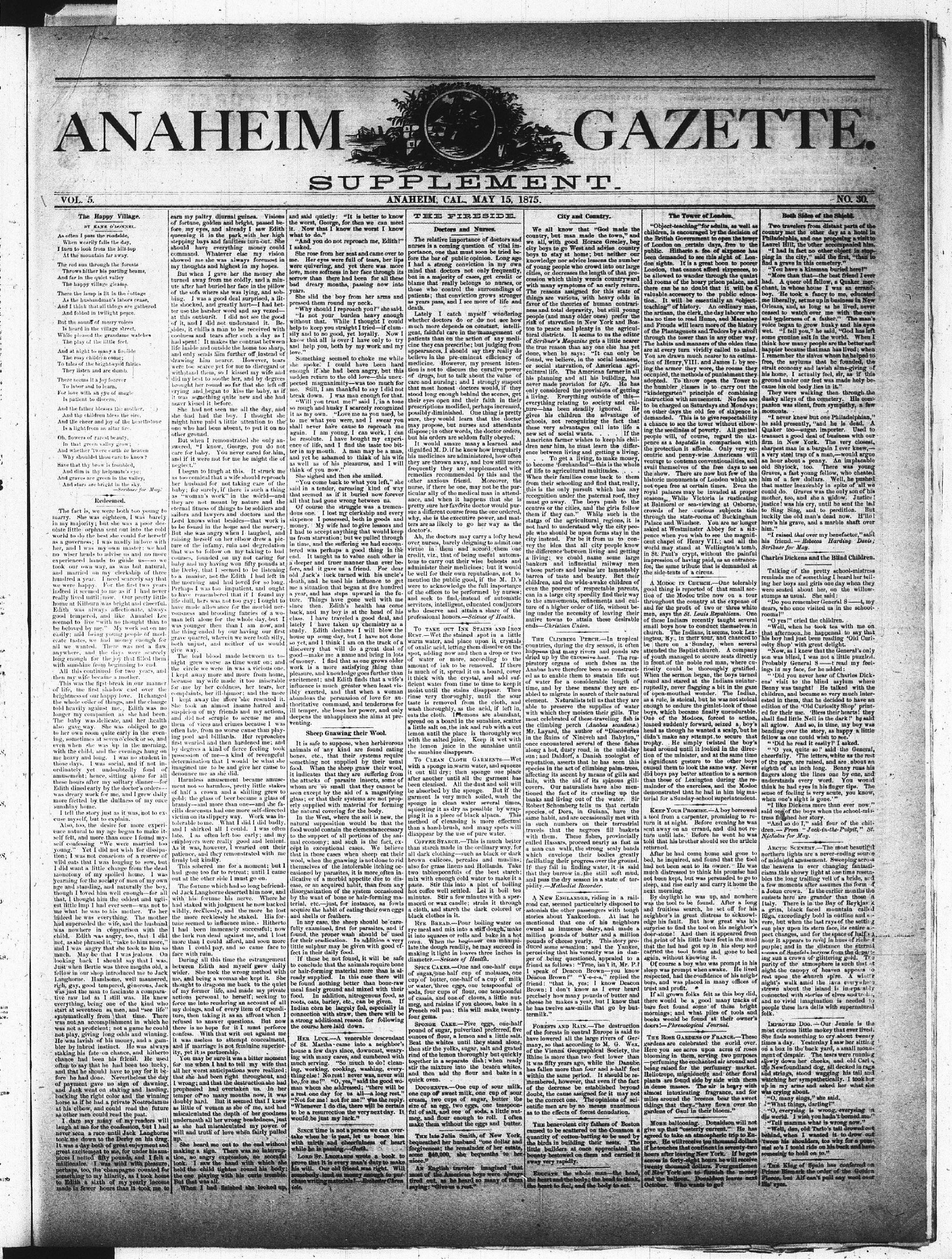
Searchable text
The Happy Village.
BY KANE O'DONNEL.
As often I pass the roadside,
When wearily falls the day,
I turn to look from the hill-top
At the mountain far away.
The red sun through the forests
Throws hither his parting beams,
And far in the quiet valley
The happy village gleams.
There the lamp is lit in the cottage
As the husbandman's labors cease,
And I think that all things are gathered
And folded in twilight peace.
But the sound of merry voices
Is heard in the village street,
While pleased the grandame watches
The play of the little feet.
And at night to many a firelide
The rosy children come;
To tales of the bright-eyed fairies
They listen and are dumb.
There seems it a joy forever
To labor and to learn,
For love with an eye of magic
Is patient to discern.
And the father blesses the mother,
And the children bless the sire.
And the cheer and joy of the heartstone
Is a light from an altar fire.
Oh, flowers of rarest beauty,
In that green valley grow;
And whether 'twere earth or heaven
Why shouldst thou care to know?
Save that thy brow is troubled,
earn my paltry diurnal guinea. Visions of fortune, golden and bright, passed before my eyes, and already I saw Edith queening it in the park with her high stepping bays and faultless turn-out. She should have everything money could command. Whatever else my vision showed me she was always foremost in my thoughts and highest in my hopes.
But when I gave her the money she turned away from me coldly, and a minute after had buried her face in the pillow of the sofa where she was lying, and sobbing. I was a good deal surprised, a little shocked, and greatly hurt—I had better use the harpsher word and say vexed—at this outburst. I did not see the good of it, and I did not understand it. Besides, it chills a man to be received with coolness and tears after such a day as I had spent! It makes the contrast between life inside and outside the home too sharp, and only sends him further off instead of drawing him nearer. However, tears were too scarce yet for me to disregard or withstand them, so I kissed my wife and did my best to soothe her, and by degrees brought her round so far that she left off crying and began to kiss the baby, as if it was something quite new and she had never kissed it before.
She had not seen me all the day, and she had had the boy. I thought she might have paid a little attention to the one who had been absent, to put it on no other ground.
But when I remonstrated she only answered, "I know, George, you do not care for baby. You never cared for him, and if it were not for me he might die of neglect."
and said quietly: "It was the worst, George, for that what to do."
"And you do not reproach me." She rose from her seat me. Her eyes were full; were quivering, and yet love, more softness in her sorrow than there had bad dreary months, p years.
She slid the boy from pressed them round my head. "Why should I reproach you? Is not your burden without that. While I help to keep you straight sily and to no good, yet know that all is over-I and help you, both by love."
Something seemed to she spoke. I could enough if she had been sudden return to the oldpected magnanimity—me. Still, I am thankful break down. I was maid. "Will you trust me?" So rough and husky I scratched it as my own. "Love me to me what you were, shall never have caused again. I am young, I be resolute. I have beenence of life, and I find in my mouth. A man and yet be ashamed to as well as of his plea think of you now."
There seems it a joy forever
To labor and to learn,
For love with an eye of magic
Is patient to discern.
And the father blesses the mother,
And the children bless the sire,
And the cheer and joy of the heartstone
Is a light from an altar fire.
Oh, flowers of rarest beauty,
In that green valley grow;
And whether 'twere earth or heaven
Why shouldst thou care to know?
Save that thy brow is troubled,
And dim is thy helpmate's eye;
And graves are green in the valley,
And stars are bright in the sky.
—Scribner for May:
Redeemed.
The fact is, we were both too young to marry. She was eighteen, I was barely in my majority; but she was a poor desolate little orphan sent out into the cold world to do the best she could for herself as a governess; I was madly in love with her, and I was my own master; we had no wiser heads to advise us and no more experienced hands to guide us—so we took our own way, as was but natural, and married on my clerkship of three hundred a year. I need scarcely say that we were happy. For the first two years indeed it seemed to me as if I had never really lived until now. Our pretty little home at Kilburn was bright and cheerful. Edith was always affectionate, always good tempered, and like Annabel Lee seemed to live "with no thought than to be beloved by me." My work sat on me easily; and being young people of moderate tastes, we had money enough for all we wanted. There was not a flaw anywhere, and the days were scarcely long enough for the joy that filled them with sunshine from beginning to end.
All this continued for two years, and then my wife became a mother.
This was the first break in our manner of life, the first shadow cast over the brightness of our happy love. It changed the whole order of things, and the change told heavily against me. Edith was no longer my companion as she had been. The baby was delicate, and her health also gave way. She was obliged to go to her own room quite early in the evening, sometimes at seven o'clock or so, and even when she was up in the morning, with the child, and the evenings hung on me heavy and long. I was no student in those days. I was social, and if not ordinately yet undoubtedly fond of amusement; hence, sitting alone for all these hours after my solitary dinner—for Edith dined early by the doctor's orders—was dreary work for me, and I grew daily more fretted by the dullness of my once sunshiny home.
I tell the story just as it was, not to excuse myself, but to explain.
Also, too, the desire for more experience natural to my age began to make itself felt, and more than once I found myself confessing "We were married too young." Yet I did not wish for dissipation; I was not conscious of a reserve of wild oats that I was longing to sow, but I did want a little change from the dead monotony of my spoiled home. I was yearning for the society of men of my own age and standing, and naturally the boy,
withstand them, so I kissed my wife and did my best to soothe her, and by degrees brought her round so far that she left off crying and began to kiss the baby, as if it was something quite new and she had never kissed it before.
She had not seen me all the day, and she had had the boy. I thought she might have paid a little attention to the one who had been absent, to put it on no other ground.
But when I remonstrated she only answered, "I know, George, you do not care for baby. You never cared for him, and if it were not for me he might die of neglect."
I began to laugh at this. It struck me as too comical that a wife should reproach her husband for not taking care of the baby; for surely, if there is such a thing as "woman's work" in the world—and they are not meant by nature and the eternal fitness of things to be soldiers and sailors and lawyers and doctors and the Lord knows what besides—that work is to be found in the hope and the nursery.
She was angry when I laughed, and raising herself on her elbow drew a picture of the infamy, ruin and degradation that was to follow on my taking to bad courses, founded on my not caring for baby and my having won fifty pounds at the Derby, that I seemed to be listening to a manic, not the Edith I had left in the morning and had loved for so long. Perhaps I was too impatient, and ought to have remembered that if I found my life dull, hers was not too gay; I ought to have made allowance for the morbid nervousness and brooding fancies of a woman left alone for the whole day, but I was younger then than I am now, and the thing ended by our having our first grave quarrel, wherein we were both silly, both unjust, and neither of us would give way.
The bad blood made between us tonight grew worse as time went on; and the circle we were in was a vicious one. I kept away more and more from home because my wife made it too miserable for me by her coldness, her tears, her complaints, her ill-harmor; and the more I kept away the more she resented it. She took an almost insane hatred and suspicion of my friends and my actions, and did not scruple to accuse me and them of vices and crimes because I was often late, from no worse cause than playing pool and billiards. Her reproaches first wearied and then hardened me; and by degrees a kind of fierce feeling took possession of me—a kind of revengeful determination that I would be what she imagined me to be and give her cause to denounce me as she did.
Harmless amusement became amusement not so harmless, pretty little stakes of half a crown and a shilling grew to gold; the glass of beer became a glass of brandy—and more than one—and she facils desecensus had one more self-directed victim on its slippery way. Work was tolerable to me. What I did I did badly, and I shirked all I could. I was often late. I as often left too early; and my employers were really good and lenient. As it was, however, I weared out their patience, and they remonstrated with me firmly but kindly.
This sobered me for a moment; but I had gone too far to retreat; until I came out at the other side I must go on.
The fortune which had so long befriend-
enough if she had been sudden return to the old pected magnanimity—me. Still, I am thankful break down. I was maid.
"Will you trust me?" so rough and husky I see it as my own. "Love me to me what you were," shall never have caused again. I am young, I be resolute. I have been ence of life, and I find ter in my mouth. A maid yet and be ashamed to do as well as of his please think of you now."
She sighed and then said: "You come back to you said in a tender caress that seemed as if it be all that had gone wrong.
Of course the struggle doubles one. I lost my cleopse sixpence I possessed, but money. My wife had to. I had to accept anything us from starvation; but in time, and the suffering tered was perhaps a gend end. It taught us to wear a deeper and truer man fore, and it gave us a fine old Jack's luck turned death, and he used his face a situation that began a year, and has steps up ture. Things have gone since then. Edith's back, and my boy is at class. I have traveled lately I have taken up study. Edith declares house up some day, but so yet, and I think I am discovery that will do good—make me a name of money. I find that any work is a more satisfactory pleasure,and knowledge excitement;and Edith influence is much greater exerted,and that abandons the persuasion thoritative command,a ill temper,she loses her deepens the unhappiness venting.
Sheep Gnawing
It is safe to suppose, we animals of any kind are bones, etc., that their something not supplied food. When the sheep pelt it indicates that they are the attacks of parasite whom are so small that seen except by the aid of glass; or that their system supply with matter the natural covering for them.
In the West, where the natural supposition was food would contain the eater to the support of all poorest economy; and suchcept in exceptional case that in those cases when wool, when the gnawing themselves of the intolerant casioned by parasites,它 dicative of a morbid apa case,或 an acquired habi
was dreary work for me, and I grew daily more fretted by the dullness of my once sunshiny home.
I tell the story just as it was, not to excuse myself, but to explain.
Also, too, the desire for more experience natural to my age began to make itself felt, and more than once I found myself confessing "We were married too young." Yet I did not wish for dissipation; I was not conscious of a reserve of wild oats that I was longing to sow, but I did want a little change from the dead monotony of my spoiled home. I was yearning for the society of men of my own age and standing, and naturally the boy, though I loved him well enough—for all that, I thought him the oddest and ugliest little imp I had ever seen—was not to me what he was to his mother. To her indeed he was everything. The mother had superseded the wife, and the husband was nowhere in comparison with the child. Edith was angry, too, that I did not, as she phrased it, "take to him more," and I was angry that she took to him so much. May be that I was jealous. On looking back I should say that I was. Just when Bertie was three months old, a fellow in our shop introduced me to Jack Langhorne. Handsome, well mannered, rich, gay, good tempered, generous, Jack was just the man to fascinate a comparative raw lad as I still was. He knew everything, being one of the kind who start at seventeen as men, and "see life" systematically from that time. There was not an accomplishment in which he was not a proficient; not a game he could not play, giving long odds and winning. He was lavish of his money, and a gambler by inbred instinct. He was always staking his fate on chance, and hitherto chance had been his friend. He used often to say that he had been too lucky, and that he should have to pay for it before he had done. Nevertheless the day of payment gave no sign of dawning, and Jack went on staking and landing, backing the right color and the winning horse as if he had a private Nostrodamus at his elbow, and could read the future as other men could read the past.
I dare say many of my readers will laugh at me for the confession, but I had never seen a race until Jack Langhorne took me down to the Derby on his drag. It was a day both of great enjoyment and great excitement to me, for under his auspices I netted fifty pounds, and I felt a millionaire. I was wild with pleasure, perhaps, too, the champagne counted for something to my hilarity, as I took home to Edith a sixth of my yearly income made in fewer hours than it took me to
of half a crown and a shilling grew to gold; the glass of beer became a glass of brandy—and more than one—and she facillis descensus had one more self-directed victim on its slippery way. Work was intolerable to me. What I did I did badly, and I shirked all I could. I was often late. I as often left too early; and my employers were really good and lenient. As it was, however, I wearied out their patience, and they remonstrated with me firmly but kindly.
This sobered me for a moment; but I had gone too far to retreat; until I came out at the other side I must go on.
The fortune which had so long befriended Jack Langhorne deserted him now, and with his fortune his nerve. Where he had staked with judgment he now backed wildly, recklessly, and the more he lost the more recklessly he staked. His fortune seemed to influence mine. Hitherto I had been immensely successful; now the lurk run dead against me, and I lost more than I could afford, and soon more than I could pay, and so came face to face with ruin.
During all this time the estrangement between Edith and myself grew daily wider. She took the wrong method with me, and being a woman she kept it. She thought to dragoon me back to the quiet of my former life, and made my private actions personal to herself; seeking to force me into rendering an account of all my doings, and of every item of expenditure, then taking it as an affront when I refused to answer questions. But now there is no hope for it I must perforce confess. With that writ out against me it was useless to attempt concealment, and if marriage is not feminine superiority, yet it is partnership.
You may be sure it was a bitter moment for me when I had to tell my wife that all her worst anticipations were realized; that she had been right throughout, and I wrong; and that the destruction she had prophesied had overtaken us. In her temper of so many months now, it was doubly hard. But it seemed that I knew as little of women as she of me, and had miscalculated the depth of her goodness underneath all her wrong headedness, just as she had miscalculated my power of will and truth of love when fairly pulled up.
She heard me out to the end without making a sign. There was no interruption, no angry expression, no scornful look. I saw the hand with which she held the child tighten round his body; the one playing with his curls tremble. But that was all.
When I had finished she looked up,
In the West, where the natural supposition would food would contain the support of all poor economic economy; and such except in exceptional cases that in those cases where wool, when the gnawing themselves of the intolleration by parasites, it dicative of a morbid apiece or an acquired habil disorganization of the sex by the want of bone or material, etc.-just, for in acquire the habit of eating and shells or feathers.
In any case, the sheep fully examined first found the proper wash for their eradication. In little sulphur may be givenfect in their daily food.
If these be not found to conclude that the animal or hair-forming materials ready supplied. In this be found nothing better meal finely ground and food. In addition, nitro roots, oats, barley, etc., Indian corn be largely connection with straw, a strong additional reason the course here laid down
HER LUCK.-A vengeous of St. Martha-came in house a few days since ing with many cares,and much serving.“So my ing, working,cooking thing else! No rest! nor be,for me!”“O yes,”man whom she addressed a rest one day for us.“Not for me! not for me.”“Whenever I do die,the to be a resurrection there would be just my luck.
Since time is not a pake take when he is past,h with mirth and cheer while he is passing.-GORD ST. LEONARD'S prove that it is every mans will. Our old friend somebody land us some writing materials here.
IM GAZ
SUPPLEMENT.
ANAHEIM, CAL., MAY 15, 1875.
and said quietly: "It is better to know the worst, George, for then we can meet it. Now that I know the worst I know what to do."
"And you do not reproach me, Edith?" I asked.
She rose from her seat and came over to me. Her eyes were full of tears, her lips were quivering, and yet there was more love, more softness in her face through its sorrow than there had been for all these bad dreary months, passing now into years.
She slid the boy from her arms and pressed them round my neck.
"Why should I reproach you?" she said.
"Is not your burden heavy enough without that. While I thought I could help to keep you straight I tried—if clumsily and to no good, yet loyally. Now I know that all is over I have only to try and help you, both by my work and my love."
Something seemed to choke me while she spoke. I could have been hard enough if she had been angry, but this sudden return to the old love—this unexpected magnanimity—was too much for me. Still, I am thankful to say I did not break down. I was man enough for that.
"Will you trust me?" said I, in a tone so rough and husky I scarcely recognized it as my own. "Love me as you used, be to me what you were, and I swear you shall never have cause to reproach me again. I am young, I can work, I can be resolute. I have bought my experience of life, and I find the taste too bitter in my mouth. A man may be a man, and yet be ashamed to think of his wife as well as of his pleasures, and I will think of you now."
THE FIRESIDE
Doctors and Nurses.
The relative importance of doctors and nurses is a coming question of vital importance, one that must soon be tried before the bar of public opinion. Long ago I had a strong conviction in my own mind that doctors not only frequently, but in a majority of cases, get credit or blame that really belongs to nurses, or those who control the surroundings of patients; that conviction grows stronger as years pass, and I see more of life and death.
Lately I catch myself wondering whether doctors do or do not see how much more depends on constant, intelligent, faithful care in the management of patients than on the action of any medicine they can prescribe; but judging from appearances, I should say they really do believe in the pre-eminent efficiency of medicine. However, my present intention is not to discuss the curative power of drugs, but to talk about the value of care and nursing; and I strongly suspect that most honest doctors would, if they stood long enough behind the scenes, get their eyes open and their faith in their prescriptions modified, perhaps increased, possibly diminished. One thing is pretty sure, they would learn that the doctor may propose, but nurses and attendants dispose; in other words, the doctor orders, but his orders are seldom fully obeyed.
It would amaze many a learned and dignified M.D. if he knew how irregularly his medicines are administered, how often they are thrown away, and how still more frequently they are supplemented with City and Country.
We all know that "God made the country, but man made the town," and we all, with good Horace Greeley, beg city boys to go West and advise country boys to stay at home; but neither our knowledge nor advice lessens the number of young people who crowd into our large cities, or decreases the length of that procession which thinly wends countryward with many symptoms of an early return. The reasons assigned for this state of things are various, with heavy odds in favor of the theories of human contrariiness and total deprivation, but still young people (and many older ones) prefer the risk of starvation in New York and Boston to peace and plenty in the agricultural districts. It seems to us the editor of Scribner's Magazine gets a little nearer the true reason than any one else has yet done, when he says: "It can only be found, we believe, in the social leanness, or social starvation, of American agricultural life. The American farmer in all his planning and all his building, has never made provision for life." He has only considered the provisions of getting a living. Everything outside of this—everything relating to society and culture—has been steadily ignored. He gives his children the advantage of schools, not recognizing the fact that these very advantages call into life a new set of social wants.
If the American farmer wishes to keep his children near him, he must learn the difference between living and getting a living. To get a living, to make money, to become 'forehanded'—this is the whole life of his children.
"The object of children is the British public. He been demanded London, to be allowed old rooms there can valuable attention. It will teaching," the artisan has no time and Fround of the Plan through the habitats are at ever You are drawn to her ringing the arm occupied, adopted. The humble "kindergarden instruction to be charged on other days demanded. a chance to ing the seen people will pence as a protection centric and venture to avail them."
enough if she had been angry, but this sudden return to the old love—this unexpected magnanimity—was too much for me. Still, I am thankful to say I did not break down. I was man enough for that.
"Will you trust me?" said I, in a tone so rough and husky I scarcely recognized it as my own. "Love me as you work, be to me what you were, and I swear you shall never have cause to reproach me again. I am young, I can work, I can be resolute. I have bought my experience of life, and I find the taste too bitter in my mouth. A man may be a man, and yet be ashamed to think of his wife as well as of his pleasures, and I will think of you now."
She sighed and then she smiled.
"You come back to what you left," she said in a tender, caressing kind of way that seemed as if it buried now forever all that had gone wrong between us.
Of course the struggle was a tremendous one. I lost my clerkship and every sixpence I possessed, both in goods and money. My wife had to give lessons and I had to accept anything that would keep us from starvation; but we pulled through in time, and the suffering we had encountered was perhaps a good thing in the end. It taught us to value each other in a deeper and truer manner than ever before, and it gave us a friend. For dear old Jack's luck turned with his uncle's death, and he used his influence to get me a situation that began at five hundred a year, and has steps upward in the future. Things have gone well with me since then. Edith's health has come back, and my boy is at the head of his class. I have traveled a good deal, and lately I have taken up chemistry as a study. Edith declares I will blow the house up some day, but I have not done so yet, and I think I am on the track of a discovery that will do a great deal of good—make me a name and bring in lots of money. I find that as one grows older work is a more satisfying thing than pleasure, and knowledge goes further than excitement; and Edith finds that a wife's influence is much greater when least visibly exerted, and that when a woman abandons the persuasion of love for authoritative command, and tenderness for ill temper, she loses her power, and only deepens the unhappiness she aims at preventing.
Sheep Gnawing their Wool.
It is safe to suppose, when herbivorous animals of any kind are found eating bones, etc., that their systems require something not supplied by their usual food. When the sheep gnaw their wool, it indicates that they are suffering from the attacks of parasite insects, some of whom are so small that they cannot be seen except by the aid of a magnifying glass; or that their systems are not properly supplied with material for forming the natural covering for the body.
In the West, where the soil is new, the natural supposition would be that the food would contain the elements necessary to the support of all portions of the animal economy; and such is the fact, except in exceptional cases. We believe that in those cases when sheep eat their wool, when the gnawing is not done to rid themselves of the intolerable itching occasioned by parasites, it is more often indicative of a morbid appetite due to disease, or an acquired habit, than from any
To take out Ink Stains and Iron Rust. — Wet the stained spot in a little warm water, and place upon it crystals of oxalic acid, letting them dissolve on the spot, adding now and then a drop or two of water or more, according to the amount of ink to be removed. If there is much of it, spread it on a board, cover it thick with the crystal, and add sufficient water from time to time to keep it moist until the stains disappear. Then rinse very thoroughly, until the sour taste is removed from the cloth, and wash thoroughly, as the acid, if left in, eats the cloth. If emons are abundant, spread on a board in the sunshine, scatter a little salt on the ink and rub with a cut lemon until the place is thoroughly wet with the salted juice. Keep it wet with the lemon juice in the sunshine until the sunshine disappears.
To clean Cloth Garments — Wet with a sponge in warm water, and squeeze it out till dry; then sponge one place after another until all the garment has been cleaned. All the dust and soil will be absorbed by the sponge. But if the garment is very much soiled, wash the sponge in clean water several times, squeezing it as dry as possible by wrapping it in a piece of black alpaca. This method of cleansing is more effectual than a hand-brush, and many spots will disappear by the use of pure water.
Coffee Starch — This is much better than starch made in the ordinary way, for all dark clothing—such as black or dark brown calcoes, percales and muslins; also for grass linens and Hollands. Take two tablespoonfuls of the best starch; mix with enough cold water to make it a paste. Stir this into a pint of boiling cultural life. The American farmer in all his planning and all his building, has never made provision for life. He has only considered the provisions of getting a living. Everything outside of this everything relating to society and culture—has been steadily ignored. He gives his children the advantage of schools, not recognizing the fact that these very advantages call into life a new set of social wants. If the American farmer wishes to keep his children near him, he must learn the difference between living and getting a living.
To get a living, to make money, to become forehanded — this is the whole life to agricultural multitudes.
When their families come back to them from their schooling and find that, really, this is the only pursuit which has any recognition under the paternal roof, they must go away. The boys push to the centres or the cities, and the girls follow them if they can. While such is the status of the agricultural regions, it is not hard to understand why the city people who should be upon farms stay in the city instead. Far be it from us to convey the idea that all city people know the difference between living and getting a living; we could name some large bankers and influential railway men whose parlors and brains are lamentably barren of taste and beauty. But their children, and the wide-awake children of even the poorest of respectable parents, can in a large city speedily find their way to the amusements, refinements and culture of a higher order of life, without being under the necessity of leaving their native towns to attain these desirable ends — Christian Union.
The Climbing Perch — In tropical countries, during the dry season, it often happens that many rivers and ponds are dried up by the excessive heat. The respiratory organs of such fishes as the Anabas have therefore been so constructed as to enable them to sustain life out of water for a considerable length of time, and by these means they are enabled to migrate in search of their natural element. Naturalists tell us that they are able to preserve the supplies of water with which they moisten their gills. The most celebrated of these traveling fish is the climbing perch (Anabas scandens). Mr. Layard, the author of "Discoveries in the Ruins of Nineveh and Babylon," once encountered several of these fishes along a hot, dusty road, in the mid-day sun; and Daldorf, a Danish zoologist of reputation, asserts that he has seen this species in the act of climbing palm-trees, affecting its ascent by means of gills and tails, with the aid of its spinous gill-covers. Our naturalists have also mentioned the fact of its crawling up the banks and living out of the water. Sir Robert Schomberg tells us that certain species of Dora, in Guiana, have same habit, and are occasionally met with in such numbers on their terrestrial travels that the negroes fill baskets with them. These fishes, provincially called Hassars, proceed nearly as fast as a man can walk, the strong scaly bands which envelope their bodies greatly facilitating their progress over the ground. If they fail in finding water, it is said that they burrow in the still soft mud, and pass the dry season in a state of torpidity. — Methodist Recorder.
seen except by the aid of a magnifying glass; or that their systems are not properly supplied with material for forming the natural covering for the body.
In the West, where the soil is new, the natural supposition would be that the food would contain the elements necessary to the support of all portions of the animal economy; and such is the fact, except in exceptional cases. We believe that in those cases when sheep eat their wool, when the gnawing is not done to rid themselves of the intolerable itching occasioned by parasites, it is more often indicative of a morbid appetite due to disease, or an acquired habit, than from any disorganization of the system occasionally by the want of bone or hair-forming material, etc.—just, for instance, as fowls acquire the habit of eating their own eggs and shells or feathers.
In any case, the sheep should be carefully examined, first for parasites, and if found, the proper wash should be used for their eradication. In addition a very little sulphur may be given with good effect in their daily food.
If these be not found, it will be safe to conclude that the animals require bone or hair-forming material more than is already supplied. In this case there will be found nothing better than bone-raw meal finely ground and mixed with their food. In addition, nitrogenous food, as roots, oats, barley, etc., can be given. If Indian corn be largely fed, especially in connection with straw, then there will be a strong additional reason for following the course here laid down.
HER LUCK.—A venerable descendant of St. Martha came into a neighbor's house a few days since, downcast, wearying with many cares, and cumbered with much serving. "So much to do! cleaning, working, cooking, washing, everything else! No rest! never was, never will be, for me!" "O, yes," said the good woman whom she addressed; "there will be a rest one day for us all—a long rest." "Not for me! not for me!" was the reply. "Whenever I do die, there will be certain to be a resurrection the very next day. It would be just my luck."
SIXCE time is not a person we can overtake when he is past, let us honor him with mirth and cheerfulness of heart while he is passing—Geoth.
LORD ST. LOUISARDS wrote a book to prove that it is every man's duty to make his will. Our old friend was right. Will somebody lend us money enough in purchase writing materials!—Enoch Chronicle.
COFFEE STARCH.—This is much better than starch made in the ordinary way, for all dark clothing—such as black or dark brown calicoes, percales and muslins; also for grass linens and Hollands. Take two tablespoonfuls of the best starch; mix with enough cold water to make it a paste. Stir this into a pint of boiling hot coffee well settled. Let it boil ten minutes. Stir a few minutes with a spermaceti or wax candle; strain it through a cloth, and starch the dark colored or black clothes in it.
RYE BREAD.—Pour boiling water on rye meal and mix into a stiff dough; make it into squares or rolls and bake in a hot oven. When the beginner can manipulate the dough readily, he may succeed in making it light in loaves three inches in diameter.—Science of Health.
SPICE CAKES.—One and one-half cups of sugar, one-half cup of molasses, one cup of butter, one-half of a cup of milk or water; three eggs, one teaspoonful of soda, four cups of flour, one teaspoonful of cassia, and one of cloves, a little nutmeg, and raisins if you choose, bake in a French roll pan; this will make twenty-four gems.
SPONGE CAKE.—Five eggs, one-half pound of sugar, pulverized preferred, five ounces of flour, a lemon and a little salt. Beat the whites until they stand alone, then stir the yolks, sugar, salt and grated rind of the lemon thoroughly but quickly together in a separate dish; when ready stir the mixture into the beaten whites, and then add the flour and bake in a quick oven.
DOUGHXUTS.—One cup of sour milk, one cup of sweet milk, one cup of sour cream, two cups of sugar, butter the size of an egg, two eggs, one teaspoonful of salt, and one of soda, a little nutmeg, and flour enough to roll. I often make them without the eggs and butter.
THE late Julia Smith, of New York, bequeathed her husband "one dollar and forgiveness; the remainder of her estate, some $40,000," she bequeaths to her niece."
An English traveler imagined that most of the American boys were always tired out, as he heard so many of them saying: "Give us a rest."
FORESTS AND RAIN.—The destruction of the forests in central Europe is said to have lowered all the large rivers of Germany, so that according to M. G. Wex, of the Vienna Geographical Society, the Rhine is more than two feet lower than it was fifty years ago, while the Danube has fallen more than four and a half feet within the same period. It should be remembered, however, that even if the fact of the decrease be established beyond doubt, the cause assigned for it may not be correct one. The opinions of scientific men are by no means unanimous as to the effects of forest denudation.
THE benevolent city fathers of Boston caused to be scattered on the Common a quantity of cotton-batting to be used by the birds in building their nests. The little builders at once appreciated the bounty bestowed on them and carried it away very rapidly.
EDUCATE THE WHOLE MAN—the head, the heart and the body; the head to feel, and the body to act.
KEEP YOU A TOOL FROM IT AT A SENT UNTIL TIME TOLD THAT HE RETURNED.
After he beded he included not been disturbed not been kept sleep and next morning.
By daylight was the tool and fruiting neighbor's edge his face surprised to door-stone his print on that last carried them again.
Of courses sleep was praised being raised Heliotropes plants are in dense mills almost in miles around tidings that gardens of
More books would bore feet mornings; books would doors!—P
THE ROSE gardens are Here you blooming like perfume being raised Heliotropes plants are in dense mills almost in miles around tidings that gardens of
More books would bore feet mornings; books would doors!—P
GAZETTE.
NO. 30.
Country.
God made the town," and since Greeley, beg advise country but neither our sens the number into our large length of that provides countryward an early return. For this state of heavy odds in human contrariety but still young ones) prefer the York and Boston the agriculturist to us the editor is a little nearer one else has yet it can only be social leanness, American agrarian farmer in all its building, has life. He has sessions of getting outside of this—society and culinary ignored. He advantage of the fact that call into life if the to keep his child earn the differ-getting a living. To make money, this is the whole
The Tower of London.
"Object-teaching" for adults, as well as children, is encouraged by the decision of the British Government to open the tower of London on certain days, free to the public. Hitherto a fee of sixpence has been demanded to see this sight of London sights. It is a great boon to poorer London, that cannot afford sixpences, to be allowed to wander through the quiet old rooms of the hoary prison palace, and there can be no doubt that it will be a valuable accessory to the public education. It will be essentially an "object-teaching" of history. An ordinary man, the artisan, the clerk, the day laborer who has no time to read Hume, and Macanlay and Froude will learn more of the history of the Plantagenets and Tudors by a stroll through the tower than in any other way. The habits and manners of the olden time are at every turn vividly called to mind. You are drawn much nearer to an estimation of Henry, VIII. and James I. by seeing the armor they wore, the rooms they occupied, the methods of punishment they adopted. To throw open the Tower to the humbler classes is to carry out the "kindergarten" principle of combining instruction with amusement. No fees are to be charged on Saturdays and Mondays; on other days the old fee of sixpence is demanded. This is to give respectability a chance to see the tower without elbowing the seediness of poverty. All genteel people will, of course, regard the sixpence as a bagatelle in comparison with the protection it affords. Only very eccentric and penny-wise Americans will venture to contemn conventionalities, and avail themselves of the free days to see
Both sides of the Shield.
Two travelers from distant parts of the country met the other day at a hotel in Philadelphia, and one proposing a visit to Laurel Hill, the other accompanied him.
"I had in fact no other object in stopping in the city," said the first, "than to find a grave in this cemetery."
"You have a kinaman buried here!"
"More than that—the best friend I ever had. A queer old fellow, a Quaker merchant, in whose house I was an errand-boy. He took a fancy to me, educated me liberally, set me up in business in New Orleans, and, as long as he lived, never ceased to watch over me with the care and tenderness of a father." The man's voice began to grow huaky and his eyes wet. "I tell you," he said, "God has left some genuine salt in the world. When I think how many people are the better and happier because that man has lived; when I remember the slaves whom he helped to free, the asylums that he founded, the strait economy and lavish alms-giving of his home, I actually feel, sir, as if this ground under our feet was made holy because his old body lies in it."
They were walking then through the dusky alleys of the cemetery. His companion was silent, from sympathy, a few moments.
"I never knew but one Philadelphiaian," he said presently, "and he is dead. A Quaker too—sugar importer. Used to transact a good deal of business with our firm in New York. The very closest, sharpest man in a bargain I ever knew—a very steel trap of a man—would argue an hour about a penny. An implacable old Shylock, too. There was young
In tropical season, it often and ponds are heat. The resilient fishes as the men so construct sustain life outable length of us they are en- of their natural us that they are supplies of water their gills. The travelling fish is (abas scandens.) of "Discoveries and Babylon," of these fishes on the mid-day zoologist of he has seen this bring palm-trees, mans of gills and spinous gillave also men-cawling up the water. Sirius that certain Iiana, have the romally met with their terrestrial fills baskets, provincially nearly as fast as long scaly bands bodies greatly over the ground, water, it is said still soft mud, as a state of tor-
A Modoc in Church.—One tolerably good thing is reported of that small section of the Modoc tribe now on a tour throughout the country at the expense of and for the profit of two or three white men, says the St. Louis Republican. One of these Indians recently taught several small boys how to conduct themselves in church. The Indians, it seems, took Lexington, Ky., in their tour, and chanced to be there on a Sunday, when several attended the Baptist church. A company of youth managed to secure seats directly in front of the noble red man, where curiosity could be thoroughly gratified. When the sermon began, the boys turned round and stared at the Indians uninterruptedly, never flagging a bit in the gaze of open-mouthed wonder. The Indian, as a rule, is stoical, but he was not stoical enough to endure the gimlet-look of those boys, which became finally unendurable. One of the Modocs, forced to action, leaned suddenly forward, seized a boy's head as though he wanted a scalp, but he didn't make any attempt to secure that trophy. He simply twisted the boy's head around until it looked in the direction of the minister, and at the same time a significant gesture to the other boys caused them to look the same way. Never did boys pay better attention to a sermon than those of Lexington during the remainder of the exercises, and the Modoc demonstrated that he had in him big material for a Sunday-school superintendent.
Keep Your Promise.—A boy borrowed a tool from a carpenter, promising to return it at night. Before evening he was sent away on an errand, and did not return until late. Before he went he was told that his brother should see the article returned.
After he had come home and gone to bed, he inquired, and found that the tool had not been sent to its owner. He was much distressed to think his promise had not been kept, but was persuaded to go to sleep, and rise early and carry it home his home, I actually feel, sir, as if this ground under our feet was made holy because his old body lies in it."
They were walking then through the duaky alleys of the cemetery. His companion was silent, from sympathy, a few moments.
"I never knew but one Philladelphian," he said presently, "and he is dead. A Quaker too—sugar, importer. Used to transact a good deal of business with our firm in New York. The very closest, sharpest man in a bargain I ever knew,—a very steel trap of a man,—would argue an hour about a penny. An implacable old Shylock, too. There was young Graves, a fast young fellow, who cheated him of a few dollars. Well, he pushed that matter inexorably in spite of 'all we could do. Graves was the only son of his mother, too, and she a widow. Justice! justice! was his cry, until he sent the lad to Sing Sing, and to perdition. But luckily the old man's dead now. H'll! here's his grave, and a marble shaft over him."
"I raised that over my benefactor," said his friend.—Rebecca Harding Davis; Scribner for May.
Charles Dickens and the Blind Children.
Talking of the pretty school-mistress reminds me of something I heard her telling her boys and girls one day when they were seated about her, on the willow-stumps as usual. She said:
"Do you remember General S——t, my dears, who once visited us in the school-rooms?"
"O yes!" cried the children.
"Well, when he took tea with me on that afternoon, he happened to say that his boy had just been reading 'Old Curiosity Shop' with great delight.
"Now, as I knew that the General's only son was blind, I was not a little puzzled. Probably General S——t read my feelings in my face, for he added:
"'Did you never hear of Charles Dickens' visit to the blind asylum where Benny was taught? He talked with the children, and became so very much interested in them, that he decided to have an edition of the 'Old Curiosity Shop' printed for their use. 'Bless their hearts! they shall find little Nell in the dark.'' he said all aglow. And so, in time, my boy was bending-over the story, as happy a little fellow as one could wish to see."
"'Did he read it easily?' I asked.
"O yes, quite so!" said the General, cheerfully. 'The letters, white as the rest of the page, are raised, and are about an eighth of an inch long. Benny runs his fingers along the lines one by one, and understands every word. You would think he had eyes in his finger tips. The sense of feeling is very acute, you know, when one's sight is gone.'"
"I like Dickens more than ever now." said one of the boys when the school-mistress finished her story.
"And so do I," said four of the children.—From "Jack-in-the-Pulpit," St. Nicholas for May.
Arctic Scenery.—The most beautiful northern lights are a never-ending source of midnight amusement. Sweeping across the heavens in ever changing fantasisms this showy light at one time resembles the long trailing veil of a bride, and a few moments after assumes the form of
KEEP YOUR PROMISE.—A boy borrowed a tool from a carpenter, promising to return it at night. Before evening he was sent away on an errand, and did not return until late. Before he went he was told that his brother should see the article returned.
After he had come home and gone to bed, he inquired, and found that the tool had not been sent to its owner. He was much distressed to think his promise had not been kept, but was persuaded to go to sleep, and rise early and carry it home the next morning.
By daylight he was up, and nowhere was the tool to be found. After a long and fruitless search, he set off for his neighbor's in great distress to acknowledge his fault. But how great was his surprise to find the tool on his neighbor's door-stone! And then it appeared from the print of his little bare feet in the mud that the lad had got up in his sleep and carried the tool home and gone to bed again, without knowing it.
Of course a boy who was prompt in his sleep was prompt when awake. He lived respected, had the confidence of his neighbors, and was placed in many offices of trust and profit.
If all grown folks felt as this boy did, there would be a good many tracks of bare feet found some of these bright mornings; and what piles of tools and books would be found at their owner's doors!—Phrenological Journal.
THE ROSE GARDENS OF FRANCE.—These gardens are celebrated the world over. Here you see acres upon acres of roses blooming in them, serving two purposes—perfuming the enchanted air around and being raised for the perfumery market. Heliotrope, magnifionette and other floral plants are found side by side with them in dense masses. The air is heavy with almost intoxicating fragrance, and for miles around the breezes bear the sweet tidings that they—"have flown over the gardens of Gaul in their bloom."
More ballooning. Donaldson will not give up that "castlerly current." He has agreed to take an atmospheric trip to Europe. He will receive ten thousand dollars if he touches that continent in seventy-two hours after leaving New York. If he gets across in forty-eight hours he will receive twenty thousand dollars. Fourgentlemen of New York are to furnish the money and the balloon. Donaldson leaves next October. Who wants to go?
ARCTIC SCENERY.—The most beautiful northern lights are a never-ending source of midnight amusement. Sweeping across the heavens in ever changing fantasisms this showy light at one time resembles the long trailing veil of a bride, and a few moments after assumes the form of a Jotun crown. In the earlier months the sunsets here are grander than those in Italy. There is in the Bay of Roykjavik a grim, black faced mountain called Riga, exceedingly bold in outline and severe, but when the last rays of the setting sun play upon its stern face, its entire aspect changes, and for the space of half an hour it appears to revel in hues of rich purple; and in the distance the eternal snows of Snefalsa borrow from the departing sun a crown of glittering gold. The purity of the atmosphere is such that at night the canopy of heaven appears to rest upon the church spire. A winter night's walk amid the lava everywhere strewn about the island is especially connected with stories of elves and frogs, and no vivid imagination is needed to people these lava dells with supernatural folk.
IMPROVED DOG.—Our Jennie is the most curious little mokey that ever lived. She finds something to cry about twenty times a day. Yesterday I saw her sitting on a box in the back yard, a small monument of despair. The tears were running slowly down her cheeks, and old Carla, the Newfoundland dog, all decked in rags and strings, stood wagging his tail and watching her sympathetically. I took her up in my arms and asked her what she was crying about.
"O, many sings," she said.
"What things, darling?"
"O, everything is wrong, everything in this world. I wish you hadn't born me."
"Tell mamma what is wrong now."
"Well, den, old Tarlo's tail drowned out behind, when I wanted it to drow out 'tween his shoulders, too why for a pennal so's I tould ride on his back and have somning to hold on to."
The King of Spain has conferred on Princess Bismark the order of the Golden Fleece, but Alf can't pull any wool over His eyes.