anaheim-gazette 1875-05-15
Scanned page
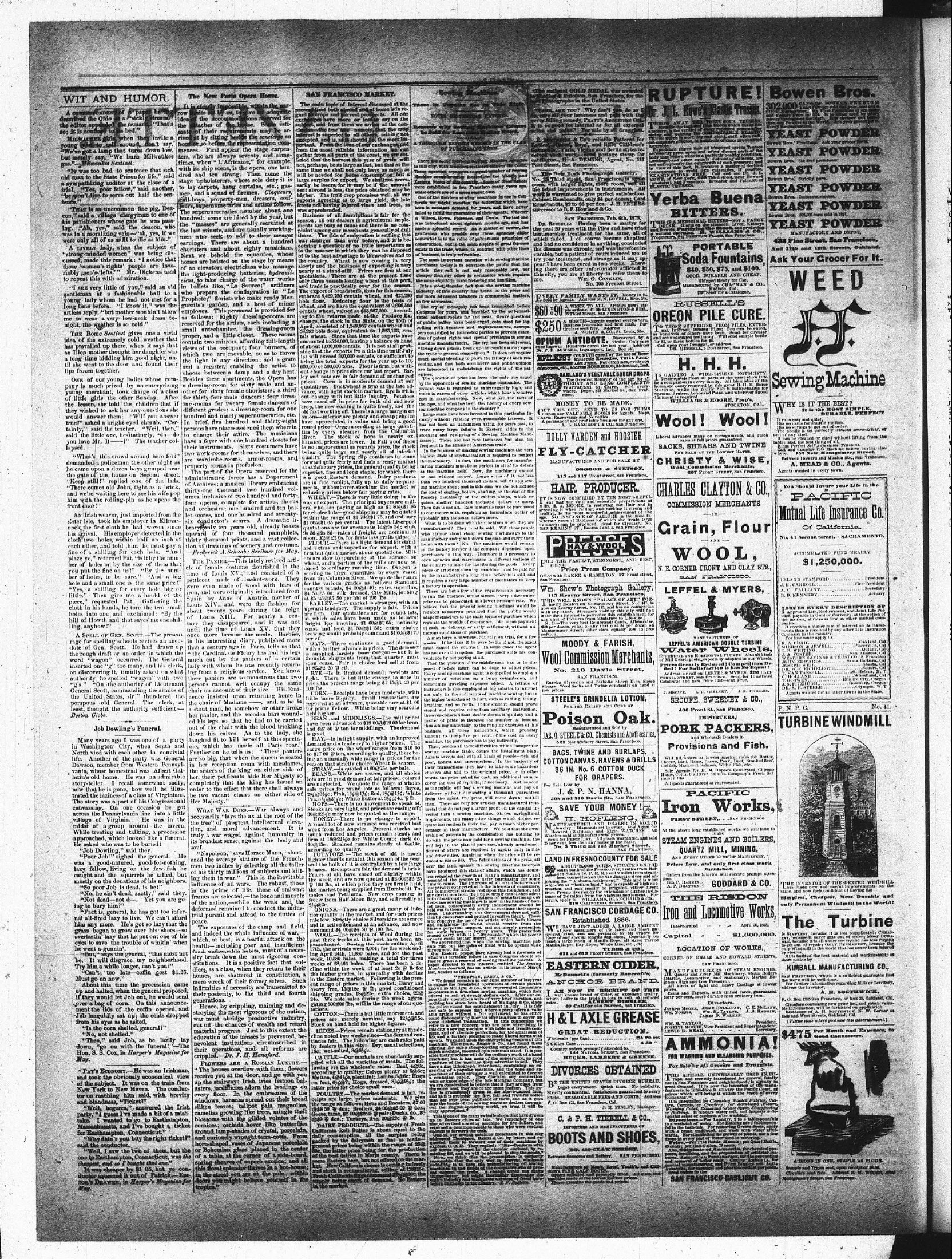
Searchable text
WIT AND HUMOR.
A commandment of a paper having described the Ohio as a "sickly stream," the editor appended the remarks: "That's so; it is confined to its bed."
Milwaukee girls, when they invite a young girl to call around, don't say, "We've got a lamp that turns down low, but merely say, 'We burn Milwaukee gas.'"—Milwaukee Sentinel.
"It was too bad to sentence that sick old man to the State Prison for life," said a sympathizing auditor at the close of a trial. "Yes, poor fellow," said another, "he won't live to serve out half the sentence."
"That is an uncommon fine pig, Deacon," said a village clergyman to one of his parishers whose gate he was passing. "Ah, yes," said the deacon, who was in a moralizing vein—"ah, yes, if we were only all of us as fit to die as him."
A lively lady, when the subject of "strong-minded women" was being discussed, made this remark: "I notice that those 'women's rights' people are invariably men's; lefts." Mr. Dickens used to repeat this with admiration.
"I see very little of you," said an old gentleman at a fashionable ball to a young lady whom he had not met for a long time before. "I know it," was the artless reply, "but mother wouldn't allow me to wear a very low-neck dress tonight, the weather is so cold."
The Rome Sentinel gives one a vivid idea of the extremely cold weather that has prevailed up there, when it says that an Ilion mother thought her daughter was a long time bidding him good night, until she went to the door and found their lips frozen together.
One of our young ladies whose company is much prized by an enterprising young merchant, took charge of a class of little girls the other Sunday. After the lesson, she told the children that if they wished to ask her any questions she would answer them. "Will you answer true?" asked a bright-eyed cherub. "Certainly," said the teacher. "Well, then," said the little one, hesitatingly, "do—do you love Mr. B——?"
"The what’s this crowd around here for?" demanded a policeman the other night as he came upon a dozen boys grouped near The New Paris Opera House.
It is clearly impossible within the narrow limits set by us, to give adequate ideas and the accommodations reserved for the balches of the house. Some estimate of their requirements may be arrived at by sitting beside the concierge on homer so before the representation commences. First appear the stage carpenters, who are always seventy, and sometimes, when “L’Africaine,” for example, with its ship scene, is the opera, one hundred and ten strong. Then come the stage upholsterers, whose sole duty it is to lay carpets, hang curtains, etc.; gasmen, and a squad of firemen. Claqueura, call-boys, property-men, dressers, coiffeurs, supernumeraries and artists follow.
The supernumeraries number about one hundred; some are hired by the year, but the “masses” are generally recruited at the last minute, and are usually working men who seek to add to their meager earnings. There are about a hundred choristers and about eighty musicians. Next we behold the equeries, whose horses are hoisted on the stage by means of an elevator: electricians who manage the light-producing batteries; hydrauliciens, to take charge of the water works in ballets like “La Source;” artificers who prepare the conflagration in “Le Prophete;” florists who make ready Marguerite’s garden, and a host of minor employees. This personnel is provided for as follows: Eighty dressing-rooms are reserved for the artists, each including a small antechamber, the dressing-room proper, and a little closet. These rooms contain two mirrors, affording full-length views of the occupant; four burners, of which two are movable, so as to throw the light in any direction; and a grate and a register, enabling the artist to choose between a damp and a dry heat. Besides these apartments, the Opera has a dressing-room for sixty male and another for sixty female choristers; a third for thirty-four male dancers; four dressing-rooms for twenty female dancers of different grades; a dressing-room for one hundred and ninety supernumeraries, etc. In brief, five hundred and thirty-eight persons have places assigned them wherein to change their attire. The musicians have a foyer with one hundred closets for their instruments. Sixty costumers have two work-rooms for themselves, and there are wardrobe-rooms, armor-rooms, and property-rooms in profusion.
SAN FRANCISCO
The main topic of this business of all deserts season; all our dealers' ments are busy as usual; plaint among our merces times. The tide of emigrant than ever coming a question of me to the manner in which of to the best advantage the country. Wheat is slowly and at the business nearly at a stand-still. Quotations. There are only three vessels loaded and trade is practically The export of breadstuff embrace 8,429,700 centils flour. Reducing wheat, and we have the centals wheat, valued in going to the returns must change; the stock in April, consisted of 1,348,582 bells flour, equivalent wheat. Since that amounted to 524,000 leafs of about 1,000,000 centilites that the exports last will exceed 300,000 bring the total export 600,000 or 500,000 tons out change in price since ley and oats are in fall prices. Corn is in quotations. Buckwhatever with light stock out change with but I have eased off in price crop; the new coming old fast working off. The onions—inferior are pay have appreciated in round ties by every steam River. The stock has hauated; prices are low is no improvement as being quite large and quality. The Spring forward quite freely at satisfactory prices.
One of our young ladies whose company is much prized by an enterprising young merchant, took charge of a class of little girls the other Sunday. After the lesson, she told the children that if they wished to ask her any questions she would answer them. "Will you answer true?" asked a bright-eyed cherub. "Certainly," said the teacher. "Well, then," said the little one, hesitatingly, "do—do you love Mr. B——?" The teacher collapsed.
"What's this crowd around here for?" demanded a policeman the other night as he came upon a dozen boys grouped near the gate of the house on Second street. "Keep still!" replied one of the ladies. "There comes old John, tight as a brick, and we're waiting here to see his wife pop him with the rolling-pin as he opens the front door."
An Irish weaver, just imported from the sister isle, took his employer in Kilmarnock the first cloth he had woven since his arrival. His employer detected in the cloth two holes, within half an inch of each other, and told him he must pay a fine of a shilling for each hole. "And plaze ye," returned Pat, "is it by the number of holes or by the size of them that you put the fine on us?" "By the number of holes, to be sure." "And a big hole and a small one is the same price?" "Yes, a shilling for every hole, big or little." Then give me a houl of the piece," requested Pat. Gathering the cloth in his hands, he tore the two small holes into one and exclaimed: "By the hill of Howth and that saves me one shilling, anyhow!"
A Spell of Gen. Scott. —The present rage for spelling schools revives an anecdote of Gen. Scott. He had drawn up the rough draft or an order in which the word "wagon" occurred. The General inserted one "g" too many, and his clerk, on discovering it, timidly asked on what authority he spelled "wagon" with two "g's." "On the authority of Lieutenant General Scott, commanding the armies of the United States, sir!" thundered the pompous old General. The clerk, at least, thought the authority sufficient. Boston Globe.
Job Dowling's Funeral.
Many years ago I was one of a party in Washington City, when South and North vied with each other in convivial life. Another of the party was General Dawson, member from Western Pennsylvania, whose homestead was Albert Gallatin's old home. He was an admirable story-teller. I recall somewhat sadly now that he is gone, how well he illustrated the laziness of a class of Virginians. The story was a part of his Congressional canvassing. On one occasion he got across the Pennsylvania line into a little village of Virginia. He was in the midst of a group around the tavern. While treating and talking, a procession approached, which looked like a funeral. He asked who was to be buried?
"Job Dowling," said they.
"Poor Job!" sighed the general. He was a good-natured, good-for-nothing, lazy fellow, living on the few fish he caught and the squirrels he killed, but mostly on the donations of his neighbors.
"So poor Job is dead, is he?"
Besides these apartments, the Opera has a dressing-room for sixty male and another for sixty female choristers; a third for thirty-four male dancers; four dressing-rooms for twenty female dancers of different grades; a dressing-room for one hundred and ninety supernumeraries, etc. In brief, five hundred and thirty-eight persons have places assigned them wherein to change their attire. The musicians have a foyer with one hundred closets for their instruments. Sixty costumers have two work-rooms for themselves, and there are wardrobe-rooms, armor-rooms, and property-rooms in profusion.
The part of the Opera reserved for the administrative forces has a Department of Archives; a musical library embracing thirty-one thousand two hundred volumes, inclusive of two hundred and forty-four operas, complete for artists, chorus and orchestra; one hundred and ten ballet-scores, and one hundred and seventy-six conductor's scores. A dramatic library only ten years old, already boasts upward of four thousand pamphlets, thirty thousand prints, and a vast collection of drawings of scenery and costume.
Frederick A. Schaehb; Seribner for May.
The Panier. —This lately revived article of female costume flourished in the time of Louis XV., and consisted of a petticoat made of basket-work. They were even made of wood with bars of iron, and were originally introduced from Spain by Anne of Austria, mother of Louis XIV., and were the fashion for about twenty years during the reign of Louis XIII. For nearly a century they disappeared, and it was not until the time of Louis XV. that they once more became the mode. Barbier, in his interesting diary, published more than a century ago in Paris, tells us that "the Cardinal de Fleury has had his legs much cut by the paniers of a certain lady with whom he was recently returning from a religious service. You know these paniers are so monstrous that two persons cannot well occupy the same chair on account of their size. His Emiliace insisted upon returning home in the chair of Madame —— , and, as he is a stout man, he somehow or other broke her panier, and the wooden bars wounded his legs, so that he had to be carried out of the chair with the blood trickling down his calves. As to the lady, she laughed fit to kill herself at this spectacle, which has made all Paris roar." Further on he tells us: "These paniers are so big, that when the queen is seated in her reception room with mesdames, the sisters of the king on either side of her, their petticoats hide Her Majesty so completely that the king has issued an order to the effect that there shall always be two vacant chairs on either side of Her Majesty."
What War Does. —War always and necessarily "lays ax at the root of the tree" of progress, intellectual elevation, and moral advancement. It is truly a war waged against humanity in its broadest sense, against the body and soul.
Napoleon," says Horace Mann, "shortened the average stature of the Frenchmen two inches by selecting all the taller of his thirty millions of subjects and killing them in war." This is the inevitable influence of all wars. The robust, those in prime of life, those of stalwart outchange in price since lay and oats are in fair prices. Corn is in imitation quotations. Buckwhence with light stock out change with but have eased off in price crop, the new coming old fast working off. The onions—inferior are价 have appreciated in a round price—Oregon prices by every steamer River. The stock is haunted; prices are low is no improvement as being quite large and quality. The Spring forward quite freely at satisfactory prices; superior, fine and long is a good Eastern Deare in free receipt; furnishes without over-reducing prices below WHEAT. —There is way of export. The pans who are paying for choice lots—good within the range of $1 60@$1 65 per cent quotations are for availance 92@$98 dd-rates of about £2@$26 sr.for FLOUR. —There is ardent extras and super firm but quiet markets are slow to purse wheat; and a portion duced to ordinary rents from the Columbia Rail for the various grade country brands,$4 0450@$50 per bus BARLEY. —The man upward tendency. There are firm. Our quotes at which sales have Bright Bay browning coast and feed,$1 85@$20 20 etl. RYE. —Is in limit light. There is limit price; the present rate 100 bs.
CORN. —Receipts little more inquiry: reported at an advancer for prime Yellow. W held higher.
BRAN AND MIDDLE have been advanced and $27 50 ton for good.
HAY. —Is in light demand and a tender cargo price on them to $17 00 ton, acceding an unusually wide reason that strictly STRAW. —Is quotation BEANS. —White lots are in good neglected. We sale prices for rout $22@$22 c; Pink,$13@$31 c; White HOPS. —There is stocks are very light 30@$32c may now HONEY. —There is a small lot of new week from Los Angeles much reduced and firm at 18@$22c for 10@15c; Strained according to qualification POTATOES. —Tighter than is usual and the bulk of it houses. Receipts at Prices of old have the week, and are not 100 bs.at which market being lower...
how that he is gone, now well illustrated the laziness of a class of Virginians. The story was a part of his Congressional canvassing. On one occasion he got across the Pennsylvania line into a little village of Virginia. He was in the midst of a group around the tavern. While treating and talking, a procession approached, which looked like a funeral. He asked who was to be buried?
"Job Dowling," said they.
"Poor Job!" sighed the general. He was a good-natured, good-for-nothing, lazy fellow, living on the few fish he caught and the squirrels he killed, but mostly on the donations of his neighbors.
"So poor Job is dead, is he?"
"No, he ain't dead, zactly," said they.
"Not dead—not d—. Yet you are going to bury him?"
"Fact is, general, he has got too infernal all-fired lazy to live. We can't afford him any more. He's got so lazy that the grass began to grow over his shoes—so everlastin' lazy that he put out one of his eyes to save the trouble of winkin' when he went a-gunnin'.
"But," says the general, "this must not be. It will disgrace my neighborhood. Try him a while longer, can't you?"
"Can'; too late—coffin cost $1.25. Must go on now."
About this time the procession came up and halted, when the general proposed, if they would let Job out, he would send over a bag of corn. On this announcement the lids of the coffin opened, and Job languidly sat up; the cents dropped from his eyes as he asked,
"Is the corn shelled, general?"
"No, not shelled."
Then," said Job, as he lazily lay down, "go on with the funeral!"—The Hon. S. S. Cox, in Harper's Magazine for May.
*Pat's Economy.*—He was an Irishman, and took the obviously economical view of the subject. It was on the train from New York to New Haven. The conductor on reaching him said, with brevity and blandness, "Ticket?"
"Well, begurna," answered the Irish party; "I guess I've made a bit of a mishake. I wanted to go to Easthampton, Massachusetts, and I've bought a ticket for Easthampton, Connecticut."
"Why didn't you buy the right ticket?" said the conductor.
"Well, I saw the two of them, but the one to Easthampton, Connecticut, was the cheapest, and so I bought that one."
It was cheaper by $1 05, but ye conductor squeezed it out of Patrick.—Enron's Drawer, in Harper's Magazine for May.
WHAT WAR DOES.—War always and necessarily "lays the ax at the root of the tree" of progress, intellectual elevation, and moral advancement. It is truly a war waged against humanity in its broadest sense, against the body and soul.
"Napoleon," says Horace Mann, "shortened the average stature of the Frenchmen two inches by selecting all the taller of his thirty millions of subjects and killing them in war." This is the inevitable influence of all wars. The robust, those in the prime of life, those of stalwart frames are selected—the bone and muscle of the nation,—while the weak and, the deformed remained to conduct the industrial pursuit and attend to the duties of peace.
The exposures of the camp and field, and indeed the whole influence of war—which, at best, is a fearful attack on the health—including poor and insufficient food, unfavorable habits, must of a necessity break down the most vigorous constitutions. It is a positive fact that soldiers, as a class, when they return to their homes, are shattered in constitution, a mere wreck of their former selves. Such infirmities of necessity are transmitted to their posterity, to the third and fourth generations.
Hence, by crippling, maiming and destroying the most vigorous of the nation, war must abridge productive industry, cut off the chances of wealth and retard material progress. Just to this extent the education of the masses is prevented, benevolent institutions circumscribed in their operations, and all reforms are crippled.—Dr. J. H. Hanaford.
FLOWERS ARE A RUSSIAN LUXURY.
"The houses overflow with them; flowers receive you at the door, and go with you up the stairway; Irish ivies festoon balusters, jardiffieres adorn the landings on every floor. In the embrasures of the windows, bananas spread out their broad silken leaves; tallpot pals, magnolias, camellias growing like trees, mingle their blossoms with the gilded volutes of the cornices; orchids hover like butterflies around lamp-shades of crystal, porcelain, and curiously wrought terra-cotta. From horn-shaped vases of Japanese porcelain or Bohemian glass placed in the center of a table, at the corner of a side-board, spring sheaves of superb exotics; and all this floral splendor thrives in a hot-house; in the street you are at the pole—within doors you might believe yourself in the tropics."
SAN FRANCISCO MARKET.
The main topic of interest discussed at the present time both abroad and at home is in regard to crops and harvest prospects. All our exchanges have more or less any on the subject, and from them we arrive at the conclusion—the true one—namely that the crop interest is superior to all others, mining not excepted, and is, as is should be, the most important. From the tone of our exchanges, and from the most reliable information we can gather from all parts of the coast, we are satisfied that the harvest this year of grain will not, perhaps, be as large as last, but that at the same time we shall not only have as much as will be needed for home consumption, but a large surplus for export. We shall not necessarily be losers; if it may be if the amount sent abroad is less, the price obtained may be higher. The fruit crop promises well, all our reports agreeing as to large yield, the late frosts not having injured vines and trees, as was apprehended.
Business of all descriptions is fair for the season; all our dealers in agricultural implements are busy as usual and there is no complaint among our merchants generally of dull times. The tide of immigration is settling this way staggering than ever before, and it is becoming a question of no little importance as to the manner in which they can be disposed of to the best advantage to themselves and to the country. Wheat is now coming in very slowly and the business of exporting is nearly at a stand-still. Prices are firm at our quotations. There are at the present time only three vessels loading wheat at this port, and trade is practically over for the season. The export of breadstuffs, thus far this season, embrace 8,429,700 centals wheat, and 421,200 bbls flour. Reducing flour to the basis of wheat, and we have the equivalent of 9,656,500 centals wheat, valued at $15,287,200. According to the returns made at the Produce Exchange, the stock in the State, on the 15th of April, consisted of 1,249,957 centals wheat and 58,392 bbls flour, equivalent to 1,825,183 centals wheat. Since that time the exports have amounted to 524,000 leaving a balance on hand of about 1,000,000 centals. It is not at all probable that the exports from this time until July 11 will exceed 300,000 centals, or sufficient to bring the total exports for the year up to 10,000,000 or 500,000 tons. Flour is firm, but without change in price since our last report. Barley and oats are in fair demand at unchanged prices. Corn is in moderate demand at our quotations. Buckwheat is firm at the late advance, with light stock in market. Rye is without change with but little inquiry. Potatoes have eased off in price for both old and new crop, the new coming in quite freely, and the old fast working off. There is a large margin on onions—inferior are plenty and cheap; choice have appreciated in value and bring a good round price—Oregon sending us large quantities by every steamer from the Columbia River. The stock of hops is nearly exhausted, prices are lower. In Fall wool there is no improvement as regards price, the stock being quite large and nearly all of inferior quality. The Spring clip continues to come forward quite freely and finds a ready market at satisfactory prices, the general quality being apprehended.
SERVING MACHINES
These in November saw its White Man.
NOTHER MACHINERY
Reasonable why inventor Marshall Common has found him rather than machine maker.
A THOROUGH REVENUE MEDIED IN THE FLAG OF PURCHASING THEM.
There are some function serving Machine operators in this city, with hundreds installed wherever the Count.
These operators represent an average number of Serving Machines manufactured located in the Middle and Eastern States of this country. Some of these machines were established in San Francisco many years ago while others are of a more recent data.
Out of the herring sewing machines in use in California we might mention the following which have been in constant demand for years, and have never failed to fulfill the guarantees of their agents: Whether & Wilson, Howe, Flannery, and Davis. The last one was introduced about eight months ago, and has made a splendid record. As a matter of course, the gentleman who predeceased these agencies differ somewhat as to the value of patents and principles of construction, but in the main a spirit of great fairness exists in the trade, which, in contrast with other lines of business, is truly refreshing.
The most important question with sewing machine merchants today is to convince the public that the article they sell is not only reasonably low, but cheaper than any other in commerce which requires the same capital in manufacturing and handling.
It is a most singular fact that the sewing machine industry of this country has found in the press and the more advanced thinkers in commercial matters, so few advocates.
The cry of monopoly has been trumpeted before Congress for years, and heralded by the self-constituted philanthropists far and near. Grave questions of public policy have been urged; coin used for rolling with Senators and representatives; newspapers controlled by interested parties to prevent extension of patent rights and special privileges to sewing machine manufacturers. The cry has been universal," Bring down prices; break up the combination; open the trade to general competition." It does not require much special pleading to prove the fallacy of such reasoning, and that both commerce and public opinion are interested in maintaining the rigors of the patentees.
The question of price has been the only one urged by the opponents of sewing machine companies. The present rate is regarded as extravagantly high, and much in excess of other articles which bear a relative cost in manufacturing. Now, what are the facts of the case, and what has been the history of every sewing machine company in the country?
Large sums have been invested in this particular industry without yielding even reasonable interest. It has not been an uncommon thing, for years past, to trace many large failures in Eastern cities to the stocking and equipping of a Sewing Machine Manufacturer. These are not rare instances, but also too frequent in annals of American trade.
In the business of making sewing machines the very highest state of mechanical art is required to perfect the machinery. In fact, the machinery for manufacturing machines must be as perfect in all of its details
out change in price since our last report. Barley and oats are in fair demand at unchanged prices. Corn is in moderate demand at our quotations. Buckwheat is firm at the late advance, with light stock in market. Rye is without change with but little inquiry. Potatoes have eased off in price for both old and new crop, the new coming in quite freely, and the old fast working off. There is a large margin on onions—inferior are plenty and cheap; choice have appreciated in value and bring a good round price—Oregon sending us large quantities by every steamer from the Columbia River. The stock of hops is nearly exhausted, prices are lower. In Fall wool there is no improvement as regards price, the stock being quite large and nearly all of inferior quality. The Spring clip continues to come forward quite freely and finds a ready market at satisfactory prices, the general quality being superior, fine and long staple, for which there is a good Eastern demand. Dairy products are in free receipt, fully up to daily requirements, without over-stocking the market or reducing prices below fair paying rates.
WHEAT.—There is very little doing in the way of export. The principal buyers are millers, who are paying as high as $1 80@$1 85 for choice lots—good shipping may be quoted within the range of $1 70@$1 75, and ordinary $1 90@$1 65 per cental. The latest Liverpool quotations are for average at 1d@$3d; club, 3d@$8d—rates of freight are nominal at about $2@$2 8s, for first-class grain ships.
FLOUR.—There is a light demand for standard extras and superfine for export, with a firm but quiet market at our quotations. Millers are slow to purchase at the advance on wheat, and a portion of the mills are now reduced to ordinary running time. Oregon is sending us large quantities by every vessel from the Columbia River. We quote the range for the various grades as follows: Standard country brands, $4 00@$4 00; extra superline, $4 50@$5 00; silk dressed, City Mills, jobbing at $2 5@$5 50 per bbl of 196 lbs.
BARLEY.—The market is stronger, with an upward tendency. The supply is fair. Prices are firm. Our quotations are for round lots, at which sales have been made as follows: Bright Bay browning, $1 60@$1 65; ordinary coast and feed, $1 50@$1 55; extra choice browning would probably command $1 60@$1 70 per ctl.
OATS.—There continues a good demand and a further advance in prices. The demand is supplied largely from Oregon—but it is thought shipments from that quarter must soon cease. Fair to choose feed sell at from $1 85@$2 20 per ctl.
RYE.—Is in limited demand; receipts are light. There is but little change to note in price, the present range being $1 15@$1 20 per 100 lbs.
CORN.—Receipts have been moderate, with little more inquiry. Small transactions are reported at an advance, quotable now at $1 60 for prime Yellow. White being very scarce is held higher.
BRAN AND MIDDLINGS.—The mill prices have been advanced to $18 00@$19 00 for bran, and $27 50@$30 ton for middlings. The demand is good.
HAY.—Is in light supply, with an improved demand and a tendency to higher prices. The cargo price on the wharf ranges from $10 00 to $17 00 ton, according to quality, there being an unusually wide range in prices for the reason that strictly choice Wheat is scarce.
STRAW.—Is quoted at $60@$75 per bale.
BEANS.—White are scarce, and all choice lots are in good demand at fair prices; colored are neglected. We quote the range of wholesale prices for round lots as follows: Bayos, $25@$21e; Pink, $15@$14e; Red, $13@$13e; White Pea, $31@$31e; White Butter at $31@$4c.
HOPS.—No movement to speak of. Stocks are very light, and prices are easing off; $30@$32e may now be quoted as the range.
HONEY.—There is no change to report. A small lot of new strained was received last week from Los Angeles. Present stocks are much reduced and prices remain steady and firm at 18@$22e for White Comb; dark do. 10@$15e; Strained remains steady at 6@10e, according to quality.
POTATOES.—The stock of old is much lighter than usual at this season of the year, and the bulk is controlled by a few large houses. Receipts are fair, the demand is brisk. Prices of old have eased off slightly within the week, and are now quoted at $2 00@$2 25 100 lbs, at which price they are firmly held.
The question of price has been the only one urged by the opponents of sewing machine companies. The present rate is regarded as extravagantly high, and much in excess of other articles which bear a relative cost in manufacturing. Now, what are the facts of the case, and what has been the history of every sewing machine company in the country?
Large sums have been invested in this particular industry without yielding even reasonable interest. It has not been an uncommon thing, for years past, to trace many large failures in Eastern cities to the stocking and equipping of a Sewing Machine Manufactory. These are not rare instances, but also, too frequent in the annals of American trade.
In the business of making sewing machines the very highest state of mechanical art is required to perfect the machinery. In fact, the machinery for manufacturing machines must be as perfect in all of its details as the machine itself. Now, the machinery cannot be had without money. Large sums of it, not less than two hundred thousand dollars, will fit up a sewing machine shop; and in this sum we do not include the cost of engines, boilers, shafting, or the cost of the foundry machinery or the cabinet shops, which requires another hundred thousand dollars or more. Then this is not all. Raw materials must be purchased to commence with, requiring an immediate outflow of probably fifty thousand dollars more.
What is to be done with the machines when they are manufactured? They must be sold. Will those people who clamor about cheap sewing machines go to the manufactory and plank down the cash and carry them home with them? No. The machines would remain in the factory forever if the company depended upon purchasers in this way. Therefore it is necessary to open agencies and warehouses in different sections of the country suitable for distributing the goods. Every piece or article in a sewing machine must be paid for by the manufacturer a long time before it is sold, and it requires a very large number of mechanics to keep a factory in operation.
These are but a few of the requirements necessary to run the business, whilst almost every other enterprise can be prosecuted at a lower pressure rate. We believe that the price of sewing machines would be reduced to morrow provided that the public would adapt themselves to the same terms of purchase which regulate the worlds of commerce. We mean payment of cash on delivery, or early settlement, without numerous conditions of purchase.
A man buys a machine, but only on trial, for a few weeks. If he likes it he pays for it; if not, the agent must cancel the contract. In some cases the agent has not even this option; the purchaser suits his convenience by not paying at all.
Then the question of the middle-man has to be disposed of before much can be done to adjust prices. Every sewing machine agent is compelled to employ a number of solicitors on a large commission, and sometimes traveling expenses added. A retinue instructors is also employed at big salaries to instruct not only in the rudiments of machine sewing, but in the higher branches of the art, such as ruffling, felling, braiding, and so forth. If the student should prove stupid and require more than ordinary instruction, the over-conscientious dealer它his duty and a matter of pride to increase the number of lessons thus adding materially to the running expenses of his business. All these incidents, which probably amount to thirty-five per cent.of the cost on every machine,the purchaser has to pay indirectly.
Then besides all these difficulties which hamper the sewing machine trade, comes the installment plan. Agents have to deal with all kinds of people-rich and poor,honest and unaupricuous.In the majority of their transactions they have to take some hazardous chances and add to the original price,或 in other words,the price asked for cash,a additional sum to cover the cost of replieving,如果 necessary.Just as soon as the public will buy a sewing machine and pay on delivery without demanding a thousand guarantees from the agent,the price will come down;not till then.
There are very few articles manufactured from metal that do not pay a larger profit on the capital invested than a sewing machine.Stoves,agricultural implements,and many other things which do not require instruction in their use,pay a much higher percentage on their manufacture.Woelhold that the ownership of patents by the combination has nothing to do with the price now paid for a sewing machine;the evil lays in the plan of purchase,a already mentioned.Scores of letters are received by agents daily in this and other cities.inquiring when the price will be reduced to $30 or $40.The faliminationsofthe press.all over land againstthe sewing machine interests have produced this state of affairswhich has doubtless retainedthe growthofmanymanufacturers,andpermittedthepeopleto deferpurchasingforsometimetocome.Theinterestsofallmanufacturersareinparalleledwiththeinterestsofconsumers.eitherdirector
LAND IN FRESNO COUNTY FOR SALE
ABOUT 8,000 ACRES,SITUATED ON THE south bank of the Fresno River,snails from Borden Station (S.P.H.K.)and9 miles from steam boat connection at Milkwood.A landmark in Milkwood.is known as "bottom land,"andis capable of high elevation,andcanbeirrigated,either director
The stock of old is much lighter than its usual at this season of the year, and the bulk of it is controlled by a few large houses. Receipts are fair, the demand is brisk. Prices of old have eased off slightly within the week, and are now quoted at $2.00@$2.25 @100 lb., at which price they are firmly held, the market being supplied from Humboldt, Tomas and Petaluma. New crop coming in freely from Half-Moon Bay, and sell readily at 2%@3c.
ONIONS. There are a great many of inferior quality in the market, and for such prices rule low. Strictly choice Silverskins are scarce and in active demand at an advance, and now command $4 @00@$4 @50 @100 lb.
WOOL. The receipts of Wool during the past three weeks at this port have been unprovened. During the week ending April 17th, the arrivals were 6,004; for the week ending April 24th, 11,880 bales, and for the past week, 10,580 bales, making a total for three weeks of 28,464 bales. There has been a decline within the week of at least 2c @D for the higher grades, in sympathy with decline in the Eastern market. Following is the present range of prices in this market: Burry and heavy free, 15@18c @D; good conditioned shipping grades, 18@22c; extra choice, 22@24c. We note sales during the week aggregating 500,000 lb., within the range of our quotations.
COTTON. There is but little movement, and prices are merely nominal, say 12%@15c. Stock on hand held for higher figures.
HIDES. Prices remain stationary at the decline noted two weeks since—the demand continues fair. The following are cash rates paid by dealers in this city: Dry, usual selections, 18c; wet-salted, 8@9%c.
CATTLE. Our markets are abundantly supplied with all the varieties of meals. The following are the wholesale rates: Beef, 4@8c according to quality; Calves plenty at 5@6c; Mutton, 4@4c; plentiful; Lambs, 5@6c; Hogs on foot, 6%@7; Hogs dressed, 8%@9%; the latter price for choice small ones.
POULTRY. The market demand is fair, receipts are large, prices moderate. We give the range as follows: Hens and Roosters, $7.00 @8.50 doz; Broilers, $4.00@$4.00 doz; Geese tame, $2.00@$2.25 pair; Ducks doz, $8 @9 doz; Turkeys live, 20@22c @D.
DAIRY PRODUCTS. The supply of Fresh California Roll Butter is about equal to the daily consumption, all the surplus being packed by the dairymen as fast as made—present prices being within the range of 25% @the latter price being for the production of the heat dairy in Marina county. There is some Eastern here, but not offered on the market. New California cheese is coming in freely and stock is accumulating, selling at 18%@15c. Fresh California Egg command $74@9c; the supply is short of demand. No Eastern in the market.
This issue of the many swindle shops that have grown up in Eastern cities of late. We remember one that advertised a sweeping farm for sale and returned to forward the cash.
One of our sweeting machine merchants in this city addressed Thompson, Hanna & Co., by letter, and renamed them to forward one of their machines by express, C.O.D. They replied: "Stir—conform with our terms expressed in the circular statement by resulting from us," and we will be pleased to see that we have achieved this goal.
The only way to prevent wholesaling is to keep the manufacturing of sweining machines in the hands of the companies who at present control the trade. A change could not make things better, but might thoroughly demonstrate the entire industry and inaugurate a system of fixed hardware unknown in the country—K.F.Paterson.
J. & P.N.HANNA,
308 and 310 Davis St., San Francisco.
SAVE YOUR MONEY!
H. HOFLENG,
MANUFACTURER AND DEALER IN SOLID Diamonds set to order, sole Agent for K.W Howard (Waltham) and Elegant Watches. All Watches sold at Manufacturer's prices.
Send for Price List. All goods warranted, and sold per cent less than any house in the State.
No. 3 Third and 754 Market Street,
San Francisco,
LAND IN FRESNO COUNTY FOR SALE
ABOUT 8,000 ACRES, SITUATED ON THE south bank of the Presso river, 8 miles from Borden Station (B.P.H.K.) and 9 miles from steamboat connection on the San Joaquin river and adjoining the "Alabama Settlement." This land is what is known as "bottom land," and is capable of high elevation, and can result in direct from Frisco to Salem by the extension of ditches (a distance of approximately 15 miles from the Alabama Settlement). For terms apply to WILLIAMS, BLANCHARD & CO.
115 CALIFORNIA STREET, San Francisco.
SAN FRANCISCO CORDAGE CO.
Established 1856.
WE HAVE JUST ADDED A LARGE AMOUNT of grain machinery of the latest and most improved kind, and are prepared to fill orders for Hope of any special lengths and sizes. Constantly on large stock of Manila rope, all size; Tarred Manila rope; Hay Hope; Whale Line, etc., etc.
TUBES & CO.
611 and 613 Front Street, San Francisco.
EASTERN CIDER.
McDennell's (formerly Baneroft).
ANCHOR BRAND.
I am now in receipt of this well-known brand of Cider of excellent quality, which I offer to the trade in lots to suit reduced rates.
ALBERT DIBLER.
49 California Street, San Francisco.
H & L AXLE GREASE
GREAT REDUCTION.
Wholesale (per Can).
$4 @00 net
5 Gallon Cans.
Country orders promptly attended.
144 Natoma Street, San Francisco.
MUCKS, LAMBERT & GREENE.
DIVORCES OBTAINED
BY THE UNITED STATES DIVORCE BUREAU.
Legal everywhere. Quick time. No publicity.
Strictly confidential. Satisfaction guaranteed to every client. HEASONABLE FEES AND COSTS.
Address P.O. Box 175, San Francisco, Cal.
J. H. FINLEY, Manager.
C. & P.H. TIRRELL & CO.
IMPORTERS AND MANUFACTURERS OF BOOTS AND SHOES.
No. 419 CLAY MEMBER.
Between San Francisco and Berkeley.
Manufacturers of Manila Rope!, Yoseka!, and Children's Fine CALF BOOT!。
Orders selected can presumably died. All data and questionable information provided herein. Please examine the goods and prices carefully.
RUPTURE!
Dr. J. L. Howe's Elastic Trusses.
THROW AWAY THE TORTURIOUS TRUSSES.
Mustle springs and Iron Booms which make life amenable to the vertid of every disease and waisting the COOPER'S ELASTIC TRUSS which is wore and plunged until after radial armaments attached in hemispheres of mass pneumatized funnels.
Experiment shows that all tempered spring trusses accumulate upon and often disease parts of the body that before were in a perfectly healthy condition. Leadged, and other equally distressing alliances, not unfrequently the overgrowth of early wounds and in view of this fact, becomes a matter of decided importance world like calamities, if possible.
EXAMINATIONS FREE. Call and see Dr. J. L. HOWE, of New York, 309 Third street, near Howard (nearest), San Francisco. Inventor and Patente of ELASTIC TRUSSES.
Yerba Buena BITTERS.
THIS IS A MEDIGINAL BITTER—FOR A FANCY DILKY. It acts on the stomach, Liver, Kidneys and Bowels, Purifying the Blood, and producing a natural operation. H. WILLIAMS & Co., Proprietors, SIX BENCHMAN PEACLE, San Francisco.
PORTABLE Soda Fountains,
$40, $50, $75, and $100.
GOOD, DURABLE AND CHEAP.
Shipped Ready for Use.
Manufactured by CHAPMAN & CO., Madison, Ind.
Send for a Catalogue.
RUSSELL'S OREON PILE CURE.
TO THOSE SUFFERING FROM PILES, EXTERNAL, Interstitial, Irthing Piles. You can be cured, as hundreds of clauses have been, Send for circular and was audited testimony. Will send sample bottle for $2, or three bottles for $8.
Call upon your Druggist, or address DR. RUSSELL, 5 Post Street, San Francisco.
H. H. H.
IS GAINING A WIDE-SPREAD NOTORIETY.
Testimonial from all parts of the coast show it to be a companion in every family. Allblemishes of the horses are easily removed by this great H. H. Horse Medicine, while the family that it indulgesable for Sprains, Bruises and Pains, and wherever a good Liniment is required.
WILLIAMS & MOORE, Prop.'s,
STOCKTON, CA.
Wool! Wool!
Liberal advances mats on comigments, and quick sales at full prices guaranteed.
SACKS, SHEARS AND TWINE
FOR SALE AT THE LOWEST RATE.
CHRISTY & WISE,
Wool Commission Merchants,
Bowen Bros.
302,000 CANADA BOWEN BROS.
MANUFACTORY AND DEPOT,
429 Pine Street, San Francisco,
And 11th and 10th Streets, Oakland.
Ask Your Grocer For It.
WEED
Sewing Machine
WHY IS IT THE BEST?
It is the MOST SIMPLE,
DURABLE PERFECT
It runs easy and quiet.
Has no cares for brittle motion.
Has no springs to get out of order.
The needle is set correctly without seru-driver, or tool of any kind.
It can be cleaned or oiled without lifting from the table; and the best thing of all.
It has Perfect Self Adjustable Tensions.
Call and examine this Machina before buying elsewhere.
159 New Montgomery Street,
Between Howard and Mission St., San Francisco,
A. MEAD & CO., Agents.
GAINING A WIDE-SPREAD NOTION ITYT
Testigmails from all parts of the coast show it
to be a companion in every family. All blemishes of the
houses are easily removed by this great H. H. H Horse
Melicine, while the family find it indispensable for
Sprains, Bruises, Aches and Pains, and wherever a good
Liniment is required.
WILLIAMS & MOORE, Prop's,
STOCKTON, CAL.
Wool! Wool!
Liberal advances made on consignments, and quick
sales at full prices guaranteed.
SACKS, SHEARS AND TWINE
FOR SALE AT THE LOWEST RATES.
CHRISTY & WISE,
Wool Commission Merchants,
607 FRONT STREET, San Francisco.
CHARLES CLAYTON & CO.,
COMMISSION MERCHANTS
IN
Grain, Flour
WOOL,
N.E. CORNER FRONT AND CLAY STS.,
SAN FRANCISCO.
LEFFEL & MYERS,
MANUFACTURERS OF
LEFFEL'S AMERICAN DOUBLE TURBINE
Water Wheels,
SPHERICAL AND HORIZONTAL FLOWER. Also all kinds
of Mill Gearing, etc., especially adapted to our Wheels.
Prices greatly Reduced! Competition Defied! For Satisfaction it has No Equal!
Address, or call on LEFFEL & MYERS, 306 CALFORNIA STREET, San Francisco. Send for Illustrated Catalogue and new Price List-sent Free.
J. SROUPE, L. H. SWEENEY, J. N. BUGGLER.
SROUFE, SWEENEY & CO.,
400 Front St., San Francisco,
IMPORTERS,
PORK PACKERS,
And Wholesale Dealers in
Provisions and Fish.
Will fill orders at lowest market rates for Butter,
Cheese, Hard, Hana, Baron, Pork, Beef, Smoked Meat,
Codfish, Mackerel, Salmon, White Fish, etc.
Sole Agents for H. M. Dupere's Celebrated Chicago
Hams, Columbia River Salmon Company's Fresh Salmon in this.
All goods guaranteed as represented.
PACIFIC Iron Works,
FIRST STREET...San Francisco.
At the above long established works we continue to make
STEAM ENGINES AND BOILERS,
QUARTZ MILL, MINING,
AND EVERY OTHER KIND OF MACHINEY.
Prices Low, and only first class work furnished.
Orders from the Interior will receive prompt attation.
Ira P. BANKIN,
A.P. BRAYTON,
Sewing Machine
WHY IS IT THE BEST?
It is the MOST SIMPLY,
DURABLE, PERFECT
It runs easy and quiet.
Has no caims for Shuttle motion.
Has no springs to get out of order.
The needle is set correctly without screw-driver, or tool of any kind.
Can be paused or oiled without lifting from the table, and the best thing of all.
It has Perfect Self Adjustable Tensions.
Call and examine this Machine before buying elsewhere.
152 New Montgomery Street.
Between Howard and Mission St., San Francisco.
A. MEAD & CO., Agents.
Agents wanted in every town.
You Should Insure your Life in the
PAÇIFIC Mutual Life Insurance Co.
Of California.
No. 41 Second Street - Sacramento.
ACCUMULATED FUND NEARLY
$1,250,000.
LELAND STANFORD...President
J. H. CARBOLL...Vice-President
A. C. VALLIANT...Secretary
B. D. KENNEDY...Actuary
ISSUES EVERY DESCRIPTION OF
Applied Life, Endowment, and Joint Life Policies payable in Gold or Currency, at the option of the insurer, at rates as low as other mutual companies.
It receives a higher rate of interest on its investments than is received by any other Life Insurance Company in the country.
For insurance apply to:
H. A. CRAGI...Oakland, Cal
MIERSON & JEWELL...Placerville, Cal
T. B. WHITING...Quincy, Cal
J. A. FORTLER...San Diego, Cal
WEK-PIN NAVIGATION & TRUST CO., N. Francisco
JOSHIP WEIL...Santa Barbara, Cal
DR.W.E. EICHELROTH...Sonora, Cal
T.VAN TASSELL...St Helena, M.T.
C.HOLLAND...Whastown, Cal
T. O'Brien...Rimpire City, Oregon
J.S.FITZHUGH...Rasbury, Oregon
DR.A.H. STRELE...Olympia, W.T.
Agents wanted for all other towns in the State.
P.N.P.C.
No. 41.
TURBINE WINDMILL
THE INVENTOR OF THE OEXTER WINDMILL
PACIFIC Iron Works,
FIRST STREET.....San Francisco.
At the above long established works we continue to make STEAM ENGINES AND BOILERS,
QUARTZ MILL, MINING,
AND EVERY OTHER KIND'D MACHINEY.
Prices Low, and only first class work furnished.
Orders from the interior will receive prompt attention.
IBA P. BANKIN.)
A. P. BEAYTON.)
THE RISDON Iron and Locomotive Works,
Incorporated
April 23, 1863.
Capital - $1,000,000.
LOCATION OF WORKS,
CORNER OF BRALE AND HOWARD STREETS,
San Francisco.
MANUFACTURERS OF STEAM ENGINES,
Quartz and Flour Mill Machinery, Steam Boilers (Marine, Locomotive, and Stationary), Marine Engines (high and low pressure), All kinds of light and heavy Castings at lowest prices.
Cams and Tappets, with chilled faces, guaranteed forty per cent, more durable than ordinary iron.
Directors:
Joseph Moore, James Hollsaday, C. K. McLane, Wm. Norris, Wm. H. Taylor, J. B. Haggin, James D. Walker.
WM. H. TAYLOR.
President.
Joseph Moore, Vice-President and Superintendent.
Lewis B. MeAD.
AMMONIA!
FOR WASHING AND CLEANSING PURPOSES.
For Sale by all Grocers and Drugstores.
THIS ARTICLE, UNIVERSALLY USED IN EUROPE, and recently introduced for general family use in San Francisco and neighborhood, is already in great demand. It is now the intention of the manufacturers to introduce it all over the Pacific Coast, at prices which will bring it within the reach of every household.
It is unsuited for Cleaning Wooden Fabrics, Cutlery, Carpets, or Crockery; for Scrubbing Furnaces, Washing Points, Removing Grease Spots, Skimming or Bathing. It renders water soft, and imparts a delightful sense of coolness after washing.
directions—For Laundry, 2 to 4 tablespoons to a wash-tub of water; For Making soap in tablespoonful in the basement; For removing Grime Spots; apply with a brush moistened, and wash with water afterwards. For stimulating the growth of plants, use a few drops in every part of water used in watering.
Wipes—Per Plat Bottle, 25 cents; per Quart Bottle, 40 cents; per Half Gallon, 75 cents.
Also, Sulphate of Ammonium, for chemical purposes, fertilizing, and for preparing artificial turf. Ammonium for sanitation; for 1 per prevention measure of bad soil. Ammonium for animal manufacturing, and Pumice Lagon and Aqua Ammonia, for chemical and pharmaceutical purposes.
Send orders to the
SAN FRANCISCO GASLIGHT CO.