anaheim-gazette 1963-12-19
Scanned page
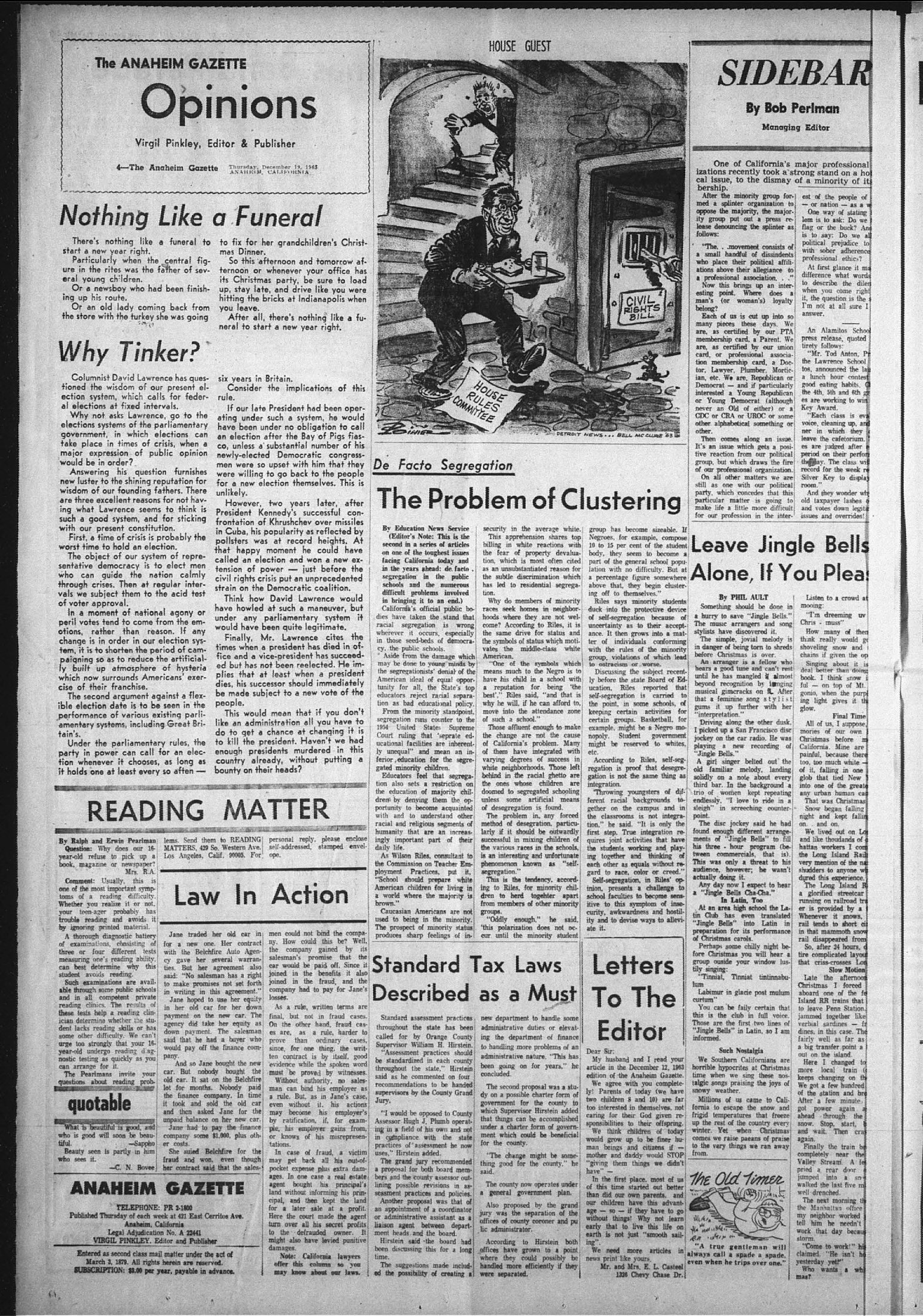
Searchable text
The ANAHEIM GAZETTE
Opinions
Virgil Pinkley, Editor & Publisher
4—The Anaheim Gazette Thursday, December 19, 1963
ANAHEIM, CALIFORNIA
Nothing Like a Funeral
There's nothing like a funeral to start a new year right.
Particularly when the central figure in the rites was the father of several young children.
Or a newsboy who had been finishing up his route.
Or an old lady coming back from the store with the turkey she was going to fix for her grandchildren's Christmas Dinner.
So this afternoon and tomorrow or whenever your office its Christmas party, be sure to up, stay late, and drive like you hitting the bricks at Indianapolis you leave.
After all, there's nothing like a funeral to start a new year right.
Why Tinker?
Columnist David Lawrence has questioned the wisdom of our present election system, which calls for federal elections at fixed intervals.
Why not asks Lawrence, go to the elections systems of the parliamentary government, in which elections can take place in times of crisis, when a major expression of public opinion would be in order?
Answering his question furnishes new luster to the shining reputation for wisdom of our founding fathers. There six years in Britain.
Consider the implications of rule.
If our late President had been eating under such a system, he have been under no obligation to an election after the Bay of Pigs co, unless a substantial number of newly-elected Democratic con men were so upset with him that were willing to go back to the pea for a new election themselves.
The wisdom of our present election system, which calls for federal elections at fixed intervals.
Why not asks Lawrence, go to the elections systems of the parliamentary government, in which elections can take place in times of crisis, when a major expression of public opinion would be in order?
Answering his question furnishes new luster to the shining reputation for wisdom of our founding fathers. There are three excellent reasons for not having what Lawrence seems to think is such a good system, and for sticking with our present constitution.
First, a time of crisis is probably the worst time to hold an election.
The object of our system of representative democracy is to elect men who can guide the nation calmly through crises. Then at regular intervals we subject them to the acid test of voter approval.
In a moment of national agony or peril votes tend to come from the emotions, rather than reason. If any change is in order in our election system, it is to shorten the period of campaigning so as to reduce the artificially built up atmosphere of hysteria which now surrounds Americans' exercise of their franchise.
The second argument against a flexible election date is to be seen in the performance of various existing parliamentary systems, including Great Britain's.
Under the parliamentary rules, the party in power can call for an election whenever it chooses, as long as it holds one at least every so often —
READING MATTER
By Ralph and Erwin Pearlman
Question: Why does our 16-year-old refuse to pick up a book, magazine or newspaper?
Mrs. R.A.
Comment: Usually, this is one of the most important symptoms of a reading difficulty. Whether you realize it or not, your teen-ager probably has trouble reading and avoids it by ignoring printed material.
lems. Send them to READING MATTERS, 429 So. Western Ave. Los Angeles, Calif. 90005. For personal reply, please self-addressed, stamped ope.
By Ralph and Erwin Pearlman
Question: Why does our 16-year-old refuse to pick up a book, magazine or newspaper?
Mrs. R.A.
Comment: Usually, this is one of the most important symptoms of a reading difficulty. Whether you realize it or not, your teen-ager probably has trouble reading and avoids it by ignoring printed material.
A thorough diagnostic battery of examinations, consisting of three or four different tests measuring one's reading ability, can best determine why this student avoids reading.
Such examinations are available through some public schools and in all competent private reading clinics. The results of these tests help a reading clinician determine whether the student lacks reading skills or has some other difficulty. We can't urge too strongly that your 16-year-old undergo reading diagnostic testing as quickly as you can arrange for it.
The Pearlmans invite your questions about reading problems.
What is beautiful is good, and who is good will soon be beautiful.
—Sappho
Beauty seen is partly in him who sees it.
—C. N. Bovee
Jane traded her old car in for a new one. Her contract with the Belchfire Auto Agency gave her several warranties. But her agreement also said: "No salesman has a right to make promises not set forth in writing in this agreement."
Jane hoped to use her equity in her old car for her down payment on the new car. The agency did take her equity as down payment. The salesman said that he had a buyer who would pay off the finance company.
And so Jane bought the new car. But nobody bought the old car. It sat on the Belchfire lot for months. Nobody paid the finance company. In time it took and sold the old car and then asked Jane for the unpaid balance on her new car.
Jane had to pay the finance company some $1,000, plus other costs.
She suied Belchfire for the fraud and won, even though her contract said that the salesmen could not bind the boy. How could this be the company gained by salesman's promise that car would be paid off, joined in the benefits joined in the fraud, a company had to pay for losses.
As a rule, written ten final, but not in fraud. On the other hand, frauds are, as a rule, have prove than ordinary since, for one thing, the ten contract is by itself evidence while the spoke must be proved by witness.
Without authority, no man can bind his employer a rule. But, as in Jane even without it, his may become his employer by ratification, if, for example, his employer gains or knows of his misreactions.
In case of fraud, a may get back all his pocket expense plus extra ages. In one case a real agent bought his private land without informing his copal, and then kept them for a later sale at a Here the court made the turn over all his secrets to the defrauded owner might also have levied damages.
Note: California law offers this column so may know about our...
HOUSE GUEST
De Facto Segregation
De Facto Segregation
The Problem of Clusterization
By Education News Service
(Editor's Note: This is the second in a series of articles on one of the toughest issues facing California today and in the years ahead: de facto segregation in the public schools and the numerous difficult problems involved in bringing it to an end.)
California's official public bodies have taken the stand that racial segregation is wrong wherever it occurs, especially in those seed-beds of democracy, the public schools.
Aside from the damage which may be done to young minds by the segregationists' denial of the American ideal of equal opportunity for all, the State's top educators reject racial separation as bad educational policy.
From the minority standpoint, segregation runs counter to the 1954 United States Supreme Court ruling that "separate educational facilities are inherently unequal" and mean an inferior education for the segregated minority children.
Educators feel that segregation also sets a restriction on the education of majority children by denying them the opportunity to become acquainted with and to understand other racial and religious segments of humanity that are an increasingly important part of their daily life.
As Wilson Riles, consultant to the Commission on Teacher Employment Practices, put it, "School should prepare white American children for living in a world where the majority is brown."
Caucasian Americans are not used to being in the minority. The prospect of minority status security in the average white.
This apprehension shares top billing in white reactions with the fear of property devaluation, which is most often cited as an unsubstantiated reason for the subtle discrimination which has led to residential segregation.
Why do members of minority races seek homes in neighborhoods where they are not welcome? According to Riles, it is the same drive for status and the symbols of status which motivates the middle-class white American.
"One of the symbols which means much to the Negro is to have his child in a school with a reputation for being 'the best.'" Riles said, "and that is why he will, if he can afford to, move into the attendance zone of such a school."
Those affluent enough to make the change are not the cause of California's problem. Many of them have integrated with varying degrees of success in white neighborhoods. Those left behind in the racial ghetto are the ones whose children are doomed to segregated schooling unless some artificial means of desegregation is found.
The problem in any forced method of desegration, particularly if it should be outwardly successful in mixing children of the various races in the schools, is an interesting and unfortunate phenomenon known as "self-segregation."
This is the tendency, according to Riles, for minority children to herd together apart from members of other minority groups.
"Oddly enough," he said, "this polarization does not oc- group has become Negroes, for example 10 to 15 per cent of the body, they seem to part of the general situation with no difficulty a percentage figure above that, they begin off to themselves.
Riles says minority duck into the protection of self-segregation because uncertainty as to the nature of individuals with the rules of the group, violations or worries.
Discussing the subjec-tion before the state Bucation, Riles repself-segregation is at the point, in some keeping certain act-certain groups. Bash example, might be a nopoly. Student might be reserved etc.
According to Riles, segregation is proof that segregation is not the same integration.
Throwting youngster ferent racial background on the campgrounds is not nation," he said. "It is first step. True inter-quires joint activities the students working together and each other as equals gardd to race, color.
Self-segregation, in union, presents a chil- school faculties to be active to this symptom curity, awkwardness ity and to devise ways to ate it.
Action
men could not bind the company. How could this be? Well, the company gained by its salesman's promise that the ear would be paid off. Since it joined in the benefits it also joined in the fraud, and the company had to pay for Jane's losses.
As a rule, written terms are final, but not in fraud cases. On the other hand, fraud cases are, as a rule, harder to prove than ordinary cases, since, for one thing, the written contract is by itself, good evidence while the spoken word must be proved by witnesses.
Without authority, no salesman can bind his employer as a rule. But, as in Jane's case, even without it, his actions may become his employer's boy ratification, if, for example, his employer gains from or knows of his misrepresentations.
In case of fraud, a victim may get back all his out-of-pocket expense plus extra damages. In one case a real estate agent bought his principal's land without informing his principal, and then kept the land for a later sale at a profit. Here the court made the agent turn over all his secret profits to the defrauded owner. It might also have levied punitive damages.
Note: California lawyers offer this column so you may know about our laws.
Standard Tax Laws Described as a Must
Standard assessment practices throughout the state has been called for by Orange County Supervisor William H. Hirstein.
"Assessment practices should be standardized in each county throughout the state." Hirstein said as he commented on four recommendations to be handed supervisors by the County Grand Jury.
"I would be opposed to County Assessor Hugh J. Plumb operating in a field of his own and not in compliance with the state practices of assessment he now uses," Hirstein added.
The grand jury recommended a proposal for both board members and the county assessor outlining possible revisions in assessment practices and policies.
Another proposal was that of an appointment of a coordinator or administrative assistant as a liaison agent between department heads and the board.
Hirstein said the board had been discussing this for a long time.
The suggestions made included the possibility of creating a new department to handle some administrative duties or elevating the department of finance to handling more problems of an administrative nature. "This has been going on for years," he concluded.
The second proposal was a study on a possible charter form of government for the county to which Supervisor Hirstein added that things can be accomplished under a charter form of government which could be beneficial for the county.
"The change might be something good for the county," he said.
The county now operates under a general government plan.
Also proposed by the grand jury was the separation of the offices of county coroner and public administrator.
According to Hirstein both offices have grown to a point where they could possibly be handled more efficiently if they were separated.
Letter To The Editor
Dear Sir:
My husband and I article in the December edition of the Anaheim.
We agree with you! Parents of today two children 8 and 10 too interested in them caring for their God-sponsibilities to their.
We think children would grow up to be man beings and citizen mother and daddy well "giving them things we have" —
In the first place, no of this time started than did our own parish our children have the age — so — if they without things! Why early that to live the earth is not just "sinking".
We need more news print like yours.
Mr. and Mrs. E. 1326 Chevy
SIDEBAR
By Bob Perlman
Managing Editor
One of California's major professionalizations recently took a strong stand on a local issue, to the dismay of a minority of itsbership.
After the minority group formed a splinter organization to oppose the majority, the majority group put out a press release denouncing the splinter as follows:
"The . . movement consists of a small handful of dissidents who place their political affiliations above their allegiance to a professional association. . ."
Now this brings up an interesting point. Where does a man's (or woman's) loyalty belong?
Each of us is cut up into so many pieces these days. We are, as certified by our PTA membership card, a Parent. We are, as certified by our union card, or professional association membership card, a Doctor, Lawyer, Plumber, Mortician, etc. We are, Republican or Democrat — and if particularly interested a Young Republican or Young Democrat (although never an Old of either) or a CDC or CRA or UROC or some other alphabetical something or other.
Then comes along an issue. It's an issue which gets a positive reaction from our political group, but which draws the fire of our professional organization.
On all other matters we are still as one with our political
Clustering
group has become sizeable. If Negroes, for example, compose 10 to 15 per cent of the student body, they seem to become a part of the general school population with no difficulty. But at a percentage figure somewhere above that, they begin clustering off to themselves.
Riles says minority students duck into the protective device of self-segregation because of uncertainty as to their acceptance. It then grows into a matter of individuals conforming with the rules of the minority group, violations of which lead to ostracism or worse.
Discussing the subject recently before the state Board of Education, Riles reported that self-segregation is carried to the point, in some schools, of keeping certain activities for certain groups. Basketball, for example, might be a Negro monopoly. Student government might be reserved to whites, etc.
According to Riles, self-segregation is proof that desegregation is not the same thing as integration.
"Throwing youngsters of different racial backgrounds together on the campus and in the classrooms is not integration," he said. "It is only the first step. True integration requires joint activities that have the students working and playing together and thinking of each other as equals without regard to race, color or creed."
Self-segregation, in Riles' opinion, presents a challenge to school faculties to become sensitive to this symptom of insecurity, awkwardness and hostility and to devise ways to alleviate it.
By PHIL AULT
Something should be done in a hurry to save "Jingle Bells." The music arrangers and song stylists have discovered it.
The simple, jovial melody is in danger of being torn to shreds before Christmas is over.
An arranger is a fellow who hears a good tune and can't rest until he has mangled it almost beyond recognition by singing musical gimcracks on it. After that a feminine song stylist gums it up further with her "interpretation."
Driving along the other dusk, I picked up a San Francisco disc jockey on the car radio. He was playing a new recording of "Jingle Bells."
A girl singer belted out the old familiar melody, landing solidly on a note about every third bar. In the background a trio of women kept repeating endlessly. "I love to ride in a sleigh" in screeching counterpoint.
The disc jockey said he had found enough different arrangements of "Jingle Bells" to fill his three-hour program (between commercials, that is). This was only a threat to his audience, however; he wasn't actually doing it.
Any day now I expect to hear a "Jingle Bells Cha-Cha."
In Latin, Too
At an area high school the Latin Club has even translated "Jingle Bells" into Latin in performance for its profession in the inter-
Listen to a crowd at mooring:
"I'm dreeming uv Chris - muss"
How many of them think really would go shoveling snow and chains if given the op
Singing about it is deal better than doing book. I think snow is ful — on top of Mt. gonio, when the purplish light gives it tha glow.
Final Time
All of us, I suppose, mories of our own Christmas before my California. Mine are painful, because there too, too much white — of it, falling in one glob that tied New York into one of the greatest any urban human can.
That was Christmas. Snow began falling night and kept falling on and on.
We lived out on Loft and like thousands of hattan workers I commandeered the Long Island Railway very mention of the na shudders to anyone who dured this experience.
The Long Island Railroad a glorified streetcar running on railroad traf er is provided by a Whenever it snows, rail tends to short ci
Letters To The Editor
Dear Sir:
My husband and I read your article in the December 12, 1963 edition of the Anaheim Gazette.
We agree with you completely! Parents of today (we have two children 8 and 10) are far too interested in themselves, not caring for their God given responsibilities to their offspring.
We think children of today would grow up to be finer human beings and citizens if — mother and daddy would STOP "giving them things we didn't have" —
In the first place, most of us of this time started out better than did our own parents, and our children have this advantage — so — if they have to go without things! Why not learn early that to live this life on earth is not just "smooth sailing".
We need more articles in news print like yours.
Mr. and Mrs. E. L. Casteel
1326 Chevy Chase Dr.
found enough different arrangements of "Jingle Bells" to fill his three-hour program (between commercials, that is).
This was only a threat to his audience, however; he wasn't actually doing it.
Any day now I expect to hear a "Jingle Bells Cha-Cha."
In Latin, Too
At an area high school the Latin Club has even translated "Jingle Bells" into Latin in preparation for its performance of Christmas carols.
Perhaps some chilly night before Christmas you will hear a group outside your window lustily singing:
"Tinniat, Tinniat tintinnabulum
Labimur in glacie post mulum curtum"
You can be faily certain that this is the club in full voice. Those are the first two lines of "Jingle Bells" in Latin, so I am informed.
Such Nostalgia
We Southern Californians are horrible hypocrites at Christmas time when we sing these nostalgic songs praising the joys of snowy weather.
Millions of us came to California to escape the snow and frigid temperatures that freeze up the rest of the country every winter. Yet when Christmas comes we raise paeans of praise to the very things we ran away from.
The Old Timer
"A true gentleman will always call a spade a spade, even when he trips over one."