anaheim-gazette 1962-08-22
Scanned page
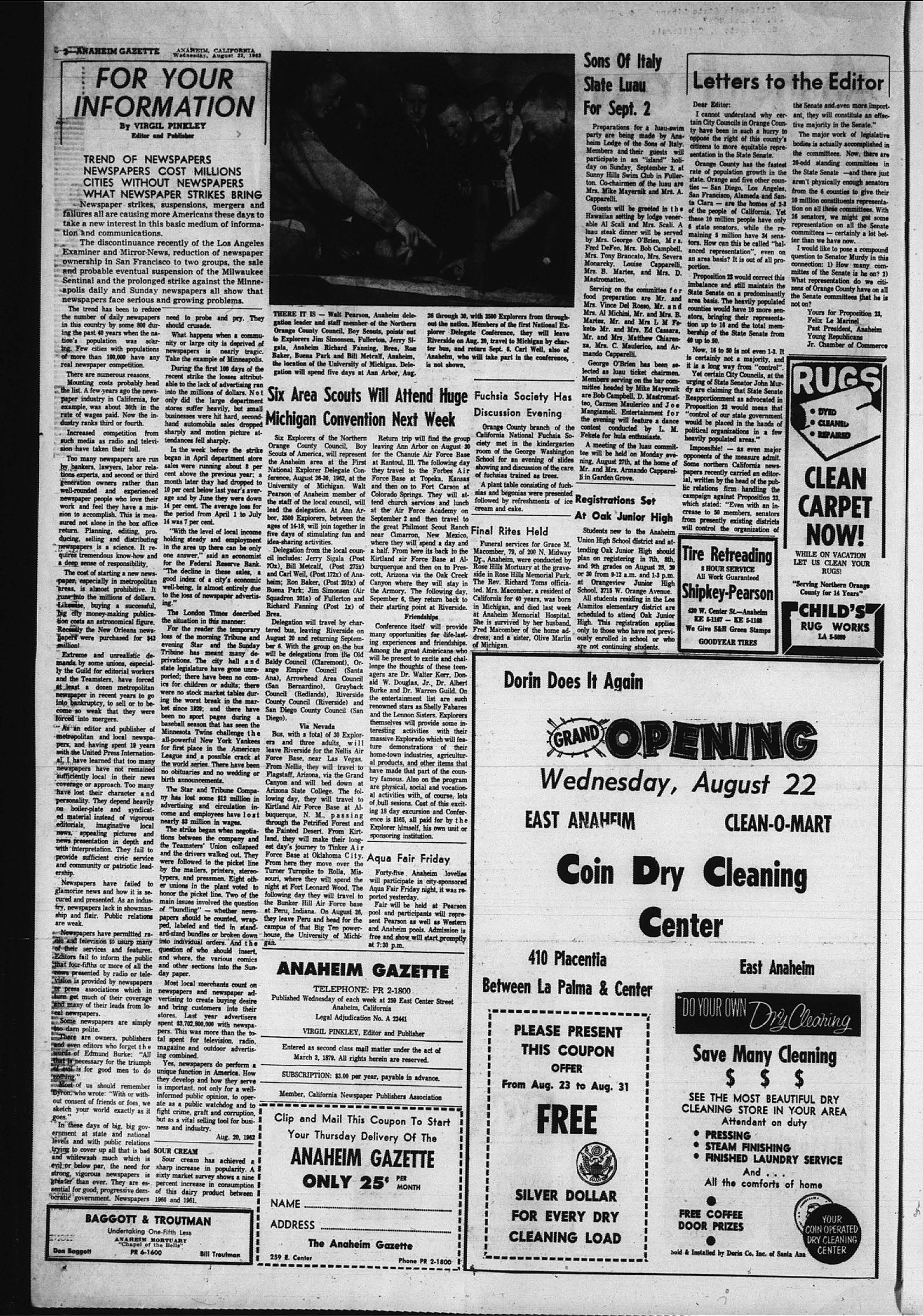
Searchable text
FOR YOUR INFORMATION
By VIRGIL PINKLEY
Editor and Publisher
TREND OF NEWSPAPERS
NEWSPAPERS COST MILLIONS
CITIES WITHOUT NEWSPAPERS
WHAT NEWSPAPER STRIKES BRING
Newspaper strikes, suspensions, mergers and failures all are causing more Americans these days to take a new interest in this basic medium of information and communications.
The discontinuance recently of the Los Angeles Examiner and Mirror News, reduction of newspaper ownership in San Francisco to two groups, the sale and probable eventual suspension of the Milwaukee Sentinal and the prolonged strike against the Minneapolis daily and Sunday newspapers all show that newspapers face serious and growing problems.
The trend has been to reduce the number of daily newspapers in this country by some 800 during the past 40 years when the nation's population was soaring. Few cities with populations of more than 100,000 have any real newspaper competition.
There are numerous reasons.
Mounting costs probably head the list. A few years ago the newspaper industry in California, for example, was about 36th in the rate of wages paid. Now the industry ranks third or fourth.
Increased competition from such media as radio and television have taken their toll.
Too many newspapers are run by bankers, lawyers, labor relations experts, and second or third generation owners rather than well-rounded and experienced need to probe and pry. They should crusade.
What happens when a community or large city is deprived of newspapers is nearly tragic. Take the example of Minneapolis.
During the first 100 days of the recent strike the losses attributable to the lack of advertising ran into the millions of dollars. Not only did the large department stores suffer heavily, but small businesses were hit hard, secondhand automobile sales dropped sharply and motion picture attendances fell sharply.
In the week before the strike began in April department store sales were running about 8 per cent above the previous year; a month later they had dropped to 10 per cent last year's average.
Increased competition from such media as radio and television have taken their toll.
Too many newspapers are run by bankers, lawyers, labor relations experts, and second or third generation owners rather than well-rounded and experienced newspaper people who love their work and feel they have a mission to accomplish. This is measured not alone in the box office return. Planning, editing, producing, selling and distributing newspapers is a science. It requires tremendous know-how and a deep sense of responsibility.
The cost of starting a new newspaper, especially in metropolitan areas, is almost prohibitive. It runs into the millions of dollars. Likewise, buying a successful big city money-making publication costs an astronomical figure. Recently the New Orleans newspapers were purchased for $43 million!
Extreme and unrealistic demands by some unions, especially the Guild for editorial workers and the Teamsters, have forced at least a dozen metropolitan newspaper in recent years to go into bankruptcy, to sell or to become so weak that they were forced into mergers.
As an editor and publisher of metropolitan and local newspapers, and having spent 19 years with the United Press International, I have learned that too many newspapers have not remained sufficiently local in their news coverage or approach. Too many have lost their character and personality. They depend heavily on boiler-plate and syndicated material instead of vigorous editorials, imaginative local news, appealing pictures and news presentation in depth and with interpretation. They fail to provide sufficient civic service and community or patriotic leadership.
Newspapers have failed to glamorize news and how it is secured and presented. As an industry, newspapers lack in showmanship and flair. Public relations are weak.
In the week before the strike began in April department store sales were running about 8 per cent above the previous year; a month later they had dropped to 10 per cent below last year's average and by June they were down 14 per cent. The average loss for the period from April 1 to July 14 was 7 per cent.
"With the level of local income holding steady and employment in the area up there can be only one answer," said an economist for the Federal Reserve Bank. "The decline in these sales, a good index of a city's economic well-being, is almost entirely due to the loss of newspaper advertising."
The London Times described the situation in this manner:
For the reader the temporary loss of the morning Tribune and evening Star and the Sunday Tribune has meant many deprivations. The city hall and state legislature have gone unreported; there have been no comics for children or adults; there were no stock market tables during the worst break in the market since 1929; and there have been no sport pages during a baseball season that has seen the Minnesota Twins challenge the all-powerful New York Yankees for first place in the American League and a possible crack at the world series. There have been no obituaries and no wedding or birth announcements.
The Star and Tribune Company has lost some $12 million in advertising and circulation income and employees have lost nearly $3 million in wages.
The strike began when negotiations between the company and the Teamsters' Union collapsed and the drivers walked out. They were followed to the picket line by the mailers, printers, stereotypers, and pressmen. Eight other unions in the plant voted to honor the picket line. Two of the main issues involved the question of "bundling" — whether newspapers should be counted, wrapped, labeled and tied in stand into the millions of dollars. Not only did the large department stores suffer heavily, but small businesses were hit hard, second-hand automobile sales dropped sharply and motion picture attendances fell sharply.
In the week before the strike began in April department store sales were running about 8 per cent above the previous year; a month later they had dropped to 10 per cent below last year's average and by June they were down 14 per cent. The average loss for the period from April 1 to July 14 was 7 per cent.
"With the level of local income holding steady and employment in the area up there can be only one answer," said an economist for the Federal Reserve Bank. "The decline in these sales, a good index of a city's economic well-being, is almost entirely due to the loss of newspaper advertising."
The London Times described the situation in this manner:
For the reader the temporary loss of the morning Tribune and evening Star and the Sunday Tribune has meant many deprivations. The city hall and state legislature have gone unreported; there have been no comics for children or adults; there were no stock market tables during the worst break in the market since 1929; and there have been no sport pages during a baseball season that has seen the Minnesota Twins challenge the all-powerful New York Yankees for first place in the American League and a possible crack at the world series. There have been no obituaries and no wedding or birth announcements.
The Star and Tribune Company has lost some $12 million in advertising and circulation income and employees have lost nearly $3 million in wages.
The strike began when negotiations between the company and the Teamsters' Union collapsed and the drivers walked out. They were followed to the picket line by the mailers, printers, stereotypers, and pressmen. Eight other unions in the plant voted to honor the picket line. Two of the main issues involved the question of "bundling" — whether newspapers should be counted, wrapped, labeled and tied in stand into the millions of dollars. Not only did the large department stores suffer heavily, but small businesses were hit hard, second-hand automobile sales dropped sharply and motion picture attendances fell sharply.
In the week before the strike began in April department store sales were running about 8 per cent above the previous year; a month later they had dropped to 10 per cent below last year's average and by June they were down 14 per cent. The average loss for the period from April 1 to July 14 was 7 per cent.
"With the level of local income holding steady and employment in the area up there can be only one answer," said an economist for the Federal Reserve Bank. "The decline in these sales, a good index of a city's economic well-being, is almost entirely due to the loss of newspaper advertising."
The London Times described the situation in this manner:
For the reader the temporary loss of the morning Tribune and evening Star and the Sunday Tribune has meant many deprivations. The city hall and state legislature have gone unreported; there have been no comics for children or adults; there were no stock market tables during the worst break in the market since 1929; and there have been no sport pages during a baseball season that has seen the Minnesota Twins challenge the all-powerful New York Yankees for first place in the American League and a possible crack at the world series. There have been no obituaries and no wedding or birth announcements.
The Star and Tribune Company has lost some $12 million in advertising and circulation income and employees have lost nearly $3 million in wages.
The strike began when negotiations between the company and the Teamsters' Union collapsed and the drivers walked out. They were followed to the picket line by the mailers, printers, stereotypers, and pressmen. Eight other unions in the plant voted to honor the picket line. Two of the main issues involved the question of "bundling" — whether newspapers should be counted, wrapped, labeled and tied in stand into the millions of dollars. Not only did the large department stores suffer heavily, but small businesses were hit hard, second-hand automobile sales dropped sharply and motion picture attendances fell sharply.
In the week before the strike began in April department store sales were running about 8 per cent above the previous year; a month later they had dropped to 10 per cent below last year's average and by June they were down 14 per cent. The average loss for the period from April 1 to July 14 was 7 per cent.
"With the level of local income holding steady and employment in the area up there can be only one answer," said an economist for the Federal Reserve Bank. "The decline in these sales, a good index of a city's economic well-being, is almost entirely due to the loss of newspaper advertising."
The London Times described the situation in this manner:
For the reader the temporary loss of the morning Tribune and evening Star and the Sunday Tribune has meant many deprivations. The city hall and state legislature have gone unreported; there have been no comics for children or adults; there were no stock market tables during the worst break in the market since 1929; and there have been no sport pages during a baseball season that has seen the Minnesota Twins challenge the all-powerful New York Yankees for first place in the American League and a possible crack at the world series. There have been no obituaries and no wedding or birth announcements.
The Star and Tribune Company has lost some $12 million in advertising and circulation income and employees have lost nearly $3 million in wages.
The strike began when negotiations between the company and the Teamsters' Union collapsed and the drivers walked out. They were followed to the picket line by the mailers, printers, stereotypers, and pressmen. Eight other unions in the plant voted to honor the picket line. Two of the main issues involved the question of "bundling" — whether newspapers should be counted, wrapped, labeled and tied in stand into the millions of dollars. Not only did the large department stores suffer heavily, but small businesses were hit hard, second-hand automobile sales dropped sharply and motion picture attendances fell sharply.
In the week before the strike began in April department store sales were running about 8 per cent above the previous year; a month later they had dropped to 10 per cent below last year's average and by June they were down 14 per cent. The average loss for the period from April 1 to July 14 was 7 per cent.
"With the level of local income holding steady and employment in the area up there can be only one answer," said an economist for the Federal Reserve Bank. "The decline in these sales, a good index of a city's economic well-being, is almost entirely due to the loss of newspaper advertising."
The London Times described the situation in this manner:
For the reader the temporary loss ofthe morning TribuneandeveningStarandtheSundayTribunehasmeantmanydeprivations.Thecityhallandstatelegislaturehavegoneunreported;therehavebeennocomicsforchildrenoradults;therewerenostockmarkettablesduringtheworstbreakinthemarketsince1929;andtherehavebeennosportpagesduringabaseballseasonthathasseentheMinnesotaTwinschallengetheall-powerfulNewYorkYankeesforfirstplaceintheAmericanLeagueandapossiblecrackattheworldseriesTherehavebeennoobituariesandnoweddingorbirthannouncements.
The Star和TribuneCompanyhaslostsome$12millioninadvertisingandcirculationincomeandemployeeshavelostnearly$3millioninwages.
The strike began when negotiations betweenthecompanyandtheTeamsters'Unioncollapsedandthedriverswalkedout.Theywerefollowedtothepicketlinebythemailers,printers,stereotypers,andpressmen.Eightotherunionsintheplantvotedtohonorthepicketline.Twoofthemainissuesinvolvedthequestionof"bundling""—whethernewspapersshouldbecounted,wrapped,labeledandtiedinstandintothemillionsofdollars.Notonlydidthelargedepartmentstoressufferheighlybutsmallbusinesseswerehithardsecondhandautomobilesalesdroppedsharplyandmotionpictureattendancefellsharply."
Newspapers have failed to glamorize news and how it is secured and presented. As an industry, newspapers lack in showmanship and flair. Public relations are weak.
Newspapers have permitted radio and television to usurp many of their services and features. Editors fail to inform the public that four-fifths or more of all the news presented by radio or television is provided by newspapers or press associations which in turn get much of their coverage and many of their leads from local newspapers.
Some newspapers are simply too darn polite.
There are owners, publishers and even editors who forget the words of Edmund Burke: "All that is necessary for the triumph of evil is for good men to do nothing."
Most of us should remember Byron, who wrote: "With or without consent of friends or foes, we sketch your world exactly as it goes."
In these days of big, big government at state and national levels and with public relations trying to cover up all that is bad and whitewash much which is evil or below par, the need for strong, vigorous newspapers is greater than ever. They are essential for good, progressive democratic government. Newspapers
The strike began when negotiations between the company and the Teamsters' Union collapsed and the drivers walked out. They were followed to the picket line by the mailers, printers, stereotypers, and pressmen. Eight other unions in the plant voted to honor the picket line. Two of the main issues involved the question of "bundling" — whether newspapers should be counted, wrapped, labeled and tied in standard-sized bundles or broken down into individual orders. And the question of who should insert, and where, the various comics and other sections into the Sunday paper.
Most local merchants count on newspapers and newspaper advertising to create buying desire and bring customers into their stores. Last year advertisers spent $3,702,800,000 with newspapers. This was more than the total spent for television, radio, magazine and outdoor advertising combined.
Yes, newspapers do perform a unique function in America. How they develop and how they serve is important, not only for a well-informed public opinion, to operate as a public watchdog and to fight crime, graft and corruption, but as a vital selling tool for business and industry.
Aug. 20, 1962
SOUR CREAM
Sour cream has achieved a sharp increase in popularity. A sixty market survey shows a nine percent increase in consumption of this dairy product between 1960 and 1961.
BAGGOTT & TROUTMAN
Undertaking One-Fifth Less
ANAHEIM MORTUARY
"Chapel of the Bella"
Don Baggott PR 6-1600 Bill Troutman
THERE IT IS — Walt Pearson, Anaheim delegation leader and staff member of the Northern Orange County Council, Boy Scouts, points out to Explorers Jim Simonsen, Fullerton, Jerry Sigala, Anaheim Richard Fanning, Brea, Ron Baker, Buena Park and Bill Metcalf, Anaheim, the location of the University of Michigan. Delegation will spend five days at Ann Arbor, Aug.
26 through 30, with 3500 Explorers from throughout the nation. Members of the first National Explorer Delegate Conference, they will leave Riverside on Aug. 20, travel to Michigan by charter bus, and return Sept. 6. Carl Well, also of Anaheim, who will take part in the conference, is not shown.
Six Area Scouts Will Attend Huge Michigan Convention Next Week
Six Explorers of the Northern Orange County Council, Boy Scouts of America, will represent the Anaheim area at the First National Explorer Delegate Conference, August 26-30, 1962, at the University of Michigan. Walt Return trip will find the group leaving Ann Arbor on August 30 for the Chanute Air Force Base at Rantoul, Ill. The following day they travel to the Forbes Air Force Base at Topeka, Kansas and then on to Fort Carson at Orange County branch of the California National Fuchsia Society met in the kindergarten room of the George Washington School for an evening of slides showing and discussion of the care of fuchsias trained as trees.
A plant table consisting of fuchsi
Sons Of Italy Slate Luau For Sept. 2
Preparations for a party are being made heim Lodge of the South Members and their g participate in an "isle day on Sunday, September Sunny Hills Swim Clubton. Co-chairmen of the Mrs. Mike Mayernik and Capparelli.
Guests will be greeted Hawaiian setting by lo able Al Scali and Mrs luau steak dinner will by Mrs. George O'Brien Fred DeFeo, Mrs. Bob Mrs. Tony Brancato, M Monarcky, Louise O Mrs. B. Martes, and Mastromatteo.
Serving on the comm food preparation are Mrs. Vince Del Rosso, Mrs. Al Michini, Mr. ar Martes, Mr. and Mrs kete-Mr. and Mrs. Ed Mr. and Mrs. Matthew za, Mrs. C. Maulerico, mando Capparelli.
George O'Brien has lected as luau ticket o Members serving on the mittee headed by Mike are Bob Campbell, D. M teo, Carmen Maulerico and Mangameli. Entertainment the evening will feature contest conducted by Fekete for hula enthusiasm.
A meeting of the luau tee will be held on Mon ning, August 27th, at the Mr. and Mrs. Armando O il in Garden Grove.
Six Area Scouts Will Attend Huge Michigan Convention Next Week
Six Explorers of the Northern Orange County Council, Boy Scouts of America, will represent the Anaheim area at the First National Explorer Delegate Conference, August 26-30, 1962, at the University of Michigan. Walt Pearson of Anaheim member of the staff of the local council, will lead the delegation. At Ann Arbor, 3500 Explorers, between the ages of 14-18, will join together in five days of stimulating fun and idea-sharing activities.
Delegation from the local council includes: Jerry Sigala (Post Ox), Bill Metcalf, (Post 275x) and Carl Weil, (Post 172x) of Anaheim; Ron Baker, (Post 291x) of Buena Park; Jim Simonsen (Air Quadron 201a) of Fullerton and Richard Fanning (Post 1x) of Area.
Delegation will travel by chartered bus, leaving Riverside on August 20 and returning September 6. With the group on the bus will be delegations from the Old Olddy Council (Claremont), Orange Empire Council (Santa Ana), Arrowhead Area Council (San Bernardino), Grayback Council (Redlands), Riverside County Council (Riverside) and San Diego County Council (San Diego).
Via Nevada Bus, with a total of 30 Explorers and three adults, will have Riverside for the Nellis Air Force Base, near Las Vegas. From Nellis, they will travel to Lagstaff, Arizona, via the Grand Canyon and will bed down at Arizona State College. The following day, they will travel to Kirtland Air Force Base at Alququerque, N.M., passing through the Petrified Forest and the Painted Desert. From Kirtland, they will make their long-day's journey to Tinker Air Force Base at Oklahoma City. From here they move over the Turnpike to Rolla, Missouri, where they will spend the night at Fort Leonard Wood. The following day they will travel to Bunker Hill Air Force base Peru, Indiana. On August 26, they leave Peru and head for the campus of that Big Ten power-
Return trip will find the group leaving Ann Arbor on August 30 for the Chanute Air Force Base at Rantoul, Ill. The following day they travel to the Forbes Air Force Base at Topeka, Kansas and then on to Fort Carson at Colorado Springs. They will attend church services and lunch at the Air Force Academy on September 2 and then travel to the great Philmont Scout Ranch near Cimarron, New Mexico, where they will spend a day and a half. From here its back to the Kirtland air Force Base at Alburquerque and then on to Prescott, Arizona via the Oak Creek Canyon where they will stay in the Armory. The following day, September 6, they return back to their starting point at Riverside.
Friendships
Conference itself will provide many opportunities for life-lasting experiences and friendships. Among the great Americans who will be present to excite and challenge the thoughts of these teenagers are Dr. Walter Kerr, Donald W. Douglas, Jr., Dr. Albert Burke and Dr. Warren Guild. On the entertainment list are such renowned stars as Shelly Fabares and the Lennon Sisters. Explorers themselves will provide some interesting activities with their massive Explorado which will feature demonstrations of their home-town industries, agricultural products, and other items that have made that part of the country famous. Also on the program are physical, social and vocational activities with, of course, lots of bull sessions. Cost of this exciting 18 day excursion and Conference is $165, all paid for by the Explorer himself, his own unit or sponsoring institution.
Fuchsia Society Has Discussion Evening
Orange County branch of the California National Fuchsia Society met in the kindergarten room of the George Washington School for an evening of slides showing and discussion of the care of fuchsias trained as trees.
A plant table consisting of fuchsias and begonias were presented followed by refreshments of ice cream and cake.
Final Rites Held
Funeral services for Grace M. Macomber, 79, of 200 N. Midway Dr., Anaheim, were conducted by Rose Hills Mortuary at the grave-side in Rose Hills Memorial Park. The Rev. Richard Toms officiated. Mrs. Macomber, a resident of California for 40 years, was born in Michigan, and died last week at Anaheim Memorial Hospital. She is survived by her husband, Fred Macomber of the home address, and a sister, Olive Marlin of Michigan.
Students new to the Union High School district tending Oak Junior High plan on registering in 7th and 9th grades on August or 30 from 9-12 a.m. and at Orangeview Junior School, 3715 W. Orange A.
All students residing in Alamitos elementary district scheduled to attend Oak High. This registration only to those who have no ousily enrolled in school are not continuing student
Dorin Does It Again
GRAND
Wednesday
EAST ANAHHEIM
Coin D
ANAHEIM GAZETTE
TELEPHONE: PR 2-1800
Published Wednesday of each week at 259 East Center Street
Anaheim, California
Legal Adjudication No. A 22441
VIRGIL PINKLEY, Editor and Publisher
Entered as second class mail matter under the act of
March 3, 1879. All rights herein are reserved.
SUBSCRIPTION: $3.00 per year, payable in advance.
Member, California Newspaper Publishers Association
Clip and Mail This Coupon To Start
Your Thursday Delivery Of The
ANAHEIM GAZETTE
ONLY 25¢ PER MONTH
NAME ...
ADDRESS ...
The Anaheim Gazette
259 E. Center
Phone PR 2-1800
410 Placentia
Between La Palma & Center
PLEASE PRESENT
THIS COUPON
OFFER
From Aug. 23 to Aug. 31
FREE
SILVER DOLLAR
FOR EVERY DRY
CLEANING LOAD
Sons Of Italy
Slate Luau
For Sept. 2
Preparations for a luau-swim party are being made by Anaheim Lodge of the Sons of Italy. Members and their guests will participate in an "island" holiday on Sunday, September 2, at Sunny Hills Swim Club in Fullerton. Co-chairmen of the luau are Mrs. Mike Mayernik and Mrs. A. Capparelli.
Guests will be greeted in the Hawaiian setting by lodge venerable Al Scali and Mrs. Scali. A luau steak dinner will be served by Mrs. George O'Brien, Mrs. Fred DeFeo, Mrs. Bob Campbell, Mrs. Tony Brancato, Mrs. Severa Monarcky, Louise Capparelli, Mrs. B. Martes, and Mrs. D. Mastromatteo.
Serving on the committee for food preparation are Mr. and Mrs. Vince Del Rosso, Mr. and Mrs. Al Michini, Mr. and Mrs. B. Martes, Mr. and Mrs. L M Fekete Mr. and Mrs. Ed Cassara, Mr. and Mrs. Matthew Chiarenza, Mrs. C. Maulerico, and Armando Capparelli.
George O'Brien has been selected as luau ticket chairmen. Members serving on the bar committee headed by Mike Mayernik are Bob Campbell, D. Mastromatteo, Carmen Maulerico and Joe Mangiameli. Entertainment for the evening will feature a dance contest conducted by L. M. Fekete for hula enthusiasts.
A meeting of the luau committee will be held on Monday evening, August 27th, at the home of Mr. and Mrs. Armando Capparelli in Garden Grove.
Letters to the Editor
Dear Editor:
I cannot understand why certain City Councils in Orange County have been in such a hurry to oppose the right of this county's citizens to more equitable representation in the State Senate.
Orange County has the fastest rate of population growth in the state. Orange and five other counties — San Diego, Los Angeles, San Francisco, Alameda and Santa Clara — are the homes of 2-3 of the people of California. Yet these 10 million people have only 6 state senators, while the remaining 5 million have 34 senators. How can this be called "balanced representation", even on an area basis? It is out of all proportion.
Proposition 23 would correct this imbalance and still maintain the State Senate on a predominantly area basis. The heavily populated counties would have 10 more senators, bringing their representation up to 16 and the total membership of the State Senate from 40 up to 50.
Now, 16 to 50 is not even 1-3. It is certainly not a majority, and it is a long way from "control".
Yet certain City Councils, at the urging of State Senator John Murdy are claiming that State Senate Reapportionment as advocated in Proposition 23 would mean that "control of our state government would be placed in the hands of political organizations in a few heavily populated areas."
Impossible! — as even major opponents of the measure admit. Some northern California newspapers recently carried an editorial, written by the head of the public relations firm handling the Senate and even more important, they will constitute an effective majority in the Senate."
The major work of legislative bodies is actually accomplished in the committees. Now, there are 20-odd standing committees in the State Senate—and there just aren't physically enough senators from the 6 counties to give their 10 million constituents representation on all these committees. With 16 senators, we might get some representation on all the Senate committees—certainly a lot better than we have now.
I would like to pose a compound question to Senator Murdy in this connection: 1) How many committees of the Senate is he on? 2) What representation do we citizens of Orange County have on all the Senate committees that he is not on?
Yours for Proposition 23,
Felix Le Marinel
Past President, Anaheim
Young Republicans
Jr. Chamber of Commerce
A meeting of the laua committee will be held on Monday evening, August 27th, at the home of Mr. and Mrs. Armando Capparelli in Garden Grove.
Registrations Set At Oak Junior High
Students new to the Anaheim Union High School district and attending Oak Junior High should plan on registering in 7th, 8th, and 9th grades on August 28, 29 or 30 from 9-12 a.m. and 1-3 p.m. at Orangeview Junior High School, 3715 W. Orange Avenue.
All students residing in the Los Alamitos elementary district are scheduled to attend Oak Junior High. This registration applies only to those who have not previously enrolled in school or who are not continuing students.
Tire Retreading
8 HOUR SERVICE
All Work Guaranteed
Shipkey-Pearson
420 W. Center St—Anaheim
KE 5-1167 — KE 5-1168
We Give S&H Green Stamps
GOODYEAR TIRES
CLEAN CARPET NOW!
WHILE ON VACATION LET US CLEAN YOUR RUGS!
"Serving Northern Orange County for 14 Years"
CHILD'S RUG WORKS
LA 5-5000
Is It Again
AND OPENING
Wednesday, August 22
ANAHEIM
CLEAN-O-MART
Join Dry Cleaning Center
JOIN Dry Cleaning Center
entia
ma & Center
East Anaheim
DO YOUR OWN Dry Cleaning
Save Many Cleaning
$ $ $
SEE THE MOST BEAUTIFUL DRY CLEANING STORE IN YOUR AREA
Attendant on duty
• PRESSING
• STEAM FINISHING
• FINISHED LAUNDRY SERVICE
And ...
All the comforts of home
FREE COFFEE
DOOR PRIZES
Sold & Installed by Dorin Co. Inc. of Santa Ana
YOUR COIN-OPERATED DRY CLEANING CENTER