anaheim-gazette 1952-07-22
Scanned page
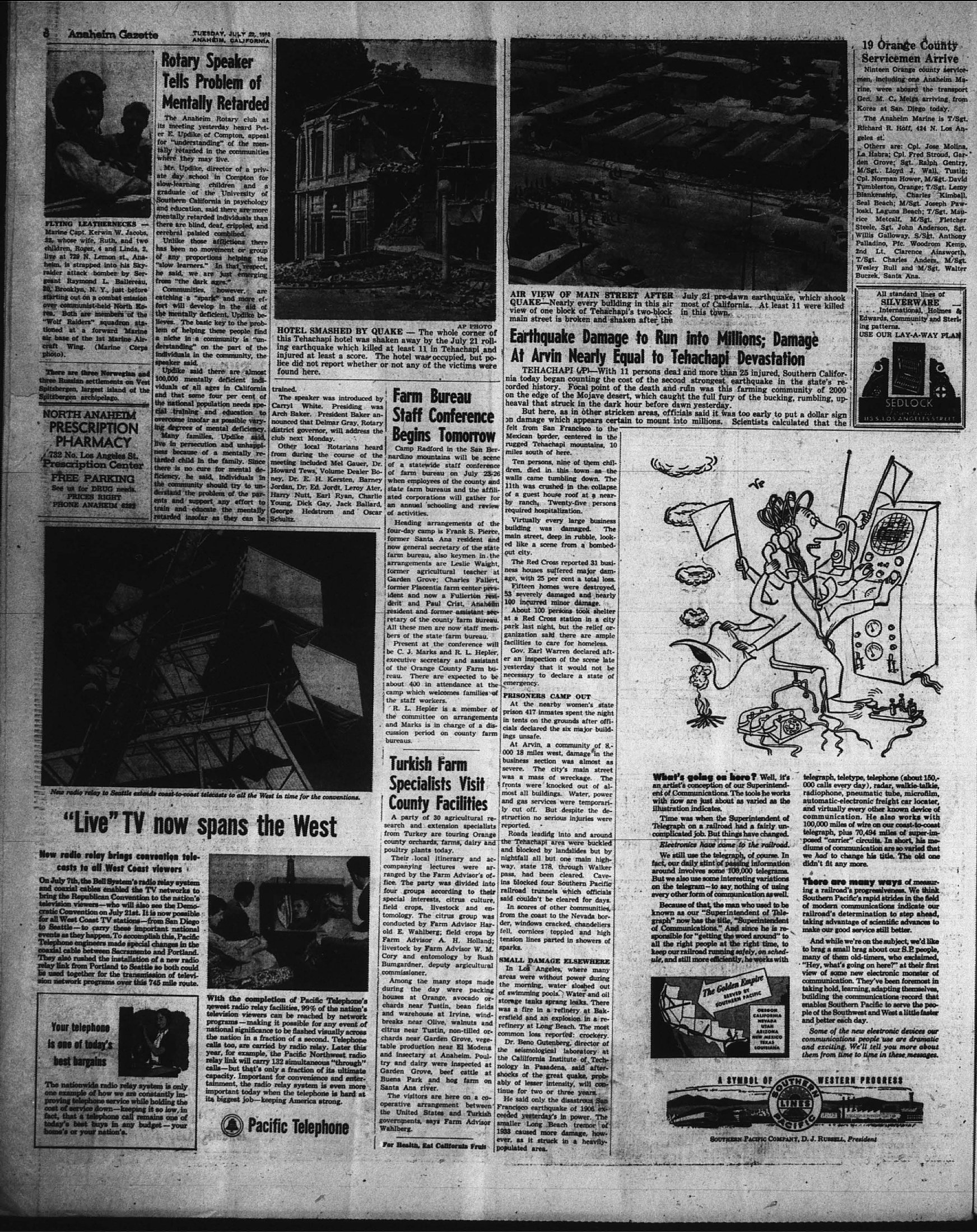
Searchable text
Rotary Speaker Tells Problem of Mentally Retarded
The Anaheim Rotary club at its meeting yesterday heard Peter E. Updike of Compton, appeal for "understanding" of the mentally retarded in the communities where they may live.
Mr. Updike, director of a private day school in Compton for slow-learning children and a graduate of the University of Southern California in psychology and education, said there are more mentally retarded individuals than there are blind, deaf, crippled, and cerebral palsied combined.
Unlike those afflictions there has been no movement or group of any proportions helping the "slow learners." In that respect, he said, we are just emerging from "the dark ages."
Communities, however, are catching a "spark" and more effort will develop in the aid of the mentally deficient. Updike believes. The basic key to the problem of helping these people find a niche in a community is "understanding" on the part of the individuals in the community, the speaker said.
Updike said there are almost 100,000 mentally deficient individuals of all ages in California and that some four per cent of the national population needs special training and education to overcome insofar as possible varying degrees of mental deficiency.
Many families, Updike said, live in persecution and unhappiness because of a mentally retarded child in the family.
FLYING LEATHERNECKS — Marine Capt. Kerwin W. Jacobs, 52, whose wife, Ruth, and two children, Roger, 4 and Linda, 2, live at 729 N. Lemon st., Anaheim, is strapped into his Skyraider attack bomber by Sergeant Raymond L. Ballereau, 20, Brooklyn, N. Y., just before starting out on a combat mission over communist-held North Korea. Both are members of the "Wolf Raiders" squadron stationed at a forward Marine air base of the 1st Marine Aircraft Wing. (Marine Corps photo).
There are three Norwegian and three Russian settlements on Vest Spitsbergen, largest island of the Spitsbergen archipelago.
NORTH ANAHEIM PRESCRIPTION PHARMACY
782 No. Los Angeles St.
There are three Norwegian and three Russian settlements on West Spitsbergen, largest island of the Spitsbergen archipelago.
NORTH ANAHEIM
PRESCRIPTION PHARMACY
732 No. Los Angeles St.
Prescription Center
FREE PARKING
See us for DRUG needs.
PRICES RIGHT
PHONE ANAHEIM 6202
Updike said there are almost 100,000 mentally deficient individuals of all ages in California and that some four per cent of the national population needs special training and education to overcome insofar as possible varying degrees of mental deficiency.
Many families, Updike said, live in persecution and unhappiness because of a mentally retarded child in the family. Since there is no cure for mental deficiency, he said, Individuals in the community should try to understand the problem of the parents and support any effort to train and educate the mentally retarded insofar as they can be trained.
The speaker was introduced Carryl White. Presiding Arch Baker. President Baker nounced that Delmar Gray, District governor, will address club next Monday.
Other local Rotarians from during the course of meeting included Mel Gaucer Howard Tews, Volume Dealerney, Dr. E. H. Kersten, B.Jordan, Dr. Ed. Jordt, Leroy Harry Nutt, Earl Ryan, C Young, Dick Gay, Jack Ba George Hedstrom and Schultz.
New radio relay to Seattle extends coast-to-coast telecasts to all the West in time for the conventions.
“Live” TV now spans the West
New radio relay brings convention telecasts to all West Coast viewers
"Live" TV now spans the West
New radio relay brings convention telecasts to all West Coast viewers
On July 7th, the Bell System's radio relay system and coaxial cables enabled the TV networks to bring the Republican Convention to the nation's television viewers—who will also see the Democratic Convention on July 21st. It is now possible for all West Coast TV stations—from San Diego to Seattle—to carry these important national events as they happen. To accomplish this, Pacific Telephone engineers made special changes in the coaxial cable between Sacramento and Portland. They also rushed the installation of a new radio relay link from Portland to Seattle so both could be used together for the transmission of television network programs over this 745 mile route.
Your telephone is one of today's best bargains
The nationwide radio relay system is only one example of how we are constantly improving telephone service while holding the cost of service down—keeping it so low, in fact, that a telephone call remains one of today's best buys in any budget—your home's or your nation's.
With the completion of Pacific Telephone's newest radio relay facilities, 99% of the nation's television viewers can be reached by network programs—making it possible for any event or national significance to be flashed visually across the nation in a fraction of a second. Telephone calls too, are carried by radio relay. Later this year, for example, the Pacific Northwest radio relay link will carry 132 simultaneous "through" calls—but that's only a fraction of its ultimate capacity. Important for convenience and entertainment, the radio relay system is even more important today when the telephone is hard at its biggest job—keeping America strong.
Pacific Telephone
HOTEL SMASHED BY QUAKE — The whole corner of its Tehachapi hotel was shaken away by the July 21 roller earthquake which killed at least 11 in Tehachapi and injured at least a score. The hotel was occupied, but police did not report whether or not any of the victims were found here.
FARM BUREAU STAFF CONFERENCE Begins Tomorrow
Camp Radford in the San Bernardino mountains will be scene
AIR VIEW OF MAIN STREET AFTER QUAKE—Nearly every building in this air view of one block of Tehachapi's two-block main street is broken and shaken after the Earthquake Damage to Run In At Arvin Nearly Equal to Tehachapi (AP)—With 11 persons dead and nine today began counting the cost of the second recorded history. Focal point of the death and ruin on the edge of the Mojave desert, which caught the heaval that struck in the dark hour before dawn. But here, as in other stricken areas, officials on damage which appears certain to mount into felt from San Francisco to the Mexican border, centered in the rugged Tehachapi mountains, 10 miles south of here.
Farm Bureau Staff Conference Begins Tomorrow
Camp Radford in the San Bernardino mountains will be scene of a statewide staff conference of farm bureau on July 23-26 when employees of the county and state farm bureaus and the affiliated corporations will gather for an annual schooling and review of activities.
Heading arrangements of the four-day camp is Frank S. Pierce, former Santa Ana resident and now general secretary of the state farm bureau, also keymen in the arrangements are Leslie Waight, former agricultural teacher at Garden Grove; Charles Fallert, former Placentia farm center president and now a Fullerton resident and Paul Crist, Anaheim resident and former assistant secretary of the county farm bureau. All these men are now staff members of the state farm bureau.
Present at the conference will be C. J. Marks and R. L. Hepler, executive secretary and assistant of the Orange County Farm Bureau. There are expected to be about 400 in attendance at the camp which welcomes families of the staff workers.
R. L. Hepler is a member of the committee on arrangements and Marks is in charge of a discussion period on county farm bureaus.
Turkish Farm Specialists Visit County Facilities
A party of 30 agricultural research and extension specialists from Turkey are touring Orange county orchards, farms, dairy and poultry plants today.
Their local itinerary and accompanying lectures were ar-
TEHACHAPI (P)—With 11 persons deal annia today began counting the cost of the second recorded history. Focal point of the death and ruil on the edge of the Mojave desert, which caught the heaval that struck in the dark hour before dawn.
But here, as in other stricken areas, officials on damage which appears certain to mount into felt from San Francisco to the Mexican border, centered in the rugged Tehachapi mountains, 10 miles south of here.
Ten persons, nine of them children, died in this town as the walls came tumbling down. The 11th was crushed in the collapse of a guest house roof at a nearby ranch. Twenty-five persons required hospitalization.
Virtually every large business building was damaged. The main street, deep in rubble, looked like a scene from a bombed-out city.
The Red Cross reported 31 business houses suffered major damage, with 25 per cent a total loss.
Fifteen homes were destroyed, 53 severely damaged and nearly 100 incurred minor damage.
About 100 persons took shelter at a Red Cross station in a city park last night, but the relief organization said there are ample facilities to care for homeless.
Gov. Earl Warren declared after an inspection of the scene late yesterday that it would not be necessary to declare a state of emergency.
PRISONERS CAMP OUT
At the nearby women's state prison 417 inmates spent the night in tents on the grounds after officials declared the six major buildings unsafe.
At Arvin, a community of 8,000 18 miles west, damage in the business section was almost as severe. The city's main street was a mass of wreckage. The fronts were knocked out of almost all buildings. Water, power and gas services were temporarily cut off. But despite the destruction no serious injuries were reported.
Roads leading into and around the Tehachapi area were buckled and blocked by landslides but by nightfall all but one main highway, state 178, through Walker
Specialists Visit County Facilities
A party of 30 agricultural research and extension specialists from Turkey are touring Orange county orchards, farms, dairy and poultry plants today.
Their local itinerary and accompanying lectures were arranged by the Farm Advisor's office. The party was divided into four groups according to their special interests, citrus culture, field crops, livestock and entomology. The citrus group was conducted by Farm Advisor Harold E. Wahlberg; field crops by Farm Advisor A. H. Holland; livestock by Farm Advisor W. M. Cory and entomology by Rush Bumgardner, deputy agricultural commissioner.
Among the many stops made during the day were packing houses at Orange, avocado orchards near Tustin, bean fields and warehouse at Irvine, windbreaks near Olive, walnuts and citrus near Tustin, non-tilled orchards near Garden Grove, vegetable production near El Modena and insectary at Anaheim. Poultry and dairy were inspected at Garden Grove, beef cattle at Buena Park and hog farm on Santa Ana river.
The visitors are here on a cooperative arrangement between the United States and Turkish governments, says Farm Advisor Wahlberg.
For Health, Eat California Fruit
was a mass of wreckage. The fronts were knocked out of almost all buildings. Water, power and gas services were temporarily cut off. But despite the destruction no serious injuries were reported.
Roads leading into and around the Tehachapi area were buckled and blocked by landslides but by nightfall all but one main highway, state 178, through Walker pass, had been cleared. Cave-ins blocked four Southern Pacific railroad trunnels which officials said couldn't be cleared for days.
In scores of other communities, from the coast to the Nevada border, windows cracked, chandeliers fell, cornices toppled and high tension lines parted in showers of sparks.
SMALL DAMAGE ELSEWHERE
In Los Angeles, where many areas were without power during the morning, water sloshed out of swimming pools. Water and oil storage tanks sprang leaks. There was a fire in a refinery at Bakersfield and an explosion in a refinery at Long Beach. The most common loss reported: crockery.
Dr. Beno Gutenberg, director of the seismological laboratory at the California Institute of Technology in Pasadena, said after-shocks of the great quake, probably of lesser intensity, will continue for two or three years.
He said only the disastrous San Francisco earthquake of 1906 exceeded yesterday's in power. The smaller Long Beach tremor of 1933 caused more damage, however, as it struck in a heavily-populated area.
19 Orange County
Servicemen Arrive
Ninteen Orange county servicemen, including one Anaheim Marine, were aboard the transport Gen. M. C. Meigs arriving from Korea at San Diego today.
The Anaheim Marine is T/Sgt. Richard R. Höff, 424 N. Los Angeles st.
Others are: Cpl. Jose Molina, La Habra; Cpl. Fred Stroud, Garden Grove; Sgt. Ralph Gentry, M/Sgt. Lloyd J. Wall, Tustin; Cpl. Norman Hower, M/Sgt. David Tumbleston, Orange; T/Sgt. Leroy Blankenship, Charles Kimball, Seal Beach; M/Sgt. Joseph Pawloski, Laguna Beach; T/Sgt. Maurice Metcalf, M/Sgt. Fletcher Steele, Sgt. John Anderson, Sgt. Willis Galloway, S/Sgt. Anthony Palladino, Pfc. Woodrom Kemp, 2nd Lt. Clarence Ainsworth, T/Sgt. Charles Anders, M/Sgt. Wesley Rull and M/Sgt. Walter Buczek, Santa Ana.
Street After July 21 pre-dawn earthquake, which shook buildings in this air most of California. At least 11 were killed in Shapii's two-block shaken after the damage to Run into Millions; Damage Equal to Tehachapi Devastation
With 11 persons deal and more than 25 injured, Southern California cost of the second strongest earthquake in the state's reef of the death and ruin was this farming community of 2000 desert, which caught the full fury of the bucking, rumbling, uprink hour before dawn yesterday.
Cricken areas, officials said it was too early to put a dollar sign certain to mount into millions. Scientists calculated that the
What's going on here? Well, it's an artist's conception of our Superintendent of Communications. The tools he works with now are just about as varied as the illustration indicates.
Time was when the Superintendent of Telegraph on a railroad had a fairly uncomplicated job. But things have changed.
Electronics have come to the railroad.
We still use the telegraph, of course. In fact, our daily stint of passing information around involves some 100,000 telegraphs, teletype, telephone (about 150,000 calls every day), radar, walkie-talkie, radiophone, pneumatic tube, microfilm, automatic-electronic freight car locater, and virtually every other known device of communication. He also works with 100,000 miles of wire on our coast-to-coast telegraph, plus 70,494 miles of super-imposed "carrier" circuits. In short, his mediums of communication are so varied that we had to change his title. The old one didn't fit any more.
What's going on here? Well, it's an artist's conception of our Superintendent of Communications. The tools he works with now are just about as varied as the illustration indicates.
Time was when the Superintendent of Telegraph on a railroad had a fairly uncomplicated job. But things have changed.
Electronics have come to the railroad.
We still use the telegraph, of course. In fact, our daily stint of passing information around involves some 100,000 telegrams. But we also use some interesting variations on the tegram—to say nothing of using every other form of communication as well.
Because of that, the man who used to be known as our "Superintendent of Telegraph" now has the title, "Superintendent of Communications." And since he is responsible for "getting the word around" to all the right people at the right time, to keep our railroad running safely, on schedule, and still more efficiently, he works with telegraph, teletype, telephone (about 150,000 calls every day), radar, walkie-talkie, radiophone, pneumatic tube, microfilm, automatic-electronic freight car locater, and virtually every other known device of communication. He also works with 100,000 miles of wire on our coast-to-coast telegraph, plus 70,494 miles of super-imposed "carrier" circuits. In short, his mediums of communication are so varied that we had to change his title. The old one didn't fit any more.
There are many ways of measuring a railroad's progressiveness. We think Southern Pacific's rapid strides in the field of modern communications indicate our railroad's determination to step ahead, taking advantage of scientific advances to make our good service still better.
And while we're on the subject, we'd like to brag a small brag about our S.P. people, many of them old-timers, who exclaimed, "Hey, what's going on here?" at their first view of some new electronic monster of communication. They've been foremost in taking hold, learning, adapting themselves, building the communications record that enables Southern Pacific to serve the people of the Southwest and West a little faster and better each day.
Some of the new electronic devices our communications people use are dramatic and exciting. We'll tell you more about them from time to time in these messages.
A SYMBOL OF SOUTHERN LINES COMPANY, D. J. RUSSELL, President