anaheim-gazette 1952-05-13
Scanned page
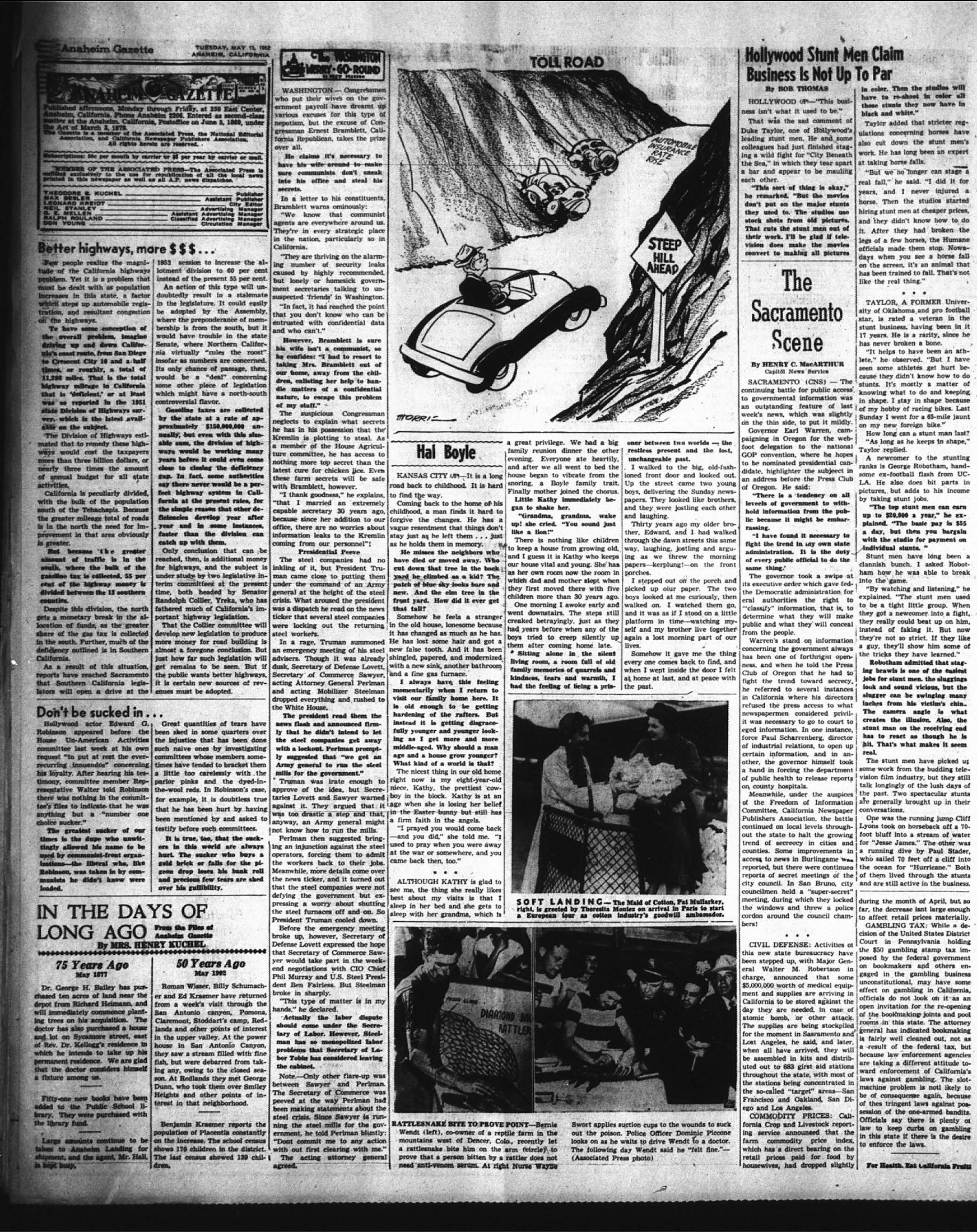
Searchable text
Better highways, more $$$...
Few people realize the magnitude of the California highways problem. Yet it is a problem that must be dealt with as population increases in this state, a factor which steps up automobile registration, and resultant congestion on the highways.
To have some conception of the overall problem, imagine driving up and down California's const route, from San Diego to Crescent City 10 and a half times, or roughly, a total of 11,298 miles. That is the total highway mileage in California that is 'deficient,' or at least was so reported in the 1951 state Division of Highways survey, which is the latest available on the subject.
The Division of Highways estimated that to remedy these highways would cost the taxpayers three billion dollars.
1953 session to increase the allotment division to 60 per cent instead of the present 55 per cent.
An action of this type will undoubtedly result in a stalemate in the legislature. It could easily be adopted by the Assembly, where the preponderance of membership is from the south, but it would have trouble in the state Senate, where Northern California virtually "rules the roost" insofar as numbers are concerned. Its only chance of passage, then, would be a "deal" concerning some other piece of legislation which might have a north-south controversial flavor.
Gasoline taxes are collected by the state at a rate of approximately $150,000,000 annually, but even with this sizeable sum, the division of highways would be working many years before it could ever come...
In Crescent City 16 and a half times, or roughly, a total of 11,298 miles. That is the total highway mileage in California that is 'deficient,' or at least was so reported in the 1951 state Division of Highways survey, which is the latest available on the subject.
The Division of Highways estimated that to remedy these highways would cost the taxpayers more than three billion dollars, or nearly three times the amount of annual budget for all state activities.
California is peculiarly divided, with the bulk of the population south of the Tehachapis. Because the greater mileage total of roads is in the north the need for improvement in that area obviously is greater.
But because the greater amount of traffic is in the south, where the bulk of the gasoline tax is collected, 55 percent of the highway money is divided between the 13 southern counties.
Despite this division, the north gets a monetary break in the allocation of funds, as the greater share of the gas tax is collected in the south. Further, much of the deficiency outlined is in Southern California.
As a result of this situation, reports have reached Sacramento that Southern California legislators will open a drive at the
Don't be sucked in...
Hollywood actor Edward G. Robinson appeared before the House Un-American Activities committee last week at his own request "to put at rest the ever-recurring innuendos" concerning his loyalty. After hearing his testimony, committee member Representative Walter told Robinson there was nothing in the committee's files to indicate that he was anything but a "number one choice sucker."
The greatest sucker of our times is the dupe who unwittingly allowed his name to be used by communist-front organizations—the liberal who, like Great quantities of tears have been shed in some quarters over the injustice that has been done such naive ones by investigating committees whose members sometimes have tended to bracket them a little too carelessly with the parlor pinks and the dyed-in-the-wool reds. In Robinson's case, for example, it is doubtless true that he has been hurt by having been mentioned by and asked to testify before such committees.
It is true, too, that the suckers in this world are always hurt. The sucker who buys a gold brick or falls for the plumber leans his bank roll its only chance of passage, then, would be a "deal" concerning some other piece of legislation which might have a north-south controversial flavor.
Gasoline taxes are collected by the state at a rate of approximately $150,000,000 annually, but even with this sizeable sum, the division of highways would be working many years before it could even come close to closing the deficiency gap. In fact, some authorities say there never would be a perfect highway system in California at the present rates, for the simple reason that other deficiencies develop year after year and in some instances, faster than the division can catch up with them.
Only conclusion that can be reached, then, is additional money for highways, and the subject is under study by two legislative interim committees at the present time, both headed by Senator Randolph Collier, Yreka, who has fathered much of California's important highway legislation.
That the Collier committee will develop new legislation to produce more money for road building is almost a foregone conclusion. But just how far such legislation will get remains to be seen. But if the public wants better highways, it is certain new sources of revenues must be adopted.
The suspicious Congress neglects to explain what she has in his possession that Kremlin is plotting to steal a member of the House Agriculture committee, he has accustomed nothing more top secret than latest cure for chicken lice; these farm secrets will be with Bramblett, however.
"I thank goodness," he exclaims "that I married an extra capable secretary 30 years ago because since her addition to office, there are no worries information leaks to the KKK coming from our personnel."
Presidential Peeve
The steel companies have inkling of it, but President man came close to putting under the command of an general at the height of the crisis. What aroused the prey was a dispatch he read on the ticker that several steel companies were locking out the retractable steel workers.
In a rage, Truman summoned an emergency meeting of his advisers. Though it was a dusk, Secretary of Defense Secretary of Commerce acting Attorney General Peterson and acting Mobilizer Steward dropped everything and rushed to the White House.
The president read them news flash and announced by that he didn't intend to the steel companies get with a lockout. Perlman probably suggested that "we got Army general to run the mills for the government."
Truman was irate enough approve of the idea, but taries Lovett and Sawyer against it. They argued that was too drastic a step and anyway, an Army general not know how to run the mills.
Perlman then suggested using an injunction against the operators, forcing them to take Mrs. Bramblett out our home, away from their drenn, enlisting her help to deal matters of a confidential nature, to escape this process of my staff."
The suspicious Congress neglects to explain what she has in his possession that Kremlin is plotting to steal a member of the House Agriculture committee, he has accustomed nothing more top secret than latest cure for chicken lice; these farm secrets will be with Bramblett, however.
"I thank goodness," he exclaims "that I married an extra capable secretary 30 years ago because since her addition to office, there are no worries information leaks to the KKK coming from our personnel."
Presidential Peeve
The steel companies have inkling of it, but President man came close to putting under the command of an general at the height of the crisis. What aroused the prey was a dispatch he read on the ticker that several steel companies were locking out the retractable steel workers.
In a rage, Truman summoned an emergency meeting of his advisers. Though it was a dusk, Secretary of Defense Secretary of Commerce acting Attorney General Peterson and acting Mobilizer Steward dropped everything and rushed to the White House.
The president read them news flash and announced by that he didn't intend to the steel companies get with a lockout. Perlman probably suggested that "we got Army general to run the mills for the government."
Truman was irate enough approve of the idea, but taries Lovett and Sawyer against it. They argued that was too drastic a step and anyway, an Army general not know how to run the mills.
Perlman then suggested using an injunction against the operators, forcing them to take Mrs. Bramblett out our home, away from their drenn, enlisting her help to deal matters of a confidential nature, to escape this process of my staff."
IN THE DAYS OF
LONG AGO
From the Files of
Anaheim Gianette
By MRS. HENRY KUCHEL
75 Years Ago
May 1877
Dr. George H. Bailey has purchased ten acres of land near the depot from Richard Heimann, and will immediately commence planting trees on his acquisition. The doctor has also purchased a house and lot on Sycamore street, east of Rev. Dr. Kellogg's residence in which he intends to take up his permanent residence. We are glad that the doctor considers himself a fixture among us.
Fifty-one new books have been added to the Public School library. They were purchased with the library fund.
Large amounts continue to be taken to Anaheim Landing for shipment, and the agent, Mr. Hall, is kept busy.
50 Years Ago
May 1902
Roman Wisser, Billy Schumacher and Ed Kraemer have returned from a week's visit through the San Antonio canyon, Pomona, Claremont, Stoddart's camp, Redlands and other points of interest in the upper valley. At the power house in San Antonio Canyon, they saw a stream filled with fine fish, but were debarred from taking any, owing to the closed season. At Redlands they met George Dunn, who took them over Smiley Heights and other points of interest in that neighborhood.
Benjamin Kraemer reports the population of Placentia constantly on the increase. The school census shows 170 children in the district. The last census showed 139 children.
Truman was irate enough approve of the idea, but taries Lovett and Sawyer were against it. They argued that was too drastic a step and anyway, an Army general did not know how to run the mills for the government.
Perlman then suggested ing an injunction against the operators, forcing them to the workers back to their Meanwhile, more details come the news ticker, and it turns that the steel companies were defying the government by pressing a worry about shaking the steel furnaces off and President Truman cooled down.
Before the emergency man broke up, however, Secretary Defense Lovett expressed that Secretary of Commerce would take part in the end negotiations with CIO Phil Murray and U.S. Steelident Ben Fairless. But Stone broke in sharply.
"This type of matter is hands," he declared.
Actually the labor di should come under the tary of Labor. However, man has so monopolized problems that Secretary of bor Tobin has considered le the cabinet.
Note—Only other flare-up between Sawyer and Perl The Secretary of Commerce peeved at the way Perlman been making statements about steel crisis. Since Sawyer ning the steel mills for th ernment, he told Perlman b "Dont commit me to any with out first clearing witf The acting attorney agreed."
WASHINGTON — Congressmen put their wives on the government payroll have dreamt up various excuses for this type of notism, but the excuse of Congressman Ernest Bramblett, California Republican, takes the prize or all.
He claims it's necessary to save his wife around to make more communists don't sneak into his office and steal his secrets.
A letter to his constituents, Bramblett warns ominously:
We know that communist agents are everywhere around us. They're in every strategic place the nation, particularly so in California.
They are thriving on the alarm number of security leaks caused by highly recommended, lonely or homesick governors secretaries talking to unsected 'friends' in Washington.
In fact, it has reached the point you don't know who can be trusted with confidential data who can't."
However, Bramblett is sure wife isn't a communist, so confides: "I had to resort to being Mrs. Bramblett out of home, away from the chil- enlisting her help to han-matters of a confidential future, to escape this problem my staff."
The suspicious Congressman directs to explain what secrets has in his possession that the emin is plotting to steal. As member of the House Agricul- committee, he has access to
TOLL ROAD
AUTOMOBILE INSURANCE RATE RISE
STEEP HILL AHEAD
MORRIS
Hal Boyle
a great privilege. We had a big family reunion dinner the other evening. Everyone ate heartily oner between two restless present a unchangeable past
Hal Boyle
KANSAS CITY (UP)—It is a long road back to childhood. It is hard to find the way.
Coming back to the home of his childhood, a man finds it hard to forgive the changes. He has a vague resentment that things don't stay just as he left them . . . just as he holds them in memory.
He misses the neighbors who have died or moved away. Who cut down that tree in the back yard he climbed as a kid? The patch of blue sky looks bare and new. And the elm tree in the front yard. How did it ever get that tall?
Somehow he feels a stranger in the old house, lonesome because it has changed as much as he has. He has lost some hair and got a new false tooth. And it has been shingled, papered, and modernized with a new sink, another bathroom and a fine gas furnace.
I always have this feeling momentarily when I return to visit our family home here. It is old enough to be getting hardening of the rafters. But instead it is getting disgracefully younger and younger looking as I get more and more middle-aged. Why should a man age and a house grow younger? What kind of a world is that?
The nicest thing in our old home right now is my eight-year-old niece, Kathy, the prettiest cowboy in the block. Kathy is at an age when she is losing her belief in the Easter bunny but still has a firm faith in the angels.
"I prayed you would come back—and you did," she told me. "I used to pray when you were away at the war or somewhere, and you came back then, too."
Little Kathy immediately began to shake her.
"Grandma, grandma, wake up! she cried. 'You sound just like a lion!'
There is nothing like children to keep a house from growing old, and I guess it is Kathy who keeps our house vital and young. She has as her own room now the room in which dad and mother slept when they first moved there with five children more than 30 years ago.
One morning I awoke early and went downstairs. The steps still creaked betrayingly, just as they had years before when any of the boys tried to creep silently up them after coming home late.
*Sitting alone in the silent living room, a room full of old family memories of quarrels and kindness, tears and warmth, I had the feeling of being a pristine between two restless present and unchangeable past.
I walked to the iron front door and Up the street came boys, delivering the papers. They looked at me and they were jostling and laughing.
Thirty years ago after Edward, and through the dawn strife way, laughing, jostling as we threw papers—kerplung!—porches.
I stepped out on picked up oiur paper boys looked at me on walked on. I watched and it was as if I strolled platform in time—self and my brother again a lost morning lives.
Somehow it gave every one comes back when I went inside at home at last, and the past.
RATTLESNAKE BITE TO PROVE POINT—Bernie Wendt (left), co-owner of a reptile farm in the mountains west of Dencer, Colo., recently let a rattlesnake bite him on the arm (circle) to prove that a person bitten by a rattler does not need anti-venom serum. At right Nurse Wayna
Swort applies suction cups to the wounds out the poison. Police Officer Domino looks on as he waits to drive Wendt. The following day Wendt said he "Associated Press photo"
Hollywood Stunt Men Claim Business Is Not Up To Par
By BOB THOMAS
HOLLYWOOD — "This business isn't what it used to be."
That was the sad comment of Duke Taylor, one of Hollywood's leading stunt men. He and some colleagues had just finished staging a wild fight for "City Beneath the Sea," in which they tear apart a bar and appear to be mauling each other.
"This sort of thing is okay," he remarked. "But the movies don't put on the major stunts they used to. The studios use stock shots from old pictures. That cuts the stunt men out of their work. I'll be glad if television does make the movies convert to making all pictures"
The Sacramento Scene
By HENRY C. MacARTHUR
Capitol News Service
SACRAMENTO (CNS) — The continuing battle for public access to governmental information was an outstanding feature of last week's news, which was slightly on the thin side, to put it mildly.
Governor Earl Warren, campaigning in Oregon for the web-foot delegation to the national GOP convention, where he hopes in color. Then the studios will have to re-shoot in color all those stunts they now have in black and white."
Taylor added that stricter regulations concerning horses have also cut down the stunt men's work. He has long been an expert at taking horse falls.
"But we no longer can stage a real fall," he said. "I did it for years, and I never injured a horse. Then the studios started hiring stunt men at cheaper prices, and they didn't know how to do it. After they had broken the legs of a few horses, the Humane officials made them stop. Nowadays when you see a horse fall on the screen, it's an animal that has been trained to fall. That's not like the real thing."
TAYLOR, A FORMER University of Oklahoma and pro football star, is rated a veteran in the stunt business, having been in it 17 years. He is a rarity, since he has never broken a bone.
"It helps to have been an athlete," he observed. "But I have seen some athletes get hurt because they didn't know how to do stunts. It's mostly a matter of knowing what to do and keeping in shape. I stay in shape because of my hobby of racing bikes. Last Sunday I went for a 65-mile jaunt on my new foreign bike."
How long can a stunt man last?
"As long as he keeps in shape," Taylor replied.
A newcomer to the stunting
oner between two worlds — the restless present and the lost, unchangeable past.
I walked to the big, old-fashioned front door and looked out. Up the street came two young boys, delivering the Sunday newspapers. They looked like brothers, and they were jostling each other and laughing.
Thirty years ago my older brother, Edward, and I had walked through the dawn streets this same way, laughing, jostling and arguing as we threw the morning papers—kerplung!—on the front porches.
I stepped out on the porch and picked up our paper. The two boys looked at me curiously, then walked on. I watched them go, and it was as if I stood on a little platform in time—watching myself and my brother live together again a lost morning part of our lives.
Somehow it gave me the thing every one comes back to find, and when I went inside the door I felt at home at last, and at peace with the past.
By HENRY C. MACARTHUR
Capitol News Service
SACRAMENTO (CNS) — The continuing battle for public access to governmental information was an outstanding feature of last week's news, which was slightly on the thin side, to put it mildly.
Governor Earl Warren, campaigning in Oregon for the web-foot delegation to the national GOP convention, where he hopes to be nominated presidential candidate, highlighter the subject in an address before the Press Club of Oregon. He said:
“There is a tendency on all levels of government to withhold information from the public because it might be embarrassing.
"I have found it necessary to fight the trend in lay own state administration. It is the duty of every public official to do the same thing."
The governor took a swipe at its executive order which gave federal Democratic administration foreral authorities the right to "classify" information, that is, to determine what they will make public and what they will conceal from the people.
Warren's stand on information concerning the government always has been one of forthright openness, and when he told the Press Club of Oregon that he had to fight the trend toward secrecy, he referred to several instances in California where his directors refused the press access to what newspapermen considered privilitit was necessary to go to court to eged information. In one instance, force Paul Scharrenberg, director of industrial relations, to open up certain information, and in another, the governor himself took a hand in forcing the department of public health to release reports on county hospitals.
Meanwhile, under the auspices of the Freedom of Information Committee, California Newspaper Publishers Association, the battle continued on local levels throughout the state to halt the growing trend of secrecy in cities and counties. Some improvements in access to news in Burlingame was reported, but there were continue seen some athletes get hurt because they didn't know how to do stunts. It's mostly a matter of knowing what to do and keeping in shape. I stay in shape because of my hobby of racing bikes. Last Sunday I went for a 65-mile jaunt on my new foreign bike."
How long can a stunt man last?
“As long as he keeps in shape,” Taylor replied.
A newcomer to the stunting ranks is George Robotham, handsome ex-football flash from UCLA. He also does bit parts in pictures, but adds to his income by taking stunt jobs.
“The top stunt men can earn up to $20,000 a year,” he explained. “The basic pay is $55 a day, but then you bargain with the studio for payment on individual stunts.”
Stunt men have long been a clannish bunch. I asked Robotham how he was able to break into the game.
“By watching and listening,” he explained. “The stunt men used to be a tight little group. When they got a newcomer into a fight, they really could beat up on him, instead of faking it. But now they're not so strict. If they like a guy, they'll show him some of the tricks they have learned.”
Robotham admitted that staging brawls is one of the easiest jobs for stunt men. The sluggings look and sound vicious, but the slugger can be swinging many inches from his victim's chin.
The camera angle is what creates the illusion. Also, the stunt man on the receiving end has to react as though he is hit. That's what makes it seem real.
The stunt men have picked up some work from the budding television film industry, but they still talk longingly of the lush days of the past. Two spectacular stunts are generally brought up in their conversations.
One was the running jump Cliff Lyons took on horseback off a 70-foot bluff into a stream of water for "Jesse James." The other was a running dive by Paul Stader, who sailed 70 feet off a cliff into the ocean for "Hurricane." Both
of public health to release reports on county hospitals.
Meanwhile, under the auspices of the Freedom of Information Committee, California Newspaper Publishers Association, the battle continued on local levels throughout the state to halt the growing trend of secrecy in cities and counties. Some improvements in access to news in Burlingame was reported, but there were continued reports of secret meetings of the city council. In San Bruno, city councilmen held a "super-secret" meeting, during which they locked the windows and threw a police cordon around the council chambers!
CIVIL DEFENSE: Activities of this new state bureaucracy have been stepped up, with Major General Walter M. Robertson in charge, announced that some $5,000,000 worth of medical equipment and supplies are arriving in California to be stored against the day they are needed, in case of atomic bomb, or other attack. The supplies are being stockpiled for the moment in Sasramento and Lost Angeles, he said, and later, when all have arrived, they will be assembled in kits and distributed out to 683 girst aid stations throughout the state, with most of the stations being concentrated in the so-called "target" areas—San Francisco and Oakland, San Diego and Los Angeles.
COMMODITY PRICES: California Crop and Livestock reporting service announced that the farm commodity price index, which has a direct bearing on the retail prices paid for food by housewives, had dropped slightly
vision film industry, but they still talk longingly of the lush days of the past. Two spectacular stunts are generally brought up in their conversations.
One was the running jump Cliff Lyons took on horseback off a 70-foot bluff into a stream of water for "Jesse James." The other was a running dive by Paul Stader, who sailed 70 feet off a cliff into the ocean for "Hurricane." Both of them lived through the stunts and are still active in the business.
during the month of April, but so far, the decrease is not large enough to affect retail prices materially.
GAMBLING TAX: While a decision of the United States District Court in Pennsylvania holding the $50 gambling stamp tax imposed by the federal government on bookmakers and others engaged in the gambling business unconstitutional, may have some effect on gambling in California, officials do not look on it as an open invitation for the re-opening of the bookmaking joints and pool rooms in this state. The attorney general has indicated bookmaking is fairly well cleaned out, not as a result of the federal tax, but because law enforcement agencies are taking a different attitude toward enforcement of California's laws against gambling. The slot-machine problem is not likely to be of consequence again, because of these tringent laws against possession of the one-armed bandits. Officials say there is plenty of law to keep curbs on gambling in this state if there is the desire to enforce the laws.
For Health. Eat California Fruits