anaheim-gazette 1952-04-22
Scanned page
Searchable text
6 Anaheim Gazette
TUESDAY, APRIL 28, 1954
ANAHEIM, CALIFORNIA
Published afternoons, Monday through Friday, at 259 East Center,
Anaheim, California. Phone Anaheim 2206. Entered as second-class
matter at the Anaheim, California, Postoffice on June 3, 1869, under
the Act of March 3, 1879.
The Gazette is a member of the Associated Press, the National Editorial
Association, and California Newspaper Publishers Association.
All rights herein are reserved.
Subscriptions: $6 per month by carrier or $6 per year by carrier or mail.
MEMBER OF THE ASSOCIATED PRESS—The Associated Press is
entitled exclusively to the use for republication of all the local news
printed in this newspaper as well as all A.P. news dispatches.
THEODORE B. KUCHEL
MAX-BESLER
LEONARD KREIDT
NEIL STANLEY
G. E. MELLEN
RALPH ROULAND
DON YOUNG
Publisher
Assistant Publisher
City Editor
Advertising Manager
Advertising Manager
Classified Advertising Manager
Circulation Manager
Let's talk about this school book...
Last week the notoriously anti-public schools Santa Ana Register published an indictment of a book used in Anaheim high school called "Our Changing Social Order"—a book used in sociology classes.
Anaheim businessmen, the Register said, prepared the case against the book.
The writer of this piece (you are now reading) got a copy of "Our Changing Social Order", and read it. He found it a rather typical sociology text book. Sociology is often a particularly frank science which tries to strip away the frills and prejudices and get at the naked truth of the institutions and systems which shape our associations with one another—it wants to show how society develops and humans progress.
Sociology often pulls no punches, it attempts to describe things as they actually are, to get at the bottom of matters affecting the human race—sometimes the truth hurts. (For this where mass production, full use of skilled labor, machinery, materials, etc., is producing attractive (tract) houses at a price which makes more and more home owners.
It gives a chronological history of the entry of local, state, and national agencies into public housing. (Whether you like it or not, they are there.) Included is a brief statement on the provisions of the Wagner-Ellender-Taft housing bill, which included among its sponsors a current Republican presidential candidate. (The book tells us what Trump is doing now in Europe making a surprise of General Eisenhower's words; he concludes his European signment and of Russia' curry drive to upset the formation of unified European army.)
PARIS—If Dwight D. Eisenhower is elected president, time may come when American publishers and newsmen who obterate Truman will look back at the free-and-easy press relations of today with signs of nostalgia longing. For Ike's press relation are going to be a lot different from the present system, until which a newspaperman can then any question under the sun. Harry Truman and have him the ball back most of the time. They will also be a lot different from the present system where a White House conference can be quoted verbatim excerpts for putting quotation marks around the president's actual words.
Ike just isn't going to do that way. His press relations are pleasant and cordial but are played according to his rules. And his rules so far do not permit questions. Current White House rules whereby you can ask Truman "have you written any more letters to music critics?" or "who is your candidate for president?" are out wi Ike.
Furthemore it looks as if fire and open press conferences, such as those conducted by Senat Taft and other candidates, would...
Sociology often pulls no punches, it attempts to describe things as they actually are, to get at the bottom of matters affecting the human race—sometimes the truth hurts. (For this reason we don't like sociology!)
The teacher genuinely hostile to any way of life, whether it is American, or foreign, probably could teach sociology in such a way as to be highly critical of any existing system of human association. The book being discussed here might be used that way, too, by emphasis on certain selected passages and attempting to show our way of life hasn't measured up.
But, by the same measure, the teacher would have a whale of a hard time explaining to a classroom full of sharpshooters the hundreds of other passages in the book which describe, in this case, the American way of life.
To be absolutely fair about the thing, then, if taught by a subversive teacher who was cleverly selective in the material he used, we'll concede "Our Changing Social Order"—as can many another respectable book — could be used to criticize some of the American ways of doing things.
But, used in combination with other books of the social sciences—as it is in Anaheim high school classes—this text on the whole possibly is a rather valuable instrument in preparing students for some of the realities of life which they will experience beyond their school years. Things they will learn from experience—some of it perhaps bitter.
THE BOOK HAS been challenged. From reading the critical report, and then reading the book, we are of the opinion it is almost impossible to give a complete hearing on a 607 page book in a short critical report.
An instance: "Coming to com-
It gives a chronological history of the entry of local, state, and national agencies into public housing. (Whether you like it or not, they are there.) Included is a brief statement on the provisions of the Wagner-Ellender-Taft housing bill, which included among its sponsors a current Republican presidential candidate. (The book omits telling the nature of the opposition to the bill.)
The book expressed the opinion that probably Congress would adopt programs to stimulate the building of homes for families of low- and middle-income groups.
"The program," the book states, "will certainly be planned to aid private enterprise to do as much of the job as possible."
The book then says when building is stimulated, it aids the nation's prosperity.
(Incidentally, there is a blunt statement on how labor unions sometimes contribute to the high cost of home building. This should delight any private builder. And, a mention of over-zealous building codes — of local governments — would hardly warm a socialist's heart.)
ON SCHOOLS, the report unfavorably alludes to the book's long discussion of "progressive education." The book itself, however, implies our schools are pretty good but that they could be-improved.
The book points out there is a feeling by many people that progressive education would meet the complaints of employers that students are not drilled in the fundamentals of reading, writing, spelling and arithmetic; that instead of "book learning" alone, youngsters need vocational training . . . teaching them things which can be used responsibly in real-life, competitive situations. The book then tells how some educators feel these complaints of employers can be met through more progressive education.
WE CITE those few points above because we can make more and more home owners.
And his rules so far do not permit questions. Current White House rules whereby you can ask Truman "have you written any more letters to music critics?" or "who is your candidate for president?" are out with Ike.
Furthemore it looks as if fire and open press conferences, such as those conducted by Senator Taft and other candidates, would be out when Ike gets back to the USA between June 1 and the Chicago convention. There will be some press conferences but rarely many, and detailed questions will not be encouraged. In brief, the old Herbert Hoover system when by questions had to be submitted in writing 24 hours in advance may be the order of the day under the next Republican president.
British Don't Want Bradley
Eisenhower's personal prestige and popularity are so great Europe that the job of replacing him is much more difficult than is generally appreciated. If weren't for a little-known even in a muddy Dutch village during the winter of 1944, Gen. Omni Bradley, chairman of the Joint Chiefs of Staff, would be the natural choice.
At that time General Bradley had suffered a setback in the Battle of the Bulge following which his First and Ninth Armies were economic liberty and economic opportunity for all."
EVEN SO, all the foregoing could indicate that in a critical report, or in an article such as this one, it is difficult to render complete judgment on a 607 page text book. There just isn't space to tell the whole story.
We have become interested in this "controversy" for this reason:
The greatest danger resulting from expressing a critical view-point on a textbook in public is the frightening prospect that people in the community, on the basis of seant information, will begin to distrust their school teachers—will drive a wedge be-
THE BOOK HAS been challenged. From reading the critical report, and then reading the book, we are of the opinion it is almost impossible to give a complete hearing on a 607 page book in a short critical report.
An instance: "Coming to compulsory health insurance, the book speaks entirely in favor of socialized medicine. The system most frequently recommended is that in effect in Great Britain." (That is a criticism the book.)
Turning to the book, the sentence about Great Britain was used-in-passing to describe those "industrial countries" of the world which have some form of health insurance. The sentence in no way was connected with the United States. In the main, the discussion on health posed a typical sociology question: "how can the family of average means pay doctor bills?"
The book then describes the various health plans now in effect in the United States (not one of them compulsory), including a plan of the American Medical Association and a plan known to be favored by some local physicians.
In a section on housing it poses another typical sociology question: how can lower wage groups get new houses?
It then tells why the cost of housing is high and says "prefabrication" of houses is a way to more inexpensive housing and gives quite a discussion (of what is called in Anaheim "tract housing") to the housing development
WE CITE those few points above because we can dispose of them quickly. We won't discuss the hundreds of points which fairly treat the American way of life, except to quote these words on Page 339-340 of this so-called socialist book:
"One of our nation's oldest and most cherished ideals is free private enterprise. Americans believe that anyone who wants to should be able to go into business for himself. In this way he can 'be his own boss' and, if he is lucky, become economically independent. The right to go into business is, we think, as important as any of our other democratic rights."
"Our goal has been a great number of small- and medium-sized businesses, with free competition between them. In such an economy any intelligent and hardworking individual who wants to start a business has a reasonably good chance to succeed. New inventions and new ideas are quickly put to work, with the result that employment is found for idle men and idle resources. There are many employers, and a worker who is dissatisfied with his job may easily find another one. Consumers have a choice between many kinds and qualities of products, and between many different suppliers. Thus free competition results in a maximum amount of
to tell the whole story.
We have become interested in this "controversy" for this reason:
The greatest danger resulting from expressing a critical viewpoint on a textbook in public is the frightening prospect that people in the community, on the basis of seant information, will begin to distrust their school teachers—will drive a wedge between our public schools and the men and women in the community who must be friends of the schools if our educational system is to continue.
The book "Our Changing Social Order" has been challenged. It is suspect, it could cause friction between some of our leading citizens and our schools.
None of us wants this to happen. If people are genuinely concerned about the book, then why shouldn't this be done?
The critics of the book meet with representative parents, some school officials, and the teacher using the book.
They all read it together honestly—every line, not just selected excerpts—discussing it as they go, much the same way it is done in the school.
When they finish, if the mothers and fathers agree the book is well-balanced, everybody should kiss and make up—if they don't like it, get another text.
But, let's don't allow the irritation now started to hang fire.
If the light of freedom in the classrooms is ever dimmed by distrust and bickering—or book burning—a major disaster will have befallen America. Then, the advocates of totalitarianism will have scored a decisive battle over us without firing a shot.
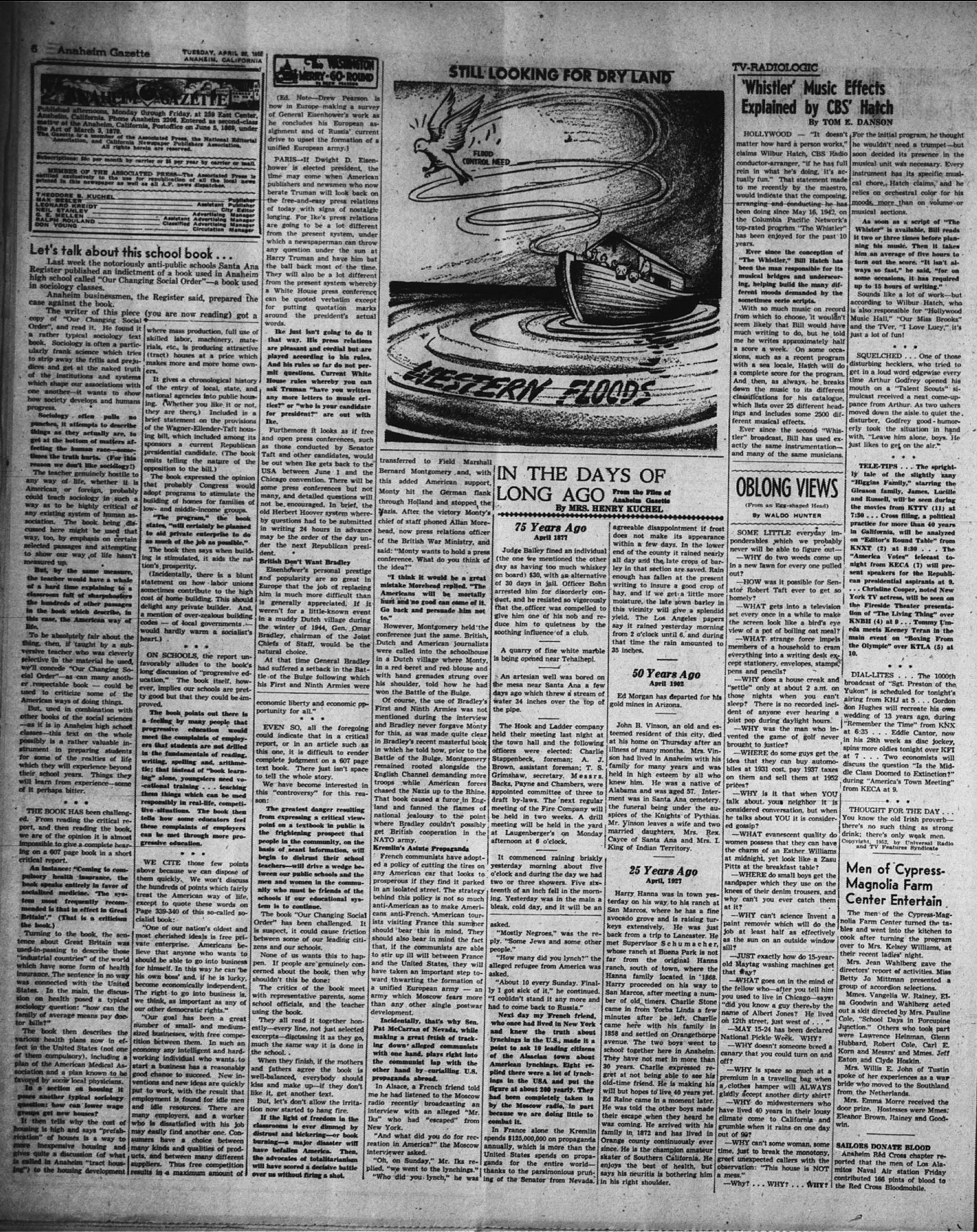
STILL LOOKING FOR DRY LAND
FLOOD CONTROL NEED
WESTERN FLOODS
transferred to Field Marshall Bernard Montgomery and, with this added American support, Monty hit the German flank through Holland and stopped the Nazis. After the victory Monty's chief of staff phoned Allan Morehead, now press relations officer of the British War Ministry, and said: "Monty wants to hold a press conference. What do you think of the idea?"
"I think it would be a great mistake Morehead replied. 'The Americans will be mortally hurt and no good can come of it. Go back and persuade him not to.'
However, Montgomery held the conference just the same. British, Dutch and American journalists were called into the schoolhouse in a Dutch village where Monty, in a red beret and red blouse and with hand grenades strung over his shoulder, told how he had won the Battle of the Bulge.
Of course, the use of Bradley's First and Ninth Armies was not mentioned during the interview and Bradley never forgave Monty for this, as was made quite clear in Bradley's recent masterful book in which he told how, prior to the Battle of the Bulge, Montgomery remained rooted alongside the English Channel demanding more troops while American forces chased the Nazis up to the Rhine. That book caused a furor in England and fanned the flames of national jealousy to the point where Bradley couldn't possibly get British cooperation in the NATO army.
Kremlin's Astute Propaganda
French communists have adopted a policy of cutting the tires on
IN THE DAYS OF LONG AGO From the Files of Anaheim Gasette By MRS. HENRY KUCHEL
75 Years Ago
April 1877
Judge Bailey fined an individual (the one we mentioned the other day as having too much whiskey on board) $30, with an alternative of 30 days in jail. Officer Bohn arrested him for disorderly conduct, and he resisted so vigorously that the officer was compelled to give him one of his nob and reduce him to quietness by the soothing influence of a club.
A quarry of fine white marble is being opened near Tehaihepi.
An artesian well was bored on the mesa near Santa Ana a few days ago which threw a stream of water 34 inches over the top of the pipe.
The Hook and Ladder company held their meeting last night at the town hall and the following officers were elected: Charlie Stappenbeck, foreman; A. J. Brown, assistant foreman; T. S. Grimshaw, secretary. Messrs. Backs, Payne and Chambers, were appointed committee of three to draft by-laws. The next regular meeting of the Fire Company will be held in two weeks. A drill meeting will be held in the yard at Laugenberger's on Monday afternoon at 6 o'clock.
It commenced raining briskly yesterday morning about five agreeable disappointment does not make its attempt within a few days. In end of the county it rain all day and the late crouch in that section are so enough has fallen at the writing to insure a good hay, and if we get a 10 moisture, the late sown this vicinity will give a yield. The Los Angeles say it rained yesterday from 2 o'clock until 6 a.m. that time the rain amps up 35 inches.
50 Years Ago
April 1902
Ed Morgan has departed gold mines in Arizona.
John B. Vinson, an old teemed resident of this city at his home on Thursday, illness of many months. Son had lived in Anaheim family for many years but held in high esteem by knew him. He was a Alabama and was aged 50 ment was in Santa Ana at the funeral being under spices of the Knights of Mr. Yinson leaves a wife married daughters, Mr Cayce of Santa Ana and King of Indian Territory.
greatest danger resulting in
prospect that the community, on the
seant information, will
distrust their school
will drive a wedge beer public schools and the
women in the commumust be friends of the
of our educational systo continue.
Our Changing Social
has been challenged. It
it could cause friction
some of our leading citinour schools.
We want this to happeople are genuinely comout the book, then why
this be done:
Metrics of the book meet
presentative parents, some
officials, and the teacher
book.
I read it together honery line, not just selected
discussing it as they go,
same way it is done in
They finish, if the mothers
agree the book is
used, everybody should
make up—if they don't
another text.
We don't allow the irritation to hang fire.
Right of freedom in the
is ever dimmed by
and bickering—or book
a major disaster will
fall America. Then,
states of totalitarianism
scored a decisive battle
without firing a shot.
French communists have adopted a policy of cutting the tires on any American car that looks to prosperous if they find it parked in an isolated street. The strategy behind this policy is not so much anti-American as to make Americans anti-French. American tourists visiting France this summer should bear this in mind. They should also bear in mind the fact that, if the communists are able to stir up ill will between France and the United States, they will have taken an important step toward thwarting the formation of a unified European army — an army which Moscow fears more than any other single postwar development.
Incidentally, that's why Sen.
Pat McCarran of Nevada, while making a great fetish of tracking down alleged communists with one hand, plays right into the communist lap with the other hand by curialling U.S. propaganda abroad.
In Alsace, a French friend told me he had listened to the Moscow radio recently broadcasting an interview with an alleged "Mr. Iks" who had "escaped" from New York.
"And what did you do for recreation in America?" the Moscow interviewer asked.
"Oh, on Sunday," Mr. Iks replied, "we went to the lynchings."
"Who did you lynch," he was troops while American forces chased the Nazis up to the Rhine. That book caused a furor in England and fanned the flames of national jealousy to the point where Bradley couldn't possibly get British cooperation in the NATO army.
Kremlin's Astute Propaganda
French communists have adopted a policy of cutting the tires on any American car that looks to prosperous if they find it parked in an isolated street. The strategy behind this policy is not so much anti-American as to make Americans anti-French. American tourists visiting France this summer should bear this in mind. They should also bear in mind the fact that, if the communists are able to stir up ill will between France and the United States, they will have taken an important step toward thwarting the formation of a unified European army — an army which Moscow fears more than any other single postwar development.
Incidentally, that's why Sen.
Pat McCarran of Nevada, while making a great fetish of tracking down alleged communists with one hand, plays right into the communist lap with the other hand by curialling U.S. propaganda abroad.
In Alsace, a French friend told me he had listened to the Moscow radio recently broadcasting an interview with an alleged "Mr. Iks" who had "escaped" from New York.
"And what did you do for recreation in America?" the Moscow interviewer asked.
"Oh, on Sunday," Mr. Iks replied, "we went to the lynchings."
"Who did you lynch," he was
It commenced raining briskly yesterday morning about five o'clock and during the day we had two or three showers. Five sixteenth of an inch fell in the morning. Yesterday was in the main a bleak, cold day, and it will be an asked.
"Mostly Negroes," was the reply. "Some Jews and some other people."
"How many did you lynch?" the alleged refugee from America was asked.
"About 10 every Sunday. Finally I got sick of it," he continued. "I couldn't stand it any more and had to come back to Russia."
Next day my French friend, who once had lived in New York and knew the truth about lynchings in the U.S., made it a point to ask 10 leading citizens of the Alsacian town about American lynchings. Eight replied there were a lot of lynchings in the USA and put the figure at about 200 yearly. They had been completely taken in by the Moscow radio, in part because we are doing little to combat it.
In France alone the Kremlin spends $125,000,000 on propaganda annually, which is more than the United States spends on propaganda for the entire world—thanks to the parsimonious pruning of the Senator from Nevada.
Harry Hanna was in toterday on his way to his
San Marcos, where he haavocado grove and is raidkeys extensively. He w耳 back from a trip to Lancemet Supervisor Schum,
whose ranch at Buena Park far from the original ranch, south of town, wh耳 Hanna family located in Harry proceeded on his San Marcos, after meeting ber of old timers. Charlie came in from Yorba Lindminutes after he left. He came here with his fair 1858 and settled on Orange avenue. The two boys w耳 school together here in Athey have not met in moo 30 years. Charlie express gret at not being able to old-time friend. He is made will but hopes to live 40 ye-Ed Raine came in a moment. He was told the other boys their escape when they he was coming. He arrived w耳 family in 1872 and has life Orange county continuously since. He is the champion ar skater of Southern California enjoys the best of health says his neuritis is bothering in his right shoulder.
TV-RADIOLOGIC
'Whistler' Music Effects Explained by CBS' Hatch
By TOM E. DANSON
HOLLYWOOD — "It doesn't matter how hard a person works," claims Wilbur Hatch, CBS Radio conductor-arranger, "if he has full rein in what he's doing, it's actually fun." That statement made to me recently by the maestro, would indicate that the composing, arranging and conducting he has been doing since May 16, 1942, on the Columbia Pacific Network's top-rated program 'The Whistler' has been enjoyed for the past 10 years.
Ever since the conception of "The Whistler," Bill Hatch has been the man responsible for its musical bridges and underscoring, helping build the many different moods demanded by the sometimes eerie scripts.
With so much music on record from which to choose, it wouldn't seem likely that Bill would have much writing to do, but he told me he writes approximately half a score a week. On some occasions, such as a recent program with a sea locale, Hatch will do a complete score for the program. And then, as always, he breaks down the music to its different classifications for his catalogue, which lists over 25 different headings and includes some 2500 different musical effects.
Ever since the second "Whistler" broadcast, Bill has used exactly the same instrumentation—and many of the same musicians.
For the initial program, he thought he wouldn't need a trumpet—but soon decided its presence in the musical unit was necessary. Every instrument has its specific musical chore., Hatch claims, and he relies on orchestral color for his moods, more than on volume or musical sections.
As soon as a script of "The Whister" is available, Bill reads it two or three times before planning his music. Then it takes him an average of five hours to turn out the score. "It isn't always so fast," he said, "for on some occasions, it has required up to 15 hours of writing."
Sounds like a lot of work—but according to Wilbur Hatch, who is also responsible for "Hollywood Music Hall," "Our Miss Brooks" and the TVVer, "I Love Lucy," it's just a lot of fun!
SQUELCHED . . . One of those disturbing hecklers, who tried to get in a loud word edgewise every time Arthur Godfrey opened his mouth on a "Talent Scouts" simulcast received a neat come-up dance from Arthur. As two ushers moved down the aisle to quiet the disturber, Godfrey good-homerly took the situation in hand with, "Leave him alone, boys. He just likes to get on the air."
YS OF
From the Files of Anaheim Gasette
RY KUCHEL
agreeable disappointment if frost does not make its appearance within a few days. In the lower end of the county it rained nearly all day and the late crops of barley in that section are saved. Rain enough has fallen at the present writing to insure a good crop of hay, and if we get a little more moisture, the late sown barley in this vicinity will give a splendid yield. The Los Angeles papers say it rained yesterday morning from 2 o'clock until 6, and during that time the rain amounted to 35 inches.
50 Years Ago
April 1902
Ed Morgan has departed for his cold mines in Arizona.
John B. Vinson, an old and esteemed resident of this city, died at his home on Thursday after an illness of many months. Mrs. Vinson had lived in Anaheim with his family for many years and was held in high esteem by all who knew him. He was a native of Alabama and was aged 57. Interment was in Santa Ana cemetery. The funeral being under the auspices of the Knights of Pythias. Mr. Vinson leaves a wife and two married daughters, Mrs. Rex. Jayce of Santa Ana and Mrs. I. King of Indian Territory.
OBLONG VIEWS
(From an Egg-shaped Head)
By WALDO HUNTER
SOME LITTLE everyday imponderables which we probably never will be able to figure out—
WHY do two weeds come up in a new lawn for every one pulled out?
HOW was it possible for Senator Robert Taft ever to get so homely?
WHAT gets into a television set once in a while to make the screen look like a bird's eye view of a pot of boiling oat meal?
WHAT strange force impels members of a household to cram everything into a writing desk except stationery, envelopes, stamps, pens and pencils?
WHY does a house creak and "settle" only at about 2 a.m. on those nights when you can't sleep? There is no recorded incident of anyone ever hearing a joist pop during daylight hours.
WHY was the man who invented the game of golf never brought to justice?
WHERE do some guys get the idea that they can buy automobiles at 1931 cost, pay 1937 taxes on them and sell them at 1952 prices?
WHY is it that when YOU talk about your neighbor it is considered conversation, but when he talks about YOU it is considered gossip?
WHAT evanescent quality do women possess that they can have the charm of an Esther Williams at midnight, yet look like a Zasu Pitts at the breakfast table?
TELE-TIPS . . . The sprightly tale of the slightly zany "Higgins Family," starring the Gleason family, James, Lucille and Russell, will be seen during the movies from KTTV (11) at 7:30 . . . Cross filing, a political practice for more than 40 years in California, will be analyzed on "Editor's Round Table" from KNXT (2) at 8:30 . . . The "America Votes" telecast tonight from KECA (7) will present speakers for the Republican presidential aspirants at 9. . . Christine Cooper, noted New York TV actress, will be seen on the Fireside Theater presentation of "The Living Thing" over KNBH (4) at 9 . . Tommy Umeda meets Keeney Teran in the main event on "Boxing From the Olympic" over KTLA (5) at 10.
DIAL-LITES . . . The 1000th broadcast of "Sgt. Preston of the Yukon" is scheduled for tonight's airing from KHJ at 5 . . . Gordon don Hughes will recreate his own wedding of 13 years ago, during "Remember the Time" from KNX at 6:35 . . . Eddie Cantor, now in his 28th week as disc jockey, spins more oldies tonight over KFI at 7 . . . Two economists will discuss the question "Is the Middle Class Doomed to Extinction?" during "America's Town Meeting" from KECA at 9.
THOUGHT FOR THE DAY . . .
You know the old Irish proverb—there's no such thing as strong drink; there's only weak men.
Copyright, 1952, by Universal Radio and TV Features Syndicate
25 Years Ago
April, 1927
Harry Hanna was in town yesterday on his way to his ranch at San Marcos, where he has a fine vinecado grove and is raising turkeys extensively. He was just back from a trip to Lancaster. He met Supervisor Schumacher, whose ranch at Buena Park is not far from the original Hanna ranch, south of town, where the ranna family located in '1868. Harry proceeded on his way to San Marcos, after meeting a number of old timers. Charlie Stone came in from Yorba Linda a few minutes after he left. Charlie came here with his family in 1958 and settled on Orangethorpe Avenue. The two boys went to school together here in Anaheim. They have not met in more than five years. Charlie expressed regret at not being able to see his late friend. He is making his but hopes to live 40 years yet. Raine came in a moment later. He was told the other boys made their escape when they heard he was coming. He arrived with his fully in 1872 and has lived in Orange county continuously ever since. He is the champion amateur writer of Southern California. He boys the best of health, but as his neuritis is bothering him this right shoulder.
WHY is it that when YOU talk about your neighbor it is considered conversation, but when he talks about YOU it is considered gossip?
WHAT evanescent quality do women possess that they can have the charm of an Esther Williams at midnight, yet look like a Zasu Pitts at the breakfast table?
WHERE do small boys get the sandpaper which they use on the knees of their denim trousers, and why can't you ever catch them at it?
WHY can't science invent a paint remover which will do the job at least half as effectively as the sun on an outside window sill?
JUST exactly how do 15-year-old Maytag washing machines get that way?
WHAT goes on in the mind of the fellow who—after you tell him you used to live in Chicago—says: "did you know a guy there by the name of Albert Jones? He lived on 12th street, just west of . . ."
MAY 15-24 has been declared National Pickle Week. WHY?
WHY doesn't someone breed a canary that you could turn on and off?
WHY is space so much at a premium in a traveling bag when a clothes hamper will ALWAYS gladly accept another dirty shirt?
WHY do midwesterners who have lived 40 years in their lousy climate come to California and grumble when it rains on one day out of 99?
WHY can't some woman, some time, just to break the monotony, greet unexpected callers with the observation: "This house is NOT a mess."
Why? . . . WHY? . . . WHY?
THOUGHT FOR THE DAY... You know the old Irish proverb—there's no such thing as strong drink; there's only weak men.
Copyright, 1952, by Universal Radio and TV Features Syndicate
Men of Cypress-Magnolia Farm Center Entertain
The men of the Cypress-Magnolia Farm Center turned the tables and went into the kitchen to cook after turning the program over to Mrs. Kelsey Williams, at their recent ladies' night.
Mrs. Jean Wahlberg gave the directors' report of activities. Miss Betty Jo Mittman presented a group of accordion selections.
Mmes. Vangelia W. Rainey, Elsa Goodwin and Wahlberg acted out a skit directed by Mrs. Pauline Cole, "School Days in Porcupine Junction." Others who took part were Lawrence Heinman, Glenn Hubbard, Robert Cole, Carl E. Korn and Messrs' and Mmes. Jeff Eaton and Clyde Hoskin.
Mrs. Willis E. John of Tustin spoke of her experiences as a war bride who moved to the Southland from the Netherlands.
Mrs. Emma Morre received the door prize. Hostesses were Mmes: Eleahor Brown, Jainey and Goodwin.
SAILORS DONATE BLOOD
Anaheim Red Cross chapter reported that the men of Los Alamitos Naval Air station contributed 166 pints of blood to the Red Cross Bloodmobile.