anaheim-gazette 1952-02-01
Scanned page
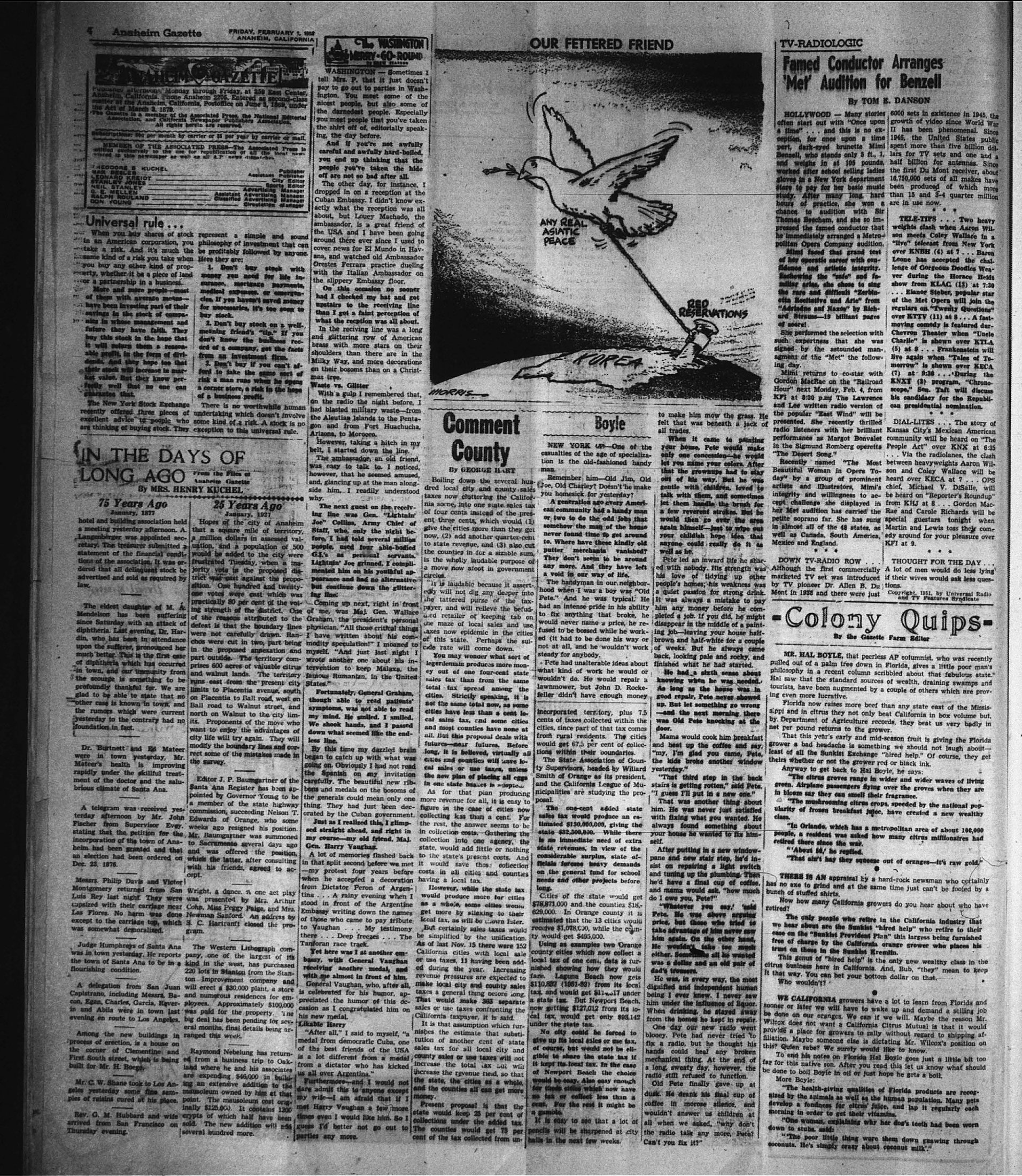
Searchable text
Universal rule ...
When you buy shares of stock in an American corporation, you take a risk. And it's much the same kind of a risk you take when you buy any other kind of property, whether it be a piece of land or a partnership in a business.
More and more people—most of them with average means—have been investing part of their savings in the stock of companies in whose management and future they have faith. They buy this stock in the hope that it will return them a reasonable profit. In the form of dividends. And they hope too that their stock will increase in market value. But they know perfectly well that no one can guarantee that.
The New York Stock Exchange recently offered three pieces of excellent advice to people who are thinking of buying stock. They represent a simple and sound philosophy of investment that can be profitably followed by anyone. Here they are:
1. Don't buy stock with money you need for life insurance, mortgage payments, medical expenses, or emergencies. If you haven't saved money for necessities, it's too soon to buy stock.
2. Don't buy stock on a well-meaning friend's "tip." If you don't know the business record of a company, get the facts from an investment firm.
3. Don't buy if you can't afford to take the same sort of risk a man runs when he opens a corner store, a risk in the hope of a business profit.
There is no worthwhile human undertaking which doesn't involve some kind of a risk. A stock is no exception to this universal rule.
WASHINGTON — tell Mrs. P. that I pay to go out to passington. You meet nicest people, but the darnedest people you meet people that the shirt off of, editing, the day before.
And if you're careful and awfully you end up thinkin' people you've taken off are not so bad now.
The other day, for dropped in on a recuban Embassy. I did actually what the receipt about, but Louey Mambassador, is a great USA and I have around there ever since cover news for El Moana, and watched old Orestes Ferrara prairie with the Italian Anno the slippery Embassy.
On this occasion had I checked my upstairs to the recumbent than I got a faint paw what the reception was.
In the receiving line and glittering row o brass with more sta shoulders than there Milky Way, and more on their bosoms than mas tree.
Waste vs. Glitter
With a gulp I remembron the radio the night had blasted military w the Aleutian Islands to gon and from Fort Arizona, to Morocco.
IN THE DAYS OF
LONG AGO
From the Files of
Anaheim Gazette
By MRS. HENRY KUCHEL
75 Years Ago
January, 1877
hotel and building association held a meeting yesterday afternoon. A. Langenberger was appointed secretary. The treasurer submitted a statement of the financial conditions of the association. It was ordered that all delinquent stock be advertised and sold as required by law.
The eldest daughter of M. A. Mendelson has been suffering since Saturday with an attack of diphtheria. Last evening, Dr. Hardin, who has been in attendance upon the sufferer, pronounced her much better. This is the first case of diphtheria which has occurred in town, and our immunity from the scourge is something to be profoundly thankful for. We are glad to be able to state that no other case is known in town, and the rumors which were current yesterday to the contrary had no foundation in fact.
Dr. Burtnett and Ed Matee were in town yesterday, Mr. Matee's health is improving rapidly under the skillful treatment of the doctor and the salubrious climate of Santa Ana.
A telegram was received yesterday afternoon by Mr. John Fischer from Supervisor Evey.
25 Years Ago
January, 1927
Hopes of the city of Anaheim that a square mile of territory, a million dollars in assessed valuation, and a population of 500 would be added to the city were frustrated Tuesday, when a majority vote in the proposed district was cast against the proposition. One hundred and twenty-one votes were cast which was practically 80 per cent of the voting strength of the district. One of the reasons attributed to the defeat is that the boundary lines were not carefully drawn. Ranchos were cut in two, part being in the proposed annexation and part outside. The territory comprises 600 acres of valuable citrus and walnut lands. The territory runs east from the present city limits to Placentia avenue, south on Placentia road, west on Ball road to Walnut street, and north on Walnut to the city limits. Proponents of the move who want to enjoy the advantages of city life will try again. They will modify the boundary lines and correct some of the mistakes made in the survey.
Editor J. P. Baumgartner of the Santa Ana Register has been appointed by Governor Young to be a member of the state highway commission, succeeding Nelson T. Edwards of Orange, who some weeks ago resigned his position.
With a gulp I remember on the radio the night had blasted military fire at the Aleutian Islands to gon and from Fort Arizona, to Morocco.
However, taking a belt, I started down.
The ambassador, and was easy to talk to however, that he seemed and glancing up at the side him, I readily why.
The next guest on the ing line was Gen. Joe" Collins, Army Staff, who, only the fore, I had told several people, used four G.J.'s as personal Lightnin' Joe grinned mented him on his youth appearance and had no but continue down ting line:
Coming up next, right of me, was Maj. Gen. Graham, the president physician. "All those cripples I have written about modity speculation!" I myself. "And just last wrote another one about tvention to keep My famous Rumanian, in States."
Fortunately, General though able to read symptoms, was not abo my mind. He smiled. We shook hands, and down what seemed like less line.
By this time my day began to catch up with going on. Obviously I had the Spanish on my carefully. The beautiful bones and medals on the generals could mean thing. They had just orated by the Cuban go.
Just as I realized this sed straight ahead,
Dr. Burtnett and Ed Mateer were in town yesterday, Mr. Mateer's health is improving rapidly under the skillful treatment of the doctor and the salubrious climate of Santa Ana.
A telegram was received yesterday afternoon by Mr. John Fischer from Supervisor Evey, stating that the petition for the incorporation of the town of Anaheim had been granted and that an election had been ordered on Dec. 23, 1876.
Messrs. Philip Davis and Victor Montgomery returned from San Luis Rey last night. They were capsized with their carriage near Las Flores. No harm was done except to the carriage top, which was somewhat demoralized.
Judge Humphreys of Santa Ana was in town yesterday. He reports the town of Santa Ana to be in a flourishing condition.
A delegation from San Juan Capistrano, including Messrs. Bacon, Egan, Charles, Garcia, Reverin and Abila were in town last evening en route to Los Angeles.
Among the new buildings in process of erection, is a house on the corner of Clementine and First South street, which is being built for Mr. H. Boege.
Mr. G. W. Shane took to Los Angeles yesterday some fine samples of raisins cured at his place.
Rev. G. M. Hubbard and wife arrived from San Francisco on Thursday evening.
Editor J. P. Baumgartner of the Santa Ana Register has been appointed by Governor Young to be a member of the state highway commission, succeeding Nelson T. Edwards of Orange, who some weeks ago resigned his position. Mr. Baumgartner was summoned to Sacramento several days ago and was offered the position, which the latter, after consulting with his friends, agreed to accept.
Wright, a dance. A one act play was presented by Mrs. Arthur Cohn, Miss Peggy Paige, and Mrs. Newman Sanford. An address by S. C. Hartranft closed the program.
The Western Lithograph company, one of the largest of its kind in the west, has purchased 220 lots in Stanton from the Stanton Improvement company and will erect a $30,000 plant, a store and numerous residences for employees. Approximately $100,000 was paid for the property. The big deal has been pending for several months, final details being arranged this week.
Raymond Nebelung has returned from a business trip to Oakland where he and his associates are expending $46,000 in building an extensive addition to the mausoleum owned by him at that point. The mausoleum cost originally $125,000. It contains 1200 crypts of which half have been sold. The new addition will add several hundred more.
By this time my daze began to catch up with me going on Obviously I had carefully. The beautiful bons and medals on the generals could mean thing. They had just oriented by the Cuban government.
Just as I realized this sed straight ahead, and my course—my old friend Gen. Harry Vaughan.
A lot of memories flashed in that split second before—my protest four years when he accepted a call from Dictator Peron or tina... A rainy evening stood in front of the Embassy writing down the of those who came to pay to Vaughan... My there... Deep freezes in Tanforan race track.
Yet here was I at another bassy, with General Vaughan receiving another medal with me almost in front.
General Vaughan, who is celebrated for his humiliated the humor of his casion as I congratulated his new medal.
Likable Harry
"After all," I said to my medal from democratic City of the best friends of us is a lot different from from a dictator who has us all over Argentina."
Furthermore—and I wore admit this to anyone my wife—I am afraid they met Harry Vaughan a few times even I would like him guess I'd better not go parties any more.
WASHINGTON — Sometimes I tell Mrs. P. that it just doesn't pay to go out to parties in Washington. You meet some of the nicest people, but also some of the darnedest people. Especially you meet people that you've taken the shirt off of, editorially speaking, the day before.
And if you're not awfully careful and awfully hard-boiled, you end up thinking that the people you've taken the hide off are not so bad after all.
The other day, for instance, I dropped in on a reception at the Cuban Embassy. I didn't know exactly what the reception was all about, but Louey Machado, the ambassador, is a great friend of the USA and I have been going around there ever since I used to cover news for El Mundo in Havana, and watched old Ambassador Orestes Ferrara practice dueling with the Italian Ambassador on the slippery Embassy floor.
On this occasion no sooner had I checked my hat and got upstairs to the receiving line than I got a faint perception of what the reception was all about.
In the reciving line was a long and glittering row of American brass with more stars on their shoulders than there are in the Milky Way, and more decorations on their bosoms than on a Christmas tree.
Waste vs. Glitter
With a gulp I remembered that, on the radio the night before, I had blasted military waste—from the Aleutian Islands to the Pentagon and from Fort Huachucha, Arizona, to Morocco.
Comment County
By GEORGE HART
Boiling down the several hundred local city and county sales taxes now cluttering the California scene, into one state sales tax of four cents instead of the present three cents, which would (1) give the cities more than they get now, (2) add another quarter-cent to state revenue, and (3) also cut the counties in for a sizable sum, is the wholly laudable purpose of a move now afoot in government circles.
"It is laudable because it assertedly will not dig any deeper into the tattered purse of the taxpayer, and will relieve the befuddled retailer of keeping tab on one maze of local sales and use taxes now epidemic in the cities of this state. Perhaps the suicide rate will come down."
You may wonder what sort of legerdemain produces more money out of one four-cent state sales tax than from the same total tax spread among the cities. Strictly speaking, it is not the same total now, as some cities have less than a cent local sales tax, and some cities and most counties have none at all. But this proposal deals with futures—near futures. Before long, it is believed, virtually all cities and counties will save local sales or use taxes, unless the new plan of placing all eggs in one state basket is adopted.
As for that plan producing more revenue for all, it is easy to figure in the case of cities now collecting less than a cent. For the rest, the answer seems to be to make him move felt that was benefited all trades.
When it came your house, Pete only one concession let you name your that the grownups out of his way, gentle with children talk with them, and let them handle a few reverent strife would then go over again himself—just your childish hope anyone could really well as he.
Pete led an inward ed with nobody. His his love of tidying people's homes; his quiet passion for it was always a mih him any money best pleted a job. If you disappear in the middle ing job—leaving you brown and half-white of weeks. But he back, looking pale and finished what he had.
He had a sixth knowing when he was long as the ho good repair, Pete ne up. But let something—and the next mo was Old Pete knock door.
Mama would cook b and heat up the coffe "my, I'm glad you the kids broke an yesterday."
"That third step stairs is getting rotten "I guess I'll put in a That was another him. He was never j with fixing what you always found somet
By this time my dazzled brain began to catch up with what was going on. Obviously I had not read the Spanish on my invitation carefully. The beautiful new ribbons and medals on the bosoms of the generals could mean only one thing. They had just been decorated by the Cuban government.
Just as I realized this, I glimpsed straight ahead, and right in my course—my old friend, Mal. Gen. Harry Vaughan.
A lot of memories flashed back in that split second before we met—my protest four years before when he accepted a decoration from Dictator Peron of Argentina. A rainy evening when I stood in front of the Argentine Embassy writing down the names of those who came to pay tribute to Vaughan. My testimony there... Deep freezes... The Tanforan race track.
Yet here was I at another embassy, with General Vaughan receiving another medal, and with me almost in front of him.
General Vaughan, who, after all, is celebrated for his humor, appreciated the humor of this occasion as I congratulated him on his new medal.
Likable Harry
"After all," I said to myself, "a medal from democratic Cuba, one of the best friends of the USA is a lot different from a medal from a dictator who has kicked us all over Argentina."
Furthermore—and I would not dare admit this to anyone except my wife—I am afraid that if I not Harry Vaughan a few more times even I would like him. So I guess I'd better not go out to parties any more.
It is that assumption which furnishes the estimate that substitution of another cent of state sales tax for all local city and county sales or use taxes will not increase the total tax but will increase the revenue yield, so that the state, the cities as a whole, and the counties all can get more money.
Present proposal is that the state would keep 23 per cent of collections under the added tax. The counties would get 75 per cent of the tax collected from futures—near futures, Before long, it is believed, virtually all cities and counties will have local sales or use taxes, unless the new plan of placing all eggs in one state basket is adopted.
As for that plan producing more revenue for all, it is easy to figure in the case of cities now collecting less than a cent. For the rest, the answer seems to be in collection costs. Gathering the collection into one agency, the state, would add little or nothing to the state's present costs. And it would save those collection costs in all cities and counties having a local tax.
However, while the state tax would produce more for cities as a whole, some cities would get more by sticking to their local tax, as will be known later.
But certainly sales taxes would be simplified by the unification. As of last Nov. 15 there were 152 California cities with local sale or use taxes, 11 having been added during the year. Increasing revenue pressures are expected to make local city and county sales taxes a general thing before long. That would make 363 separate sales or use taxes confronting the California taxpayer, it is said.
It is that assumption which furnishes the estimate that substitution of another cent of state sales tax for all local city and county sales or use taxes will not increase the total tax but will increase the revenue yield, so that the state, the cities as a whole, and the counties all can get more money.
Present proposal is that the state would keep 23 per cent of collections under the added tax. The counties would get 75 per cent of the tax collected from futures—near futures, Before long, it is believed, virtually all cities and counties will have local sales or use taxes, unless the new plan of placing all eggs in one state basket is adopted.
As for that plan producing more revenue for all, it is easy to figure in the case of cities now collecting less than a cent. For the rest, the answer seems to be in collection costs. Gathering the collection into one agency, the state, would add little or nothing to the state's present costs. And it would save those collection costs in all cities and counties having a local tax.
However, while the state tax would produce an estimated $130,000,000, giving the state $32,500,000. While there is no immediate need of extra state revenues, in view of the considerable surplus, state officials foresee heavy demands on the general fund for school needs and other projects before long.
Cities of the state would get $78,871,000 and the counties $18-629,000. In Orange county it is estimated that the 13 cities would receive $1,078,000, while the county would get $495,000.
Using as examples two Orange county cities which now collect a local tax of one cent, data is furnished showing how they would fare. Laguna Beach now gets $110,832 (1961-82) from its local tax, and would get $114,17 under a state tax. But Newport Beach, now getting $127,012 from its local tax, would get only $93,142 under the state tax.
No city could be forced to give up its local sales or use tax, of course, but would not be eligible to share the state tax if it kept its local tax. In the case of Newport Beach the choice would be easy. Also easy enough for those cities which now have no tax or collect less than a cent. For the rest it might be a gamble.
It is easy to see that a lot of pencils will be sharpened at city halls in the next few weeks.
The State Association of County Supervisors, headed by Willard Smith of Orange as its president, and the California League of Municipalities are studying the proposal.
The one-cent added state sales tax would produce an estimated $130,000,000, giving the state $32,500,000. While there is no immediate need of extra state revenues, in view of the considerable surplus, state officials foresee heavy demands on the general fund for school needs and other projects before long.
Cities of the state would get $78,871,000 and the counties $18-629,000. In Orange county it is estimated that the 13 cities would receive $1,078,000, while the county would get $495,000.
Using as examples two Orange county cities which now collect a local tax of one cent, data is furnished showing how they would fare. Laguna Beach now gets $110,832 (1961-82) from its local tax, and would get $114,17 under a state tax. But Newport Beach, now getting $127,012 from its local tax, would get only $93,142 under the state tax.
No city could be forced to give up its local sales or use tax, of course, but would not be eligible to share the state tax if it kept its local tax. In the case of Newport Beach the choice would be easy. Also easy enough for those cities which now have no tax or collect less than a cent. For the rest it might be a gamble.
It is easy to see that a lot of pencils will be sharpened at city halls in the next few weeks.
The State Association of County Supervisors, headed by Willard Smith of Orange as its president, and the California League of Municipalities are studying the proposal.
The one-cent added state sales tax would produce an estimated $130,000,000, giving the state $32,500,000. While there is no immediate need of extra state revenues, in view of the considerable surplus, state officials foresee heavy demands on the general fund for school needs and other projects before long.
Cities of the state would get $78,871,000 and the counties $18-629,000. In Orange county it is estimated that the 13 cities would receive $1,078,000, while the county would get $495,000.
Using as examples two Orange county cities which now collect a local tax of one cent, data is furnished showing how they would fare. Laguna Beach now gets $110,832 (1961-82) from its local tax, and would get $114,17 under a state tax. But Newport Beach, now getting $127,012 from its local tax,would get only $93,142 under the state tax.
No city could be forced to give up its local sales or use tax,of course,but would not be eligible to share the state tax if it kept its local tax. In the case of Newport Beach the choice would be easy. Also easy enough for those cities which now have no tax or collect less than a cent. For the rest it might be a gamble.
It is easy to see that a lot of pencils will be sharpened at city halls in the next few weeks.
The State Association of County Supervisors,headed by Willard Smith of Orange as its president,and the California League of Municipalities are studying the proposal.
The one-cent added state sales tax would produce an estimated $130,000,000,givingthestateofficialsforeseetheheavydemandsonthegeneralfundforschoolneedsandotherprojectsbeforelong.
Cities ofthestatewouldget$78,871,000andthecounties$18-629,000.InOrangecountyitisestimatedthatthe13cityswouldreceive$1,078,000,而thecountywouldget$495,000.
UsingasexamplestwoOrangecountycitieswhichnowcollectalocaltaxofonecentdataisfurnishedshowinghowtheywouldfare.LagunaBeachnowgets$110,832(1961-82)fromitslocaltax,andwouldget$114,17underastatetax.ButNewportBeach.nowgetting$127,012fromitslocaltax,andwouldgetonly$93,142underthestatetax.
Nocitycouldbeforcedtogiveupitslocalsalesorusetax.ofcourse,boththengroupscouldhealandmechanicalthing.Atthelong,sweatyday,hydroradiostillrefusedtofly.
OldPete finallygaduck.Hedrankhisfinalcoffeeinmorosesilhouwwouldn'tanswerusclientswhenweasked,"vtheradio talkanymore.Can'tyoufixit?"
TV-RADIOLOGIC
Famed Conductor Arranges 'Met' Audition for Benzell
By TOM E. DANSON
HOLLYWOOD — Many stories often start out with "Once upon a time" ... and this is no exception, for once upon a time port, dark-eyed brunette Mimi Benzell, who stands only 5 ft., 1, and weighs in at 105 pounds, worked after school selling ladies gloves in a New York department store to pay for her basic music study. After many long, hard hours of practice, she won a chance to audition with Sir Thomas Beecham, and she so impressed the famed conductor that he immediately arranged a Metropolitan Opera Company audition.
Mimi faced that grand test of her operatic career with confidence and artistic integrity. Enchowing the "safe" and familiar aria, she chose to sing the rare and difficult "Zerbinetta Recitative und Arie" from "Adrienne auf Naxos" by Richard Strauss—19 brilliant pages of score!
She performed the selection with such expertness that she was signed by the astounded management of the "Met" the following day.
Mimi returns to co-star with Gordon MacRae on the "Railroad Hour" next Monday, Feb. 4, from KFI at 8:30 p.m. The Lawrence and Lee written radio version of the popular "East Wind" will be presented. She recently thrilled radio listeners with her brilliant performance as Margaret Bonvalet.
6000 sets in existence in 1945, the growth of video since World War II has been phenomenal. Since 1946, the United States public spent more than five billion dollars for TV sets and one and a half billion for antennas. Since the first Du Mont receiver, about 16,750,000 sets of all makes have been produced of which more than 15 and 3-4 quarter million are in use now.
TELE-TIPS . . . Two heavy weights clash when Aaron Wilson meets Coley Wallace in a "live" telecast from New York over KNBH (4) at 7 ... Baron Leone has accepted the challenge of Gorgeous Doodles Weaver during the Horace Heidt show from KLAC (13) at 7:30 ... Elanor Steber, popular star of the Met Opera will join the regulars on "Twenty Questions" over KTTV (11) at 8 ... A fast-moving comedy is featured durChevron Theater when "Unele Charlie" is shown over KTLA (5) at 9 ... Frankenstein will live again when "Tales of Tomorrow" is shown over KECA (7) at 9:30 ... During the KNXT (2) program, "Chrono-scope," Sen. Taft will discuss his candidacy for the Republican presidential nomination.
DIAL-LITES . . . The story of Kansas City's Mexican American community will be heard on...
to make him mow the grass. He felt that was beneath a jack of all trades.
When it came to painting your house, Pete would make only one concession—he would let you name your color. After that the grownups had to stay out of his way. But he was gentle with children, loved to talk with them, and sometimes let them handle the brush for a few reverent strokes. But he would then go over the area again himself—just to wipe out your childish hope idea that anyone could really do it as well as he.
Pete led an inward life he shared with nobody. His strength was his love of tidying up other people's homes; his weakness was a quiet passion for strong drink. It was always a mistake to pay him any money before he completed a job. If you did, he might disappear in the middle of a painting job—leaving your house half-brown and half-white for a couple of weeks. But he always came back, looking pale and rocky, and finished what he had started.
He had a sixth sense about knowing when he was needed. As long as the house was in good repair, Pete never showed up. But let something go wrong—and the next morning there was Old Pete knocking at the door.
Mama would cook him breakfast and heat up the coffee and say, "my, I'm glad you came, Pete, the kids broke another window yesterday."
"That third step in the back stairs is getting rotten," said Pete. "I guess I'll put in a new one."
That was another thing about him. He was never just satisfied with fixing what you wanted. He always found something about
signed by the astounded management of the "Met" the following day.
Mimi returns to co-star with Gordon MacRae on the "Railroad Hour" next Monday, Feb. 4, from KFI at 8:30 p.m. The Lawrence and Lee written radio version of the popular "East Wind" will be presented. She recently thrilled radio listeners with her brilliant performance as Margot Bonvalet in the Sigmund Romberg operetta "The Desert Song."
Recently named "The Most Beautiful Woman In Opera Today" by a group of prominent artists and illustrators, Mimi's integrity and willingness to accept challenge she displayed in her Met audition has carried the petite soprano far. She has sung in almost all of the 48 states, as well as Canada, South America, Mexico and England.
DOWN TV-RADIO ROW . . . Although the first commercially marketed TV set was introduced by TV pioneer Dr. Allen B, Du Mont in 1938 and there were just
-Colony QuipsBy the Gazette Farm Editor
MR. HAL BOYLE, that peerless AP columnist, who was recently pulled out of a palm tree down in Florida, gives a little poor man's philosophy in a recent column scribbled about that fabulous state. Hal saw that the standard sources of wealth, draining swamps and tourists, have been augmented by a couple of others which are proving even more lucrative.
Florida now raises more beef than any state east of the Mississippi and in citrus they not only beat California in box volume but, by Department of Agriculture records, they beat us very badly in net per pound returns to the grower.
That this year's early and mid-season fruit is giving the Florida grower a bad headache is something we should not laugh about—least of all the Sunkist Exchange "hired help." Of course, they get theirs whether or not the grower red or black ink.
Anyway to get back to Hal Boyle, he says:
"The citrus groves range in wider and wider waves of living green. Airplane passengers flying over the groves when they are in bloom say they can smell their fragrance."
"The mushrooming citrus crops, speeded by the national popularity of frozen breakfast juice, have created a new wealthy class."
In Orlando, which has a metropolitan area of about 100,000
Mama would cook him breakfast and heat up the coffee and say,
"my, I'm glad you came, Pete, the kids broke another window yesterday."
"That third step in the back stairs is getting rotten," said Pete.
"I guess I'll put in a new one."
That was another thing about him. He was never just satisfied with fixing what you wanted. He always found something about your house he wanted to fix himself.
After putting in a new window-pane and new stair step, he'd insist on repairing a light switch and tuning up the plumbing. Then he'd have a final cup of coffee, and mama would ask, "how much do I owe you, Pete?"
"Whatever you say," said Pete. He was above arguing price, but those who tried to take advantage of him never saw him again. On the other hand, He wouldn't take too much either. Sometimes all he wanted was a dollar and an old pair of dad's trousers.
He was, in every way, the most dignified and independent human being I ever knew. I never saw him under the influence of liquor. When drinking, he stayed away from the homes he kept in repair.
One day our new radio went blooey. Pete had never tried to fix a radio, but he thought his hands could heal any broken mechanical thing. At the end of a long, sweaty day, however, the radio still refused to function.
Old Pete finally gave up at dusk. He drank his final cup of coffee in morose silence, and wouldn't answer us children at all when we asked, "why don't the radio talk any more, Pete? Can't you fix it?"