anaheim-gazette 1951-10-16
Scanned page
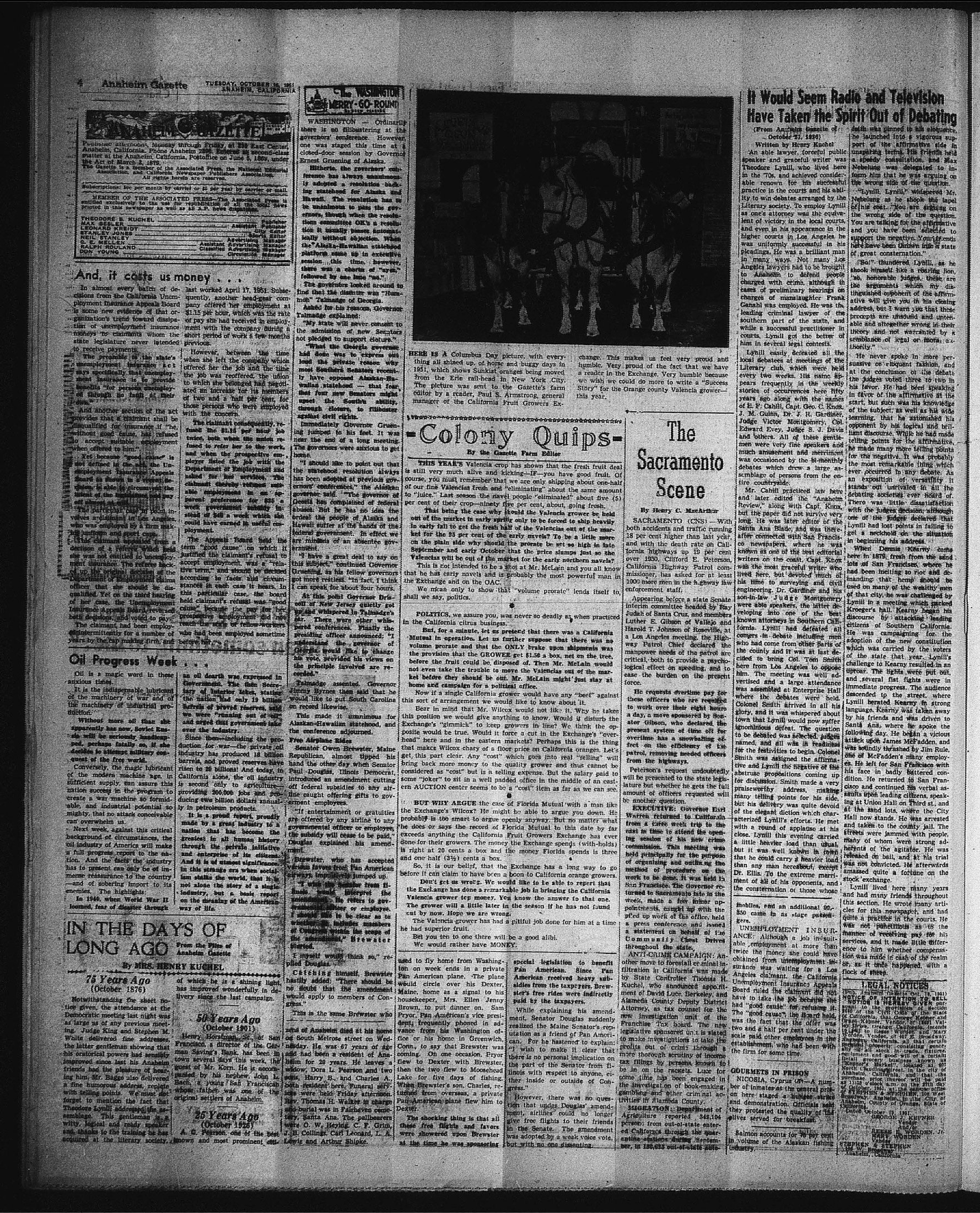
Searchable text
4 Anaheim Gazette TUESDAY, OCTOBER 16, 1951 ANAHEIM, CALIFORNIA
Publisher afternoons, Monday through Friday, at 250 East Center, Anaheim, California. Phone Anaheim 2899. Entered in second-class matter at the Anaheim, California, Postoffice on June 5, 1899, under the Act of March 3, 1879.
The Gazette is a member of the Associated Press, the National Editorial Association, and California Newspaper Publishers Association. All rights herein are reserved.
Subscriptions: See per month by carrier or 41 per year by carrier or mail.
MEMBER OF THE ASSOCIATED PRESS—The Associated Press is entitled exclusively to the use for republication of all the local news printed in this newspaper as well as all A.P. news publications.
THEODORE B. KUGHEL Publisher
MAX BESLER Assistant Publisher
LEONARD KREIDT City Editor
STANLEY JONES Sports Editor
NEIL STANLEY Advertising Manager
G E MELLEN Assistant Advertising Manager
RALPH HOULAND Classified Advertising Manager
DON YOUNG Circulation Manager
And, it costs us money ...
In almost every batch of decisions from the California Unemployment Insurance Appeals Board is some new evidence of that organization's trend toward dissipation of unemployment insurance monies to claimants whom the state legislature never intended to receive payments.
The preamble to the state's unemployment insurance act says specifically that unemployment insurance is to provide benefits "for persons unemployed through no fault of their own."
And another section of the act provides that a claimant shall be disqualified for insurance if "he, without good cause, has refused to accept suitable employment when offered to him."
Last worked April 17, 1951. Subsequently, another head-gear company offered her employment at $1.15 per hour, which was the rate of pay she had received in employment with the company during a short period of work a few months previous.
However, between the time when she left the company which offered her the job and the time the job was reoffered, the union to which she belonged had negotiated an increase for its members of two and a half per cent, for those persons who were employed with the concern.
The claimant consequently, refused the $1.15 per hour job twice, both when this union refused to refer her to the work.
WASHINGTON — there is no filibuster governors' conference one was staged this closed-door session Ernest Gruening of Haiti. The result be unanimous to passions committee OKtion it usually passes locally without objecting the Alaska-Hawaiian platform came up in session this time there was a chart followed by one line. The governors looked find that the disinterment Talmadge of Geasked for his reason Talmadge explained:
"My state will never the admission of not pledged to support What the Georgia had done was to enload the private rent most Southern Senate have opposed Al wallan statehood — that four new Senate upset the South's through cloture, to against civil rights.
Immediately Govern ing judipped to his feet near the end of a long The governors were anx
The promise to the state's unemployment insurance act says specifically that unemployment insurance is to provide benefits "for persons unemployed through no fault of their own."
And another section of the act provides that a bimant shall be disqualified for insurance if "he, without good cause, has refused to accept suitable employment when offered to him."
Yet because "good cause" is not defined in the act, the Unemployment Insurance Appeals Board is shown in a recent decision to circumvent the limit of the insumption and pay off almost all will.
The particular case in point involves a defendant in Los Angeles, who was employed by a firm making uniform and sport caps.
This claimant appealed from a decision of a referee which held she was not entitled to unemployment insurance. The referee backed up the original decision of the Department of Employment claims officer that she should be disqualified. Yet on the third hearing of her case, the Unemployment Insurance Appeals Board reversed both decisions, and voted to pay.
The claimant had been employed intermittently for a number of years by the cap making firm, and
Oil Progress Week
Oil is a magic word in these anxious times.
It is the indispensable lubricant of the machinery of war and of the machinery of industrial production.
Without more oil than she apparently has now, Soviet Russia will be seriously handicapped, perhaps fatally so, if she decides to attempt military conquest of the free world.
Conversely, the magic lubricant of the modern machine age, in sufficient supply, can assure this nation success in the program to create a war machine so formidable, and industrial potential so mighty, that no attack conceivable can overwhelm us.
Next week, against this critical background of circumstances, the oil industry of America will make a full progress report to the na-
an oil dearth was expressed in Government. The then Secretary of Interior later stated the nation had only 19 billion barrels of proved reserves, said we were "running out of oil" and urged that government take over the industry.
Since then—including the production for war—the private oil industry has produced 18 billion barrels, and proved reserves have risen to 20 billions! And today, in California alone, the oil industry is second only to agriculture—providing 200,000 jobs and producing two billion dollars annually in petroleum products.
It is a proud report, proudly made by a great industry to a nation that has become the greatest in all human history through the private initiative and enterprise of its citizens.
When she left the company which offered her the job and the time the job was reoffered, the union to which she belonged had negotiated an increase for its members of two and a half per cent, for those persons who were employed with the concern.
The claimant consequently refused the $115 per hour job twice, both when the union refused to refer her to the work, and when the prospective employer listed the job with the Department of Employment and asked for her services. The claimant thereby refused suitable employment in an apparent preference for $25 a week government subsidy instead of $48 a week which she could have earned in useful employment.
The Appeals Board held the term "good cause" on which it justified the claimant's refusal to accept employment, was a "relative term," and should be decided according to facts and circumstances in each case it hears. In this particular case, the board held claimant's refusal was "good cause" because the pay for her prospective employment did not reach the scale of fellow-workers who had been employed sometime before her.
"I have a great deal in this subject," continued Gruening, as his fellow got more restless. "In fact I can speak for about forty."
At this point GovernorCollom New Jersey quitted and whispered in Travis Car. There were other pered conferences. His presiding officer annoyed understand the governor Georgia would like to his vote, provided his principle involved corded."
Talmadge assented. Jimmy Byrnes then said would like to put South on record likewise.
This made it unanimous Alaskan-Hawaiian Statewide Free Airplane Rides.
Senator Owen Brewster Republican, almost the hand the other day when Paul Douglas, Illinois introduced an amendment off federal subsidies to line caught offering gift-ment employees.
"It if entertainment or are offered by any airline governmental officer or the subsidy will cease to Douglas explained his im-
Conversely, the magic lubricant of the modern machine age, in sufficient supply, can assure this nation success in the program to create a war machine so formidable and industrial potential so mighty, that no attack conceivable can overwhelm us.
Next week, against this critical background of circumstances, the oil industry of America will make a full progress report to the nation. And the facts the industry has to present can only be of immense reassurance to the country—and of sobering import to its enemies. The highlights:
In 1940, when World War II loomed, fear of disaster through
IN THE DAYS OF LONG AGO From the Piles of Anaheim Gazette
By MRS. HENRY KUCHEL
75 Years Ago (October 1876)
Notwithstanding the short notice given, the attendance at the Democratic meeting last night was as large as any previous meeting. Judge King and Stephen M. White delivered fine addresses, the latter gentleman showing that his oratorical powers had sensibly improved since last his Anaheim friends had the pleasure of hearing him. Mr. Bagge also delivered a fine humorous address, replete with telling points. We must not forget to mention the fact that Theodore Lynn addressed the assembly. This gentleman is a witty, logical and ready speaker and, thanks to the training he has acquired at the literary society,
of which he is a shining light, has improved wonderfully in delivery since the last campaign.
50 Years Ago (October 1901)
Henry Horstman, St. of San Francisco, a director of the German Saving's Bank, has been in town several days this week, the guest of Mr. Korn. He is accompanied by his nephew, John L. Bach, to young San Francisco whose father was one of the original settlers of Anaheim.
25 Years Ago (October 1926)
A. G. Pearson, one of the best known and most prominent citizens of Anaheim died at South Melrose street on Sunday. He was 67 years old and had been a resident in Anaheim for 20 years. He widowed, Dora L. Pearson, sons, Harry B., and Chad both residents here. Funerals were held Friday at Rev. Thomas H. Walker and burial was in Fairbairney, Santa Ana. The pallions were O. W. Heying, C. J. B. Collings, Carl Leonard Lewis and Arthur Shipke
WASHINGTON — Ordinarily there is no filibustering at the governors' conference. However, one was staged this time at a closed-door session by Governor Ernest Gruening of Alaska.
Hilberte, the governors' conference has always unanimously adopted a resolution backing statehood for Alaska and Hawaii. The resolution has to be unanimous to pass the governors, though when the resolution committee OK's a resolution it usually passes automatically without objection. When the "Alaska-Hawaiian statehood platform" came up in executive session this time, however, there was a chart of "aye," followed by one line "no."
The governors looked around to find that the disaster was "Hummon" Talmadge of Georgia.
Asked for his reasons, Governor Talmadge explained:
"My state will never consent to the admission of new Senators not pledged to support cloture."
"What the Georgia governor had done was to express out loud the private reason why most Southern Senators recently have opposed Alaska-Hawaiian statehood — that fear that four new Senators might upset the South's ability, through cloture, to filibuster against civil rights.
Immediately Governor Gruening jumped to his feet. It was near the end of a long meeting. The governors were anxious to get change. This makes us feel very humble. Very proud of the fact that a reader in the Exchange. Very humble we wish we could do more to write Story" for the Orange county Valencich this year.
- Colony Quips -
I should like to point out that the statehood resolution always has been adopted at previous governors' conferences," the Alaskan governor said. "The governor of Georgia has complained of federal abuses. But he has no idea the ordeal the people of Alaska and Hawaii suffer at the hands of the federal government. In effect we are minims of an absentee government.
"I have a great deal to say on this subject," continued Governor Gruening, as his fellow governors got more restless. "In fact, I think I can speak for about four hours.
At this point Governor Driscoll of New Jersey quietly got up and whispered in Talmadge's ear. There were other whispered conferences. Finally the presiding officer announced: "I understand the governor of Georgia would like to change his vote, provided his views on the principle involved are recorded."
Talmadge assented. Governor Jimmy Byrnes then said that he would like to put South Carolina on record likewise.
This made it unanimous for Alaskan-Hawaiian statehood, and the conference adjourned.
Free Airplane Rides
Senator Owen Brewster, Maine Republican, almost tipped his hand the other day when Senator Paul Douglas, Illinois Democrat, introduced an amendment cutting off federal subsidies to any airline caught offering gifts to government employees.
"If entertainment or gratuities are offered by any airline to any governmental officer or employee, the subsidy will cease be paid," Douglas explained his amendment.
- Colony Quips -
By the Gazette Farm Editor
THIS YEAR'S Valencia crop has shown that the fresh fruit deal is still very much alive and kicking—IF you have good fruit. Of course, you must remember that we are only shipping about one-half of our fine Valencias fresh and "eliminating" about the same amount to "juice." Last season the navel people "eliminated" about five (5) per cent of their crop—ninety five per cent, about going fresh.
That being the case why should the Valencia grower be held out of the market in early spring only to be forced to ship heavily in early fall to get the fresh half of the Valencias out of the market for the 95 per cent of the early navels? To be a little more on the plain side why should the prorate be set so high in late September and early October that the price slumps just so the Valencias will be out of the market for the early northern navels?
This is not intended to be a shot at Mr. McLain and you all know that he has early navels and is probably the most powerful man in the Exchange and on the OAC.
We mean only to show that "volume prorate" lends itself to, shall we say, politics.
POLITICS, we assure you, was never so deadly as when practiced in the California citrus business.
But, for a minute, let us pretend that there was a California Mutual in operation. Let us further suppose that there was no volume prorate and that the ONLY brake upon shipments was the provision that the GROWER get $1.50 a box, net on the tree, before the fruit could be disposed of. Then Mr. McLain would not even take the trouble to move the Valencias out of the market before they should be out. Mr. McLain might just stay at home and campaign for a political office.
Now if a single California grower would have any "beef" against this sort of arrangement we would like to know about it.
Bear in mind that Mr. Wilcox would not like it. Why he takes this position we would give anything to know. Would it disturb the Exchange's "gimmick" to keep growers in line? We think the opposite would be true. Would it force a cut in the Exchange's "overhead" here and in the eastern markets? Perhaps this is the thing that makes Wilcox chary of a floor price on California oranges. Let's get this part clear. Any "cost" which goes into real "selling" will bring back more money to the quality grower and thus cannot be considered as "cost" but is a selling expense. But the salary paid to some "joker" to sit in a well padded office in the middle of an eastern AUCTION center seems to be a "cost" item as far as we can see.
BUT WHY ARGUE the case of Florida Mutual with a man like the Exchange's Wilcox? He might be able to argue you down. He probably is too smart to argue openly anyway. But no matter what he does or says the record of Florida Mutual to this date by far exceeds anything the California Fruit Growers Exchange has ever done for their growers. The money the Exchange spends (with-holds) is right at 20 cents a box and the money Florida spends is three and one-fifth ($26) cents a box.
The Sacraments Scenic
By Henry C. M.
SACRAMENTO (Oregon) both accidents and traps 18 per cent higher than for formia highways up over 1950. Clifford California Highway missenger, has asked 1000 men in the enforcement staff.
Appearing before an intercommittee he Judah of Santa Cruz, Luther E. Gibson of Harold T. Johnson of Harold T. Johnson of Los Angeles meeting way Patrol Chief of manpower needs of its critical, both to provide logical effect on speed ease the burden on force.
He requests overtime those officers who ran to work over their day a day, a move sponsorator Gibson, who does present system of time overtime has a snow feet on the efficient patrol, removing need from the highways.
Peterson's request will be presented to the lature but whether he amount of officers reeled another question.
EXECUTIVE: Gov Warren returned to from a three week east in time to attending session of his commission. This me held principally for this year.
hand the other day when Senator Paul Douglas, Illinois Democrat, introduced an amendment cutting off federal subsidies to any airline caught offering gifts to government employees.
"If entertainment or gratuities are offered by any airline to any governmental officer or employee, the subsidy will cease to be paid," Douglas explained his amendment.
Brewster, who has accepted various favors from Pan American airways, impulsively jumped up.
"I wish the Senator from Illinois would interpret the amendment. He refers to governmental officer or employee. I should like to be clear as to whether he includes members of Congress within the scope of the amendment." Brewster started.
I myself would think so," replied Douglas.
Catching himself, Brewster hastily added: "There should be no doubt that the amendment would apply to members of Congress."
This is the same Brewster who seems of Anaheim died at his home on South Melrose street on Wednesday. He was 67 years of age and had been a resident of Anaheim for 20 years. He leaves a widow, Dora L. Pearson and two sons, Harry B., and Charles A., both resident here. Funeral services were held Friday afternoon. Stay Thomas H. Walker in charge and burial was in Fairhaven cemetery, Santa Ana. The pallbearers were O. W. Heying, C. P. Grim, B. Collings, Carl Leonard, L. A. Lewis and Arthur Shipke.
used to fly home from Washington on week ends in a private Pan American plane. The plane would circle over his Dexter, Maine, home as a signal to his housekeeper, Mrs. Ellen Jenny Brown, to put dinner on. Sam Pryor, Pan American's vice president; frequently phoned in advance from his Washington office or his home in Greenwich, Conn., to say that Brewster was coming. On one occasion, Pryor flew to Dexter with Brewster, then the two flew to Moosehead Lake for five days of fishing. When Brewster's son, Charles, returned from overseas, a private Pan American plane flew him to Dexter.
The shocking thing is that all these free flights and favors were showered upon Brewster at the time he was sponsoring special legislation to benefit Pan American. Since Pan American received heavy subsidies from the taxpayers, Brewster's free rides were indirectly paid by the taxpayers.
While explaining his amendment, Senator Douglas suddenly realized the Maine Senator's reputation as a friend of Pan American. For he hastened to explain: "I wish to make it clear that there is no personal implication on the part of the Senator from Illinois with respect to anyone, either inside or outside of Congress."
However, there was no question that under Douglas' amendment, airlines could no longer give free flights to their friends in the Senate. The amendment was adopted by a weak voice vote, but with no one dissenting.
Peterson's request will be presented to the lature but whether he amount of officers required another question.
EXECUTIVE: Gov Warren returned to from a three week east in time to attending session of his commission. This man held principally for the organization and out method of procedure work to be done. It was San Francisco. The Government turned to Sacramento week, made a few pointments, caught up work of the day a press conference on a statement on behalf Community Chest throughout the state.
ANTI-CRIME CAMPAIGN other move to forestall filtration in California by State Controller Kuchel, who announcedment of David Luce. Bel Alameda County Deputy Attorney, as tax county new investigation unfranchise Tax board legislative sponsored unto make investigations profits out of crimes more thorough scrutiny tax filings by persons be in on the rackets come time hits been the investigation of boating and other activities in Alameda County.
MIGRATION: Deposit Agriculture reported person from out-of-state California through antine stations during ber, in 180,025 out-of-
It Would Seem Radio and Television Have Taken the Spirit Out of Debating
(From Angeles Gazette of October 21, 1926)
Written by Henry Kuchel
An able lawyer, forceful public speaker and graceful writer was Theodore Lynill, who lived here in the '70s, and achieved considerable renown for his successful practice in the courts and his ability to win debates arranged by the Literary society. To employ Lynill as one's attorney was the equivalent of victory in the local courts, and even in his appearance in the higher courts in Los Angeles he was uniformly successful in his pleadings. He was a brilliant man in many ways. Not many Los Angeles lawyers had to be brought to Anaheim to defend people charged with crime, although in cases of preliminary hearings on charges of manslaughter Frank Ganahl was employed. He was the leading criminal lawyer of the southern part of the state, and while a successful practitioner in courts, Lynill got the better of him in several legal contests.
Lynill easily defeated all the local debatees at meetings of the Literary club, which were held every two weeks. His name appears frequently in the weekly stories of occurrences here fifty years ago along with the names of E. F. Cahill, Capt. Geo. C. Knox, J. M. Gulfin, Dr. J. R. Gardiner, Judge Victor Montgomery, Col. Edward Evey, Judge S. J. Davis and others. All of these gentlemen were very fine speakers and much amusement and entertainment.
Athens was pinned to his eloquence, he launched into a vigorous support of the affirmative side in unsparing terming. His friends held a speedy consultation, and Max Nebelung was delegated to inform him that he was arguing on the wrong side of the question.
"Lynill, Lynill," whispered Mr. Nebelung as he shook the lapel of his coat. "You are arguing on the wrong side of the question. You are talking for the affirmative and you have been selected to support the negative. Your friends here have been drawn into a state of great consternation."
"So!" thundered Lynill, as he shook himself like a roaring lion, "so honorable judges, these are the arguments which my distinguished offspring of the affirmative will give you in his closing address, but I warn you that these procepts are unbound and untenable and altogether wrong in their theory and not warranted by a semblance of legal or moral authority."
He never spoke in more persuasive or eloquent fashion, and at the conclusion of the debate the judges voted three to two in his favor. He had been speaking in favor of the affirmative at the start, but such was his knowledge of the subject, as well as his wide learning, that he astonished his opponent by his logical and brilliant discourse. While he had made telling points for the affirmative, he made many more telling points
The Sacramento Scene
By Henry C. MacArthur
SACRAMENTO (CNS) — With both accidents and traffic running 18 per cent higher than last year, and with the death rate on California highways up 19 per cent over 1950, Clifford E. Peterson, California Highway Patrol commissioner, has asked for at least 1000 more men in the highway law enforcement staff.
Appearing before a state Senate interim committee headed by Ray Judah of Santa Cruz, and members Luther E. Gibson of Vallejo and Harold T. Johnson of Roseville, at a Los Angeles meeting, the Highway Patrol Chief declared the manpower needs of the patrol are critical, both to provide a psychological effect on speeding, and to ease the burden on the present force.
He requests overtime pay for those officers who are required to work over their eight hours a day, a move sponsored by Senator Gibson, who declared the present system of time off for overtime has a snowballing effect on the efficiency of the patrol, removing needed officers from the highways.
Peterson's request undoubtedly will be presented to the state legislature but whether he gets the full amount of officers requested will be another question.
EXECUTIVE: Governor Earl Warren returned to California from a three week trip to the east in time to attend the opening session of his new crime commission. This meeting was held principally for the purpose local debates at meetings of the Literary club, which were held every two weeks. His name appears frequently in the weekly stories of occurrences here fifty years ago along with the names of E. F. Cahill, Capt. Geo. C. Knox, J. M. Guinn, Dr. J. R. Gardiner, Judge Victor Montgomery, Col. Edward Evey, Judge S. J. Davis and others. All of these gentlemen were very fine speakers and much amusement and merriment was occasioned by the bi-monthly debates which drew a large assomblage of persons from the entire countryside.
Mr. Cahill practiced law here and later edited the "Anaheim Review," along with Capt. Knox, but the paper did not survive very long. He was later editor of the Santa Ana Blade, and was thereafter connected with San Francisco newspapers, where he was known as one of the best editorial writers on the coast. Capt. Knox was the most graceful writer who lived here, but devoted much of his time to surveying and civil engineering. Dr. Gardiner and his son-in-law Judge Montgomery were able speakers, the latter developing into one of the best known attorneys in Southern California. Lynnill had defeated all comers in debate including men who had come from other parts of the county and it was at last decided to bring Col. Tom Smith here from Los Angeles to oppose him. The meeting was well advertised and a large attendance was assembled at Enterprise Hall where the debates were held. Colonel Smith arrived in all his glory, and it was whispered about town that Lynnill would now suffer ignominious defeat. The question to be debated was selected, judges named, and all was in readiness for the festivities to begin. Colonel Smith was assigned the affirmative and Lynnill the negative of the abstruse propositions coming up for discussion. Smith made a very praiseworthy address, making many telling points for his side, but his delivery was quite devoid of the elegant diction which characterized Lynnill's efforts. He met with a round of applause at his close. Lynnill this evening carried a little heavier load than usual, but it was well known in town he never spoke in more persuasive on elbow fashion, and at the conclusion of the debate the judges voted three to two in his favor. He had been speaking in favor of the affirmative at the start, but such was his knowledge of the subject, as well as his wide learning, that he astonished his opponent by his logical and brilliant discourse. While he had made telling points for the affirmative, he made many more telling points for the negative. It was probably the most remarkable thing which ever occurred in any debate. As an exposition of versatility it stands out unrivaled in all the debating societies ever heard of. There was little dissatisfaction with the judge's decision although one of the judges declared that Lynnill had lost points in failing to get a neckhold on the situation in beginning his address.
When Dennis Kearny came here in 1879, fresh from the sand lots of San Francisco, where he had been meeting to riot and demanding that he help should be used on many of the wealthy men of that city, he was challenged by Lynnill in a meeting which picked Kroeger's hall. Kearny began his discourse by attacking leading citizens of Southern California. He was campaigning for the adoption of the new constitution which was carried by the voters of the state that year. Lynnill challenge to Kearny resulted in an uproar. The lights were put out, and several fist fights were in immediate progress. The audience descended to the street, where Lynnil berated Kearny in strong language. Kearny was taken away by his friends and was driven to Santa Ana, where he spoke the following day. He began a vicious attack upon James McFadden, and was soundly thrashed by Jim Rule, one of McFadden's many employees. He left for San Francisco with his face in badly battered condition. He returned to San Francisco and continued his verbal assaults upon leading citizens, speaking at Union Hall on Third st., and at the sand lots, where the City Hall now stands. He was arrested and taken to the county jail. The streets were jammed with people, many of whom were strong adherents of the agitator. He was released on bail, and at his trial
Peterson's request undoubtedly will be presented to the state legislature but whether he gets the full amount of officers requested will be another question.
EXECUTIVE: Governor Earl Warren returned to California from a three week trip to the east in time to attend the opening session of his new crime commission. This meeting was held principally for the purpose of organizing and outlining the method of procedure on the work to be done. It was held in San Francisco. The Governor returned to Sacramento late in the week, made a few minor appointments, caught up with the pled up work of the office, held a press conference and issued a statement on behalf of the Community Chest Drives throughout the state.
ANTI-CRIME CAMPAIGN: Another move to forestall criminal infiltration in California was made by State Controller Thoniss H. Kuchel, who announced appointment of David Luce, Berkeley, and Alameda County Deputy District Attorney, as tax counsel for the new investigation unit of the Franchise Tax board. The new legislative sponsored unit is slated to make investigations to take the profits out of crimes through a more thorough scrutiny of income tax filings by persons known to be in on the rackets. Luce for some time has engaged in the investigation of book-making, gambling and other criminal activities in Alameda County.
MIGRATION: Department of Agriculture reported 342,104 persons from out-of-state entered California through the quarantine stations during September, in 150,625 out-of-state admitted.
GOURMETS IN PRISON
NICOSIA, Cyprus (7). A number of inmates at the central prison here staged a hunger strike and demonstration. Officials said they protested the quality of the alives served for breakfast.
Salmon accounts for 70 per cent in volume of the Alaskan fishing industry.
LEGAL NOTICES
NOTICE OF INTENTION TO SELL NOTICE IS HEREBY GIVEN pursuant to the Civil Code of the State of California, that George Mather and Grass Knopf, Vendor, of 1891 Valley Drive, Orange California, intends to lodge Worden and Mary Worden, Vendor, of 1872 Broadway, Anheims California, all that certain personal property consisting generally or all stock in trade, fixtures, equipment and goodwill of a certain retail business known as "Koopner Market," located at 607 North Chaunding street, in the city of Anaheim, California, and that the purchase price thereof will be paid at 11:38 o'clock a.m. on the fifth day of October, 1891, at the grocery office of STEPHEN & STEPHEN, 108 West Broadway, Anaheim, in the City of Anaheim, County of Orange, State of California.
Dated October 19, 1891.
GEORGE J. KEPNER
Vendor
And/or
REESE P. WORDEN, Jr.
MARY WORDEN
Vendor
STEPHEN & STEPHEN
108 W. Broadway,
Anaheim, California.