anaheim-gazette 1951-09-11
Scanned page
Searchable text
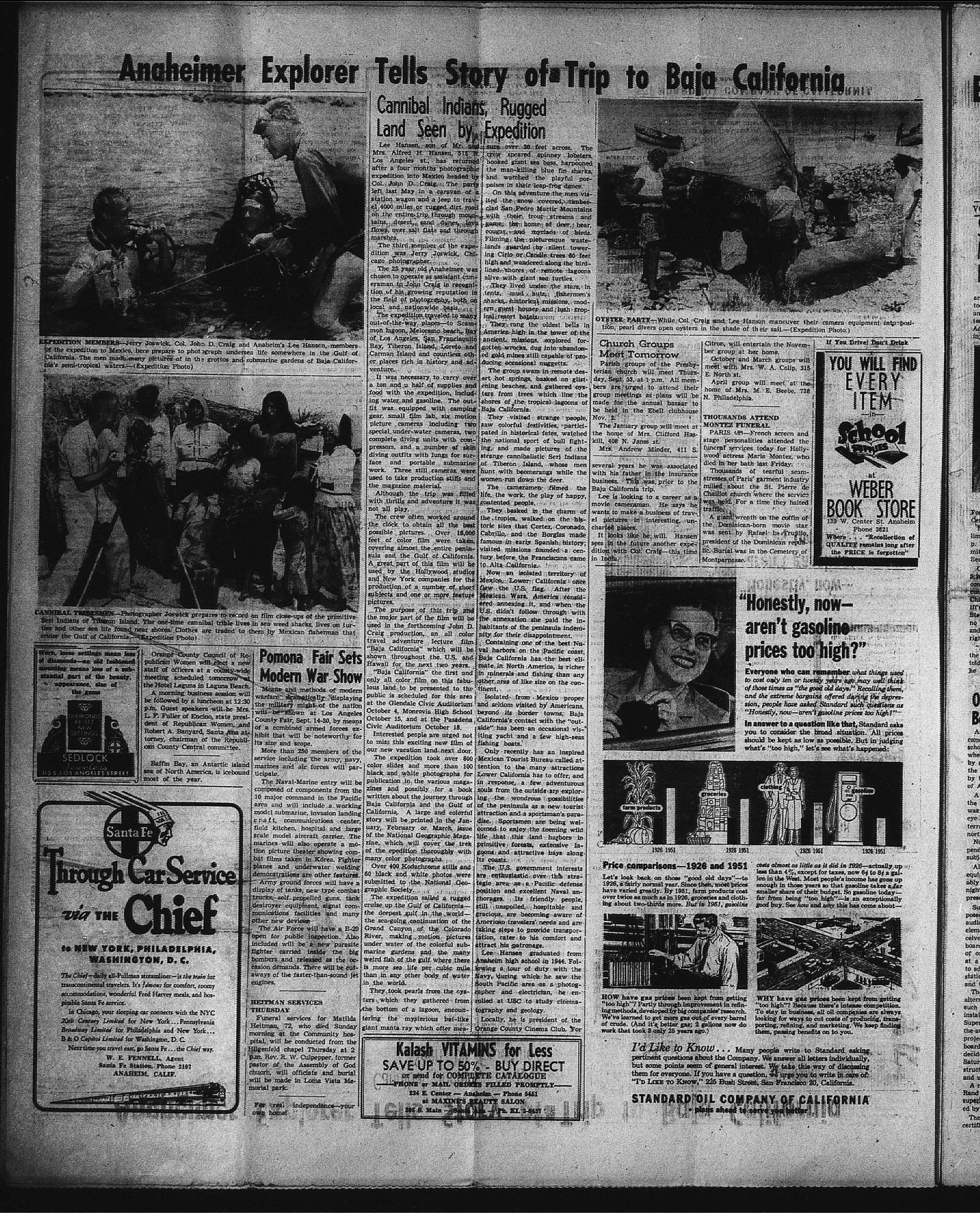
EXPEDITION MEMBERS—Jerry Joswick, Col. John D. Craig and Anaheim's Lee Hansen, members of the expedition to Mexico, here prepare to photograph undersea life somewhere in the Gulf of California. The men made many pictures of in the grottos and submarine gardens of Baja California's semi-tropical waters. (Expedition Photo)
CALIFORNIA. The men made many pictures of in the grottos and submarine gardens of Baja California's semi-tropical waters. (Expedition Photo)
CANNIBAL TRIBESMEN—Photographer Joswick prepares to record on film close-ups of the primitive Seri Indians of Tiburon Island. The one-time cannibal tribe lives in sea weed shacks, lives on turtles and other sea life found near shores. Clothes are traded to them by Mexican fisherman that cruise the Gulf of California. (Expedition Photo)
Worn, loose settings mean loss of diamonds—an old fashioned mounting means loss of a substantial part of the beauty, appearance, size of the gems.
DIAMONDS RE-SET NEW SETTINGS
SEDLOCK
1135 LOS ANGELES STREET
Orange County Council of Republican Women will elect a new staff of officers at a county-wide meeting scheduled tomorrow at the Hotel Laguna in Laguna Beach.
A morning business session will be followed by a luncheon at 12:30 p.m. Guest speakers will be Mrs. L. F. Fuller of Encino, state president of Republican Women, and Robert A. Banyard, Santa Ana attorney, chairman of the Republican County Central committee.
Baffin Bay, an Antartic island sea of North America, is icebound most of the year.
Pomona Fair Sets Modern War Show
Means and methods of modern warfare dramatically displaying the military might of the nation will be shown at Los Angeles County Fair, Sept. 14-30, by means of a combined armed forces exhibit that will be noteworthy for its size and scope.
More than 250 members of the service including the army, navy, marines and air forces will participate.
The Naval-Marine entry will be composed of components from the 10 major command in the Pacific area and will include a working model submarine, invasion landing craft, communications center, field kitchen, hospital and large scale model aircraft carrier. The marines will also operate a motion picture theater showing com-
Santa Fe
Through Car Service
via THE Chief
to NEW YORK, PHILADELPHIA,
WASHINGTON, D. C.
The Chief—daily all-Pullman streamliner—is the train for transcontinental travelers. It's famous for comfort, roomy accommodations, wonderful Fred Harvey meals, and hospitable Santa Fe service.
In Chicago, your sleeping car connects with the NYC 20th Century Limited for New York...Pennsylvania Broadway Limited for Philadelphia and New York...
B & O Capitol Limited for Washington, D. C.
Next time you travel east, go Santa Fe...the Chief way.
W. E. FENNELL, Agent
Santa Fe Station, Phone 3107
ANAHEIM, CALIF.
The Naval-Marine entry will be composed of components from the 10 major command in the Pacific area and will include a working model submarine, invasion landing craft, communications center, field kitchen, hospital and large scale model aircraft carrier. The marines will also operate a motion picture theater showing combat films taken in Korea. Fighter planes and underwater welding demonstrations are other features.
Army ground forces will have a display of tanks, new type combat trucks, self-propelled guns, tank destroyer equipment, signal communications facilities and many other new devices.
The Air Force will have a B-29 open for public inspection. Also included will be a new parasite fighter carried inside the big bombers and released as the occasion demands. There will be cut-outs of the faster-than-sound jet engines.
HEITMAN SERVICES
THURSDAY
Funeral services for Matilda Heitman, 72, who died Sunday morning at the Community hospital, will be conducted from the Hilgenfeld chapel Thursday at 2 p.m. Rev. R. W. Culpepper, former pastor of the Assembly of God church, will officiate and burial will be made in Loma Vista Memorial park.
For real independence—your own home!
Explorer Tells Story of Trip to Baja Cannibal Indians, Rugged Land Seen by Expedition
Lee Hansen, son of Mr. and Mrs. Alfred H. Hansen, 515 N. Los Angeles st., has returned after a four months photographic expedition into Mexico headed by Col. John D. Craig. The party left last May in a caravan of a station wagon and a jeep to travel 4000 miles or rugged dirt road on the entire trip through mountains, desert, sand dunes, lava flows, over salt flats and through marshes.
The third member of the expedition was Jerry Joswick, Chicago photographer.
The 25 year old Anahelmer was chosen to operate as assistant cameraman to John Craig in recognition of his growing reputation in the field of photography, both on local and nationwide basis.
The expedition traveled to many out-of-the-way places—to Scammon lagoon, Meloremo beach, Bay of Los Angeles, San Franciscoquito Bay, Tiberon Island, Loreto and Carman Island and countless other places rich in history and adventure.
It was necessary to carry over a ton and a half of supplies and food with the expedition, including water and gasoline. The outfit was equipped with camping gear, small film lab, six motion picture cameras including two special under-water cameras, two complete diving units with compressors, and a number of skin suits over 20 feet across. The crew speared spinney lobsters, hooked giant sea bass, harpooned the man-killing blue fin sharks, and watched the playful porpoises in their leap-frog dance.
On this adventure the men visited the snow covered timber-clad San Pedro Martir Mountains with their trout streams and game; the home of deer, bear, cougar and myriads of birds. Filming the picturesque wastelands guarded by silent towering Cirlo or Candle trees 60 feet high and wandered along the bird-lined shores of remote lagoons alive with giant sea turtles.
They lived under the stars, in tents, mud huts, fishermen's shacks, historical missions, modern guest houses and lush tropical resort hotels.
They rang the oldest bells in America high in the tower of the ancient missions, explored forgotten wrecks, dug into abandoned gold mines still capable of producing occasional nuggetts.
The group swam in remote desert hot springs, basked on glistening beaches, and gathered oysters from trees which line the shores of the tropical lagoons of Baja California.
They visited strange people, saw colorful festivities, participated in historical fetes, watched the national sport of bull fighting, and made pictures of the
OYSTER PARTY—While Collision, pearl divers open oysters
Church Groups Meet Tomorrow
Parish groups of the Presbyterian church will meet Thursday, Sept. 13, at 1 p.m. All members are urged to attend the group meetings as plans will be made for the annual bazaar to be held in the Ebell clubhouse Nov. 2.
The January group will meet the home of Mrs. Clifford Haillick, 408 N. Janssst. Mrs. Andrew Minder, 411
It was necessary to carry over a ton and a half of supplies and food with the expedition, including water and gasoline. The outfit was equipped with camping gear, small film lab, six motion picture cameras including two special under-water cameras, two complete diving units with compressors, and a number of skin diving outfits with lungs for surface and portable submarine work. Three still cameras were used to take production stills and the magazine material.
Although the trip was filled with thrills and adventure it was not all play.
The crew often worked around the clock to obtain all the best possible pictures. Over 18,000 feet of color film were taken, covering almost the entire peninsula and the Gulf of California. A great part of this film will be used by the Hollywood studios and New York companies for the production of a number of short subjects and one or more feature pictures.
The purpose of this trip and the major part of the film will be used in the forthcoming John D. Craig production, an all-color travel adventure lecture film "Baja California" which will be shown throughout the U.S. and Hawaii for the next two years.
"Baja California" the first and only all color film on this fabulous land to be presented to the public is scheduled for this area at the Glendale Civic Auditorium October 4, Monrovia High School October 15, and at the Pasadena Civic Auditorium October 18.
Interested people are urged not to miss this exciting new film of our new vacation land next door.
The expedition took over 800 color slides and more than 100 black and white photographs for publication in the various magazines and possibly for a book written about the journey through Baja California and the Gulf of California. A large and colorful story will be printed in the January, February or March issue of the National Geographic Magazine, which will cover the trek of the expedition thoroughly with rare images capable of producing occasional nuggets.
The group swam in remote desert hot springs, basked on glistening beaches, and gathered oysters from trees which line the shores of the tropical lagoons of Baja California.
They visited strange people, saw colorful festivities, participated in historical fetes, watched the national sport of bull fighting, and made pictures of the strange cannibalistic Seri Indians of Tiberon Island, whose men hunt with boomerangs while the women run down the deer.
The cameramen filmed the life, the work, the play of happy contented people.
They basked in the charm of the tropics, walked on the historic sites that Cortez, Coronado, Cabrillo, and the Borglas made famous in early Spanish history; visited missions founded a century before the Franciscan came to Alta California.
Now an isolated territory of Mexico, Lower California once flew the U.S. flag. After the Mexican Wars, America considered annexing it, and when the U.S. didn't follow through with the annexation she paid the inhabitants of the peninsula indemnity for their disappointment.
Containing one of the best Naval harbors on the Pacific coast, Baja California has the best climate in North America, is richer in minerals and fishing than any other area of like size on the continent.
Isolated from Mexico proper and seldom visited by Americans, beyond its border towns, Baja California's contact with the "outside" has been an occasional visiting yacht and a few high-seas fishing boats.
Only recently has an inspired Mexican Tourist Bureau called attention to the many attractions Lower California has to offer, and in response, a few adventurous souls from the outside are exploring the wondrous possibilities of the peninsula as a new tourist attraction and a sportsman's paradise. Sportsmen are being welcomed to enjoy the seeming wild life that this land harbors in primitive forests, extensive lagoons and attractive bays along several years he was associated with his father in the insurance business. This was prior to the Baja California trip.
Lee is looking to a career as movie cameraman. He says he wants to make a business of travel pictures in interesting up-charted places.
It looks like he will. Hansen sees in the future another expedition with Col. Craig—this time in India.
Rail-Marine entry will be composed of components from the command in the Pacific will include a working marine, invasion landing communications center, en, hospital and large aircraft carrier. The will also operate a mo- theater showing com- taken in Korea. Fighter underwater weldingions are other features. Sound forces will have a banks, new type combat propelled guns, tank equipment, signal com- facilities and many devices.
Force will have a B-29 public inspection. Also will be a new parasite carried inside the big and released as the oceans. There will be cut- faster-than-sound jet services for Matilda 2, who died Sunday the Community hos- conducted from the Chapel Thursday at 2 W. Culpepper, former Assembly of God officiate and burial in Loma Vista Me- independence—your color slides and more than 100 black and white photographs for publication in the various magazines and possibly for a book written about the journey through Baja California and the Gulf of California. A large and colorful story will be printed in the January, February or March issue of the National Geographic Magazine, which will cover the trek of the epedition thoroughly with many color photographs.
Over 400 Kodachrome stills and 50 black and white photos were submitted to the National Geographic Society.
The expedition sailed a rugged cruise up the Gulf of California—the deepest gulf in the world—the sea-going continuation of the Grand Canyon of the Colorado River, making motion pictures under water of the colorful submarine gardens and the many weird fish of the gulf where there is more sea life per cubic mile than in any other body of water in the world.
They took pearls from the oysters which they gathered from the bottom of a lagoon, encountering the mysterious bat-like giant manta ray which often men-tention to the many attractions Lower California has to offer, and in response, a few adventurous souls from the outside are exploring the wondrous possibilities of the peninsula as a new tourist attraction and a sportsman's paradise. Sportsmen are being welcomed to enjoy the teeming wild life that this land harbors in primitive forests, extensive lagoons and attractive bays along its coasts.
The U.S. government interests are enthusiastic over this strategic area as a Pacific defense position and excellent Naval anchorage. Its friendly people, still unspoiled, hospitable and gracious, are becoming aware of American traveler's needs and are taking steps to provide transportation, cater to his comfort and attract his patronage.
Lee Hansen graduated from Anaheim high school in 1944. Following a tour of duty with the Navy, during which he saw the South Pacific area as a photographer and electrician, he enrolled at USC to study cinematography and geology.
Locally, he is president of the Orange County Cinema Club. For
Kalash VITAMINS for Less
SAVE UP TO 50% - BUY DIRECT
or send for COMPLETE CATALOGUE
PHONE or MAIL ORDERS FILLED PROMPTLY
234 E. Center — Anaheim — Phone 5451
at MAXINE'S BEAUTY SALON
388 S. Main — Sanitary Aim — Ph. KL 3-6457
to Baja California
ER PARTY—While Col. Craig and Lee Hansen maneuver their camera equipment into posipearl divers open oysters in the shade of their sail. (Expedition Photo.)
Church Groups
Get Tomorrow
Each groups of the Presbychurch will meet Thursday,
13, at 1 p.m. All memre urged to attend their
meetings as plans will be
for the annual bazaar to
d in the Ebell clubhouse
January group will meet at
home of Mrs. Clifford Has8 N. Janss st.
Andrew Minder, 411 S.
Citron, will entertain the November group at her home.
October and March groups will
meet with Mrs. W. A. Colip, 315
E. North st.
April group will meet at the
home of Mrs. M. E. Beebe, 738
N. Philadelphia.
THOUSANDS ATTEND
MONTEZ FUNERAL
PARIS (P)—French screen and
stage personalities attended the
funeral services today for Holly-
If You Drive! Don't Drink
YOU WILL FIND
EVERY
ITEM
in
School
Supplies
THOUSANDS ATTEND MONTEZ FUNERAL
PARIS (UP)—French screen and stage personalities attended the funeral services today for Hollywood actress Maria Montez, who died in her bath last Friday.
Thousands of tearful stresses of Paris' garment industry milled about the St. Pierre de Chaillot church where the service was held. For a time they halted traffic.
A giant wreath on the coffin of the Dominican-born movie star was sent by Rafael Isa Trujillo, president of the Dominican republic. Burial was in the Cemetery of Montparnasse.
"Honestly, now—aren't gasoline prices too high?"
Everyone who can remember what things used to cost only ten or twenty years ago may well think of those times as "the good old days." Recalling them, and the extreme bargains offered during the depression, people have asked Standard such questions as "Honestly, now—aren't gasoline prices too high?"
In answer to a question like that, Standard asks you to consider the broad situation. All prices should be kept as low as possible. But in judging what's "too high," let's see what's happened:
1926 1951
1926 1951
1926 1951
1926 1951
price comparisons—1926 and 1951
It looks back on those "good old days"—to 1951, a fairly normal year. Since then, most prices are varied greatly. By 1951, farm products cost twice as much as in 1926, groceries and clothing about two-thirds more. But in 1951, gasoline costs almost as little as it did in 1926—actually up less than 4%, except for taxes, now 6¢ to 8¢ a gallon in the West. Most people's income has gone up enough in those years so that gasoline takes a far smaller share of their budget. So gasoline today—far from being "too high"—is an exceptionally good buy. See how and why this has come about.
We have gas prices been kept from getting high"? Partly through improvement in refin-methods, developed by big companies' research. We learned to get more gas out of every barrel crude. (And it's better gas; 2 gallons now do that took 3 only 25 years ago.)
WHY have gas prices been kept from getting "too high"? Because there's intense competition. To stay in business, all oil companies are always looking for ways to cut costs of producing, transporting, refining, and marketing. We keep finding them, passing benefits on to you.
I'd Like to Know... Many people write to Standard asking pertinent questions about the Company. We answer all letters individually, but some points seem of general interest. We take this way of discussing them for everyone. If you have a question, we urge you to write in care of: "I'd Like to Know," 225 Bush Street, San Francisco 20, California.
STANDARD OIL COMPANY OF CALIFORNIA
• plans ahead to serve you better