anaheim-gazette 1951-06-12
Scanned page
Searchable text
Anaheim Gazette
TUESDAY, JUNE 12, 1951
ANAHEIM, CALIFORNIA
Published afternoons, Monday through Friday, at 259 East Center,
Anaheim, California. Phone Anaheim 2206. Entered as second-class
matter at the Anaheim, California, Postoffice on June 5, 1869, under
the Act of March 3, 1879.
The Gazette is a member of the Associated Press, the National Editorial
Association, and California Newspaper Publishers Association.
All rights herein are reserved.
Subscriptions: 500 per month by carrier or 15 per year by carrier or mail.
MEMBER OF THE ASSOCIATED PRESS—The Associated Press is entitled exclusively to the use for republication of all the local news printed in this newspaper as well as all A.P. news dispatches.
THEODORE B. KUCHEL Publisher
MAX BESLER Assistant Publisher
LEONARD CREIDt Assistant Editor
NEIL STANLEy Advertising Manager
G. E. MELLEN Advertising Manager
MARY ROULAND Advertising Manager
RALPH ROULAND Classified Advertising Manager
LUCY HUBBARD Circulation Manager
On the offensive...?
There's talk in the air that President Truman is going to start fighting back at the critics of his administration. If he does, it will be a sort of change of pace.
This talk seems to have sprung up over the weekend after a White House announcement he would make a radio TV speech to the nation Thursday night, urging that price and wage and other controls be continued by Congress beyond June 30.
It will be the president's first major speech to the nation since April 11 when he took to the air to explain why he had just fired General MacArthur. Fighting talks by the president in the past year or so have been infrequent.
In fact, talks by the president even explaining policies have been fairly infrequent leaving a big vacuum that has provided questions firmly but it's debatable whether that could be called aggressive.
President Truman seemed pleased with Acheson's performance. He publicly pronounced a blessing of well done and said Acheson would remain as his Secretary of State.
Compared with the attacks made on him, Acheson's answers were mild, indeed. It's possible he doesn't feel he should reply to his critics with the same terse toughness they turned loose on him, for at one place he said:
"Criticism is something which I have to bear as an occupational hazard and I am quite ready to bear it."
Mr. Truman himself certainly is capable of vigorous answers as he demonstrated when he successfully campaigned for the presidency in 1948. Since then
By DREW PEARL
One of the hottest things the government today is concerned confidential exchange President Truman and Bradley over General But a report on the Clerk and California might solve the long dispute over western The report, which tucked into a convoan address by C. Emily Los Angeles. Then a Freise. Presentation of the Turners will be a social hop. Turn merger active section of the Turn Verde have lists at San Diego, Habenfelner, Jos B. Yungbluth and Frank
25 Years Old-Timers with records
All old-timers who in this section for 40 years welcome guests at a bar and Pioneer's re-union en by the ladies of Mony chapter, Daught American Revolution, a Friday, June 18, 1926, Among many old-timers signified their intention present are the follow Dyer, who swam in frific ocean, landing on sometime during the la He has papers to pro
It will be the president's first major speech to the nation since April 11 when he took to the air to explain why he had just fired General MacArthur. Fighting talks by the president in the past year or so have been infrequent.
In fact, talks by the president even explaining policies have been fairly infrequent leaving a big vacuum that has provided plenty of room for his critics.
In the past year or so criticism has piled up on his administration. It reached a climax with the public acclaim given MacArthur when he returned home.
And since then Mr. Truman's Republican critics in particular have continued to sharpshoot at him and members of his administration. The tone of that criticism gets less polite as time goes on, with words like "dishonest" being thrown around.
When the history of these times is written it may show the Truman administration went on the defensive when Senator McCarthy, Wisconsin Republican, began making broad charges of communism in the State Department, with Secretary of State Acheson the particular target of his attack.
What a sustained counterattack by the Trumanites might have accomplished will have to remain one of the unanswered questions of history. But there certainly has been no attempt at such a counterattack.
There's been some comment in Washington that Acheson, in his testimony at the Senate inquiry into MacArthur's firing, was aggressive, for a change. He answer-
doesn't feel he should reply to his critics with the same terse toughness they turned loose on him, for at one place he said:
"Criticism is something which I have to bear as an occupational hazard and I am quite ready to bear it."
Mr. Truman himself certainly is capable of vigorous answers as he demonstrated when he successfully campaigned for the presidency in 1948. Since then he has been quieter.
It may have been his deliberate policy to stand back and say comparatively little, believing the criticism would blow itself out of its own accord in time. Certainly the public uproar over McCarthy's charges has died down.
And there's less interest evident now in the MacArthur inquiry than in the first week or so of it. The public has been drenched in the 1,500,000 words of testimony, spread over five weeks of hearings.
In a country like this, where sensation seems to follow sensation—each in turn submerged in the language of argument—it may be that the public loses interest in one sensation as it turns to another.
Maybe Mr. Truman is going to go on the offensive for a change. But it will take more than a speech urging retention of controls to show that. He's been talking of making a cross-country trip when Congress quits.
That would be one way of talking directly to a lot of people and making the headlines day after day for, with Congress gone home, he wouldn't have to share them with his Congressional critics as much as he does now.
IN THE DAYS OF LONG AGO From the Files of Anabeim Gazette
By MRS. HENRY KUCHEL
75 Years Ago
The captain of the barkentine Ella, finding it impossible to obtain a crew, was compelled to telegraph to San Francisco for sailors. They are expected to arrive at the Landing on Monday next and the "Anti-Coolie League" and pledge to each other to use their influence and best energies to prevent the influx of any cargoes of coolies into the state of California. "Realizing as we do the dangers which threaten us by reason welcome guests at a bar and Pioneer's re-union en by the ladies of Monony chapter, Daught American Revolution, at Friday, June 18, 1926, and Among many old-timer signified their intention present are the following Dyer, who swam in frantic ocean, landing on sometime during the lace He has papers to prove.
Billy Wallop, who can helm where great flock sands of sheep roamed and where he is supposed laid the foundation for fortune by minding his nests in the dark of the night is the only man in Oran who says it doesn't pay watermelons. It's cheap the other fellow raise t
Fayette Lewis, who hath a willow hedge around nice as a barricade to thof hostile Indians. Fa scalped more Redskins man who ever lived in Johnny Dwyer, discover Hassayampa river, whence Anaheim about the time trouble at Bunker Hill lated that people who dis waters of the Hassayans strangers forever thereafter truth, but Johnny dewater never had such upon him, and we believe
Bry Williams, casfife First National Bank of S to whom we apply f when we're broke, and frequently broke. Bry i white settler who even city of Orange, and he u a line of ferry boats raging Santa Ana river alto to Delhi. For years on nothing but kidney word will be taken and lleved that he will have r with Article 1.
City Clerk Ned Mer came over in the Mayfle was a personal friend o pher Columbus.
Edgar Johnson of the Tribune, who came out at of the Revolutionary w ing his uniform and can musket.
Jimmy Heffron of the over-seas veteran, her
75 Years Ago
The captain of the barkentine Ella, finding it impossible to obtain a crew, was compelled to telegraph to San Francisco for sailors. They are expected to arrive at the Landing on Monday next, and the Ella will probably sail on Tuesday or Wednesday.
The Gazette has made arrangements to have the Republican nominations telegraphed from Cincinnati (where the convention is being held) as soon as made. The convention was called to order by Gov. Morgan, chairman of the Republican National committee. Hon. F. McPherson of Pennsylvania, a strong Blaine man, was elected permanent chairman of the convention which then adjourned.
Addis bought a lot on Poplar Row (Lemon st.) yesterday, and will soon build a residence there on.
In another column will be found a decision of the Supreme Court, which declares unconstitutional the state law for the suppression of the importation of Chinese women.
Over 100 names of Anaheimers have so far been appended to a document which is being circulated all over the state. The gist of it is that the signers wish to belong to an association known as the "Anti-Coolie League" and pledge to each other to use their influence and best energies to prevent the influx of any cargoes of coolies into the state of California. "Realizing as we do the dangers which threaten us by reason of the presence here of at least 300 Mongolians (one-sixth of the population of Anaheim), we believe the time has come when the white race must act for their own protection—all are requested to sign." Anaheim, June 12, 1876.
Mr. Frank Poor showed us a map of the Westminster Cemetery yesterday. The ground—ten acres—is most beautifully laid out, after the plan of a cemetery in an eastern state.
Deputy sheriff Dick Barham has summoned the following grand jurors for the June term: DeWitt C. Dimmick, Rudolph Luedke and Joseph W. Brackett.
50 Years Ago
The ladies of the Turner Sisterhood will have an entertainment at Turner hall on Sunday evening, at which time a $60 silk flag will be presented to the Turn Verein, which leaves next week to attend the Kraals Turn fest at San Diego. At this meeting Turners from all sections of the state will participate in athletic contests. The program for Sunday evening will open with a song by the singing section, followed by County clerk J. M. known as "Cupid," born in Anaheim. When he the Pacific ocean came up entire st. and he used to sters on the high school girls.
Charley Stone, who was school from his father's m Orangethorpe ave., when Habra hills were infested tribes of hostile Indians, got his shotgun out and them over to Whittier where descendants now survive and to be getting on quite w
BY DREW PEARSON
One of the hottest reports in the government today as far as the West is concerned, is not the confidential exchanges between President Truman and General Bradley over General MacArthur, but a report on the Colorado river and California water which might solve the long-smouldering dispute over western water.
The report, which has been tucked into a convenient p-
an address by C. Entermann of Los Angeles. Then a song by Wm Freise. Presentation of the flag to the Turners will be followed by a social hop. Turn members of the active section of the Anaheim Turn Vereln have entered the lists at San Diego, vkh: John Habenfelner, Jos Backs, Fritz Yungbluth and Frank Arnold.
25 Years Ago
Old-Timers with wonderful records
All old-timers who have lived in this section for 40 years will be welcome guests at a basket picnic and Pioneer’s re-union to be given by the ladies of Mother Colony chapter, Daughters of the American Revolution, at City park, Friday, June 18, 1926, at 4 o'clock. Among many old-timers who have signified their intention of being present are the following: Frank Dyer, who swam in from the Pacific ocean, landing on Lemon st. sometime during the last century.
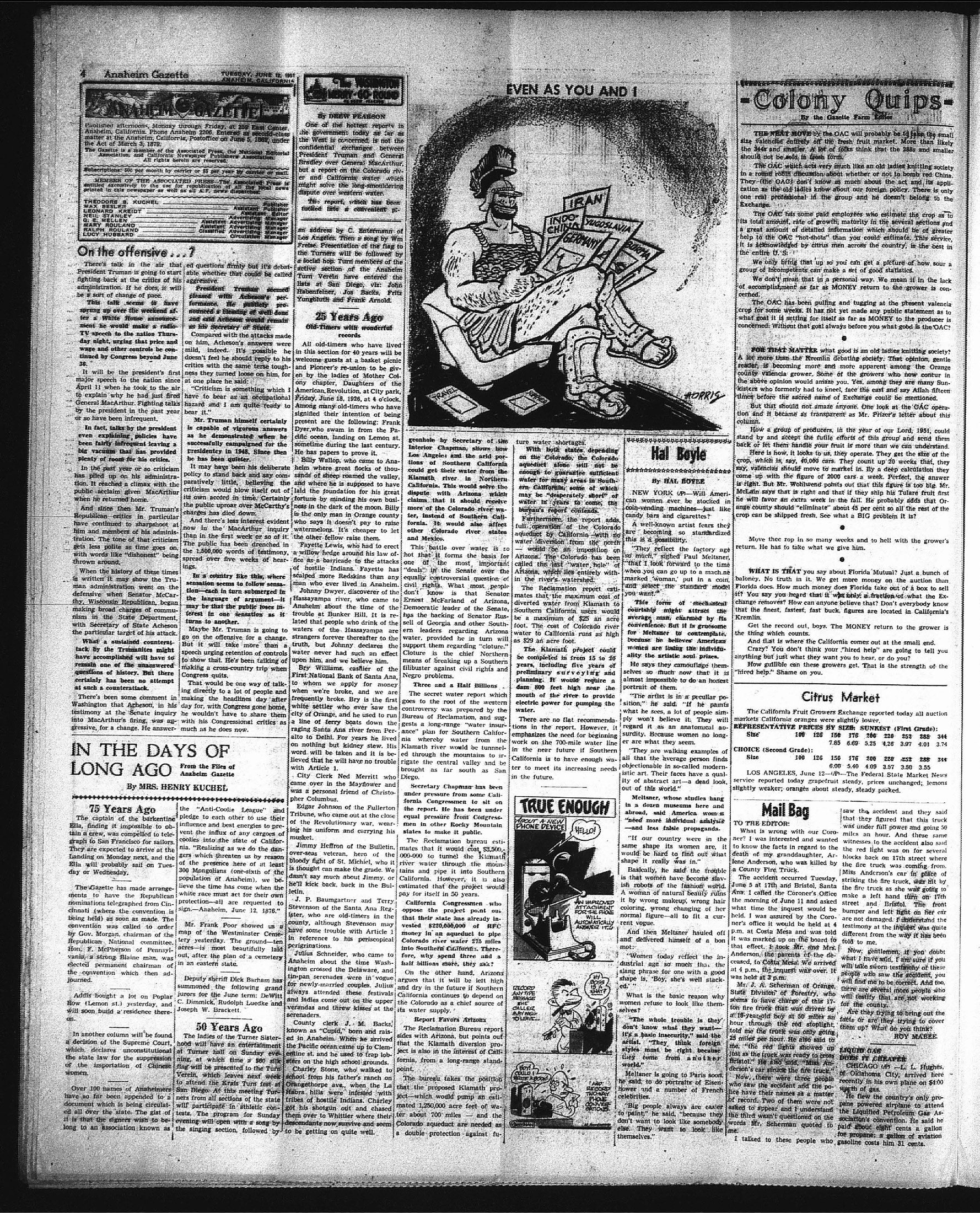
EVEN AS YOU AND I
welcome guests at a basket picnic and Pioneer's re-union to be given by the ladies of Mother Colony chapter, Daughters of the American Revolution, at City park, Friday, June 18, 1926, at 4 o'clock. Among many old-timers who have signified their intention of being present are the following: Frank Dyer, who swam in from the Pacific ocean, landing on Lemon st. sometime during the last century. He has papers to prove it.
Billy Wallop, who came to Anaheim where great flocks of thousands of sheep roamed the valley, and where he is supposed to have laid the foundation for his great fortune by minding his own business in the dark of the moon. Billy is the only man in Orange county who says it doesn't pay to raise watermelons. It's cheaper to let the other fellow raise them.
Fayette Lewis, who had to erect a willow hedge around his law office as a barricade to the attacks of hostile Indians. Fayette has scalped more Redskins than any man who ever lived in Anaheim.
Johnny Dwyer, discoverer of the Hassayampa river, who came to Anaheim about the time of the trouble at Bunker Hill. It is related that people who drink of the waters of the Hassayampa are strangers forever thereafter to the truth, but Johnny declares the water never had such an effect upon him, and we believe him.
Bry Williams, casquier of the First National Bank of Santa Ana, to whom we apply for money when we're broke, and we are frequently broke. Bry is the first white settler who ever saw the city of Orange, and he used to run a line of ferry boats down the raging Santa Ana river from Peralto to Delhi. For years he lived on nothing but kidney stew. His word will be taken and it is believed that he will have no trouble with Article 1.
City Clerk Ned Merritt who came over in the Mayflower and was a personal friend of Christopher Columbus.
Edgar Johnson of the Fullerton Tribune, who came out at the close of the Revolutionary war, wearing his uniform and carrying his musket.
Jimmy Heffron of the Bulletin, over-seas veteran, hero of the geohole by Secretary of the Interior Chapman, shows how Los Angeles and the arid portions of Southern California could get their water from the Klamath river in Northern California. This would solve the dispute with Arizona which claims that it should receive more of the Colorado river water, instead of Southern California. It would also affect other Colorado river states and Mexico.
This battle over water is so hot that it forms the basis for one of the most important "deals" in the Senate over the equally controversial question of civil rights. What most people don't know is that Senator Ernest McFarland of Arizona, Democratic leader of the Senate, has backed of Senator Russell of Georgia and other Southern leaders regarding Arizona water, provided he in turn will support them regarding "cloture." Cloture is the chief Northern means of breaking up a Southern filibuster against civil rights and Negro problems.
Three and a Half Billions
The secret water report which goes to the root of the western controversy was prepared by the Bureau of Reclamation, and suggests a long-range "water insurance" plan for Southern California whereby water from the Klamath river would be tunnnelled through the mountains to irrigate the central valley and be brought as far south as San Diego.
Secretary Chapman has been under pressure from some California Congressmen to sit on the report. He has been under equal pressure from Congressmen in other Rocky Mountain states to make it public.
The Reclamation bureau estimates that it would cost $3,500,-000-000 to tunnel the Klamath picture water shortages.
With both states depending on the Colorado, the Colorado aqueduct alone will not be enough to guarantee sufficient water for many areas in Southern California, some of which may be "desperately short" of water in years to come, the bureau's report contends.
Furthermore, the report adds full operation of the Colorado aqueduct by California—with no water diversion from the porth—would be an imposition on Arizona. The Colorado has been called the last "water hole" of Arizona, which lies entirely within the river's watershed.
The Reclamation report estimates that the maximum cost of diverted water from Klamath to Southern California users would be a maximum of $25 an acre foot. The cost of Colorado river water to California runs as high as $29 an acre foot.
The Klamath project could be completed in from 15 to 20 years, including five years of preliminary surveying and planning. It would require a dam 800 feet high near the mouth of the river to provide electric power for pumping the water.
There are no flat recommendations in the report. However, it emphasizes the need for beginning work on the 700-mile water line in the near future if Southern California is to have enough water to meet its increasing needs in the future.
Hal Boyd
NEW YORK (P)—can women ever be coin-vending machines candy bars and cigarettes? A well-known artist are becoming so this is a possibility.
"They reflect the so much," sighed Paul "that I look forward when you can go up to marked 'woman,' put and select the stamp you want."
This form of courtship might average man, charm convenience. But it for Meltsner too because he believes women are losing their ability to artify souls.
He says they camouflage selfs so much now almost impossible to do portrait of them.
"The artist is in a position," he said. "If what he sees, a lot of it won't believe it. Regard it as an anal surdity. Because woman are what they seem."
"They are walking all that the average person objectionable in so-calledistic art. Their faces hint at city of abstract art—a out of this world."
Meltsner, whose stuff in a dozen museums abroad, said America "need more individuals—and less falsie pro..." If our country wore same shape its women would be hard to find.
City Clerk Ned Merritt who came over in the Mayflower and was a personal friend of Christopher Columbus.
Edgar Johnson of the Fullerton Tribune, who came out at the close of the Revolutionary war, wearing his uniform and carrying his musket.
Jimmy Heffron of the Bulletin, over-seas veteran, hero of the bloody fight of St. Michiel, who it is thought can make the grade. We don't say much about Jimmy, or he'll kick back, back in the Bulletin.
J. P. Baumgartner and Terry Stevenson of the Santa Ana Register, who are old-timers in the county, although Stevenson may have some trouble with Article 1 in reference to his periscopical perigrinations.
Julius Schneider, who came to Anaheim about the time Washington crossed the Delaware, and tin-pan serenades were in vogue for newly-married couples. Julius always attended these festivals and ladies come out on the upper verandas and threw kisses at the serenaders.
County clerk J. M. Backs, known as "Cupid," born and raised in Anaheim. When he arrived the Pacific ocean came up to Clementine st. and he used to frap lobsters on the high school grounds.
Charley Stone, who walked to school from his father's ranch on Orangethorpe ave., when the La Sabra hills were infested with tribes of hostile Indians. Charley got his shotgun out and chased them over to Whittier where their descendants now survive and seem to be getting on quite well.
Secretary Chapman has been under pressure from some California Congressmen to sit on the report. He has been under equal pressure from Congressmen in other Rocky Mountain states to make it public.
The Reclamation bureau estimates that it would cost $3,500,000-000 to tunnel the Klamath river water through the mountains and pipe it into Southern California. However, it is also estimated that the project would pay for itself in 50 years.
California Congressmen who oppose the project point out that their state has already invested $220,000,000 of RFC money in an aqueduct to pipe Colorado river water 275 miles into Southern California. Therefore, why spend three and a half billions more, they ask?
On the other hand, Arizona argues that it will be left high and dry in the future if Southern California continues to depend on the Colorado as a chief source of its water supply.
Report Favors Arizona
The Reclamation Bureau report sides with Arizona, but points out that the Klamath diversion project is also in the interest of California, from a long-range standpoint.
The bureau fakes the position that the proposed Klamath project—which would pump an estimated 1,250,000 acre feet of water about 700 miles—and the Colorado aqueduct are needed as a double protection against fu...
- Colony Quips -
By the Gazette Farm Collier
THE NEXT MOVE by the OAC will probably be to take the small size valonlas entirely off the fresh fruit market. More than likely the 344s and smaller. A lot of folks think that the 288s and smaller should not be sold in fresh form.
The OAC which acts very much like an old ladies knitting society in a round robin discussion about whether or not to bomb red China. They (the OAC) don't know as much about the act and its application as the old ladies know about our foreign policy. There is only one real professional in the group and he doesn't belong to the Exchange.
The OAC has some paid employees who estimate the crop as to its total amount, rate of growth, maturity in the several sections and a great amount of detailed information which should be of greater help to the OAC "hot-shots" than you could estimate. This service, it is acknowledged by citrus men across the country, is the best in the entire U.S.
We only bring that up so you can get a picture of how sour a group of incompetents can make a set of good statistics.
We don't mean that in a personal way. We mean it in the lack of accomplishment as far as MONEY return to the grower is concerned.
The OAC has been pulling and tugging at the present valencia crop for some weeks. It has not yet made any public statement as to what goal it is setting for itself as far as MONEY to the producer is concerned. Without that goal always before you what gobd is the OAC?
FOR THAT MATTER what good is an old ladies knitting society? A lot more than the Kremlin debating society: That opinion, gentle reader, is becoming more and more apparent among the Orange county valencia grower. Some of the growers who now concur in the above opinion would amaze you. Yes, among they are many Sun-kissers who formerly had to kneel, face the east and say Allah fifteen times before the sacred name of Exchange could be mentioned.
But that should not amaze anyone. One look at the OAC operation and it became as transparent as Mr. Prizer's letter about this column.
How a group of producers, in the year of our Lord, 1951, could stand by and accept the futile efforts of this group and send them back or let them handle your fruit is more than we can understand.
Hal Boyle
BY HAL BOYLE
NEW YORK (P)—Will American women ever be stocked in coin-vending machines—just like candy bars and cigarettes?
A well-known artist fears they are becoming so standardized this is a possibility.
"They reflect the factory age so much," sighed Paul Meltsner, "that I look forward to the time when you can go up to a machne marked 'woman,' put in a coin, and select the standard model you want."
This form of mechanical courtship might attract the average man, charmed by its convenience. But it is grossome for Meltsner to contemplate, because he believes American women are losing the individuality the artistic soul prizes.
He says they camouflage themselves so much now that it is almost impossible to do an honest portrait of them.
"The artist is in a peculiar position," he said. "If he paints what he sees, a lot of people simply won't believe it. They will regard it as an anatomical osurdity. Because women no longer are what they seem.
"They are walking examples of all that the average person finds objectionable in so-called modernistic art. Their faces have a quality of abstract art—a dead look, out of this world."
Meltsner, whose studies hang in a dozen museums here and abroad, said America woman "need more individual analysis—and less falsie propaganda."
"If our country were in the same shape its women are, it would be hard to find out what A lot more than the Kremlin debating society: That opinion, gentle reader, is becoming more and more apparent among the Orange county valencia grower. Some of the growers who now contur in the above opinion would amaze you. Yes, among they are many Sunkisters who formerly had to kneel, face the east and say Allah fifteen times before the sacred name of Exchange could be mentioned.
But that should not amaze anyone. One look at the OAC operation and it became as transparent as Mr. Prizer's letter about this column.
How a group of producers, in the year of our Lord, 1951, could stand by and accept the futile efforts of this group and send them back or let them handle your fruit is more than we can understand.
Here is how, it looks to us, they operate. They get the size of the crop, which is, say, 40,000 cars. They count up 20 weeks that, they say, valencias should move to market in. By a deep calculation they come up with the figure of 2000 cars a week. Perfect, the answer is right. But Mr. Wohlwend points out that this figure is too big. Mr. McLain says that is right and that if they ship his Tulare fruit first he will favor an extra week in the fall. He probably adds that Orange county should "eliminate" about 45 per cent so all the rest of the crop can be shipped fresh. See what a BIG problem it is?
Move the rop in so many weeks and to hell with the grower's return. He has to take what we give him.
WHAT IS THAT you say about Florida Mutual? Just a bunch of baloney. No truth in it. We get more money on the auction than Florida does. How much money does Florida take out of a box to sell it? You say you heard that it was only a fraction of what the Exchange removes? How can anyone believe that? Don't everybody know that the finest, fastest, fast buck, figures are located in California's Kremlin.
Get the record out, boys. The MONEY return to the grower is the thing which counts.
And flat is where the California comes out at the small end.
Crazy? You don't think your "hired help" are going to tell you anything but just what they want to hear, or do you?
How guillible can these growers get. That is the strength of the "hired help." Shame on you.
Citrus Market
The California Fruit Growers Exchange reported today all auction markets California oranges were slightly lower.
REPRESENTATIVE PRICES BY SIZE: SUNKIST (First Grade):
Size 100 126 150 176 200 220 252 288 344
7.85 6.69 5.25 4.26 3.97 4.01 3.74
CHOICE (Second Grade):
Size 100 126 150 176 200 220 252 288 344
6.00 5.40 4.09 3.57 3.50 3.55
LOS ANGELES, June 12—P—The Federal State Market News service reported today grapefruit steady, prices unchanged; lemons slightly weaker; oranges about steady, steady packed.
Mail Bag
TO THE EDITOR:
What is wrong with our Coroner? I was interested and wanted to know the facts in regard to the death of my granddaughter, Ar-
objectionable in so-called modernistic art. Their faces have a quality of abstract art—a dead look, out of this world."
Meltsner, whose studies hang in a dozen museums here and abroad, said America women "need more individual analysis—and less falsie propaganda."
"If our country were in the same shape its women are, it would be hard to find out what shape it really was in."
Basically, he said the trouble is that women have become slaveish robots of the fashion world. A woman of natural beauty ruins it by wrong makeup, wrong hair coloring, wrong changing of her normal figure—all to fit a current vogue.
And then Meltsner hauled off and delivered himself of a bon mot:
"Women today reflect the industrial age so much that the slang phrase for one with a good shape is, 'Boy, she's well stacked.'"
What is the basic reason why women refuse to look like themselves?
"The whole trouble is they don't know what they want—it's a basic insecurity," said the artist. "They think foreign styles must be right because they come from another world."
Meltsner is going to Paris soon, he said, to do portraits of Elsenhower and a number of French celebrities.
"Big people always are easier to paint," he said, "because they don't want to look like somebody else. They want to look like themselves."
Mail Bag
TO THE EDITOR:
What is wrong with our Coroner? I was interested and wanted to know the facts in regard to the death of my granddaughter, Arlene Anderson, who was killed by a County Fire Truck.
The accident occurred Tuesday, June 5 at 17th and Bristol, Santa Ana. I called the Coroner's Office the morning of June 11 and asked what time the inquest would be held. I was assured by the Coroner's office it would be held at 4 p.m. at Costa Mesa and was told it was marked up on the board to that effect. I took Mr. and Mrs. Anderson, the parents of the deceased, to Costa Mesa. We arrived at 4 p.m., the inquest was over. It was held at 3 p.m.
Mr. J. A. Scherman of Orange State Division of Forestry, who seems to have charge of this 17-ton fire truck that was driven by a 10-year-old boy at 50 miles an hour through the red stoplight, told me the truck was only going 25 miles per hour. He also said to me, "the red lights showed up just as the truck was ready to cross Bristol." He also said, "Miss Anderson's car struck the fire truck."
Now, there were three people who saw the accident and the police have their names as a matter of record. Two of them were not asked to appear and I understand the third wasn't questioned on the words Mr. Scherman quoted to me.
I talked to these people who saw the accident and they said that they figured that this truck was under full power and going 50 miles an hour. And these same witnesses to the accident also said the red light was on for several blocks back on 17th street where the fire truck was coming from. Miss Anderson's car in place of striking the fire truck, was hit by the fire truck as she was going to make a left hand turn on 17th street and Bristol. The front bumper and left light on her car are not damaged. I understand the testimony at the inquest was quite different from the way it has been told to me.
Now, gentlemen, if you doubt what I have said, I am sure if you will take sworn testimony of these people who saw the accident, you will find me to be correct. And too, there are several more people who will testify that are not working for the county.
Are they trying to bring out the facts or are they trying to cover them up? What do you think?
ROY MABEE.
LIQUID GAS DOES IT CHEAPER
CHICAGO (UP) — L. L. Hughes, of Oklahoma City, arrived here recently in his own plane on $4:00 worth of gas.
He flew the country's only propane powered airplane to attend the Liquified Petroleum Gas Association's convention. He said he paid about eight cents a gallon for propane; a gallon of aviation gasoline costs him 31 cents.